.jpeg) |
Captain Edward L. Tindall,
One-time master of
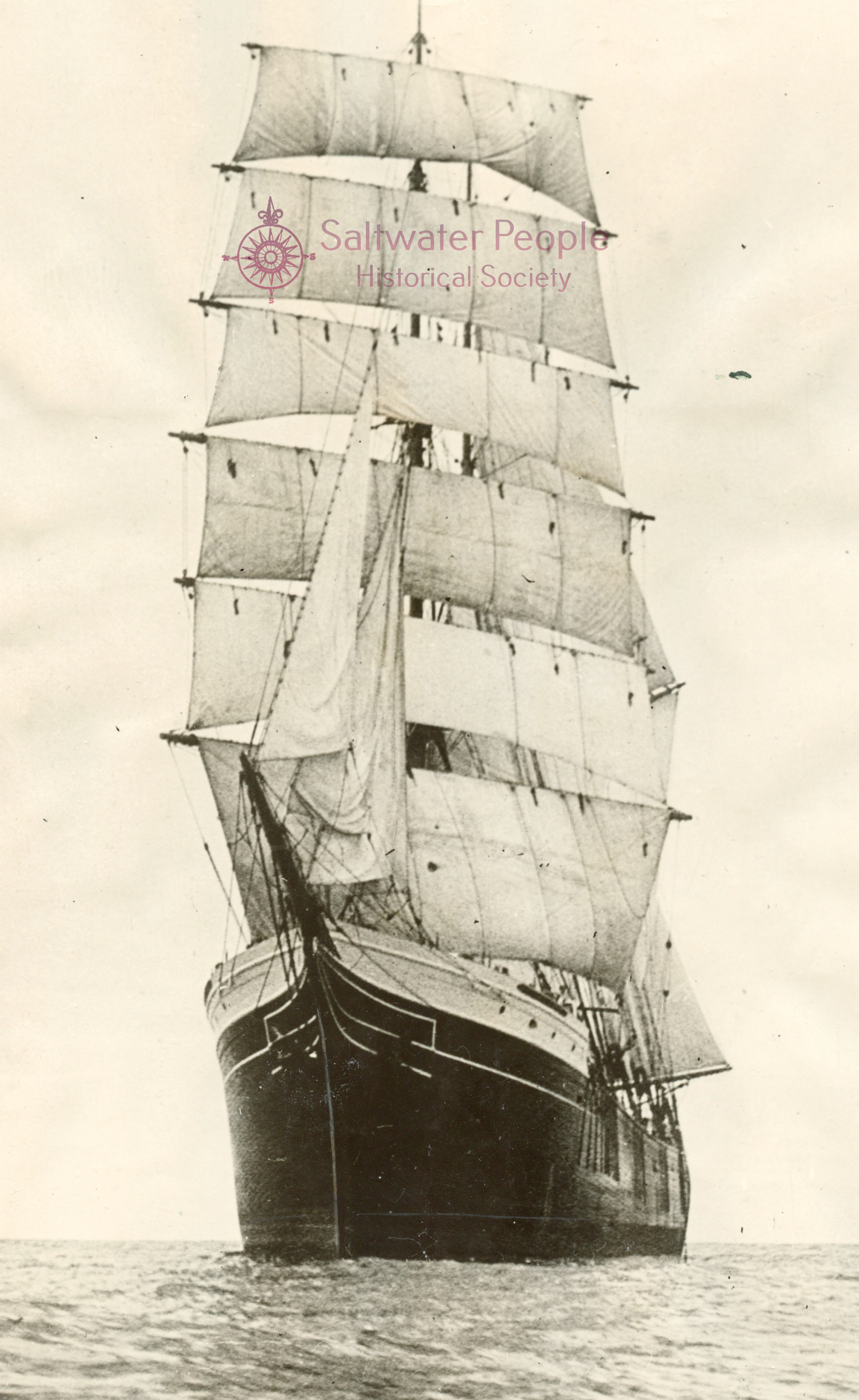
Barquentine FOREST FRIEND
Low-res scan courtesy of his
great-grandson,
Ed David,
to accompany the below essay.
|
 |
FOREST FRIEND
219452
built 1919,
Aberdeen, WA.
243' l x 44' b x 10' d.
1,614 G.t.
click image to enlarge.
scan from a gelatin-silver
photo from the archives of the
Saltwater People Historial Society©
|
Words by Reece Hague,
Formerly with the
Adelaide Journal.Published by
The Mail, Victoria, British Columbia, Canada
31 August 1929
10 June 1929
"Take off your hats, gentlemen, she is the last of a vanishing race."
The speaker was Capt. Edward L. Tindall, veteran master mariner, and as he spoke he directed attention to a barquentine sailing with all the grace and dignity of her kind, through the heads which give access to the beautiful Sydney Harbor.
A closer examination would have revealed that the barquentine had lost much of her pristine splendor, but to the sailor and his landsmen friends, she was a thing of beauty and romance.
It was February 1928, the barquentine FOREST FRIEND majestically entered Sydney Harbor, to awaken memories and longings in the hearts of many old seadogs.
Capt. Tindall himself had almost decided to settle down to a humdrum existence on land, but the sight of the FOREST FRIEND revived a latent longing to take his place once again on the poop deck of a windjammer.
As he left the harbor, musing over past happy years, Capt. Tindall murmured, "Oh, for one last trip on a ship such as that."
Little did he then realize that less than 12 months later she should be towed, under the command of none other than Capt. Tindall himself, into the Esquimalt Harbor, Vancouver Island, there to be ignominiously libeled, and eventually sold for her value as a hulk.
It was actually only a few days after his first glimpse of the FOREST FRIEND that Capt. Tindall was informed that a skipper was required for the barquentine, and his desire to sail once again the high seas as the master of a windjammer was realized.
In May this year, while the FOREST FRIEND was lying at Esquimalt with libel notices nailed to her mast, I met Capt. Tindall, and told him that I had been present in Port Adelaide, Australia, in the latter part of 1927, when I had seen the barquentine in a similar predicament.
Together we gathered up the threads of the story that I was now unfolding.
In November 1919, when the whole world was crying out for ships to carry freight, a new and splendid barquentine, bearing the name FOREST FRIEND on her bows, sailed for the first time out of the harbor of Aberdeen, Washington, where she had been constructed a cost of £ 25,000. In June 1929, the same ship was sold to Victoria, B.C., for £800 to a firm of general towage contractors.
For the first 2 or 3 years of her life, the FOREST FRIEND sailed jauntily over the great ocean.
Then, as more and more mammoth steamships were built by the seafaring nations of the world, the owners of the FOREST FRIEND found it increasingly difficult to secure suitable cargoes.
Speed in transporting cargo became a watchword, and fewer and fewer cargoes were available for the fast-vanishing sailing ships.
The climax, of the FOREST FRIEND came in May 1927, when, 90 days after she had sailed from Anacortes, WA, the barquentine, badly battered by storms, limped into the Port Adelaide Harbor.
Immediately, the American master of the ship cabled to his owners for money with which to meet the ship's liabilities. The owners considered that the FOREST FRIEND had been sufficient of a liability for some years, and ignored the request.
Harbor officials became tired of waiting for the dues and libeled the ship.
Long legal proceedings followed, and after many delays, a Supreme Court judge ordered the sale of the vessel.
At the sale, an offer of £ 500 was received, and the barquentine was knocked down for that sum to South Australian interests styling themselves the Massey-Mort Shipping Co.
Legal costs absorbed most of the £ 500, and the crew were sent to their homes in the United States by American boats, and the master obtained a berth as second mate on a ship bound for America.
Capt. Adams another American sailor, who happened to be in South Australia, accompanied by his wife and child, was given command of the FOREST FRIEND, and in February 1928, sailed for Sydney. Heavy weather was encountered, and one morning, while Capt. Adams was attending to one of the halyards when his oilskins
caught in the barrel winch, and he was severely injured.
The mate signaled with flares, and a pilot cutter was dispatched from Sydney to the FOREST FRIEND, which was then laying 20 miles from the heads. The captain and his wife and child were taken ashore and the ship was taken to anchorage by the mate.
Three weeks later Capt. Adams died from his injuries, and on 29 March 1928, Capt. Tindall took command of the barquentine. She sailed for Peru with a cargo of Australian coal.
Capt. Tindall's words:
"We set out from Sydney with a scratch crew of 13 men. The first mate was an inveterate drunkard and as I had been unable to get a second mate I was forced to appoint one of the men from the forecastle. He turned out to be quite useless.
Only three of the crew were experienced sailors, and before we had been out two weeks I had trouble with one of them. He was a Russian. He was demoralizing the rest of the crew, so I sent for him, and with the aid of the storekeeper and steward, I put handcuffs on him. I kept him in irons for the rest of the voyage.
As soon as I reached Callao, Peru, I cabled the owners for funds to pay off the crew, but it was two weeks before the money arrived. In the meantime, the crew refused to work until they got their money.
When I paid off the crew, I was left on the ship alone except for the mate, who had gone on a prolonged drinking bout as soon as he got his money.
Before I could get a fresh crew to take the boat out it was necessary to get a portrait from the port captain, and he insisted that I should take my old crew back. I did not want the men back and squared the immigration authorities to lay off them, but the port captain called upon the police to arrest them and put them on board the FOREST FRIEND. the police would bring one or two on at a time, and as soon as they had departed in search of another batch the first crew would go back on shore.
The port captain got so sick of seeing me around that he approved one of the many crew listed I had presented to him. I left Callao in ballast for Port Townsend, Washington.
The trip from Peru was uneventful until we ran into the latitude of San Francisco when gale after gale struck us. For a long time, we lay off Cape Flattery but managed to get 10 miles down Juan de Fuca Strait. It commenced to blow hard from the southeast, and I had to anchor in Neah Bay. There we waited for a fair wind, but the barometer was dropping, and had weather was looming up. We were in a very dangerous position off an exposed coast when a coastguard wirelessed for a tug. Four hours after we had left in tow for Port Townsend a howling gale set in."
It was in November 1928, that the FOREST FRIEND arrived at Port Townsend. Capt. Tindall was instructed by his owners to proceed to Port Winslow, WA, for cargo on charter. A survey of the ship showed that repairs amounting to ca. £1,600 would be necessary before the underwriters would insure her for the outward voyage. The charterers refused to release £2,000 in trust, and Capt. Tindall was reduced to borrowing money on the security of the ship and himself to pay off the crew.
Pleas to the owners in Australia for money were in vain, but eventually, they instructed Capt. Tindall to proceed to Esquimalt, Vancouver Is, B.C. On arrival in B.C., the captain was informed by cable that the company owning the ship had gone into liquidation. Claims amounting to £950 were immediately filed against the ship.
Once again, as had happened at Port Adelaide, libel notices adorned the masts of the FOREST FRIEND. Witnesses told Mr. Justice Martin, in the Victoria, B.C., Admiralty Court, that the FOREST FRIEND was valuable only as a hulk and might fetch £1,000 at a forced sale.
The ship was appraised at a value of £950, the total of the claims against her, and early in June a sale was conducted on the deck of the vessel.
When the terms of the sale were explained, it was discovered that as the FOREST FRIEND was of American registry it would be necessary to pay duty amounting to ca. £ 400 on the barquentine before she could be used off the coast of B. C., Canada.
The additional sum for duty brought the price to more than anyone was willing to pay, and no bids were received.
The Admiralty Court authorized the marshal to receive private bids on the vessel, and on 23 June, Hodder Brothers, general towing contractors of Vancouver, tendered an offer of £ 800 for the vessel. The offer was promptly accepted.
"What will be the future of the FOREST FRIEND?" I asked the Hodder brothers after they had left the Admiralty office.
Mr. Hodder shook his head somewhat sadly as he replied, "Well, I am afraid she will have to end her days as a hulk carrying lumber or other commodities. It seems a shame for such a noble ship, but after all, what else can I do with her?"
And this is the tale of the FOREST FRIEND, one of the stateliest sailing ships that ever sailed the seven seas. She is to be relegated to the menial tasks of the hulk engaged in the lumber or the cannery trade on the B.C. coast.
And how does Capt. Tindall view the fate of the barquentine of which for 12 months he was the master?
"She was a fine ship," he said slowly, as I walked with him after he had taken his last view of his late command. "but I suppose, the days of the sailing ship have passed."
Capt. Tindall, however, will command another sailing ship.
"I have been instructed to find a small barque and take it to Peru, he told me.
It will not have the stately lines of the FOREST FRIEND but in the eyes of Capt. Tindall it will be infinitely superior to steam.
There is another SPHS post of this former Washington-built sailing vessel HERE
If anyone has ship's plans for FOREST DREAM, FOREST FRIEND, or FOREST PRIDE, please email or leave a comment in the box below. Thank you.


.jpeg)


 Posts
Posts

