"The Cure for Everything is Saltwater, Sweat, Tears, or the Sea."

About Us

My photo
San Juan Archipelago, Washington State, United States
A society formed in 2009 for the purpose of collecting, preserving, celebrating, and disseminating the maritime history of the San Juan Islands and northern Puget Sound area. Check this log for tales from out-of-print publications as well as from members and friends. There are circa 750, often long entries, on a broad range of maritime topics; there are search aids at the bottom of the log. Please ask for permission to use any photo posted on this site. Thank you.
Showing posts with label Sch. VIGILANT. Show all posts

19 August 2020

❖ Champion of Gallant Tradition ❖ with Ralph Andrews


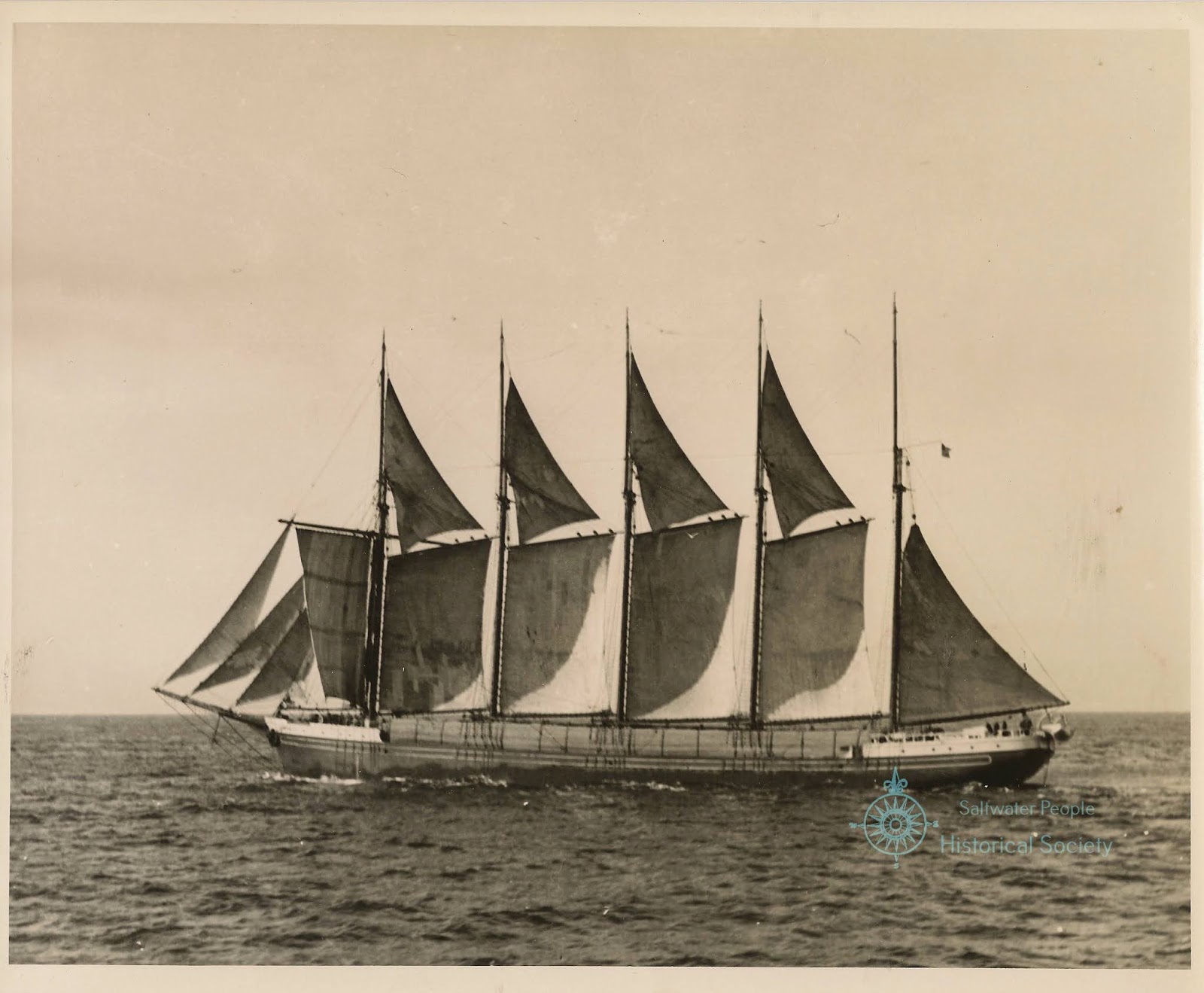
Schooner VIGILANT
Skippered by the famous Capt. Matt Peasley
and later by Capt. Charles H. Mellberg.
From the archives of the
Saltwater People Historical Society©
Her five masts standing as staunch monuments to sea trade of a past era, the sturdy schooner VIGILANT was last of the sailing ships regularly engaged in commerce between Hawaii and the Pacific coast.
      "Owned by the City Mill Company of Honolulu, the vessel is employed every summer to transport millions of feet of lumber from the Pacific Northwest to Hawaii. When she rounds Diamond Head with her sails filled and her big sticks straining, she's a proud sight that makes Hawaii forget for the moment that this is an age of clipper planes and trim motor freighters.

Capt. Charles H. Mellberg
Photo dated 1932.
Click image to enlarge.

Photo from the archives of the 
Saltwater People Historical Society©
      Freshly painted after a year of idleness in Bellingham, Washington, she arrived in Honolulu recently 25 days out of Puget Sound. Her master, Capt. Charles Mellberg, reported an uneventful crossing distinguished by unusually favorable winds, which carried her along steadily for most of the distance and promised for a time to assist her in beating her best previous record of 17 days. But as she neared the islands the breezes withdrew their aid and teased her into port with occasional puffs. For one crossing last year from Bellingham to Honolulu she took 55 days.
      

Capt. Matt Peasley
Dated 1929.
Original photo from the archives of the
Saltwater People Historical Society©
      Honolulu waterfront men remember the days when Capt. Matt Peasley, original of Peter B. Kyne's 'Cappy Ricks' stories, used to bring the schooner into port. Old-timers remember, too, the friendly rivalry between the Vigilant and the Commodore, now shorn of her masts and used as an Alaskan oil barge.
      Still fresh in the memories of many local waterfront observers is the race from Honolulu to Seattle in which these two gallant vessels engaged in November 1931. The COMMODORE departed from Hawaii for the Sound November 20 of that year. She made fair progress; was comfortably on her way when the VIGILANT sailed for the same destination six days later.
      Favorable winds carried the COMMODORE straight up to the Strait of Juan de Fuca, where they dropped her like a punctured balloon and left her to icy winter squalls and tricky currents. She was taken in tow by tugs dispatched to her assistance. But before she could be brought into peaceful sound waters a storm caught her, broke the two lines, and drove her out to sea. The VIGILANT which had trailed her by more than 1400 miles up to that time, skirted the storm and scudded triumphantly into the Sound to be declared the official winner."
Ralph Andrews. This was Seafaring. Seattle. Superior Publishing. 1955
      

01 December 2018

❖ BUSY AT BLOEDEL DONOVAN ❖

BLOEDEL DONOVAN LUMBER MILLS,
Bellingham, Washington.
Dated April 1932, with
4-masted COMMODORE
5-masted VIGILANT
Steamer WILLBORO, for New York.

Click image to enlarge.
Low res scan of an original photo from S.P.H.S.©
In 1898 Julius Bloedel founded Whatcom Logging Co with frontier businessman John J. Donovan and Peter Larson, which later became known as Bloedel-Donovan Mills.
      In the 1950s, now under the direction of his son, Prentice, Bloedel's company merged with H.R. MacMillan Co to form one of the largest forest products companies in the world, MacMillan-Bloedel Limited. Often called Mac-Blo, it was eventually taken over by Weyerhaeuser in 1999. Bloedel Hall at the UW, Seattle, was named for Julius Bloedel. The Bloedel Conservatory of Queen Elizabeth Park in Vancouver was named for his son Prentice Bloedel for donating nearly $1.4 million for its construction in 1967. The Bloedel Reserve on Bainbridge Island, WA., was created by Prentice Bloedel and his wife Virginia.

      The two schooners in the photo above can be seen under sail below. Unfortunately, the WILLBORO was sunk by a torpedo from U-159 on 10 Sept. 1942 two hundred miles SW of Capetown. Six people lost their lives.
The COMMODORE (ex-BLAATIND)
as she is trying to catch a tow off Cape Flattery,
 headed to Bellingham for more lumber.
After all the other sailers were gone, the
COMMODORE and the VIGILANT sailed side by side.
Original photo from the archives of S.P.H.S.©

CAPTAIN CHARLES MELLBERG
8 January 1932
On board the VIGILANT after the
much publicized 'race' with the COMMODORE.
VIGILANT was towed into the Strait of Juan
de Fuca after the 38-day crossing ahead

of the COMMODORE. The passage was
2,289-miles across the Pacific.
Low res scan of an original photo from the
Saltwater People Log©

Schooner VIGILANT
Heading to sea with a full cargo of lumber.
Click image to enlarge.
Original photo from the Saltwater People Log©


21 September 2016

❖ BELLINGHAM SHELLBACKS ❖ 1932


Schooner VIGILANT headed out.
She carried millions of feet of lumber from 
Bellingham, WA to Hawaii.

Click to enlarge.
Original photo from the archives of the S.P.H.S.©

Alace A. Clift (L) and Ferle M. Rogers,
of Bellingham, WA. Date of photo 23 June 1932.
Taken at the west coast port of San Francisco, CA.

Photo by Acme Newspictures, Inc. 
 from the archives of the S.P.H.S.©
Alace A. Clift (L) and Ferle M. Rogers, Bellingham, WA., decided their most exciting vacation would be to journey to Honolulu on the lumber laden, five-masted schooner VIGILANT. She was one of the few sailing vessels still in active service. The gals were refused bookings as passengers––but before the vessel cleared, the two signed on as stewardess and supercargo before sailing down the coast and across the broad Pacific.
      Capt. Ralph Peasley and Capt. Charles A. Mellberg were two of the most famous in 
command of the VIGILANT. 

06 November 2015

❖ CAPTAIN PEASLEY and CAPPY RICKS

Meet Capt "Matt" Peasley, resourceful and two-fisted skipper of the "Blue Star" fleet––in real life he was Capt. Ralph E. Peasley, of Aberdeen, WA.
Captain R.E. Peasley, 14 Feb. 1929.
Known throughout the world as the hero of Peter B. Kyne's 
sea stories, was in his 37th year of high seas sailing.
Click photo to enlarge.

From the archives of the S.P.H.S.©
      Peter B. Kyne pictured Peasley exactly as he was––stalwart, keen of eye, vigorous, friendly and a masterful sailing man. When you read Kyne's 'Cappy Ricks', stories of romantic Pacific Coast shipping, you get a perfect view of Capt Peasley, as he was in 1930.
      The tall mariner quit the sea––temporarily, at least––but if the sailing ships were abroad again the chances are he would be right back at his old command. Not even Mrs. Peasley could keep him ashore. In fact, Mrs. Peasley probably would go along!
      It has been quite awhile since Capt Peasley and Peter B. Kyne first met, but the passing years have served only to enhance Kyne's 'Cappy Ricks' characters and build around Capt Peasley an admiring aura of fame and popularity that made him a chosen man wherever he went.
      In his home region of Grays Harbor, he was a favorite without reservation. Shortly after he retired from the sea he ran for port commissioner and was elected by an enormous majority. Then he served the state as district inspector for the liquor control board––and that was a job that required as much application and hard work as running a ship. Only recently the Aberdeen Pioneers Association elected him president.
      Among Kyne's many duties at that time was to peruse reports sent in by the fleet masters. He was immediately attracted by Capt Peasley's. They were of such concise and original nature that in them Kyne found inspiration and subject matter for what ten years later flowed from his pen as the story of Matt Peasley, Cappy Ricks and the latter's beautiful daughter.
      "Aw, they call me Matt wherever I go, all right." said Peasley, "but Kyne's stories are mostly all fiction. No skipper could be as good as that fellow Matt. No shipowner could have so much fun as Cappy Ricks, but that isn't saying we don't like to read about them. I know Mrs. Peasley and I do."
      As depicted in Kyne's novel, Peasley's marriage to the shipping magnate's daughter was a romantic event, and as it applies to the real Capt Peasley's marriage it is not wholly imaginary. Mrs. Peasley's father was Capt James Dalton, prominent in Grays Harbor lumbering and shipping circles, and she grew up among sawmills and ships.
      They were married in 1903, shortly after a great fire leveled the business district of Aberdeen. Capt Peasley had brought the schooner WAWONA into Willapa Harbor for a cargo of lumber, and while she was burdening there the skipper went by train to claim his bride. Their wedding trip consisted of a brief train journey to Seattle––two days or so––and then they headed for home. At Gate City they separated, Capt Peasley taking another train to Raymond, whence he sailed the following day. At that time he was sailing the WAWONA in the coastwise trade, but at that, it was six weeks before he saw his bride again.
      It was some years later that Mrs. Peasley tired of sitting at home waiting, and decided she would go to sea, too. So with him she went, and for nearly two decades the Peasleys sailed together––to Honolulu, to Callao, to Newcastle and a host of other ports of the Pacific.
      "Yes, said Mrs. Peasley, "I was a poor sailor at first. But I got so I could 'take it' with the rest of them. I can remember one time when we were standing out to sea at Cape Flattery. It was so rough that every sailor aboard was more or less sick, but not I. That was after I had gotten my sea legs."
      Capt Peasley sailed many windjammers in his 40 years on the Pacific. Among them were the four-master MARY E. FOSTER, the schooner FRED J. WOOD, the schooner LOUIS, first five-master on the Pacific Coast and named after Louis Simpson, San Francisco ship and mill owner; the WAWONA, MELANCTON and VIGILANT, and many others.
Schooner VIGILANT
Heading out with a load of lumber.
Undated photo from the archives of S.P.H.S.©
      Of them all, both Capt and Mrs. Peasley liked the big, fast-stepping schooner VIGILANT the best. They took this finely appointed five-master on her maiden voyage in 1920 and sailed her for nine years, mostly in the Honolulu lumber trade. She operated between Bellingham, WA, and Honolulu. When the E. K. Wood Lumber Co of Bellingham and Hoquiam sold her some six years ago, the firm offered Capt Peasley a steam command, but he could not take it. He retired rather than go in for steam.
      In his four decades as a sailing man on the Pacific, nearly 35 years of which were as master, Capt Peasley never had a wreck. He came close once on a reef off the coast of Australia, and another time in a boisterous blow inside the Straits of Juan de Fuca, but both times good seamanship cheated the sea of its prey.
      Born in Maine, Capt Peasley comes of a long line of seafaring men. Like his ancestors, he went to sea at a tender age and at 22, he was entrusted with his first command. Most of his seafaring life he spent on the Pacific, and to South Africa he went only in Kyne's imagination, there to further the 'Blue Star' line's interests by subduing that redoubtable person called "All-Hands-and-Feet."
      The roughest sea Capt Peasley ever experienced was in late January 1922, when he was a few hundred miles off the coast of Washington with the schooner VIGILANT. A hurricane blew up, the same storm that felled billions of feet of Western WA timber.
      The log of that voyage told a vivid story of a tumultuous sea after the barometer skidded to 29.01 and a gale of 100-mile intensity raged for four hours. Mrs. Peasley was along, and she says it was a harrowing experience, although the stout VIGILANT survived without great damage.
      Recently the sturdy VIGILANT was reported long overdue in a bad storm. En route to Honolulu from Seattle, she was out 53 days before word was heard of her on the Pacific Coast. Capt Peasley's faith in the staunch craft was vindicated, when she limped into port, pretty well battered, but still sailing. A couple of seamen were hurt in the raging seas that  smashed over the VIGILANT.
      On Grays Harbor there are legendary tales of windjammer skippers who sailed their ships right up to the docks at Hoquiam and Aberdeen. That was a matter of some 12 miles of what was then a tortuous channel. It is not all legend. Twenty years ago Capt Peasley sailed the schooner FRED J. WOOD over the bar and almost up to Hoquiam.
      "I could have warped her up to the dock at Blagen's mill, I think," said Peasley, "but a dredge was squatted right in the middle of the channel at Grays Harbor City and we had to let the tugboat hook on. That tug had tried to keep up with us all the way from Westport, and believe me, we gave them a race!"
      Capt Peasley was a vigorous man, young looking and with ever a twinkle in his keen eyes. He stood about six feet three inches and had the straight figure of youth. His famous mustache and shock of black hair were but slightly touched with gray. Before he started on his new job with the state liquor control board he was a faithful attendant at meetings of the Aberdeen lodge of Elks, where a special seat was always his.
      Before the war he and Kyne met occasionally, but for many years the famous writer and noted mariner never crossed trails. If and when they do, there should result an interesting reunion and a fine picture for the newspapers."
Above text from the Eugene Register Guard. 29 March 1930.
   

CAPPY RICKS book search


1930, November: 
Auxiliary schooner SANWAN, 1930.
107.6' x 26' x 15'

Designed and built by Robert Moran.
Launched at his estate on Orcas Island, WA., 1917.
Date stamped original from the archives of S.P.H.S.©
Capt "Matt" Peasley kept sailing. In this year he was reported off on a three-month cruise of the South Seas in the good ship SANWAN, under his command. The SANWAN put into San Francisco harbor for a couple of days, from there she headed to Los Angeles, where twelve western youths were signed to join the ship. They were scheduled for a great adventure––I am not locating data on the oceania chapter. Did they visit the South Seas? In the middle of the following summer Peasley was at the helm of another ship.

1931, July 14:
Capt "Matt" Peasley 
Aboard LINDA (ex-ROAMER)
Seattle, WA., dated 14 July 1931.
Click to enlarge.
Original photo from the archives of S.P.H.S.©
Jack London's old ship of romance, the ROAMER, and Capt. R. "Matt" Peasley, immortal hero of Peter B. Kyne's sea stories, was the rare combination that, according to some national news, would lead ten Seattle youths along the paths of adventure in Alaska, the summer of 1931. The trim auxiliary sloop, renamed LINDA, was casting off en route to Alaska on a scientific expedition that included stops near Glacier Bay and Mount Fairweather. The latter named places are haunts of the Killer whale, that they wanted to hunt with cameras, instead of harpoon guns. They had also made plans for trips inland to study the flora and fauna of AK. The photo was taken just before departure.

20 November 2011

❖ The Steamer ROOSEVELT ❖ by Captain Ed Shields

Steamer ROOSEVELT
Original Photo from archives of the S.P.H.S.©
"The ROOSEVELT was a steam powered towboat that operated on Puget Sound and in adjacent waters for many years. She was constructed in 1905 for Robert E. Peary to transport him and his supplies as far north as possible in Davis Strait and then land on the coast of Greenland. She was of exceedingly heavy construction, being 600 T-burden, 194-ft L x 35-ft B; she was built to withstand the ice flows of Davis Strait.
   
Robert E. Peary and the ROOSEVELT

Two antique postcards cancelled 1911.
Bottom: "Capt. Bartlett, experienced with Peary in the
privations of the Arctic region, indicated by the cross.
Men who were willing to brave unseen perils and dangers
in the cause of conquest and honor to their mother country
––such were these men; their efforts
were crowned with success."
Click to enlarge.
From the archives of the Saltwater People Historical Society©
      After Peary's return to New York, the vessel was sold to Puget Sound interests and brought to the northwest via the newly opened Panama Canal. One of the first noteworthy events the ROOSEVELT participated in was the opening of the Lake Washington Ship Canal, on 4 July 1917. She led the flotilla of vessels through the canal that day.
      In 1923 the ROOSEVELT was owned by the Washington Tug and Barge Company of Seattle. She was employed in towing three former WW I wood hulls, which were serving as barges, loaded with lumber from Puget Sound to San Diego. They were towed one at a time. One loading on Puget Sound, one unloading in San Diego, and the third at sea. The ROOSEVELT would bring an empty barge to the Puget Sound mill, take the loaded barge in tow to San Diego, and on arrival, the other barge was now unloaded and ready for the return trip. She was able to make two round trips per month and hauled 2,500,000-board feet of lumber each time south bound. She was the best tugboat on the coast for this form of ocean towing.
Mammoth log booms towed from the Columbia River
down the Pacific Coast to San Diego, CA.
Saltwater People Historical Society archives.
     In 1924 the ROOSEVELT, along with two other smaller tugs, took a flotilla of barges loaded with lumber to Miami, Florida.
     In 1931 the ROOSEVELT was dispatched to Cape Flattery to tow the schooner VIGILANT into Puget Sound, after her race from Hawaii with the COMMODORE. Extreme weather produced violent seas and several of the ROOSEVELT's pilot house windows were smashed; however, she accomplished her task.

Seattle Tug ROOSEVELT
 and the Schooner VIGILANT
A 1932 Seattle Times page from the scrapbook of
 PNW Captain W. C. "Pappy" Beachum (1906-1980).
From the archives of the Saltwater People Historical Society©
1932 found the ROOSEVELT towing large ocean going log rafts south to San Diego.
On 3 May 1934 the motor ship CHILDAR was outbound across the Columbia River bar when she was battered onto Peacock Spit on the north side of the entrance. The USCG Cutter REDWING succeeded in towing the stricken vessel from the grip of the breakers. They could not cross the Columbia River bar to return Astoria or Portland due to the exceedingly high breakers, so both vessels proceeded north. The next morning the ROOSEVELT took over the tow and brought the stricken CHILDAR into Esquimalt, BC.
      The last voyage of this famous tug was in 1937. She was sold to the California Towing Co in San Francisco. She set out on her final trip towing the former USN collier JUPITER from Puget Sound to the East Coast for scrapping. The tow yawed excessively and the tow line damaged the ROOSEVELT. She also experienced engine problems with her old power plant. After departing the Panama Canal the ROOSEVELT became totally disabled, turned the tow over to the New York tug RELIEF, and returned to the Panama Canal. She was laid up, and the crew finally sold her equipment, as they had not been paid. Finally, this former Artic exploration ship rotted away."
Written by Captain Ed Shields
About the Boats,1994

Archived Log Entries