"The Cure for Everything is Saltwater, Sweat, Tears, or the Sea."

About Us

My photo
San Juan Archipelago, Washington State, United States
A society formed in 2009 for the purpose of collecting, preserving, celebrating, and disseminating the maritime history of the San Juan Islands and northern Puget Sound area. Check this log for tales from out-of-print publications as well as from members and friends. There are circa 750, often long entries, on a broad range of maritime topics; there are search aids at the bottom of the log. Please ask for permission to use any photo posted on this site. Thank you.
Showing posts with label Ralph Hitchcock. Show all posts

29 November 2021

A MODEL MAKER DOES HIS MOSQUITO RESEARCH


The S.S. Bailey Gatzert was an important sternwheelin' gal who caught our attention and yours with a lengthy post in 2016. Her looks also caught the attention of the skilled craftsman, Ralph Hitchcock, who has written below about the requirements needed to see her fine lines come to life again.


S.S. BAILEY GATZERT
Built by the J.J. Holland Yard, 
Ballard, Washington & launched in 1890.
Her first master was Capt. George Hill.
Out of service in 1925.
Original photo from the archives of the
Saltwater People Historical Society©

"The sternwheeler Bailey Gatzert was a very historic vessel known around the nation. She so impressed the author that a special file of information was started over 30 years ago with additions being made from time to time. She was certainly a mosquito fleet vessel of special interest.
      The Bailey Gatzert was built in Ballard in 1890 for the Seattle Steam Navigation & Transportation Company. Her registered dimensions were 177.3' x 32.3' x 8'. These remained her dimensions until 1907. Her steam machinery was supplied by James Ross & Sons, Pittsburgh, Pennsylvania. The popper valve engines were 22" diameter by 84" stroke. She was non-condensing. It is assumed that her boiler was built in the Pacific Northwest.
      The Gatzert operated on the Seattle-Tacoma-Olympia run until 1892, when she was acquired by the Columbia River & Puget Sound Navigation Co and transferred to the Columbia. There she engaged in the excursion trade until 1895 and then operated on the Portland-Astoria run.
      Apparently, her hull became unserviceable, for in 1907 a decision was made to build a new hull and to transfer the passenger cabin, texas, and pilothouse, from the old hull to the new. According to The H.W. McCurdy Marine History of the Pacific Northwest, the engines were transferred to the Gatzert from the Telephone at the time of her rebuild. The hull design was by J.H. Johnson, whose Portland shipyard built the new hull. The new registered dimensions were 194.3' x 32.8-ft x 8'.
      Many photographs show the second Bailey Gatzert running excursions to the Cascade Locks after the 1907 rebuild. No specific reference has been found stating that she ran from Portland to Astoria, but it seems likely that she did.
      In 1917 the Gatzert was purchased by the Navy Yard route affiliate of the Puget Sound Navigation Co, and in 1918 she was towed by the tug Wallula to Puget Sound where she served on the Seattle-Bremerton run starting 18 April 1918. In 1920 she was sponsoned out for additional hull stability, and an elevator was installed on her forward deck, allowing her to carry 30 cars of that day. She was the first car ferry on the Seattle-Bremerton run.
      In 1922 the Gatzert was stripped of her machinery. In 1926 she was taken over by the Lake Union Drydock & Machine Works in Seattle and converted into a floating ways and machine shop. At that time her hull was found to be well-preserved.
      The Bailey Gatzert was a fast sternwheeler. She participated in races on Puget Sound with the Greyhound and the T.J. Potter. The "hound" won two, the Gatzert a third. In the two races with the Potter, each vessel won one race. According to the Railway and Marine News of October 1909, though they never raced against each other, the Hassalo, Telephone (number 2), and Bailey Gatzert were the fastest sternwheelers on the Columbia. The same article quotes Mr. Marcus Talbot, general manager of the Alaska Pacific Steamship Company, as saying, 'The Gatzert is the fastest sternwheeler in the world.'

      Surely such a historic and photogenic vessel deserves to be presented to posterity by an accurate and representative model. However, such a model must be preceded by precise scale drawings showing all external details just as they were on the original vessel. Experience dictates such a procedure. The author prepared detailed drawings to the scale of 1/4" - 1'0" before building models of the Flyer, North Pacific, and J.M. White. The first two of these are in the Washington State Historical Museum in Tacoma, the latter in the Smithsonian Museum in Washington, D.C. It is interesting to note that 150 detail drawings were prepared and needed to construct the J.M. White model.
      Drawings for the Bailey Gatzert are well underway. One very fortunate basis for these drawings is a drawing of the new (1907) hull for the Gatzert prepared by John H. Johnson, builder of the new hull. The photocopy of this drawing was procured recently from the Oregon Historical Society. As usual, detailed photographs are indispensable to such work. Photos being used for the Gatzert model drawings include twelve from the PSMHS Williamson Collection, eight from the Oregon Historical Society's files, one each from Bill Somers and Bert Giles, as well as numerous photo reproductions from books.
      It is expected that the Gatzert model drawings will be completed by the time this article is in print. Thus a model of the Gatzert could be initiated in 1989 and presented to PSMHS upon completion. The author solicits proposals from one or more experienced model builders to proceed with the Bailey Gatzert model."

      Words by Ralph Hitchcock. The Sea Chest, published by the Puget Sound Maritime Historical Society. Seattle, WA.
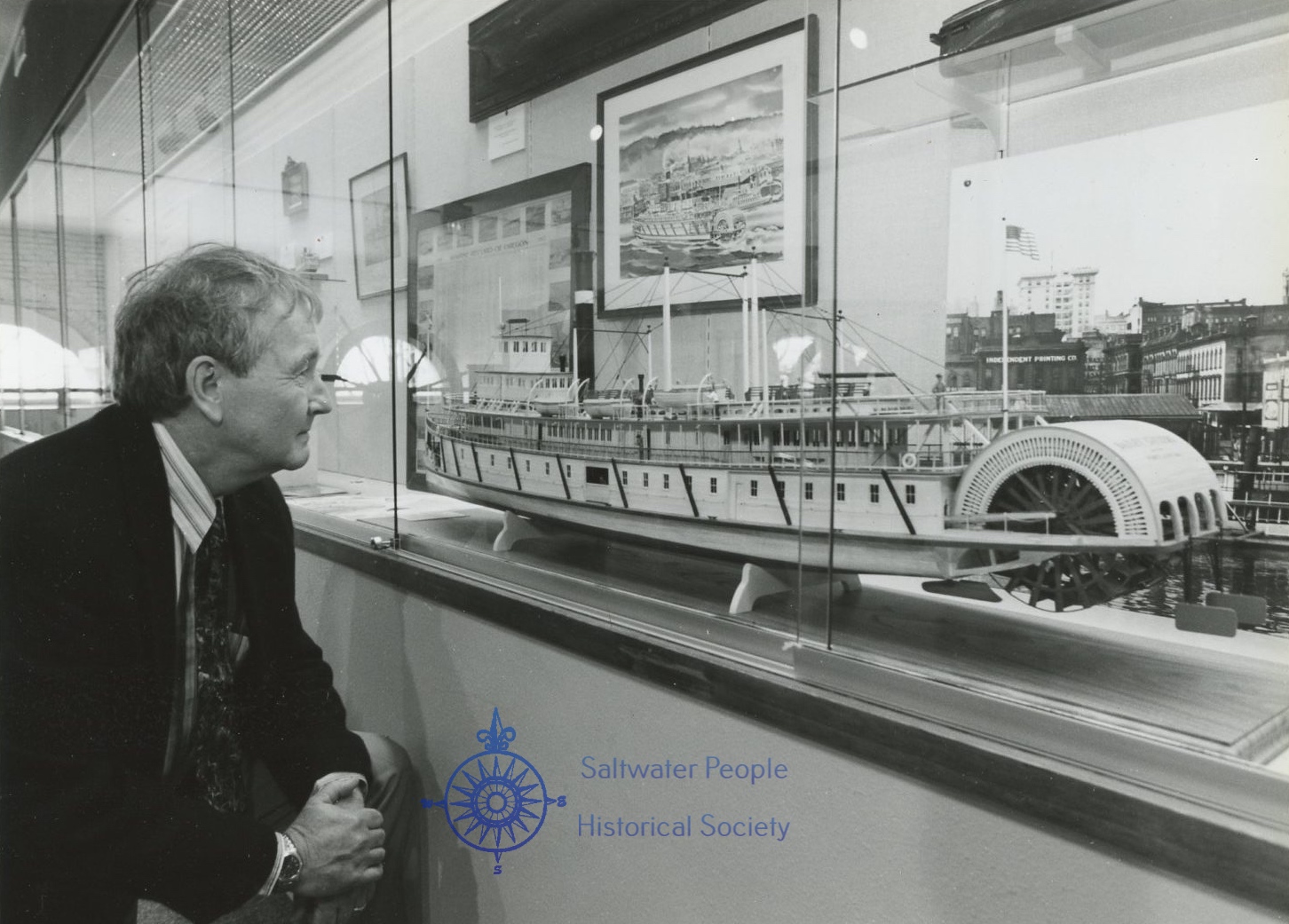

And the Bailey Gatzert model was completed
by Ralph Hitchcock.
Is this the one he built and but do you know
of her whereabouts? 
Tap image to enlarge.
This photo is dated March 1995.
Original photograph from the archives of the 
Saltwater People Historical Society©


04 April 2013

❖ Lopez Island Dock and Ferry Recollections ❖

Ralph HItchcock's route from Anacortes to Lopez Island, WA.
Click to enlarge.

Small detail from Puget Sound and the San Juan Islands
Revised 4th edition, 1989, not for navigational use, 

R. O. Malin copyright. Courtesy of Sobay Maps, Olympia, WA. ©
Please don't copy; these artistically drawn maps are available
from retailers and from their website, here.

The c. 53"x30" copy shows numerous WA. State Parks, shipwrecks, 
ranging from Olympia, WA, up north to Saltspring Island, B. C.
it also depicts the area near Cypress Island 
where Capt. Vancouver lost his anchor in 1792.

"These memories start in 1955 when we acquired waterfront acreage on Swift's Bay, Lopez Island, two miles from the Upright Head ferry dock. In 1923 the original ferry dock was at Port Stanley when the steam ferry CITY OF ANGELES was serving the San Juan Islands and Sidney.
CITY OF ANGELES
Original photo from the archives of the S. P. H. S.©

      In the 1950s the daily mail came to the Lopez ferry dock and the other San Juan islands by the mail boat BRISTOL until she was sunk in a collision (apparently while on automatic pilot). Her successors included the DENNY M, MACARD, and finally the WATER BABY. After that the mail was flown to and from Lopez.
      Starting about 1957, the Lopez dock attendant was Robert Frederickson, whose wife Mary operated the restaurant they built adjacent to the dock. One of the favorites was Mary's lemon pie, ordered by most customers until it was gone. Which leads to an anecdote about the ferry VASHON.
      On summer weekends in the late '50s and early '60s, the VASHON was the Sunday 'cleanup' boat.
The darling VASHON
Pre 1960.
both original photos from the archives of the S. P. H. S.©

     She was to be in the islands in the afternoon to take overload cars off Orcas and Lopez to Anacortes on the mainland. Her crew was very fond of homemade lemon pie. So the VASHON would arrive at the Lopez ferry dock early just about every Sunday afternoon, tie up, and send a few crew members to the restaurant for lemon pie. After they'd eaten, they would undock and cruise toward Orcas to pick up at least part of the overload.
      After we had erected a simple cabin and acquired electrical power in 1959, we spent many weekends at 'Driftide' on Swift's Bay, avoiding Friday and Sunday ferry overloads by leaving our car at Anacortes. Our principal supplies (mostly food) were neatly packaged in a big, canvas, tote bag. Upon arrival at Lopez, we walked up the dock to the restaurant where we kept a two-wheeled cart into which the tote bag closely fit. The road beyond Odlin Park and past Swift's Bay had recently been blacktopped, so it was a very pleasant two-mile walk to the cabin. On Sunday afternoons, we reversed the process, walking back to the ferry dock past scores of waiting cars in the lineup. We dropped off our cart and walked aboard the ferry. 
      We recall one sunny Sunday afternoon returning to Anacortes on the VASHON. Because of the noisy crowd on the passenger deck, we decided to stay on the car deck, seating ourselves at the foot of the stairway with our backs against the stair trunk sides. It was one of those days when the swells from the west on the Strait of Juan de Fuca were rounding Colville Point and coming north on Rosario Strait parallel to the ferry's course. After coming out from Thatcher Pass and past James Island we were astonished to feel the stair trunk sides flexing as the ferry gently rolled in the swells. It became quickly obvious that the whole ferry house was swaying on the deck as she rolled. We concluded we didn't want to travel on the VASHON during a southeast storm when it gets really lumpy in Rosario Strait. We wonder if the passenger deck beams were ever reinforced with heavier gussets to the sides of the house.
      The VASHON had only manual steering--no power boost--and the quartermaster had to work hard, especially when docking.
      One weekday, with Capt. Snart in command of the VASHON, we were in our car with friends next to the VASHON's bow at the starboard bulwark. It was a morning trip--very foggy. Either the radar wasn't functioning or had not yet been installed. Soon after departure from Anacortes, two of us left the car to bring coffee and doughnuts to the ladies, saying to them jokingly, 'We'll be right back in case there's any trouble.' We quickly returned with the food and were eating when a great indefinable shadow loomed up on the starboard bow. Then the VASHON's engine shut down and we glided toward that nearing threat. I said, 'let's get out of the car!'
      The VASHON's engine went into reverse. We realized that thankfully, the unknown shape was not a ship but rocky land, now dead ahead.
      Within a ferry's length of a steep rocky cliff, the VASHON stopped and very slowly commenced moving away. We had almost landed on the southern end of James Island, more than a mile off course. To our knowledge, that was the closest a ferry had come to landing there. We slowly moved north, past James Island and into Thatcher Pass where the fog in the Strait cleared. Soon we were docking at Lopez. There is a manually controlled siren at the Lopez dock to assist ferry captains in locating the dock in dense fog. Fortunately, it wasn't needed by Capt. Snart for that particular trip.
      Another time we were on the KLICKITAT eastbound to Anacortes on a cloudy day. A strong southeast wind was blowing. The captain elected to hold course toward Guemes Channel. The KLICK was occasionally slamming into the heavier seas and rolling considerably--enough so that the unoccupied observation cabin chairs slid back and forth from side to side on the linoleum deck.
     
Lopez Ferry Landing
both images from the S. P. H. S.©
       
In the summer of 1964, the ferry system started work on a new ferry dock at Lopez. One September day, a floating crane lifted the old dock bridge out and lifted the new dock bridge in. The next morning the KLICKITAT was dispatched on a special trip (no car or passengers) to Lopez to act as a tugboat and pull out the old ferry dock wing walls.
      On a few occasions, we had breakfast on the ferry while traveling from Anacortes to Lopez. We particularly remember getting good pancakes and coffee in the KLICKITAT's galley, which, in her old arrangement, was at the opposite end of the passenger cabin from the observation room. 
      Our most enjoyable ferry trips to and from Lopez were on the EVERGREEN STATE when Capt. Cecil Weyrich's crew were on duty. We had a good camaraderie with Ted Gagner, the mate, Vic Bottoms, an able seaman, and sometime quartermaster, and Sam Kerris, ordinary seaman. Captain Weyrich was easy to talk to, and welcomed us in the pilothouse after undocking and before docking, on several occasions."
Text by Ralph Hitchcock
Published by the Puget Sound Maritime Historical Society
Quarterly journal, The Sea Chest, September 1994.
      The present-day, dedicated editors of the publication, volunteers Ron and Connie Burke, have led their team to a highly regarded, first-class publication, now with touches of color added. The Sea Chest, going into its 45th year, is a benefit of membership. Here's a link.
Ralph Hitchcock, 1965.
Former Lopezian & author of this essay.
Original photo from the archives of the S. P. H. S. ©

   Mr. Hitchcock and his wife Eva were both life members of the PSMHS, with keen maritime interests. 
      After Ralph retired as a Boeing engineer for 27 years, he expanded on his avocation, to become a professional model builder for 25 more years, producing 22 models, most all of museum quality. There are three donated to the Lopez Island Historical Museum. In retirement, the Hitchcocks lived on Lopez Island for a dozen years.
      There is another log entry written by model maker Mr. Hitchcock, which can be viewed here

13 October 2012

❖ A Ship for Captain Louis Van Bogaert ❖


Captain Louis Van Bogaert

Original 1957 photo
from the archives of the S.P.H.S.©
"Captain Louis Van Bogaert, who retired in 1957 after 54 years on Puget Sound vessels, had a special fondness for one boat, the ROSALIE.
      He had gone to work on the ROSALIE as a watchman in 1910, later he was second mate, then first mate, and finally, in 1914, her skipper.
      So the captain was especially happy about a gift that he took back to his home in Alhambra, CA, after a visit in Seattle.


Ralph C. Hitchcock

Ship model maker, 1965, Lopez Island.
Original photo from the
archives of the S. P. H. S.
      It was a bottle with a scale model of the ROSALIE in it.
      The model was the work of Ralph C. Hitchcock, a retired Boeing engineer. In retirement he became a professional model builder, producing 22 models, most all of museum quality. Mr. Hitchcock and his wife lived on Lopez Island for several years and bestowed 3 ship models to the collection of the Lopez Historical Museum. His work also went to the Puget Sound Maritime Historical Society, the WA. State Hist. Museum and the Smithsonian.
     Hitchcock and his wife, Eva, had driven from CA to Seattle with Capt. Van Bogaert and on several occasions Van Bogaert had wanted to stop and look for a bottle with a ship model in it. But Hitchcock always found an objection.
      'I'll get you a bottle,' Hitchcock kept saying.
      But Van Bogaert was surprised when the bottle turned out to have a model which Hitchcock himself had made.
      Hitchcock made the model of the famous Puget Sound passenger ship the FLYER which is in the aforementioned State Museum at Tacoma, but the ROSALIE is the first model he ever assembled in a bottle.
      'And it only took twice as long to make as I thought it would,' he said. That made it an 85-hour job.
      The model was in 34 pieces before Hitchcock began assembling it inside the bottle, which has a neck with a diameter of only three-quarters of an inch across.
      The ROSALIE, 136 ft, was built in Alameda, CA in 1893. She carried passengers between San Francisco and Oakland when it cost only a nickel to make the trip.
      The ROSALIE came to Puget Sound, but when gold was discovered in AK she was put into service between Seattle and the North. Among her skippers, while she was owned by the Alaska Steamship Co was Capt. Johnny (Dynamite) O'Brien.
      Much of the ROSALIE's service was in the San Juan Islands as part of the Puget Sound Navigation  Co. fleet. That was where Van Bogaert served aboard her.
      ROSALIE's career came to an end 22 June 1918 when she caught fire while tied to a pier on the Duwamish Waterway and was a total loss."
The above text from The Seattle Times. 1965
Ralph HItchcock recorded that he had made 22 ship models up to this date.


Steamer ROSALIE, 
West Sound, Orcas Island, WA.
The captain left his Orcas home 
in 1903 to sign on the  
shrimper VIOLA. 
He worked on the water for 54 years.
When a passenger asked him if he knew 
where all the rocks were on his route--
he replied--'No, But I know where they aren't."

Photo from the archives of the S.P.H.S.©


Archived Log Entries