"The Cure for Everything is Saltwater, Sweat, Tears, or the Sea."

About Us

My photo
San Juan Archipelago, Washington State, United States
A society formed in 2009 for the purpose of collecting, preserving, celebrating, and disseminating the maritime history of the San Juan Islands and northern Puget Sound area. Check this log for tales from out-of-print publications as well as from members and friends. There are circa 750, often long entries, on a broad range of maritime topics; there are search aids at the bottom of the log. Please ask for permission to use any photo posted on this site. Thank you.
Showing posts with label Warwick M. Tompkins. Show all posts

23 November 2016

❖ SAILING FOR ADVENTURE WITH WANDERBIRD ❖ 1930


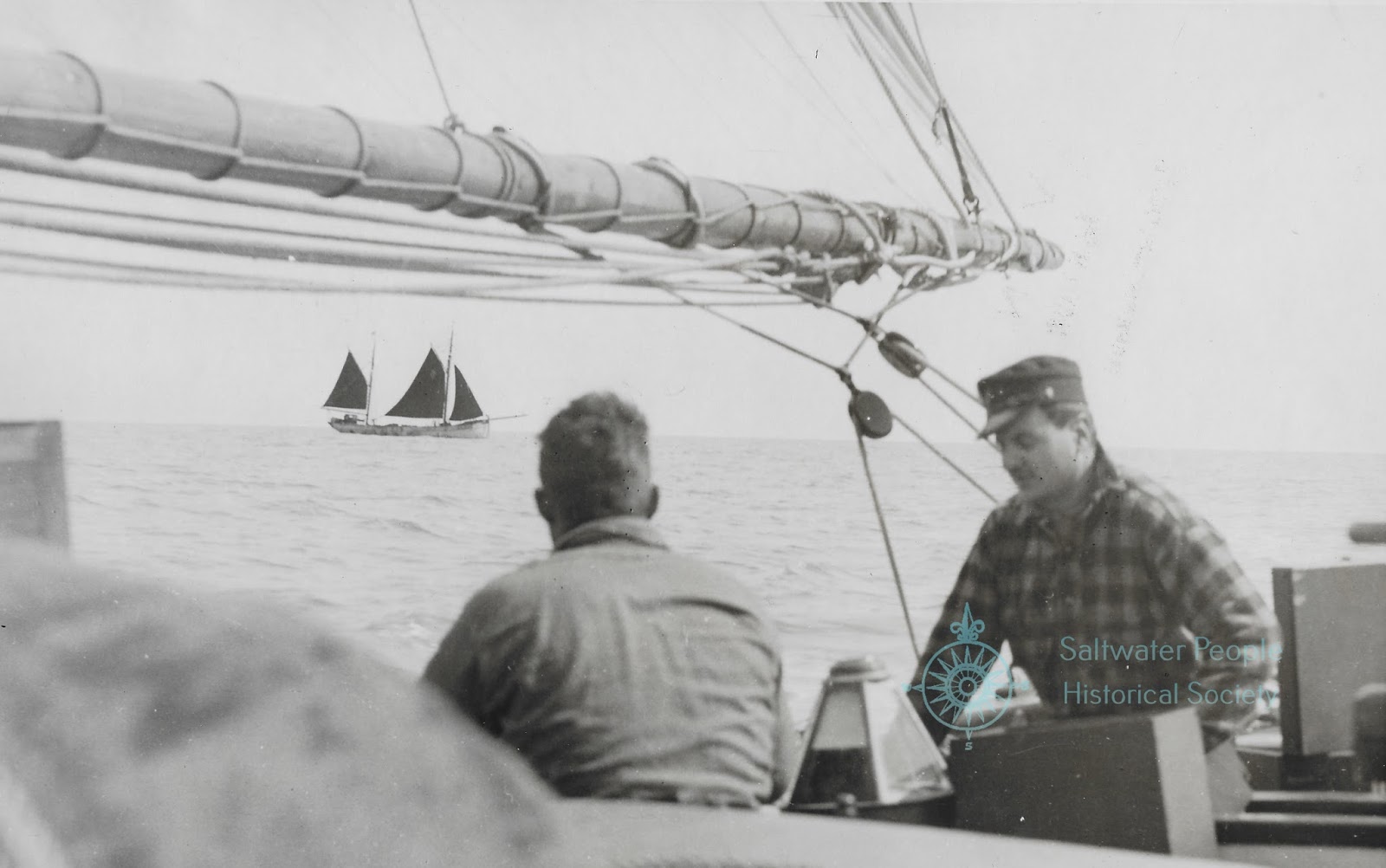
Crew member Barbara Leighton

Schooner WANDERBIRD
1930.
Original photo from the
archives of the Saltwater People Historical Society©

Before the schooner WANDERBIRD sailed into the hearts of hardworking Capt. Harold Somers and his wife Anna Lise, in California, for one of the most amazing restoration programs in the U.S., the good ship was sailing other oceans.
      Tompkins sailed for adventure and found it on the stormy 5,000-mile voyage from Spain to Florida in the little 76-ft schooner WANDERBIRD. 

     "Lief Erickson in modern dress made port [Miami Beach] the other day. His craft was the schooner WANDERBIRD, his crew totaled six men and two gals and his log told of a 5,000-mile cruise across the stormy Atlantic from Vigo, Spain to these tropical moorings.
      Half a century ago the WANDERBIRD, then the WANDERVOGEL, bucked the gales of the North Sea. She's just as sturdy and staunch today. 'No bigger than the Viking ships, but a sweeter sailing vessel and much more seaworthy,' said Capt. Warwick M. Tompkins.
      Tompkins and his crew, that included his wife, Gwen, and Miss Barbara Leighton of New Haven, CN, had no auxiliary motor on which to call in heavy weather, or calms. The WANDERBIRD is one of the few remaining deep-sea schooners that depends only on sail. 
      The women of the schooner's crew stood watch and watch with the men at the wheel, helping set canvas and going aloft when it was necessary to shorten sail for a heavy blow. The other members of the crew were Alfred W. Pain of Cambridge, Mass,  first officer; Alfred Lorens of Hamburg, Germany, second officer; two sailors and a cook.
      The WANDERVOGEL was one of a fleet of pilot boats built for the German government fifty years ago for service in the North Sea. She is framed and planked of solid oak throughout and copper-sheathed. Despite her staunch build, the schooner made 1,000 miles in six days from Vigo to Las Palmas in the Canary Islands.
'We logged ten knots under shortened canvas,' said Cap'n Tompkins. 'We had gales in the Bay of Biscay, the wind reaching a velocity of eighty-three miles an hour. But from there on it was better. We left Cowes, England, 20 September for Vigo and made port here in 48 days.'
      Tompkins whose home is in Berkeley, CA, attended the U of CA. His deep-sea experiences date from war days when he held the battleship ARIZONA on her course as a quartermaster. He purchased the WANDERBIRD in Hamburg last July and with a crew of English and Dutch schoolboys made a 6-week cruise of the British Isles last summer. 
       His latest venture on the WANDERBIRD is not his first conquest of the Atlantic in a small sailing vessel. He was navigator of the 17-ton PRIMROSE IV* on a crossing of the North Atlantic by way of Iceland an exploit that won him the Blue Water medal in 1927."
* The Log entry of PRIMROSE IV can be seen here.
The above text from the Journal Gazette, Mattoon, IL. 1930.
 
WARWICK TOMPKINS

Aboard as navigator on PRIMROSE IV.
Well known sailor and one-time owner of
Schooner WANDERBIRD.
Click image to enlarge.
Original photo from the archives of S.P.H.S.©


10 March 2015

❖ Ames and Schooner PRIMROSE IV awarded a Blue Water Medal ❖ JOHN ALDEN'S NO. 111


Schooner PRIMROSE IV

ON 223224
Sail area; 1,305 sq. ft. Lines drawn in 1919

shows a lot of similarity to the early Malabars.
Displacement of 48,200 pounds.
Tracing by John Alden Crocker.
Click image to enlarge.
Courtesy John G. Alden, Inc.
See credit below.

"John Alden's schooner used extensively in northern waters was PRIMROSE IV, design number 111. She became, for a time, one of the designer's most talked about boats, because in 1927 she won for her young master, Frederick I. Ames, the Cruising Club of America's Blue Water Medal, described as sailing's most coveted award.

PRIMROSE IV crew L-R:

Warwick M. Tompkins, navigator
Jack Bishop, Abel Seaman
Frances La Farge, Able Seaman
Skipper Fred L. Ames, in blazer,
Tom Sherwen, Cook
Photo backdated 11 May 1928.
Photographer unknown.
Original from the archives of the
Saltwater People Historical Society©

PRIMROSE IV

With the owner, Frederick I. Ames (top)
& Warwick Tompkins, Sr. 
with his hands on the bowsprit.
19 May 1928
Photo by Acme, N.Y.

Original photo from the
archives of Saltwater People Historical Society©
 

       PRIMROSE IV was built in 1923 by Rufus Condon at Friendship, ME, for Walter H. Huggins of Boston. She was the second, or "B" boat, built to the 111 design, that was created in 1920. In a sense, she was a forerunner to the early Malabars. Like the Malabars, PRIMROSE IV has a gradually curving keel profile with a fair amount of drag. Her beam at the deck is generous forward and aft, while her waterlines are fairly fine forward but full aft. Like the Malabars, she is quite short-ended, has a generous sheer, and in general, has the look of a fisherman. Her dimensions are 50.2-ft, by 39 feet 11 inches, by 13-ft x 7.2-ft. Her construction is sturdy, with sawn frames and 1.5-inch planking. She carries about eight tons of ballast, half inside and half outside.
      While under the command of Huggins, PRIMROSE IV sailed in the 1924 Bermuda Race and took second in her class.
       Then she was sold to Frederick Ames, who cruised in the schooner to Labrador a year later and in 1927 sailed her across to England for the Fastnet Race. She was the first American yacht to compete in this rugged event, and she did well, finishing second on corrected time. The heavy weather during that race forced many contestants, including the hard-driven British cutter JOLIE BRISE, to heave-to, but PRIMROSE IV carried on under reduced canvas. Her crew discussed heaving-to, but as yachting reporter, Alfred R. Loomis put it, "their discussion outlasted the gale." Ames sailed the schooner back home by way of Iceland, Labrador, and Cape Breton Island, and it was for this 58-day passage, carefully prepared and competently carried out, that he was awarded the Blue Water Medal.

PRIMROSE IV, right of center,
at Thorshaven, 18 May 1928,
en route home to the US.

Photo by Acme, N.Y.
Original from the archives of S. P. H. S.©

Looking aft on PRIMROSE IV

dated 18 May 1928
From the archives of the S.P.H.S.©


Ships That Pass
From the 1928 trip of PRIMROSE IV

Archives of the S.P.H.S.©


Captain Fred Ames
PRIMROSE IV
Dated 18 May 1928
Photo from the archives of the 
Saltwater People Historical Society©

Light Airs and a Shetland Islands Trawler;
Headed home to the US,
Aboard PRIMROSE IV with
Captain Fred Ames (R)
Dated 18 May 1928.

From the archives of the 
Saltwater People Historical Society©

JOLIE BRISE (L) and PRIMROSE IV
Transatlantic voyagers 19 May 1928.

From the archives of the S.P.H.S.©

PRIMROSE IV
Inscribed:
"Running our westing down under square sail
Iceland to Labrador."
Dated 23 May 1928

From the archives of S.P.H.S.©
The bald-headed rig permits easy handling, although one might be concerned about the lack of sail area when racing in light airs. Of course, the schooner was not designed for typical round-the-buoys racing; she was intended for rough waters and strong winds. In contrast with some of Alden's later gaff-rigged schooners, PRIMROSE IV's foresail is fairly small, which facilitates lying to in very heavy weather. During her worst mid-Atlantic gale, the schooner lay-to very successfully under reefed foresail and backed jumbo.
      The arrangements below follow the typical plan used during the days of professional crew, when it was customary to place the galley between the fo'c's'le and the saloon. The owner's cabin aft has its own toilet room, and there is another at the after end of the saloon, with a head for the crew forward. The companionways are off-center on the starboard side, so it might be desirable to heave to on the starboard tack.
      Yachting historian John Parkinson, Jr., has written that Frederick Ames was not only a fearless sailor but also a daring stunt flier whose life was cut short by an airplane accident. No doubt Ames' cruising exploits were considered daring too, but they were carried out with careful seamanship and in almost the safest boat that a yachtsman of that day could ask for."

Text and drawing from John G. Alden and His Yacht Designs, by Robert W. Carrick and Richard Henderson; Camden, ME by International Marine Publishing Co.

Book Search––
John G. Alden & His Yacht Designs


If you have any story of the race or long sail trip home, feel free to comment or send an email through this site. 

04 October 2014

❖ CLIPPER SHIP ❖

Fifty South to Fifty South by Lieut. U.S.N.R. Warwick M. Tompkins, is a 1938 classic featuring the track of the well-known German built Schooner WANDERBIRD, published in 1938 by W. W. Norton and Co. A well-known vessel and a well known sailor/author; a number of the same book, with wind in her sails, kept disappearing from S. P. H. S. members bookshelves. Innocently sailing off.
      So with another copy warmly welcomed home, we'll celebrate with a quote from Tompkins' glossary from his book, pg 256.

CLIPPER SHIP
"A term properly applied to the very beautiful, very fine, fast and over-sparred ships built in the U. S. between 1850 and 1859 and some of their British prototypes of later date (like CUTTY SARK, built in 1869) that carried the rarest cargoes at the high freights demanded by high speed. Such square-rigged ships as survive today are rather floating warehouses supplying long-term storage as well as transportation, and are loosely termed clippers only by very unpoetic license."
Clipper GLORY OF THE SEAS.
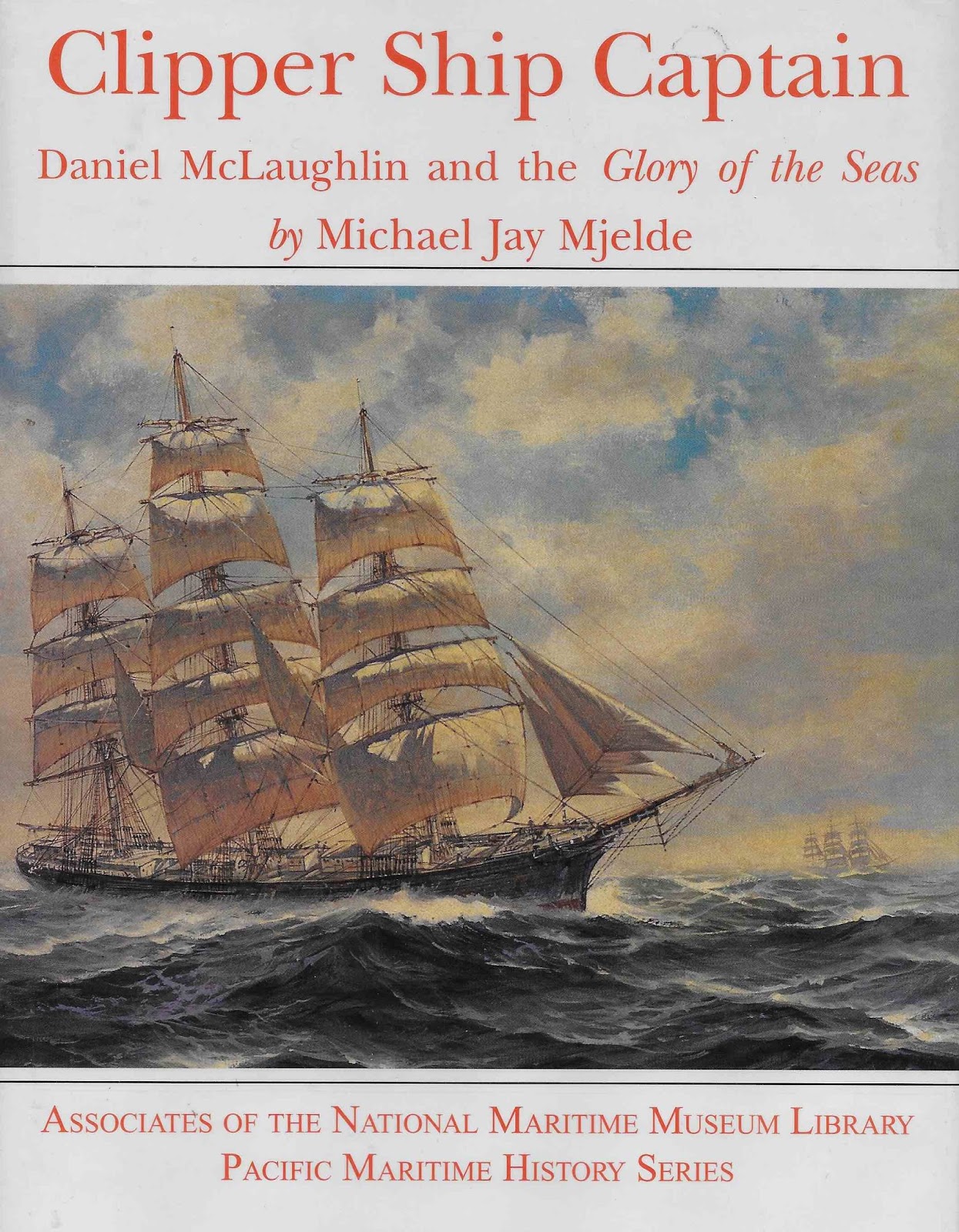
Endpaper from book Clipper Ship Captain
Daniel McLaughlin and the GLORY OF THE SEAS

by Michael Jay Mjelde. 


An example of a medium clipper ship sailing Puget Sound was the GLORY OF THE SEAS, 240.2 x 44.1 x 28.3 feet and 2,102.57 gross tons, the last full-rigged ship built by Donald McKay of East Boston, registered at Boston.
Ron R. Burke, cartographer.

      The above artwork by Ronald R. Burke, editor of The Sea Chest, published by Puget Sound Maritime Historical Society, along with Michael Jay Mjelde, an honorary life-member, accompanies Mjelde's most recent article on GLORY OF THE SEAS
      A cover painting of the clipper GLORY by Mark Myers RSMA, F/ASMA, with 16 pages of her last voyage under sail is featured in the Sept. 2014 issue of the members quarterly journal. P.S.M.H.S. site has information on signing on as a member, and an index for purchasing past issues of The Sea Chest.

What Michael Mjelde doesn't know about this clipper ship is not worth knowing. 
His published books are: 


Glory of the Seas,
Book search here


Sequel to the Glory of the Seas.
Clipper Ship Captain 
Book search here 


 The clipper ship GLORY OF THE SEAS ended her days burned for her metal fittings on a gravel beach, just south of Seattle, 13 May 1923. 


Archived Log Entries