"The Cure for Everything is Saltwater, Sweat, Tears, or the Sea."

About Us

My photo
San Juan Archipelago, Washington State, United States
A society formed in 2009 for the purpose of collecting, preserving, celebrating, and disseminating the maritime history of the San Juan Islands and northern Puget Sound area. Check this log for tales from out-of-print publications as well as from members and friends. There are circa 750, often long entries, on a broad range of maritime topics; there are search aids at the bottom of the log. Please ask for permission to use any photo posted on this site. Thank you.
Showing posts with label purse seiner. Show all posts

02 July 2019

❖ NORTH TO ALASKA 70 SUMMERS AGO ❖


SEA TRIALS WITH A SEINER DESIGNED BY ED MONK, 
BUILT BY GRANDY BOAT COMPANY, 
AND READY FOR WORK IN THE FAR NORTH


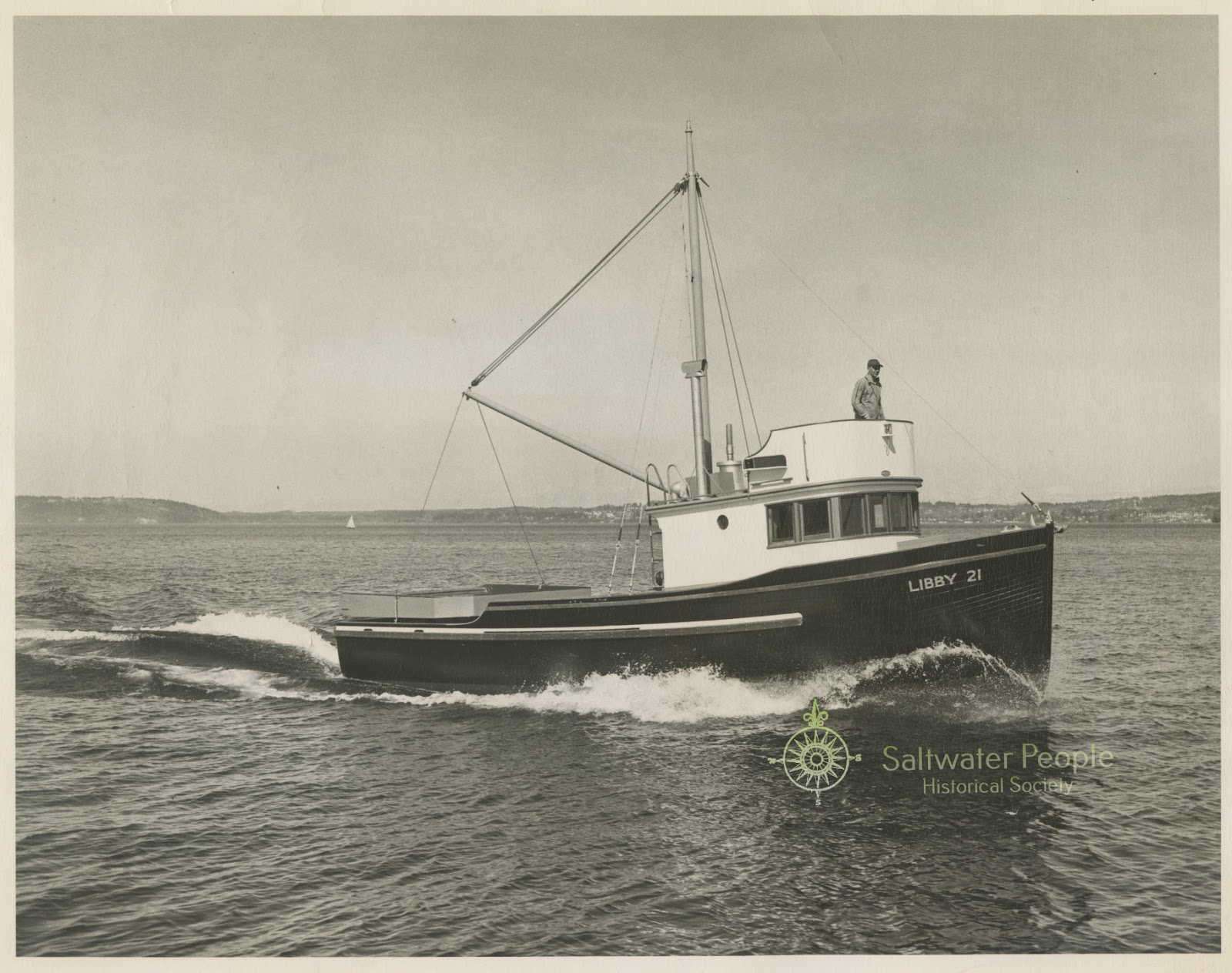
LIBBY 21
"One of the speediest of the 1949 crop
of new fishing vessels built in Seattle, 
 was the Libby 21 from the drafting
board of designer Mr. Ed Monk of Seattle.
She was constructed by Grandy Boat Co
yard on Lake Union for the Alaska salmon
Department of Libby, McNeil & Libby.
She was equipped with a
140-HP engine and logged 11-knots.
The 40' purse seiner was shipped on the
deck of a freighter to the cannery
at Mosher Bay, AK."
Click photo to enlarge.
Photo by Ray Krantz
from his photo-boat STARDUST
on Lake Washington, Seattle, WA.
From the archives of the
 Saltwater People Historical Society©
Photo date of 3 June 1949.


By the 1940s Libby, McNeil & Libby was one of the largest producers of salmon canning operations in the US. On average it produced 700,000 cases of canned salmon annually. Their canneries were at Egegik, Ekuk, Libbyville, Koggiung, Egushik, Nushagak, Kenai, Yakutat, and Ketchikan.

23 December 2013

❖ CAYAFAS––A REAL SAILOR ❖ (Updated with photo added.)


Nick Cayafas, age 90.
At his annual sprucing up and rigging,
atop his 47-ft mast, 1987.
Photo by George Carkonen

 From the archives of the S. P. H. S.
The PERPETUA, a trim two-masted sailing vessel, has long been a familiar landmark at its offshore mooring near Duwamish Head, midway between Harbor Island and Alki Beach.
      For 25 years, the ketch-rigged, white sailboat has been home to Nicholas Cayafas, a mustachioed Greek fisherman who, at 89, still climbs to the top of the 47-ft mast, and sails the 36-ft ketch single-handed.
      The elderly bachelor and his neatly kept boat are almost an anachronism in today’s jet age, virtually the last vestige of Seattle’s once colorful colony of Greek-born fishermen.
      The PERPETUA, for instance, has a miniature chapel in the forward compartment, complete with votive lights and Greek icons, an old-world custom that was commonplace in the days when the city’s Greek fishing fleet included 30 or so boats.
      For many years a Greek crucifix also adorned the PERPETUA’s topmast, but the cross was lost when hoodlums stole the boat several years ago and apparently knocked off the crucifix while going under the Spokane Street Bridge.
      Nick Cayafas is a Seattle old-timer. He came here from Astoria, OR, in 1908. For many years, he and his brother, Chris, who died five years ago, were partners in a long series of fish boats, mostly purse seiners with names such as IKAROS and IKAROS II, NICK C and NICK C II, TWO BROTHERS, CHRIS C––12 boats in all, and they fished from Alaska to the Golden Gate.
Cayafas' NICK C II, August 1949,
at WA Fish and Oyster Co, Pier 54, Seattle, WA.
She picked up ocean-caught salmon from smaller boats 
at Neah Bay before delivering to the city
 every Tuesday and Friday.
Here she is offloading 30,000 lbs of salmon.

Original photo from the archives of the S. P. H. S.©
TWO BROTHERS, 
Seattle, 1977.
From the archives of the S. P. H. S.©
      Today, despite his 89 yrs, Nick doesn’t wear glasses, even for reading, and he stands up to row the dory that takes him from ship to shore, just like his ancestors who fished the Aegean Sea.
      The colorful old-timer with his sweeping mustache and immaculate boat lead an old-world touch to the Harbor Avenue Southwest waterfront.
      George Carkonen, a Seattle Times photographer, whose family has known Nick more than 50 years, recalled when he was a youngster and Nick and other Greek fishermen would take families from Seattle’s Greek community aboard their flag-bedecked boats for Sunday outings to Port Madison, Blake Island, and other places on Puget Sound.
      
Nick Cayafas, born in Ikros, Greece.
With some of the boats he has made since 
he first went to sea. The model on which he works 
represents a ship he crewed at age 14.
At the time of this photo, he was living on W. Orleans, Seattle,
in a house shared with brother Chris, where they had a view 
out over Puget Sound from Tacoma to Whidbey Island. 
Photo by George Carkonen, March 1952.
Original from the archives of the S.P.H.S.©

      “Spiro Koutinas, whom we call ‘Sam’, has a Columbia River double-ender and still fishes for salmon, mostly around Blaine. And as for me, I manage to catch a few rock cod but I haven’t done much serious fishing since the government took over my big boat, the Nick C II, an 80-footer, shortly after the outbreak of WWII”, said Nick. Today, Nick is one of the last of the Greek fishermen.
      “I got her back, after the war and did some sardine fishing, also halibut, but by then I had bought the PERPETUA and she has been my home ever since.”
      During recent years, however, Nick makes his home during the winter in a small brick bungalow he owns on 49th Ave S. W. On cold winter mornings, he grins, “it’s more comfortable than the boat.”
      Nick has rigged his boat so that he can sail it by himself, seldom leaving the tiller or cockpit. Mostly he makes short trips, seldom venturing beyond the San Juan Islands.
      “Nick is very self-sufficient,” said Carkonen. “Why should he buy food when there are so many clams, oysters, cod, and red snapper right in our own backyard? He makes a real good clam chowder.”
      “Are you a pretty fair cook?” I asked the elderly bachelor.
      “I manage not to burn the pots,” he replied modestly.
      Most persons, meeting Nick for the first time, are astonished by his happy disposition and almost youthful enthusiasm. Probably because of his stern visage, impressive mustache, and big, work-calloused hands, they mistakenly figure the grizzled, old fisherman as a gruff or crotchety man.
      Actually, Nick is a jolly oldster––an old Nick full of “the old Nick.”
Above text by Glen Carter for The Seattle Times, October 1966
“The families would bring picnic baskets of food, jugs of wine, mandolins, and other musical instruments, and we would barbecue a whole lamb on the beach,” Carkonen said. “The kids would swim all afternoon, while the older folks gossiped, talked politics, argued, and otherwise enjoyed themselves. For the trip home, the fishermen would lash their boats together side-by-side. Sleepy children were put to bed in bunks out of harm’s way, and the older folks would dance Greek dances on the afterdeck or sing the old Greek songs.
      I can still remember the music and laughter drifting over Elliott Bay on a summer night as the boats made their way across the Sound to their home port in the Duwamish Waterway. It was great fun, the unsophisticated era before automobiles became popular and changed people’s habits and customs…”
The next year:
       "The PERPETUA, with an unusual rigging of wishbone-type gaffs which carry her triangular canvas inverted with the wide base at the top of her two masts. She wears no booms. Before Nick was hoisted aloft by Melvin Miller, close friend, West Seattle automobile salesman and sailing enthusiast, Cayafas said:
      "I've been sailing since I was 11. Last night when I went to bed I knew I'd have to decide when I woke up whether I was going to get out of bed and sit in a rocking chair or come over here to the moorage and swing in a bos'n's chair. So here I go."
      Watching with admiration was Curtis Hitchings, operator of the Riverside Marina. 
      "That's Nick for you, Hitchings said. Everybody loves him. He's a wonderful, gentle, thoughtful man who loves to sail and loves his independence.
       I've been trying to buy the PERPETUA for six years from him. It'd be easier to buy a man's right arm.
      He's always said he was going to give her up and quit sailing next year. But he's never been very definite about which next year, and here he goes again."
      Once Nick was aloft and out of earshot, Miller added:
      "He's the kindest, sailingest, hardiest man I've ever known. He's lost none of his admirable Greek heritage.
      There are no mattresses aboard. He sleeps on a bear skin and wraps up in a couple of goat skins. His lights are all kerosene.
      He has her rigged up so he can handle the jib, the staysail, the mainsail, and the spanker all by himself from the cockpit. 
      He's a real sailor."
Bottom text by Robert A. Barr for The Seattle Times, 5 May 1967.

16 November 2013

❖ EVERYONE WORKS IN ANACORTES ❖

when the Sockeye Start to Run.
Fall 1942.


"Gus Dalstead's card reads, G. N. Dalstead, Postmaster, Anacortes, WA. That's a good job and Gus is proud of it.
      But you'll never guess where I met him. In a salmon cannery, dressed in dungarees, with sweat streaming down his face, heaving cans of sockeye around!
      Four of Gus' postal employees were sweating alongside him. Elsewhere in the plant, the chief of police, the fire chief, and other civic dignitaries were toiling. Everyone in Anacortes works in the canneries while the salmon run is on.
      I was walking around, soaking up atmosphere, when a foreman yelled above the din, 'Hey, Bud, ya wanna go to work? A buck an hour.'
      I shouted back. 'Thanks, I am working, can't you tell?'
      'Well, if you see anybody uptown who does, send 'em down here a runnin'.'
      That's the little town of Anacortes while the salmon are running. There are tears, drama, and heartbreak––and plenty of hootin', hollerin', happiness, when the Silver Horde rips into the Strait of Juan de Fuca. The salmon can make a man in a week––or break him.
      The canneries send 'buyer boats' out to where the fishing fleet is hauling them in. Individual boats pull alongside the buyer boats, unload their catch, get a receipt for it, then dash off to set nets for another haul. When buyer boats are loaded to the gunwales, they chug back to the canneries, unload, then tear out for more.
"Toilers of the sea as they shift a huge catch of salmon
from the 
fish boat to the buyer boat."

Original photo, dated 1942, from the archives of the S. P. H. S. ©
       I went out with a buyer boat early in the morning. We started out with one boat, three men, including myself. We came back to the cannery ten hours later, with two boats so heavily weighted down with fish they had to be tied together for sufficient power to make headway.
      Between the two boats we had 25,000 sockeye salmon. That's about 175,000 pounds of fish.
      Salmon fleet men spend all year getting ready for the run. They repair nets, paint boats, overhaul engines. The season opens when the salmon start coming in from the blue Pacific––down from Alaska. That's in late July or August. It ends around September––or sooner if the Fisheries Dept. decides it's necessary to conserve the fish pack.
      That was the case this year. Too many salmon had been caught. The remainder had to be allowed to get up the rivers to spawn.
      We took the morning catch from the WATERLAND, a nine-man boat, 4,500 salmon. The price then was $1.65 a fish. The eight-man crew collected $300 each for the mornings work! They told me they'd have a similar haul from their afternoon cast.
      But it's hard work. No place for sissies. Salt and wind and sun burn the men brown. They stay out fishing from 6 am Sunday until sundown Thursday. Friday the boats come into Anacortes to refuel and replenish provisions. Those are Fisheries Dept. rules. It gives the salmon two whole days to get past the fleet unmolested, en route to the spawning grounds.
      Normally the price of fish is set at so much per pound. This year, with such mammoth catches, the canneries hadn't time to weigh each haul. So an average price per fish was agreed upon. Boat skippers count the salmon with mechanical counters as they heaved from the fish boats to the buyer boats by hand with one-pronged fish forks. Canny Slav skippers never miss a count.
      Often a net is ruined. Then a boat must put into the nearest port, and have the net repaired. At least once this year, one boat had such a huge haul that the driving, thrashing, salmon surged through the net and got away.
Purse seine fishermen hauling in the net.
Original photo dated 1943 from the archives of the S. P. H. S.

      There are usually nine men to a boat. A crew of eight and the skipper, who charters the boat or owns it outright. Money from the catch is divided into shares, 13 to a nine-man boat––two for the boat, one and a half for the seine, and one and a half for the skipper himself, one each for the crew.
      
Nets Cost Money
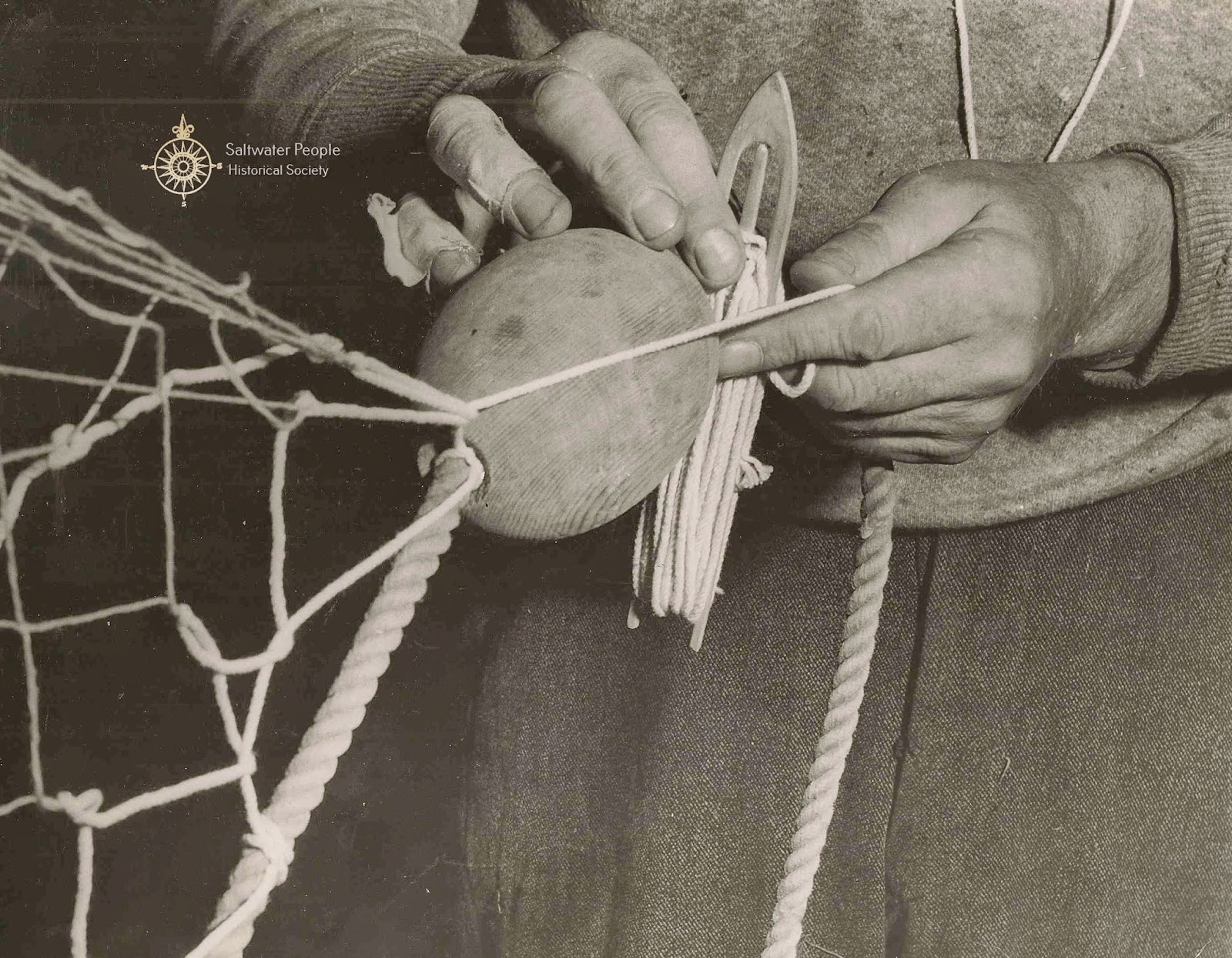
Louis Zuvich mending net
Photo from the archives of the S.P.H.S.©
      Seine nets are worth a lot of money. One skipper told me it cost $5 a day to keep his in shape during the season.  
      Sometimes the individual fishing boats have a full load and the buyer boats are full too. Nothing for it then but to head for the cannery and unload at the dock. We passed one boat, the WONDERLAND, churning cannery-bound. She was loaded so deep the crew members were wearing life-preservers, and keeping their fingers crossed. In her holds and on her decks were 10,000 sockeye.
      Two boats were sunk trying to get home with such loads. One went down in deep water and was lost. The other was nearer shore and sank with only the mast top and wheelhouse showing above water. It was salvaged the next day, overhauled, and back fishing again.
      Back at the canneries it's a different story. Cannery officials are crying. They can't get help. It's only seasonal work and most of the men have gone to shipyards or other war industries.
      I saw more than a hundred thousand salmon piled in bins. Canning lines were clanging at fever heat. Never since 1930 had there been such a catch. The fish must be cleaned, packed into cans within 24 hours after they're caught. Otherwise they'll spoil. Long lines of women toil eight-hour shifts, cleaning, slicing, packing.
      Anyone wanting to work can walk into the canneries, peel off his coat, and start right in. I saw two bandy-legged cowhands far from familiar range country, stroll in the cannery entrance, speak to the foreman, shuck off their Stetsons, slither through the fish muck in high-heeled boots and start to work.
      Maybe I should have taken that foreman's offer. Gus Dalstead told me later that one of his boys made $18 that day.
Above text by Grant MacDonald for The Seattle Times, September 1942.


Archived Log Entries