"The Cure for Everything is Saltwater, Sweat, Tears, or the Sea."

About Us

My photo
San Juan Archipelago, Washington State, United States
A society formed in 2009 for the purpose of collecting, preserving, celebrating, and disseminating the maritime history of the San Juan Islands and northern Puget Sound area. Check this log for tales from out-of-print publications as well as from members and friends. There are circa 750, often long entries, on a broad range of maritime topics; there are search aids at the bottom of the log. Please ask for permission to use any photo posted on this site. Thank you.
Showing posts with label Whidbey Island. Show all posts

12 April 2022

TROUBLE IN A STORM OFF WHIDBEY ISLAND ❖ ❖


F.V. MIDWAY
lashed to Leiter Hockett's salvage tug AMAK
after three months underwater near
Whidbey Island, Washington.
Four were lost on 9 March 1959.
Click image to enlarge.
Original photo from the archives of the 
Saltwater People Historical Society©

Four Seattle fishermen were lost when the 56-foot fishing vessel Midway capsized and sank in a storm half a mile off Partridge Point.
        The overturned boat was sighted by the tug Tartar and reported to the Coast Guard.
        Less than 14 minutes later the tug reported that the fishing boat had sunk.
        The men lost were Bjarne Olsen, John Eikevik, Carl Jensen, and Simon Ingebretsen.
        The Midway's 18-ft dory was found about the same day; it still had the canvas stretched over it, indicating it had not been used.
        The Midway was bound Bellingham to Seattle when the accident occurred.
        The vessel's owner, Albert Anderson, was not aboard because of an ailment.
        The vessel, a trawler, had been off the Washington Coast and had unloaded her catch yesterday in Bellingham, before departing for Seattle about 3:30 p.m. She was riding high, without cargo, and with little ballast when she capsized.
        The Midway was a sister ship of the Northern Light, which sank ten days ago in Georgia Strait. The two were launched a few weeks apart 15 years ago and had fished together much of the time.
        Text from the Seattle Times three months later.


06 February 2021

❖ CROP MOVEMENTS AND A SOCIAL HALL ❖


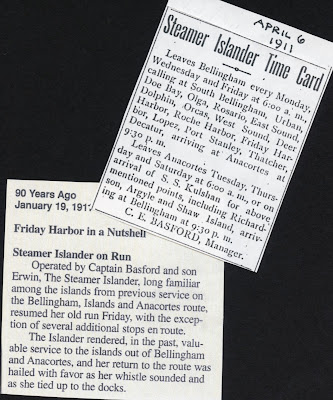
The S.S. ISLANDER
Built in 1904 by J.A. Scribner
at Newhall, Orcas Island, WA.
Fate: sold to Mexico.
From the archives of the 
Saltwater People Historical Society©


Above clips from the Friday Harbor Journal
with dates from 1911.


S.S. ROSALIE
ON 111022
Built in 1893.
Here she stops at West Sound, Orcas Island,
(postmarked 1908)
and Richardson, Lopez Island, undated,
San Juan Archipelago, WA.
Click the image to enlarge.
From the archives of the 
Saltwater People Historical Society©

"In the newly settled San Juan Islands crop movements became a life support system to steamers like the Rosalie and the Islander. Settlers had broken ground on Decatur, Blakely, Stuart, and Waldron Islands, all virtually deserted today but settled enough by 1900 to warrant post offices. Most island crops were grown on the bigger islands: Shaw, Lopez, Orcas, and San Juan, cultivated by homesteaders from Ireland, Germany, Sweden, Norway, Denmark, England, Scotland, and Canada. Others arrived fresh from the worked-out goldfields of California or the riffles of the Fraser River. Captains on vessels loading spars for Falmouth and Brest returned to come ashore and "swallow the anchor." Other island settlers were Civil War veterans [such as Oscar Fowler and Isaiah Jones, the latter the father to San Juan County sheriff Newton Jones] and Midwest farmers beaming at the misty rains.
      In 1900, Island County boasted its population had soared 40 percent during the past decade. Stripped of boosterism, that still meant a population of only 3,000. But the newcomers were prodigal producers.

        Island apples became as popular as today's harvest from Yakima and Wenatchee, soon to begin bearing fruit and deny the islanders' dreams of becoming the "Apple Basket of America." Wagons rattled their way to island docks laden with fruits, dairy products, grains, and beef and lamb.
By the turn of the century, another bounty—along with the lime mined on San Juan Island—was making its way to market on the steamers. Drawn by the closeby migratory routes of salmon, fish traps, reefnetters, and boatsmen were bringing in a rich harvest. One Friday Harbor cannery alone packed 50,000 cases in a single year.
      Vashon Island shipped berries, greenhouse tomatoes, and cucumbers. Steamers stopped to load cases of eggs that were to win national blue ribbons.

      On Whidbey Island, Langley and Coupeville docks creaked with movements of provender for Everett and Seattle, including potatoes grown by Chinese farmers and sacks of wheat harvested by Dutchmen who, until soils became depleted, harvested
record-breaking yields of wheat (117 bushels per acre in 1892.)

      The San Juan Islanders became the first on the Sound and its ancillary waters to become wedded to the steamer. Most were landlubbers, but they relaxed aboard workhorses like the Islander and the Rosalie.
      Islanders had watched some of these being built by their skipper owners on crude ways in a tideland clearing. To the islanders, the steamer was a truck, an ambulance, a school bus, a hearse, and a bearer of mail and visitors. Best of all it was a social hall where, in the warmth of a cabin, coffee could be shared and loneliness melted as the blue-black shores of the islands flowed by."


Jim Faber. Steamer's Wake. Enetai Press, Seattle. 1985.


15 April 2014

❖ SHELLBACK ❖

Shellback papers for "Pappy" Beachum
(1906-1980)
Captain Walter Clarence Beachum

grew up on Whidbey Is. where he learned
his trade from Captain Bartlett Lovejoy,
of the Black Ball LIne.
Pappy was master of ferry IROQUOIS on the
Seattle-Victoria route before becoming
 Chief Pilot for the Puget Sound Naval Shipyard
 for 23 years––retiring 1968.

From the archives of the S. P. H. S.©

"The sailor's commendatory term for the landsman's old salt. Some authorities say that it comes from his back being bent like a shell; but it seems more probable that the implication is that the shellback is growing barnacles from having been at sea so long.
      The term is fairly well known to landspeople. The degree of "able shellback," signed by Rex Neptune, is currently [1945] being conferred upon men crossing the Line for the first time aboard troopships."
Sea Language Comes Ashore, Joanna Carver Colcord. Cornell Maritime Press, N.Y. 1945.

28 February 2014

Coffee First.

S. S. LURLINE "Lost" on Puget Sound
By Captain James Crooks
Bush Point, Westside of Whidbey Island, WA.
Click to enlarge.

I joined the S. S. LURLINE at San Francisco, CA, early in February 1923. The LURLINE was a combination cargo and passenger vessel plying between Pacific Coast ports and the Hawaiian Islands and was operated by the Matson Navigation Co of San Fran. I shipped as quartermaster and we left for Puget Sound.
S. S. LURLINE, Matson Line, mid 1930s, arriving Hawaii.
 Yes, this is the gal that played on the shore of Whidbey Island, WA.

Courtesy of Wikipedia.
      We picked up cargo and passengers at various Sound ports and were on our way to Hawaii when we ran into a dense fog in the vicinity of Whidbey Island; while maneuvering at different speeds and even being completely stopped at intervals, the current evidently carried us off our course and suddenly while traveling at full seed ahead––we ran ashore.
      The engine room was located in the after end of this vessel and most of the weight, of course, being in that end, we ran well up on the beach when we grounded. The passengers felt the impact and soon they were all out on deck. The fog was so dense that we could not even see the land where we had beached.
      There did not appear to be any particular damage done and soundings disclosed that the vessel was dry and no water was entering the hull. 
      About an hour after we grounded, the fog cleared away and passengers and crew alike, gathered on the fore part of the vessel to look around and, if possible, to ascertain where we were. As we looked at the beach we observed a very old, gray-haired man approach the bow of our vessel. He carried a small stool with him; in a slow-motion manner, carefully set it down on the shingle beach right alongside our bow which was high and dry. Questions were fired at this old man from those assembled on the bow asking him where we were but he ignored them and asked to see the captain. The captain was immediately notified and appeared on the bow high above the old man calmly sitting on his stool on the beach. It was obvious that while we were all interested, the captain was the one who was most interested in solving that question. He leaned over the bow with his scrambled-egg hat and four gold rings on his coat sleeves prominently displayed to the old man. Apparently not wishing to have both passengers and crew know that he did not know where we were, he asked the old man how far we were from Bush Point. 
      This old man, who apparently had at one time been a seaman, was not eager to answer questions. He said, "Well, you are the captain, I see. I have lived here for many years (in an isolated cabin which was close by) and I have had many things drift on to the beach but never before have I had an ocean liner come pretty near right into my house!" Then he asked if we had any coffee on board and when told we had plenty he said, "when you give me some coffee I will tell you just where you are".      
      The master stood by waiting and obviously worried while a white coated flunkey was dispatched for a pitcher of coffee which the boatswain lowered down with a heaving line and a bucket. It was not until he had a swig of coffee that the old man resumed his conversation and then he said, addressing the captain, "so you want to know how far you are from Bush Point. Well, you could not be any closer for you are right on it".
      As soon as the captain definitely knew where we were, the Coast Guard was notified and a Coast Guard cutter and several towboats soon arrived and at high water attempted to pull us off the beach without success.
      These vessels did not leave the vicinity after they failed to haul us off but anchored close by with the intention of making another attempt on the next high tide. That same night shortly before high water and without any warning we slipped down the beach into deep water; so suddenly did this occur that we almost drifted on top of the vessels anchored close by. The heavy current carried us free of the coast. A survey showed that there had been no damage done to the ship and we proceeded on the voyage to the Hawaiian Islands.
E. C. Kropp postcard
From the archives of the S.P.H.S.©

Text courtesy of Puget Sound Maritime Historical Society,
Seattle, WA.
By Capt. James Crooks, 
Quarterly journal ,The Sea Chest. March 1974.
Bush Point ❖ ❖ Named in 1855 by the US Coast Survey because of "one or two clumps of trees and bushes."  
Washington State Place Names. James W. Phillips. U of WA, 1971.

16 September 2013

❖ WHALE OFF WHIDBEY ISLAND ❖

"Little-piked" whale, 
Off Double Bluff, Whidby Island, Washington State.
Original photo from the S. P. H. S. , dated 5 July 1954.
"Puget Sound summers not only lure thousands of tourists––now they've convinced a whale this is the place to spend the summer.
      The whale is a full grown little-piked whale. The "little" is misleading. This whale weighs four to five tons.
      For the past four summers the visitor has appeared off the shore of Double Bluff, on the west side of Whidby Island. And the whale is there again this summer [1954].
      Spinning fishermen and Game Department men have had the huge mammal for a fishing partner regularly off Double Bluff, one of the state's top spinning grounds.
      The whale is the smallest species of the baleen whales of the Pacific Coast, maturing at about 27 to 30-ft.
      The first Puget Sound specimen on record was found on the north shore of Admiralty Inlet, a few miles north of Double Bluff, in 1872. It was 27-ft long.
      Little-piked whales reportedly were captured by Indians off Cape Flattery and the Strait of Juan de Fuca.
      A young female specimen was captured in a salmon trap off Whidby Island in 1928. It was brought to Seattle, where it was frozen. It still is on exhibit at the Port of Seattle's Frozen Fish Exhibit at the Spokane Street cold-storage warehouse. It is 13-ft long and weighed about 1,400 pounds.
      Two specimens were found in fresh-water tributaries of Puget Sound. In 1929 McAllister Creek Estuary in the Nisqually Valley gave up one, and another swam up the Snohomish River for more than ten miles before it was killed in 1938.
      A whale of this type was found in 1945 on the beach of Waadah Island, Neah Bay, WA. It was thought that this whale fell victim to antisubmarine devices during WW II.
      The little-piked whale feasts on candlefish and does not disturb salmon. It is hunted commercially by Norwegian whalers.
      Many persons have confused the little-piked whale with the  blackfish, or killer whale. The blackfish measures only about 15-ft."
Above text as reported in The Seattle Times, 5 July 1954.
Species map from the IUCN Red List website.

This whale, now more commonly known in the PNW as the Minke whale (Balaenoptera acutorostrata) has innumerable common names. It is found in all oceans. No known estimate of total global population but estimates from parts of the range in the N. Hemisphere show it is well above threshold for the threatened category. For more information on the habitat see the IUCN Red List here

   
Double Bluff beach at the State Park ,
South Whidbey's best public beach.
24,000+ ft stretch of beach on the SW shore,
Marine Area 9 (Admiralty Inlet).

Archived Log Entries