"The Cure for Everything is Saltwater, Sweat, Tears, or the Sea."

About Us

My photo
San Juan Archipelago, Washington State, United States
A society formed in 2009 for the purpose of collecting, preserving, celebrating, and disseminating the maritime history of the San Juan Islands and northern Puget Sound area. Check this log for tales from out-of-print publications as well as from members and friends. There are circa 750, often long entries, on a broad range of maritime topics; there are search aids at the bottom of the log. Please ask for permission to use any photo posted on this site. Thank you.

08 October 2014

❖ Flattie to SIR TOM ❖ ❖ ❖ ROY W. CORBETT ❖

From 1905 to 1969, the Blanchard Boat Co of Seattle was renowned and respected for its well-built vessels, large and small, sail and power. Today hundreds of graceful Blanchard boats still ply the sounds and inlets of Washington, Alaska, and B.C.
      Norman C. Blanchard is the son of Norman J. Blanchard, founder of the firm; here follows one of his abridged stories he wrote for Knee Deep in Savings with Stephen Wilen. (Search link below.)

R boat SIR TOM 
L-R: Andy Joy, Roy Corbett, J. Swift Baker, and
SYC Commodore Ted Geary, helmsman.
The 1930 crew after winning back the Lipton Trophy
at the P.I.Y.A. race at Cadboro Bay, Victoria, B.C.
These original photos from the archives of S.P.H.S.©


"Roy W. Corbett arrived in Seattle about 1920. I don't have any idea what brought him here. I don't think Roy even had a job when he got to Seattle, but within a short time, he did find work selling Cadillacs. Just how he got hooked up with L. E. 'Ted' Geary and the SIR TOM gang is a mystery, because when he first arrived in Seattle Roy Corbett didn't know sickum about sailing or sailboats. Over time, though, he managed to become a pretty good sailor.
      My acquaintance with Roy was made when he was having his first sail with Geary on the SIR TOM. I think he thought Ted was going to buy a Cadillac from him, and I'm just as certain that Ted thought that Roy was going to have himself a yacht. They remained good friends for life. It was probably around 1921 or 1922 when this occurred, and I think that Capt. Griffiths' two sons, who had been part of SIR TOM 's crew, decided they were getting a little too old for the game. So in the summer of 1922 Roy Corbett crewed on SIR TOM, with Geary at the helm, and my dad, who was the foredeck man, Colin Radford, and one or two others.
      Now, this was the time when the SIR TOM was being campaigned heavily. She always finished first, and her crew practiced very seriously right off our company dock. In time Roy became a very adept sailor and was the main sheet man on the SIR TOM under Geary, and later with Jack Graham at the helm.

Roy Corbett
Sailing a one-design Flattie, 1931,
designed by L. E. 'Ted' Geary.
Later called a Geary 18.
Photo from the archives of the S.P.H.S.©
      Roy, to my knowledge, never sailed in any catboats, but, when Ted introduced the design for the Flattie, Roy was one of the first to put up the $150 and order one from my dad. I think that Roy mainly wanted the boat for their daughter, Mary Helen, to race. She became a pretty good sailor herself and was the 1929 Seattle Yacht Club Flattie champion.
      Finally, Roy bought a real boat from Geary, a Marconi-rigged ketch, c. 50-ft, built on speculation in CA. After C. W. Wiley died, Roy bought ALICE, renamed her MAHERO and won the SYC Opening Day Class A Race in 1932 and in 1937. Roy was commodore of the SYC in 1933, and active in the Barnacle Bill cruises that had been started by Bill Hedley. Roy kept the MAHERO until early in WW II when she was taken over by the Coast Guard."
DEBUTANTE,
Roy Corbett, 1937, Seattle.
Above text; Knee-Deep in Shavings by Norman C. Blanchard.


Book search here.

04 October 2014

❖ CLIPPER SHIP ❖

Fifty South to Fifty South by Lieut. U.S.N.R. Warwick M. Tompkins, is a 1938 classic featuring the track of the well-known German built Schooner WANDERBIRD, published in 1938 by W. W. Norton and Co. A well-known vessel and a well known sailor/author; a number of the same book, with wind in her sails, kept disappearing from S. P. H. S. members bookshelves. Innocently sailing off.
      So with another copy warmly welcomed home, we'll celebrate with a quote from Tompkins' glossary from his book, pg 256.

CLIPPER SHIP
"A term properly applied to the very beautiful, very fine, fast and over-sparred ships built in the U. S. between 1850 and 1859 and some of their British prototypes of later date (like CUTTY SARK, built in 1869) that carried the rarest cargoes at the high freights demanded by high speed. Such square-rigged ships as survive today are rather floating warehouses supplying long-term storage as well as transportation, and are loosely termed clippers only by very unpoetic license."
Clipper GLORY OF THE SEAS.
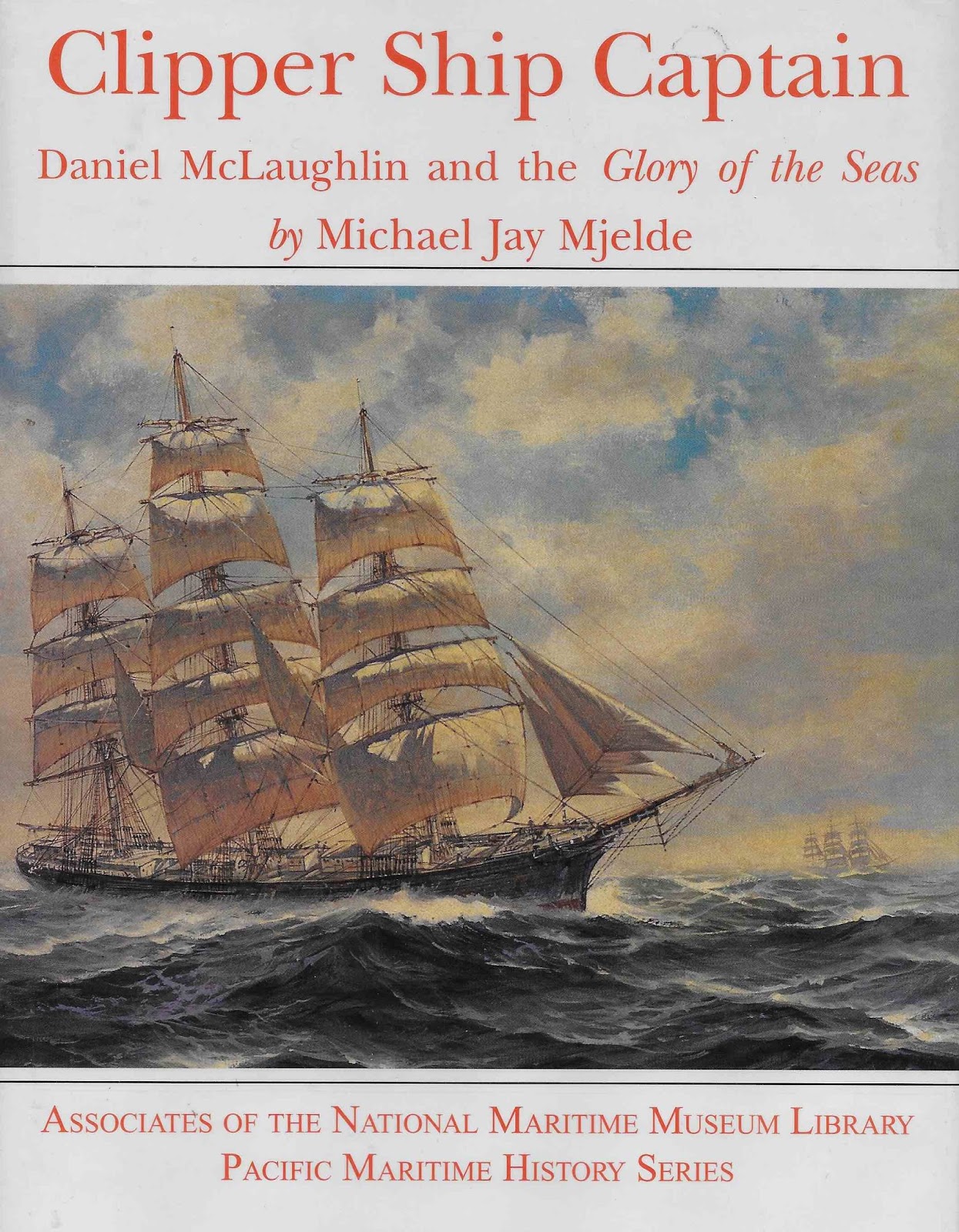
Endpaper from book Clipper Ship Captain
Daniel McLaughlin and the GLORY OF THE SEAS

by Michael Jay Mjelde. 


An example of a medium clipper ship sailing Puget Sound was the GLORY OF THE SEAS, 240.2 x 44.1 x 28.3 feet and 2,102.57 gross tons, the last full-rigged ship built by Donald McKay of East Boston, registered at Boston.
Ron R. Burke, cartographer.

      The above artwork by Ronald R. Burke, editor of The Sea Chest, published by Puget Sound Maritime Historical Society, along with Michael Jay Mjelde, an honorary life-member, accompanies Mjelde's most recent article on GLORY OF THE SEAS. 
      A cover painting of the clipper GLORY by Mark Myers RSMA, F/ASMA, with 16 pages of her last voyage under sail is featured in the Sept. 2014 issue of the members quarterly journal. P.S.M.H.S. site has information on signing on as a member, and an index for purchasing past issues of The Sea Chest.

What Michael Mjelde doesn't know about this clipper ship is not worth knowing. 
His published books are: 


Glory of the Seas,
Book search here


Sequel to the Glory of the Seas.
Clipper Ship Captain 
Book search here 


 The clipper ship GLORY OF THE SEAS ended her days burned for her metal fittings on a gravel beach, just south of Seattle, 13 May 1923. 


17 September 2014

❖ BOOK REVIEW ❖ THE CURVE OF TIME


One of the most visited posts on this Log is an abridged biography of M. Wylie 'Capi' Blanchet by author Edith Iglauer Daly, with permission from the publisher, Harbour Publishing. Link to post

Today we are updated by Allison Hart Lengyel with a review of the audio version of Blanchet's The Curve of Time, published by Post Hypnotic Press. This is Lengyel's fourth review for Saltwater People Historical Society; book reviews are easily accessed by viewing the search labels at the bottom of the Log.


I’m just a wild sea gypsy
Born of the wind spray
Restless of all that would hold me
Bidding me come and stay.

Safe in my heart I kept my dreams
And laughed the hard years through
Now before your eyes I bring them out
Softly uncover and spread them to view. 

-M. Wylie Blanchet

Wylie Blanchet turned many actual summers into a narrative of one apparent long season spent motoring about the Canadian Pacific Gulf Islands with five children, and sometimes a dog, in the family’s 25’ cedar cruiser. She and her husband had bought the boat together sometime after they came west from Toronto to British Columbia in 1921. But he went out on a solo trip one day in 1927 and disappeared; the boat was found bobbing off Knapp Island, without a captain.  It was not without a captain for long, as Blanchet surprised her eastern relations by choosing both to keep the boat and to remain in BC, home-schooling her children during the year in the little house they’d bought on Curteis Point, near Sidney on Vancouver Island, and spending June to October free and independent, exploring the inland sea’s island- and inlet-strewn waters. 

To pull off this feat of self-reliance, Blanchet had to be an able diagnostician of marine mechanical and electrical problems, ready to improvise with what was at hand or to make do, while mindful of the weather, the currents, the winds, and safe spots to anchor. A boat of that size—the Caprice’s beam was only 6’ 1/2’’—couldn’t hold enough food and water for six people for five months, so the family learned the locations of reliable freshwater waterfalls and streams and sources and seasons for forage food (huckleberries, thimble berries, trout, salmon, clams, crabs, apples). In the 1930s and 1940s, when the family’s travels took place, there were a few isolated outposts, points of civilization, where mail and replacement parts could be forwarded; fuel, matches, batteries, and coffee purchased. Blanchet also administered the family’s first aid and protected them all from black bears, cougars, and a few shady human characters met along the way. Most of the people the family encountered were friendly, harmless recluses. And although it’s hard to imagine now, for the most part there were no marinas, no game wardens, and few evident rules about catch limits or private property. 
The book Blanchet wrote in 1961 is now available in audio format, narrated by voice actor Heather Henderson, with a forward by Timothy Egan. Henderson does a good job of conveying Blanchet’s no-nonsense demeanor. As captain of her little boat and crew (a role that earned her the lifelong nickname “Capi”)—and often the only adult around for many miles—Blanchet had to be unflappable and accomplished in multiple practical skills. Yet lucky for her family—and for the audience of her story—she had a philosophical, poetic side, intensely curious about the natural world and full of insights linking this water world of dense trees and fog with the greater world of literature and ideas. 

My only criticism of the audio book—and this is a small one—is that Henderson lacks any sort of Canadian accent. Blanchet, born in 1891 in Lachine, Québec, surely would have had one. Henderson’s characterization of the children’s voices is also perhaps a bit unrealistic--the way someone who had never spent summers on a boat with small children might imagine them. [Full disclosure: this reviewer has three school-age children and a boat.] On the plus side, Henderson’s narrative is easy to understand, with careful elocution and unambiguous phrasing.

The title of the book comes from the writing of Belgian Maurice Maeterlinck, who compared time to a curve, from the apex of which one can see the past, the present, and the future. Blanchet had Maeterlinck aboard, as well as a copy of George Vancouver’s travel diary from his 18th-century voyages in the area. As the Blanchet family traveled about in apparent aimless wandering, spending long days swimming, drying their freshly washed clothes on the rocks, gathering berries and hiking, motoring down inlets and weathering storms, they were actually also following the  stops made by Vancouver and noting his observations along the way, visiting Indian villages and logging camps, noting the indigenous plants and animals, and learning the skills of navigation. 

Thanks to the motor car, Maeterlinck wrote in 1904, it has become possible for people to absorb “in one day, as many sights, as much landscape and sky, as would formerly have been granted to us in a whole lifetime” (Maeterlinck, “In an Automobile,” 1904). In similar fashion, touring the waters of the Gulf Islands in a motor boat, even a 25’ gas-powered cruiser, opened up a wide world of experience to Blanchet and her family and allowed them to become deeply acquainted with a place formerly comprehended at the pace of dugout canoes, sail power, and the occasional steamship.

“When was that we had watched them? Yesterday? A hundred years ago? Or just somewhere on that Curve of Time? Farther and farther into that Past we slipped. Down winding tortuous byways—strewn with reefs, fringed with kelp. Now and then, out of pity for our propeller, we poled our way through the cool, green shallows—slipping over the pointed groups of great starfish, all purple and red and blue; turning aside the rock cod swimming with the lazy tails; making the minnows wheel and dart in among the sea grapes. In other stretches herons disputed our right-of-way with raucous cries, and bald-headed eagles stared silently from their dead tree perches. Once a mink shrieked and dropped his fish to flee, but turned to scream and defy us. Perhaps, as Peter suggested, he was a mother one. We turned into more open water, flanked with bigger islands, higher hills. ‘Mummy! Mummy! A whale!’ shouted Jan, and almost directly ahead of us a grey whale blew and dived. ‘Two whales! Two whales!’ shrieked the whole crew, as a great black killer whale rose in hot pursuit, his spar fin shining in the sun. He smacked the water with his great flanged tail and dived after his prey—both heading directly our way. We were safe behind a reef before they rose again.” (Blanchet, The Curve of Time, p.75-76)

Thanks to the audio version of Blanchet’s classic, The Curve of Time, we can now listen in on those long-ago summers, experiencing as Maeterlinck said, the “landscape and sky” of a whole lifetime, at the speed of a motor boat and our automobile.

The Curve of Time, M. Wylie Blanchet
Unabridged, 7 hours, 24 minutes
2014 Post Hypnotic Press, Canada

05 September 2014

❖ YACHT "A" Headed South ❖

Yacht "A",
San Juan Archipelago, WA.

Passing through this archipelago, was the 394-ft yacht "A," kindly recorded this week and shared by Blakely Islander, Lance A. Douglas.
      Russian banker and his wife, Audrey and Aleksandra Melnichenko, were cruising down from Ketchikan, AK, to Seattle, to refuel at Pier 90. 
      "A" was built by Blohm & Voss in Kiel, Germany. For more stats, she has her own Wikipedia page that can be seen here.

23 August 2014

❖ S. G. SIMPSON ❖ Sternwheeler to Tug

Vintage postcard detail
Olympic Peninsula

postcard pub. by C. P. Johnston Co., Seattle, WA.
From the archives of S. P. H. S.©
"An array of the time-worn craft plying the Shelton run in the '80s and '90s would be an interesting sight today. The tri-weekly boats from Tacoma making all the way-stops included the ancient JOSEPHINE, MESSENGER, OTTER, and NELLIE. Later the more up-to-date CLARA BROWN, and for a brief period the smart MONTE CRISTO handled this trade. None of these packets were averse, when en route, to dropping a log tow out of the numerous shallow inlets to deep water tugs. This was accepted by the  occasional passenger, as a matter of course.
      All these steamers were stern wheelers, as was the pioneer on the direct Olympia-Shelton route, the WILLIE, operated by the Wiley Navigation Co. The similarity of names between owner and boat is but a coincidence. She was built for Capt. W. H. Ellis, intended for the Nooksack River and named for his son William. For the record, the WILLIE was 65-ft x 15-ft. On this meager hull was piled two full houses, topped by a pilot house on the boat deck.
      Her most noted characteristic was the constant list to port, unless one considers her lack of speed paramount. "Port list, long passage," is a sailor's maxim. The WILLIE surely lived up to this saying were the tides adverse. The whistle was enormous. In fact, the descriptive term "wheel and whistle" was coined for her long before the GREYHOUND made that appellation famous. That whistle by the way, is still in use [1948] on one of the few surviving steam tugs.
      In 1986, the WILLIE was succeeded by the larger and speedier (still with reservations) CITY OF SHELTON. Built for and operated by the Simpson Logging Co. interests, the SHELTON gave good service for ten years. 
S.G. SIMPSON
Photo pre 1910.
Vintage postcard from the archives of the S. P. H. S.©
      Then came the S. G. SIMPSON, without doubt the finest small stern wheeler ever on the Sound. She was built by Crawford & Reid of Tacoma from designs by Capt. Ed Gustafson, longtime master of the SHELTON.
      The new boat went into service in 1907. Her engines gave her a 15-mile speed, well above the average for her class. 
      Hammersly Inlet, better known as The Big Skookum, is an attractive waterway so the designer provided the SIMPSON with a neat observation cabin forward on the passenger deck. At that period the camps had three crews. One working, one coming and one going. You guessed it, the observation cabin became the "Bull Pen" for the loggers, with their caulk shoes and like gear. Her service was light, two round trips daily and except for the tricky shoal navigation between Arcadia and Shelton, the run was a sinecure.
      In 1922 land transportation had ruined the once prosperous trade, relegating the SIMPSON to service as a freighter with Tacoma as the northern terminal.
      Puget Sound Freight Lines took over the boat and route in 1926. Her excess power and fine lines made her unsuitable for freighting so the Freight Lines sold the SIMPSON two years later to Martin Tjerne and associates of Stanwood. 
E. G. ENGLISH
Original photo from the archives of the S. P. H. S.©
She was rebuilt by Harold Durham at Everett as the tugboat E. G. ENGLISH, again bearing the name of a well known pioneer logging operator. Her new service was even more limited, towing log rafts from the mouth of the Skagit River to Camano Island. 
Her length of 115-ft was a detriment in the narrow confines of Tom Moore Slough, where the logging company had their rafting grounds. Mr. Tjerne pioneered by having a dredger type spud fitted forward of the house. This innovation was a success and was later adopted by other streamers using the same waters. Progress, so called, again caught up with the ENGLISH (ex-SIMPSON.)
      In the early 1940s the business intermittent at best, could be better handled by smaller Diesel powered tugs. Ol' Scutt saw the pathetic E. G. ENGLISH recently abandoned and weatherworn on a lonely strip of beach, but still showing traces of the thoroughbred that she had been in her better days.
      Nearby were the bones of her predecessor, the even more historic LILY. Two fine old craft mouldering on to oblivion."
Pacific Motor Boat, August 1948.
For J.R.


Archived Log Entries