"The Cure for Everything is Saltwater, Sweat, Tears, or the Sea."

About Us

My photo
San Juan Archipelago, Washington State, United States
A society formed in 2009 for the purpose of collecting, preserving, celebrating, and disseminating the maritime history of the San Juan Islands and northern Puget Sound area. Check this log for tales from out-of-print publications as well as from members and friends. There are circa 750, often long entries, on a broad range of maritime topics; there are search aids at the bottom of the log. Please ask for permission to use any photo posted on this site. Thank you.

29 November 2020

❖ TRICKS OF THE TRADE by Glen Carter (1923-2002) ❖


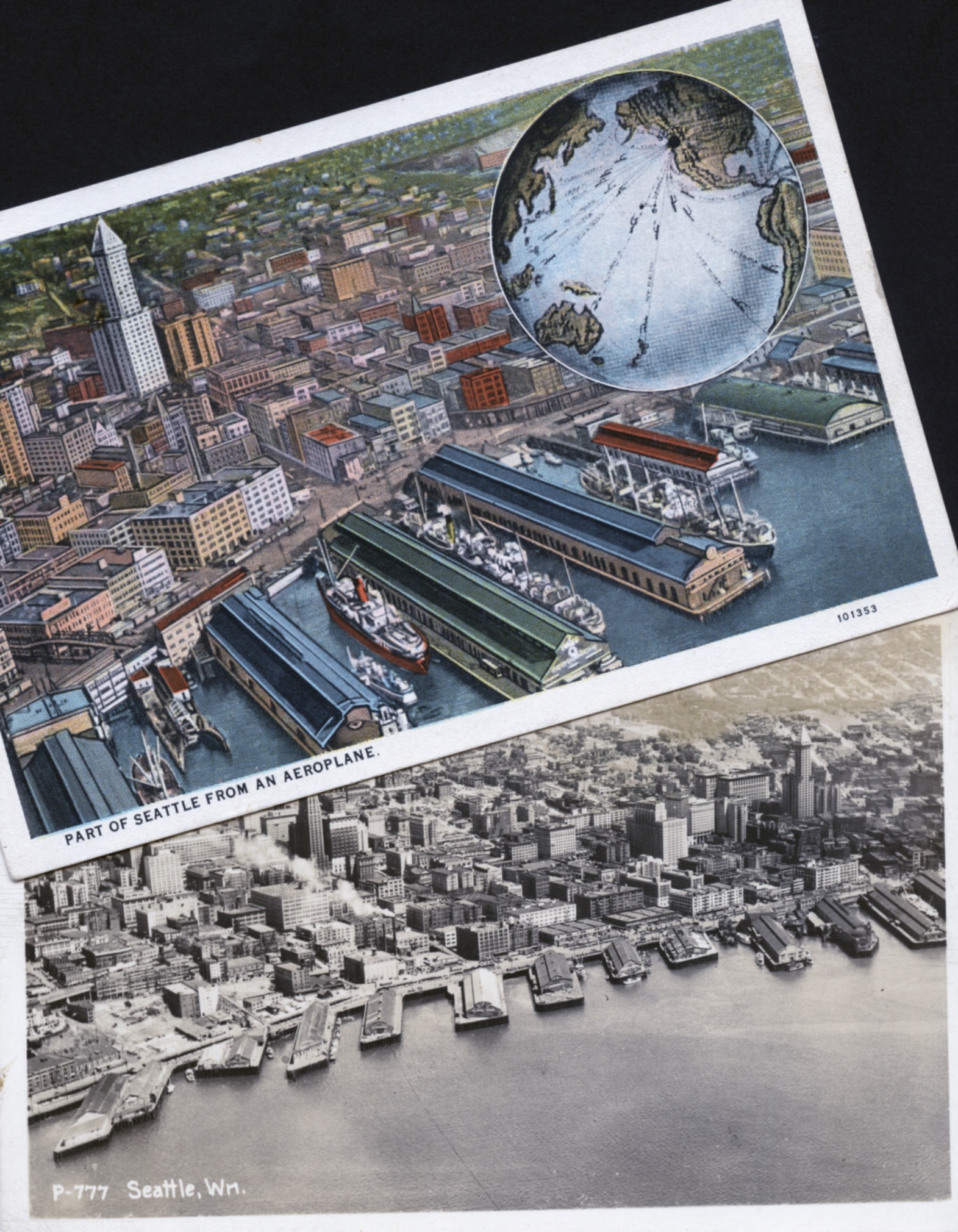
Seattle Terminal
The top postcard was postmarked in 1927.
Click the image to enlarge.


"When it comes to preferences of newsmen's beats, I stand pat with good-enough cards.
      I have pounded a few sidewalks and regard police stations, city halls, and politicians, as look-alikes.
      But there is only one Port of Seattle.
      Besides, I can get away from my desk. Most of the action is in Seattle Harbor. But it also ranges from San Diego to the Aleutians and from Elliott Bay to the Far East.
      When somebody growls that I have missed a story, I remind him it is a big ocean out there and I cannot cover every square foot of it thoroughly. So far, so good.
      Of course, I don't cover the maritime beat alone. Hundreds of persons are involved, and there are valuable mechanical aids. My most prized is the telephone. Not to mention reference books, nautical charts, ship registers, the Marine Exchange, Coast Guard, and Navy public information, teletypes, periodicals, trade papers, and hundreds of phone numbers of who's what in the Pacific Northwest maritime business.
      

      Ask me the water depth of any place in Puget Sound. I will tell you after consulting my nautical charts near at hand. Tide books are in my desk drawer. A Port of Seattle map of piers is on the wall.
      Among my handy-dandy aids is a volume listing all American-flag merchant ships, their owners, home ports, and radio call letters. Also the length, tonnage, and horsepower of each. I know what phone number to dial to learn about ships of foreign nations.
      Ships' tonnage? There are six kinds. Please don't ask me why, but I can read them to you.
      lf you are beginning to surmise that I am not a walking encyclopedia, you are right. I don't burden my memory files with data that can be stowed and plucked from drawers and cabinets.

The bottom postcard was postmarked from 
Seattle in 1952 by a Capt. Jim ______.
Click image to enlarge.


      Bend this way a little closer, gentle reader, and I will whisper some trade secrets. Call it the confessions of a professional waterfront chronicler.
      One challenge I've grown to accept is Seattle's legion of ship-watchers. They spot odd-looking vessels out their windows and phone inquiries to me. The way to identify a passing steamship through binoculars is by the insignia on its stack. I find its listed company if the caller describes the insignia. The chart near my desk shows symbols of nearly all foreign and domestic steamship lines operating on the West Coast. Once the ship's owner is known, my books tell me what agency in Seattle represents that line. I phone the agent and ask what ship is incoming or due.
      Without helpful agents, maritime news would be dreadfully tepid. Ask a savvy agent the ship's length, tonnage, number of crewmen, nationality, captain's name, engine horsepower, and what cargo is aboard. He knows--after consulting documents.
      Ask me how much wheat is going to be shipped from Seattle this week, and I will tell you--thanks to the right phone number at the Pier 86 grain terminal.
      No brag, just fact.
      People on learning I am a maritime editor suggest that I probably meet a lot of interesting people. I usually concur but add that I hear an awful lot more phone voices.
      Keeping track of merchant-ship traffic in Puget Sound is easy. Estimated times of arrival are available a month in advance.
      If a strange-looking ship is being towed in Puget Sound, I ask the phone caller for the colors of the tug. If its stack is red, I phone the radio dispatcher at Puget Sound Tug & Barge. If the tug is green and white, I dial Foss Launch & Tug.
      Depending on the tug's colors, I phone Puget Sound Freight, American Tug Boat Co., Northland Marine, Pacific Inland Navigation, Washington Tug, Fremont Tugboat. That failing, I fall back and punt.
       My trusty phone and filing cabinets are like a security blanket. I take on all comers. But I'm susceptible to shut-in cabin fever and do get outside for some salt air.

The top photo card with the Sightseer at Pier 54
was postmarked from Seattle in 1949.


       Once I rode a tug to Alaska and back. Also, an Alaska ferry to Skagway, and a train-ship from British Columbia to beautiful downtown Whittier, AK. I usually average one night a year aboard a commercial gillnetter in Puget Sound. On Monday, my day off, I usually am tending my own boat moored in the Lake Washington Ship Canal.
      Despite attempted vigilance, I've missed the last three major ship mishaps within view of my residential neighborhood. When the Sirius caught fire and capsized, I had the day off. A tanker exploded within view of my living room while I was on vacation.
      On the last day of the same vacation, the big Sugar Islander ran aground only blocks away. I sauntered over and gazed down at it from Magnolia Bluff.
      Embarrassing for a pro.
      I vowed never again to miss another major fire, explosion, capsizing, or grounding. My chance to atone happened at 2 o'clock one Monday morning--again my day off. But the dock foreman who rousted me out of bed said it looked pretty serious. Two men hospitalized. Flames shooting.
      Again, it was visible through my living-room window. I jumped into my car and sped toward the scene--only to be stopped by police for traffic violations. I got to the scene after the fire was out but interviewed some soot-smeared crewmen. The fire could have been disastrous but wasn't.
      Spectaculars come and go, but long-ago ships in men's minds go on forever. Mention some famous old Seattle freighter in a line of type, and my telephone rings. I get mail.
      One thing leads to another, and I am knee-deep in Puget Sound maritime history. I have in my home library perhaps 20 volumes on maritime events of yesteryear. The most valuable, to me, is the massive and fact-jammed H.W. McCurdy's Marine History of the Pacific Northwest. Another hundred or so are on various nautical subjects.
      But telephone voices are my best friends. I give information and receive it. If anybody cares enough to write to me about something, I take time willingly, to type or pen an answer.
      Sundays and Mondays are my days off. Weather permitting, I'm usually making the rounds of waterfront haunts where men earn their wages but have time to chat briefly. Either that or I'm working aboard my old gaff-rigged sloop or cruising in it.
      All of which is a roundabout way of saying that a man should enjoy his work but not take it home with him, which I don't. It's 50-50 and two-way on the best news job in town."
      Mr. Carter began work at the Seattle Times in 1967 and became marine editor in 1970. He retired in the 1980s to Carousel, his 38-ft Ingrid sailboat with the motto-- 
"If you live on the water, you'll live forever."
      This essay is an extract from his book My Waterfront published by Seagull Books Co., 1977. 


19 August 2020

❖ Champion of Gallant Tradition ❖ with Ralph Andrews


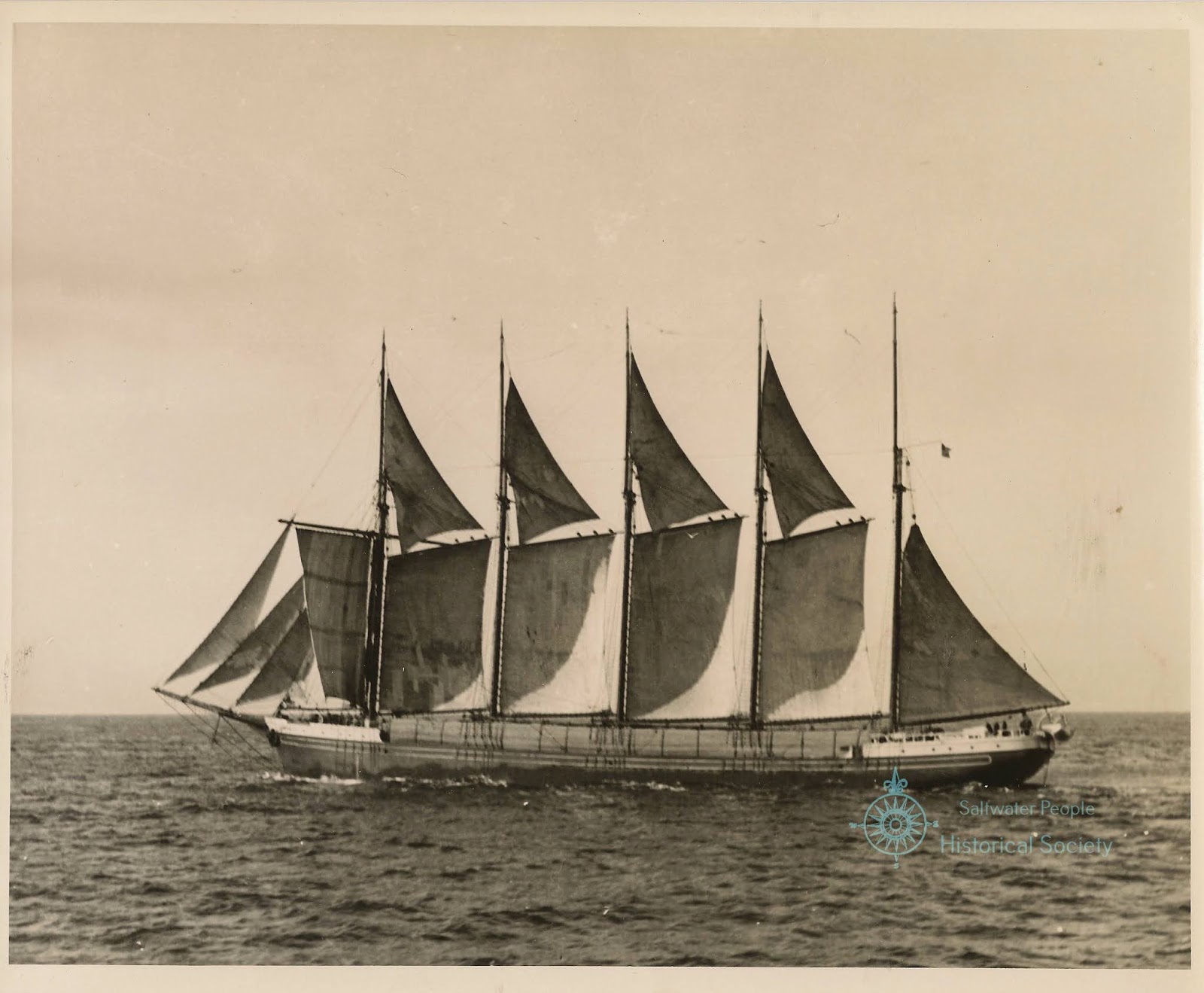
Schooner VIGILANT
Skippered by the famous Capt. Matt Peasley
and later by Capt. Charles H. Mellberg.
From the archives of the
Saltwater People Historical Society©
Her five masts standing as staunch monuments to sea trade of a past era, the sturdy schooner VIGILANT was last of the sailing ships regularly engaged in commerce between Hawaii and the Pacific coast.
      "Owned by the City Mill Company of Honolulu, the vessel is employed every summer to transport millions of feet of lumber from the Pacific Northwest to Hawaii. When she rounds Diamond Head with her sails filled and her big sticks straining, she's a proud sight that makes Hawaii forget for the moment that this is an age of clipper planes and trim motor freighters.

Capt. Charles H. Mellberg
Photo dated 1932.
Click image to enlarge.

Photo from the archives of the 
Saltwater People Historical Society©
      Freshly painted after a year of idleness in Bellingham, Washington, she arrived in Honolulu recently 25 days out of Puget Sound. Her master, Capt. Charles Mellberg, reported an uneventful crossing distinguished by unusually favorable winds, which carried her along steadily for most of the distance and promised for a time to assist her in beating her best previous record of 17 days. But as she neared the islands the breezes withdrew their aid and teased her into port with occasional puffs. For one crossing last year from Bellingham to Honolulu she took 55 days.
      

Capt. Matt Peasley
Dated 1929.
Original photo from the archives of the
Saltwater People Historical Society©
      Honolulu waterfront men remember the days when Capt. Matt Peasley, original of Peter B. Kyne's 'Cappy Ricks' stories, used to bring the schooner into port. Old-timers remember, too, the friendly rivalry between the Vigilant and the Commodore, now shorn of her masts and used as an Alaskan oil barge.
      Still fresh in the memories of many local waterfront observers is the race from Honolulu to Seattle in which these two gallant vessels engaged in November 1931. The COMMODORE departed from Hawaii for the Sound November 20 of that year. She made fair progress; was comfortably on her way when the VIGILANT sailed for the same destination six days later.
      Favorable winds carried the COMMODORE straight up to the Strait of Juan de Fuca, where they dropped her like a punctured balloon and left her to icy winter squalls and tricky currents. She was taken in tow by tugs dispatched to her assistance. But before she could be brought into peaceful sound waters a storm caught her, broke the two lines, and drove her out to sea. The VIGILANT which had trailed her by more than 1400 miles up to that time, skirted the storm and scudded triumphantly into the Sound to be declared the official winner."
Ralph Andrews. This was Seafaring. Seattle. Superior Publishing. 1955
      

09 August 2020

❖ DEADMAN BAY ❖ SAN JUAN ISLAND


Deadman Bay, San Juan Island,
San Juan Archipelago, Washington.
Photo by Ellis. Undated.
Click photo to enlarge.

Original photo postcard from the collection of
the Saltwater People Log©
"This small bay, under Mt. Dallas, was earlier called Deadman's Bay, Dead Man's Bay, and Dead-Man's Bay. In accordance with general practice, the possessive form was gradually dropped by cartographers, probably for simplicity, and to save space by shortening names on the charts. Edmond S. Meany states: 'It is claimed that the first white man known to have died on the island was buried there. He was a working man killed by a cook.' Meany does not identify his source. Walter Arend, retired postmaster at Friday Harbor, considers that this local name probably was used to identify the place where a man's body had drifted ashore. However, Etta Egeland states that an unnamed white man criticized a Chinese cook at the Lime Kiln, who killed him with a knife. The Chinese was aided to escape from San Juan Island by a farmer named Bailer, who hid him in a wagon until he found a vessel that was leaving from Friday Harbor. This occurred about 1890, and indicates the state of law enforcement on that island at the time."

Bryce Wood. San Juan Island Coastal Place Names and Cartographic Nomenclature. Published in Ann Arbor, Michigan for Washington State Historical Society by University Microfilms International. 1980.

04 August 2020

❖ Scratching the Beach with the MARTIN D


MARTIN D 
Working in Alaska.

Photo courtesy of Keith Sternberg.
"My philosophy is to forge ahead whatever the state of the tide. Perhaps this is derived from my log towing days. 
      Sometimes we scratched along the beach, as close as we dared, to avoid the current and might get into a back eddy. I was in log-towing tugs in Alaska and Puget Sound. Samson Tug & Barge in Sitka towed pulp logs to the mill at Sitka and saw logs to a mill in Wrangell. The sawlog tows were Sitka spruce and Alaska yellow cedar. These were made up as very large tows, 72 sections, with all five of the company tugs pulling. 
      Nearing Petersburg the tow was broken up into small units and towed through Wrangell Narrows. The tug in which I was mate, was the MARTIN D, originally a US Army ST built during WWII. She had a direct-reversible Busch-Sulzer diesel engine which turned 380 rpm at full-ahead. 


Mate Keith Sternberg
MARTIN D,
Alaska.
Photo courtesy of Keith Sternberg.

On the MARTIN D, I stood the midnight to 6 A.M. watch alone, usually
towing logs at about one knot. With the pilothouse stool under a
spoke of the wheel she would hold course fairly well while I went
below to oil the engine's rocker arms every two hours and have a look
around the engine room."

Submitted by Keith Sternberg, Lopez Island, WA.

Please see a reader's comment below.

07 July 2020

❖ Sluckus from the Upper Islands ❖ with June Burn.


San Juan Archipelago
including Spieden Island where the author
June Burn homesteaded with Fararr Burn.

This card courtesy of publisher Smith-Western Co, Tacoma, WA.©
from the archives of the Saltwater People Log.
Apologies for taking so long to coax June Burn back to share another of her soothing stories through the northern islands she knew so well. 
   
      "The little group of upper San Juans around the Canadian line is a favorite resort of the Natives. They can find as much employment as they want cutting cordwood in the winter, fishing in the summer, and resting a good deal between jobs. The Native women lead lives of purest romance and maybe you think they don’t know it! My neighbor, who employs them off and on his farms, will admonish a wife of one of his workmen, urging her to stay at home more and prepare suitable food for her husband who is working hard at the wood cutting. He doesn’t make any progress to speak of! She will grunt, maybe smile sheepishly, maybe even make some sort of reply. But she won’t stay at home and cook. Not she!
      Early in the morning of a day sunny or gray–– what difference does the weather make?–– Native women can be seen out trolling up and down the channels. A woman-full dugout canoe rowed, maybe, by one little 6-year old boy and his 7-year old sister, will glide around the point, head in to the beach for no apparent reason, and deposit its entire human load. Perhaps to go berrying with little buckets and cedar bark baskets. Maybe they will gather sluckus if the tide is out (sluckus is a narrow, long, leaf-like sea plant that grows on the rocks and which may be gathered at low tide on most of the rocky beaches. I believe it is sea lettuce, though am not sure.) They may build a small fire and boil something or other in curious kettles. They may only sit around and talk or hunt agates among the various colored gravel of the beautiful beaches. I wish I did know what their comings and goings mean.
      Right now, I see Old Katherine, fat Isaac’s wife, sitting up on a yellow grass bank hunkered over her knitting tending a miniature campfire. Her colorful washing of blue work shirts and pink petticoats flaps on a line behind her. The youngest born of one of the women out fishing in a nearby channel lies in a little box near Katherine. She is “minding! it. And meanwhile of what is she thinking? Neat and tidy is Katherine and something of a leader among them, I think, though there again I am on unsure ground.
      I’ve grown so accustomed to seeing the Natives around the islands I know best that it wouldn’t be coming home if they were not here now. Stewart Island’s nearness to the Canadian border keeps them here. They sell their sluckus in Victoria, whence it is shipped to China for soup. They get 10 and 15 cents a pound for it dried and sometimes return to America with 30 or $40 worth of gaily painted washpans, calico, outing flannel, fancy china, and who knows what all else stowed away in their cedar dugouts. Relatives live on the Canadian side, also, which keeps them visiting back and forth across the line. Further down the islands one hardly ever sees a Native save as their dugouts or motor launches pass back and forth in the channels.
      Once, when the boys and I were summering on Johns Island, General and his family, with old Isaac and Katherine, decided to go up to the Sucia Islands to gather sluckus. General came up to my cabin to ask me to take care of his chickens while he was gone. I promised, but later discovered he had taken them with him, fearful, perhaps, that I might forget to look after them a mile down the island from me.
      They pulled out early one morning on a fair tide around my end of Johns Island out into the channel towards the Sucias. In General’s thirty-foot dugout five people sat on the bottom of the boat or on thin narrow slats across the edge. Besides the family, there were two boxes of chickens, one of a hen setting on her eggs and the other of the hen whose five chicks had just hatched. There were tents and bedding, cooking things, and boxes of food, a crippled lamb donated by Spieden to be killed for food, every personal belonging of both women of the family, and sacks in which to gather the sluckus. It was the fullest boat ever I saw. And to top it all, in the bottom there lay the flat rocks on which they would build their little campfire in mid-channel and cook their food in the boat while it was moving along.
      Two weeks later the family returned, General who had done the bulk of the rowing, looking thinner than ever and very hungry. They had got a hundred pounds of sluckus for which they would receive a fourth of what they would have made if they had stopped at home and cut cordwood. But that was not the point. Gathering sluckus to sell for lots of money was only an excuse. Romance was the main crop, although they did not know it. They perhaps don’t bother to say in words what it is that drives them through terrific tides after little dabs of sluckus or clams or fish and it may be that they don’t question themselves at all. But I’ll bet old Isaac could phrase it if he chose!
      Hello, high bluffs of Spieden! This long mountain ridge up thrust high and steep above the water is the first island we knew. Its people neighbored and fed and transported us in homesteading days. The very tip of the three-mile-long island was itself, homesteaded many years ago by a naturalized soldier from the English Camp, Robert Smith. To have climbed so high to find his perch proves that he loved hard things. It is his daughter who lives there now, never having known another home. She has running water and electric lights now and radio and piano and automobile and boats and wealth. But the marvelous scape of sea and island and sky and snowcapped mountains from the top of Speiden is what holds her there. See you tomorrow. June."
June Burn. Puget Soundings. The Bellingham Herald. 26 October 1929.

Archived Log Entries