"The Cure for Everything is Saltwater, Sweat, Tears, or the Sea."

About Us

My photo
San Juan Archipelago, Washington State, United States
A society formed in 2009 for the purpose of collecting, preserving, celebrating, and disseminating the maritime history of the San Juan Islands and northern Puget Sound area. Check this log for tales from out-of-print publications as well as from members and friends. There are circa 750, often long entries, on a broad range of maritime topics; there are search aids at the bottom of the log. Please ask for permission to use any photo posted on this site. Thank you.

17 December 2020

❖ Washington State Board on Geographic Names ❖


The San Juan Archipelago.
The county of San Juan is  
the smallest in
Washington State by land area.
Click image to enlarge.
    

SAN JUAN ISLANDS

"This name, long accepted in popular usage, has finally appeared on NOAA chart 18400 (ex-6300) written vertically through Orcas and Lopez Islands. The Washington State Board on Geographic Names, at its meeting of March 14, 1979, confirmed "San Juan Islands" as the name for the area, and rejected both "Quimper Sound" and "Washington Sound" as names identifying the whole body of water in which the islands lie.

      Subsequently, an issue arose before the Board as to the proper application of the term "San Juan Islands," in the form of a request that "the Board reviews its decision to confine the "San Juan Islands" to those islands within San Juan County." Minutes of the Board, March 14, 1979. At the meeting of the Board on June 22, 1979, the Acting Chairman, Robert Hitchman, commented that the critical feature in any such decision would be the "usage" of the term by persons in the area of the islands. the Board accepted the present author's offer to attempt to determine such usage, and a report was written and distributed in advance of the Board's September meeting.

      Specifically, the aim of the request was to include in "San Juan Islands" those islands, or some of them, that lie to the east of Rosario Strait, principally Guemes, Cypress, and Sinclair islands, although Lummi, Vendovi, Fidalgo, Allen, and Burrows islands might also be included.

      The report, entitled "Usage of the Term 'The San Juan Islands,'" found that, in the view of historical societies in the islands, and in the opinions of real estate dealers and newspaper figures, there was near unanimity that no change should be made in the current designation that limited the San Juan Islands to those west of Rosario Strait. The Board, at its September 1979 meeting, approved the report and decided against any change in the coverage of "San Juan Islands" on the charts."

Text by small craft mariner Bryce Wood.
Formerly of San Juan Island.
Coastal Place Names and Cartographic Nomenclature
1980. Published for the Washington State Historical Society.

14 December 2020

❖ MOSQUITO MONDAY~~~ THE RELIANCE ❖


Steamer Reliance  
Kitsap County Transportation Company 
Verso dated 17 April 1913.
During this time she was busily employed 
in transporting logging machinery, horses,
and wagons from Seattle.
On the summer schedule, Capt. Charles Wallace
provided two round trips per day to Harper,
Colby, and Manchester, five days per week and 
three trips on weekends. Just before her busy season,
she went into drydock for her annual overhaul.
Click image to enlarge.
Original photo from the archives of the
Saltwater People Historical Society© 

 The Reliance Pitches and Rolls into Puget Sound, 1900

As told to Captain Torger "Tom" Birkland
by Captain Chris Moe.


"In 1889, the steamboat service to Poulsbo was not satisfactory. We felt that a bigger, faster boat should be on the run to take care of the fast increasing population. The steamer Dauntless on the Seattle-Tacoma via Vashon Island run was available, so we bought her for the home run by the east side of Bainbridge Island, taking in several way ports. We soon bought out the opposition boat, and the business increased to a point where the Dauntless became too small.
      The Oregon Railway & Navigation Co., of Portland, had a fast and larger boat for sale. This boat was built in 1899 for the upper Columbia River run between Portland and the Dalles and was very speedy with a larger capacity for passengers and freight. Andrew and I went to Portland to look at this vessel, and after a thorough inspection found her to be practically new and in excellent condition. We returned home with a favorable report so father went to Portland and prepared to close the deal, which he did after first telling the OR & N the vessel was of flimsy construction, and not worth the price which they asked. He then made an offer of several thousands of dollars less, which was finally accepted and we made plans for bringing our new ship home.
      I immediately went to Portland to supervise the job of preparing the little boat for the deep-sea voyage from the Columbia River to Puget Sound. The deckhouse was braced and re-enforced, the windows boarded up, the smokestack well-secured and everything lashed down.
      We departed from Portland on 8 September 1900, with a crew of two sailors, two firemen, two engineers, two mates, and Captain George Tyler in command. We arrived at Astoria on the evening of the 9th. For the next two days, the bar was too rough to cross, and this delay presented an opportunity for some of our thirsty crew members to go uptown, come back drunk and demand more money for liquor. This caused no end of trouble. Instead of money, we gave them meal tickets, which they pawned for liquor. We finally managed to get them all aboard at one time, and cast off the lines to get away.
      On September 12th, at 5:00 we crossed the bar. The first few violent rolls broke the water lines. Losing all our freshwater, it was necessary to use saltwater in the boilers. The seas broke over the superstructure and flooded the engine room to a point where there was danger of it putting out the fires. The engineer was worried about the saltwater in the boilers but there was nothing we could do about it. The brave little steamer rolled, twisted, and pitched along the Oregon and Washington coast until Cape Flattery was reached on the morning of September 13th. What a welcome sight was the faint flash of the Tatoosh Island light when first sighted by the anxious mariners that morning at 4:00 AM.
      With the boilers full of saltwater, progress was slow. It was noon before we finally rounded Cape Flattery and set our course up Juan de Fuca Strait. The chief engineer said he would try to make Clallam, hoping that there we could replenish our completely exhausted water supply. If not, the boat would have to stay at the dock! 
      Forest fires were raging and every man and boy in this community were out firefighting, and no one could be found to haul water to the dock for us. And now, to add to our already troubled minds, the heavy ground swell rolling in from the ocean kept the vessel surging on the lines to a point of eventually parting or pulling out the bitts.
      The following day on her regular run from Neah Bay and way stops to Seattle, the steamer Alice Gertrude came in. I boarded the vessel for a ride to Port Angeles to get a tug to tow our disabled ship to that city. The tugboat Katy was available and we departed for Clallam. All went well until a few miles west of Ediz Hook when she broke down. After temporary repairs, the captain hauled around and went back to the Port Angeles dock and tied her up. That was the end of that.
      What to do next? Constantly worrying about our boat, I boarded the next regular steamer for Clallam. There was not much else I could do as all means of communication with Seattle were broken down and word could not be sent through for a tug from there. On our arrival at Clallam we found the boat missing. I thought "the worst has happened--the lines must have parted and she's gone adrift." The man in charge of the dock had no idea of what had happened; all he knew was that a steamboat had disappeared. I could do nothing but remain aboard for the long run to Neah Bay and back to Port Angeles. It was a disagreeable trip. The smoke in the straits hung over the water like a dense fog and being uneasy and restless, I was pacing the deck with the man on watch most of the way. 
      But a pleasant surprise was in store! About the first thing I did see through the haze was the Reliance snugly tied up at the dock, with steam up and ready to go. I learned that the tug Tyee had stopped in at Clallam and our captain asked for a tow into Port Angeles. All this took place during the night, and in the dense smoke and fog, our ships passed unnoticed.
      But we were on our way home at last. During all this time since we left Astoria I had not had a wink of sleep, so no wonder when nearing our destination, I fell asleep. After what seemed only a few minutes I was wakened and told the boat was hard aground on some unknown beach and the tide was ebbing. The captain was going around in a drunken stupor and had no idea of where we were, so now it was all up to me. Realizing the danger of the vessel taking an out-board list and turning on its side and filling with water, I ordered the shore side lifeboats lowered and filled with water to give the vessel an inboard list. Then we waited for the tide to turn.
      With the captain sound asleep in his bunk, we once again got underway. As nearly as I could figure we were somewhere between Jefferson Head and Agate Pass, and by the echoes, we navigated the Reliance home to Poulsbo with no more mishaps arriving home on a Sunday morning just in time for church--where I fell asleep, and that's the truth."
Courtesy of The Sea Chest membership journal, 
Vol. 1, No. 1, September 1967
Puget Sound Maritime Society, Seattle, WA.

~~~~~~~~~~~~~~~~~~~~~~~~~~~~~~~~~~~~~~~~~~

Sometimes, when known, we list some of the "other" officers and crew of a featured vessel, not part of the story presented, but part of the past life of the vessel. 
From Roland Carey's, The Sound of Steamers; pages 102-109, Seattle; 1965, we learn of Chief Roy H. Kimmel. (Abridged.)

      "Many a young man, during the bygone era of steamboating, earned his first wages working on a Sound steamer. Those lessons in resourcefulness, loyalty, and reliability were invaluable in later life and some men carried skills from Puget Sound to the wide waters of the world. 
      Such a man was Roy H. Kimmel (born on Vashon Island, 1891), who began steamboating at the age of 18, as fireman for Robert McDowell. Next, he worked for the Vashon Navigation Co., on several of their vessels, including the steamer RELIANCE, featured in the above writing by Capt. Birkland. Kimmel became Chief Engineer in 1918 on the RELIANCE. In 1922 he returned to Inland Transportation Co as chief engineer on the CALISTA. He had been back on the CALISTA but one day, on 27 July 1922, for her Seattle-Whidbey Island route. The fog became thick at the north entrance to Seattle harbor. On this day the CALISTA in command of Capt. Barlett Lovejoy was hit by the big Japanese liner HAWAII MARU. Chief Kimmel and all crew and passengers were saved before the CALISTA went to the bottom 28 minutes later. 
       During WW II, Kimmel carried his skill into the Pacific. In Nov. 1943, he was first assistant engineer on the Liberty Ship JOHN P. GAINES when the vessel with crew, Navy gun crew, and Army passengers, were battered with their ship broken in two by a hurricane 100 miles off the Alaskan coast. Everyone was rescued. 


Liberty Ship John Burke
Built by Oregon Shipbuilding Co.
Launched at Portland, 15 Dec. 1942.
422.10' x 57.0' x 27.10'
Two oil-fired boilers, 
triple expansion, reciprocating steam engine, 
single screw.
In this photo the John Burke is NW
of Vancouver Island, B.C, May 1944.
She was lost Philippines, 28 Dec. 1944
Complement: 40 crew & 28 Armed Guard.


      One year later chief engineer Kimmel was on the Liberty Ship JOHN BURKE, carrying ammunition to troops fighting in the Philippine Island of Mindoro. The ship, commanded by Capt. Herbert A. Falk, was part of a big supply convoy coming up from Leyte Gulf with manpower and material for airfield construction. The convoy was screened by nine destroyers. Japanese air forces attacked at dawn, morning, noon, dusk, and night. The pilots were well briefed, for they knew which ships in the convoy carried vital cargo. Kamikaze fighters made a direct hit on the BURKE and the explosive charge in the fighter mingled with the explosives in the ship's hold. 
      A tremendous flash was followed by an enormous white cloud covering an area of several thousand yards. When the cloud cleared, it was as though the BURKE had never been. As she sank to the depths of Mindanao Sea, other ships in the vicinity felt a severe underwater explosion, the last defiant growl of a vessel that went down with all hands." 

The BURKE had departed Seattle in late 1944 for Guam where she spent several days loading munitions for the invasion force on the island of Mindoro. BURKE then departed with the 100-ship "Uncle Plus 13" convoy, bound for Leyte in the Philippines. The JOHN BURKE fragments lie 1,500-ft below the surface in the strait between Negros, Siquijor Islands and Dapitan, Mindanao, Philippines. 

09 December 2020

❖ THE FOUR-MASTER FORESTER ❖


Schooner Forester
217' x 32' x 13.6' 
Launched 10 Nov. 1900 at
 at Hay & Wright Yard,
Alameda, CA.
Click image to enlarge.
She came to Penn's Cove, Whidbey Island
to transport mining props to Mexico,
ca. the 1920s, as noted on verso of photo.
Original from the archives
of Saltwater People Historical Society©


A Rainy Afternoon aboard the Forester


"A couple of months ago, I took the family for a ride. We crossed the bay from Marin County on the San Quentin ferry, drove along the Sacramento highway to Pinole, and then to Martinez. Crossing Carquinez Strait on the Benicia ferry, you could look back and see her lying in the sedge of the tidelands, a little west of Martinez town.
      The skipper of the ferry was a jovial man named Captain Jansen, a Cape Codder by birth and on the Benicia ferry run since the early 20s. Above the wind that whipped through the strait, I shouted through the open window of the wheelhouse and asked him what she was.
      'Lumber schooner. Been tied up there for years. Go over and talk to her skipper sometime. He lives on board.'
      'Thanks,' I replied. 'I will.'
      The other day, I drove back to Martinez, crossed the railroad tracks, and bumped and swayed down a wet, muddy road. I parked the car as close to the schooner as the road would take me and struck off on a path across the flats toward the water's edge. a cold, west wind was blowing, driving the rain clouds up from San Pablo Bay and piling them up in the sky to the east. The path ended in a narrow plank walk leading out over the water to the side of the ship, and the walk ended at a locked door on which was the sign, 'Beware of the dog.' I pushed the bell button and waited.
      A few minutes later, Captain Otto Daeweritz, skipper of the schooner Forester, led the way down into the after cabin of the ship. 'One thing,' he said over his shoulder, 'I'm not bothered by noisy neighbors.'
      He was a short, stocky man, coatless in spite of the cold, and wearing a knitted sailor's cap. He had started going to sea in 1879, was 83, and like most men who have lived alone for many years, reluctant to talk about himself or his life. 
      Captain Daeweritz made his puppy lie down, got out some old photographs, and told me about his ship. She was launched 10 November 1900, at the Hay & Wright yards in Alameda, and as far as he knows is the only four-master left in the Bay Area. She went immediately into the offshore lumber trade for the San Francisco exporting firm of Sanders and Kirchmann. Captain Daeweritz, who was the only skipper she ever knew, had a financial interest in her too. 
      The Forester, one of Sanders & Kirchmann fleet of 16 schooners and barkentines, would take on a cargo of lumber in Oregon or Washington--the long, straight fir logs rising to a height of 15 feet on her narrow deck--and beat across the Pacific with it to ports in China or India or Australia. For the return trip, she'd pick up anything she could in the way of cargo, copra, mostly.
      'That's what she did until after WWI,' said Captain Daeweritz. 'Then, in the 1920s, business got bad. Copra, that had been $42 a ton, dropped to $10. And the Swedish and Norwegian steamers took all the lumber business away. They could make more trips and make them cheaper than we could.'
      When her day passed he bought out his partners' interest in the Forester and laid her up. From 1927 to 1931, she was anchored in the strait, protecting a pier of the Carquinez bridge from the swift-running tides. For the four years after that, she was in the Oakland estuary. And when Oakland port authorities told him he would have to move her, she was a menace to shipping there, he had her towed to those Martinez flats, and she's been there ever since.
      She makes a snug home for Capt. Daeweritz. She's wired for electricity, but has no water; he carries it onboard from shore and catches rainwater for washing purposes. In the tiny skylighted cabin off the sleeping quarters, there was the table at which we sat. On it were the paper he has been reading, a deck of cards and an ashtray from the Turquoise Room, Hotel Rosslyn, L.A. On the bulkhead over the table was a small painting of the Forester under full sail, done by an amateur, and the ship's original clock and barometer.
      There was a sudden patter of rain on the skylight, and the captain got up at once. 'Got to get my washing in,' he said. 'Should have had it in an hour ago.' I followed him up the companionway and onto the deck. He hurried forward, took down a few shirts and towels from the clothesline, and hung them up inside, over the stove in the galley.
      'What will happen to the Forester?' I asked.
      'I don't know,' he said. 'She probably will be burned up someday, like the rest of her kind. I'm the only friend she's got left.'
      We said good-bye a few minutes later, and he showed me over the side. The rain was coming in heavy gusts from the little gray sky. From the car, Benicia across the strait was dim in the low mist. The Forester, listing slightly to starboard, was dark against the green waters of the strait, and her four masts leaned dark against the sky."

Robert O'Brien. Published by the San Francisco Chronicle, 1947. 


SCHOONER FORESTER
in the mud with Captain Otto.

Forester Facts:

Cost to build; $60,000

Captain Otto A. Daeweritz, born in Czechoslovakia, was the Forester's only master. He came to San Francisco in the 1890s and received his captain's papers at the age of 24. He helped design the schooner and had two partners until 1927 when he bought them out. He lived on the ship with his faithful companion, the bulldog, Texas, until his death in 1947. 

Charles "Charlie" J. Fitzgerald moved aboard the ship in 1948, purchased it in 1950 for $90, and settled in, trying to preserve and protect the Forester from vandals and souvenir hunters.

In 1962, a crew from the San Francisco Maritime Museum dismantled parts of the ship and put them in an interpretive display at the museum.

On 18 June 1975, a fire swept through the Forester. It burned almost to the waterline.

Forester Facts courtesy of the Martinez Historical Society, CA.

07 December 2020

❖ Monday Night Mosquitos ❖

The COLUMBIA RIVER STERNWHEELER--A TYPE
Written by Fritz Timmen
Blow for the Landing
Caxton Printers, Ltd. 1973.

WAUNA
The low, powerful lines of a sternwheel towboat
are evident on Wauna of 1906. She was built
for Lake River log towing. She later handled
oil barges on the Willamette until her layup in 1937.
Original photo by James Turner from the archives of 
Saltwater People Historical Society©

"To the eye of many beholders, there was beauty in the Columbia River type sternwheeler. Her hull lines were graceful, clean, and shallow, and about five times longer than the beam. The slight dead-rise made for a flat deck. The lower deck was housed forward from the wheel, with the forward doors and those on the guards wide enough for freight or engine and boiler parts. Above was the cabin deck, with a wide, railed promenade all around, a central passenger lounge and dining room, and windowed saloons fore and aft. The upper, or hurricane deck, carried a texas, with crew cabins or passenger accommodations. Atop the texas and well forward was the pilothouse. This was the Holy of Holies, grandly occupied by the captain and pilot, with lesser mortals granted admission only by special dispensation. Three sides of the pilothouse bore gracefully carved name boards. Often fancy fretwork topped it all.
      Aft of the pilothouse rose the single stack. The kingpost soared amidships, flanked by at least four hog posts to which were secured the hog chains that keep the supple hull aligned. After 1870, the stern-wheel often was enclosed in a box on which appeared the craft's name and port of registry and which also served to keep spray off the passengers.
      The main deck forward was open for winches and capstans and cargo.
      Wood construction was favored, even after steel became available. The initial cost and upkeep of wooden hulls were cheaper. Damage repair was easy -- a soft patch spiked over a broken plank kept the boat afloat until it could reach the beach.
      For propulsion, early engineers preferred a high-pressure, non-condensing engine. Cylinder bores varied between ten and twenty-two inches and the piston stroke was six or seven feet, rarely more. Locomotive-type boilers had a working pressure of about one hundred pounds per square inch. Not until well after WW I did cross-compound engines appear. These engines transmitted relatively low but effective power to the wheel and so were often provided with a bypass valve to permit fast injection of live steam into the low-pressure boiler in case the pilot called for extra power in a hurry. A few tandem-compound power plants were built. Among these was the Henderson at the time of her 1929 rebuild.

Sternwheeler HENDERSON 
O.N. 93168
Here she is working in a film in 1952 as
the RIVER QUEEN.
Built by Shaver Transportation Co. in 1901
158.7' x 31.' x 7.5' 
The skipper this day was
Capt. Sidney J. "Happy" Harris.
She was burned for scrap in 1964.
More about her racing on the river
 can be seen
HERE


      A sleek, trim sternwheeler, moving grandly through a covey of noisy, bustling steam tugs, had a never-to-be-forgotten air about her whether she was a fast passenger packet or a towboat. Sure enough, they don't make 'em like that anymore."


29 November 2020

❖ TRICKS OF THE TRADE by Glen Carter (1923-2002) ❖


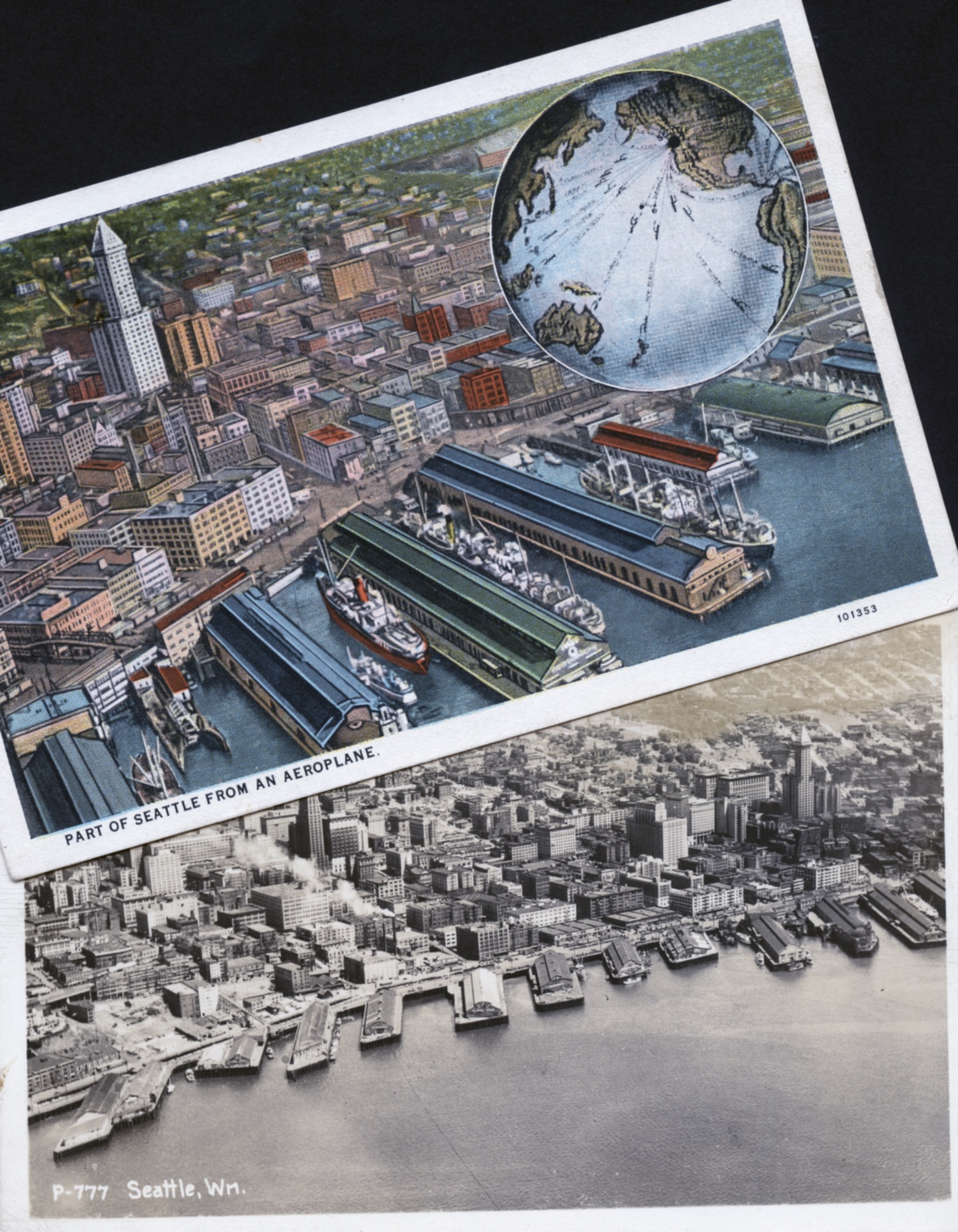
Seattle Terminal
The top postcard was postmarked in 1927.
Click the image to enlarge.


"When it comes to preferences of newsmen's beats, I stand pat with good-enough cards.
      I have pounded a few sidewalks and regard police stations, city halls, and politicians, as look-alikes.
      But there is only one Port of Seattle.
      Besides, I can get away from my desk. Most of the action is in Seattle Harbor. But it also ranges from San Diego to the Aleutians and from Elliott Bay to the Far East.
      When somebody growls that I have missed a story, I remind him it is a big ocean out there and I cannot cover every square foot of it thoroughly. So far, so good.
      Of course, I don't cover the maritime beat alone. Hundreds of persons are involved, and there are valuable mechanical aids. My most prized is the telephone. Not to mention reference books, nautical charts, ship registers, the Marine Exchange, Coast Guard, and Navy public information, teletypes, periodicals, trade papers, and hundreds of phone numbers of who's what in the Pacific Northwest maritime business.
      

      Ask me the water depth of any place in Puget Sound. I will tell you after consulting my nautical charts near at hand. Tide books are in my desk drawer. A Port of Seattle map of piers is on the wall.
      Among my handy-dandy aids is a volume listing all American-flag merchant ships, their owners, home ports, and radio call letters. Also the length, tonnage, and horsepower of each. I know what phone number to dial to learn about ships of foreign nations.
      Ships' tonnage? There are six kinds. Please don't ask me why, but I can read them to you.
      lf you are beginning to surmise that I am not a walking encyclopedia, you are right. I don't burden my memory files with data that can be stowed and plucked from drawers and cabinets.

The bottom postcard was postmarked from 
Seattle in 1952 by a Capt. Jim ______.
Click image to enlarge.


      Bend this way a little closer, gentle reader, and I will whisper some trade secrets. Call it the confessions of a professional waterfront chronicler.
      One challenge I've grown to accept is Seattle's legion of ship-watchers. They spot odd-looking vessels out their windows and phone inquiries to me. The way to identify a passing steamship through binoculars is by the insignia on its stack. I find its listed company if the caller describes the insignia. The chart near my desk shows symbols of nearly all foreign and domestic steamship lines operating on the West Coast. Once the ship's owner is known, my books tell me what agency in Seattle represents that line. I phone the agent and ask what ship is incoming or due.
      Without helpful agents, maritime news would be dreadfully tepid. Ask a savvy agent the ship's length, tonnage, number of crewmen, nationality, captain's name, engine horsepower, and what cargo is aboard. He knows--after consulting documents.
      Ask me how much wheat is going to be shipped from Seattle this week, and I will tell you--thanks to the right phone number at the Pier 86 grain terminal.
      No brag, just fact.
      People on learning I am a maritime editor suggest that I probably meet a lot of interesting people. I usually concur but add that I hear an awful lot more phone voices.
      Keeping track of merchant-ship traffic in Puget Sound is easy. Estimated times of arrival are available a month in advance.
      If a strange-looking ship is being towed in Puget Sound, I ask the phone caller for the colors of the tug. If its stack is red, I phone the radio dispatcher at Puget Sound Tug & Barge. If the tug is green and white, I dial Foss Launch & Tug.
      Depending on the tug's colors, I phone Puget Sound Freight, American Tug Boat Co., Northland Marine, Pacific Inland Navigation, Washington Tug, Fremont Tugboat. That failing, I fall back and punt.
       My trusty phone and filing cabinets are like a security blanket. I take on all comers. But I'm susceptible to shut-in cabin fever and do get outside for some salt air.

The top photo card with the Sightseer at Pier 54
was postmarked from Seattle in 1949.


       Once I rode a tug to Alaska and back. Also, an Alaska ferry to Skagway, and a train-ship from British Columbia to beautiful downtown Whittier, AK. I usually average one night a year aboard a commercial gillnetter in Puget Sound. On Monday, my day off, I usually am tending my own boat moored in the Lake Washington Ship Canal.
      Despite attempted vigilance, I've missed the last three major ship mishaps within view of my residential neighborhood. When the Sirius caught fire and capsized, I had the day off. A tanker exploded within view of my living room while I was on vacation.
      On the last day of the same vacation, the big Sugar Islander ran aground only blocks away. I sauntered over and gazed down at it from Magnolia Bluff.
      Embarrassing for a pro.
      I vowed never again to miss another major fire, explosion, capsizing, or grounding. My chance to atone happened at 2 o'clock one Monday morning--again my day off. But the dock foreman who rousted me out of bed said it looked pretty serious. Two men hospitalized. Flames shooting.
      Again, it was visible through my living-room window. I jumped into my car and sped toward the scene--only to be stopped by police for traffic violations. I got to the scene after the fire was out but interviewed some soot-smeared crewmen. The fire could have been disastrous but wasn't.
      Spectaculars come and go, but long-ago ships in men's minds go on forever. Mention some famous old Seattle freighter in a line of type, and my telephone rings. I get mail.
      One thing leads to another, and I am knee-deep in Puget Sound maritime history. I have in my home library perhaps 20 volumes on maritime events of yesteryear. The most valuable, to me, is the massive and fact-jammed H.W. McCurdy's Marine History of the Pacific Northwest. Another hundred or so are on various nautical subjects.
      But telephone voices are my best friends. I give information and receive it. If anybody cares enough to write to me about something, I take time willingly, to type or pen an answer.
      Sundays and Mondays are my days off. Weather permitting, I'm usually making the rounds of waterfront haunts where men earn their wages but have time to chat briefly. Either that or I'm working aboard my old gaff-rigged sloop or cruising in it.
      All of which is a roundabout way of saying that a man should enjoy his work but not take it home with him, which I don't. It's 50-50 and two-way on the best news job in town."
      Mr. Carter began work at the Seattle Times in 1967 and became marine editor in 1970. He retired in the 1980s to Carousel, his 38-ft Ingrid sailboat with the motto-- 
"If you live on the water, you'll live forever."
      This essay is an extract from his book My Waterfront published by Seagull Books Co., 1977. 


Archived Log Entries