"The Cure for Everything is Saltwater, Sweat, Tears, or the Sea."

About Us

My photo
San Juan Archipelago, Washington State, United States
A society formed in 2009 for the purpose of collecting, preserving, celebrating, and disseminating the maritime history of the San Juan Islands and northern Puget Sound area. Check this log for tales from out-of-print publications as well as from members and friends. There are circa 750, often long entries, on a broad range of maritime topics; there are search aids at the bottom of the log. Please ask for permission to use any photo posted on this site. Thank you.

28 December 2022

WRECK: LIBERTY SHIP GEORGE WALTON~~ 1950

 GEORGE WALTON

243051
Liberty Ship hull #0344
7,176 G.t. 4,380 N.t.
Built 1943, Savannah, Georgia. 422.8' x 57' x 34.8'
Lost to fire off WA. coast.
Died: 1 by explosion and 5 by drowning, according to McCurdy's.
Another source claims more died.
Capt. Alfred Bentsen


Liberty Ship GEORGE WALTON

Lost en route to India loaded
with a cargo of wheat.

Acme Wire Photo to US Coast Guard.
From the archives of the S.P.H.S.©

"The steamship GEORGE WALTON was swept by fire 390 miles off the WA coast on 6 Nov. 1950 as a result of a boiler explosion which killed Second Engineer Gus Larsen. Capt. Bentsen and the crew launched boats in heavy seas that capsized one of the boats. Five more members of the crew were drowned as a result of this accident. The Greek freighter KATHERINE picked up 12 survivors, the Japanese freighter KENKON MARU rescued 12 and the Coast Guard cutter WACHUSETT, six. The injured seamen were flown to Seattle hospitals, the remainder being landed at Port Angeles. The GEORGE WALTON, a Liberty ship, had departed Portland with 9,000 tons of grain for India. It was first assumed that the burned-out vessel would sink, but she maintained an even keel and, almost two weeks later, was towed to Puget Sound by the tug Barbara Foss. She was later scrapped."

Above quote from The H.W. McCurdy's Marine History of the P.N.W. Newell, Gordon, editor.

20 December 2022

LIME WORKS WITH JUNE : November 1929


Roche Harbor,
San Juan Archipelago, WA.
 The Lime Transport
moored to load barrels.
Click image to enlarge.
Original gelatin-silver photographs from 
the Saltwater People Historical  Society©

Puget Soundings
June Burn
Bellingham Herald, November 1929

"Five years ago and Capt. Wirstrom retired from the sea. He had sailed his last ship, kept his last watch, and tooted his last whistle in a pea-soup fog. He was going to farm for the rest of his life and take things easy far from the mad winds and the merciless reefs of rock out where no gentlemanly reef ought to be.
      Today, as you read this, Captain Wirstrom is probably down in Coos Bay, having navigated a boatload of lime rock from Roche Harbor, WA, to the paper mills of Empire City. For, when the call came, the old mariner found he could not resist it and so he sits again in what seems to me a lonely state in his captain's quarters aft, on the big Roche Harbor Lime Transport.
      On the northern tip of San Juan Island, two companies dig lime from hills full of the purest lime deposit in the world, they say. Moreover, there is said to be enough lime in those hills to last more than a century with both companies going for all they are worth. (It is my private opinion that in a hundred years they will have dug up the whole island at the rate they are going now.


Orcas Lime Company
Click image to enlarge.

"The Orcas Lime Co worked a small quarry 
just a few hundred yards south of the 
Roche Harbor deposit. 
It supplied its single kiln with 
limestone by means of rail carts pushed 
along on top of a long trestle.
That plant and dock were located on narrow
Mosquito Pass, also served by 
Puget Sound Freight Line boats.
When the quarry rock finally gave out 
in the mid-30s, this trim little competitor
 gave up the ghost and the land 
  became a sheep ranch."
Text from the Journal Jan. 2003.
Author unknown.

Roche Harbor, San Juan Island, WA.
Original gelatin-silver photograph from the 
archives of the Saltwater People Historical Society©


On the beautiful old Scurr place, the Orcas Lime Works dig out the fine, white angular rocks to be broken and burned in the kilns where they will become flaky snow-white lime for a score or uses.
      And against the curving hill slopes behind one of the prettier harbors in the world, Roche Harbor Lime Company digs and burns, and barrels are loaded on ships for places far and near.
      The fine long dock at Roche Harbor is piled with barrels upon barrels, four deep, all filled with lime ready for the boats. Sacks upon sacks of lime are stacked behind the barrels. The daily capacity of the works is 1,500 barrels.


Antique copper stencils 
once used to inscribe lime barrels  
shipping out to these destinations from
Roche Harbor Lime Co.
Now archived at the 
San Juan Island Historical Museum.
Stop by during their open hours
and visit their wonderful 
effort highlighting history of San Juan Island,
San Juan Archipelago, Washington.


Boats come and go, bringing in thousands of cords of wood to Roche Harbor, going out with tons and tons of lime from Roche Harbor. The little bay is lively with boats.
      Ten years ago we helped to dig rock out of those hills. That is, Farrar broke the rock and I watched him! I used to walk up the Clematis-covered banks, over the tiny railway to the high-walled quarries to watch the men with their big sledge hammers cracking the boulders, breaking off one corner after another, sometimes finding themselves faced with an almost round, unbreakable rock at the end if they weren't skilled. The game was to break them so that there would always be another angle left. Farrar used to say there was poetry in watching the rocks come down after the blast, in selecting one's boulder to conquer with sledge and muscle, in breaking it so skillfully that the last bit was so full of sharp angles as the original boulder had been.
      The Clematis on those banks was planted forty-three years ago on the birthday of Mr. McMillin's son. The original plant is now a hoary old vine several inches thick, crawling all over the place. And the progeny of that vine softens every nook and cranny of the hill. It is chiefly responsible for the beauty of the place as one comes in by boat.

Hotel de Haro
Roche Harbor, 
San Juan Archipelago, WA.

      Against the dark hill rising up from the harbor on the left, as one enters, are the white cottages of the laborers, the combination church and schoolhouse, with its spire, the vine-covered hotel, the Clematis banks, and the big flower garden coming down to the water's edge. The effect is incomparably lovely. If there were no lime there at all, and no industry, the dainty small harbor would still be a village for the sheer beauty of the location.
      But to get back to Captain Wirstrom: Several years ago the lime company bought a big sailing boat––a beautiful thing she is, with flowing robes riding her prow. For two or three years, the long slender six-masted schooner sat still in the harbor. She too has retired, maybe. Thought to ride the calm waters of a picturesque harbor for the rest of her days. But now she is to be used again. Stripped of three of her masts, part of them used now as cargo booms, she will haul lime rock down the coast to the new paper mills at Empire City in Coos Bay.
      La Escocesa (Scotch Maid) was built in 1868 in Dundee, Scotland. She ran as a steamship between England and India. Later her name was changed to Coalinga and she was used in the carrying trade, whatever that means. Freight, I suppose. Finally, the Alaska Packers bought her, changed her name once more to Star of Chile, and used her as a sort of floating cannery in Alaska. Now she is the Roche Harbor Lime Transport barge and once more a "carrier" of things.
      Of iron her hull--thick plates of Swedish iron--and of her iron spirit, else she would never have lived out the seas which have broken over her in every sea in the world. And perhaps there is some iron in the spirit of her new captain that he comes from retirement to pilot a "barge." She doesn't look like a barge, certainly, with her trim lines and the three masts rising so fine and tall. But she is to be towed, sailing only when there is sufficient wind to make the use of her small canvas, worthwhile, and so she must now be called a barge, though her captain doesn't like it.
      Here comes my boat to take me to another island! I had thought to have dinner in the attractive hotel here and the soft-voiced Japanese boy is just serving the salad, but I must run. There will be a sunset on the channel as we chug across the island's dark shadow against the bright waters. See you tomorrow. June. "


10 December 2022

PULLING 250 MILES EACH SUMMER –– FOR FIFTY-ONE YEARS


Arthur O. McCormick,
Rowed the San Juan Archipelago 
for 250 miles every August.
His vacations were enjoyed for
fifty-one years in his 15' boat.
He passed at age 81, in Seattle, WA. 
Gelatin-silver original photograph 
from the archives of the 
Saltwater People Historical Society©

"A. O.  McCormick rowed a journey of 250 miles each summer for his three-week camping trip in the islands. He did this every August without fail for 51 years. Often his excursions made news in the weekly newspaper in the islands.

His mode of transportation was a 15-ft rowboat, of the old type that does not move unless someone is pulling the oars. McCormick said in 1947 when this photo was taken he pulled his oars just as hard as 45 summers ago. "Not as fast, maybe, but just as strong," he says.

McCormick attributes his robust health to all the Augusts of rowing in the sun.

He tried a sloop once––in 1905, his third junket into the islands––but sold it that fall. "I couldn't go where I wanted," he explained.

McCormick preferred to pull silently along the crooked shorelines of the San Juan Islands, putting in here and there wherever it struck his fancy. Often in the heat of the day, he hauled his craft above the tide line and scrambled off into the woods or rock to make pictures with one of his two ancient cameras.

McCormick said he would rather prowl along a shady shoreline with a camera than sit in a boat on the sunburned end of a fishline.

The oarsman shoved off from the same spot about a quarter of a mile west of the Deception Pass Bridge, which oldtimers of the region have named "Mac's Cove."


CANOE PASS,
Deception Pass State Park, Washington.
48°24'30"N, 122°38'40"W

Signed original gelatin-silver photo
by photographer James A. McCormick,
who might have been catching his brother Arthur
down below in his small craft working the tide   
from "Mac's Cove" to camp on island beaches.
Arthur was still rowing in 1935 when a 511.2'
bridge was built across this scene  
to carry vehicles and foot traffic 
on WA-20 from Fidalgo Island
 to Pass Island (on right),
then to the next bridge   
over Deception Pass to Whidbey Is., WA. 
The views are a major attraction
for visitors to the area. 
from the archives of the Saltwater People Log©

Every night during his three weeks trip, McCormick pitches his tent on a different beach, just out of reach of high tide, where he can hear the waves washing and there are no ants to crawl down his neck.

McCormick and his older brother, J.A. "Mac" McCormick, a noted photographer of Seattle and San Juan County came to Puget Sound in 1901 from Denver, 1,500 miles on foot for 14 months. 

'Part of the time we walked, and part of the time we shoved the burros.'

The brothers came across the Rocky Mountains in the dead of winter, but they feared not because those were the days when young bucks laughed at danger the way young fellows today sit by the radio and laugh at Bob Hope. 

Arthur O. McCormick was a picture framer in the University District, widely known for his rowing tours. Proud of his physical strength and health, he declared he had never taken a nickel's worth of medicine in his life."
Lenny Anderson, for the Seattle Times.


Two salty scenes captured by  
James A. McCormick.
Click the double image to enlarge.

 Mac also took summer vacations in a small craft 
loaded down with glass plate negatives,
tripod, camera, and camping gear.
When he got back to shore, he would process
at his seasonal photo studio in the county
 seat of Friday Harbor, Washington.
Two gelatin-silver original photos from 
Saltwater People Historical Society archives.©


30 July 2022

MEMORIES OF MADRONA INN :::::: ON A SMALL ROCKY SPIT :::::: Orcas Island, WA., 1950s.


MADRONA INN
in the center of this photo of 
Madrona Point, Eastsound, WA.
The first cottages were built by 
Dr. I.M. Harrison and managed later by 
his widow Dr. Agnes A. Harrson and 
their son, Max. 
postmarked Eastsound, 1924.
Click the image to enlarge.
Original photo from the archives of the 
Saltwater People Historical Society©

"The thoughts of those summers working at Madrona Inn are filled with warm and nostalgic memories.

The location of Madrona Inn was on a small rocky spit that went out into the waters of Eastsound, Orcas Island. It was surrounded by tall firs and native Madrona trees. The small self-contained cabins were tucked along winding trails, craggy boulders, and trees at various places. The main lodge housed the dining room, kitchen, lobby, office, and sitting /library room. The style of the main lodge was rustic comfort having a large stone fireplace (usually lit,) solid homey chairs, and exposed dark oak ceiling rafters. Many window views overlooked the grounds and pristine water. The dining room tables always had tablecloths and flowers. Fresh water, tea, and coffee were available in the library. Although there were other inns and lodges on Orcas Island, Madrona Inn was considered unique and was usually well booked all summer. This was true until the privately owned Rosario Estate (near Eastsound) was sold and turned into a high-end resort.

The guests came year after year often for months at a time. They came from the cities in Washington, California, and other states. Meals were served three times a day with a set menu that rotated over a couple of weeks; some menu variations were also enjoyed–– such as a guest sharing a self-caught salmon. There were 12-14 college students who worked various jobs to fulfill the needs of the guests at the Inn. The jobs were housekeeping, waitress, dishwasher, hostess, laundry, pots and pans washer, building and grounds maintenance, etc. Seven to eight girls were selected as waitresses' they wore yellow uniforms and were assigned tables. Two people were in housekeeping; one was a rover covering those who had days off; one was a dishwasher, and one was a hostess. We, as employees, came from a variety of colleges in Washington, and other states and island residents were also part of the team. A two-story house was the home for the girls. Our meals were at the lodge and showers were at the bathhouse by the laundry. I remember the night some bats flew in through the open upstairs window. Some girls shrieked with fear and put towels over their heads. After that, there was always an open window check and often the lights were left on all night. 

I worked as a dishwasher, waitress, and hostess over three summers. I remember serving meals to Mark Toby, a renowned artist, with some of his artist friends from Seattle and around the world. At the time I did not recognize his fame as an artist with work in the Louver in Paris. I also remember serving an evening meal to the Harrison family one Sunday night. Mr. Harrson's son, a distinguished and decorated U.S Army General from WA, D.C., and his family were visiting. I set a plate of bread on the table; my finger caught the edge of a slice of bread and the slice flipped over the flower arrangement into his soup. I was mortified!!! Many distinguished guests had their names on the sign-in roster. Mr. Max Harrison was an amiable proprietor––always wore a sports coat, usually had a cigar in his hand, and often cleared his throat with a "harrumph." Mrs. Harrison, a frail and gracious lady usually stayed in their private quarters.
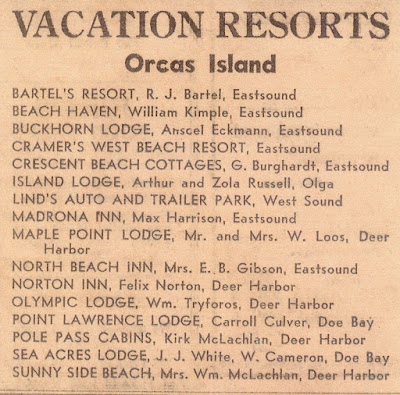

The Orcas Islander newspaper
26 July 1951

Always a front page source of information
about the many resorts on Orcas Island,
the guests, and the reports of the
salmon being landed.

By mid-summer, much of the produce came from local growers. Other groceries bought in bulk, came from the mainland by ferry or from the local grocery store. The boys often made grocery runs to the ferry or the store. As a kitchen helper, I remember shelling peas, washing lettuce, and strawberries, or helping with salads. On days when the kitchen was hot, it was good to step into the large walk-in refrigerator and rearrange things. As a waitress or cabin worker, you got to keep your tip money, therefore you tried to do your best to serve your people well.

On Saturday nights we rushed to get our work done because there was always the Island dance to attend. The dances were alternately held at the Eastsound Grange Hall or Deer Harbor on the other side of the island. The dances were attended by vacationers, visiting people from their yachts, the young men who worked at Camp Orkila, and many island residents. At about 11 P.M. food would be offered; it was usually a generous and welcome spread. The band played music from the 40s and 50s with some polkas and schottisches included. What fun we had as did most anyone there. When the dance at Eastsound ended we girls walked home amid giggles, teasing, and singing. Without street lights, the road was very dark and a bit scarey. As a postcard from Orcas Island claimed, "there was never a place as dark at night as Eastshoud on Orcas Island.

One memory stands out for me. In August of 1955 six of us girls were invited to be the guest of Mr. Donald Rheem at his Rosario estate. He and his wife purchased the estate in 1938 from the original owner Mr. Robert Moran. Rheem made extensive improvements to the estate property as well as building dock moorings for some of his well-known friends from California. John Wayne regularly visited each summer as did other celebrities. We  (6 Madrona girls) were photographed for the Seattle Times as Rheem showed us the property. The photographer was the well-known Joseph  Scaylea. It was a spectacular mansion on a wonderful site. Later, after it was sold, additions and other amenities were added to make it into an upscale resort; it lost some of its uniqueness and character.

Guest use of the Madrona Inn started to close down after Labor Day. Coed workers headed back to college of jobs; the cook, Mrs. Tharp went back to cook for the "Figi" fraternity at the U of W. Mr. and Mrs. Twedt continued as resident caretakers of the property and handled the off-season use of the property.

I think of the time spent there with fondness. At times I am reminded of the fresh air smell of the warm fir boughs. I hear the rustle of fallen leaves on the trails to the cabins. The boulders held the sun's summer warmth long after sundown. The night darkness, the brilliant stars, and at times the Aurora Borealis, are not forgotten.

Madrona Inn was a place where one could renew and refresh themselves––let the breezes wipe worries and care away. Guests came to write, paint, read, and reconnect with nature. With its comfortable and rustic setting, it provided a haven of rest for the patrons. It was a wonderful place for a college student to earn a wage, and find adventure while getting ready for the year ahead. There were so many things to do in the natural surroundings of the island––hiking, swimming, boating, fishing, and a visit to a local pottery shop or the store in Eastsound. 

The views of Mt. Baker, Mt. Rainier, the Cascades, all the islands of Puget Sound, Vancouver Island, and so much more were and are always spectacular unless surrounded by fog. After hiking the trails we often stopped for a refreshing swim in Lake Moran at Moran State Park. 

On one of my days off, my father met me at Buckhorn Lodge on the north side of the island and drove us in his 16-ft boat to Lummi Island where we had a cabin. In the middle of the Straits, I heard a swishing noise and all of a sudden about 20 Orcas came under and around our boat. As the boat rocked, I was filled with fear. Dad kept his cool and as quick as they came, the Orca pod continued on its way to hunt for food. What an experience to be so close to nature. I will not forget how much they need their freedom 
in the sea just as we need ours on land."
Above words by Kathy Parker, September 2010.

The author of this letter mentions Dr. Agnes Harrison of Madrona Inn. There is more posted about this amazing woman here on this site.

Notices in the San Juan Islander newspaper promoting summer resorts and camping on Orcas Island in the 19th century:

2 August 1894
"Camping sites set up by Smith Stowers and other citizens. Platforms for tents and bathhouses near the beach improve natural facilities and make it the most popular resort on the sound. Civil rights and property must be respected, good order and decent behavior maintained!"

13 September 1894
"Orcas is overrun with campers from all over the Sound. This island has become an attractive summer resort and accommodations will be made for people who desire to spend the summer here." 


22 July 2022

AT WOODMEN HALL AND AROUND LOPEZ ISLAND with June ::: May 1930


Lopez Island, 
San Juan Archipelago, WA.

"We didn't arrive at the big Woodmen hall, standing alone in the middle of the woods, until along about 9:30 p.m.

It was exactly like going to meeting in the South. The meetinghouse was a lodge hall and we were going to play five hundred instead of sing and pray. But the feeling was the same. The same quiet assembling of buggies, one after the other coming in out of the night, finding their places between the trees. Except that they were all automobiles instead of buggies. The same leisurely goings and comings to and out of the meetinghouse. The same low talking. And when we get inside, the meeting had started so that we felt a little embarrassed at being late, exactly as if the friendly preacher was about to scold us!

It was a delightful evening and I almost learned how to play five hundred. 

Esther is coming to drive me over the island. What a prosperous, beautiful island it is! The  New England farms look no mellower, no healthier than these big Lopez farms reclaimed in the last seventy-odd years ago. they look like generations of people, of cattle, of crops had grown up here.

Grassy pastures and orchards in blossom on the Strafford farm. Berries and cattle, green fields, and a tractor plowing on the neat Erb place. Rolling green slopes and dozens of gorgeous apple trees in fragrant bloom on the Kilpatrick farm.

Down the road along the backbone of the island, beautiful farms fell away into pleasant valleys on both sides. Sheep in the pastures, chickens cackling from modern hen-houses. Loganberries on Joe Ender's place. The McCloud house, low and brown, nestled on a big rock.Strait of Juan de Fuca. 

A very tiny loghouse with a very big ivy cluster nearly hiding it, a cloud of pear blossoms hovering over it. Somebody lived in that diminutive picturesque house once and enjoyed its charm, enjoyed the sweep of pastoral beauty on the slopes below it.

Pheasants and mountain quail in gardens. the McCauley farm is lush and lovely on both sides of the road. 

Down the dim cathedral woods to McKay harbor. Hemlock, white fir, and cedar. Long, curving beach washed by gentle surf. Crows on a fence. The pretty white Tralness house above the beach and a lavender-pink mass of starry flowers on the edge of the road. Out in the harbor, a gray slick rock tipped with seagulls.

In Barlow's Bay a great flower-covered rock. Lacy yellow blooms. Sedum is about to burst into fragrant blossoms. Dark blue verbena-like flowers, bell-like flowers. Crane's bill. A creamy white bell-like flower––how tantalizing not to know the names of these sweets! You would not live here so long without knowing all the flowers by their real and common names, would you? Well, I knew them once. And I shall know them again!

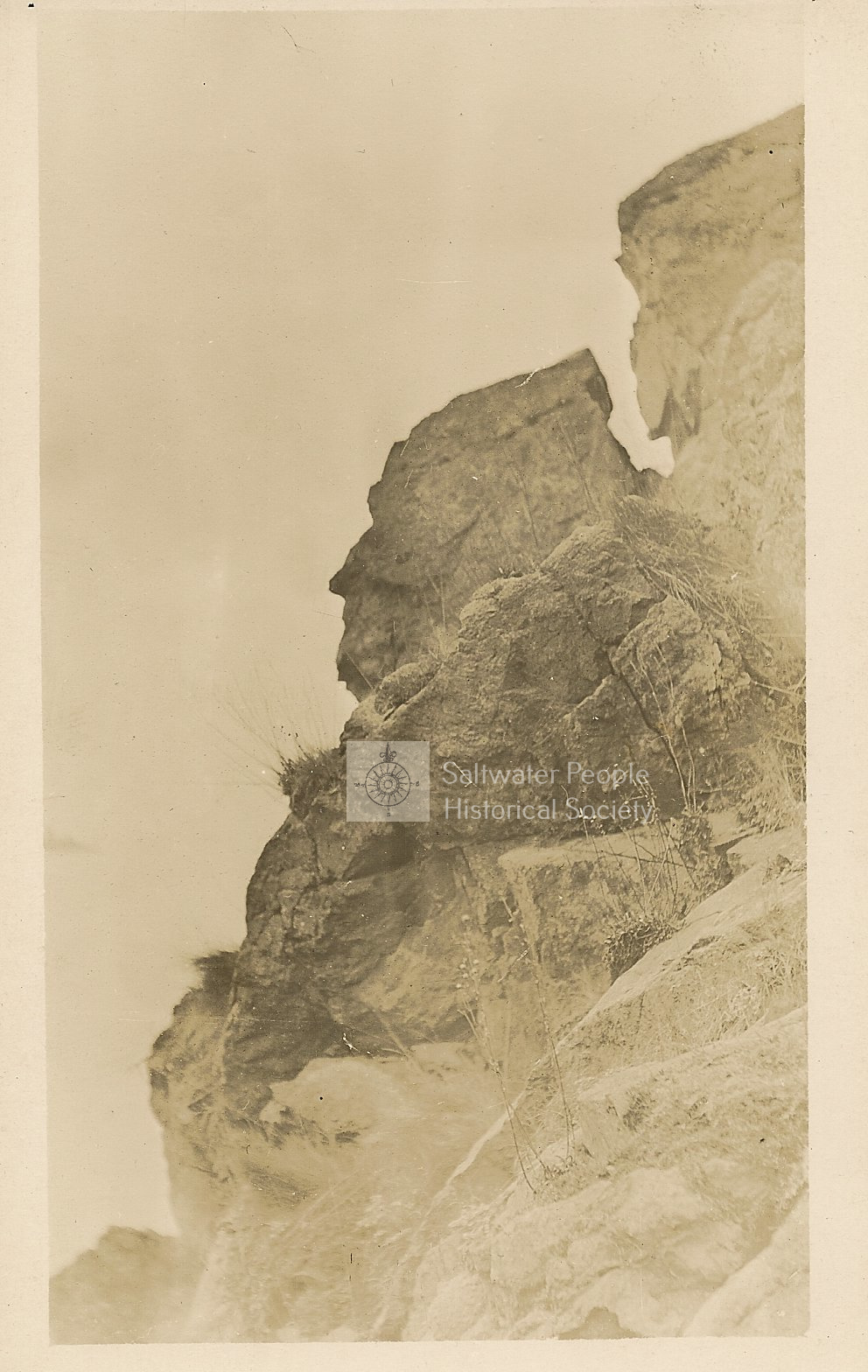
We climb up into the woods and around the outer bluff of the island to find Washington's profile. 


Washington's profile
A rock formation on Lopez Island
that went by several names.
June Burn mentions the
landmark in this essay.
Click image to enlarge.


We find the bluff where the face used to be, but something seems to have happened to the nose, or else we have not come to the right place.

But we find dark blue camas in bloom. And against an old abandoned house a gorgeous lilac heavy with purple flowers. The woods are full of wildflowers. Lady slippers, Oregon grape, starflower. Soapalalee will be along presently. From these berries, the Natives make a bitter foam which some call Native ice cream.

Across the island, is John Thompson's big lonely house where the white-headed old mariner lives alone. He promises to take us with him to Smith's island next Monday. 

The Mud Bay schoolhouse and Eaton's pretty home. On up and around to the Vogt loghouse built a half-century ago of alder logs mind you. Inside, an old square piano, hooked rugs in original designs, and handsome ship models made by the son while tending fishtraps. Outside, flowers and blossoming fruit trees and green meadows and the forest not a hundred yards away. A lovely place.

Well, you needn't think I can go all over the whole island in one letter! See you tomorrow. June"

June Burn. Puget Soundings May 1930


Archived Log Entries