"The Cure for Everything is Saltwater, Sweat, Tears, or the Sea."

About Us

My photo
San Juan Archipelago, Washington State, United States
A society formed in 2009 for the purpose of collecting, preserving, celebrating, and disseminating the maritime history of the San Juan Islands and northern Puget Sound area. Check this log for tales from out-of-print publications as well as from members and friends. There are circa 750, often long entries, on a broad range of maritime topics; there are search aids at the bottom of the log. Please ask for permission to use any photo posted on this site. Thank you.

08 February 2024

DAYS OF BLOOD IN THE EARLY LIME QUARRYS----from 1860-- 1959 with Lucile McDonald


Remains of the old Cowell quarry
stands on a hillside of
western San Juan Island,
where the Island's limestone industry began.
Photo dated 1959.
Click image to enlarge.
Photograph by W.R. Danner.
From the archives of the
Saltwater People Historical Society©

"Geologists this summer (1959) combed the San Juan Islands in a study of limestone deposits, trying to determine how much of the mineral resource remains on the islands and how practical the deposits are for exploitation.

Long ago the white substance furnished the principal year-round payrolls in the islands and was one of the factors in their settlement. Quarrymen, kiln-tenders, and coopers comprised an important part of the population between 1870 and the end of the century. 

Dr. W.R. Danner, a Seattle geologist on the U of British Columbia faculty, headed a crew sent out by the Division of Mines and Geology of the State Department of Conservation to make a comprehensive survey of the deposits in the past three months. He worked mostly in the San Juans and in Skagit County, while Dr. J.W. Mills of WA. State University, with a similar crew, carried on the search east of the Cascades.


Dr. W. R. Danner,
Seattle geologist, at the door of 
a disintegrating limekiln at the former
Eureka site on San Juan Island, WA.
Click image to enlarge.
1959 photograph by Parker McAllister,
from the archives of the 
Saltwater People Historial Society©


Industries such as pulp manufacturing consume enormous quantities of limestone, now being imported into Washington because of lower production costs elsewhere.

At present, only one operator, of the Everett Lime Co. deals in this commodity from the islands. He employs a crew to blast rock from the Westerman quarry at Eastsound, Orcas Island, break it into chunks called 'spalls', and load it on barges to be taken to pulp mills.

The market for Washington limestone has shrunk greatly. Only in cement manufacturing is it expanding. However, this outlet requires large and easily accessible deposits.

It was once supposed there was so much limestone in the San Juans that possession of tiny O'Neal Island alone was sufficient reason to justify the British-American boundary dispute of 1859. 

Danner found this century-old idea amusing because, although limestone is visible on the surface of O'Neal, the island on close examination proved to have a negligible amount of the mineral.

'Islanders think lime is all over the archipelago,' Danner said. 'This is not true. It is found in small deposits; there are no great sheets of it. We want to discover what actually is here, what is left in the quarries, and what deposits have not been quarried.'

With his two assistants, Danner tracked down forgotten places such as limestone caves, crumbling towers that once were kilns, and prospect holes in picturesque fern-filled glens where early-day miners did not find enough mineral to justify quarrying.

'There are nine groups of quarries on San Juan Island and at least 14 groups on Orcas.' Danner said 'The Roche Harbor operation on San Juan, which ended several years ago after having been the largest on the Pacific Coast, had 12 quarries.'

The Roche Harbor plant was modern, compared with the ruins of earlier ones scattered in the islands. The towering old stone kilns, into which rock was dropped from the top and drawn out through oven doors at the bottom, have a medieval look about them.

Seven kilns can be seen on San Juan, ten on Orcas, two on Henry, and one in ruins on Crane, Danner says. The geologist found 21, including some which have almost disappeared.

Inaccessibility usually was the factor governing the closing of the old mines. A few were abandoned because of the height of overhanging cliffs, which threatened landslides. Another was shut down because of the death of a workman. Most became too costly to operate.

Danner had explored for lime in the islands in previous summers for private companies. This year he thoroughly examined San Juan, Orcas, Henry, Cliff, Crane, O'Neal, and Jones Islands for the state. He mapped old workings, took samples, and assembled all the lore he could extract from residents. Many of the lime properties have become residential sites.
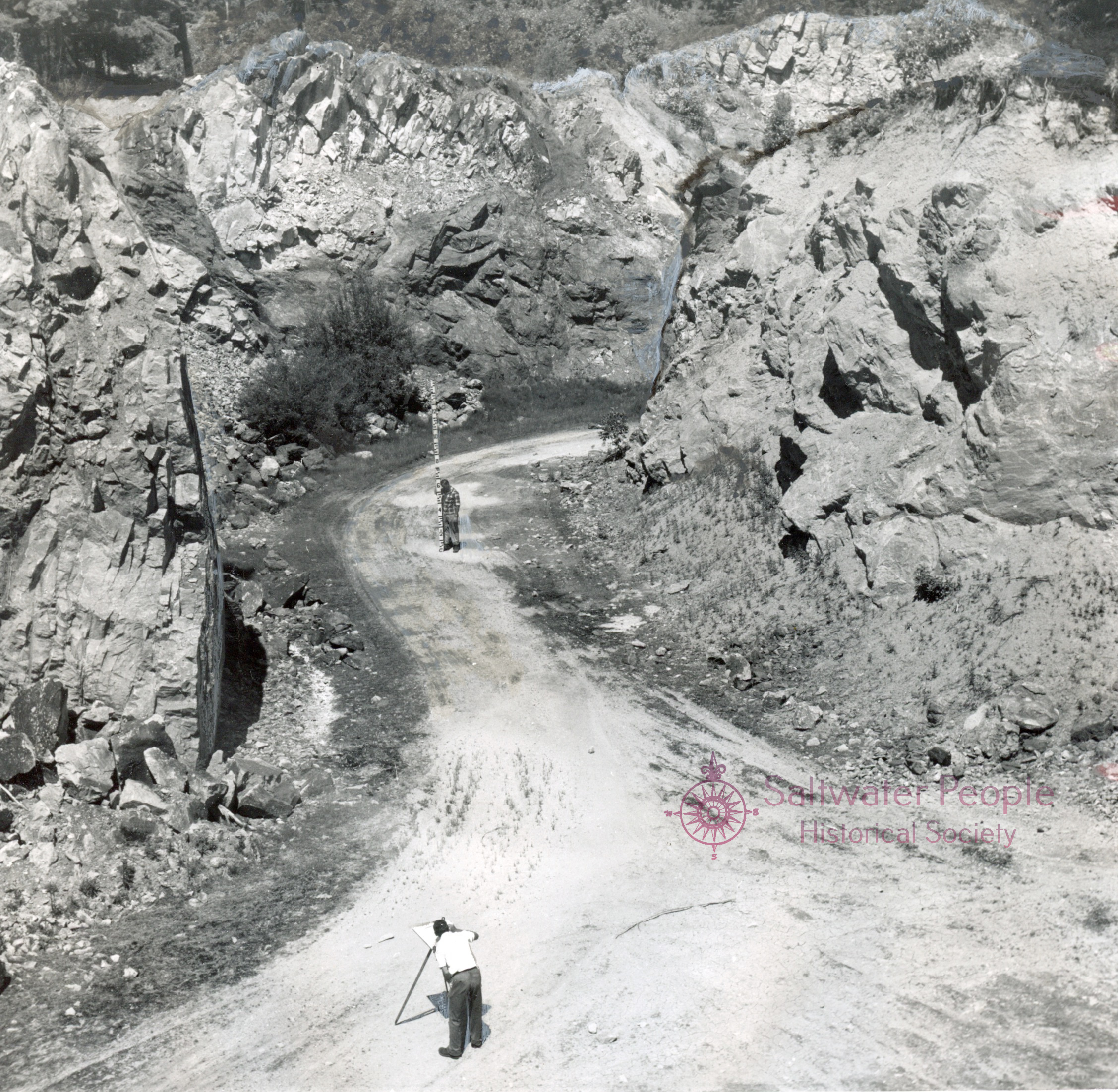

Charles McKillop, Friday Harbor, foreground 
& Alder Revisto, of Tacoma, survey the old 
Cowell quarry in 1959, on San Juan Island,
San Juan County, WA. 
They were assistants to Dr. W.R. Danner.
Click image to enlarge.

Photo by Danner from the archives of the 
Saltwater People Historical Society.©

The industry began on San Juan Island's west side, on the cliffs near Lime Kiln Lighthouse.

Augustus Hibbard, who became the island's first quarry operator in 1860, was a man who attracted trouble. Military authorities were annoyed with his men for keeping liquor in camp and selling it to soldiers and Indians. Hibbard's cook was stabbed to death by a cooper and Hibbard himself was killed by his partner, on June 17, 1868, in a quarrel over an Indian woman.

Hibbard died just before the completion of a new kiln. His heir, who journeyed from the East to take possession, died two years later. The federal census of 1870 indicated that the firm then employed 18 persons and in 12 months had produced 13,000 barrels of lime, worth $26,000.

Lime at that time was used mainly for mortar and as a soil 'sweetener' in agriculture. None had been discovered closer than California or Vancouver Island, so trade in Washington Territory appeared to offer good prospects.

George R. Shotter, a Canadian, opened the first quarry on Orcas about 1862, across Eastsound from the site where Clauson is mining today (1959.) The Shotter site, north of Rosario on Eastsound, is owned by the Crown Zellerbach Corp. Two ruined kilns on the beach are all that remains of the lime settlement of Port Langdon, which existed before there was a town of Eastsound.

Nova Langell, an old resident of the island, is a son of Ephraim Langell, a Nova Scotian who went to work at the quarry in 1871. He recalled that the company's oldest kiln has disappeared: the two standing on the shore are later ones.

In 1874, after American ownership of the San Juans was agreed through arbitration, the British quarry firm sold to Daniel McLachlan, an employee, and Robert Caines of Port Townsend, who later bought McLachlan's interest.

McLachlan went to the east side of San Juan Island and, with his brother, William, and Thomas H. Lee, a relative by marriage, in 1881, organized the Eureka Lime Kiln, on what became the property of Mrs. D.M. Salsbury.

Seven little quarries are scattered through the woods on Mrs. Salsbury's 250-acre tract and two kilns stand on the beach. Once a small community was on the spot, including a hotel, post office, saloon, and 20 families.

Eureka is one of the oldest quarries in the islands, older than the McLachlan-Lee enterprise. Probably it was opened by an Englishman named Roberts during the joint military occupation of San Juan by the British and Americans. Early in 1863, American squatters attempted to seize it from him through an illegal order of the Justice of the Peace. The controversy ended with Roberts's death by drowning before the year was out.

The Eureka property has not been operated since about 1890. Mrs. Salsbury converted two of the quarries into a Japanese grotto and a woodland chapel. Rock from one of the kilns was used for building her chimney and fireplace.

Danner found the forgotten quarry of the Chuckanut Lime Co. on the east side of Point Lawrence, Orcas Island. It was abandoned before 1910.

One of the most spectacular quarries, Danner said, is on the west side of Orcas Island, about 300' up in the cliffs, where the Orcas Lime Co plant for many years was operated by a woman, Mary Louise Dally. She and her husband, F.W.R. Dally, bought the original kiln on the President Cannel side of the island in 1900.

From 1914 until she died in 1928, Mrs. Dally had lime properties on San Juan and Henry Islands, including one with an ancient pot kiln, the most primitive type of oven to be seen in the archipelago.

Part of Danner's objective has been to learn the age of the limestone deposits in the islands, using tiny fossils of one-celled creatures that lived in shallow sea-bottom and were uplifted after the age of glaciers. On Orcas, he found limestone 350,000 years old.

The fossils, Danner said, are dependable clues to the age of any land where they exist. Through their presence, scientists have determined that the San Juan Mountains (now submerged, the islands are their peaks) ca. 200,000,000 years older than the Cascade Range.

The basic purpose of the summer work has been to learn whether suitable deposits of limestone are available to attract new industries.

Whereas kilns used to be of backyard proportions and a 200-barrel shipment was considered newsworthy in 1875, today's thinking has to be on a gigantic scale. If quarrying should reopen in the islands it will have to be undertaken by some large corporation financially able to overcome the physical obstacles and install an economical burning plant."

Words by historian/author Lucile McDonald and published by the Seattle Times.

04 February 2024

The PRESIDENT, a Veteran Making History


S.S. PRESIDENT 
417' l x 48.2' b x 19.7' d.
Original gelatin-silver photo dated 1910.

Click to enlarge image.
Original gelatin-silver photo from the 
 Saltwater People Historical Society©

1907: With a tonnage of 5,433, a single screw,  the S.S. PRESIDENT was launched by New York Shipbuilding at Camden, New Jersey. Upon her arrival on the Pacific Coast, Capt. H.P. Weaver was placed in charge, where she was known for providing excellent passenger line service and the efficient handling of cargo. 

1913: The PRESIDENT gave up coal and was installed with an oil burner.

1922: The veteran liner, S.S. PRESIDENT, following a thorough renovation, was renamed S.S. DOROTHY ALEXANDER, becoming the third of the famous steamers in the company's primary coastwise service.


S.S. DOROTHY ALEXANDER
(ex-PRESIDENT)

Original gelatin-silver photo from the 
Saltwater People Historical Society©
1923: A historic event in the sea community occurred in May with the official tests of the radiotelephone equipment installed aboard the steamships H.F. ALEXANDER and DOROTHY ALEXANDER (ex-PRESIDENT.)

"Greetings, Capt. Bartlett of the H.F. ALEXANDER, this is Capt. Harris of the DOROTHY ALEXANDER off Cape Blanco. How's the weather at Cape Flattery?" Such was the first voice radio conversation ever held between ships at sea on the North Pacific. The H.F. ALEXANDER was then 300 miles south of Seattle, and the DOROTHY ALEXANDER, 280 miles north of San Francisco. The wireless message was dispatched by Jafet Linderberg, a prominent Nome mining man, to J.W. Kelly in Seattle, and was relayed via land stations at Carmanah and Tatoosh Island. A return message from Kelly was received by the PRESIDENT. This event took place shortly before the placing in operation of similar equipment aboard the U.S. liner LEVIATHAN on the Atlantic.

1935: DOROTHY ALEXANDER was sold to Alaska Steamship Company and following her completion of the 1935 schedule, she was placed in service on the Puget Sound-Alaska route as the S. S. COLUMBIA. 


S.S. COLUMBIA 
(ex-PRESIDENT AND DOROTHY ALEXANDER)

Original gelatin-silver photo from the 
Saltwater People Historical Society©

1946: COLUMBIA (ex-PRESIDENT AND DOROTHY ALEXANDER) was sold by the Alaska Steamship Company to Portuguese owners and transferred from Vancouver to Oporto by a Portuguese curfew under the new name of PORTUGAL.

Words in this piece were extracted from H.W. McCurdy's Marine History of the Pacific Northwest. Gordon Newell, editor. Superior Publishing. 1966.

15 January 2024

23 December 2023

A Christmas Surprise for Tib –– From "Jello" Island and Lew Dodd


The Tib and Lew Dodd cabin 
Yellow Island, 
San Juan Archipelago, WA.
Ca. 1948.
Courtesy of their family.


"Tib" Van Order Dodd (1895-1989)
and Lew Dodd (1892-1960)
Yellow Island residents
Photo courtesy of their family.
Click image to enlarge.


A letter written by the former co-owner of Yellow Island, San Juan Archipelago, WA.

"Jello Island"
(is what one Swede calls it)
Deer Harbor, WA.
December 1957

"Dear –––––––––––,

Well, the Islands are about rolled up in mothballs until Springtime, I guess, and from all appearances anyway–for there are extremely few boats to be seen nowadays; the Channels are deserted except for the mailboat and the ferry.
        It is not really broad light in the morning until 7:30 and the sun (if any -and wherever seen) goes down behind the black San Juan Island hills at 4:15 PM. The whole Archipelago is slumbering and quiet in its usual winter hibernation so far as any comparison with June to October.
        For the first time since last July, accompanying Jack Tusler in his boat, we went to Deer Harbor, most of whose sparse population isn't very much in evidence; for, those who can afford it have folded their summer tents, so to speak, and have migrated to the South––the road from Kirk's to the store, black in the gloomy wet and little traveled, and at Norton's dock a single troller leaning wearily against the float as if utterly tired out from the summer's fishing, the essence of ennui!
        Blue smoke issues straight up from a few chimneys, and the forlorn old red cannery seems to stare vacantly upon the scene, which more than at any other time of year, resembles a small Port that once was and may never be again; deserted, forlorn, useless, abandoned; hopeless! Hard by, across the inlet, at the bridge, a forlorn sawmill no longer sings a tune, drift logs beachcombed, and red rust is King over all its metal machinery. The attitude which the whole hamlet has seemed to have acquired is one of extreme lassitude, and, perpetual waiting in a permeating forlorn hope that--well--"Something might occur someday; maybe." The place somehow manages to convey a very bleak empty and depressing picture as it sits on its sidehill, soggy, sodden, clammy, and damp--with its feet in the cold December sea. --Deer Harbor in winter! "The deserted village!"
        We are always glad to return to our Island from such a brooding atmosphere, for upon clearing the vicinity the forlornness and the lifelessness leave one as if awakening from an unrealistic dream.
        Back on our own Island, we are happy to pull the skiff up into its snug boathouse, shoulder the provisions, and climb the path to the bright, warm cabin where for so long as we have lived here we have been happy and content.
        There is never a dull or uninteresting day at our Island home and no two days are alike: for there is always something, yesterday Tib and I watched two otters hauled out on our East end. It was a sight seldom seen by even those who do live in the country, and we may never see such an interesting performance as they went through with no idea in their heads that two human beings were observing through binoculars every move they made.
        One reason that prompted me to drop you a line is because I wanted to (which is an excellent one, in my opinion!) Another reason is that I need Lloyd's advice:
        Recently I saw an "ad" in December National Geographic of Zenith's new Transistor Transoceanic radio (8 bands) etc. price advertised as $250. Lloyd, what do you think of this radio and do you deal with them?
        We are out here beyond television until they produce some kind of a battery set maybe––and even then if the programs don't get any better we wouldn't be interested. But, radio, a good one, yes, for it would give us worldwide contact everywhere, internationally––everywhere there are broadcasters. Ship to shore, aircraft, etc. How do these transistors stack up with the tube radios in performance? Do you think this new Zenith is a good buy at that price and could you buy one of them at any sort of a discount if you do not handle them?
        I've been toying with this zenith idea to surprise Tib for Christmas. (I'm 65 now and may not last too long.) I can manage to pay for something that should give us whatever is to be had in worldwide radio for some time to come. But before I make any move at all I'd like your candid opinion about this machine. Just what your knowledge and experience can tell me. I will certainly appreciate it.
        Tonight 8:00 PM we're having a hard westerly (about 40 mph) and the sea is noisy but the solid little cabin doesn't have a vibration in it, the kettle sings on the stove, the lamp is bright, and it a sweet, sweet home on an island in the San Juans far from the milling crowds and traffic, the fumes, and burning gasoline and the roar of trucks and trailers.
        Our sojourn in Bellingham this summer, after so many years away from the modern clatter and clutter taught us both to appreciate and love even more our peace and quiet, sweet air, unchlorinated water, clear running tides; and natural surroundings, the seabirds calling and soaring in the clear, clean sky! We are so thankful and grateful for it all. It is a good life.
        Our best wishes to you for a happy holiday season and we hope your year ahead will be a successful and contented one filled with whatever is GOOD and with whatever you most prefer."

Signed, Lew and Tib.

Another SPHS post of Yellow Island Dodd's can be seen HERE
Another SPHS post of Lew's sail on Gracie S around Vancouver Island, B.C.,                         can be seen HERE
And a post under the History section on the home page, for the 8,500 mile 
passage crewing the R.B. Brown schooner Ranger from Milwaukee, WI.  to Orcas Island in 1939, 
click HERE.

08 August 2023

"BIG STUFF" coming through the Islands 7 August 2023

 OCEAN GUARDIAN working in the San Juan Islands.

Photographs courtesy of  Lance Douglas from Blakely Island, San Juan Archipelago, WA. The top photo has Rosario Resort, Eastsound, Orcas Island in the background. Click an image to enlarge.

The offshore work vessel can be seen at https://www.vesselfinder.com/vessels/details/9272060


Archived Log Entries