"The Cure for Everything is Saltwater, Sweat, Tears, or the Sea."

About Us

My photo
San Juan Archipelago, Washington State, United States
A society formed in 2009 for the purpose of collecting, preserving, celebrating, and disseminating the maritime history of the San Juan Islands and northern Puget Sound area. Check this log for tales from out-of-print publications as well as from members and friends. There are circa 750, often long entries, on a broad range of maritime topics; there are search aids at the bottom of the log. Please ask for permission to use any photo posted on this site. Thank you.

11 March 2025

CAPTAIN JAMES GRIFFITHS AND "SIR TOM"


Captain James Griffiths,
(1862-1943)

Griffiths grew up in a historic maritime
seaport of Newport, Monmouthshire, Wales.
He headed to Puget Sound in 1885 and 
 played a major role in the development of
Puget Sound commerce.
 He needs a book but here is a little below
by boatbuilder, Norm Blanchard, late of Seattle.
Original photo from the archives of the 
Saltwater People Historical Society.©

Essay by Norm Blanchard and Stephen Wilen (abridged)

Knee-Deep in Shavings, Memories of Early Yachting and Boatbuilding on the West Coast. Horsdal & Schbart Ltd, Victoria, B.C., Canada. 1999. 

"In 1912, a syndicate made up of ten wealthy Seattle businessmen, some of whom were Seattle Yacht Club (SYC) members, contributed $100 each and commissioned Ted Geary to design the Sir Tom to compete for the Sir Thomas Lipton Perpetual Challenge Trophy. She was built by my father and his partners, Dean and Lloyd Johnson, and Joseph McKay. The Sir Tom went on to become the most famous sailboat in the entire history of the SYC. Of all the various syndicate members who supported her over the years, even though he was not one of the founding members, it was Captain James Griffiths who really made sure that she remained in active competition as long as she did.

Captain James was one of the most prominent people around the Seattle waterfront in general, and the SYC in particular, since he served as commodore three times, in 1921, '22, and '28. He was the first person to be made an honorary life commodore in the club. He was a Welshman, born in 1861. He had the characteristic British small stature, with red hair. 

He emigrated to Victoria, B.C., around 1885, and set up a stevedoring and towboat company. He settled next in Tacoma, where he formed James Griffiths & Co Ship Brokers, and found the Tacoma Steam Navigation Co. He later moved to Seattle, where he began a towboat operation on Puget Sound, and formed Griffiths & Sprague Stevedoring Co. He had either a branch of that company, or perhaps a second stevedoring company which he continued to operate in Vancouver, B.C. He also owned, or was partner to, the Coastwise Steamship & Barge Co and the Seattle-Everett Dock & Warehouse Co and acquired his own shipyard, the old Hall Brothers yard, which he renamed Winslow Marine Railway & Shipbuilding Co at Eagle Harbor over on Bainbridge Island.[ see photo below.]


    Eagle Harbor, Bainbridge Island, WA.

Back-stamped with inscription 
"James Griffiths & Sons
Burke Building, Seattle, WA.
View from the west end of property, 
showing undeveloped portion of the plant.
Yacht at anchor is MAUD F,
Steamers at the dock are the 
FLORENCE K. & BAINBRIDGE."
click image to enlarge.
Undated, from the archives of the 
Saltwater People Historical Society©

Later, Captain Griffiths became involved with James J. Hill, the "Empire Builder," in the business of importing silk from the Orient, and Griffiths is the man who is credited with bringing the Chinese silk through Seattle. He simply went to China and contacted the right people, who were with the Nippon Yusen Kaisha Line. He had to work through interpreters entirely, but he convinced them they could get the silk to market faster if they came to Seattle rather than San Francisco. This was a huge gamble on his part, but it paid off for the Captain: his company became agents for the NYK Line, Hill's "silk trains" met the ships at the pier and rushed the silk express on specially cleared tracks all the way from Seattle to New York City.

Despite his active involvement in heading up the syndicate that financed the building and campaigning of the Sir Tom, the Captain himself seemed to be only interested in power boats. By 1925, Captain Griffiths he commissioned Ted Geary to design his yacht, Sueja III and in 1926 the 117 foot yacht was launched at the captain's own yard, Winslow Marine Railway & Shipbuilding Co. Sueja III was, and is ––because she is still in the charter business on the east coast, now known as Mariner III. All of her woods were Oriental. She was largely built in China and shipped in knock-down fashion to Captain Griffith's yard, where she was assembled under the supervision of Geary.

There are many stories about the Sueja III, but one that I recall in particular occurred about 1927, which would have been the first full cruising season. One morning on a trip to California, when the yacht lay at anchor in Wilmington harbor, Art, a step-son, was standing up on the deck. He'd just finished breakfast when he saw a launch heading toward the Sueja III and he couldn't figure out who this would be, as their own launch was moored on a boom alongside. Well, this launch pulled up alongside the gangway and out jumped two fellows, and one of them came bounding up the gangway ladder. Art walked over to meet him, and the stranger asked, "Is the owner aboard? I want to meet the owner. I'm going to buy this boat."

Art replied, "Well, I'll tell the captain you want to speak with him," and went to find him. Naturally, Art hung around to hear what was said.

The Captain was really pretty short, and the stranger was pretty tall, and he said to Captain Griffiths, "I want to buy your boat," or something to that effect.

Captain Griffiths drew himself upon to his full height, and jabbing a forefinger at the stranger's chest, he sputtered, "Young man, this boat is not for sale, but if you'll keep a civil tongue in your head I'll introduce you to the man who designed her, and he can design one for you and you can build it."

Well, the stranger was none other than John Barrymore and so that's the story of how the 120-foot, Geary designed Infanta came to be built in 1920. She, of course, is now known to us as THEA FOSS.  She has been the Foss Maritime Company's corporate yacht for many years, and is still a beautiful yacht.

To get back to the Sir Tom. The R Class Rule had been developed by Nathanael Herreshoff in Rhode Island, and when Geary returned from M.I.T. and was commissioned by the syndicate to design the Sir Tom, he created a really fast hull shape. The Sir Tom was the first Seattle R Class sloop and easily won the right to challenge other candidates for the Lipton Cup, which she did, and she held it continually from 1914 until 1928.


SIR TOM 

Undated photo from the archives of the 
Saltwater People Historical Society©


My first memories of her competitive years date from right after WW II. We did all the practice racing on her in Lake Union right offshore from the Blanchard Boat Co at the foot of Wallingford Ave., where the Seattle Police Harbor Patrol dock is now. Captain Griffiths had two sons, Stanley, the eldest, and Bert. In those days, Stanley would be in the cockpit with Geary, and Bert was the mainsheet man. My dad was the foredeck man. I don't recall who was his partner up there with him initially, but Roy Corbet joined that group, in 1922, and that year was the first time the Sir Tom had her famous curved Marconi mast and new sails. Up until 1928 she never entered a race that she didn't finish first. She didn't always win because sometimes races consisted of a mixed fleet and there would be time allowances, but she was a very, very fast R Class sloop, as well as one of the smallest boats in the class, at 39 feet, 8 inches.


CREW OF SIR TOM,
dated verso, July 1930.


L-R: Andy Joy, Roy Corbet,
J. Swift Baker and Ted Geary.
The Seattle yacht was captained by Geary,
Commodore of the Seattle Yacht Club. 
The team regained the coveted 
Lipton Trophy at the PIYA regatta in 
Cadboro Bay, Victoria, B.C. 
Original photo from the archives of the 
Saltwater People Historical Society©

Well, I think Bert and Stanley Griffiths were the first to leave the Sir Tom crew, and they were replaced by Ray Corbet, Swift Baker, Colin Radford, and later Jack Graham took over the helm when Geary was sailing on Don Lee's Invader in the Trans Pacific Race.

The syndicate stuck together and paid Sir Tom's bills pretty much for years. Captain Griffiths was recognized as the manager of the syndicate, and as various members of the original group died be would either find the money from somebody else or dig into his own pockets,  because he really felt that the Sir Tom and Ted Geary were head and shoulder about the gang at the Royal Vancouver and the Royal Victoria yacht clubs. He was always the perfect host aboard the Sueja II and the Sueja III

The Sir Tom eventually became, I guess by survival mainly, the property of Captain Griffiths. During WW II all international competition ceased, so she was stored at his shipyard at Eagle Harbor. Captain Griffiths died before the Armistice, on 29 June 1943, and for a while his son, Stanley, ran the companies, but he soon passed on. His son, James, became head of the Washington Tug and Barge Co and his brother Churchill was right in there as vice-president of operations. 

When my brother, Wheaton, got out of the navy about the end of WW II, he was at Officers Candidate School at the U of WA campus, and in 1946 he persuaded my dad to go 50-50 with him and buy the Sir Tom. That summer Wheaton actively campaigned the boat at the SYC races, but the R Class was dead by that time. After he got married, he couldn't afford to pay his half of the boat bills, so the Sir Tom came to sit on our dock at the boat company for quite a few years.

In 1956, a young fellow came into the boat company and told me he wanted to buy the Sir Tom. I asked him, "Do you think you can repair her and put her back in condition?" Well, yes, he thought he could. I questioned him, "What kind of experience have you had?" Well, he replied he hadn't really had any experience, so I said, "I'll tell you what I'll do. I'll write to Ted Geary and get the exact weight of the lead keel, and the day that you're ready to write a check, I'll sell the boat to you for just what the lead is worth on that day. We can check the newspaper for the quotation on the price of lead. I'll give you five more years of free storage on the mast. If you haven't been to get it after five years, why, if it's still up there and you want it, we'll have to negotiate a new deal on the mast."

He eventually went through with the deal, and as he was leaving I said to him, "Now don't sell that lead for a honeymoon!"

About five years later, I know it was at least five years, because he never came back for the mast and I sold it. I was lying in the large lock in my "33" sloop, Aura, and a Senior Knockabout came alongside and rafted up. The owner or skipper was at the tiller and another fellow with him, and the other fellow said to me, "You don't remember me, Mr. Blanchard? Well, I'm the guy who took the lead keel off the Sir Tom and sold it for a honeymoon __ and that was a bad mistake, too." It seems his marriage had failed. After he bought Sir Tom he had her hauled out someplace and trucked to his parents' backyard, and after he sold the lead, I suppose the boat was simply broken up for kindling.

So that's the story of Captain James  Griffiths and the Sir Tom syndicate. Wells Ostrander, the son of one of the early members, gave his father's certificate or membership paper in the Sir Tom syndicate to the Seattle Yacht Club a few years back, and we still have that at the clubhouse. It's sad the way we lost the Sir Tom, but as I've said about other former grand boats, sometimes when they fall into such neglected condition it's maybe best to just let them slip away. "

09 March 2025

THE FOREST BARKENTINES


            FOREST FRIEND 

Built with two sister ships
at Gray's Harbor, WA.
1919. 
 

The barkentine rig –– that strange marriage of square and fore-and-aft sails, came to the bloom on the west coast.

Such a combination of differently cut canvas obviously prompts the question: Why the two rigs? Why not keep either to the square of the schooner rig? The answer lay in the use to which such vessels were put or, more correctly, the pattern of trade routes such vessels would traverse most inexpensively.

With lumber being king and the new countries "down under" clamoring for building materials, the Barkentine rig was ideally suited for the long runs in the Trades to "fetch" up the Antipodes. Vessels of this rig could run the large schooners out of sight in the Trades or on voyages such as to South Africa or the Islands.

Three later-day examples of this rig were the beautiful, large barkentines FOREST FRIEND, FOREST PRIDE, and FOREST DREAM, built in 1919 at Grays Harbor, WA. 

The vessels measured 249 feet by 44 feet by 19 feet and had 1,650,000 board feet capacity.

Their maiden voyages took them to Sydney, Australia with lumber, the usual pattern being then to load coal at Newcastle for Honolulu, Callao, Mauritius, Antwerp, the Caribbean, San Antonio, France, Cadiz, Queenstown, Noumea, Iquique, Pimental, and Stromstad were other ports of call.

These big barkentines were not clippers, but on occasion showed their heels and demonstrated that as late as the 1920s profits were to be made in sail. In April, 1925, after temporary layup in Lake Union, FOREST PRIDE loaded 1,560,000 feet of lumber at Williapa Harbor for Adelaide, Australia at $15 per thousand (1,000 board feet,) returning to Seattle in December in forty days from Callao.

In 1926, she went outward to Adelaide in ninety-eight days, returning in eighty-two days during which passage she logged 2,222 miles in nine days, or an average of almost 247 miles per day. That was good sailing in that day and age!

All three vessels operated under tow along the West Coast for a while, sometimes in tow of the steamship FOREST KING.

In the late 1920s, FOREST DREAM was sold at auction in Australia after a charterer had gone bankrupt. A group of officers from the Swedish training ship C.B. PEDERSEN purchased the vessel and operated her between Europe and the West Coast of South America, carrying guano and then logwood between the Caribbean and Central American ports and France. She finally was destroyed by fire at Stromstad, Sweden, in 1933.

The PRIDE, after arriving in Seattle in September of 1927, was laid up in Lake Union never to feel the press of wind-filled canvas again. Later, as a barge, she assisted in raising the ill-fated ISLANDER. There is a post of that adventure on this site..


FOREST PRIDE

FOREST PRIDE took lumber from Bellingham to Noumea, New Caledonia in the excellent time of forty-two days, then crossing to Newcastle to load coal for South America. On the run from Australia to the West Coast she logged seven hundred miles during a forty-eight hour stretch.

In the spring of 1929, the FRIEND was libeled by a shipyard at Vancouver, B.C., that had not been paid for repairs. She was laid up there until 1938 when the Island Tug and Bargo Co., purchased the ship for conversion to a hog fuel barge.

Thus came to an end the rather short-lived careers of three graceful but sturdy sail carriers, plodding onward in an age which had outrun their kind. It is a wonder they lasted as long as they did.

They were not only three ships, they were a culmination of hundreds of years of evolution and development, from the full-rigged ship and the topsail schooner, the end result being a combination of the advantages of the schooner and the square-rigger. By using a square-rigged fore mast, the barkentine had the advantage of spreading a larger sail area before the wind, as compared to the fore-and-aft schooner. The rig came into great popularity as a substitute for either large 3 or 4 masted schooners or ships about 1880.

Pacific Coast builders gave a good deal of attention to this rig. While more expensive to build than the schooner rig, the barkentine was far less costly than a ship or a bark and
required fewer hands.

The "forest" barkentines were fine examples of the rig. They were a credit to their builders and beautiful manifestations of the shipwrights' art during sail's last stand.

Words by Mr. Gordon "Chips" Jones for The Sea Chest membership journal 
published by the Puget Sound Maritime Society, Seattle, WA.


25 February 2025

THE LEXICON OF LINES


GRACIE S.
Skipper Ed Kennell, Seattle, WA.

For our lexicon of salt;

 On a run in from the Cape, as 
shellback Miles McCoy relates, 
"Reading both pages, that is when 
running before it and the main is out
to one side and the fore is out to the 
opposite side. I clearly remember this sail.
Bob Schoen was in his prime climbing all over
the wet decks snapping photos.
That was a grand sail for everyone."
Photo by the late Bob Schoen with memories 
by his good friend 94-year old Miles McCoy,
Orcas Island, San Juan Archipelago, WA.


Lore from The Lazarette.... a look back,
Courtesy of the Honourable Doug Adkins and
The Cruising Club of America

The vocabulary of sailing is absorbed and then employed by those of us who engage in the adventurous use of the sea. We use it with ease and sometimes forget how unusual and arcane it must seem to those who do not speak our seasalted mother tongue. The great Cruising Club historian Jack Parkinson gave us the indispensable Nowhere is Too Far, The Annals of the Cruising Club of America which chronicled our history by each year from 1922 through 1959. He clearly loved language. His account of the year 1947 included a remarkable poem by Thorvald S. Ross of the Boston Station, he the third New Englander to serve as Commodore of the CCA. The Commodore ranged widely and sailed with fellow members from across the roster. He wrote a ballad as his answer to the old, old question of "How many ropes on a full-rigged ship?" and Parkinson, to our everlasting benefit, included it in his annual account. 
Enjoy Seven Ropes by Past Commodore Thorvald Ross.

SEVEN ROPES

In taproom, when the wind was wailing,
  Old bo's'ns yarned of serve and splice,
Of wagers won by mighty sailing,
  Of whip and warp, of trim and trice.
No more are clippers trade-wind driven; 
  We scarce remember, save in rhymes,
The names their riggin's all were given-
  Lost lingo of hard-bitten times.
A maze of flax and coir and cotton,
  Of ramie, sisal, hemp, and jute,
The very twists and lays forgotten,
  Since steam and diesel won repute.
We class their halyards, sheets, and braces,
  Their lifts and lanyards, vangs, and guys,
As ropes that ran to mystic places
  And sinewed spars in multi-plies.
But take a full-rigged ship, from master
  Down to the boy, they knew each one,
And how to haul and pay it faster
  Or reeve or snub or let it run.
Yet ropes as such they had but seven
  In all that lexicon of lines,
That cobweb spun from deck to heaven,
  Which Knight in Seamanship defines;
Man rope, on gangway to the landing; 
  Foot rope, the beckets under yard
To furl and reef-a risky standing!
  They held their swabs in light regard.
The top rope swayed topm'st for staying;
  The bolt rope edged the cloth for roach;
The bell rope was for watch and praying;
  The wheel rope whirled to save a broach.
There was one more, and it no piker,
  I'd like to've been it if I could,
The back rope of the dolphin striker-
  That tough and trusty stick of wood.
From sheer to bow past bobstay bending,
  It held the jib boom to its search
For new horizons, never-ending,
  And foiled the sea at plunge or lurch.
It's gone the way of all its brothers;
  It did its job, not best or worst,
But on the voyage with all the others
It led the rest and did it first.

04 February 2025

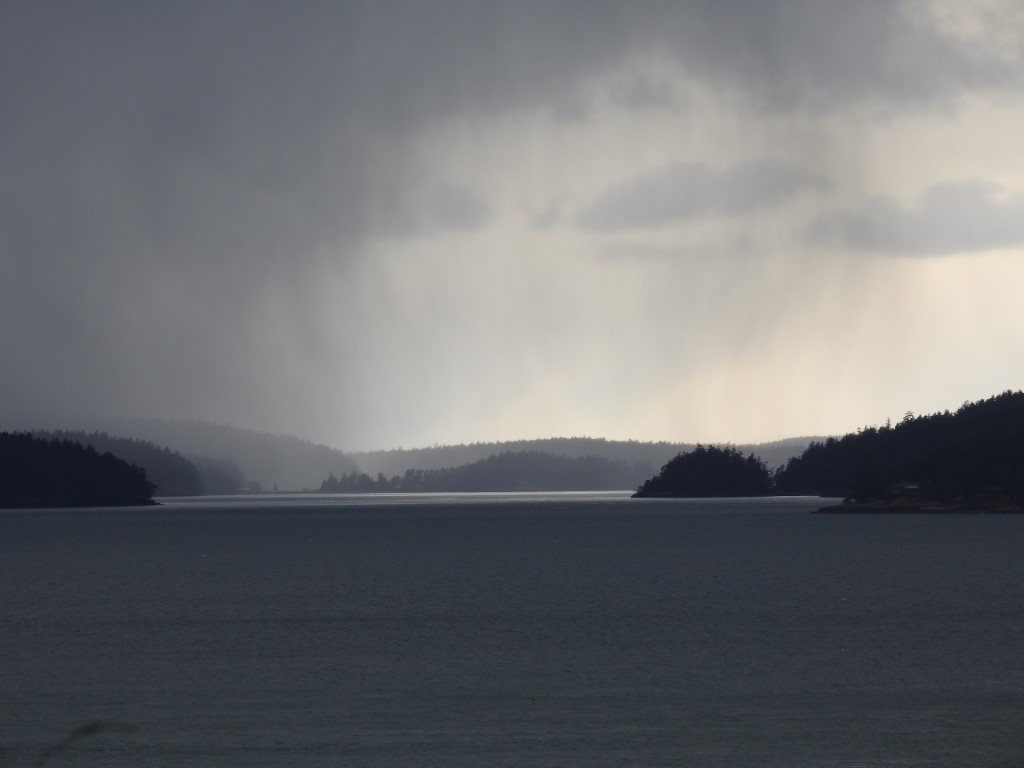
BEAUTIFUL AND WONDERFUL with Sir Attenborough


Henry Cayou Channel
San Juan Archipelago, WA.
Photograph from Blakely Island,
courtesy of  L.A. Douglas
Click image to enlarge.

3 February 2025

"People must feel that the natural world is important and valuable and beautiful and wonderful and an amazement and a pleasure."

David Attenborough

01 February 2025

MEN AND SHIPS OF THE NORTHWEST – a Review by Don Page


L-R; Seattle/Olympia salty writer
Gordon Newell
and Capt. Shaver
with precious cargo 
aboard steamer PORTLAND. 

Dated 27 Nov. 1966. Colman Dock, Seattle.  
Aboard they are transporting the first load
of 800 books, weighing 6,200 pounds.
Low-res of an original photograph from the 
archives of the Saltwater People Historical Society©


The H.W. McCurdy Marine History of the Pacific Northwest

Edited by Gordon Newell. Superior Publishing Co.
$100. (in 1966)

"The H.W. McCurdy Marine History of the Pacific Northwest may be the most remarkable book ever published on the West Coast.

It's a big book almost any way you look at it. Its buckrum binding houses 736 pages. Those pages are divided into 61 chapters, crammed with 2,000 pictures and the 950,000 words it took writer Gordon Newell to sketch the story of ships and men of the waterfront and the sea from 1896 to 1965.

These 70 years bridged the eras of sail, of coal, of oil, and now, of nuclear power aboard our ships. They saw booms and busts, hot wars and cool peace, gold rushes, launching and sinking, arrivals, and final departures.

Newell has told his story well, revering maritime history and the people who made it. He has also provided the deft touch of a professional writer and a dash of sardonic humor now and again to give the text a welcome crackle.

The history opens in 1895 with Nippon Yusen Kaisha, in company with the Great Northern Railway and Captain James Griffiths, opening the first regular Japanese steamship service to Seattle. It closes with the death in 1965 of 

'Einar Endresen, 83, an old-time sparmaker whose father founded the Endresen Spar & Lumber Co at Aberdeen, which he later managed, furnishing masts and spars to sailing vessels on the Pacific and the Atlantic coasts.'

In between are many well-remembered sea stories of the Northwest–stories such as the construction of the battleship NEBRASKA, the arrival of the 'ton of gold' ship PORTLAND, the fading of the Puget Sound Mosquito Fleet, and the rise of the waterfront unions from blood and grime to positions of responsibility.

Many of the stories are less well-remembered. For instance, the story of the two submarines built in Seattle and bought by the Province of British Columbia at the start of WW I. British Columbia's premier borrowed money from a bank to buy the subs, and Newell comments, 'For a time British Columbia enjoyed the historic distinction of being the only province of Canada to own its own mortgaged Navy.'

Newell memorializes, too, the Puget Sound skipper who went on to become admiral of the Turkish Navy and the ill-starred Skagit sailor who departed this vail by wrapping the anchor rope around his neck and jumping.

The McCurdy Marine History is not just history of Seattle or Puget Sound, of course. Its stated geographic range is from the California border north into the Arctic Ocean.

Newell has done a responsible, commendable job. He was strengthened and guided in this effort by a distinguished sponsor and a conscientious board of review. The book would have been impossible without an 'angel.' That angel and guiding light of the history was wealthy, now retired, Seattle shipbuilder, Horace McCurdy.

Early in 1963, McCurdy established a grant with the Seattle Historical Society for the research and writing of the new History. He picked Newell to do the writing. The grant grew as the book grew. It started at around $50,000 by the time Superior Publishing began distributing the 1,500 volume press run of the McCurdy History. That grant, of course, won't be paid back. Whatever small profits come will go to the Historical Society and to publisher Albert Salisbury for his gamble in putting out the book (Publishers of Lewis and Dryden went broke on it.)

McCurdy is an admitted dewy-eyed lover of things of the seas. He also is a hardheaded businessman. He wanted the best, most authentic history he could buy with his $50,000. To ensure this be assembled a review board of 17 men, all authorities on one or more phases of subjects to be covered in the History. That review board read three progressive manuscripts of the book. Members made suggestions to author Newell and supplied source material. Some even contributed sections for his editing.

The result of McCurdy's and Newell's work and the contributions of the review board, coupled with the rich material of 70 years of Northwest maritime history is a handsome volume as impressive as it looks."

Don Page review published by the Seattle Post-Intelligencer 21 May 1967. This review was extracted from Don't Leave Any Holidays Volume II, H.W. McCurdy. Inscribed copy number 38. Published July 1981. Saltwater People Historical Society collection.


Below, Don Page writes further in the Seattle P-I, 20 Oct. 1974:

"The publishing time and size of Volume I roughly doubled and McCurdy found he'd underrated the cost of playing godfather to a book of Northwest marine history. He financed the book through grants to the Seattle Museum of History and Industry and Museum Director Mrs. Sutton Gustison recalled:

'Every time we ran out of money, we'd call Mr. McCurdy and say, 'We need another thousand,' and he'd always come through.'

Everyone was happy, though, with the finished product. The "McCurdy History" sent saltwater buffs of our part of the world into ecstasy. Superior Publishing was so pleased that it put out a new edition of "Lewis & Dryden's History," to form, with the McCurdy volume, a handsome two-volume set. Newell continued to mix more books in with his Olympia politicking. The museum profited. McCurdy beamed. And a second volume was published to cover the following ten years of marine history to yield a fine three-volume collectible set. 

"This book is going to be the last word. It's going to belong to the ages, just like Lincoln." H.W. McCurdy.  


Archived Log Entries