"The Cure for Everything is Saltwater, Sweat, Tears, or the Sea."

About Us

My photo
San Juan Archipelago, Washington State, United States
A society formed in 2009 for the purpose of collecting, preserving, celebrating, and disseminating the maritime history of the San Juan Islands and northern Puget Sound area. Check this log for tales from out-of-print publications as well as from members and friends. There are circa 750, often long entries, on a broad range of maritime topics; there are search aids at the bottom of the log. Please ask for permission to use any photo posted on this site. Thank you.

07 November 2016

❖ MOSQUITO FLEET MONDAY ❖ A Mosquito RUNS THE RAPIDS ❖ S.S. HARVEST QUEEN ❖

River steamboat HARVEST QUEEN
846 t. 200-ft., built at Celilo in 1878.
She and 8 or 9 other vessels were transferred to
the lower river in 1881, where this story begins.
Original photo from the archives of the S.P.H.S.©

The term 'Mosquito Fleet' may, to readers not familiar with the Puget Sound Country, suggest only very small craft. It was however, a phrase universally employed by the people and publications of that section to differentiate the Sound steamers from ocean and coastwise fleet. Some of the inland ships were as large as the deep-sea vessels, but their trade placed them in the 'Mosquito Fleet.' The term enjoys the authenticity of tradition and long usage. Author, historian Gordon Newell, 1951.

"The serenity of this scene as the HARVEST QUEEN moves out of her slip heading for the Columbia River is in sharp contrast to an earlier run of the HARVEST QUEEN––one that took her over Celilo Falls.
In 1881, hard times on the Middle River above the rocky barrier at Celilo Rapids had prompted the passage. It was a risky one. To breach the falls meant a 20-ft drop over a basalt ledge. Then followed the hazards of rock strewn Tenmile Rapids. This churning gutted into a mile long cauldron that compressed the Columbia between sheer rock walls less than 300-ft apart.

      Running the Celilo Rapids was first accomplished in 1866 when Capt. Thomas Stump threaded the OKANOGAN through the hazardous chasm, followed by other sternwheelers of similar size: the NEZ PERCE CHIEF, the classic ONEONTA, the HASSALO (II), and now one of the river's finer steamers, the HARVEST QUEEN. At the helm was Capt. James W. Troup, 29, who six years earlier had entered the HARVEST QUEEN's pilot house as her skipper. Peter De Huff, a veteran riverboat engineer, manned the engine room throttle as she moved from her Celilo slip. A slight rise in the low River had prompted the young captain to make his move. For a few minutes it seemed as though it might be his last for, as the HARVEST QUEEN swept into the narrow chute, she was unable to clear the ledge.
The rocks tore into the stem of the 200-ft steamer, ripping off her rudders and disabling the engine supports. Legend has it that Capt. Troup picked up his speaking tube and shouted:


'Back her, Pete! Back her if you love me!'
'I can't. Everything's busted,' came the doleful reply.

      Captain Troup, with the skill of command that was to make him an outstanding riverboatman on the Columbia and the Fraser, left his useless wheel. Anchors and kedges were dropped to pull the drifting HARVEST QUEEN out of the whirlpools and away from the threatening rocks into the eddy. The worst was over. Defying the chill waters, the steamer's crew completed repairs. Within two days, the HARVEST QUEEN was ready and defiant, sweeping at railroad speed through the remaining rapids to be greeted by cheering crowds at the Dalles."

Above words by author Jim Faber, The Steamers Wake. Entetai Press, Seattle. 1985.
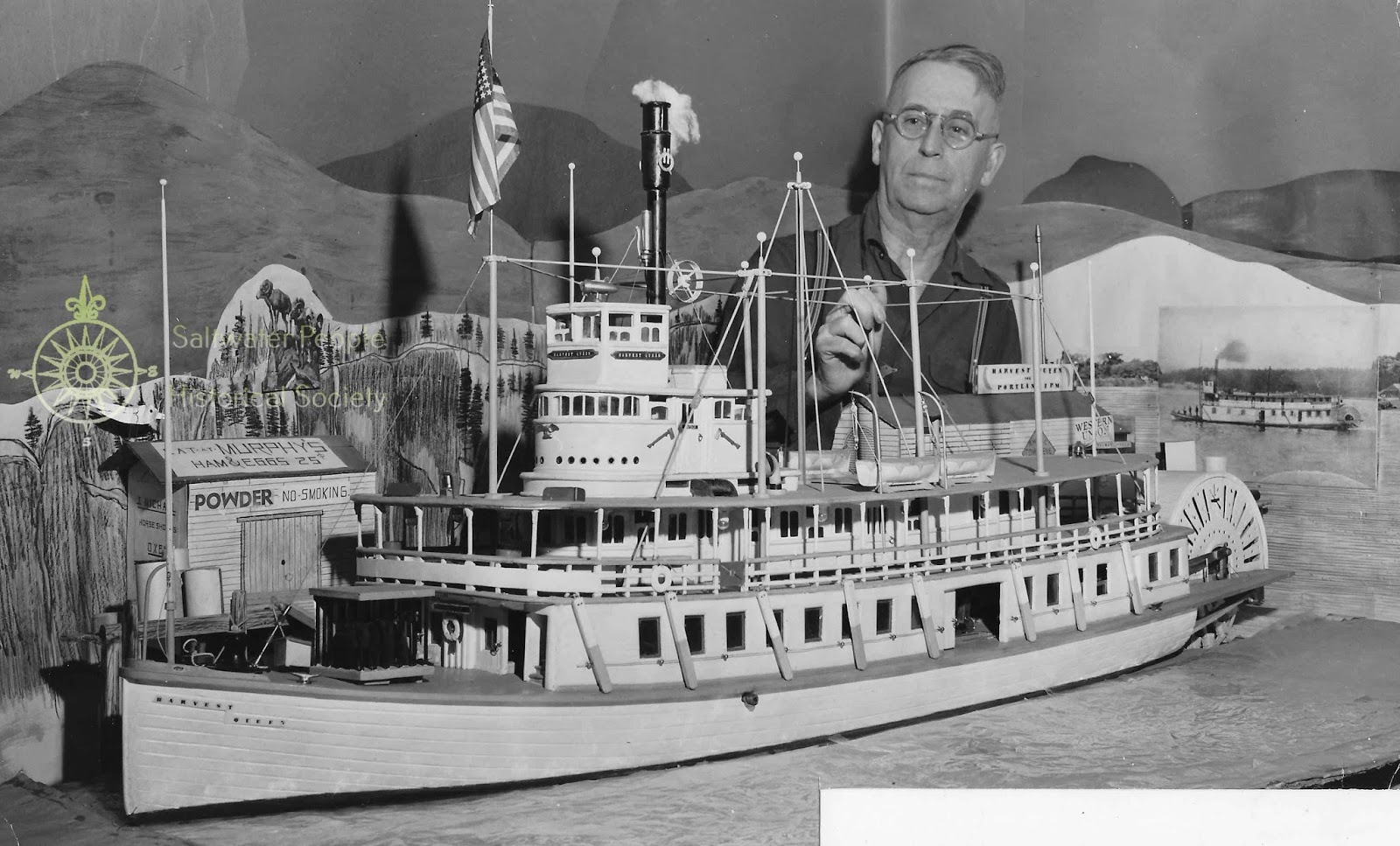
HARVEST QUEEN
6-ft long ship model by Spencer W.Young, 1953.
Young took 13 months to make the craft of birch, oak, pine, and
mahogany. Boilers and twin engines drive walking beams,
11" long, that turn the paddlewheel. The lounge is furnished
with a grand piano, armchairs, tables, all to scale.
LIghts come on in cabins and smoke pours from the stack.
Unknown photographer.

Original photo from the archives of
the Saltwater People Historical Society©
1928: Capt. Troup had a truly great maritime career that closed with his retirement at age 73 years of age––having passed the age limit set by BC Coast Steamship Service by 8 years.

05 November 2016

❖ JOAN LOWELL and her HOAX WITH A MORAN BROS. SCHOONER ❖

Fiction creeping into the Non-fiction: 
Readers were "had." 
Actress, author, Joan Lowell (1902-1967)
and father Capt. Nicholas Wagner

with Capt. Jack Apple on board their 48-ft
Schooner BLACK HAWK.
Original photo from the archives of S.P.H.S.©

Words by legal historian Molly Manning.
From: The
Legal Historian.com 14 May 2012.
The theatrics are from New York and California; for a connection to home, the schooner was built by Moran Shipyards, Seattle, WA.

Schooner MINNIE A. CAINE
Launching 1900 

at Moran Brothers Shipyard, Seattle, WA.
Photographer unknown,
Washington Rural Heritage site.
      "In 1929, Simon and Schuster, along with a myriad of readers and reviewers, developed a keen interest in Joan Lowell, whose recently published a book––Cradle of the Deep––told of her harrowing adventures on the high seas as she traveled with her father in his glorious four-masted ship. Her book's foul-mouthed accounts of being the only female on a ship full of hardened sailors, of learning life's lessons (including how to swim, which occurred after she was literally thrown into the ocean to see whether she would sink or stay afloat), and fighting for survival was shocking, engaging, and page-turning.
      When the New York Times reviewed the book, it sang its praises. The book was deemed a "jolly yarn," told with "dash and ardor" and a "vocabulary as replete with expletives as one will encounter at sea or in a highly modern Broadway show." Although the Times noted that the book seemed plagued with dramatics as Lowell described "each and every calamity at sea--shipwreck, scurvy, fire and so on," the reviewer was quick to add that he did not "question the veracity of the sea-going author."
      Oh, but he should have. Nautical experts who read the book found "innumerable flaws" in Lowell's account, including facts that any amateur sailor would not have mistaken. Some were so enraged that it was said that they 'called upon Heaven, Homer, and Herman Melville to witness that she didn't know her ship's lee scuppers from a marlinspike."'The truth was soon revealed that Lowell grew up exclusively on dry land in California, not on a ship.

Simon and Schuster 1929
Schooner MINNIE A. CAINE, 1929.
A pictorial refutation of one of the two statements
made in Joan Lowell's Cradle of the Deep.
The schooner is moored 
to her dock in Oakland, CA,
 that proved the ship did not burn and sink,
  as related in the book.
Original World Wide photo dated 8 April 1929.
From the archives of the S.P.H.S.©
      Lowell's publisher and her readers had been "had." Not knowing before publication that it was entirely make-believe, Simon & Schuster was forced to offer a refund to its fooled readers (as the first printing was 75,000 copies, the refund was a costly punishment). Further, since the book's true nature was not discovered until after the Book-of-the-Month Club recommended it to its members, the hoax's repercussions leaked into the courtroom as this book club was publicly ridiculed and criticized by powerful figures in the book world, which resulted in litigation.
Joan Lowell
Aboard BLACK HAWK, 1 April 1933,
attempting a circumnavigation with her father
Capt. Nicholas Wagner. They got as far as Guatemala.
      Lowell seems to have escaped her mischief unscathed, as she continued to write and even starred in a movie of her own making. In 1934, her film, Adventure Girl, was shown in theaters; the movie supposedly re-enacted her adventures with her father and his crew while on board a schooner headed for the West Indies and Central America. Lowell was said to have created the film to lend credibility to Cradle of the Deep––but there was no redeeming the latter after it was exposed for the hoax it was. Lowell never abandoned her tales of navigating the seas; it almost seems that she spent most of her life trying to revitalize her first fictitious book about such adventures. She even married a sea captain in 1936 and sailed with him to Brazil, where they built a home in the jungle. Her attempts to escape from her hoax were unavailing--even twenty years after its publication, the book- world still reeled from her shenanigans--Cradle of the Deep was declared "one of the most violent literary controversies of modern times" in 1952.
      Should Lowell's hoax be considered harmful or hilarious? Should it be taken seriously or with a sense of humor?"


Below, Anne Colby writing for the L.A. Times, 2008:

In an interview at the time, Lowell maintained that a writer's primary obligation was to provide readers with color and excitement: "Any damn fool can be accurate––and dull."
She never admitted deceit, and though the scandal followed her, it didn't put a halt to her literary adventures.
1936:
Lowell moved to the jungles of Brazil where she died in 1967.

31 October 2016

💀 AT THE TOMB OF THE CAPTAIN 💀 1967


The tomb of Captain Bligh (1754-1817)
St. Mary-at-Lambeth, London, England.
Photo dated verso 12 August 1967.

Click on photo to enlarge.
Original photo from the archives of the S.P.H.S.©

In an ancient churchyard, the descendants of Captain William Bligh and Mr. Fletcher Christian, who started the famous mutiny on the BOUNTY, in 1789, met and made up. 
      Before Bligh's restored tomb at St. Mary-at-Lambeth, London, they shook hands and agreed that old Bligh wasn't such a bad chap after all. Just difficult to get on with. 
      The occasion was a service to commemorate the 150th anniversary of Bligh's death [1817] and the repair of his tomb, damaged by wartime bombing and vandals. Representing Captain Bligh was Mrs. Clifford Tetley (nee Bligh,) of Wendover, Bucks. She is Bligh's niece, immeasurably removed, and her family have cared for the famous man's grave for 30 years. 
       Appearing for Mr. Christian was his great-great-great-great grandson, Mr. Glyn Christian, a 25-year old actor-writer from New Zealand, now living in London. 
      The Rev. Oliver Fiennes, rector at the church, said a short prayer for those in peril at sea. 
      And Mr. Christopher Lloyd, a naval historian, complained that Bligh had become 'one of the most maligned figures in British history.' 
      Although he was a brilliant navigator and sailor, all this seemed to have been forgotten and his name was synonymous with brutality and tyranny. Afterward Mrs. Tetley and Mr. Glyn Christian agreed that this was a great pity and that something ought to be done about it. They also said it was silly to keep on with the quarrel over the mutiny that had split their families for generations.
For more 'bio' on Captain Bligh CLICK HERE

26 October 2016

⛵️ VESSELS SPIRIT II, SIR TOM, and the GENIUS OF DESIGNER/SAILOR TED GEARY ⛵️


SPIRIT II

48' x 28' with 1,275-ft of sail.
Built by Adolph Rohlfs and Merrill at their 
new plant on the East Waterway.
Photo dated,  8 June 1909
Seattle, WA.
Click image to enlarge.
Photographer unknown.

Photo from the Carl Weber Collection,
Archives of the Saltwater People Historical Society©
 

SPIRIT II, 1909

Ted Geary, 1885-1960 (center)
designer, helmsman
with Dean and Lloyd Johnson

ready for launching, Seattle, WA.
click image to enlarge.
Photographer unknown.
From the Carl Weber Collection, 
Saltwater People Historical Society©


SPIRIT II

Dated 29 June 1909
Seattle, WA. 
Photographer unknown .
Carl Weber Collection,
Saltwater People Historical Society©

"I never heard from my father––or anyone else––when or how he and Ted Geary and the Griffiths boys all got together as young sailors, but it must have been shortly after Dad built the WINONA. Ted Geary, whose full name was Leslie Edward Geary, was born in Kansas in 1885. When he was still a boy the Geary family moved to Portland, and soon on to Seattle, where Ted grew up on the waterfront. Two of his childhood friends were Dean and Lloyd Johnson, who later became my dad's partners. In fact, Ted and the Johnson boys circumnavigated Seattle in a sailing canoe sometime before the turn of the century, and at that time, the feat required portaging between Salmon Bay, Lake Union, and Lake Washington.
      Ted went to high school at the old Broadway High on Capitol Hill, and I think he was probably designing boats even before he graduated in 1904. After he finished high school he enrolled at the U of WA, and in 1907, joined the Seattle Yacht Club when it was still known as the Elliott Bay Yacht Club.
      The first yacht design that really brought Ted any acclaim was for the SPIRIT, launched in 1907. SPIRIT II was launched two years later. Ted designed her while still at the university, and she was built mostly by the Johnson brothers in a former firehouse on the top of Queen Anne Hill. A fire station bay in those days was about the right size to build a fairly good-sized boat. The SPIRIT was a 42-ft sloop, built to challenge the Canadians for the Dunsmuir Cup, and, skippered by Geary, she beat the Vancouverites entry, the ALEXANDRA, and won the cup from the Canadians in 1907.
      The next year, the SPIRIT lost to the ALEXANDRA, so the SYC commissioned the SPIRIT II in 1909. Well, this second design was to the then-new Universal Rule, developed by Nathanael Herreshoff. And what Geary did was design the SPIRIT II with a keel that went from nothing and then was not totally straight down, but steeper than most. Practically all the English keel designs, like the Canadians' ALEXANDRA, were the long, sweeping profile. So the SPIRIT II beat the Canadians the next season.
      In fact, I heard that they got so badly beaten that the measurer demanded that the SPIRIT II be hauled out so he could measure it, and he called this slight variation in design a notch in the keel. The first measurement was made in the notch. Of course, it wasn't a notch at all, it was just kind of a corner. There've been thousands, tens of thousands, of boats built like this since. But this episode caused a rift between the Canadians and the Americans that was not patched up until 1912 when Sir Thomas Lipton visited Seattle and brought about a truce.
      Around 1907, Geary left Seattle to study naval architecture at MIT. He returned to Seattle in 1910 with a degree in naval architecture and soon had many commissions for yachts as well as work boats.
      Ted Geary could make a sailboat sail faster than anybody else. He was probably the savviest helmsman on the west coast. He could sense changes in wind, things like that, with incredible accuracy. So for a good ten or eleven years, the SIR TOM was never beaten.


SIR TOM

L.O.A. 38'+ L.W.L. 23'-0" x 7'-10" x 5'-6"
Displace 8,500 lbs;
Lead Keel 4,500 lbs.

Sail area 400 sq. ft.
Rating 19.99
Built by the Johnson brothers
and Blanchards.

1914-1956
Seattle, WA.

Throughout most of her racing days,
she was skippered

by her designer, Ted Geary.
back-stamp date of  July 1937.

Original photo from the archives of the
Saltwater People Historical Society©

 WW I interrupted competition in sailing, so when the war was over people were anxious to get sailing and racing going again. I recall it must have been in the early spring of 1919 when one Sunday a bunch of the fellows came over to get my dad and go down and have a look at the SIR TOM, which was sitting on the ground leaning against a fence at some commercial shipyard down on the waterfront. I was included in this expedition, and I don't remember why, because I was still pretty young. So we went down to this shipyard, and the TOMMY was sitting there with the entire first 18 or 24 inches of her bow missing. During the winter of 1916 and '17, there had been a record-breaking northwest wind and freezing conditions, and quite a few of the fleet at the SUC had broken loose. Some of them would up unharmed on sandbanks, but more of them were badly damaged, and the SIR TOM had pounded her snout off on her mooring float.
      This was a big shipyard, but at the time it was more or less down to a maintenance crew. They had steam locomotives in those yards and it was no problem for the yard to fire up one of the steam locomotive cranes on a weekday and set the TOMMY back in the water. Quent Williams or somebody with a power boat picked her up and brought her up to the Blanchard Boat Co. They built a new nose on her, and that first year, 1919, she still sailed with her gaff rig. 
      The Vancouverites had a brand new boat called the LADY VAN, and she was a hard- chine design. She was designed by someone up in Canada, and Geary was successful in shipping both boats down to California, so right away he could see the handwriting on the wall; he had to put a new rig on the TOMMY. At that time, in the early 1920s, the original syndicate that owned the SIR TOM was pretty much intact, and old Capt. James Griffiths would say, "C-mon now, you're going to put up another $150 so Norm can build a new mast for the SIR TOM."
      In 1922, the Pacific Coast Championship Regatta was held in Newport Harbor, CA. My dad had built a cradle for the SIR TOM and she was towed afloat down to the Pacific Coast Steamship dock for the trip to CA. I think they put her on the EMMA ALEXANDER. We were there and the boat did not have lifting eyes at that time, so they used automobile slings and spreaders and lifted her into her cradle.
      The races were off Newport Beach, which was nothing much but a beach. Newport Harbor had been made by dredging out a natural salt-water marsh. The big red interurban cars ran on standard railroad track out to the end of the peninsula, where they made a circle and stopped. About 50 or 100 yards from the end of the peninsula was the Newport Harbor Yacht Club. It was about the size of a triple garage, big enough for a bar and not much else.
      The SIR TOM won all three races and was still the west coast R Class champion. Geary's career blossomed. In addition to commissions to design working boats, he had considerable success with bigger motor yachts after the SAMONA was built, and to name a few, the ELECTRA, the CANIM, the PRINCIPIA, the BLUE PETER, but those boats were all built at the Lake Union Dry Dock. He also turned out some fine sailboats like the schooner KATEDNA, which we know as the RED JACKET. And in 1927, he designed a new class of small sailboat for the juniors. These Flatties, as they were called, were built at the Blanchard Boat Co.
      Ted continued to work in Seattle as a naval architect until after he married for the second time in 1927. His success continued in S. California. He designed the big, steel-hull yacht in 1930 for John Barrymore, that we know as the THEA FOSS.
      The last time I had a good contact with Ted was when he came up here to design the new rig for a MALABAR VII, a John Alden-designed schooner. I had redesigned a 22-ft Phil Rhodes sloop into a 25-footer, so Ted came over and laid out the sail plan for me, and we had a nice visit. Ted passed on in 1960; he was undoubtedly the finest helmsman I ever sailed with and had the pleasure of knowing."

Words by the well-known boatbuilder/mariner Norman C. Blanchard. 
Knee-Deep in Shavings. Victoria, B.C. Horsdal & Schubart. 1999.


22 October 2016

❖ HISTORIAN TRICK in SAN FRANCISCO ❖

"Plate of Brasse"
This brass plate, engraved with what purported to be
Francis Drake's 1579 claim to Nova Albion,
became California's greatest historic treasure
when it was found and authenticated in the 1930s.
It turned into the state's greatest hoax when it was
retested forty years later.
(Courtesy Bancroft Library)

"By the grace of God and in the name of her majesty
Queen Elizabeth of England and her successors forever
take possession of this Kingdome whose King and people freely
reign their rights and title in the whole land unto herr majesties
keepeing now named by me and to bee knowne unto all men
as Nova Albion. Francis Drake."
Photo dated 7 April 1937 from the archives of the S.P.H.S.


    At a press conference today (Tuesday, 18 Feb. 2003) at the University of California, Berkeley, the researchers revealed what may be the final chapter in the story of a brass marker dubbed "Drake's Plate." The plate was discovered in 1936 and purportedly recorded the California coastal landing in 1579 of English explorer Francis Drake and his ship, THE GOLDEN HIND.
          It passed muster at the time of its discovery and was proudly acquired by the campus's Bancroft Library. However, scientific testing 40 years later determined it to be a fake.
          Among the newest findings was that the hoax:
    Was created by a group of respected Bay Area men active in history and the art world;
    Was an elaborate joke that got terribly out of hand;
    Was successful despite indirect warnings that the plate was a fake.
          Researchers Edward Von der Porten, a nautical historian, archaeologist and retired maritime museum director; Raymond Aker, a maritime researcher who died earlier this year; Robert W. Allen, a historical researcher and educator; and James M. Spitze, an amateur historian, have published these findings and more in the latest issue of California History, a California Historical Society publication.
          Their conclusions may surprise many Golden State history buffs who accepted the long-circulating story that the playful E Clampus Vitus historical fraternity, also known as the Clampers, was responsible for the prank. The group has bristled at the accusation.
          While acknowledging they lack a "smoking gun," lead author Von der Porten and his fellow researchers cite a wide range of sources that they say point the finger at a band of well-established and respected gentlemen of the day - only one of whom was known to have been a Clamper.
The cast included:
  • G. Ezra Dane, a prominent member of the Clampers and of the California Historical Society. He instigated the hoax. 
  • George Haviland Barron, curator of California history at the de Young Museum in San Francisco until 1933 and a leading member of the California Historical Society. He designed the fake plate. 
  • George C. Clark, an inventor, art critic, appraiser and friend of Barron's, who engraved the plate. 
  • Lorenz Noll, an art dealer and restorer, and Western artifact dealer Albert Dressler. They are believed to have helped with the fluorescent lettering "ECV" applied to the back of the plate. 
  • Herbert E. Bolton, who was director of The Bancroft Library from 1920-1940 and Sather Professor of American History. He also was, like Dane, a member of the California Historical Society and the Clampers. Fascinated by stories about Drake posting a brass plate to mark his entry into California, Bolton was known for telling his students to be on the lookout for it when in Marin County. The plate's appearance fulfilled Bolton's dream, and he was thrilled to acquire it for The Bancroft. 
      Sport brought these men together, although Bolton was unaware of the game. "Spoofing its own members was an accepted part of Clamper fun, and the distinguished Professor Bolton was a tempting target," the researchers said.
      But the organization's leaders did not sanction the joke, so Dane sought assistance from Barron, Clark, Noll and Dressler, the writers said.
      Barron designed the plate, borrowing most of the text from "The World Encompassed by Sir Francis Drake," a detailed account of Drake's voyage that was first published in 1628, with reprints available in the early 1930s.
      Barron's friend and neighbor, Clark, reportedly designed the layout for the plate and chiseled the lettering.
      The plate was fashioned from common brass, with text carved with a chisel and the letters' raised edges hammered down. Then, the plate was heated over a wood fire to create a dark patina. It was hammered once more, darkened more with dirt, ash and possibly more chemicals, and possibly subjected to fire once again and buried for a time.
      Then one of the conspirators - the authors believe it was probably Dane in cahoots with Noll and Dressler - labeled the plate a Clamper prank by painting "ECV" on the back with fluorescent paint.
      
All the handiwork paid off, even more than they had planned, the researchers write: "...the realization that Bolton was almost unquestioningly supporting the plate's authenticity must soon have changed jubilation to shock, and quickly, deep concern. Their inside joke, intended to be resolved with a good laugh over a dinner table or at a Clamper meeting, had escaped from their control."
      It was of major significance that Bolton was not the only one conned. Among others also taken in was Alan Chickering, a lawyer and president of the California Historical Society and other society officers and members who donated $3,500 to buy the plate for the library. The historical society's directors, who authorized publications about the plate, also were fooled.
     The tricksters and most of the hoaxed all belonged to the same small world of California history enthusiasts, the researchers said, making a public confession very difficult. Though the tricksters tried to warn Bolton indirectly, he disregarded the warnings.
      About a decade after the plate was found, Lorenz Noll told Albert Shumate, a San Francisco doctor, California historian and longtime leader of the California Historical Society and the Clampers, what really happened. He said that Barron, Dressler, himself and others were involved in what Shumate characterized as an elaborate joke that got terribly out of hand.
 
      After Dane, Barron and Clark died in the early 1940s, and Bolton in 1953, Noll began opening up with his story to a somewhat wider circle, the researchers say. When Noll confided to the editor of The Pony Express, the editor convinced him to dictate a statement, which was typed and signed by him in May 1954. He identified Clark and Barron as the plate's creators, and Noll just listened.
      Officials at The Bancroft Library called the new California History article very persuasive.
      This research "may well be the final chapter in this great mystery," said Stephen Becker, director of the California Historical Society. He commended the researchers "for their excellent scholarship, for setting the story straight, and helping us all enjoy this wonderful tale of historical fact and fiction."

The phony plate become a centerpiece of the 1939-1940 Golden Gate International Exposition on Treasure Island, and photographs of it appeared in textbooks and popular magazines. The discovery location on San Francisco Bay also set off 50 years of fierce debate about where along California's coast Drake really landed.
      For all the confusion and misinformation surrounding the plate, the California History article authors said the hoax has had positive impacts that include increased public awareness of the state's explorer-era history and a wide range of related research.
      The fake plate will remain on display at The Bancroft Library, but the real thing, researchers say, may still lie deep beneath the water, rocks and sand of Drake's Bay.
Above text by Kathleen Maclay/ UC Berkeley News 18 Feb. 2003.
1977:
Berkeley Lab's Nuclear physicists Frank Asaro and Helen Michel demonstrated that the Plate of Brass, a much-celebrated artifact said to have been left on the California coast by Sir Francis Drake in 1579, was not authentic. Neutron activation analysis showed that zinc content was too high and the impurity levels too low for sixteenth century English manufacturing techniques. The brass in the plate, which was found under a rock in 1936, was most likely manufactured no earlier than the first half of the nineteenth century.
Berkeley Lab Science Beat 2 Dec. 1999


Archived Log Entries