"The Cure for Everything is Saltwater, Sweat, Tears, or the Sea."

About Us

My photo
San Juan Archipelago, Washington State, United States
A society formed in 2009 for the purpose of collecting, preserving, celebrating, and disseminating the maritime history of the San Juan Islands and northern Puget Sound area. Check this log for tales from out-of-print publications as well as from members and friends. There are circa 750, often long entries, on a broad range of maritime topics; there are search aids at the bottom of the log. Please ask for permission to use any photo posted on this site. Thank you.

30 January 2017

❖ MOSQUITO FLEET MONDAY ❖ H.B. KENNEDY

Steel Mosquito

H.B. KENNEDY

206030

Built in 1909 by the Willamette Iron Works,
Portland, OR.
499 G.t. / 216 N.t.
170.2' x 28.1' x 11.3'
4 cyl. triple-exp engine,
18 1/2, 27 1/2, 34, 34, with
steam at 350 lbs working pressure
and developing 2,000-HP.
(1924 she was renamed "SEATTLE")
Click to enlarge.

Original photo from the archives of the S.P.H.S.©
Photograph by Webster & Stevens.
"Rate wars and rivalries represented only the exciting and colorful sidelights of the development of inland water transportation in the Puget Sound region as it approached its glory days and subsequent swift decline. More significant events in the affairs of Joshua Green and Charles Peabody [Puget Sound Navigation Co] transpired during the first decade of the 20-C, although with less publicity.
      (Joshua Green, in his words, was the largest individual stockholder of the company from the time of its formation in 1901 until he sold his stock to Capt. Alex Peabody and associates in 1927.)
      In 1908 the PSNC had taken over Colman Dock at the foot of Marion Street. This pier, its ornate Victorian clock tower and domed waiting room roof providing a Seattle waterfront landmark, remained headquarters of the company's steamers throughout the rest of the steamboat era, and through the decadent days of the automobile ferries which replaced them.


H.B. KENNEDY
206030

Litho postcard from the archives
of the S.P.H.S.©

The first brand-new steel steamer was placed under company operation when the 179-ft H.B. KENNEDY was completed at Portland for the joint Kennedy-Puget Sound Navy Yard Route. The handsome two-stacker came up the coast under her own power, commanded by Capt. W.E. (Billy) Mitchell, in command for her first 8 years of operation, a total of 408,000 miles. She knifed her way up the Sound from Port Angeles to Seattle at better than her specified speed of 22-mph. That afternoon, with a party of company officials on board, the KENNEDY continued to show off, chasing the INDIANAPOLIS that was minding her business on the regular Seattle-Tacoma run, and passing her up amid much derisive whistling. Capt Penfield, who was still being humiliated by the FLYER, didn't much appreciate the gratuitous insult from a fleet-mate and Joshua Green didn't quite approve of the performance either. H.B. Kennedy, a more flamboyant type, was enjoying the proceedings so thoroughly, however, that he didn't have the heart to expostulate––and he was impressed with the KENNEDY's speed, and by the fact that, at normal cruising rates, her modern engines consumed little more fuel than some of the smaller and slower steamers of the fleet.
      The KENNEDY wound up the day's festivities by lying in wait in Elliott Bay for the FLYER to come in from Tacoma. She then pranced out, all flags flying, to challenge that notable old champion. Captain Coffin was already slowing down for his landing, the FLYER was blowing off steam, and he disdainfully ignored the gaudy newcomer.
      Like the giant Diesel-electric 'super ferries' that have taken over her old run to Bremerton, the H.B. KENNEDY suffered a number of minor mechanical difficulties during her shakedown period, but when these were solved, she continued to perform her duties efficiently and just as rapidly as the maritime marvels of sixty years later. 
      Early in her career, the KENNEDY was diverted to the Moran Shipyard for tests and inspection, for Joshua Green was dickering with that firm on the possible construction of more modern steel steamers. She was raced over the measured mile course at a speed of over 21-mph, with Green, Manager Frank Burns and J.W. Paterson, manager for the firm which had taken over the Moran yard, checking her performance carefully.
      Paterson convinced Green that the Puget Sound yard (soon to be named Seattle Construction & Drydock Co) could build steamers just as good as the KENNEDY and could meet or beat Portland's prices. Always a great booster for his adopted home town, Green placed orders with Paterson. The result over the next three years, was a new fleet of handsome and efficient, if not gaudy, home-built Sound packets that were to carry the PSNC house flag throughout the remainder of the Steamboat era.
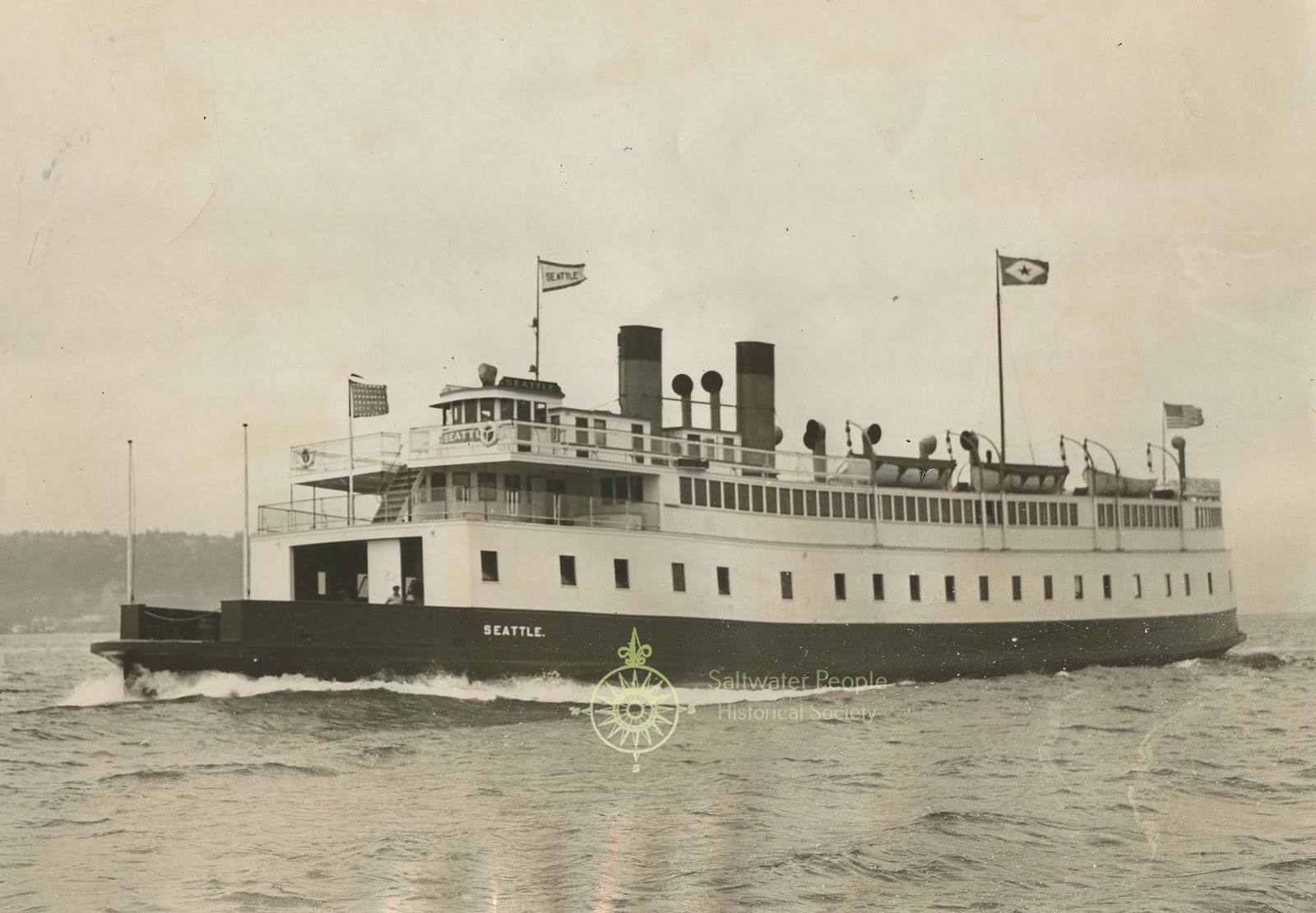

FERRY SEATTLE (ex-H.B. KENNEDY)

Photo is date stamped 5 May 1924;

The Navy Yard Route's new ferry.
She was scrapped in 1938.

Photographer unknown.
Original photo from the archives of the S.P.H.S.©

       In 1924, the H.B. KENNEDY became the steam ferry SEATTLE with the conversion being done at Todd Shipyard."
The [Joshua] Green Years. Newell, Gordon. Superior Publishing Co. 1969
      "In 1938 the newly acquired Diesel ferries came up from San Francisco, the KEHLOKEN (ex-GOLDEN STATE), entered service replacing the steam ferry SEATTLE (ex-H.B. KENNEDY), the latter vessel being laid up. Although the replacement of the old steamer of 1909, vintage by the modern Diesel-electric craft, was generally viewed as an example of maritime progress, a few malcontents persisted in pointing out that, whereas the handsome old SEATTLE had operated quite smoothly at a speed of 17.4 mph, the new KEHLOKEN, a remarkably ugly craft, progressed with considerable vibration at a rate of 14 mph." The H.W.McCurdy Marine History of the PNW. Newell, Gordon. Superior Publishing. 


26 January 2017

❖ The Familiar Put-Put of the Island Launches ❖ with June Burn

SAN JUAN II
ON 210893
Built in Bellingham, WA.
58.3' x 13.9' x 6.4'

41 t gas passenger/freight propeller,
Indicated HP 100.
1913-1929

Photo scan courtesy of Charles Torgerson,

descendent of Willard Maxwell who started the 
San Juan Transportation Company, the crew 
awarded the mail contract for c. 40 years.

     "In the middle of the narrow swift-running tidal river of Johns Pass, between beautiful Johns Island and Stewart. Still aboard the SAN JUAN II. We are whistling for somebody to row out to the boat and relieve it of its note-taking passenger. Nobody comes, though my old neighbor's boat swings at his float. He is up in the swamp, maybe. We'll have to go on to the next island and whistle for a lift––no, the good captain skillfully noses his boat into Dad's small float. Homer goes down and helps my small son, South Robin, and I off the boat, and here we are! (How it always delights one to catch or leave a boat in the middle of a channel or far out from any dock. As if somehow the world were still the simple, friendly, unhurried place they say it used to be. I know well enough that the boat's crew can quickly get enough of that sort of thing, but it is fun while it lasts!) 
We set our bags and typewriter onto the PAWNEE, Dad's boat, and wander off up the dusty farm road to look for the master of the farm. There comes Dad in the clumsy wagon driving old Barney! He has been up to the swamp with grain for the turkeys fattening them for the Thanksgiving market. We climb aboard and sit talking of gone days. The sea laps the beach a dozen yards from us, lolloping in and out of the potholes of the sandstone formations. How good it smells! Dad says he sits at his window during winter storms watching the spray and sniffing that fragrance of salt water and seaweed. The people who live on the islands say very little about the romance of their home, but when you do get them talking about the water, and boating, and beaches, and agates, you discover there is a very positive appreciation of the beauties around them. 
      We go down to the boat to chug over to Speiden, the headquarters of this big farm sprawled over three islands. We'll go by the reefnets and watch them fish awhile.
      Oh, the familiar put-put of the little island launches, the smell of their exhaust, foul but somehow agreeable. The boats are twenty-thirty feet long, but there is no room on them. The engine with its oil and noise quite fills the cabin. The tender rides the afterdeck. The pilot stands at the wheel. If there is a passenger he rides in the seat of the tender if the weather is fine or hunkers down inside with the engine if the weather is rough. Roomy the boats look, but there is really no room for them at all. When outboard motors will do the work of inboards they will be enormously popular for the inboard engine is a hog for room.
      The near slopes and bluffs stroll leisurely by as we swing out and around the point to the reefnets on the south slopes of Stewart Island. The incomparable thrill of being home again. Bellingham, I love you––jolly, friendly, cordial, lively little city that you are––but I love the islands more!

June Burn loved the Islands,
the people of San Juan County loved her in return.

Click to enlarge.
From the archives of the S.P.H.S.©


The long, white graveled beaches and lush green ravines, the rocky bluffs and steep hills, the little coves, the fields of kelp, the smooth fair waters or the white madness of wind-blown channels; the grain fields and fishing banks; the flowers and birds and romance––but we are at the fishing grounds!
      One gear has already been lifted for the year, two others fishing now. Four, long, slender fishing boats lie out there on the water just outside the kelp field, the nets swung between each two boats, the leads running out fifty or more yards, spreading as they go. From the wooden floats of the leads hang lines that serve to direct the fish down the narrowing runway over the nets.
      One man in each boat stands on a high box from which vantage he can see deep into the water and know when the fish are coming down the road, bound lickety-split for his net. He gives a signal to the other members of his crew that the fish are coming, bids them be ready, tells them when to begin lifting the net and directs the speed of their lifting.
      At the gear furthest up towards the bay, Indians fish. General's thirty-foot canoe with its long, slender up-thrust bow and stern holds Willie Jim, maybe or Joe, with his two 16-year -old Indian girl helpers. In the other skiff fat old Isaac sits on the high box as watcher, while General (Major General Scott is his full given name) and one other man sit waiting for the signal.
      At the gear that I am watching, Art and Louis stand at the bows of their respective boats. The helpers are gone. Dad gets into Art's boat to be ready to help in case the fish come. I wonder what they would have done if we hadn't come along, for two men cannot easily handle a net full of fish.
      *  *  *  *  *
      Suddenly, the three men stiffen as if electrified. "Tu-tu-tu-tu-tut" Art begins to shout, which interpreted means "Here come the fish!" "Not yet!" he shouts. "Now!" and "Slow boys! Slow, now! Now they're in! Haul her in, fast! Uumph, umph, umph!" the men grunt as they haul the net up. The towboats come together slowly, the fish wiggling and leaping in the net.
      "Altogether, boys! Over with them! There goes a big fellow overboard––catch him, Louis! Ah-h-h!" as the net is emptied over into one of the boats––the one least full of fish. It is the end of the season and few fish are being caught. This is the only haul of the day, the boys are delighted to get even these few that leap and flop and squirm in Art's boat beside which I sit in PAWNEE's tender.
      Once this summer, the boys say they had 1,600 salmon in the boats, 800 of them having been hauled in at once. What shouting and yelling, and pulling, and tugging there must have been that day! What a shining silver mass of salmon! What leaping overboard, what flopping and slithering! It is a thousand wonders the net didn't tear, so old and black it is.
      The fish buyers come along every day and twice a day during the big run. Men hip-deep in fish, pitchfork the "shining apostrophes" from the 40' fishing boats into the fish buyer's barge, whence they are once more pitchforked into the receiving places of the cannery.
      So much for reefnet fishing. See you tomorrow. June." Puget Soundings. June Burn.1929


23 January 2017

❖ MOSQUITO FLEET MONDAY ❖ CHIPPEWA––AGROUND NEAR CAPE HORN ❖


STEAMER CHIPPEWA

127440
Dressed ship for her first run
to Victoria, BC.

Moored in front of the Empress Hotel.
Original photo from the archives of the S.P.H.S.©

Once a splendid, twin-stack, passenger steamship launched in Toledo, Ohio in 1900, the CHIPPEWA was designed to run as a fast commuter ship on the Great Lakes. She did so for seven years before a sale was negotiated by Joshua Green of the Puget Sound Navigation Co. with Arnold Transportation Co. Green's partner, Charles E. Peabody, negotiated to purchase two other steamers, the INDIANAPOLIS and the IROQUOIS.
      A mechanical overhaul was done on the CHIPPEWA at Hoboken prior to the departure on the afternoon of 18 February 1907, Capt. McClure, commanding and C. F. Bishop as chief engineer.
      On her trip west to Seattle, she traveled 17,500 miles on the Cape Horn passage. She spent 54 days, and 17 hours of actual running time with some extremely rough weather in the Strait of Magellan.
      Trouble began soon after the New York harbor pilot was dropped. Fires started throughout the ship as seawater shorted out the electrical cables. The navigating lights went out, the boiler injector pipes began to leak, pipe joints blew out and the forward bulwarks were stove in. "Everybody is sick and everything going wrong," wrote Bishop in his engine room log. Saltwater kept getting into the boilers and it was necessary to shut one of them down completely for much of the voyage. On 24 March, just south of deadly Cape Horn at the entrance to the Straits of Magellan, the CHIPPEWA twice went aground; (click on "read more" just below ––

19 January 2017

❖ SILK on a Seattle Dock ❖ 1917

Nippon Yusen Kaisha liner YOKOHAMA MARU
visits Seattle and Victoria.
Complimentary advertising postcard by N.Y.K.
from the Clinton Betz Collection in the archives of the S.P.H.S.©
Click to enlarge.
      The Nippon Yusen Kaisha Line published beautiful art cards promoting their shipping routes to Europe, America, Australia, India, and other parts of the world. This was not the first visit of the NYK to the Port of Seattle, they began doing business in 1898, thanks to quick thinking of Seattle's businessman/mariner James F. Griffith, to be covered in an upcoming post. 
      This NYK shipping news item of 1917, was found listed on the same Seattle Times page as the news item announcing the launch of Robert Moran's auxiliary schooner SANWAN, the latter being researched for a different post.
      Seattle maritime historian, Clinton Betz, in later years, saved a few of the NYK artistic postcards including the YOKOHAMA MARU, the ship mentioned moored at the Great Northern Pier. Let's put the two together to record that day; the NYK art piece and the silk cargo sailed safely to Seattle go nicely together.

      "Silk shipments valued at more than $1,590,000 [USD of 1917] and a general cargo of 4,800 tons are being discharged by the Nippon Yusen Kaisha liner YOKOHAMA MARU at the Great Northern Pier. At Victoria, the vessel discharged general cargo to the extent of 385 tons. The voyage from the Orient was made according to schedule and while the trip was marked by considerable foggy and misty weather, no gales of consequence were encountered." The Seattle Times. June 1917.
      If you missed reading the 1917 SANWAN launching news in the Time-Line , here is a link to the Log entry of Mr. Moran's party day on Orcas Island, San Juan Archipelago.

16 January 2017

❖ MOSQUITO FLEET MONDAY 🍀 The SHAMROCK and the RELIABLE buddies

Steamers RELIABLE and SHAMROCK
Southbend to Nahcotta, WA.
RELIABLE, ON 111423, 

was built in 1902, Astoria, OR.,
for the Willapa Bay Transportation Co (Capt. A.W. Reed.)

Photographer unknown.
Original photo from the archives of the S.P.H.S.©
"Despite the challenge and weather of Washington coast north of Long Beach (served by a fleet of Columbia River steamers,) hardy vacationers flocked to hotels and summer cabins at Westport, Moclips, and Pacific Beach aboard doughty little sternwheelers like the HARBOR BELLE and HARBOR QUEEN and the steamer FLEETWOOD docking at Westport and Cosmopolis.
      Sternwheelers like the ALLIANCE and DOLPHIN were sailing every week from Portland to Hoquiam, Aberdeen, Cosmopolis, North Cove, South Bend, Willapa and Bay Center. The steam launch JESSIE would ferry you to South Aberdeen for a dime.
      In 1908, popularity of Washington beaches and resorts led to daily runs between Portland and tiny South Bend on the Willapa River, requiring two steamers and a short train ride.
S.S. SHAMROCK
ON 201668
Passenger and freight steamer built in 1905 at Astoria, OR
for the Willapa Bay Transportation Co.
G.t. 116 / N.t. 79
72.3' RL x 18.2' x 6.2'
Converted to a towboat in her later years.
In this original photo from the archives of the S.P.H.S.© 
she is seen near Nahcotta, WA.
Click image to enlarge. 
RELIABLE
ON 111423

Built in 1902 at Astoria, OR.
Seen on her South Bend route.
Photo from the archives of the S.P.H.S.©

Returning home, excursionists would board one of the Willapa Bay mail steamers, SHAMROCK or RELIABLE at South Bend, crossing to Nahcotta midpoint on the Long Beach Peninsula. Here trains would carry passengers to connecting OSN steamers docked at Ilwaco, for the relaxing river ride back to Portland. Fare: $4.25.
      In addition to carrying passengers, mail, and freight, the stubby steamers offered weekend cruises to view a wreck or whales. 
      The most festive outing occurred on June 1908, when the steamers rendezvoused for a viewing of the Great White Fleet as it passed off the coast." 
The Atlantic Fleet entering Puget Sound
1908
Romans Photo / Asahel Curtis 1908
Click to enlarge.
Original photo from the archives of the S.P.H.S.©

Above text from: Steamer's Wake. Faber, Jim; Enetai Press. 1985.

Archived Log Entries