"The Cure for Everything is Saltwater, Sweat, Tears, or the Sea."

About Us

My photo
San Juan Archipelago, Washington State, United States
A society formed in 2009 for the purpose of collecting, preserving, celebrating, and disseminating the maritime history of the San Juan Islands and northern Puget Sound area. Check this log for tales from out-of-print publications as well as from members and friends. There are circa 750, often long entries, on a broad range of maritime topics; there are search aids at the bottom of the log. Please ask for permission to use any photo posted on this site. Thank you.

27 April 2012

✪ BOOK REVIEW: The Log from the Sea of Cortez ✪


The Log from the Sea of Cortez
John Steinbeck
(New York: Viking, 1951)
The log from the Sea of Cortez [Book]
We have a book to write about the Gulf of California. We could do one of several things about its design. But we have decided to let it form itself: its boundaries a boat and a sea; its duration a six weeks’ charter time; its subject everything we could see and think and even imagine; its limits—our own without reservation.
We made a trip into the Gulf; sometimes we dignified it by calling it an expedition. Once it was called the Sea of Cortez, and that is a better-sounding and more exciting name....
      We said, “Let’s go wide open. Let’s see what we see, record what we find, and not fool ourselves with conventional scientific strictures.” (The Log from the Sea of Cortez, Introduction, pp. 1-2).
      And in this way and in this frame of mind did John Steinbeck and his good friend, marine biologist Ed Ricketts, set out on an off-season fishing boat for a 4,000-mile voyage from Monterey around the Baja peninsula to see what they could see and write about it in the spring of 1940.
It was an uneasy time in the United States for anyone aware of the gathering storm already underway in Europe and Asia. The violence and pointless destruction of war are ever-present in the back of Steinbeck’s mind even as he is escaping from the reach of newspapers and newsreels. “Hitler was invading Denmark and moving up towards Norway; there was no telling when the invasion of England might begin; our radio was full of static and the world was going to hell.” (Steinbeck, p. 7)
Steinbeck’s mind roamed the world and the history of humankind, even as his eyes and hands were occupied with the business of collecting samples. Plenty of marine biology took place on the trip. Thousands of specimens were dipped up in nets, pried off rocks, and harpooned after the boat turned left at the corner of the tip of Baja and made its way slowly north. The log offers full details of the common and Latin names of the specimens, their customary habitats, and their taxonomy (the contribution, no doubt, of  Ricketts, who was listed as co-author on the earlier, unabridged version of the story, Sea of Cortez: A Leisurely Journal of Travel and Research. New York: Viking, 1941). But both as individuals and as members of functional ecosystems, the marine organisms inspired Steinbeck to poetic description, forays into word origins and mythology, analysis of their design and purpose, and philosophical reflection comparing their lives and communities to human ones.
      Aquariums, tanks, and trays filled the hold of the 76-foot WESTERN FLYER. Neither Steinbeck nor Ricketts had ever attempted this sort of prolonged scientific expedition before, and much of the trip was a series of experiments, missteps, and disappointments in trying variously to keep the specimens alive (for observation) or to kill and preserve them without destroying their distinctive forms and brilliant colors. There were problems with equipment—notably, the outboard motor for the small shore boat that refused to work except when removed for inspection and installed in a bucket—and both the still and film cameras produced poor images in the rare instances when there was anyone with dry hands free to use them.
      There were the usual sorts of squabbles you’d expect among a group of men (which included Steinbeck, Ricketts, the boat owner and captain, an engineer, and two Italian fishermen hired in Monterey), sharing a small, hot, and fishy space together for weeks. Tensions grew when the store of liquor ran out and when fresh food or delicacies found their way aboard; crew members were occasionally mutinous about doing dishes, frustrated by faulty equipment and the efforts to collect, or testy from lack of sleep. At one point, Steinbeck dryly admits that, “all collecting trips to unknown regions should be made twice; once to make mistakes and once to correct them.” (Steinbeck, p.10)
      The WESTERN FLYER encountered many Mexicans in its travels. At each port of call or small anchorage, once the locals figured out what the boat was up to, small boys and men alike tied up alongside to sell specimens they’d found or to offer their services as scouts and collectors. Steinbeck is generous in his description of these mostly poor, local inhabitants, noting their common humanity and describing their living arrangements without condescension.
In fact, the main subject of Steinbeck’s account is not the marine organisms they were collecting, but philosophical reflections on the meaning of life, human character, and the characteristics and course of civilizations—including the human tendency to make war and commit murder. He compares the study of tide pool animals to the study of homo sapiens, “We name them and describe them and, out of long watching, arrive at some conclusion about their habits so that we say, ‘This species typically does thus and so,’ but we do not objectively observe our own species as a species....When it seems that men may be kinder to men, that wars may not come again, we completely ignore the record of our species.” (Steinbeck, p. 15)
The voyage offered a respite from the reality of all that. “...the great world dropped away very quickly. We lost the fear and fierceness and contagion of war and economic uncertainty. The matters of great importance we had left were not important.” (Steinbeck, p. 173) At some point, after the boat had gone as far north in the Sea of Cortez as it could go, had filled all its tanks and trays and turned for home, they would have to rejoin that world again. But for now, there was a pause and a chance to concentrate on the matter at hand—the boat, the sea, the creatures swimming and crawling within it. “France had fallen, the Maginot Line was lost—we didn’t know it, but we knew the daily catch of every boat within four hundred miles. It was simply a directional thing; a man has only so much.” (Steinbeck, p. 7)
Near the end of the expedition, Steinbeck observes that, “It is advisable to look from the tide pool to the stars and then back to the tide pool again.” (Steinbeck, p. 179) In this way, a person comes to see that “all things are one thing and that one thing is all things...all bound together by the elastic string of time.” But lest the book end on a note too high-toned and philosophical, Steinbeck sums up what the expedition meant to him in the most basic terms. “Here was no service to science, no naming of unknown animals, but rather—we simply liked it. We liked it very much. The brown Indians and the gardens of the sea, and the beer and the work, they were all one thing and we were that one thing too.”

2015, Spring Update. The WESTERN FLYER has been salvaged from the mud of Swinomish Slough and lives on the hard in Pt. Townsend, WA. For an update of the future plans for her please see here.

This is the third in a series of book reviews kindly contributed by mariner, Allison Hart Lengyel of San Juan County, WA.

Her first review was posted 13 Nov. 2011: Leviathan or the Whale by Philip Hoare; Harper Collins, 2008.

The second from her pen, posted January 2012 please see N by E by Rockwell Kent; Wesleyan Univ. Press, 1930. 

30 March 2012

❖ ON KNOTS ❖

Knots tied by Spike Africa in the 1970s
Object history from the archives of the
 Saltwater People Historical Society©
"The sailor, from the very nature of his craft, has a dependence upon rope and a consequent familiarity with knots that is demanded of no other workman. It follows that most important knots owe both their origin and their names to the requirements of a ship at sea. So diverse are these requirements that the number of knots devised by the sailor is probably ten times greater than the sum of all other handicrafts combined. Nor is this surprising if we consider that on a full-rigged ship, in everyday use, are several miles of rigging, and an able seaman, of necessity, is acquainted with every inch of this extent.
      Knotting has been an important adjunct to the everyday life of all people from the earliest days of which we have knowledge. There are still primitive races who fasten their huts, traps, canoes, and harness with knotted thongs and withes. But civilized man is no less dependent on knots than his more backward brothers, even though knots today are much less in evidence in sophisticated surroundings.
      Long ago man recognized the decorative possibilities of knots, and 'fancy knotting' is one of the oldest and most widely distributed of the folk arts. But it remained for the sailor to seize upon this art and to develop it into something that is peculiarly his own.
      Aboard ship knotting had reached its flood early in the 19th-c and by mid-century, with the commencement of the Clipper Era, it had begun to ebb. Folk arts flourish best where there are leisure and contentment, and either of these conditions obtained on clipper ships. After the American Civil War the economic situation in the merchant marine was such that all ships were undermanned; sailors had little or no time to spare from their labors, and knotting was pushed into the background.
      At the beginning of the 19th-c it was unusual to find in the forecastle of a sailing ship more than one or two sailors who could read and write. It was a common thing for boys to go to sea before they were 10-yrs old, and cabin boys of 7 and 8-years of age were not unusual. Even ashore, at that time, education was considered unnecessary in the classes from which seamen were recruited. But the isolation of the sea was such that the sailor's inability to read and write was an almost intolerable hardship. In order to keep his mind occupied when off duty, it was necessary for him to busy his hands. Fortunately there was, aboard ship, one material that could be used for that purpose. There was generally plenty of condemned rope with which to tie knots.
      There were two arts that belonged to the sailor: scrimshaw, which was the carving and engraving of whalebone and ivory, peculiar to the whaling fleet, and knotting, which belonged to all deepwater ships, including whalers.
      Jackknife industries also flourished aboard ship, and much of the tattooing of the old days was done in the forecastle. Sailors knitted, sewed, and crocheted; made baskets and straw hats. But the true shellback was more apt to specialize in knots.
      Aboard coasters and fishermen knotting has has never been so widely practiced. There is a fundamental difference between the deepwater and the coastwise sailor. The latter, in common with the fisherman, spends much of his time ashore, making harbor at short intervals. Usually he has a home and family ties of some sort. His excursions on the sea are too brief, and his hours at sea too busy, to encourage handicrafts. But the shellback, if he has a home, generally ignores it when ashore so long as his health and thirst last. Most of the days of his life are actually lived at sea.
      The character of a sailor's knotting depends to a great extent on what branch of the service he is in. It would be impossible in the Navy to hand out rope in sufficient quantity for the large crews that are carried. Generally the men have to be content with log line, fishline, and such small stuff. This has resulted in the Navy's seamen specializing in 'square knotting' or 'macrame.'
      Merchant sailors have been better provided. Although they seldom obtain new material to work with, junk is generally issued, which they 'work up' into foxes, nettles, and twice-laid rope.
      It was the whaleman who fared best; his voyages were longer and less broken, and his ship was heavily overmanned. New whale line was frequently allowed, that had been broken in the whale hunt. This was the best quality rope that was manufactured; and could be worked up into any size material required. But to balance against these favorable conditions was the divided interest of the whaleman. Unless he possessed a special gift for knots he was apt to succumb to the lure of scrimshaw.
      The interest of seamen in their knots was widespread and intense, and often decidedly competitive. Complicated knots were explained under pledge of secrecy; often a knowledge of one knot was bartered for another. I have heard of a sailor who carried an unfinished blackjack in his ditty bag for several voyages until at last he found a shipmate who could teach him the knot. A sailor was judged by his chest beckets and his bag lanyards. A superlative knot tier, in the middle of the 19th-c, stood in the estimation of the forecastle about where the Artist of the Cavern Walls stood in the Cro-Magnon days.
      Very little nationalism is evident among knots. One reason for this may be that the merchant sailor has never been too particular about what flag he sailed under, and in the general shifting about, knots soon became common property. Here and there we have a 'Spanish', 'Portuguese', 'English', 'French', or 'American' knot, but seldom is the application of such a name at all universal. 
      It is impossible to make a distinction between the British and the American contribution to knots. There were English sailors in every Yankee forecastle. But it would seem that English-speaking people as a whole have made the largest single contribution to the subject. At the present time Scandinavian sailors are doing more toward preserving the traditions of marlingspike seamanship than any other seamen.

Above text by Clifford Ashley (1881-1947)
Two pages from the 620-pages of the encyclopaedic reference, 
The Ashley Book of Knots,
Doubleday & Co.,1944


25 March 2012

❖ ROALD AMUNDSEN and the GJÖA ❖

The First Vessel to Transit the Northwest Passage
1903-1906
Original photo postcard postmarked 1936, San Francisco.
From the archives of the Saltwater People Historical Society.
"Roald Amundsen, born in 1872, was raised near Oslo, Norway. From early childhood he had had the yen to explore the Arctic regions. Somewhere along the line he read of the explorations of Sir John Franklin and the death of the entire expedition.
       Amundsen began preparing himself for this calling. He practiced daily exercises to produce a super body and strength for the trials of life in the Arctic.
       Together with a companion, he undertook a several-day, cross-the-mountains trip in the dead of winter to become somewhat acquainted with hardships in the frozen north.
       On reading of past Arctic explorers he discovered one flaw in their management organization. The ships had an exploration leader and also a captain on the vessel. Many times the two were at odds. Amundsen determined to avoid this possibility by studying navigation and ship handling. To add to his knowledge, he shipped out on a sailing vessel bound for antarctic exploration.
       Amundsen acquired the GJÖA on credit, and proceeded to outfit her in Oslo. He had sought financial backing both in Norway and Germany but had not obtained sufficient backing. On 16 June 1903 his creditors demanded payment. He was without funds. That night, Amundsen and his six followers slipped the GJÖA's moorings and sailed out of Oslo and into the North Atlantic beyond the reach of his creditors.
       The GJÖA was a one-mast vessel of 74-ft. in length, 11-ft. of beam, shallow draught, and 47-tons. The GJÖA also had a small gas engine, although these machines were not very reliable at that time. Stops were made along the coast of Greenland where additional supplies and 20 dogs were obtained.
       They sailed north and then west through Lancaster Sound, thence south; on 9 September, with winter threatening, they found a small, snug harbor on the south end of King William Island and named it GJÖA Harbor. A shore camp was set up including a building for magnetic observations. For this, Amundsen had made careful preparations. Only coppers nails were used and all other precautions were taken to avoid any object that could affect the magnetic observations. Hunting parties went forth and secured over 100 caribou for winter food.
       Amundsen and party were secure and safe in this snug harbor and finally departed on 13 August 1905, having spent nearly two years there performing scientific studies. During this time, they found the last camp of the Franklin Expedition where those men had perished.
       Amundsen then sailed west through Simpson Strait, between King William Island and an unnamed peninsula jutting north from the continent. This area had been charted by shore parties, but no sounding had been obtained. Three weeks were required for the GJÖA to negotiate this channel, with many times only one inch between the keel and the bottom. At other times they were stuck in the sand.
       On 26 August 1905, when they sighted the whaler CHARLES HANSSON of San Francisco, they realized they had finally completed the Northwest Passage. They had just sailed west through Coronation Gulf, Dolphin and Union Strait, and into the Beaufort Sea. On 2 September they were beset by new ice and had to seek shelter for another winter. They found a location behind several icebergs, only a few miles from Herschel Island where several vessels of the whaling fleet were secured in harbor for the winter. The winter of 1905-1906 was spent icebound. When the thaw came, Amundsen and GJÖA proceeded west past Point Barrow, south through the Bering Sea, the North Pacific Ocean and on to San Francisco. He entered the Golden Gate in October 1906.
       The GJÖA became the first vessel to transit this most fabled waterway--the Northwest Passage. For many years the GJÖA was open for show in Golden Gate Park in San Francisco. Several years ago, the GJÖA was returned to Oslo on the deck of a steamship and is on display there.
       The adventurous Amundsen went on to be the first man to reach the South Pole. Eventually, he lost his life in the Arctic in 1928 during a attempted rescue of the explorer Umberto Nobile who had crashed in the dirigible ITALIA."
Text by Captain J. Edward Shields,
Poulsbo, Washington.
Writing for the Journal of the P.S.M.H.S.
The Sea Chest, June 1995

20 March 2012

❖ Guardians of the Sea ❖ THERMOPLYAE CLUB ❖ Victoria, B. C.

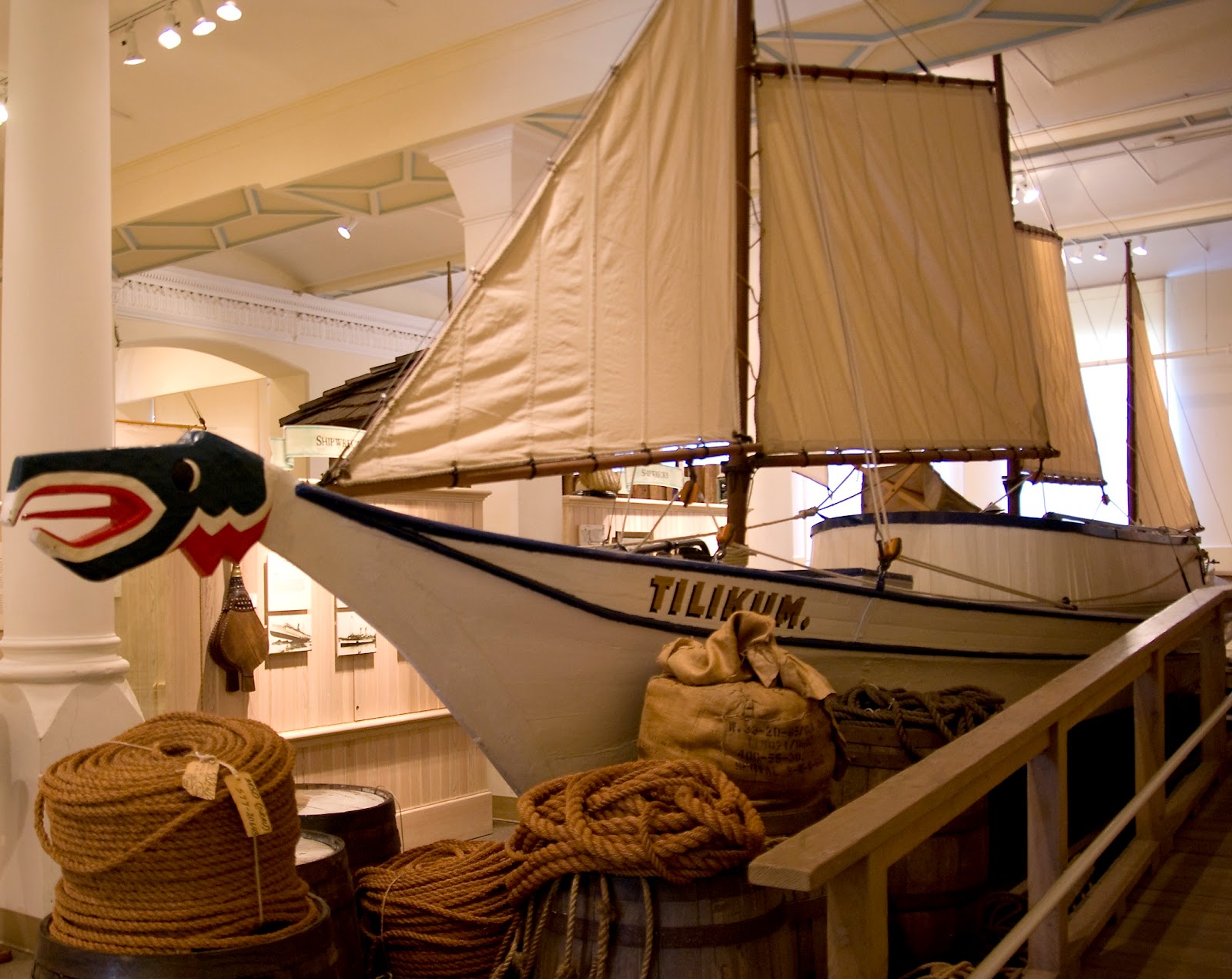
"As guardians of memories of the sea, the Thermoplyae Club [formerly of Victoria, B.C.] has undertaken a variety of projects. Of these, most valuable was its part in the preservation and restoration of the famous TILIKUM, the craft (basically an Indian canoe), in which in 1901 Captain J. C. Voss set out from Victoria; three years and 40,000 miles later he reached England after a voyage that took him across three great oceans [with a near] circumnavigation of the world.
TILIKUM 
Home port, Maritime Museum of B.C., Victoria.
      That this boat should, after all the admiration heaped on her at Earls Court, by the mid-1920s have become a derelict hulk, rotting in the mud on the banks of the Thames, seems unbelievable. Equally surprising is it to learn that although in 1930 the efforts of the Victoria and Island Publicity Bureau and the generosity of the Furness Withy Line saw the canoe returned to its home port, the repair the hull was given was but rudimentary, and it was left roofless, exposed both to the weather and to the depredations of vandals.
      So she lay for some years--but then there came one evening to the Thermopylae Club meeting some naval yachtsmen who had just sailed across the Pacific. These told the club members in no uncertain terms their opinion of a group that called itself ship-lovers yet neglected such a priceless, irreplaceable craft as the TILIKUM.
      The club sprang into action. Led by the dynamic Captain McDonald, they soon collected the money needed to finance restoration and Captain Victor Jacobsen started on the work that saw her returned to more or less, the condition in which she appears in the Maritime Museum today.
      Later the Thermopylae Club, on the suggestion of old sealing captain Max Lohbrunner, and through the work of shipmate Bob Dallaway (with the permission of the BC government) installed in her three hollow masts. These, though shorter than the original, do give some idea of her rig and also provide ventilation for the interior.
      The club has also painted her hull and encouraged her removal to the protected position in Thunderbird Park that she occupied for many years. Today they rejoice that now she, like themselves, enjoy the hospitality of the Maritime Museum in Bastion Square, Victoria.
      Another spot that finds TILIKUM and THERMOPYLAE close neighbours is on the Causeway wall above Victoria's Inner Harbour. Here 28 bronze plaques make up the Centennial Parade of Ships which commemorates vessels that had some historical connection with Victoria, TILIKUM and THERMOPYLAE of course among them. The first was donated by the Royal Victoria Yacht Club, the second, presented by its namesake, is easily found since it is the only tablet bearing an illustration of the craft it memorializes--a non-conformity not achieved without effort and obduracy on the part of the veteran mariners!
      Another reminder that Victoria was once the home port of this famous ship was the ten-foot water-line model of her entered in the history section of the Victoria Day Centennial street parade of 1958.
      Built on the premises of the 100-year ship chandling firm owned by Shipmate Emerson Smith, and not far from the rings on the cliff at which the original clipper once tied up, the model is one of fine detail. That these are accurate was assured by the daily visits of Captain Harry Bilton to the premises on Wharf Street. It was by then 65-years since he had trodden her decks but he had not forgotten, although it is to be doubted that on so small a replica her figurehead of King Leonidas would be provided with the demountable sword whose removal, for safety's sake, the old captain remembered as one of his last duties before the start of each voyage.
      Later this model was given to the Rainbow Sea Cadets in whose headquarters in Victoria West she holds an honoured place.
      Yet a few miles farther west, above a little cove in Esquimalt Harbour, a concrete pillar marks the spot where, as the bronze tablet on it records:

      'When Vancouver Island was an infant colony nearly a century ago it was here that the gallant sailing ships from the old world stopped to replenish their supplies of water.'
Conceived by Shipmate John Keziere and carried out through the co-operation of provincial government departments, the generosity of city building supply firms and the sweat of sundry Thermopylae Club members, the cairn recalls the days when, from ships anchored off in Limekiln Cove, sailors poled to shore the floats loaded with barrels in which they would take on from the fresh-flowing stream water for the long journey back to Europe.
      Today the sailing ships and most of the men who sailed them are gone, but through this book some of their experiences, it is hoped some little contribution may be made to the preservation and dissemination of the memories of those sturdy times".
Ursula Jupp, Home Port: Victoria. Published by author, Victoria, B.C. 1967.


Book search here––


Not quoted here but an interesting book on the "absorbing and instructive true-life story" of Captain J. C. Voss (1854-1922) and his 40,000 mile voyage from Victoria to England has been published.

Captain John C. Voss
The Venturesome Voyages of Captain Voss, 
Century Publishing, 1989.

A introduction to the Voss book by F.E. Grubb, the Registrar & Librarian of the Maritime Museum of B.C., lists historian/writer Ursula Jupp as the greatest authority on Captain Voss.
 Book search here––

12 March 2012

❖ Schooner WAWONA "A Lucky Ship" ❖

"Ships of the sea, particularly those graceful sailing ships now finally slipping into the limbo of the past, have always been endowed with distinctive individual characteristics. No ship ever built has been exactly like any other. Once down the ways each ship has acquired not only a name but a soul of its own in an amazingly short time. And a reputation.
      One would soon be known as a dry ship, another as a wet one. This one would be called a "stiff" ship, that one "easy". One would be labeled "steady", her sister a "roller". She might be known as a "happy" ship or a "workhouse". Some ships cruise like a millionaires' yacht, while others get into all sorts of trouble.
      Sailors have only one definition of the character of a ship. The wet, uncomfortable, cantankerous workhouse they would call an "unlucky" ship. The other kind would simply be known as "lucky".
      A "lucky" ship has been the WAWONA, a three-masted fore-and-aft rigged schooner owned and operated by the Robinson Fisheries Co. of Anacortes, WA. If ever there has been a ship worthy of the appellation, the WAWONA is it. For she has been serving faithfully and well for nearly fifty years, in many parts of the world, and is still making money for her owners. From the days of Capt. Matt Peasley, one of her first masters, to the present, she has been every inch a lady, well behaved, and the pride of the men who have sailed her.


Robinson Fisheries, Anacortes, WA.

Original vintage postcard from
the archives of the Saltwater People Historical Society.

      In the offices of the Robinson Fisheries they actually speak in reverent tones of the WAWONA. Jack Trafton, the company's president, and E. N. Trafton, his son, could scarcely find words to tell of the old schooner's long service in the N. Pacific codfish trade, of the masters, mates, and men to whom she has been home and career, of the part she played in both world wars. But the company watchman, who has known the WAWONA a good part of his life, expressed it in a few words:

"She has always been a lucky ship, and 

has always landed a good trip of fish."
Postcard reproduction was purchased 
from the Anacortes Museum.
      The WAWONA was built in Fairhaven, CA., in 1897, by the famous [Hans Bendixsen] yard. Her registered dimensions are 468 G. tons, 413 N. tons, 156-ft. length, 36-ft. beam, and a depth of 12-ft., 3-in. One of her first masters was Capt. Matt Peasley of "Cappy Ricks" fame. In that era, Peter B. Kyne's stories in the Saturday Evening Post were widely read, and Matt--the fellow who, in fiction, wiped up the deck with the "Big Swede" and who finally married the attractive daughter of Cappy Ricks--was identified with the life-sized skipper. Capt. Peasley, now 80-years of age, retired from the sea a few years ago, and now lives in Aberdeen, WA.
      The Robinson Co. purchased the schooner in 1914, and she has made a least one trip to the Bering Sea every year since except when she was in government service. She is the largest fore-and-aft rigged sailing ship on the Pacific Coast, and she is one of the few sailing ships that have served through both world wars and is still in active service. In 1917, during WW I, she made a voyage from Vancouver, B.C., to Suva in the Fiji Islands with a full load of lumber, and served with the U.S. Army from 1941 through 1945. Between wars, she has landed a tremendous tonnage of codfish for her owners.
      Captain Charles Foss was her master from 1914 through 1935, which was one year when misfortune overtook the hard-working ship. While clearing Unimak Pass on her way home from the 1935 codfishing season in the Bering Sea, Capt. Foss suddenly passed away. The ship was put about, and Capt. Foss was buried by his sorrowing crew in Lost Harbor, AK. The first mate, now Capt. Tom Haugen, took command and has been her master ever since, except when she was in Army service. On her first trip north in 1936, she carried with her a monument to mark Capt. Foss' grave, and each year on her way north the WAWONA stops at remote Lost Harbor, Akun Island, so that her crew may pay their respects to Foss and care for his resting place.


The 1940 burial of Capt. Richard A. 
Trafton, 
M.V. DOROTHY,
at Lost Harbor, Akun Island, AK., next to the grave of
Capt. Charles Foss, who died on board WAWONA, 1935.
Courtesy of Bruce Trafton for S.P.H.S.
      The WAWONA has always been a proud ship, but she has never been prudish. At sea, she has always been as graceful as a bird, yet during the late war, stripped of her masts and gear, she served without shame as a lowly scow. Since then her former beauty and accouterments have been restored in shipyards at Friday Harbor and Bellingham. Once again the grime of war service is gone. She is scrubbed and shined and polished. Three 114-foot "sticks" were brought down from the woods and stepped in. With Tom and his crew of 36 men, she sailed this spring for another season in the Bering.
      The WAWONA has always been a "lucky" ship. Her reputation is still good. And when that can be said of such a ship, it is like saying of a fair lady, "here is a useful and honorable life."

Above words by Leon M. Swank
Pacific Motor Boat
October 1946
Archives of the Saltwater People Historical Society
Typed verbatim.
1941: An unlucky day on 27 May when the 2nd mate, Nick Field, age 58 of Tacoma was lost from a WAWONA dory. The master was Capt. Tom Haugen.
Seattle Times 4 Sept. 1941.
1963: An organization known as "Save Our Ships" was organized with the intent to purchase the WAWONA, one of two remaining sailing ships in Puget Sound. The other, FALLS OF CLYDE, was purchased by a fast, fund-raising campaign in Honolulu, where the vessel was taken in 1963 to serve as a floating museum. All of the other sailing ships either have been broken up for scrap or sold to other ports for maritime museums.
1968: Not quoted in this log but a fine tribute to WAWONA is featured in West Coast Windjammers by Jim Gibbs. Superior.
1970: WAWONA was declared a National Historic Site, the first vessel to receive that designation in the country.
1981: The president of the National Maritime Historical Society, Peter Sanford, sent out an SOS to save the WAWONA, owned at that time by Northwest Seaport who moored her in Lake Union, Seattle, WA. Sanford described the WAWONA as an international maritime treasure that deserved better treatment than decrepitude.
2009: After 46 years of volunteer effort, the WAWONA was towed to a Seattle scrapping yard.
2011: Archived on this Log are some of those scraps in Schooner WAWONA's Bones, written by Roy Pearmain.


Archived Log Entries