when the Sockeye Start to Run.
Fall 1942.
"Gus Dalstead's card reads, G. N. Dalstead, Postmaster, Anacortes, WA. That's a good job and Gus is proud of it.
But you'll never guess where I met him. In a salmon cannery, dressed in dungarees, with sweat streaming down his face, heaving cans of sockeye around!
Four of Gus' postal employees were sweating alongside him. Elsewhere in the plant, the chief of police, the fire chief, and other civic dignitaries were toiling. Everyone in Anacortes works in the canneries while the salmon run is on.
I was walking around, soaking up atmosphere, when a foreman yelled above the din, 'Hey, Bud, ya wanna go to work? A buck an hour.'
I shouted back. 'Thanks, I am working, can't you tell?'
'Well, if you see anybody uptown who does, send 'em down here a runnin'.'
That's the little town of Anacortes while the salmon are running. There are tears, drama, and heartbreak––and plenty of hootin', hollerin', happiness, when the Silver Horde rips into the Strait of Juan de Fuca. The salmon can make a man in a week––or break him.
The canneries send 'buyer boats' out to where the fishing fleet is hauling them in. Individual boats pull alongside the buyer boats, unload their catch, get a receipt for it, then dash off to set nets for another haul. When buyer boats are loaded to the gunwales, they chug back to the canneries, unload, then tear out for more.
 |
"Toilers of the sea as they shift a huge catch of salmon
from the fish boat to the buyer boat."
Original photo, dated 1942, from the archives of the S. P. H. S. © |
I went out with a buyer boat early in the morning. We started out with one boat, three men, including myself. We came back to the cannery ten hours later, with two boats so heavily weighted down with fish they had to be tied together for sufficient power to make headway.
Between the two boats we had 25,000 sockeye salmon. That's about 175,000 pounds of fish.
Salmon fleet men spend all year getting ready for the run. They repair nets, paint boats, overhaul engines. The season opens when the salmon start coming in from the blue Pacific––down from Alaska. That's in late July or August. It ends around September––or sooner if the Fisheries Dept. decides it's necessary to conserve the fish pack.
That was the case this year. Too many salmon had been caught. The remainder had to be allowed to get up the rivers to spawn.
We took the morning catch from the WATERLAND, a nine-man boat, 4,500 salmon. The price then was $1.65 a fish. The eight-man crew collected $300 each for the mornings work! They told me they'd have a similar haul from their afternoon cast.
But it's hard work. No place for sissies. Salt and wind and sun burn the men brown. They stay out fishing from 6 am Sunday until sundown Thursday. Friday the boats come into Anacortes to refuel and replenish provisions. Those are Fisheries Dept. rules. It gives the salmon two whole days to get past the fleet unmolested, en route to the spawning grounds.
Normally the price of fish is set at so much per pound. This year, with such mammoth catches, the canneries hadn't time to weigh each haul. So an average price per fish was agreed upon. Boat skippers count the salmon with mechanical counters as they heaved from the fish boats to the buyer boats by hand with one-pronged fish forks. Canny Slav skippers never miss a count.
Often a net is ruined. Then a boat must put into the nearest port, and have the net repaired. At least once this year, one boat had such a huge haul that the driving, thrashing, salmon surged through the net and got away.
 |
Purse seine fishermen hauling in the net.
Original photo dated 1943 from the archives of the S. P. H. S.
|
There are usually nine men to a boat. A crew of eight and the skipper, who charters the boat or owns it outright. Money from the catch is divided into shares, 13 to a nine-man boat––two for the boat, one and a half for the seine, and one and a half for the skipper himself, one each for the crew.
Nets Cost Money
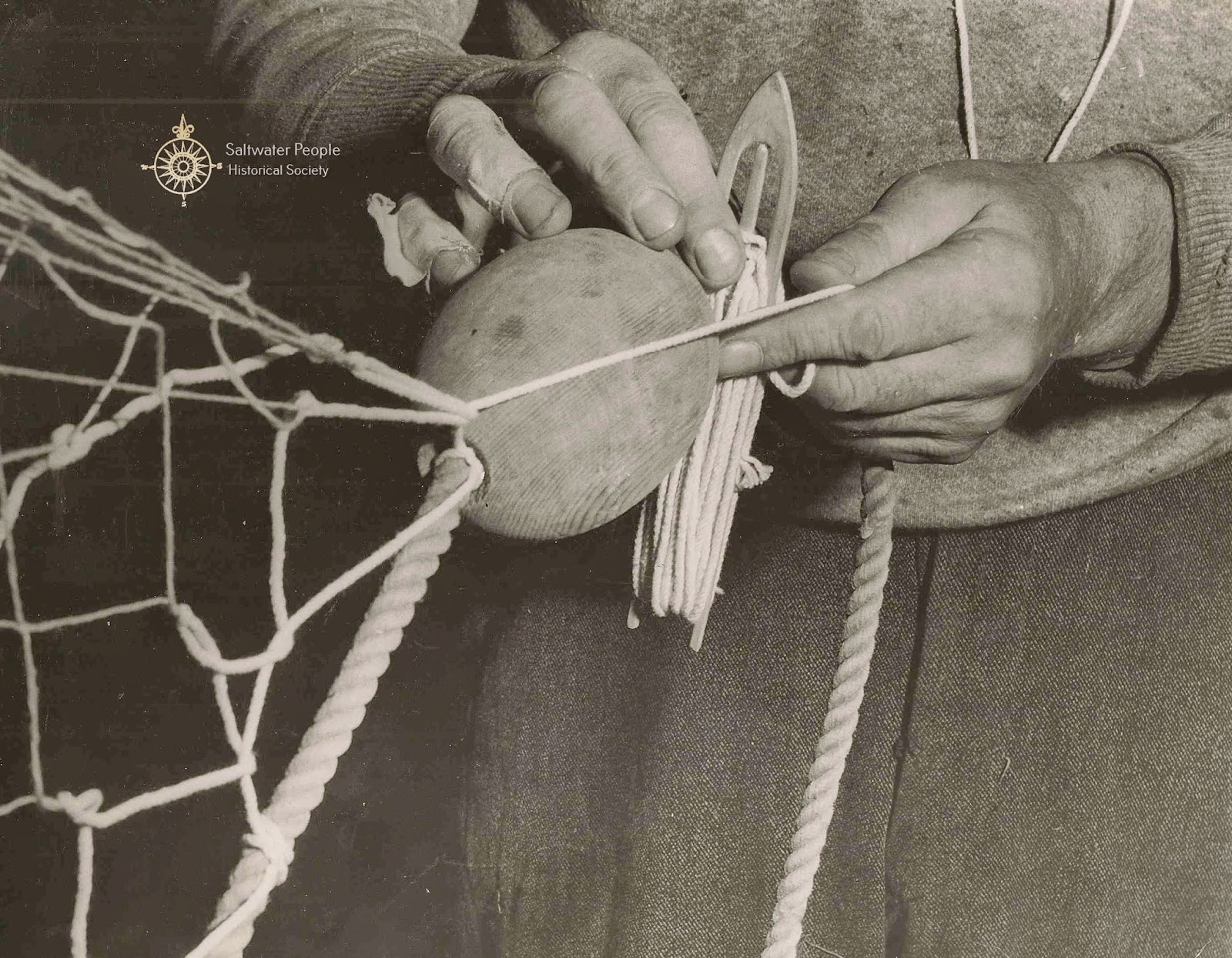 |
Louis Zuvich mending net
Photo from the archives of the S.P.H.S.© |
Seine nets are worth a lot of money. One skipper told me it cost $5 a day to keep his in shape during the season.
Sometimes the individual fishing boats have a full load and the buyer boats are full too. Nothing for it then but to head for the cannery and unload at the dock. We passed one boat, the WONDERLAND, churning cannery-bound. She was loaded so deep the crew members were wearing life-preservers, and keeping their fingers crossed. In her holds and on her decks were 10,000 sockeye.
Two boats were sunk trying to get home with such loads. One went down in deep water and was lost. The other was nearer shore and sank with only the mast top and wheelhouse showing above water. It was salvaged the next day, overhauled, and back fishing again.
Back at the canneries it's a different story. Cannery officials are crying. They can't get help. It's only seasonal work and most of the men have gone to shipyards or other war industries.
I saw more than a hundred thousand salmon piled in bins. Canning lines were clanging at fever heat. Never since 1930 had there been such a catch. The fish must be cleaned, packed into cans within 24 hours after they're caught. Otherwise they'll spoil. Long lines of women toil eight-hour shifts, cleaning, slicing, packing.
Anyone wanting to work can walk into the canneries, peel off his coat, and start right in. I saw two bandy-legged cowhands far from familiar range country, stroll in the cannery entrance, speak to the foreman, shuck off their Stetsons, slither through the fish muck in high-heeled boots and start to work.
Maybe I should have taken that foreman's offer. Gus Dalstead told me later that one of his boys made $18 that day.
Above text by Grant MacDonald for The Seattle Times, September 1942.


 Posts
Posts

