"The Cure for Everything is Saltwater, Sweat, Tears, or the Sea."

About Us

My photo
San Juan Archipelago, Washington State, United States
A society formed in 2009 for the purpose of collecting, preserving, celebrating, and disseminating the maritime history of the San Juan Islands and northern Puget Sound area. Check this log for tales from out-of-print publications as well as from members and friends. There are circa 750, often long entries, on a broad range of maritime topics; there are search aids at the bottom of the log. Please ask for permission to use any photo posted on this site. Thank you.
Showing posts with label Friday Harbor. Show all posts

25 October 2024

LOG OF THE M.V. INDIAN – 1948


The M.V. INDIAN
dated 23 May 1948, 
home dock, Seattle, WA.
One or both twin brothers 
 were on board the Indian for this trip
north and caught this shot  on the waterfront
at 5:30 a.m.
Click image to enlarge.
Original photo signed by
Bob and Ira Spring,
from the archives of the 
Saltwater People Historical Society.
©

"Fifty-two ports along the 2,000 miles of Puget Sound shoreline receive regular calls from a small fleet of freight boats, and another 50 had docks at which occasional stops were made. The boats traveled south to Olympia and Shelton, and north to Bellingham and Powell River, B.C. The fleet had six boats, the Indian, Lovejoy, Seatac, Belana, Warrior, and Skookum Chief. The third name is derived from Seattle and Tacoma and the fourth name from Bellingham and Anacortes. The freight boats were of shallow draft. Most of them had a large lower deck that ran the full length and width of the boat. The freight was loaded on small sleds at the warehouses. These sleds were carried aboard by gasoline-driven lift trucks and placed on the long, lower deck. At the ports, the process reversed, the freight-laden sleds carried off to the docks. The boats carried crews of 12, including the skipper, other officers, deckhands, lift-truck drivers, and last but far from least important, the cook. 

Want to take a trip on one of these boats? Here is a sample log of the motor vessel Indian on one of its trips to Bellingham and the San Juan Islands, Washington State.

Monday, May 23 1948

5:30 a.m. left Pier 53, home dock in Seattle, loaded with general merchandise for Anacortes, Bellingham, and other ports. A photographer aboard.

6:15 a.m. Point Wells, unloaded empty oil drums and took on full ones.

10:50 a.m. Headed through the swift waters under Deception Pass Bridge.

1:20 p.m.


Arriving Bellingham waterfront
1:20 p.m. 
where the well-konown Osage was tied up.
Photo by Bob and Ira Spring
From the archives of the 
Saltwater People Historial Society©

Tuesday 4:53 a.m. 


The Indian slips into Friday Harbor,
San Juan Archipelago, WA., 

4:53 a.m. as logged by the 
photographers, Bob/Ira Spring 
for this amazing shot. 
Click image to enlarge.
The M.V. VASHON is standing by
on the left border 
watching over new arrivals.
Original photo from the archives of the
Saltwater People Historical Society©


7:40 a.m. 

The INDIAN arrives at 7:40 a.m.
at Roche Harbor,

San Juan Island, WA., 
 to load sacks of lime 
from Roche Harbor Lime Works.
This original photo is dated May 1948
but the photographer is unknown.
Click image to enlarge.
From the archives of the 
Saltwater People Historical Society©


9:45 a.m. Headed through Pole Pass (225 ft wide) between Orcas and Crane Island.
11:10 a.m. Arrive Anacortes, Skagit County, WA. The last stop on return home. General merchandise was unloaded at Anacortes Port dock."
From an article published by the Seattle Times. No byline.

Crew and officers aboard:
Homer Stroup, Master
Arie Millenaar, Mate
Merrill Fleck Quartermaster
William Carlson, Chief engineer
Other crew: M.H. Roen, Clyde Durham, John Barr, Erwin Duly, Clarence Ostrom, and cook Helen Scott

06 September 2024

FRIDAY HARBOR SHIPBUILDERS

Noted Friday Harbor Shipbuilders


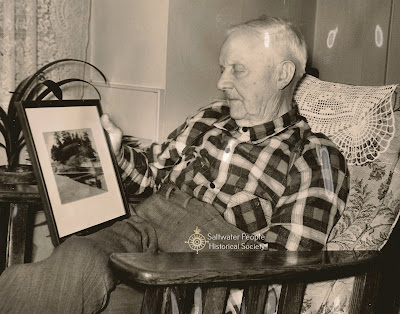
Shipbuilder Frank Jensen
Photograph dated 1960

Admiring a photo of his boat VERDUN,
built in 1919
for himself and his brother Joseph,
as stated on the federal 
Master Carpenter Certificate.
Click image to enlarge.
Original silver-gelatin photo from
the archives of the 
Saltwater People Historical Society©


A family tradition that reaches well back into the 19th Century, was carried on at Friday Harbor, in the San Juan Islands. The shipyard of Albert Jensen & Sons, Inc., was a Jensen family enterprise since the early days of the island’s settlement.
      Nourdine Jensen, the last owner of the company was the third generation of Jensen family boat-builders. His father was boatbuilder, Albert Jensen.
      Nourdine’s grandfather, Benjamin Jensen, was a shipbuilder in Bergen, on the north coast of Norway, in the 1860s and 70s. He also sailed some, making several trips to Canada. Finally, he came to the New World for good and settled on San Juan Island in 1883. His sons Joe, Albert, Frank, and Pete were with him.
      At the time of this interview, Frank Jensen was 86 and retired. He kept up his interest in the activity at the shipyard, making occasional trips to “see how things are going.”
      The Jensens lived for a while at San Juan Town, or “Old Town,” as it was called by the old-timers. After three months, the family moved to a farm on Griffin Bay, building a house on a spit just below the bay now known as Jensen Bay.
      Along with their farming, Benjamin and his four sons began building a few boats, almost as a sideline. The “sideline” turned into a regular thing, but Frank Jensen recalled they never considered that they were running an organized business.
       “We were no company at all,” Jensen said. “We just built boats.
      Among the boats the Jensen “just built” were the sailing ships NORTH STAR and the NELLIE JENSEN. The NELLIE JENSEN, on the ways for three years, was the largest sailing vessel the family built. It was 59 feet long and carried a crew of five. Later it was given a steam engine.
      Other early vessels they built were the steamships GRIFFIN, MESSENGER, and the VALIANT
      The last boat to be built at Jensen Bay was the Adventurer. The NELLIE JENSEN burned to the water, years ago, off Dungeness while carrying a cargo of shingles. The GRIFFIN was wrecked and is on the bottom of Lake Washington. The VALIANT was lost on the beach at California, and another Jensen boat was wrecked in Alaska on the Chignik River.
      Jensen says he doesn’t know of a single life being lost in any of these mishaps.
      In 1901, Frank Jensen got the gold fever and went to Alaska. He never struck it rich but worked for wages shoveling dirt. He didn’t stay long in Alaska. Years later, he made another trip to Alaska, landing at 3 o’clock in the afternoon. By 9 o’clock that night, he was on his way back to Seattle.
      In 1905, Frank married and a few years later, moved to Friday Harbor. About this time, the family became involved in a sawmill operation, but before long the Jensens were back to building boats again. In 1910, they acquired property on a bay a mile south of town and built the shipyard which was long in operation.
      Frank and Joe married sisters, Emily and Alice Guard. When Joe died, his wife, Alice, stayed on with Frank and Emily Jensen in the country place Frank built east of the shipyard, across from Turn Island. The Jensens lived in that house 29 years.


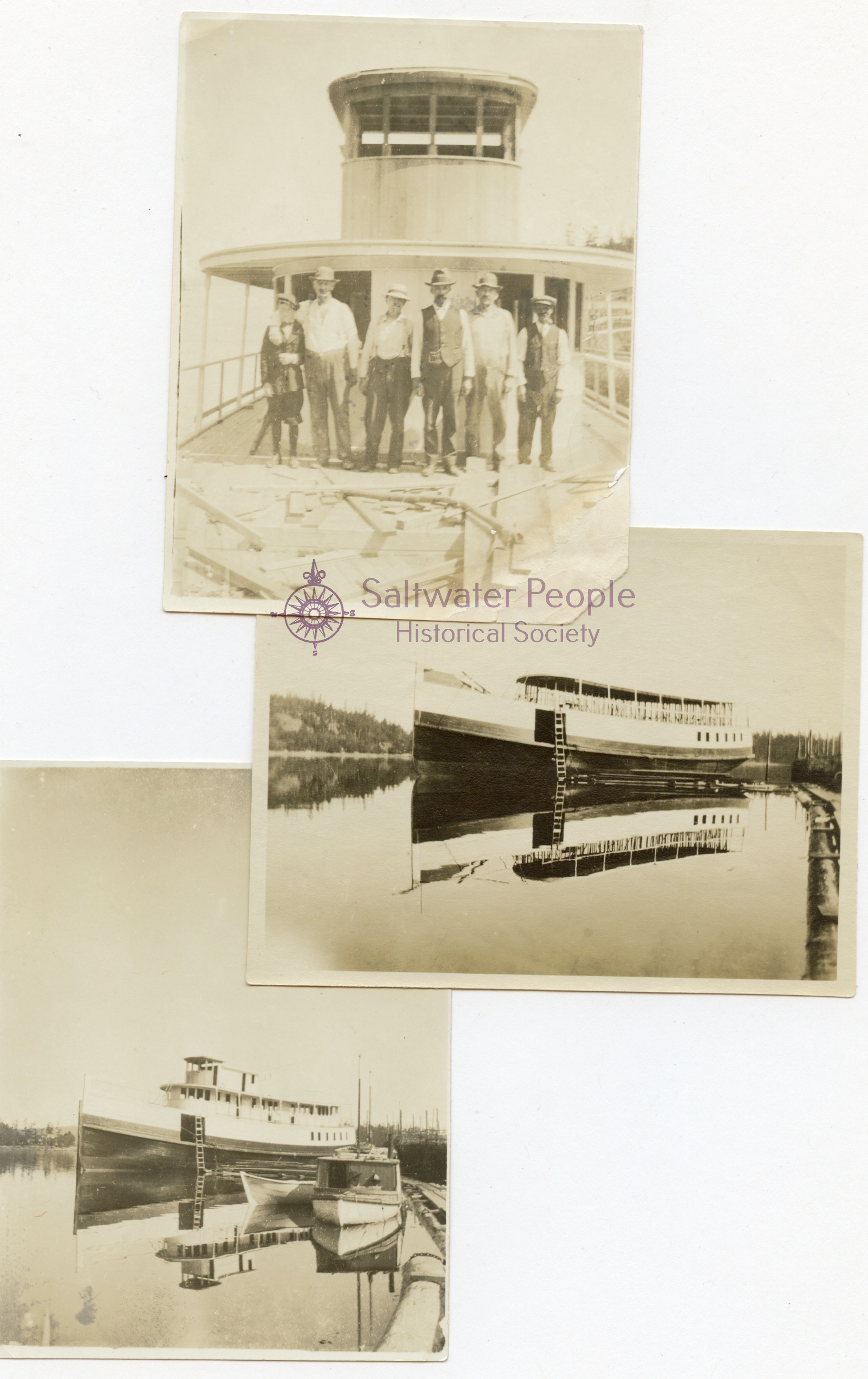
The ISLANDER,

new launching at Jensen's Yard
Friday Harbor, San Juan Island,
all dated 1921.
Click image to enlarge.
The work crew is so far unidentified.
Can you help?

      One of the largest boats the family ever built, and no doubt the best known, was the ISLANDER––a 106 ft freight and passenger boat. The business “Life Line” of the San Juans for many years, the ISLANDER made regular trips through the islands from Anacortes and Bellingham.


clips courtesy of the
Friday Harbor Journal.
Click image to enlarge.

      Later, the ISLANDER was sold to the Puget Sound Freight Lines and renamed the MOHAWK.


Cannery tender NEREID
Moored in her home port of Friday Harbor, 
San Juan Island, Washington.
Jensen built in 1911.
Original photo from the 
Saltwater People Historical Society©


      The first boat built at the new yard was the NEREID, a boat used for decades by the Friday Harbor Canning Company. Julia Jensen says the NEREID also was designed by her husband and was his favorite of the boats built by the family.
      During WW II, Albert Jensen and Sons built a fleet of 36-ft tugboats and a dozen wooden barges for the war effort. Another shipyard started up during the war adjacent to the Jensen yard. Both companies specialized in building pleasure boats in the under 90-ft category, as well as fishing boats, and occasionally other types of craft.
      A recent Jensen boat that attracted the attention of numerous boating journals was the 55 foot MECO, built for Archie Morgan, of a Seattle electrical contracting firm.
      Altogether, Nourdine estimates his company built about 50 boats of more than 20 feet each in the years since the war, for an average of two and one-half boats a year.
      Nourdine’s brother, Frits, carried on the family tradition as a prominent Seattle naval architect.
      Frank Jensen was one of the county’s longtime residents. He recalled the island’s settlers well and could recite the names of all the farmers and businessmen who had “places” on San Juan at the end of the past century.
      Frank doesn’t consider that his family pioneered in the usual sense; he recalls there was very little vacant land left on the island when they arrived.
      Of all the Jensen-built boats, Frank’s favorite was the one built for his own use, the 40 foot VERDUN (pronounced with the accent on the first syllable.) He made four or five trips to Alaska with her and sailed her throughout the San Juan Islands many times.
      When he was home, Frank kept her anchored in the bay off Turn Point, where she was a familiar sight for many years. Next, the VERDUN saw service in the San Juans as a fishing and workboat owned by Sherman Thompson of Deer Harbor, Orcas Island.

Words by the late author, historian David Richardson, formerly of San Juan and Orcas Islands in the Archipelago. Published by the Seattle Times.

The Port of Friday Harbor purchased the Jensen Shipyard which was reported here.


08 May 2023

THE ALMOST UNSINKABLE MARINER OF FRIDAY HARBOR, WA. by Brad Warren


CARTOON BY DENNIS DAY
1984
click image to enlarge.
From the archives of the 
Saltwater People Historical Society.


When the only bar on Friday Harbor's waterfront changed hands last year [1983,] its detractors watched the name disappear from its weathered sign and confidently predicted that the raucous Mariner Galley & Bar had finally, and fortunately sunk. It had surrendered its prime location, they gloated, to a fancy new restaurant that would show San Juan Island what "class" could be. But neither the Mariner nor Friday Harbor was ready to be gentrified. The new restaurant fizzled out in November, a financial and social disaster. In December the Mariner's old owners, Ron and Sandy Speers, reclaimed it and fighting the building's owners, and the State Liquor Control Board, brought the bar back to its former self. Almost.
        The Mariner was still a salty den of noisy fishermen, surly rebels, 19th-century holdouts, and 20th-century dropouts––still the stubborn soul of a roistering bordertown, fishing port past, and still for Mariner regulars at least, the place that kept Friday Harobr true to its real identity as "the southernmost town in SE Alaska."
        But the Mariner lost its liquor license––on account of past violations for which it has already paid fines, suffered closures, and fired bartenders, according to the Speers. Unless they could win the license back, their lease will expire. "We'll get it back," said Ron Speers. "I'm willing to fight this all the way into court if I have to, but I'm sure we'll prevail."
        "The Mariner was the first place I worked when I came to the island," says self-proclaimed Marinero Tom Hook. "I went in and saw the piano and asked if they need someone to play it. They put me to work that night. The pay was lousy but it was a great place to work. A few weeks later I met Phil Martin there. I was playing 'Take Five' and I looked up, and there was the biggest fisherman I'd ever seen––he filled the doorway. He had a black beard down to his chest, and he looked like Wolf Larsen, straight out of the Sea Wolf. When he saw me, he said, 'Oh! A piano player!'
        "He walked right over and grabbed the handles on the back of the piano, braced the bottom of it against his leg, and lifted the whole thing six inches off the floor while I was playing it. "My name's Phil, he said with a big smile. "I like country and western."
        "I gulped and looked up at him, I said, "Yeah? Well, I like tips."
        "He put down the piano, slammed a five-dollar bill on top of it, and said, "There's more where that came from, partner if you're any good."
        I met him when we were reporting for competing island newspapers, and we became friends when I started playing guitar at the Mariner with the Crawlspace Blues Band. It was a great rowdy place to play. We were never paid much––sometimes not at all–– but we always got a free meal. That made a big difference when cash was scarce, as it usually was on the island. Nobody had money in the winter.
        If the waitress wasn't around in the morning when were went to collect our free meal, we'd go behind the counter, pour our coffee, and tell the cook what we wanted. Phil Martin and a bunch of local fishermen would be there rumbling or joking about the bad fishing or repairs on their boats, sometimes griping about the Boldt decision, something just staring out the window at the harbor. The Mariner was their place; they ate, drank, and brooded there by day––between turns of a wrench on their boats or knots in a net they were mending––and they came back to cut loose at night.
        Some fishermen had no phones at home and gave out the Mariner's number. One was Dennis Day, a seiner and artist who used to sit at the bar all afternoon when he wasn't working, drawing on napkins: he made magnificent, mythical images of boats riding out storms, mermaids rising from the surf, black-bearded fishermen hauling in nets––elemental, powerful visions. The wall behind the bar gradually became Dennis' gallery as the bartender saved and hung his napkins, and on another wall, Tom Hook hung a hand-drawn map of places to get drunk in southern France.
        The Mariner was full of people whose rough looks hid surprising talents. Many had left their old lives in the fast lane to rust back on the mainland. There were fishermen with doctorates and an amateur live-aboard boatbuilder who had dissolved his successful public-interest law practice and came to hide out quietly on the island. Even Ron and Sandy, the owners, were an unlikely mix. They ran a farm on the island and looked like it. But Ron had graduated from Harvard and been a naval officer; Sandy, the Mariner's fearless den mother, had lived for years in Germany. Almost everyone there had made a sort of stand against nine-to-five, bureaucratic, domesticated, and disoriented mainland American culture. The sea was their antidote. My landlady, an Alaskan troller and sometime teacher in Friday Harbor, once told me, "When you're out there on the open water in your own tiny fishing boat and you see a big storm come up over the horizon, it does something for your priorities. It's you and the sea, and you've got to survive."
        The sale of the Mariner meant a lot more than a change of ownership. It was a signal of Friday Harbor's rapid, painful growth into a prosperous resort and retirement community––a prestigious place to have a second home or yacht. The population of San Juan Island had doubled during the 1970s, and few newcomers fit into the islands' rough-handed fishing, farming, and logging tradition, where good old boys held office and smugglers held out in the islands many hidden coves. That era came to a political finish in the late 1970s, when the new electorate recalled a corrupt county commissioner and voted in strict land-use controls and reforms. At the same time, poor management by the Washington Department of Fisheries and a raft of court-imposed restrictions crippled the commercial salmon fishery in Puget Sound.
        The old diehard spirit, which had reached its apogee when locally notorious lawyer Charlie Schmidt drafted a plan for the island to secede from the union and become a free port, was losing its grip. Islanders watched the changes and said cynically that Friday Harob r would soon be "the northernmost town in Southern California." Land prices were skyrocketing and it looked, in Sany Speers' words, as if "the little people were going to be squeezed out."
        The Speers' precarious revival of the Mariner won't change any of that. But it is somehow cheering to think of returning to find the old crowd still scowling and winking at the ferry as it pulls in, the last dive holding out for all that is un-reconstructible and defiant in Friday Harbor, an enduring chip off the ornery, generous heart of the islands.

Words by Brad Warren.
Published by the defunct Puget Sound Enetai
9 February 1984.
From the archives of the Saltwater People Historical Society.


15 January 2022

CAPTAIN BAXTER AND HIS "BRIGANTINE"


Lieber Schwan
 David Baxter, aboard
his 70-ft, 1850 design
he called a "square-rigged brigantine."
Launched 1966.
Location: Friday Harbor, WA., 1983.
Tap image to enlarge.
Photo by Richard S. Heyza
from the archives of the 
Saltwater People Historical Society

They are a special breed, these San Juan boat people. They've jettisoned the soft comforts of spacious homes on the mainland and chose instead to live in cramped cabins hardly bigger than suburban coat closets.
      "Living aboard a boat is true adventure, said David Baxter who with his wife Marjorie, lived afloat for over 18 years.
      Their vessel, the Lieber Schwan, was one of hundreds crowded into the Friday Harbor marina area.
      The Baxters lived the kind of carefree life most people only dream about. They repaired or built boats, then, when the local scenery paled, they sailed away.
      But they didn't expect ever to tire of the San Juans, because they loved Washington with the frank passion that marked them as former Californians.
      In the early 1980s, Baxter retired from running a little shipyard at Morro Bay, CA. In 33 years he had built some nine boats and rebuilt many others, including boats owned by actors Dick Powell and Burt Lancaster.
      Baxter himself looked as if Central Casting sent him to play an Old Sea Dog. He was shortish, wide-shouldered, blond-haired, a galleon medallion hung over the front of his jersey, and his work-weathered fists appeared carved from oak.
      The Lieber Schwan, which he built, is an 1850 design. Baxter managed to raise the nine sails single-handedly while his wife was at the helm.
      Actually, the Lieber Schwan had a third crew member; Chula, a 5-year-old Amazon parrot.
      Admittedly, the Baxters led a more comfortable shipboard life than most. They had a fireplace, shower, and a stereophonic sound.
      A huge proportion of boats cruising the San Juans are fiberglass. But Baxter preferred wooden ones. They're warmer and dryer, especially in this climate, and if they're built right the maintenance is minimal, he said.
      For a retired man, Baxter stayed pretty busy. He rebuilt two 44-foot sketches in the winter of 1982-'83.
      "We've sailed to Mexico and the Hawaiian Islands but we prefer it here, Baxter said. The climate is so invigorating."
      He also liked the relaxed pace of life in the San Juans."
      "Quitting work when friends visit in the middle of the day is what life is all about," Baxter said. "A 'manana man' like me feels right at home."
Words by Frederick Case for the Seattle-Times, June 1983.

When it was time, the Baxters sailed for Olga, Orcas Island, San Juan Archipelago, WA.

Marjorie L. "Kitty" Johnson Baxter
7 May 1937-3 Feb. 2020


12 January 2021

❖ TUGBOAT RACE HISTORY, Olympia, Washington ❖ (Updated)


Yacht El Primero
18 August 2013
The first honorary committee boat.
Photo courtesy of Ron R. Burke
who loved this boat so much
he crafted a fine scale model. 


From a Harbor Days Official Program, 
Olympia News
by Chuck Fowler 
with Pat Haskett
31 August 1983

Now a major Puget Sound maritime festival, the Olympia Harbor Days vintage tug boat races began in 1975 when only six small workboats gathered for a single heat race north of Olympia's harbor on Budd Inlet.

The Olympia tug race has its historic roots in the informal towing boat competitive events which began before the turn of the century on Puget Sound. On major holidays, workboat skippers would pit their vessels against those of other captains to decide who had the fastest and most powerful tugs. Today that tradition lives on as members of the Retired Tug Association and other skippers come to the Capital city to race, gather their crews and families, and join in the fun of Harbor Days and Harbor Fair.

The initial race nine years ago was started by Captain Bert Giles, who had continued to signal the beginning of the competition with a blast of the whistle from his historic mini-steamboat Crest. Finishing first in that original race was Gordon Willies's small tug Sunset which was one of the workboats once owned by Delta V. Smyth, a pioneer Olympia tugboat operator. Wayne Smyth, who followed his father as head of Delson Lumber Co, donated a trophy in his father's name. The award, which was presented to the Sunset at the initial race, remains the first place honor for the Harbor Days Inland Class event.

Word of the first race began spreading throughout the Puget Sound area, and in 1976, 16 tugboats came to Olympia to compete. Both the 1976 and 1977 races were won by the 100-ft tug Odin (ex-Prosper,) then owned by Al Wolover of Seattle. The second race included several tug skippers who have returned for the Harbor Days events ever since: Mark Freeman of Seattle, who owns the Sovereign, Standfast, and Barf; Jon Paterson of Gig Harbor, who now owns the Winamac; Dan Grinstead of Seattle, owner of the Lorna Foss, and Franz Schlottman of Olympia, who owns the host Harbor Days tug Sandman.

In 1978, Odin and the Simmons Towboat Company's Beaver shared first place honors and the Delta V. Smyth perpetual trophy. However, Wolover of the Odin claimed permanent ownership of the award and a new Smyth trophy was created for subsequent annual presentations.

In 1979 Olympia tugboat race winner was Les Cooper's Chickamauga, the first diesel-powered tug built in the US, followed by a 1980 win by Stan Longaker's Palomar.

For the past three years, the small and fast Reliance, owned and piloted by Phil Shively of Bainbridge Island, has churned away with the first place inland class honors.  Among the larger tugs, Crowley Maritime Corp 's Retreiver bested the Arthur Foss in the 1981 Unlimited Class race. The Mini Class race, for tugs under 20-ft long, was won by Willy Block's tug Trio of Olympia.

In the 1982 race, in addition to the Reliance, the winner of the Mini Class event was Eric Freeman in the tug Barf. The Unlimited Class race was cancelled because of the potential danger to spectator boats caused by the huge bow waves created by the larger tugs.


Favorite
Captain Phil Martin
Photo courtesy of John Dustrude,
Friday Harbor, WA.

❖ Then in 1986, to the Labor Day races at Olympia came a contingent from the San Juan  Islands.
      Phil Martin on the Favorite won first place in the small tug boat class.
      Martin's Favorite was as well known in Friday Harbor as is Captain Martin. It is fitting that Favorite should win first place after being tied to a dock in red tape for two years prior to this race as a result of a law suit.
      Martin and Favorite were familiar faces at Memorial Day and Labor Day tug boat races. "Everbody was glad to see the Favorite back on the block." said friend and crew member, Kim Slocomb.
      According to Slocomb, Martin took back possession of Favorite just three days before the races in Olympia.
      He was noticeably enthusiastic about what he referred to as the midnight speed trials Thursday evening, and the good performance of the boat on its way to Olympia and at the races on Sunday.
      Favorite, a 36-foot tug built in 1937 for Tacoma Tug and Barge was a noticeable part of the Friday Harbor scene and often photographed for years.
      Slocomb said prior to a lawsuit over the tug, Favorite was overhauled from stem to stern to the tune of $200,000. "I was the one who built the machinery on the boat," he said.
      Slocomb, who droved down to Olympia to meet Favorite and was on board for the races and events, said the scene at the tug boat races at Percival Landing in downtown Olympia was a festival of street bands, food concessions, and racing events. One of the traditional events is to have all the tug boats run against a Foss tug the morning of the races.
      Slocomb said they all raced against Henry Foss and he thought the race seemed to be going well until he realized the Foss tug was running in reverse.
      "The Henry Foss does 13 knots sideways or backwards. It's the most phenomenal display of horse power and engineering I ever saw in my life," Slocomb said.

On the Water
Ilene Anderson

Friday Harbor Journal, 3 September 1986.


19 July 2019

❖ FERRY NAMES ON PUGET SOUND


M.V. KLICKITAT
approaching Port of Friday Harbor,
San Juan Archipelago, WA.
4 February 1962.
Click image to enlarge.
Original photo by Fred Milkie,
from the archives of the
Saltwater People Historical Society©


What's the best name for a new ferry? The Vacation State, or the Klahowya!
The Washington State, or the TillikumHow about the Sales-Tax State, or the Duckabush?
If it weren't for William O. Thorniley and a determined band of citizens who followed his lead, our Washington State ferries wouldn't bear the Native American names that puzzle tourists (and a few natives as well).
      It was early 1958 when the furor arose. Lloyd Nelson, a member of the State Toll Bridge Authority, had been given the innocent-sounding task of naming two new ferries in the state's seven-year-old expanded system. After reviewing the names of the most recent acquisitions––the Rhododendron and the Olympic launched in 1953; the Evergreen State, christened in 1954––Nelson set sail with his imagination and came up with two sure winners; the Vacation State and the Washington State. A small item announcing the names appeared on a back page of the January 14 1958, Seattle Times. With the pleasing sensation of a job well done, Nelson went on to his next task.
      He hadn't reckoned with William O. Thorniley. An employee of the Black Ball Ferry Line before the state acquired that private service in 1951, Thorniley had long advocated using Native American names for the ferries. In fact, he had collected Chinook names for years and had personally named many of the ferries on the Black Ball Line. Now, when he heard the proposed names, Thorniley launched a campaign through the Seattle Chamber of Commerce to return to the tradition of Native American ferry names. The result was a month-long controversy, with hundreds of citizens joining the fray.

      State officials explained that Native American names were too difficult for tourists to pronounce or understand –– and the state intended to make the tourists as comfortable as possible. But to Bill Thorniley, a bored tourist was no more likely to return than a confused tourist. The redundant new names certainly bored him.
      "Vacation State!" Thorniley snorted. "What's the matter with nice-sounding colorful Indian names like Bogachiel, Twana, Humptulips, Solduc, Dosewallips, Nooksack, Stillaguamish, and Duckabush!"
      Poor Lloyd Nelson. Many Washingtonians agreed with Bill Thorniley, and there were plenty of ideas besides those he half-jokingly suggested. Letters poured into the State Toll Bridge Authority. Western Washington newspapers took up the hue and cry. Suggestions ranging from Tahoma after the mountain to Squat (Salish for silver salmon) were submitted by interested and irate citizens, complete with scorching comments about the state's lack of imagination.
      Supporting a return to Native American names, Edward E. Carlson, executive vice president of Western Hotels, asserted, "Anything that has to do with the romance of a region adds to its attraction for tourists. Look at the fantastic job they have done in Hawaii. We should lay emphasis on everything that's colorful and picturesque in the Puget Sound area."
      Rudi Becker, connected with a harbor sightseeing service, branded the new names "unimaginative––just what you'd expect from politicians with no romance in their souls."


Rudi Becker, protestor
with his boat named Sales Tax State.

      In protest, Becker dubbed the 1918-model power dory he kept in his backyard the Sales Tax State. (Now there's a name that would have stood the test of time.)
      In the end, the state gave in. "All I want to do is smoke the peace pipe," Nelson declared. On February 15, just one month after the names Vacation State and Washington State had been announced, Nelson offered to withdraw them. Later, Thorniley served as the expert on Chinook Jargon when the state set up a nine-member committee for name selection. After three months, the committee decided on two new names. Klahowya, meaning "greetings" and Tillikum, meaning "friend."
      Following are the Native American names for some of the ferries currently in service [1986.] Most of the definitions were among Thorniley's papers and can be found with other definitions, in Ferry Boats, a book by Mary Kline and George Bayless. (Thorniley had remarked that Chinook was exclusively a spoken language, so the accuracy of spelling and pronunciation in his list depended on the hearing and literacy of early settlers who first wrote them down.)


Elwha: The Elwha River on the Olympic Peninsula takes its name from the word for elk in the Clallam tongue.
Hiyu: Chinook Jargon for "plenty, much."
Hyak: Chinook Jargon for "fast, speedy."
Illahee: Chinook Jargon for "land, place" or "location."
Kaleetan: Chinook Jargon for "arrow."
Klahowya: Chinook Jargon for "greetings" or "welcome."
Klickitat: Native American tribe of south-central Washington. Some early explorers claimed the word meant "beyond," but the majority seemed to favor "robbers" or "dog robbers."
Nisqually: The tribe is headquartered at the mouth of the Nisqually River.
Quinault: Lake Quinault and the Quinault tribe of the western Olympic Peninsula.
Spokane: Tribe in eastern Washington.
Tillikum: Chinook Jargon for "friend."
Walla Walla: Tribe in eastern Washington.
The most recent line of ferries was launched in the early 1980s, christened in the tradition of Northwest Native American names.
Chelan: A lake on the eastern edge of the Cascade Mountain range, from the word for "deep water."
Issaquah: A city in western Washington, from a word of uncertain origin.
Kathlamet: Tribe in western Washington.
Kittitas: Shoal people; also defined as "land of bread."
Kitsap: Chief Kitsap, sub-chief of the Suquamish Tribe, under Chief Sealth.
Sealth: Chief Sealth, after whom the city of Seattle was named.
What's the best name for a ferry?
      For a sense of regional history combined with a spirit of romance, Bill Thorniley's ideas were worth a few shots across the state's bow––and a second look. Take a ride on the Sealth, or the Tillikum, or someday (who knows?) maybe even the Duckabush."

Text by Margaret D. McGee, Seattle, WA. Excerpt from Ferry Tales of Puget Sound; Collected by Joyce Delbridge. Vashon Point Productions. pp 26-28.

19 July 2018

❖ THE OCEAN LABS of FRIDAY HARBOR ❖

Day 83 of One Hundred Days in the San Juans.
One hundred articles were written by June Burn on contract with the Seattle Post-Intelligencer in 1946.
      June's articles also appeared in what is now an out of print book One Hundred Days in the San Juans. Edited by San Juan Islanders, Theresa Morrow, and Nancy Prindle; Long House Printcrafters & Publishers, Friday Harbor, WA. 1983.
      The text below is verbatim for June and Farrar's Day 83 with vintage photographs from the Saltwater People collection.
The University of WA. Oceanographic Laboratories,
as it was called in August 1931,
the date of this photograph.

Click image to enlarge.
Original photo from the archives of the
Saltwater People Historical Society©
Photographer unknown.
"As you cruise into the bay of Friday Harbor from the north, just as you go around that last point, look to the right of you. Along that north shore, you will see many low buildings with tile roofs. They are the laboratories of one of the world’s few and famous oceanographic stations.
      These laboratories have had a long and honorable history. 


The laboratories at Friday Harbor had their
beginning in this "camp" photo c. 1905.
Students and teachers lived in tents.
Classes met in a rented cottage.
A 4-acre site was later donated by Andrew Newhall.
Photo from the archives of
the Saltwater People Log©
More than a generation ago, Professor Kincaid, at the University of Washington, thought it would be useful to study marine life; somehow wangled that old, ugly, yellowed-windows house on piers against the bluff south of Friday Harbor known as the Marine Station.
Early Oceanographic Laboratories, c. 1905, when
c. 15 students with Prof Kincaid and botanist T.C. Frye
camped among the fir and madronas near
Friday Harbor, San Juan County, WA.
Photo by James A. McCormick
Original photo from the archives of
the Saltwater People Log©
      To this, in delightful hardship and fun, students first came, began to study the living animals of sea and shore. It was called the ‘bug station’ and the islanders thought the students were playing at getting an education.
Long-standing Professor Trevor Kincaid
of the University of Washington.

Collecting specimens along the shore 
near Friday Harbor, San Juan Island.
Low res scan of an undated vintage photo from the archives
of the Saltwater People Historical Society©
Photographer unknown.

Professor Trevor Kincaid
Photo dated 1948.
Here he holds the old oyster shells or culch,
strung on wires to be hung in the water where
oyster larvae become attached to them. The
shells carrying the 'seed,' are scattered in oyster
beds to plant the new crop. In 1947
56,000 cases of seed were imported from Japan
and planted in Anacortes, Seattle, and Willapa Bay.
Photograph from the archives of
the Saltwater People Historical Society©
Gradually, though, the work of those students began to tell. (Witness the development of the Kincaid oyster industry itself, big and important, but promising far more for the future.) A knowledge that intangible but terribly potent good! —was increased. The bug station grew.
      Later, the UW bought 400 acres on the north shore of the bay, set up a larger plant known as the Biological Station, of which Dr. T.C. Frye became the director. There were tents in the woods and a big dining-living room to which, in its largest year, nearly 200 students, professors, and their families came from the world around.
      At the Biological Station undergraduates as well as graduate students could study the chemistry, physics, zoology, and botany and ecology of the sea. They could also study land botany and ornithology. Many thousands did. The old laboratories were in tents.
      Then, 15 years ago, I think it was, this marine station took still another form. The Rockefeller Foundation wanted to give our University some money. Had we needed for some specific new important project?
      The young chemistry professor of the old biological station thought we certainly had that need. It was time the scientists knew more about the sea, mother of all living things. Instead of a station where only plants an animals of the sea were studied, why not set up laboratories where the sea itself might also be explored? That was Dr. Tommy Thompson who was thereupon made the director of the project.
      What would it take to do this ambitious thing?
      Tommy had the answer ready. It would take new laboratories. The rest of the plant was all that was needed. Dr. Frye had already built that big main building to house library, kitchen, showers, reading-dining-living room. He had begun to set up new and more complete labs, too.
Friday Harbor Marine Laboratories
Photo date 17 Sept 1940.
Click image to enlarge.
From the archives of the
Saltwater People Historical Society©
Photographer unknown.
      We already had the old boat, the MEDEA, to take students out over the Archipelago for new material. This whole area had already been set aside for the University’s use as far as gathering specimens.
      The main new need was for a floating laboratory — a ship in which students could actually go out to sea studying currents, temperatures, saltiness, heaviness, light, radioactivity, and many other properties of the ocean itself from California to Alaska.
      Thus it was that we got our ship The CATALYST in which, until the war, students traveled near and far, learning things about the sea that you can't call commercially useful, learning other things –– such as fish diseases and their causes, why water here or there is warmer than elsewhere and what effect it has on the fishing and what to do about it –– which are so useful that we now wonder how we ever got along without knowing them.
      Now that we had our ocean labs; the botany lab where kelp, seaweeds of all kinds are studied; the zoology lab where animals and parasites are studied; the physics lab where light penetration, heavy water, radioactivity, etc, are studied; the chemistry lab where salinity and all the complex chemistry of our mother blood is studied –– and so on through seven laboratories.
      Now we had our ship in which students went over the sea learning the most important things there are to learn, About 100 graduate students a year came from all over the world to study here. Great scientists came. Our Archipelago became world-famed.
      But everything stopped during the war. The labs were taken over by the Coast Guard. The ship was sold. That fine ship so delicately and fully outfitted for scientific exploration was sold! It seemed incredible that one of the most significant units of the University should be thus casually disposed of.
      Down on the campus, too, the parent Ocean Lab, dedicated by Milliken in 1931, was turned over to the Navy –– or maybe it was just taken by the Navy––for its work. Nobody minded at the time.
      But now that the war is over, people are saying again that the ocean work should get underway. We must get a new and better ship. The labs must start to work again.
      Dr. Thompson, on McConnell this summer instead of at the laboratories, reassures us. Of course, he says, they will get underway again. It takes a little time. 
      Come next summer, it won't be archaeologists borrowing part of the plant to live in while they dig. It will be chemists again and physicists, zoologists, pathologists, bacteriologists, botanists, ecologists with their seven laboratories, their two ships––one to stay in inland waters and the other to roam further afield––and their hundred young students delving into ocean lore, digging for the most important knowledge in the world! See you tomorrow. June."
Another Saltwater People post with founding information can be seen HERE

20 June 2018

❖ CAPT. NORMAN DRIGGS: Ballard to the San Juan Islands. ❖


Captain Norman L. Driggs.
"Norman pioneered transportation over
the route from Friday Harbor to Anacortes
& to Bellingham. His first boat was the
VAGABOND, then the CONCORDIA,
CITY OF ANACORTES, BAINBRIDGE,
and the SPEEDER.
After competing for some time with
Capt. Kasch and the ALVERENE,
Capt. Driggs was identified with the 
 US Shipping Board and was
stricken while bringing an oil-tanker
to port in Seattle, WA."
Above words by his sister,
Marguerite Driggs Murray.
This photo scan is courtesy
of Jan Anderson.
Click image to enlarge.


"Captain Norman L. Driggs was born in Seattle on 14 May 1886. He was the son of Granville B. and Fanny Lake Driggs.
      For many years his grandfather, T. W. LAKE, owned and operated a shipyard at Ballard, WA., and Norman's play days were divided between this shipyard and the shores of the San Juan Islands where he developed a lasting love for ships of the sea.

      At the tender age of sixteen, the lad shipped on the schooner NELLIE JENSEN. Later he tried working ashore in a concrete works, but, Norman said, he 'almost starved to death' and the work was not at all to his liking. So he shipped again, this time on the tug MESSENGER, doing a deck watch for a while, then standing watch in the engine room.
      At this time Norman had an opportunity to enter college so he left the sea for a few long homesick watches, graduating from Pullman about 1907.


CITY OF ANACORTES
Freight and passenger boat 66' x 12'
with a 65 HP Troyer-Fox engine.
Built in 1909 at Reed's Shipyard,
Decatur Island, WA.
Capt. Robert Fullerton and engineer Griggs
were principal owners of the Co.
Later she was taken over
by the well-known Capt. Kasch.
Original photo with time-table inset
from the archives of
the Saltwater People Log.©


It was the happiest day of his life when he arrived back on the saltchuck again. 
      To start with he purchased a half interest in the CONCORDIA and established the first round trip schedule from the Islands––Friday Harbor, Lopez, Decatur, and Anacortes. 
      Later he built the CITY OF ANACORTES at Decatur and put her on the Roche Harbor, Waldron, Friday Harbor, Lopez and Anacortes route. Times were good and the rock quarry at Waldron Island was running full swing, shipping the rock to Grays Harbor to build the breakwater and jetty. And when things began to slow down, Norman bought the boats, equipment, and floating machine shop at Bremerton and started a ferry business between Bremerton and the Washington Veterans Home at Annapolis (Retsil.) He sold out later and went into the general towing business with the CONCORDIA and CITY OF ANACORTES, also chartered the FREDDIE, SKIDDOO, BUFFALO, VAGABOND, TAKU, and RAKU II. A year or so he started the Inter-Island Navigation Co, using the BAINBRIDGE, CITY OF ANACORTES, YANKEE-DOODLE, and GEORGIA.
      Norman carried the mail through the San Juan Islands for 8 years and encouraged the idea of the Anacortes-Sidney Ferry with Capt. Harry Crosby. He did not follow up the operation due to other interests, but Crosby did. 


BUFFALO 


CARLISLE II

From the archives of the Saltwater People Log©
It was at this time that Capt. Driggs chartered the CARLISLE II and started the Gooseberry-Orcas ferry run, and a year later sold out and built the 87-ft SPEEDER. Signed as mate on a shipping board boat during WW II; before she sailed the armistice was signed and the war was over.
      So Norman set out to work on everything afloat and didn't miss it very far at that. Among his commands of the last two decades are ROSARIO, COLUMBIA, SEA KING, TYEE, IROQUOIS, INTREPID, WALOLA, MOHAWK, MARVIN, BARNEY JR., and many others. 


MOHAWK (ex-ISLANDER)

Built at Jensen's Shipyard
Friday Harbor, San Juan Island, WA. 
From the archives of the Saltwater People Log©

Next came the tugs MARTHA FOSS, ANDREW FOSS, PATRICIA FOSS, and ANNA FOSS –– and when you make out the KATHERINE FOSS in the offing, rest assured it will be Captain Norman L. Driggs at the wheel, with that cheery smile which has won him a million friends and almost that many boats."  
Above text from the Marine Digest, Jan. 1944. From the archives of the Saltwater People Historial Society.

11 July 2017

❖ 83483 ❖ Mother Hen of the Islands in 1946 ❖ Written by June Burn

San Juan Island, 1946.
United States Coast Guard 83483
Standing by in Friday Harbor,
the county seat of San Juan County.

Click to enlarge.
Original photo by Webber from the archives of SPHS©
"The Friday Harbor waterfront would look snaggle-toothed without a long blue-gray ship that lies along one of its docks year in, year out.
     The San Juan Islands would wander around lost in the wet grass, like young turkeys after a rain, if it wasn't for that same boat.
     Coast Guard boat, 83483, is the very mother of the San Juans. She's our ambulance: when you are sick, call the Coast Guard and they will rush you to a doctor. She's our rescuer: when you get stuck on an uncharted reef, don't worry; get in your dinghy, row for shore and telephone the Coast Guard, though chances are someone on shore has seen you and done it already.
     The Coast Guard will take the county nurse around to the islands, or the county superintendent of schools, or any government official who needs to get somewhere fast. They patrol the islands for lost boats, patrol the international regatta races, answer calls from the lighthouses, occasionally hunt somebody on vacation who is wanted quickly back home.
     One day Farrar and I were standing on the dock above the float where we had our boat, looking around at this amazing, busy scene of the Friday Harbor waterfront. (The water was just as still, Mount Baker was still and white, the boats tiptoed in and out of the harbor.)
     A nice looking fellow in faded, spotless jeans came up to us and asked if we'd like to come aboard the Coast Guard ship lying off that dock.
     We would! All week we had wanted to, hadn't got up the nerve to ask.
     The tide was low. We climbed down the sturdy ladder onto that lean, spacious deck, met the crew of three and went below for coffee.
     Charlie Novak of Nebraska, 20 years in the CG, is the skipper. Roy Rosensier, also of Nebraska, is seaman first class and Gene Carrigan of Missouri is the machinist mate. These three keep a boat normally meant for a nine-man crew and they keep it in apple pie order, too.
     Inside the pilot house we are allowed to look through the eyepiece into the radar machine, which takes a miraculous moving picture of whatever is around. 
     Day or night, in fog or sunshine, this contraption can find a lost boat or show the way through the islands. Radar beats a cat for seeing in the dark.
     Below deck, two big 1,200 HP engines start with a push on a button, shove the big boat along at racing speed. This tall blond machinist mate loves these horses.
     How lovingly he brushes and curries them till their coats shine! How neat his stable where the tools are all in their places––no curry combs, but monkey wrenches and pliers.
     Below deck, forward, we see the galley with its electric range and refrigerator––the ship generates its own electricity. The captain's quarters are behind this, the crew's quarters still farther forward, all clean as pins. They can sleep 14.
     The first two numbers of a CG boat tell its length; the next three, its class number. This ship is 83 feet long and is the 483rd in that size. This ship is copper sheathed, fast, utile, powerful and handsome.
     We sit in the galley having coffee. The skipper gets down his report for this month to show what kind of calls they go out on.
     The boat took a land office inspector from Friday Harbor to Waldron to see some land a man had built on without knowing that it belonged to the government. (It came out all right. I guessed it was young Ethan Allen from the description of the location. He had written the land office, telling what he had done; they appraised the land, gave him a chance to pay for it and that was that.)
     Governor Wallgren came up, was taken around on 83483.
     They searched for a missing plane. Found it on Waldron Island with a missing propeller. Transported a bomb disposal officer to Lopez Island––found it was nothing.
     Searched for the Malibu Steelhead.
     Looking after smaller boats seems to be the main job of the Coast Guard. Fishermen are pretty good, the boys say. They take care of themselves. Yachtsmen who go in herds are okay, too. But when they go singly they're forever getting into trouble. And hunting for lost boats in all the nooks and crannies of these islands is nobody's idea of a picnic.
     The Friday Harbor CG boat serves all the islands from Smith Island north, from Bellingham west––the whole archipelago. But when it isn't out on some call, the big gray ship lies here against the dock reserved for it.
      The tide is not so low as we leave. The ship has climbed up part of the ladder for us. As we step out onto the dock we turn to look again at the slender ship that is the guardian angel of the islands."
June Burn. Day 91. One Hundred Days In the San Juans. The Seattle-Times. 1946.

19 March 2017

❖ FRIDAY HARBOR CANNERIES ❖ 1894

"I am going to take you back 60 years when I was a boy in Friday Harbor. My brother-in-law, Ashton Thomas, was the sheriff of San Juan County. He was also the proprietor of the Bay View Hotel, now the San Juan Hotel, and I was helping there. Sheriff Thomas and his two brothers had a little track of land on Waldron Island where they were [having a boat built.] At that time San Juan County and the entire USA were in the grip of a great depression. There was no employment for anybody. The wages for young men at that time were about $20 a month, and a girl could get $2 a week if she could find a job. However, SJC was rich with fertile lands and large herds of stock, but there was no call to raise much of anything for there was no sale. The people of that day, couldn't buy a new suit of clothes or a new dress every time there was a dance. However, they made the best of it.
      

KATY THOMAS

ON 161054
Built on Waldron Island by A.J. Hinckley
for the Thomas Brothers of Waldron Island, WA.
38' x 12' x 3.6' wood sloop
11 May 1894.

Source: Master Carpenter Certificate from
the National Archives, Seattle, WA.
 

Around the first part of April 1894, one beautiful afternoon a new boat came sailing around Carter Point with brand new sails and fresh paint. This was the little vessel the Thomas boys had built. It wasn't long until she sailed up close to the dock, then it was necessary to get their oars to assist them in getting to the dock. There were no gas or steam engines in those days for smaller boats.

      She landed at Sweeney's Dock and it wasn't long before Thomas was aboard and talking to his two brothers regarding their trip down. For the next two days, Sheriff Thomas was very busy taking his friends aboard the new sloop named after my sister, Katy Thomas. After taking some of his friends for a number of short sailing trips into San Juan Channel on a Sunday afternoon, Thomas and his two brothers and three other men left Friday Harbor for a trip to Pt. Townsend to get her measured for register. They went on down through San Juan Channel and through San Juan Pass and then off into the Strait of Juan de Fuca and across, arriving in Pt. Townsend about 5:30 AM Monday.


S.S. LYDIA THOMPSON (on right)
Location: Port of Friday Harbor, WA.
ON 141266
92' x 28'
built in 1893 by Enos Raymond, Pt. Angeles 
for Thompson Steamboat Co. 
She ran Seattle–Bellingham via 
the Islands 3 times/week. 
Capt. W. B. Thompson (author of this letter)
 was master when 
she went on rocks near Orcas Island, in 1898.
A post of LYDIA's event that day 
 No lives were lost; the crew camped ashore, 
 the LYDIA was floated free and towed 
 Seattle for repairs.
She went back in service for many years of 
uneventful sailing on local runs.
Original undated photo from 
the archives of the S.P.H.S.©
      
About that time, the steamer LYDIA THOMPSON was just arriving from a trip through the Islands at six o'clock. The LYDIA landed a little ahead of the new KATY THOMAS, and as Thomas' boat was coming alongside, three men came running over and were not long in getting into a conversation with the Sheriff. Those three men were looking for a fishing place to start a cannery or something of that sort. In mentioning that to Thomas they couldn't have found a better-known man, and after only a few words, Thomas decided to leave his boat and return with those men who were from Astoria, OR. These men were Johnny Devlin, Fred Keen, and Phillip Cook. During the trip from Pt. T. to Argyle in SJC, it gave Thomas plenty of time to line up the different places for fishing and the conditions, pertaining to that business.
      At Argyle, they were fortunate enough to find Alfred Douglas with a new buggy and a team of horses who volunteered to drive the four men to Friday Harbor, about one and a quarter miles. A hurried meeting of the merchants and businessmen of Friday Harbor was called while Thomas stated the conditions that the men were looking for. Called to order–– everybody came to terms almost immediately.
      The men at the meeting were: banker J.A. Gould; Joe Sweeney, merchant: Churchill & Nofsgar, of the San Juan Trading Co; L.B. Carter, merchant; C.L. (Kergy) Carter, former county commissioner; S.E. Hackett, county attorney; C.L. Tucker, county treasurer; Wm Shultz, superintendent of Roche Harbor Lime Co; Mr. E.H. Nash, county clerk; Mr. Louis Hix* and his step-son, Del Hoffman from Shaw Island; the latter two being very important men because they owned the only pile-driver in SJC at that time, and they knew where piling could be obtained.
      The meeting was such a success that those three men from Astoria decided right then and there they would build a cannery in the Harbor, provided Devlin could get the Chinamen to do that kind of work. It was late in the year, for this is what they had to do; they had to build a cannery, get the material to make the cans, install machinery, and have this work done before the 25th of July because that is the time the fish commence to run. The little steamer, SUCCESS, was chartered to take Mr. Devlin and Mr. Keen to Anacortes where Devlin would go to Astoria and Keen would stop at Seattle to arrange conditions there, while Phillip Cook was left in Friday Harbor to open an office to handle the business of a new cannery. 
       Four days later the little steamer MICHIGAN came steaming into Friday Harbor with Captain Howard Buline as master, and Mr. Keen on board as well. Mr. Devlin had succeeded in hiring the Chinese; he stayed in Portland to take care of the business. Two weeks later the steam schooner SIGNAL came steaming into Friday Harbor with lumber, tin plate, and all kinds of cannery machinery that were required for the cannery and word went out to all parts of the county for men who didn't have a job, and it was high speed to get the China house built so the Chinese could land and start work.
      It was a bolt of thunder into a silent little community and before twenty days had passed, there wasn't a man, woman, or child who wanted to work that didn't have a job.
      The San Juan Trading Co had volunteered to let the newly formed company use their dock at no cost in order to get everything going. Mr. Gould also gave a 30-year lease for enough property on which to build the cannery and China house. From that time on, men would arrive from the OR canning industry and Jimmy Burke, well-known son of a homesteader, Alfred Burke of Shaw Island, had charge of placing the machinery in the completed cannery. The Friday Harbor cannery was built and when the fish started to run on 1 August of that year, they were all ready for work. At the close of the season, they had canned 18,000 cases of salmon. In those days all they canned were sockeyes. The humpbacks, silvers, and others were thrown back into the sea. 
      This was the start of the bust of the depression, and after the fish business got going, there were two more canneries started in Anacortes, two more in Blaine, and one in Bellingham." [Later there were canneries on other nearby islands.]
Above words by Captain William P. Thornton, June 1958.
Fish and Ships. Andrews, Ralph W. and A.K. Larssen.

Do you know of a photo of the pile-driver belonging to L.D. Hix? We'd be interested in adding to San Juan County maritime archives. 

*What was formerly called HIcks Bay on the south shore of Shaw Island underwent an official spelling correction with the Washington State Board of Geographic Names in 2016. Government charts will adopt the correct spelling of "Hix" for Louis D. Hix and his wife Cynthia Bish Hoffman HIx. 


Archived Log Entries