"The Cure for Everything is Saltwater, Sweat, Tears, or the Sea."

About Us

My photo
San Juan Archipelago, Washington State, United States
A society formed in 2009 for the purpose of collecting, preserving, celebrating, and disseminating the maritime history of the San Juan Islands and northern Puget Sound area. Check this log for tales from out-of-print publications as well as from members and friends. There are circa 750, often long entries, on a broad range of maritime topics; there are search aids at the bottom of the log. Please ask for permission to use any photo posted on this site. Thank you.
Showing posts with label Seattle Seafair. Show all posts

31 July 2025

Seafair Merry Making...... 1959


Whooping things up
for Seattle Seafair, 
Kathi Ferguson and 
Diane Gadotti;

Pirates Bill Durfee, 
 Weaver Dial 
and Fred Lanouette. 
July 1959
Photographer unknown.
Original from the archives of 
The Saltwater People Historical Society©


26 January 2021

❖ SEATTLE'S GOLD CUPPER ❖ STANLEY SAYRES


Stan Sayres and his crew being presented 
the GOLD CUP in July 1950. 
SLO-MO-SHUN IV took all 3 heats of the
Gold Cup Race held on the Detroit River.
Lou Appel, Ted Jones, driver & designer;
Owner Stanley Sayres;
Mike Welsh, riding mechanic.
Wire photo print from the archives of the
Saltwater People Historical Society©

"No member brought more renown to the Seattle Yacht Club than did Stan Sayres. He was truly a gentleman sportsman. Sayres sought perfection in his boats, recognition for his championship crew, and honors for his club and city. He was a tough competitor, but a most generous and gracious champion.
      Sayres, with his Slo-mo-shun boats, revolutionized hydroplane speedboat racing, and his achievements made Seattle the speedboat capital of the world.          
      In 1952 he broke his own mile straightaway record with a run at 178.497 miles per hour. In 1950 he captured the American Powerboat Association's Challenge Cup, commonly called the Gold Cup, and brought it to SYC for the first time. He alone defended the Gold Cup against all challengers for the next four years. He is also credited with bringing the British International Trophy for Motor Boats (the Harmsworth Trophy) and the President's Trophy to the club, in addition to winning five consecutive Gold Cup championships.
      Stan Sayres' achievements with his famous Slo-mo-shun boats stimulated the organization of Seattle Seafair, gaining national prominence for this community; it was most fitting that these efforts earned him Seattle's Man of the Year title.
      Sayres also received worldwide recognition with the award of the Bronze Medal of Honor from the Union of International Motorboating in Belgium.
      When Stan Sayres passed away in 1956, the Seattle Yacht Club lost one of its most distinguished members. His friendliness, his eagerness to help others, and his loyalty are still remembered." Seattle Yacht Club 1892-1992.


Only the agile young were able to command
the best seats in the house for the 
Seafair hydroplane trial runs, scaling the 
giant madrona trees along the shores of 
Lake Washington in the Sayres Memorial Park.
Click image to enlarge.
Photo by Vic Condiotty from the archives of the 
Saltwater People Historical Society© 

30 July 2016

❖ THE FOUNDING OF THE SEATTLE SEAFAIR PIRATES 1949 ❖

To honor Seattle's Seafair Torchlight Parade, which entertained the city last night, here is some background on the annual festival. 


Seattle Seafair

Verso date July 1959.
L-R:  Kathi Ferguson and Diane Gadotti
with Bill Durfee,
(who became Capt. Kidd in 1959)
Weaver Dial
(who became Capt. Kidd in 1962)
and Fred Lanouette.
Click to enlarge.

Photographer unknown.
Original photo from the archives of the S.P.H.S.©

"How many people realize that the name "Seafair" was coined by an 11-year-old kid named Mike? The real truth is, no single individual or organization can really lay claim to starting the Seafair Festival. True, the Seafair Pirates often claim to have invented the whole thing, but that's too simple. An obvious case of "victors" writing history. 
      As far back as 1909, when the great Alaska Yukon Pacific Exposition whetted Seattle's appetite for festivals and fairs in general, there had been plans and attempts at creating an annual summer festival. In 1911, there was the first Golden Potlatch. The "gold" came from the gold rush that steamed down from Alaska, straight into Elliott Bay. And the Potlatch was a Northwest Indian tradition involving a prodigious party where the host gives away pretty much everything but the shirt on his back. The Potlatches were a great success, featuring the election of the King d'Oro, (King of Gold) a fleet of Navy ships, and an Indian encampment on 4th and Lenora. Believe it or not, they even had a Hydroplane that year, and two more turned up in 1912. Everything was a rousing success until 1914, when riots, looting, and politics halted the whole thing.
      Not that Seattle didn't know a good thing when they saw it, but the great depression and World War II caused every attempt to revive the Potlatch to fail.
      Seattle still needed some kind of Summer Festival, but what was it going to be?
      In 1947, then-Mayor William Devin began pushing for a new festival to celebrate Seattle's Centennial. A lot of groups answered his call In 1949, the WA Federation of Garden Clubs created the City of Flowers Festival. The festival chairman, Ralph Grossman, wasn't sure that flowers struck the right note. While clearly the festival was a good idea, he and his group wanted Seattle's event to celebrate the SEA. (Click "read more" below, leading  to another historical photo and more history from an unidentified, authentic Seafair Pirate.)

30 September 2015

❖ WAITING FOR THE ALVERENE ❖


"
Waiting for the Alverene"
Carrie Hammond and Charlie Hammond,
Crane Islanders in Old Bob,
Pole Pass, San Juan Archipelago, 1923.


The Alverene
Built in Everett, WA, 
by A. J. Goulette for
Captain J.H. Prather in 1912.
Here operated by the 
well-known Capt. Kasch,
detail from 8" x 10" undated photo.
Original from the archives of the S.P.H.S©

The pioneer navigator, William H. Kasch, "Capt. Bill" (as he was affectionately called), the owner of Kasch Navigation Co., bought his first boat in 1901 to haul freight and mail to Friday Harbor, between towing jobs. He found business was so good, he formed the Inter-Island Navigation Co. in 1913. After the war, Kasch returned to his inter-island business to sell the slow, old Georgia and purchased the Alverene, which quickly became a very popular boat among his many island and Bellingham patrons.
      Following the death of "Captain Bill" in 1927, his wife, Adelaide, continued to operate the fine steamer for several years.
Below, the Yukon Club members, the Crenshaws, and the Jeffersons
were helping with the preparations. Tug Skookum was scheduled to 
tow the Alverene to the firemen, while the city fireboat, Duwamish, 
would be standing by.
Photographer unknown.


Age 40 years ... Going out ablazing.
The Alverene seen here at
the Fremont Boat Co
was chosen for the annual ship burning
ritual to take place on Elliott Bay, 
part of the Seafair celebration.
 Seattle, WA, July 1952.


30 July 2015

❖ SEAFAIR DAYS OF OLD ❖


SCHOONER GRACIE S

sails 
in the Royal Entourage
to open Seattle Seafair

Photo dated 11 August 1950
from the archives of the Saltwater People Log©

King Neptune takes over Seattle: Victor Rabel, as King Neptune I led his royal entourage ashore at the Harbor Patrol dock at the foot of Washington Street to officially open Seattle's first annual Seafair. 
      Mayor William Devin welcomed the Seafair ruler and his party. The group included: Prime Minister Ray L. Eckmann, a company of guards, and 25 princesses, contenders for Seafair Queen. The royalty arrived on the schooner GRACIE S, under full sail. King Neptune was crowned last night at the Green Lake Aquatheater.

Text from The Seattle Times, 12 August 1950. Front page. 


1950

Old sternwheelers churn Elliott Bay.
US Army Corps W.T. PRESTON, right 
powered past the SKAGIT BELLE, center
and the 

SKAGIT CHIEF to take the lead
and win the 3-mi race.

The course of the Seafair event
ran from Magnolia bluff

to the foot of Lenora St. 
The race was sponsored by the
Puget Sound Maritime Historical Society
Photograph by Larry Dion.
Original from the archives of S.P.H.S.©

1950

WORLD RECORD HOLDER 
SLO-MO-SHUN IV.

Best of all this photo depicts 
the designer, Ted O. Jones;
the builder, Anchor Jensen;
the driver, Stanley S. Sayres;
the second year of the 
Seattle SeaFair, 1950.
Original photo from the archives of S.P.H.S.©

1952

King Neptune,
E. L. Blaine, Jr.

gets a royal reception, as he steps ashore
from the yacht GRACIE S
to take over Seattle for the Seafair.
He was given a king salmon
by Joan Knutson, representing Ballard.
L-R: Ray Lichtenberger, holding the salmon,
Mayor Allan Romeroy, in background,
King Neptune, holding Joan,
Rack Eckmann, first prime minister
of Seafair,
Vic Rebel, King Neptune, and 

Willis Camp, 1952 prime minister.

1954

Are we serious about this parade?
Bobby Dow, Mary, and Peggy Dow
and Judy Knightlinger watch from
Times Square, Seattle, WA.
Click image to enlarge.
Photographer unknown,
From the archives of the Saltwater People
Historical Society©

1955

British Cruiser SUPERB,

Pier 91, Seattle, WA.
Original photo dated 1955

from the archives of the S.P.H.S.


Visitors streamed aboard the British cruiser at Pier 91 that year as the SUPERB and 12 ships of the USN were opened for Seattle inspection. Another major attraction was the US aircraft carrier MIDWAY. With them on display were the destroyer escorts BRANNON, GILLIGAN, ROMBACH, JOHNSON, NICKEL, GRADY, WELDEN, GOSS and BUTLER with minesweepers REDSTART and DEXTROUS. Crew members were the guides aboard their ships.
Text from the Seattle Times, 31 July 1955.

1957


PAR-LIN

14-ft sloop after 1,000 miles from
Sitka, AK 
to the Seattle Seafair
Summer 1957.
Original photo from the archives of the
Saltwater People Historial Society©

Two suntanned youths from Alaska got a Seafair welcome in Seattle after completing a 1,000-mile trip from Sitka. 
      The sailors were directed to the pier by Harbor Patrol to receive an official Seafair greeting.
      Sailors Don Noreen, 18, and Lester Radach, 19, steered their small craft to Pier 50 after a trip from Everett. The boys, who started their trip on 9 June at Stika, also were greeted by Noreen's grandfather, Adam Fries of Tacoma, and other relatives.
      The men made most of the journey by sail, but used a borrowed outboard motor for the last leg of the trip; they plan to sell the boat.
      The daily distances varied from four to 75 miles; they only experienced minor sailing difficulties. 
Abridged text from the Seattle Times 31 July 1957.
      
1964

Third Lake Bridge,
Lake Washington, 1964.

The first symptom of the annual malady––
hydroplane fever––was detected as men
from the 554th Engine Co at Fort Lewis
built a 472' floating span from the Stan Sayres
Memorial Pits to the official barge.
The Army brought half pontoons and
decking from Fort Lewis
in heavy trucks and six trailers.
Thirty-five men assembled the span in five hours.
At left, a USCG buoy tender marked the course for
the Seafair Trophy Race of 9 August 1964.
Photo by Bruce McKim
on 30 July 1964
Original photo from the archives of S.P.H.S.©

1965

Army engineers push a section towards
the bridge already installed.

Photo date verso, 29 July 1965.
Original photo from the archives of the S.P.H.S.©

Army engineers constructed the bridge from the shore of Lake Washington to the official barge near the Stan Sayres Memorial Park, the site where the unlimited hydroplanes would begin the build-up for the Gold Cup.

1967

Honorary Marshal
Mr. Joshua Green

(c. 1870-1975)
SeaFair, Seattle, WA. 1967.
Original photo from the archives of S.P.H.S.©

Long on years but high on Seafair enthusiasm, Joshua Green appeared in a new role as honorary marshal of the Torchlight Parade. Green took to the honor like a duck takes to Lake Washington in parts uncharted by hydroplanes. "Tip top!" Green cried on learning of the choice.
      Promptly, Green slipped into a Seafair Commodores' jacket, temporarily discarded his hard-brim sailor straw in favor of a Commodore cap and saluted Seafair and all Seattle in his new role.
      Honorary chairman of the board of Peoples National Bank of Washington, a golfer, a pheasant-and-duck hunter, a brisk man for all his 97 years. Green said of his appointment:
      "It fits me like the paper on the wall. It's a very nice thing, but I don't think I rate it. My steamboating days make me just right for this Seafair job––right out of my Seafair book. Great cities have great festivals––New Orleans has its Mardi Gras, and Seattle has its Seafair. My steamboating fits me for Seafair; my banking fits me for Seafair, for it pours money into the city at this season, and that makes for more prosperity.
      Green saluted in front of the Neal Ordayne portrait of him that hangs in the Green home. He grinned as he struck a pose for the new role. 
      "Reckless abandon," Green said impishly.
Above text by Robert Heilman for the Seattle Times, 31 July 1967


1986


Boats of all shapes and sizes
moored at the log boom
to watch the hydros on Lake Washington
This day 3 August 1986
with photograph by freelancer,
James Robert Zebroski

Original photo from the archives of S.P.H.S.©


Log boom spectators 

watching the Blue Angels, 1986.
Racecourse for the hydroplane races,
Lake Washington, Seattle, WA.

Click to enlarge.
Photo by Greg Gilbert.
from the archives of the
Saltwater People Historical Society©

11 May 2013

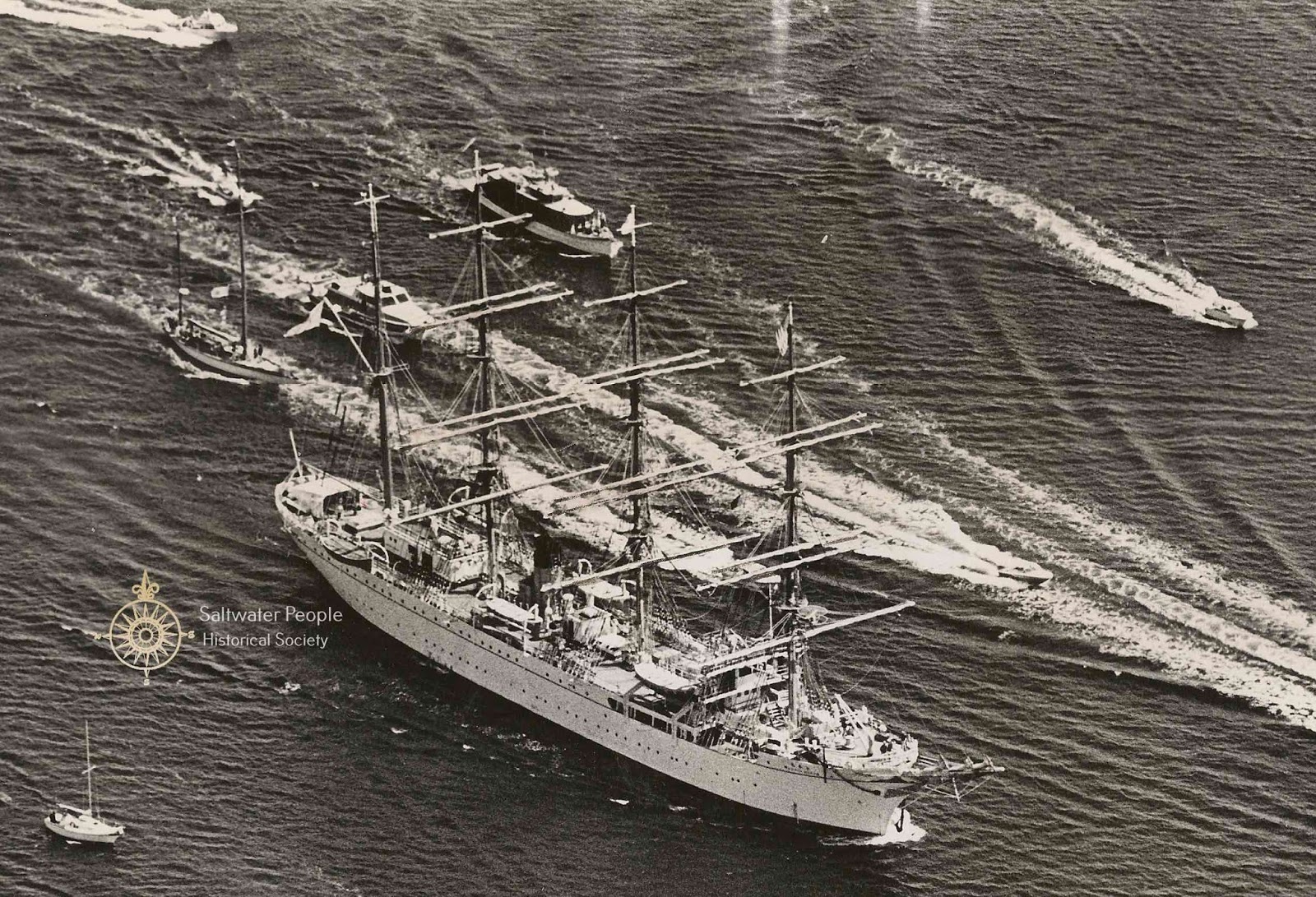
❖ The Sails of a Stately Lady ❖ The NIPPON MARU ❖ 1957

NIPPON MARU
Arriving Seattle 1957

NIPPON MARU
Arrival in Seattle, WA
For Seafair 1978.

According to the Seattle Times reporter, 
she could make 14.5 knots under sail,
faster than her Diesel propulsion speed of 11.4.

Photo by Larry Dion©
Original photo from the archives of the S. P. H. S.
      The magnificent, four-masted, steel, Japanese merchant marine training barque, the 318-ft  NIPPON MARU carrying 32 sails with 25,727 sq ft, en route to a Seattle pier. 
      She was built in 1930 by Kawasaki Shipbuilding in Kobe, Japan for the Imperial Japanese Navy; rated at 2,285 g. tons with a maximum mast height of slightly more than 176-ft. The ship carries 183 men, 20 officers, 112 cadets, and 51 crewmen who would perform sail drills for the huge crowds and open the ship for viewing. 
     
Nippon Maru
Seattle, WA., 1978.

Photograph by Larry Dion.
Original from the archives of the S.P.H.S.©


      Her good-will visitations to Seattle were 1938, 1941, 1957, 1962 for the World's Fair, 1965 with Capt. Isao Ikeda at Pier 56, 1973 with Capt. Shosaku Kadama at Pier 91, and 1978. Traffic stopping conditions existed along Alaskan Way when she was in port, with a fire-boat send-off display when she was departing.
      Decommissioned in the 1980s––NIPPON MARU is preserved as a museum ship at Nippon Maru & Yokohama Port Museum, where she is docked at Minato Mirai, Yokohama, Japan.

     
Nearing 50 years of age, NIPPON MARU, was the first of the Seafair Tall Ships to arrive in port with her 78 cadets, ages 21-25 as they head to Pier 70 in 1978. All are fifth-year students at the University of Mercantile Marine in Japan. Some of them plan naval careers after their September graduation, but for most, the six-month cruise is the climax to their careers. After graduation, several cadets said, they'll sell insurance, teach, or study law.
Thank you to Capt. Jack Russell of Sternwheeler Charters, Seattle, for the donation of maritime newspaper snippets depicting the years Seattle welcomed this beautiful visitor. 
      If you were on board this day and would like to leave a comment, it is easy to do just below this post. 

Archived Log Entries