"The Cure for Everything is Saltwater, Sweat, Tears, or the Sea."

About Us

My photo
San Juan Archipelago, Washington State, United States
A society formed in 2009 for the purpose of collecting, preserving, celebrating, and disseminating the maritime history of the San Juan Islands and northern Puget Sound area. Check this log for tales from out-of-print publications as well as from members and friends. There are circa 750, often long entries, on a broad range of maritime topics; there are search aids at the bottom of the log. Please ask for permission to use any photo posted on this site. Thank you.
Showing posts with label Commercial fishing. Show all posts

09 June 2018

❖ BRISTOL BAY FISHING GROUNDS❖


Fishing grounds of Bristol Bay, Alaska.

From a report compiled by the
Bristol Bay Regional Planning Team
For State of Alaska Fish and Game, 1988.
click image to enlarge.

"Fishing being an ancient industry, it is only natural that certain fishing grounds should have become famous. One of them is Bristol Bay, AK.
      These waters form the southeastern corner of the Bering Sea and include the area from Cape Newenham to Cape Menshikoff. Of the six salmon rivers in this territory, five are open for commercial fishing: The Nushagak, the Naknek, the Egegik, and the Ugashik rivers. The sixth river, the Togiak, is fished for 'personal use' only, by the inhabitants of that watershed.


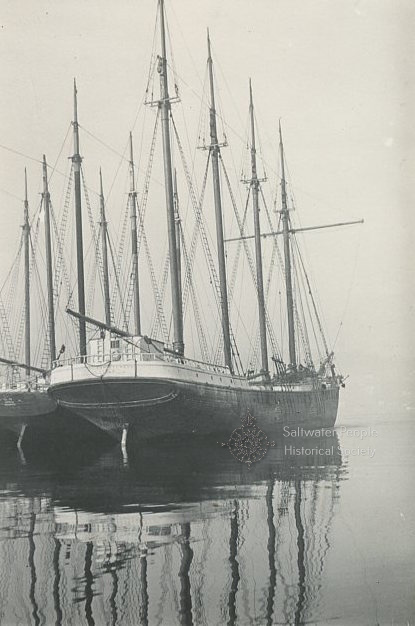
Schooner WAWONA

Captain Charlie Foss.
"In 1914, she cleared Anacortes, WA.
31 March and 
arrived at Unimak Pass on 8 April
with 23 fishermen.

The largest vessel of the fleet caught
240,000 fish (550 tons)

 most were caught from 32-45 fathoms deep."
 McCurdy's Marine History/Newell

Cod schooner WILLIAM H. SMITH
full of dories sailing north from
 San Francisco, 31 March 1933
for the Alaska fishing grounds. 

      Bristol Bay’s claim to fame rests upon the very solid foundation that from the beginning of commercial fishing in America, it has been the largest producer of red—or sockeye—salmon in the world. Yearly catch has reached into the millions of salmon and the yield to the canners of millions of dollars in one year. Some wonder then that the name “Bristol Bay” has a magic sound in a fisherman’s ear and is spoken with wonder and respect when fishermen get together.

Dories sailing to the fishing grounds
Bristol Bay, Alaska.

On Bristol Bay fishing grounds setting a gillnet
with a fresh-caught salmon breaking water.
June 1938

From the archives of the Saltwater People Historical Society ©


Cod fisherman in the 1940s got their food
from scows anchored in the Bay.
Bristol Bay, Alaska.

"Fishermen going ashore Bristol Bay, AK."
As inscribed verso.

Click image to enlarge.

      The gillnet is the only legal fishing gear in Bristol Bay. It may be used as a drift net, or as a set net—also called “stake net” or “beach net.” Set nets may be used by the local people only, and one must be a resident for a certain time period to operate this in any of the rivers. From the beginning of commercial fishing in Bristol Bay and for some 60-odd years thereafter the fishing was done with open boats, using sails and oars as propulsion, the use of motorboats having been prohibited by law.
      The reasons for this prohibition were not quite clear, it seemed. Some said that it was for the sake of conservation, as powerboats would be so much more efficient than the sailboats. Others again insisted that motorboats were prohibited at the request of the canning companies, as motors cost big money, and had to be repaired and replaced when worn, whereas Squarehead, Finn, and Italian fishermen could be thrown away when worn out, and replaced at no extra cost. Whatever the reason the law was there and had to be obeyed.
      The law prohibiting powerboats was changed finally, and the fishing season of 1951 brought the first power fishing boats to the Bay. They began to take over the field completely and the old sailboat is seen no more on the rivers of Bristol Bay.

      The history of early Bristol Bay fishing is a proud and terrible record of grueling work, privations, sufferings; of heroism and skullduggery, of foresight and initiative. Bristol Bay boasts what is perhaps the most “un-navigable navigable” waters in North America, with dangerous sandbars and banks extending miles out to open sea. The tidal difference is the third-largest in the world, creating dry land where, only five hours earlier, there was a navigable channel with twenty feet of water. The currents are unusually strong and erratic—storms are frequent and violent. Such are the waters fished by small, open sailboats—a testing ground that served to divide the 'men from the boys.'
      The rivers of Bristol Bay took their toll, year after year; boats were capsized, sunk, stuck on a sandbar and broken to pieces by the tide when a sudden storm came up. No statistics have been compiled but is common knowledge that hundreds of fishermen found their grave in the sands of wide river mouths.
      

Bark BERLIN (3223)
and others
stuck in the ice of Bristol Bay
One hundred years ago.
Dated May 1918.

Click image to enlarge.
BERLIN escaped back to Oregon...


But in May 1922, BERLIN, age 46 years,
went aground at Ugagak, Capt. E. Wendt of
Portland, OR., and was a total wreck.
She was bringing salmon to Naknek Cannery.
Vessel value $25,000 and Cargo $111,000.
All crew members were saved.
Naknek River, Bristol Bay, Alaska.


In the early transportation to and from the Bristol, fishing grounds was by sailing ships, each canning company operating its own fleet of vessels. The trip from “stateside” —Astoria, Seattle, San Francisco, and other ports—often had unpleasant surprises in store for the fishermen—who, during the voyage, also served as sailors. The Gulf of Alaska is known as rather a rough piece of water, especially in the time of winter and early spring, and the sailing vessels had to take a lashing from wind and waves before reaching the Pass—Unimak Pass, the gateway from the Pacific Ocean to the Bering Sea. And then the sailor might find—drifting ice in the Bering.
      Days and weeks might go by fighting the way to the anchorage at the mouth of the river. A 40-day voyage from stateside to Bristol Bay was far from uncommon and it often happened that as many as 63 days were spent underway.
      The working requirements? Here are excerpts from ‘Articles of Agreements and Wage Scale for the season of 1907 between the various AK Salmon Packers and Fishermen’s Union.’
      ‘...They agree to give their whole time and energy to the business and interests to said Company, and to work day and night (Sundays and holidays, not excepted), according to the lawful orders of the Captain, Superintendent, or whoever may be in charge for the Company, and for the compensation provided, but shall not be required to work for outside parties.’
      ‘...While preparing for fishing or after fishing has closed, the men shall not be required to work on Sundays as a rule, and if they are required to work any time on Sundays, such time shall be given to them during the week. In case of an emergency such as safety of ship or company’s property is in danger, such work to be done at any and all times without giving time back.
      

Heading home and
leaving the ice behind.

Vessel unidentified.
Click image to enlarge.

A cosmopolitan bunch they were, the Bristol fishermen. Italians, Finns, Norwegians, Swedes, constituted the main force, with a sprinkling of Danes, Irishmen, Scots, Germans, Hollanders—men of many races, creeds, and color of hair.

Peaceful and easy-going, as a rule, disagreements were slow to arise, tempers to flare. Such things did happen —there were black eyes or bloody noses now and again. By and large, peace and good fellowship were the rules of the fishing camps.
       The actual canning work was done by the ‘China gang’, under the command of the ‘China Boss.’ In due time the Iron Chink replaced the Chinese cannery worker. Later still the Filipinos were replaced by natives from the area adjacent to Bristol Bay, Aleuts, and Aleut-Eskimos.”

Above text from Fish and Ships, This was Fishing from the Columbia to Bristol Bay. Ralph Andrews and A.K.Larssen. Bonanza Books.

Bark BERLIN 
homebound September 1918
Bering Sea to Portland, OR.
Click image to enlarge.

Fourteen photos from the archives of
the Saltwater People Historical Society©

20 August 2016

❖ COOLING OFF ON THE BERING ❖ 1937

Schooner SOPHIE CHRISTENSON
Coming home from the Bering Sea.
Photo dated 2 years before James Flynn story below.

Original photo from the S.P.H.S.©
"James N. Flynn of Issaquah and his cousin, Richard Holder of Langley, Whidbey Island, remember codfishing in the Bering Sea aboard the four-masted SOPHIE CHRISTENSON as the most difficult $300 they ever earned.
      Flynn kept a pencilled 1937 journal of their ordeal. Most of the pages were accidentally lost, but his memory is keen. The SOPHIE'S exploits, and those of her captain, J.E. Shields, are documented.
      Men like Flynn and Holder are significant to me because each day I can look out my office window, north over Lake Union, and see Seattle's last remaining sailing ship, the forlorn-looking three-masted WAWONA. She, too, was a codfisher in the Bering Sea, at times within hailing distance of the SOPHIE.
      Equally important, Flynn's penciled journal and his recollections convince me that wooden ships were manned by men of iron. Ashore, many of the men were stumbling, rum-soaked derelicts. One readily admitted he chose thieving to working for wages. Two were tough, grizzled men in their 80s who had been at sea all their adult lives. One was a stowaway deaf mute. There were 45 men in all, and every one performed courageously and well.
      One day, Flynn handed me the age-yellowed pages of his journal. I looked at them and asked what would have been the title. He grinned and said, "Five Months Without a Bath."
      This is James N. Flynn's story.
❖  ❖  ❖
      My cousin, Rich, was only 17 but he was around 6 feet and husky. I was 22, and both of us and been toughened by manual labor. Neither of us and been at sea. We hired on as salters, helped by 'connections.' Times were lean.
      We were aboard the SOPHIE somewhere near Pier 51, waiting to be towed by tug beyond Cape Flattery. It took seven hrs to get the crew on board. They were trying to drink enough to last them for five months.
      I was in awe. Thirty men out of their drunken minds. The mates would herd a group aboard, then go into the taverns for the others. While the mates were gone, those on board would wander ashore again.
       We got under way in the evening, in tow. Up on the forecastle, the jugs and bottles were open. They were drinking everything dry before we were to let go of the tow line.
      When the tug's tow line let go, beyond Cape Flattery, the drinking stopped. According to some kind of code, all remaining booze was tossed overboard.
      Then began a weird transformation in the men, like a Jekyll-Hyde change. The drunks straightened up and became sailors. They cleansed themselves, changed clothing and went to work. We hoisted sails and got under way. I went aloft and was scared at the 100-foot height, but the old hands understood and helped me. 
Aloft on SOPHIE CHRISTENSON
Undated, unknown fishermen,
Unknown photographer.
Courtesy of R.R. Burke

I learned that if you are willing to pitch in, you get help and respect.
      The men were mechanical wizards. We had 22 fishing dories aboard, each equipped with a 10-HP Johnson outboard engine (only recently the dories had  been sail-powered.) The men disassembled the engines to basic pieces on the docks, right down to needle valves. They cleansed and inspected every part, then reassembled the engines and honed them to perfection, as if a man's life depended on a perfect engine. It did.
      We hauled out ropes and lines, canvas and brass. The old-timers went to work with their needles and twine. The dress gang sharpened knives.
Aboard Fishing Schooner SOPHIE CHRISTENSON
Unknown date, crew or photographer.
Click to enlarge.
Courtesy of R.R. Burke

      We sailed through an Aleutian pass, probably Unimak, and into the Bering Sea.
      Now, we're organized into rosters: 23 men listed as fishermen, 18 in the dress gang. The deck fisherman was Jalmar, the tongue cutter was Mac, the watchman was Harry, and the cooks were Walter and Frank. I did not record last names, but two men signed themselves as Cash Money and No Dory.
      The captain, J.E. Shields, and his brother and son owned the codfish packing plant at Poulsbo, the SOPHIE, C.A. THAYER and MY NORDIC MAID.
      Captain Shields operated the ship's store and, as we sailed northward into cold, sold us warm clothing and foul-weather gear as desired. He was the doctor, provisioner, chaplain, navigator, and judge.
      But crewmen settled their differences among themselves. When Finns and Swedes became clannish and segregated themselves, we insisted that everybody speak English. AS for medical aid, nobody during the 4 1/2 months became ill in that adverse climate––no flu, no colds, no lung congestion. Health was excellent.
      The SOPHIE was traditionally a good-luck ship. By reputation, illness or storm damage never enfeebled her. By 9 July we had taken and salted down 212,154 cod. Fourth July is memorable, not because it was a holiday, but because a one-day blizzard, or williwaw, iced the decks and sent us below.
      There was no heat in the crew's forecastle and no electric lights. We had no bathing facilities, except for buckets or whatever we improvised. The toilet was on the weather deck, extending over the side.
      These dorymen awed me.
Crew of SOPHIE CHRISTENSON
Bering Sea
Undated, unknown crew names,
unknown photographer.
Courtesy of RR Burke.
 They fished from dawn to dusk, and there wasn't much darkness. We worked up to 18 hours a day. They did not wear life preservers, because they reasoned the cold water would finish them in seven minutes. They would come back to the ship, heavily laden, and disappear behind giant waves. They would come alongside to mountainous gray swells and pitchfork their catches to us on deck, using one-prong forks. 
      Our hands were calloused like dogs' paws by rock salt and sea water. Our hands would split wide open and bleed. Men would strike matches on their horny palms. One common healing balm for split hands was human urine––our own.
      Maybe you have heard of the codfishermen's war against the Japanese. The Japanese fishing ships laid a net around us, entirely hemming us in. The captain was infuriated and gave orders to sail through it, ram our way out. We became entangled, our rudder was disable, and men tried to dive down and cut us fee. The cold water immobilized them. Finally, using knives attached to the ends of poles, we cut our way free of the nets. Captain Shields threatened to shoot at the encroachers with rifles, but he was dissuaded. (But the next year, in 1938, he instigated an arms buildup among fishermen which bordered on a shootout.)
      We returned to Seattle in late August 1937. I was a year older, having observed my 23rd birthday on 8 May. We sailed into Poulsbo, to Captain Shields' codfish processing plant, carrying about 400,000 pounds of cod. We had been gone about 4 1/2 months, and my wages were $300 net. 
Schooner SOPHIE CHRISTENSON
Home at winter moorage, Seattle, WA.

1941 photo by James A. Turner from
the Archives of the S.P.H.S.©

      Many of the crewmen collected their pay and resumed where they left off––in the taverns. My cousin and I returned to Issaquah in time for the potato harvest in the Yakima area. I had gained 25 pounds.
      I know you wonder whether I would sail aboard the SOPHIE again. Yes, I would––as a young man."
Above text from: My Waterfront. Carter, Glenn, Seattle, WA. Seagull Books Co. 1977.


26 September 2013

❖ FISHING THEN AND NOW ❖ by Louise Dustrude, 1979.

Friday Harbor waterfront
Original photo from the archives of the S. P. H. S.©
      "There weren’t too many commercial fishermen in Friday Harbor before World War II. People farmed, or worked for the Roche Harbor Lime & Cement Co., or maybe they cut cordwood for the Roche Harbor lime kilns.
       And a lot of them worked in the Friday Harbor Cannery (down where the condominiums are being built, next to the present ferry dock). Nearly everyone in town worked there at one time or another.
       Leith Wade was manager of the cannery before and during the war, and he remembers blowing the whistle half a dozen times a day during the big humpy season in 1945 to call people to work. 'The minister came, and the undertaker, and the barber, and people would even close up their stores and come down to help,' he recalls.
      
Purse seiners fishing for pinks and sockeye salmon
South end of San Juan Island, 1959
Photo by Larry Dion from a State Fisheries airplane.
Original photo from the archives of S.P.H.S.©


      The fish that kept the cannery running were caught mainly by purse seiners from Gig Harbor and Tacoma. Leonard Crosby was one of them. He met and married a local girl, Margaret Nielsen, and they settled here in 1950.
      

 Seiner moorage, Friday Harbor, WA.
Best boat photo of all time by
Friday Harbor's John Dustrude.
Thank you John.
The down-Sound seiners would fish from Sunday morning through Friday afternoon, and then tie up at the cannery for the weekend. It was said you could walk to Brown Island on the seine boats tied up in the harbor. There’d be a dance every Friday night at the Masonic Hall near the courthouse or the Moose Hall on lower Spring Street, and many Friday Harbor people remember those as 'the good old days.'
      But very few local people owned commercial fishing boats of any kind in those depression and war years.
      Lee Marble thinks there were only a half-dozen gillnetters on San Juan Island in the 1930s, and Charlie Nash says there were no more than a dozen in the entire county in 1940.
      The oldest type of commercial fishing gear in this area, according to Marge Workman, is the reefnet---and there never have been many of those.
      Her grandfather, Ed Chevalier, owned one of the earliest reefnet gears in the county, located in John's Pass between Stuart and Johns Islands. Marge fished there in the 1950s, and she says, 'It’s the most exciting way to fish. You can actually see the fish coming into the net. But you have to have good eyes to see them soon enough, and if you make a move they all turn at once and they’re gone.'
      She and her husband, Bob, have been gillnetting together for the past three years, but he too recalls reefnetting in the years past. And he remembers his father and uncle trolling from a round-bottom rowboat during the 1930s, selling their fish for 10 cents each and catching 50 fish on a good day.
      They fished off the west side of San Juan Is., and Bob recalls, 'We went out there and camped during the fall for a month or six weeks when the silvers were in.'
      Leith Wade helped build fish traps---the piling would be pulled out and reset every year---and operated buyer boats that went out and got the fish from the traps for the canneries, until traps were outlawed by a vote of the people in 1934.
      
Mitchell Bay Fish Trap, San Juan County, WA.
Photos from the archives of the S. P. H. S.©

      Fish were kept alive in the traps until picked up a cannery tender—or by a fish pirate. “Everybody knew about the fish pirates,” Leith says. Watchmen would be posted to guard the traps, but under cover of darkness outlaw boats would move in and steal the fish, using bribery or violence to take care of the watchmen.

      Bob Workman and his brother, Stub, started gillnetting in 1938 at Point Roberts, using two 20’ open skiffs with a half an engine from an old Model T. “Two of the cylinders had been removed, “ Bob remembers. And they pulled the net by hand.
      Everyone pulled nets by hand in those days. There were no power blocks or drums to make the work easier. “Your fingertips would bleed all the time,” Leonard Crosby says.
      The nets were made of cotton or linen, and they were very susceptible to rot. Gillnets and purse seines had to be soaked in bluestone every weekend, and the reefnets were tarred.
      There were no electronic aids to navigation, such as radar or fathometers. A few fishermen had radios, but Charlie Nash recalls that he couldn’t even afford the batteries for a radio.
      'All we had was a compass,' recalls Lee Marble, who started gillnetting in 1957.
      Charlie Nash was one of the first on the island to get into gillnetting after World War II. 'I got my first gillnetter in 1948, a Columbia River bow picker with a hand pulled net,' he says.
      Today Charlie has a reputation as one of the best fishermen on the island, but he says that when he started he “didn’t know anything about fishing, and I was a slow learner.”
      What are the major things a fisherman has to learn? 'Where to catch fish and how to stay out of trouble.'
      In those days, with so few boats out, 'If you got into trouble you could drift all day while you figured out what to do. If you did that now you’d drift into one of the other boats.'
      Charlie was the first fisherman in the county to get a nylon net, in about 1949 or 1950, and that was a great improvement. They’re less visible to the salmon, and you don’t have to bluestone them. 'You just take them home and pile them in a corner.'
      It was a big year for sockeye in 1954 and 'everybody found out about it,' Charlie recalls. During the fall and winter of 1954-55 there were a number of gillnetters built at Jensen Shipyard, including the STEADFAST, the SWEET GENEVIEVE, and the ETHEL M.
      And 1958 was another big year, 'and it was just a runaway after that.'
      Leith Wade says, 'It went from about 15 gillnetters on the Salmon Banks to three or four hundred.'
      And the numbers are still increasing, Chuck Hasty says, 'I can even see a difference since I started [in 1970]. It’s hard to find a place to set your net.'
      There are about 50 commercial fishermen now living on San Juan Island, and in the last few years more have joined the ranks than have quit. The overwhelming majority are gillnetters, with a handful of purse seiners and a handful who both gill net and reefnet.
      Those who do both---such as Terry Jackson and Charlie Brown—are outspoken in their preference for reefnetting. 'But you can’t make any money in it,' and so they gillnet too.
     'Reefnetting is a lot more fun because you see what’s going on,' Charlie says.
      'It’s a challenge. You’re on a one-to-one basis with the fish,' Terry says. “You might have to adjust your gear every 10 or 15 minutes to keep up with changes in the tide. And if you see a school of fish that turns away and doesn’t come into your net, you’d better know why.'
      Gillnetting, he says, once you put your gear out, “it’s just a waiting game.”
      Are there as many fish as there used to be? The consensus seems to be that there are, but a few dissenters say there aren’t. Most local fishermen say it just seems like fewer because there are so many more boats in the water.
     But Marge Workman says, 'I’ve never seen fish so thick as I did in the ‘40’s when they had that terrifically big humpy run. It looked like you could walk on them between Spieden and Sentinel Islands.'
      Phil Martin says that last year there was one of the biggest chum returns in history. The International Sockeye Commission predicts that this year will be big for humpies and next year for sockeye.
      Most local fishermen praise the work of the Sockeye Commission in building up the runs and conserving fish for the future.
      But offshore trollers, such as George and Karlene Morford, believe that the salmon resource “is in a crisis situation.” They believe that the hatchery programs are being poorly managed, and that salmon are being bred to return either earlier or later than the troll fishery season.
      They are also concerned to see large corporations, such as Weyerhaeuser, getting into the aquaculture business, fearing that not too far into the future the corporations will put pressure on state governments to eliminate the independent fishermen, claiming, “they are our fish.”
      Terry Jackson expresses the same concerns about corporate aquaculture and “changing the fishes’ cycle so they come back in the winter when you couldn’t possibly fish for them.”
      Friday Harbor is not the Morfords’ home, but they’ve been wintering here for three years now, aboard their 70’ east coast sailing schooner, the HELEN McCOLL.
      George has been fishing in Washington for 24 years. He started out fishing in Alaska in a 20’ double-ender with a 7½ hp engine, accompanied only by his dog. He hand trolled then, using rod and reel similar to that used on party fishing boats.
      He says, 'when I first started fishing there weren’t very many fish. It was after the dams had cut the runs, and before the hatchery programs really got started. Trollers were really funky, a real humble kind of fishing.'
      'But in the ‘60s the hatcheries started producing, trollers started making money, and then the price of fish went up and they made even more money. So in the last few years a lot of people have gone into trolling with very expensive gear.'
      It’s more expensive than ever to get into any fishery now, whether trolling, gillnetting, purse seining, or reefnetting. According to Phil Martin, gill net licenses are going for $15,000 now, available only from another fisherman because the state has put a moratorium on new licenses. It would probably take $50,000 or so to get a good used gill net boat and a couple of nets, he says.
      But people keep getting into fishing, and not even the 1974 Boldt decision is discouraging them. That decision allotted 50 percent of the salmon catch to members of certain Indian tribes because of 19th C. treaties with the U.S. government allowing members of the tribes to fish 'in common with' other citizens of the territory.
      The decision was at last argued to the U.S. Supreme Court on 28 February, and a ruling is expected in June.
      One other change may be coming to the local fishing industry, though very slowly. One by one, some of the local fishermen are gearing up for commercial fishing of other than salmon: herring, bottom fish, crab, even dog fish. There isn’t the money in these other fisheries that there is in salmon, but some say it’s coming.
      Probably a fair number of fishermen will do whatever seems necessary to stay in some sort of fishing because, in the words of one of them––probably speaking for all––'I like the freedom and independence of it.”
Above text by Louise Dustrude, Friday Harbor, WA.
Fishing Then and Now, The Island Record, 1979

Archived Log Entries