"The Cure for Everything is Saltwater, Sweat, Tears, or the Sea."

About Us

My photo
San Juan Archipelago, Washington State, United States
A society formed in 2009 for the purpose of collecting, preserving, celebrating, and disseminating the maritime history of the San Juan Islands and northern Puget Sound area. Check this log for tales from out-of-print publications as well as from members and friends. There are circa 750, often long entries, on a broad range of maritime topics; there are search aids at the bottom of the log. Please ask for permission to use any photo posted on this site. Thank you.
Showing posts with label Mosquito Fleet. Show all posts

29 June 2019

❖ Little Mosquito to the Summer House

S.S. SENTINEL
1898-1928.
One member of the hard-working Mosquito Fleet,
the photograph is dated 11 April 1913,
Click image to enlarge.
From the archives of the
Saltwater People Log©
"With the first indications of the near approach of the unrivaled summer of the great Northwest, the advance guard of campers, suburbanites, and lovers of the bracing out-of-doors yesterday started transportation of furniture, tents, and supplies to many of the scenic island resorts in the vicinity of Seattle. The steamboat SENTINEL, operated by the Merchants' Transportation Co, left Seattle for Vashon Island points with her holds crammed and decks packed high with campers outfits. Officials of the line said that during the coming summer of 1913, Vashon Island and points on the mainland served by the SENTINEL will be thronged with campers and those making their summer homes out of Seattle. The SENTINEL maintained a service from Seattle to the west side of Vashon Island and ran to Lisabeula, Quartermaster Harbor, Cove, and Colvas."
News clip possibly from the Seattle-Times, 1913.


Upper Puget Sound
 early communities, containing
VASHON-MAURY ISLAND.
Click image to enlarge.
Oceans of thanks to cartographer
Ronald R. Burke, Seattle, WA.

1898: built for the Hunt brothers.
1903: sold to Hansen Transport Co., rebuilt and widened to increase passenger capacity from 100 to 250.
1921: sold to Ed Lorentz.
1928: scrapped and the engine installed in the steamer ARCADIA.

Some of the known officers and crew working aboard;
Capt. Francis Sherman (1899), Capt. A. R. Hunt, Capt. John Dorotich (1910, 1911, 1912.)
Ethan E. "Eth" Emmons, Engineer    

06 November 2017

❖ FAREWELL MOSQUITOS ❖ 1937

1937
Moored at the Lk. Washington Shipyards at Houghton,
near Kirkland, was a fleet of forgotten ships,
once a prominent part of transportation on Puget Sound.
In this group are the old ferry WEST SEATTLE,
the HYAK, the MOHAWK, the TACOMA,
the KULSHAN, the SOL DUC, the CITY OF BREMERTON,
the ATALANTA, the WINSLOW, the SUQUAMISH, the
sternwheeler TOURIST, and the tug SEAL,
all veterans of Puget Sound routes.
The MOHAWK escaped the ship breaker's torch to
lead another short chapter as a tug on the Columbia River.
Original photo from the archives of the Saltwater People Historical Scty.©
Click image to enlarge.

"What became of the ships of yesteryear?
      To what haven have disappeared the pleasure vessels that residents of Puget Sound country used to board for their Sunday excursions in the days before the automobile?
      One answer was at the Lake Washington Shipyards at Houghton, which became almost a graveyard for an obsolete or obsolescent craft that formerly proudly plied the waters of Puget Sound in a day that is gone.
     Victims of men's changing habits, changing whims, and political views and of mechanical progress, these once gay ships, formerly brightly painted and kept spic and span, were tied up, many of them apparently for the last time, with a few that were still in good condition, waiting new uses for which they were still fit.
      Not only the coming of the automobile, the motor truck, the new streamlined ferry and modern freight boat, has helped to consign these once fine ships to oblivion.
      The passing away of such social and economic theories as prohibition has also helped to put an end to the usefulness of some of the old steamers.
      Such was the City of Victoria, which in its heyday plied between Edmonds and Victoria, to carry thirsty passengers beyond the boundaries of the USA for week-end revelries where bootleggers did not flourish.
      Built in the gay nineties––in 1893 to be exact––at Sparrow Point, MD, the Victoria ran up and down the Chesapeake Bay for many years, until she was brought to Puget Sound for the Victoria run. Many a Seattleite will remember her and will recall pleasant voyages to a more liberal environment during the days before repeal in this steamer's elaborately decorated salons, with their scrolled woodwork and carved finishing, reminiscent of the period when she was first built. Now the City of Victoria wastes away in the wind and weather among her sister ships of another day. 
     The Indianapolis, which once cut the waves between Seattle and Tacoma, and came around the Horn from the Great Lakes before the Panama Canal was completed and before the AYP Exposition in Seattle, was tied up not far from the City of Victoria.
      Built in 1904 in Toledo, Ohio, the Indianapolis piled between Seattle and Tacoma for many years. She was converted later into a ferry and served on other Sound runs until the new diesel ferries put her in her place at last.
      There is the old Sol Duc, built in Seattle in 1912 for the run to Port Angeles. She was retired from service in 1935 after the Sound ferry strike, and after the motor truck had replaced her as a freight carrier, and the modern ferry boat had made her obsolete for the passenger trade.
      Others are the Hyak, once familiar to travelers across the Sound to Poulsbo and Liberty Bay, and the Kulshan, built in 1920 for the service between Seattle and Bellingham.
      Still serviceable for many purposes, but awaiting a buyer, was the sturdy little ship Mohawk (ex-Islander) that used to run from Seattle to the San Juan Islands. She was tied up at the shipyards since the ferry strike of 1935. In the similar case was the Atalanta, built in Tacoma in 1913 for service between that city and North Bay, Case Inlet and Longbranch, later familiar on the run to Whidbey Island. 
       Ghostliest of all the boats at the yard was the old Morning Star, a mere shell waiting for final disintegration. She was out of service for at least 20 years, but in her more prosperous times ran between Seattle and British Columbia points in the service of Frank Waterhouse.
      Others at the Lake WA yards include the old West Seattle ferry, the Oregon, once in the Alaska service, the Beeline and Airline, Quilcene, Comanche, the Washington of Everett, and the Einar Beyer of Wrangell." From the Seattle Times, 1938.


18 August 2017

❖ A FREIGHTING MOSQUITO ❖ WAKENA 1911-1925 ❖

WAKENA
208632
Built in Portland, OR., in 1911
116.5' x 25.7' x 7.8'
310 G.t. / 226 N.t. 

Click image to enlarge.
Photo purchased from the Puget Sound Maritime, Seattle, WA.
Negative 955-5.
The twin-screw, gas powered freight barge WAKENA owned by Clatskanie Transportation Co and formerly operated in connection with the sternwheeler BEAVER between Portland & Clatskanie was transferred to Puget Sound in Sept 1914 by Capt. Bernt Olsen. Soon after she was sold to Border Line Transport Co. 

1915: Walter Allenby of Seattle, first mate, and August Krotz, quartermaster, were killed by carbon monoxide poisoning aboard the vessel early Nov. 1915. The WAKENA left Tacoma on the morning of 4 Nov, bound for Seattle and towing a large barge alongside. A head wind was encountered all the way to Seattle, with the result that an air pocket was apparently formed between the towing vessel and the barge at the point where the barge rested against the vessel, the gasoline engines of the freighter pumping a steady flow of lethal fumes, which were not dispelled as would normally have been the case. Allenby and Krontz were asleep in their staterooms, which were found to be full of fumes, and it was impossible to revive them upon the WAKENA's arrival in Seattle.

1917: 
This standard size dated postcard is one of only a few
business documents found to represent the cannery
that operated on Harney Channel, Shaw Island, WA.
It was found in an antique rolltop desk that was once used in
the Shaw Store by proprietor 'Gene' Fowler. The desk was
being cleaned and glued together for a donation to the
Shaw Island Historical Museum. From this document, we
learn of one of the vessels that transported canned fish
and fruit produced by the Shaw Island Canning Co. 

Cannery building at the Shaw Island Landing.
The plant operated between 1911 and 1922.
This photo is dated between 1930 and 1951.
Click to enlarge. 
1925: WAKENA was sold by Border Line transportation to the LaTouche Packing Co for use as a floating cannery in the Alaska herring fishery.

          While bound for Alaska in the service of LaTouche Packing Co the motor freighter WAKENA caught fire off Nanaimo on 27 May 1925 and was completely destroyed, the officers and crew were rescued and taken to Nanaimo by tug BELLE.
     
Source: 
Gordon Newell, editor. The H.W. McCurdy Marine History of the PNW. Superior Publishing. 1965.

05 June 2017

❖ Mosquito Fleet Monday ❖ CHESTER

Sternwheeler CHESTER, left.
ON 127201
Built in 1897 by Joseph Supple, Portland, OR.
Click image to enlarge.
Original photo from the archives of the S.P.H.S.©

The 101-ft CHESTER was built for the Cowlitz River operations of Captains Orin, Ed, and Joseph Kellogg. Working upstream from Kelso she was able to navigate in a channel a foot deep. At many stops along the river, customers simply drove their wagons alongside the steamer to transfer freight and passengers. 
      The design of the CHESTER was subsequently widely copied in building light draft steamers for gold rush river service in the north. 
      According to Jim Faber in Steamer's Wake, the steamer was noted for her flexible hull, supported by hog chains and planked with cedar. Her planking constantly being replaced  due to the fact she literally sand-papered her bottom as she slid over the Cowlitz River sandbars. 
      Owners liked to boast she "floated like a shingle on a pond."

22 May 2017

❖ MOSQUITO FLEET MONDAY ❖ The FLYER

The Flyer
ON 120876
1891-1929

"The most faithful old boat,
not in Seattle, not in the state of Washington,
not in the US, but the most 
faithful old boat in the whole 
wide, wide world, 
was that old Flyer––day in and day out."
Joshua Green 1869-1975

"The trade magazine Railway and Marine News in 1908 termed her 'the most remarkable steamer in the world.' Scaling off the exaggeration, the slender hulled Flyer was indeed one for the record book.
      The Flyer was built in Portland of Douglas fir by Capt. U.B. Scott, a Midwest transplant with a unique savvy for extracting the maximum speed from a steamboat. His Columbia River sternwheeler Telephone was a consistent winner in races between Portland and Astoria. Later he designed the aptly named propellor, Fleetwood, again winning the broom for speed. In 1898 the steamer made a record run from Tacoma to Seattle rushing a fire engine to join the battle against the Great Fire.
      So finely drawn were the lines of the knife-nosed Flyer that when launched in 1891, sans equipment, she rolled over. The hull was then sponsoned out; in other words a second hull was wrapped around the original. This second hull was improperly sealed, allowing tons of water to enter and remain sloshing around inside the hulls. Despite the handicap, the Flyer emerged fleet and dependable; a skinny upstart outrunning just about everything moving on Puget Sound.
      Along with speed, the Flyer became as dependable as the tides. 'Citizens of Seattle,' vowed the Railway and Marine News, 'used the Flyer whistle instead of clocks.' At the time of the magazine's accolade, the 170-ft Flyer had voyaged the equivalent of 51 times around the world, largely on the Seattle-Tacoma route (running time: 1 hour, 40 minutes), carrying more than three million passengers.
      Unlike any of her sisters, the Flyer boasted a dining room. Entertainment was provided by a viewing of her flashing engine, with its symphony of thuds and hisses seasoned with the smell of steam and hot oil. The triple-expansion engine, a duplicate of one designed for J.P. Morgan's Corsair, was capable of 2,000 horsepower, but due to boiler limitations never operated at more than 1,200. Despite a cruising speed of 16 knots, the Flyer created no more wake than a Mallard." 
Steamer's Wake. Jim Faber; Seattle, Enetai Press.(1985)
The Washington (ex-Flyer)
Friday Harbor, San Juan Archipelago,
dated 1924.
Original photo from the archives of the S.P.H.S.©

03 April 2017

❖ MOSQUITO FLEET MONDAY ❖ STEAMER F. G. REEVE


F.G. REEVE

214043
1916-1938
Photograph by James A. Turner, Seattle.
Undated original from the archives of the S.P.H.S.©
This wooden steamer was built by John Martinolich (1877-1960) at Dockton, WA.,
for passengers on the Washington Route of Capt. F.G. Reeve. 
Gross tons 87; Net tons 49.
101.7' x 22.5' x 6.4'
Her 325 HP triple-expansion engine was originally in the INLAND FLYER. 

Dockton Drydock

A few years before the building of the F.G. REEVE.
Undated litho card from the archives of S.P.H.S.©

"The village of Dockton, located on Quartermaster Harbor, formed one of the first major settlements on Maury Island; an industrial center of the south Puget Sound for a brief period in the 1890s. Dockton was named by the Puget Sound Dry Dock Co which had a shipyard and drydock (the largest on the west coast) there from 1892 to 1909.
      The shipbuilding and repair activities continued at Dockton with the Stucky and Martinolich yards producing boats until 1929 when the Jane G, the last commercial boat built at Dockton, was launched.
      As shipbuilding began to decline after the dry dock moved in 1909, Dockton began a slow gradual transformation into the quiet backwater community it is today." From: Vashon-Maury Island Heritage Association.

1917: Charles A. Stohl began steamboating on the F.G. REEVE this year then served as an engineering officer on offshore ships during WW I.
1922: F.G. REEVE, out of documentation.
1938: The F.G. REEVE was sold and her machinery & fittings were removed. The hull was abandoned in Lake Union.
1950s: During this decade, Cleo Crawford of Shaw Island, saw the vessel getting closer to the shipbreakers and talked Foss Tug into towing the hull to the mud in front of the Crawford home in Blind Bay, San Juan Islands. It is not known what plans Cleo had in mind, but the vessel rotted away there, visible for many years along the eastern shore just south of the state ferry landing. 
      Not much of a story for the short life of the F.G. REEVE. If you have more feel free to contribute.


Capt. F. G. REEVE

Aboard the CHIPPEWA
17 May 1939
Original photo from the archives of
the Saltwater People Historical Society.©


01 March 2017

❖ MOSQUITO FLEET RACING FOR TRADE ❖

S.S. VERONA
207675
112.9' x 22.8' x 7.3' 

Undated photo from the J.A. Turner Collection
S.P.H.S.©

"While Puget Sound history recalls dozens of spectacular steamer races, none could have been more heated that the rivalry between the HYAK and the VERONA about 80 years ago––near the end of the "mosquito fleet" era.
      The sleek HYAK, built at Portland in 1909, was the flagship in the Kitsap County Transportation Co.'s fleet of passenger and freight vessels, that served Bainbridge Island and docks of call beyond––including Poulsbo, settled by immigrant Norwegians in the early 1880s.
      The VERONA, built at Dockton on Maury Island in 1910, was acquired by a Poulsbo cooperative when travelers became dissatisfied with the Kitsap company's schedules and fares. Thus the stage was set for intense competition, and races between the rivals.
      In those days, numerous docks jutted out from shore in all Puget Sound waterways––flag stops, where passengers and freight embarked or disembarked.
      On the Seattle-Poulsbo route, stops were made at such points as Scandia, Keyport, Brownsville, Venice, Enetai, Gibson, Westwood, Crystal Springs, Pleasant Beach, South Beach, Fort Ward, Seabold, Agate Point and Port Madison.
      Especially on Saturdays, trade was brisk––with farmers along the route taking their produce to Seattle for sale in places like the Public Market. And frequently the farmers found time to see a show and do some shopping.
     
S.S. HYAK
206294
Built 1909 at the Supple Yard, Portland, Or.
134-ft, 195 t.
Triple expansion engine (12,18,32 x 18) with steam
at 225 lbs working pressure and developing 750 HP.
In McCurdy's Marine History, it is said she attained a speed of
c. 20 mph, at times, on her voyage up the coast.
S.S. HYAK
206294

Both HYAK original photos by J.A. Turner
Archives of the S.P.H.S.©


Accordingly, the first steamer out of the Poulsbo overnight stop skimmed off the cream of the trade––except that the VERONA, the "farmers' boat," had a popularity advantage over the big company's HYAK.
      Generally, the VERONA and HYAK left Poulsbo on the same early morning schedule and then raced to see which would get to Scandia first, and so on, from dock to dock.
      Capt. Alf Hostmark skippered the HYAK and Capt. Torger Birkeland was master of the VERONA, at that time. They were friends, yet determined rivals. On at least one occasion the two vessels collided while hustling toward a dock.
      To get maximum speed, safety valves on the steam apparatus were tied or braced down, and once the VERONA's stack got so hot she caught fire. (No serious causalities.)
      On weekends, the two vessels also carried commuters to their summer homes at such places as Crystal Springs and Westwood––and to a dance hall resort at Venice.
      The competition ended in 1923, when the KCTC bought out the VERONA's owners and the latter vessel donned the 'white collar' around her smokestack.
      Soon, though, shovel-nosed automobile ferryboats took over the trade. The building of roads and he automobile doomed the 'mosquito fleet––ending an exciting and picturesque era in Puget Sound transportation."
Above words by Ross Cunningham. Published by The Seattle Times. 25 May 1976.
Below from Steamer's Wake. Faber, Jim. 
"One of the Mosquito Fleet's key roles was that of serving as a farm-to-market highway for settlers. To farm women particularly it was a welcome role, one that introduced a measure of warmth and companionship into an often dreary rural setting. The steamers serving farms on Bainbridge, Vashon and Whidbey Islands and other stops, furnished bright swatches of color on market day in Seattle. Here produce houses, and by 1906 the Pike Street Farmer's Market, provided a bazaar within walking distance of Colman Dock and Pier 3 where most steamers docked. Writes Murray Morgan, co-author of The Pike Place Market:
      When the boat whistled its approach, the farmers or their wives would gather on the dock, bringing chickens dressed and wrapped in cheese cloth; butter molded into rose patterns, wrapped in butterpaper, and packed in wooden boxes; eggs nestled in straw baskets; root vegetables in burlap sacks; milk in galvanized cans; crates of fruit; bundles of rhubarb."

16 February 2017

❖ GOLD RUSH MOSQUITO ❖ S.S. DIRIGO Aground with GOLD in the HOLD

Steam Schooner DIRIGO
157502
Built in Hoquiam, WA. 1898.
Original photo from the archives of the S.P.H.S©
"In the Gold Rush days of 1897, as a temporary measure, the Alaska Line joined forces with the Washington and Alaska Steamship Co., each contributing a boat to the Skagway run. The ROSALIE and the CITY OF SEATTLE alternated each week with sailings from the Northern Pacific Dock in Tacoma and Schwabacher's in Seattle. By July 1898, the Alaska line had chartered a second ship, the DIRIGO outright. 
      The DIRIGO was a steam schooner built at Hoquiam, WA. She was 165' x 35' x 13.50' and 843 Gross tons overall. Immediately after completion, she was placed in the Alaska trade by J.S. Kimball and Co. She was noted for her hard luck. In April 1898, she left Skagway and put in at Juneau because of condenser troubles. When she tried to come alongside the steamer CZARINA at Peoples Wharf, her engine room signals got crossed and she rammed the other vessel, badly holing her side. The CZARINA had to make a quick run to the beach at Douglas.
S.S. DIRIGO
1898-1914.
Undated original photo from the S.P.H.S.©
      On 9 March 1899, the DIRIGO was stranded with 100 passengers off Midway Island, south of Juneau, during a heavy snowstorm. She was on the rocks for 46 hours before she was re-floated. The steamer was commanded by two well-known officers Capt. George Roberts and Chief Engineer George Lent. On 12 March the DIRIGO was towed to Juneau and was later brought to Seattle. She was so badly damaged she required a new keel and garboard strakes. Repairs ran to about $30,000, more than a third of the vessel's value. Eventually Alaska Steam had her back on the run with the ROSALIE on a regular schedule.
      The DIRIGO figured in a more cheerful news story the same year. The 18 Oct. 1899 edition of the Seattle Post-Intelligencer described her return to Seattle with the largest single shipment of gold up to that time, sent by way of Lynn Canal. The metal was valued at more than $1,064,000 and weighed two tons. It consisted mostly of gold bars, melted at Dawson, that were enclosed in wooden boxes bound with steel. Two officers of the North West Mounted Police accompanied the consignment, altogether there were six armed guards standing six-hour watches. Also on board were two leather trunks containing $90,000 in gold dust from one bank and another box containing $37,000 shipped by the Alaska Commercial Co. The vessel also brought 7,500 cases of canned salmon and 78 passengers on that trip."
Above text from Alaska Steam. Lucile McDonald & the Puget Sound Maritime Historical Society. Seattle. 1984.
Some of the officers who served DIRIGO:
Capt. Gus Soderman, Capt. Charles L MacGregor, Capt. George Roberts
Chief Engineer John H. Bragdon
, Capt. John A. Johnson.
1914, 11 April. Owing to increased activity in the Cook Inlet district, officials of the Alaska Steamship Co., announced they had decided to establish a regular freight and passenger route from Seward to that section of the country. To that end, steamship DIRIGO will be commissioned and pressed into service. The DIRIGO is being overhauled and will begin service in May. 
Above news clip from The Progressive. Petersburg, AK 11 April 1914.
1914, 16 November.  Commaded by Capt. John A. Johnson, foundered while in tow of the CORDOVA off Cape Spencer. The US Merchant Vessels publication lists DIRIGO was lost 40 miles east of Cape Elias. Crew safe.


06 February 2017

❖ MOSQUITO FLEET MONDAY ❖ KITSAP II WANTS TO RACE

KITSAP II
ON 214056
140.6' x 25.6' x 7.3'
Gross tons 258
Net tons 149
Built by Joseph Supple of Portland for 

the Kitsap County Transportation Co. 
Location: Colman Dock, Seattle, WA.
Original photo by Roger Dudley of Seattle,
archived with the S.P.H.S.©
Click to enlarge.

"The Liberty Bay Transportation Co, known locally as the "Farmer's Line" gave serious competition to Kitsap County Transportation Co. with their steamers the ATHLON, MAGNOLIA, VERONA, and the LIBERTY. 
      Warren L. Gazzam and his associates of KCTC decided to build a very fast steamer that the "Farmer's Line" could not compete with, and as a result, an order was placed with Joe Supple, Portland, OR for a vessel to be known as the KITSAP II.
      The new vessel was of striking appearance with her flush cabins and two funnels, all very well proportioned.
      As beautiful as the KITSAP II was, her crowning jewel was her power plant, a four-cylinder triple expansion engine that ran with the precision of a fine watch. The Curtis engines that Joe Supple obtained to power the KITSAP II gave very fine service throughout the life of the vessel. Steam was supplied by two Seabury boilers with a pressure of 340 pounds per sq. inch.
KITSAP II
Original photo from the S.P.H.S.©
Click image to enlarge.

      On arrival at Seattle from her builders, Capt. Alf Hostmark took over as master of the KITSAP II with Ole Hansen as Chief Engineer. There was quite a bit of talk about the speed of the new boat. Joe Supple claimed that she would make 22-mph. Mr. Gazzam claimed to have the fastest steamer on Puget Sound and it is said he offered PSNC a $1,000 bet that the KITSAP II could beat the TACOMA. PSNC paid no attention to this offer, but evidently tiring of what they were hearing, gave Capt. Everrett B. Coffin of the TACOMA the word to take the KITSAP II. The writer has been told the story of this race by three men in the TACOMA who were there––Capt. Coffin, Carl Williamson, one of the engineers, and Peter Christiansen, quartermaster. All told the same story, about how the TACOMA backed out of Colman Dock and laid there waiting for the KITSAP II to come out. When the KITSAP men saw the TACOMA waiting, they realized their bluff had been called and they had better get going. The KITSAP II not only was given a chance to get underway but was given a fairly long lead before Capt. Coffin "hooked" the TACOMA on. 
TACOMA
Elliott Bay, Seattle, WA.
Original photo from the archives of the S.P.H.S©
Click image to enlarge.
The TACOMA carried only her normal steam pressure that was regularly used on the Seattle-Tacoma run. By Smith Cove, she had not only overtaken the KITSAP II but had a lead of c. 4 lengths. Capt. Hostmark, fine gentleman that he was, conceded to the TACOMA by saluting her with three blasts of the whistle, and then the TACOMA came about and headed for Alki Point. Mr. Gassam never gave up trying to arrange races for his speed queen. One story is that the crew of the KITSAP II offered a bet of $5,000 of their own money that she could beat the H.B. KENNEDY. No race developed as it would be quite a feat for a crew that was paid $40.00 a month to raise that kind of money. In researching this article, an item was found in Pacific Marine Review that stated the KITSAP II and the H.B. KENNEDY had an impromptu race, with the KENNEDY winning. The KENNEDY on speed trial had made 18.37  knots. 
      When put into service on the Sea-Poulsbo route, the KITSAP II proved to be a disappointment to her owners, not that she did not come up to expectations or failed in her performance, but she was large enough to be unhandy on her landings. Her revenue did not justify the increased operating costs over the earlier steamers. After trying for a year to make a success of the KITSAP II, she was sold to the Navy Yard Route and placed on that run. This was one of the few mainline routes on the Sound and the KITSAP II settled down to show everyone what a fine and dependable vessel she was, making the run to Bremerton in 55 minutes. The KITSAP II ran to that city for many years with an occasional side trip, now and then. 
      The year 1926 came along and with it the demand for a different type of transportation, the auto ferry. This put an end to the service that had been so successfully performed by the little KITSAP II. 
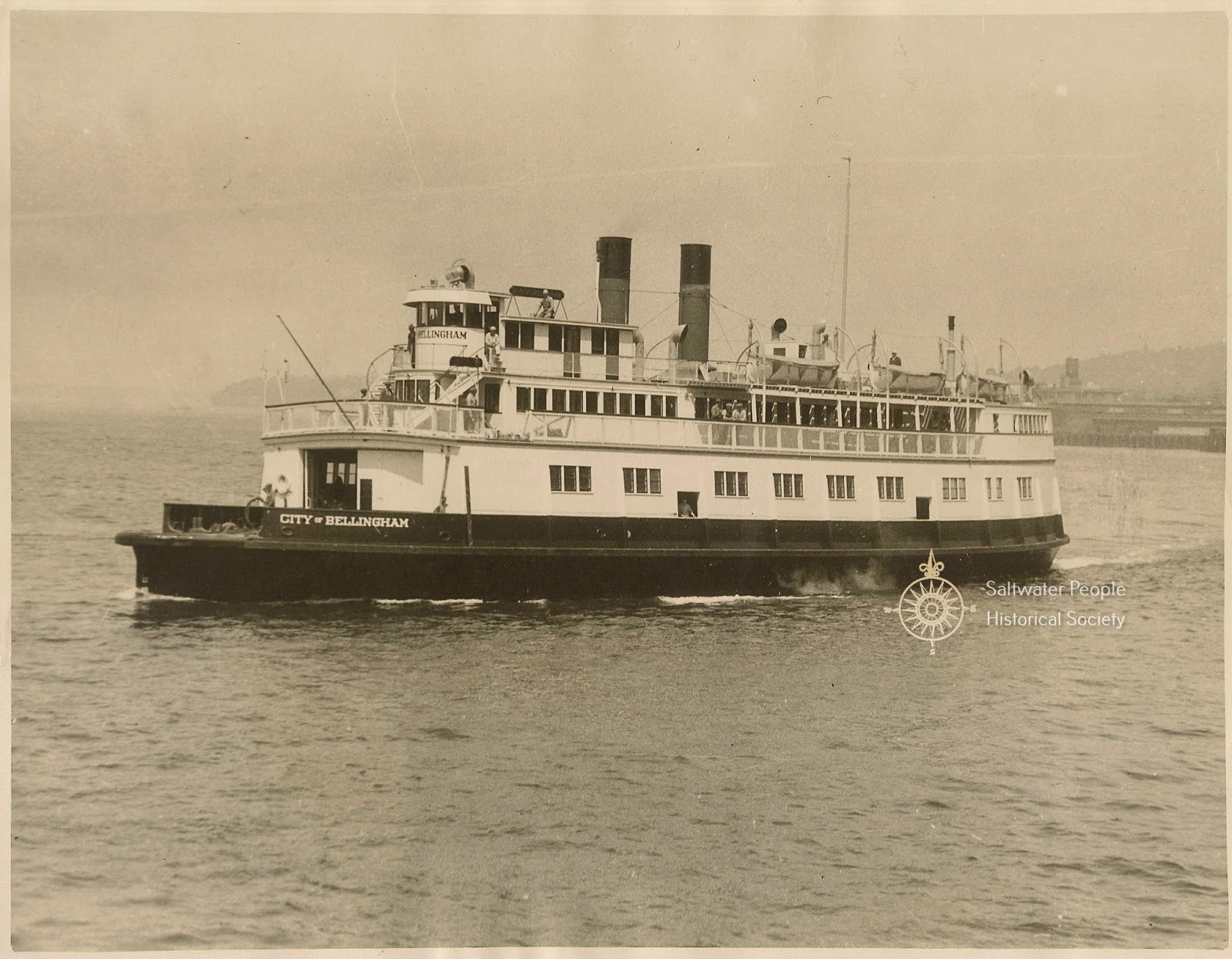
CITY OF BELLINGHAM (ex-KITSAP II)
As an auto ferry making her first swing on the new
schedule from Bellingham to Sidney and Victoria, BC
via the San Juan Islands route.
Photo stamped with the date of 27 Oct. 1929,
from the archives of the S.P.H.S.©
Click image to enlarge.
      She was rebuilt that year into an auto ferry and renamed CITY OF BELLINGHAM. Sponsoned out, the only recognizable features were her cables, wheelhouse, Texas and two stacks. PSNC ran her between Bellingham and Sidney, BC making two round trips daily with a stop at Orcas.
S.S. CITY OF BELLINGHAM (left)
Awaiting her turn behind the
S.S. CITY OF ANGELES
to depart the Orcas Landing.
San Juan Archipelago, WA.
Original undated photo from the S.P.H.S.©
Click image to enlarge.

Most of this period she was under the command of the justly famous Capt Sam Barlow, the dean of the San Juan County skippers.
      
M.V. QUILCENE
ON 214056
Photo dated 25 Dec. 1930
The Black Ball ferry QUILCENE was given a rousing
reception at Pt. Townsend on her first trip from Seattle.
The remodeling was so complete she was virtually a new ship.
She was rebuilt at Lake Washington Shipyards.

Photo by Acme Engraving Co, Seattle,
from the archives of the S.P.H.S.©
Click image to enlarge.

In 1929-1930, Capt. Alexander Peabody, who was one of the most progressive steamship operators that Puget Sound ever had, had the KITSAP II rebuilt, this time renaming her QUILCENE. The passenger accommodations in the QUILCENE were exceedingly well planned and very fine, providing every comfort that could be desired by the passenger. She still retained her original engine and according to Capt. Asmund Rindal, who commanded her when the writer sailed in her, she could make close to 14 knots. 
      When the QUILCENE was placed on the Pt. Townsend run after her rebuilding, it was under the command of Capt. Allen P. 'Paddy' Burneson. 
      In 1933, Cap. Asmund Rindal took the QUILCENE into Colman Dock in Seattle, where her final rebuilding took place. The house was raised in order to give clearance to allow trucks aboard. 
      The writer was in the QUILCENE two winters on this run with Capt. Rindal as master. During this time, she made what is believed to be her quickest passage from Edmonds to Pt. Townsend, which was one hour and 32 min.
      In 1938, the necessary truck clearance was such that she was replaced by the double-ended ferry KLAHANIE that had come up from San Francisco. 
      From then on the QUILCENE was run on occasional excursions, used as a spare boat, until she was taken over by the USN in 1942. Five years later she was sold to Freeman & Gibson in Seattle for conversion to a floating machine shop. 
      Many of the top men in steam-boating spent some very enjoyable times in the KITSAP II (ex-CITY OF BELLINGHAM, ex-QUILCENE), such as Captains Alfred Hostmark, Louis Van Bogaert, Wally Mangan, Sam Barlow, Asmund Rindal, Greg Mangan, Harry Owens, and many others. Three of the men in charge of her engine room were Ole Hansen, First Chief Engineer; Ernie Shelgren and Al Grady, who went on to become Port Engineer for PSNC and later Outside Super for Todd Shipyards. "
Above text by Wilbur B. Thompson for The Sea Chest, membership journal of the Puget Sound Maritime Society in Seattle, WA. December 1979.


30 January 2017

❖ MOSQUITO FLEET MONDAY ❖ H.B. KENNEDY

Steel Mosquito

H.B. KENNEDY

206030

Built in 1909 by the Willamette Iron Works,
Portland, OR.
499 G.t. / 216 N.t.
170.2' x 28.1' x 11.3'
4 cyl. triple-exp engine,
18 1/2, 27 1/2, 34, 34, with
steam at 350 lbs working pressure
and developing 2,000-HP.
(1924 she was renamed "SEATTLE")
Click to enlarge.

Original photo from the archives of the S.P.H.S.©
Photograph by Webster & Stevens.
"Rate wars and rivalries represented only the exciting and colorful sidelights of the development of inland water transportation in the Puget Sound region as it approached its glory days and subsequent swift decline. More significant events in the affairs of Joshua Green and Charles Peabody [Puget Sound Navigation Co] transpired during the first decade of the 20-C, although with less publicity.
      (Joshua Green, in his words, was the largest individual stockholder of the company from the time of its formation in 1901 until he sold his stock to Capt. Alex Peabody and associates in 1927.)
      In 1908 the PSNC had taken over Colman Dock at the foot of Marion Street. This pier, its ornate Victorian clock tower and domed waiting room roof providing a Seattle waterfront landmark, remained headquarters of the company's steamers throughout the rest of the steamboat era, and through the decadent days of the automobile ferries which replaced them.


H.B. KENNEDY
206030

Litho postcard from the archives
of the S.P.H.S.©

The first brand-new steel steamer was placed under company operation when the 179-ft H.B. KENNEDY was completed at Portland for the joint Kennedy-Puget Sound Navy Yard Route. The handsome two-stacker came up the coast under her own power, commanded by Capt. W.E. (Billy) Mitchell, in command for her first 8 years of operation, a total of 408,000 miles. She knifed her way up the Sound from Port Angeles to Seattle at better than her specified speed of 22-mph. That afternoon, with a party of company officials on board, the KENNEDY continued to show off, chasing the INDIANAPOLIS that was minding her business on the regular Seattle-Tacoma run, and passing her up amid much derisive whistling. Capt Penfield, who was still being humiliated by the FLYER, didn't much appreciate the gratuitous insult from a fleet-mate and Joshua Green didn't quite approve of the performance either. H.B. Kennedy, a more flamboyant type, was enjoying the proceedings so thoroughly, however, that he didn't have the heart to expostulate––and he was impressed with the KENNEDY's speed, and by the fact that, at normal cruising rates, her modern engines consumed little more fuel than some of the smaller and slower steamers of the fleet.
      The KENNEDY wound up the day's festivities by lying in wait in Elliott Bay for the FLYER to come in from Tacoma. She then pranced out, all flags flying, to challenge that notable old champion. Captain Coffin was already slowing down for his landing, the FLYER was blowing off steam, and he disdainfully ignored the gaudy newcomer.
      Like the giant Diesel-electric 'super ferries' that have taken over her old run to Bremerton, the H.B. KENNEDY suffered a number of minor mechanical difficulties during her shakedown period, but when these were solved, she continued to perform her duties efficiently and just as rapidly as the maritime marvels of sixty years later. 
      Early in her career, the KENNEDY was diverted to the Moran Shipyard for tests and inspection, for Joshua Green was dickering with that firm on the possible construction of more modern steel steamers. She was raced over the measured mile course at a speed of over 21-mph, with Green, Manager Frank Burns and J.W. Paterson, manager for the firm which had taken over the Moran yard, checking her performance carefully.
      Paterson convinced Green that the Puget Sound yard (soon to be named Seattle Construction & Drydock Co) could build steamers just as good as the KENNEDY and could meet or beat Portland's prices. Always a great booster for his adopted home town, Green placed orders with Paterson. The result over the next three years, was a new fleet of handsome and efficient, if not gaudy, home-built Sound packets that were to carry the PSNC house flag throughout the remainder of the Steamboat era.


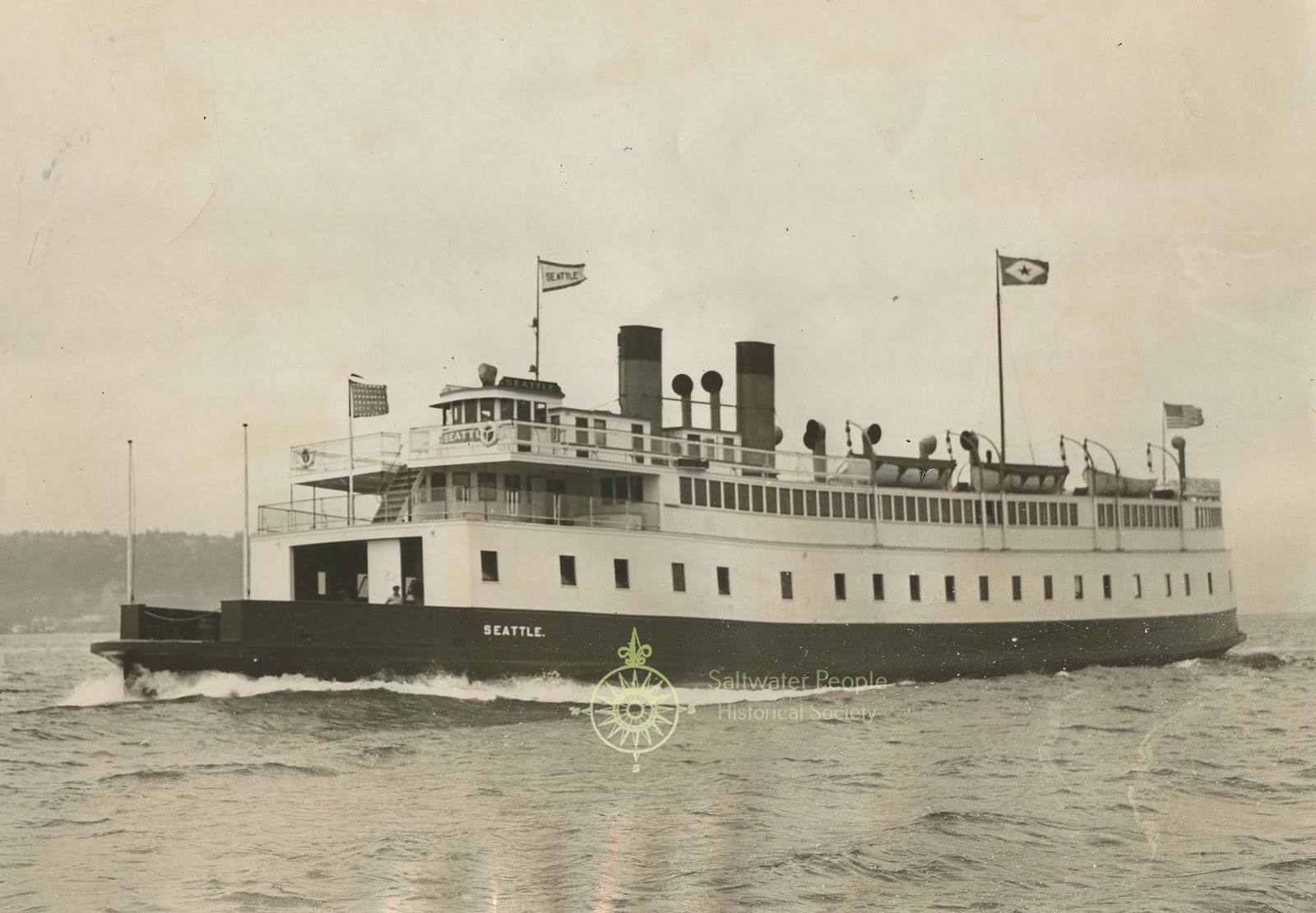
FERRY SEATTLE (ex-H.B. KENNEDY)

Photo is date stamped 5 May 1924;

The Navy Yard Route's new ferry.
She was scrapped in 1938.

Photographer unknown.
Original photo from the archives of the S.P.H.S.©

       In 1924, the H.B. KENNEDY became the steam ferry SEATTLE with the conversion being done at Todd Shipyard."
The [Joshua] Green Years. Newell, Gordon. Superior Publishing Co. 1969
      "In 1938 the newly acquired Diesel ferries came up from San Francisco, the KEHLOKEN (ex-GOLDEN STATE), entered service replacing the steam ferry SEATTLE (ex-H.B. KENNEDY), the latter vessel being laid up. Although the replacement of the old steamer of 1909, vintage by the modern Diesel-electric craft, was generally viewed as an example of maritime progress, a few malcontents persisted in pointing out that, whereas the handsome old SEATTLE had operated quite smoothly at a speed of 17.4 mph, the new KEHLOKEN, a remarkably ugly craft, progressed with considerable vibration at a rate of 14 mph." The H.W.McCurdy Marine History of the PNW. Newell, Gordon. Superior Publishing. 


23 January 2017

❖ MOSQUITO FLEET MONDAY ❖ CHIPPEWA––AGROUND NEAR CAPE HORN ❖


STEAMER CHIPPEWA

127440
Dressed ship for her first run
to Victoria, BC.

Moored in front of the Empress Hotel.
Original photo from the archives of the S.P.H.S.©

Once a splendid, twin-stack, passenger steamship launched in Toledo, Ohio in 1900, the CHIPPEWA was designed to run as a fast commuter ship on the Great Lakes. She did so for seven years before a sale was negotiated by Joshua Green of the Puget Sound Navigation Co. with Arnold Transportation Co. Green's partner, Charles E. Peabody, negotiated to purchase two other steamers, the INDIANAPOLIS and the IROQUOIS.
      A mechanical overhaul was done on the CHIPPEWA at Hoboken prior to the departure on the afternoon of 18 February 1907, Capt. McClure, commanding and C. F. Bishop as chief engineer.
      On her trip west to Seattle, she traveled 17,500 miles on the Cape Horn passage. She spent 54 days, and 17 hours of actual running time with some extremely rough weather in the Strait of Magellan.
      Trouble began soon after the New York harbor pilot was dropped. Fires started throughout the ship as seawater shorted out the electrical cables. The navigating lights went out, the boiler injector pipes began to leak, pipe joints blew out and the forward bulwarks were stove in. "Everybody is sick and everything going wrong," wrote Bishop in his engine room log. Saltwater kept getting into the boilers and it was necessary to shut one of them down completely for much of the voyage. On 24 March, just south of deadly Cape Horn at the entrance to the Straits of Magellan, the CHIPPEWA twice went aground; (click on "read more" just below ––

16 January 2017

❖ MOSQUITO FLEET MONDAY 🍀 The SHAMROCK and the RELIABLE buddies

Steamers RELIABLE and SHAMROCK
Southbend to Nahcotta, WA.
RELIABLE, ON 111423, 

was built in 1902, Astoria, OR.,
for the Willapa Bay Transportation Co (Capt. A.W. Reed.)

Photographer unknown.
Original photo from the archives of the S.P.H.S.©
"Despite the challenge and weather of Washington coast north of Long Beach (served by a fleet of Columbia River steamers,) hardy vacationers flocked to hotels and summer cabins at Westport, Moclips, and Pacific Beach aboard doughty little sternwheelers like the HARBOR BELLE and HARBOR QUEEN and the steamer FLEETWOOD docking at Westport and Cosmopolis.
      Sternwheelers like the ALLIANCE and DOLPHIN were sailing every week from Portland to Hoquiam, Aberdeen, Cosmopolis, North Cove, South Bend, Willapa and Bay Center. The steam launch JESSIE would ferry you to South Aberdeen for a dime.
      In 1908, popularity of Washington beaches and resorts led to daily runs between Portland and tiny South Bend on the Willapa River, requiring two steamers and a short train ride.
S.S. SHAMROCK
ON 201668
Passenger and freight steamer built in 1905 at Astoria, OR
for the Willapa Bay Transportation Co.
G.t. 116 / N.t. 79
72.3' RL x 18.2' x 6.2'
Converted to a towboat in her later years.
In this original photo from the archives of the S.P.H.S.© 
she is seen near Nahcotta, WA.
Click image to enlarge. 
RELIABLE
ON 111423

Built in 1902 at Astoria, OR.
Seen on her South Bend route.
Photo from the archives of the S.P.H.S.©

Returning home, excursionists would board one of the Willapa Bay mail steamers, SHAMROCK or RELIABLE at South Bend, crossing to Nahcotta midpoint on the Long Beach Peninsula. Here trains would carry passengers to connecting OSN steamers docked at Ilwaco, for the relaxing river ride back to Portland. Fare: $4.25.
      In addition to carrying passengers, mail, and freight, the stubby steamers offered weekend cruises to view a wreck or whales. 
      The most festive outing occurred on June 1908, when the steamers rendezvoused for a viewing of the Great White Fleet as it passed off the coast." 
The Atlantic Fleet entering Puget Sound
1908
Romans Photo / Asahel Curtis 1908
Click to enlarge.
Original photo from the archives of the S.P.H.S.©

Above text from: Steamer's Wake. Faber, Jim; Enetai Press. 1985.

Archived Log Entries