

 |
Captain John Claus Voss Tilikum his mate Norman Luxton, a newspaper journalist at Oak Bay, Victoria, B.C. beginning their sailing trip to London, England, dated 1901. |
The saga of Capt. J. C. Voss still is unparalleled. Between 1901-1904, he sailed nearly around the world in a rebuilt Native American dugout canoe, making a voyage of 40,000 miles.
He established a small-boat record in sail never approached since then. He carried no auxiliary motor and not even a dinghy!
Yet, in his last days, when long thought dead, he took up a new occupation, ironic for one whose life had been spent at sea. It generally was believed he drowned when he mysteriously sailed away from Yokohama harbor in 1913 on his 25-ft yawl, the SEA QUEEN a boat he designed.
He was always an enigma to seafarers; a man given to many actions that were unpredictable. A striking example: his sailing from Yokohama in his pigmy boat in 1913 without a word to anyone.
The story of how Voss spent his final years, his astonishingly different occupation at the end, his formerly unknown nationality, and the unexpected place of his death add a striking twist to this seafaring saga.
However, let us first consider some of his voyaging before embarking upon his most famous one around the world.
John C. Voss went to sea at 16. In 1896, as master of the sealing schooner AURORA, he made an unsuccessful trip to the Cocos Islands, seeking buried treasure. He returned to the Islands in 1897 in the ten-ton, 35-ft sloop XORA, and again was unsuccessful. He sailed to South America, a voyage of 7,000 miles.
Voss made a study of ships' reaction to ocean waves. With this knowledge, he selected a Nootka Native dugout canoe from the west coast of Vancouver Island as best conforming with his theories to meet wave reaction, for his voyage around the world.
This craft, already 50 years old in 1901, had been hollowed out of an enormous red cedar log by a Native. Voss bought it early in 1901 for $75. The Native owner gave him the skull of his father as talisman, the father having built the canoe.
As the craft stood, it was only a beginning: The lines, lightness, and cedar buoyancy were merely first essentials.
 |
Tilikum and crew passing the Gulf Islands, B.C., Canada 1901. |
Voss faced several months of hard work to bring the rebuilt craft in conformance with his plans. The canoe was towed to Victoria.
There Voss strengthened the cedar hull with inch-square oak frames and built up the sides seven inches. Inside were placed floor timbers. He added 300 pounds of lead to the keel. The canoe was decked to allow a cabin. The craft was fitted with three small masts for four sails. All running gear was so arranged that one man at the helm could set and take in all sails. Thus was an ancient dugout, never originally intended for sail, turned into a 38-foot sailing craft.
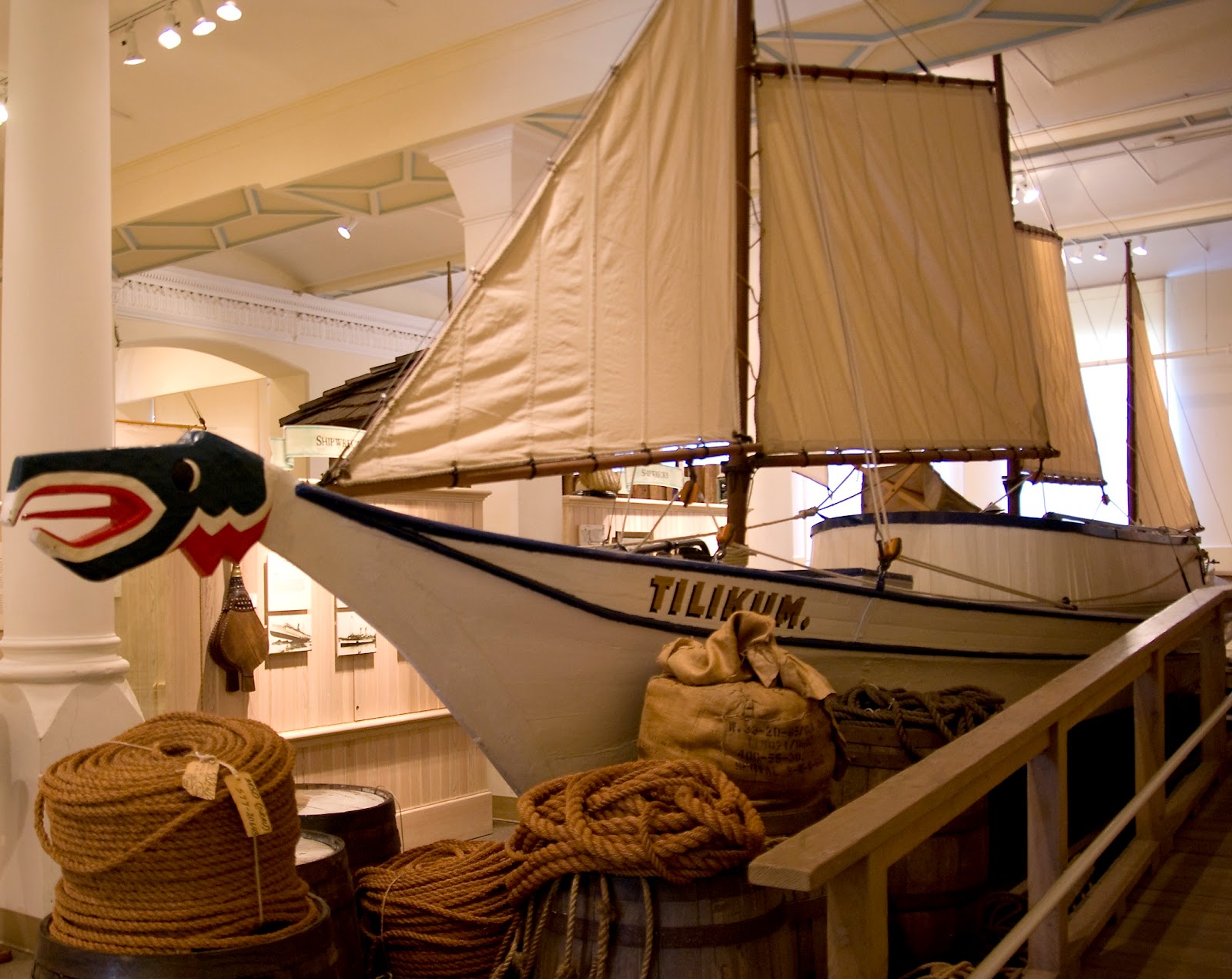
Over the grotesque bird figurehead, Voss broke a bottle of wine, christened this remodeled shell the TILIKUM, a word in the Chinook dialect meaning friend. On 27 May 1901, he sailed from Victoria for Suva, in the Fiji Islands, first lap of the journey. And in this slim, light structure he went three-quarters of the way around the world in three years, three months, and 12 days of leisurely travel.
Voss at the start was 40 years old. Some thought he was of Nova Scotian birth; others though he was from Newfoundland or the Netherlands. On the TILIKUM he had as first companion, Norman Luxton, a newspaperman, inexperienced at sea. Luxton now lives at Banff. He had shared half the expenses of fitting out the vessel. Also, he promised Voss $2,500 if they circled the globe in a craft small enough to set a new record.
Ten days out, a terrific gale made it imperative to put out a seaanchor, Voss had invented several specially designed for the small sailing craft. To launch this anchor in the enormous following sea, Luxton tied a life line around his waist and crawled to the foremast, held on to it, while Voss tensely waited for the arrival of a lesser wave and the right moment to yell to Luxton to let the anchor go. When he did, the greenhand panicked, climbed half-way up the mast, almost turning the TILIKUM over. Voss jerked the life-line to pull the inexperienced man to the deck in time to save the TILIKUM from capsizing. On the next lower wave, the mate succeeded in getting the anchor over the side. The little craft rode safely to the wind.
On arrival at Suva, Voss met his first disappointment. Luxton announced he was going to make the next lap of the voyage to Sydney, Australia, by the regular passenger steamer. Voss took on, as his second assistant, Louis Begent, able seaman, age 31. On October 21, the TILIKUM began her 1,800-mile voyage to Sydney.
Six days out, at night, they were forging ahead with a high easterly wind and great following seas. It was Voss' watch on deck when the binnacle light went out. He called to the mate to take the tiller and went to the cabin with the compass box to fit the light. This done, he handed it up to Begent. Unthinkingly, the mate let go the tiller just as an exceptionally high following wave came upon them.
As the TILIKUM swung far round to the wind the wave crashed over them, hurling Voss down into the cabin, filling it with water. When Voss scrambled back to the deck, the mate was gone, now far behind. Voss was helpless to aid him, as it was impossible to go back into that following sea. The mate lost his life because he had disobeyed the captain's strict order always to fasten his lifeline when he came on deck.
The captain now found the compass also had been washed away. He was about 1,400 miles from Sydney, the cabin half full of water, all bedding and clothing soaked. He bailed out the cabin. Two days and nights he stayed at the helm without food and nearly perished from the cold in his wet clothes.
Then he dozed. As the tiller swayed, a squall hit, sending the TILIKUM on her beam, hurling the captain against the lee washboards, knocking him unconscious.
When he recovered, he saw the foresail, part of the foremast, the forward staysail, and all the head gear overboard. Yet, by this very disaster, the craft had been held safely into the wind. He picked up the wreckage, put out the sea anchor into the calming sea, lit the riding light, let the vessel drift and went to sleep. The riding light went out. He woke in darkness horrified to see the red and green lights of a large steamer bearing straight down upon him. Pulling off his left sock, he dipped it in kerosene, lit it, waved it from the end of a frying pan. Just in time the steamer altered course.
Steering by sun and stars and the movement of the waves, the captain arrived at Sydney to face the worst disappointment of the voyage. His partner would go no further. Thus was lost to the captain the $2,500 offer for circling the globe.
Yet now Voss was more sure than ever he could succeed. So he bought out his partner's share. Unfortunately, this left him with only $10.
How to get money to continue the journey? the Sydney newspapers had given him immense publicity when he arrived. A reporter suggested Voss put the TILIKUM ashore in a tent in the city's park and charge admission to see this novelty ship, made out of a cedar log.
Voss did so. Inexperienced as a showman, he waited nervously at the tent flap on the opening forenoon. In spite of the publicity, only one person arrived the first morning, an old woman of imperious manner. After paying her sixpence admission, she climbed into the cockpit and sat. The captain timidly ventured: "How do you like my little ship?"
She answered sharply: "When is she going to start?"
The captain, flabbergasted, asked: "Start for where?"
Angrily the woman replied: "I paid my sixpence for a boat ride, and I want it!"
The captain, now thoroughly flustered, expostulated: "But the boat's on exhibition as a novelty!"
The old lady exploded: "I can see hundreds of boats out there in the harbor for nothing. Give me back my sixpence."
Fortunately, crowds came and the paid admissions continued two months. Now realizing he could make money in this manner, Voss changed his original plan of sailing direct to England from Sydney. He went on the visit other parts of Australia, then to Tasmania, New Zealand, South Africa, South America, and some European islands.
On January 4, 1903, he set sail for Hobart, Tasmania, on the 27th to New Zealand.
Voss, having overcome his first shyness, turned lecturer, describing the most thrilling parts of the voyage. At Palmerston, listeners were nearly all Maoris.
On 17 August, the TILIKUM left Auckland for Durban, S.A. Three terrific storms were encountered. Then, for 30 days, Voss and his mate drifted helplessly becalmed. Death from thirst appeared to be their fate until a deluge of rain came when they had been three days without water.
 |
Tilikum and crew, 1903 Durban, South Africa |
They reached Durban on 28 December where Voss once more became a showman and lecturer. By flatcar they visited Pietermartisburg--a strange triumph, she became the only ocean-going craft to reach a height of 6,800-ft above sea level.
On 14 April 1904, the TILIKUM sailed from Cape Town for England, last lap of the history-making voyage. Voss signed on as ninth mate, Edward Harrison, 22, and in first stages of consumption, a boy never before at sea. At the end of the voyage, Harrison had completely recovered.
 |
The exhibit sign Captain Voss placed for his speaking engagements. Click image to enlarge. |
The TILIKUM reached Margate, England, on 2 September 1904. The entire voyage had required more than three years. Ship and crew were grandly received at Margate and later at London. Voss was made a fellow of the Royal Geographical Society. The TILIKUM was shown at the Naval and Marine Exhibition in London in 1905.
Then Voss sailed away to Japan, leaving his gallant ship to rot on a tide flat on the Thames. The reason for this never has been ascertained. Those who knew the captain admitted he was a strange man.
Soon the TILIKUM was a sorry wreck. Before she was beyond repair, her condition came to the attention of two noted yachtsmen, A.W. E. and A. Byford, of the Greenwich Club. They refitted the TILIKUM at their own expense, and paid her passage by freight steamer to her home port of Victoria, her starting point. At Victoria, 1 July 1930, Dominion Day, the TILIKUM in a special ceremony was placed in a covered shed beside the House of Parliament
In a protected house she now stands in Thunderbird Park, Victoria (1965.) She is an example of, perhaps, the mosts remarkable small sailing ship in modern times.
 |
TILIKUM Undercover exhibit in Victoria, 1947, near the place of her departure in 1901. [Years later she was moved inside.] |
Voss, after going to Yokohama in 1905, became a familiar figure along the waterfront. Evidently he had made money by his lecture tours. With leisure, he began working on plans to build an even smaller and better seagoing vessel.
This completed in the spring of 1913, was a 25-ft yawl, named the SEA QUEEN. Without a word to anyone, Voss sailed out of Yokohama harbor in June. He never heard of again. Except for one man, all others believed Voss was lost at sea in his SEA QUEEN.
Then, 51 years later, came the amazing and strange discovery that Voss was not lost at sea.
Despite the belief that Voss was lost at sea in 1913, one man refused to accept this. He began a long research. He found that Voss sailed to the Bering Sea. Disposing of the SEA QUEEN to a man going into the far north to trade with the Eskimos. Voss became captain of a schooner trading in the North Pacific. Then, in 1918, he turned up in the small inland California town of Tracy, where his family had lived during Voss' half a lifetime at sea.
Voss, by then 57, was no longer in good circumstances, as he purchased a touring car and set himself up to supply the town with transportation. As a jitney driver, the fare he charged was 5 cents. For four years he acted as the town's only bus driver! He died in 1922; his death certificate lists him age 64 and his birthplace as Germany. He was survived by a son and a daughter.
Written by Francis Dickie for the Seattle Sunday Times, 3 January 1965.
Photos courtesy of the British Columbia Maritime Museum
This completed in the spring of 1913, was a 25-ft yawl, named the SEA QUEEN. Without a word to anyone, Voss sailed out of Yokohama harbor in June. He never heard of again. Except for one man, all others believed Voss was lost at sea in his SEA QUEEN.
Then, 51 years later, came the amazing and strange discovery that Voss was not lost at sea.
Despite the belief that Voss was lost at sea in 1913, one man refused to accept this. He began a long research. He found that Voss sailed to the Bering Sea. Disposing of the SEA QUEEN to a man going into the far north to trade with the Eskimos. Voss became captain of a schooner trading in the North Pacific. Then, in 1918, he turned up in the small inland California town of Tracy, where his family had lived during Voss' half a lifetime at sea.
Voss, by then 57, was no longer in good circumstances, as he purchased a touring car and set himself up to supply the town with transportation. As a jitney driver, the fare he charged was 5 cents. For four years he acted as the town's only bus driver! He died in 1922; his death certificate lists him age 64 and his birthplace as Germany. He was survived by a son and a daughter.
Written by Francis Dickie for the Seattle Sunday Times, 3 January 1965.
Photos courtesy of the British Columbia Maritime Museum
More details on Captain Voss and his 40,000 mile voyage can be seen on this Victoria, B.C., web site HERE.
And then, of course, the words by the skipper himself in this below listed book.
 |
First published in Yokohama in 1913. Second edition in London in 1926. This book has also been published in Australia, New Zealand, and South Africa. An introduction is by F. E. Grubb, Registrar & Librarian, Maritime Museum of British Columbia. |




 Posts
Posts

