"The Cure for Everything is Saltwater, Sweat, Tears, or the Sea."

About Us

My photo
San Juan Archipelago, Washington State, United States
A society formed in 2009 for the purpose of collecting, preserving, celebrating, and disseminating the maritime history of the San Juan Islands and northern Puget Sound area. Check this log for tales from out-of-print publications as well as from members and friends. There are circa 750, often long entries, on a broad range of maritime topics; there are search aids at the bottom of the log. Please ask for permission to use any photo posted on this site. Thank you.
Showing posts with label Hendersons Camp. Show all posts

27 May 2014

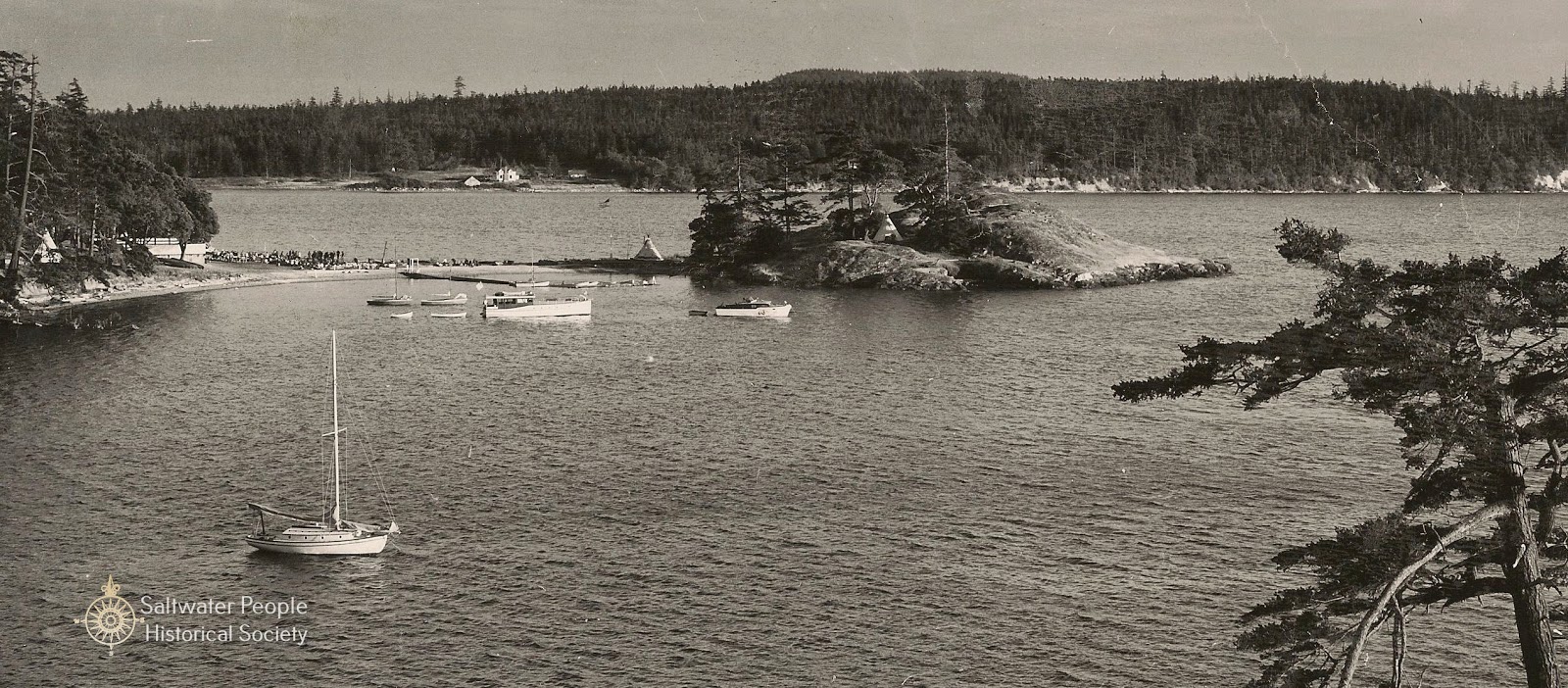
❖ HENDERSON CAMP ❖ Lopez Island, WA.

The top card, 1936, mailed from a camper
to his mother when the camp was founded as
San Juan International Camps
for Boys and Young Men, on San Juan Is.
The bottom photo card, posted in 1956, 

when the Hendersons relocated their camp 
on Sperry Peninsula, Lopez Island.
Click to enlarge.
Both originals from the archives of the S. P. H. S.©
Lucile Townsend Henderson and Frank Henderson founded the Henderson Camps which encompassed San Juan for boys and Northstar for girls. Lucile had been the director of the Seattle Girl Scouts Council and was on the national staff in New York; she also had lectured about field work at Harvard University.
     "Lucile and Frank were legends. That camp was there for as long as I can remember," said former Gov. Booth Gardner, who was a camp counselor during high school.
      Every summer from 1935 to 1966, when the Hendersons retired, the camp let kids sleep in tepees and learn canoeing, sailing, swimming, and Native American art and dance.
      Lucile inspired and continued to serve a vital role in the lives of former campers and camp counselors long after their summers at camp. She was very interested in the lives and development of the children and their safety, according to former camper John Dickson.
      Dickson spent 13 summers as a camper and then worked as a camp counselor in the 1950s and 60s, and later became a rheumatologist in Seattle. His relationship with the Hendersons was such that a significant donation is being made to the University of Washington's Division of Rheumatology from Lucile Henderson's estate.
      Members of the third generation of some families are now attending the camp, renamed Camp Nor'wester. [An earlier post of the artistic happenings at Camp Nor'wester on John's Island in 2013, can be viewed here.]
Henderson Camps, Lopez Island.
Cactus Rock, the Lodge, and pool.

Three original photos from archives of the
Saltwater People Historical Society©
      Donn Charnley, a state legislator from 1970 to 1984, spent his first summer at the camp in 1937. All six of his children have camped there over the years, and now his grandchildren are becoming involved.
      Charnley said he probably wouldn't have become a state official if not for the self-confidence inspired by the Hendersons. Charnley, a professor emeritus of geology taught occasionally at Edmonds Community College. "I became a teacher because of that camp; I learned to love the Earth," he said.
     
Henderson Camp, Lopez Island, WA. 1962
      Bill Holm, art professor emeritus at the University of WA and the Burke Museum, met his wife Marty when they were camp counselors in 1949. They married in 1953.
      Camp Nor'wester has passed through many hands since the Hendersons retired in 1966, but for many, it remains a Henderson institution.
      Gardner was instrumental in helping the property remain a camp after the Hendersons sold it. After the original land on Lopez Island was eventually sold, Camp Nor'wester reopened on John's Island in 2000.
      The Hendersons also campaigned to preserve Point Colville on Lopez Island from development. As a result of their work, the US Bureau of Land Management determined the land to be a significant wetlands area.
      After Mr. Henderson died in 1986, Lucile remained an important part of former campers' lives.
Above text by Kathy F. Mahdoubl, for The Seattle Times, 2006, written in celebration of the life of Lucile "Rabbit" Henderson who lived to be 101-yrs.

18 July 2013

❖ The Nootka Sailer with Author Archie Binns ❖ 1962

Archie Binns and his Nootka Sailer, 
February 1962
Photo by Roy Scully for the Seattle Times©.

Original photo from the S. P. H. S.
"A capital ship for a sailing trip is the Nootka Sailer––a jaunty dinghy designed by Archie Binns, a Seattle writer, and Edwin Monk, Seattle Naval Architect.
      They based the design of the craft on the dugout canoes developed by the Nootka Indians. The canoe was so good that Indian tribes copied it all the way from Vancouver Island to Tillamook, OR, Binns said.
      'What we've tried to do is to give the marvelous lines the Indians developed a chance with modern materials and techniques,' Binns said.
      The sleek dinghy has a long curving prow that arches up proudly from its narrow, flat bottom, giving it somewhat the appearance of a Viking boat. It is 4-ft wide and 12.5-ft long.
      Binns built his first Nootka-type boat with the help of his son, Richard, 8. Called the Nootka Sailer, she came through the test of rigorous use with flying colors.
      'I think one of the significant things about the Nootka Sailer is that it is the first modern boat that is indigenous to the Pacific Northwest,' said Binns, who writes about Pacific Northwest history. 'The Nootkas developed the boat through trial and error, to suit the particular conditions here.'
      The Nootka Sailer was used last summer [1961] by the Henderson Camps for Children on Lopez Island. Howard S. Eddy, sailing master of the camps, wrote Binns of the dinghy:
      'She is fast, able, and seaworthy––an ideal sailing or cruising dinghy––her sea-keeping is far superior to any comparable dinghy with which I am acquainted.'
      Eddy suggested some alterations in the design which were incorporated in a second boat just completed by Binns.
      Binns gives the Nootka Indians most of the credit for the design.
      'Anthropologists say the Nootka canoe is the most perfect one of primitive design ever made,' Binns said.
      Unlike the Nootkas, Binns and Monk weren't limited to a hollowed-out tree in constructing the new boat. The frame is of laminated Alaskan yellow cedar and the planking is laminated of two thicknesses of African mahogany. The guard is of oak.
      Fiberglass in the bottom of the craft will withstand scraping on the beach. All the fastening was done with bronze, and the tiller extends through a port, so it won't jump out of its slot.
      The second boat has an 18-ft cat-rig mast of airplane spruce. Binns expertly rounded the two glued halves of the mast with a hand plane.
      Binns pointed to the rudder and centerboard, which are designed to fold up when the craft is beached. Another feature of the boat is its dryness and comfort. Binns explained how the curving prow and top of the boat throw off waves so that no water is taken aboard even in the roughest weather.
Archie Binns and his NOOTKA SAILER
February 1962 Photo by Roy Scully,
for the Seattle Times©
Original from the archives of the S. P. H. S.
       He did all of the building with hand tools except for an electric drill.
      The Nootka Sailer showed excellent buoyancy when the Binns' took their four children sailing in it.
      "It's an excellent boat for a couple of adults or an adult and a couple of children to sail in". I particularly wanted to work out a boat that would be safe with children. This is about as stable a one as you could get."
      Binns said the Nootka boat is the only primitive one that stood up to whaling. The Makahs used it for whaling at Neah Bay.
      The daring Makahs had so much confidence in the boat and in their prowess that sometimes, for sport, they would harpoon a killer whale in sort of a 'bull-fighting' contest, the writer said.
      Binns said the Indians first powered the boat with oars, but later began using sails woven of cedar board or made of thin bands of wood."
     Text by Matt Miletich for the Seattle Times, 11 February 1962

Archie Binns (b. Port Ludlow,WA 1899-d.1971)
Graduated Stanford 1921.
Published c. twenty books.
Taught creative writing at U of WA, Western Washington University and Skagit Valley College.
Retired to Sequim, WA in 1964.


Archived Log Entries