"The Cure for Everything is Saltwater, Sweat, Tears, or the Sea."

About Us

My photo
San Juan Archipelago, Washington State, United States
A society formed in 2009 for the purpose of collecting, preserving, celebrating, and disseminating the maritime history of the San Juan Islands and northern Puget Sound area. Check this log for tales from out-of-print publications as well as from members and friends. There are circa 750, often long entries, on a broad range of maritime topics; there are search aids at the bottom of the log. Please ask for permission to use any photo posted on this site. Thank you.
Showing posts with label steam. Show all posts

02 August 2019

❖ STEAMERS OPENED PUGET SOUND TRAVEL

Northwest Washington State
with Puget Sound.
Click image to enlarge. 
Map published by C.P. Johnson Co., Seattle.
"Residents of western Washington, ever since the early days of civilization here, have faced the crossing of Puget Sound.
      The only change is man’s struggle to cross the Sound. And man struggles with man, as well as with the Sound, for there still are those who curse and those who bless Peter Puget’s waterway.
      This is the story of that struggle.


Port Blakeley, Puget Sound, Washington Territory.
Verso dated 1882.
Ships await loading with steam rising from the sawmill
in background. Lumber shipping was one of
the first industries in the Sound.
Click image to enlarge.
Original photograph by Huff, from the archives
of the Saltwater People Log©
Port Ludlow
Photo by Torka Studio, Pt. Townsend, WA.
Port Ludlow, WA.
47°55'25" N   122°40'32" W
Listed on the map above.
      In the beginning, there was timber. They were all sawmill towns... Port Ludlow, now just a yachtsman’s pleasant harbor dozing in the memory of her great mill; Port Gamble, her historic mill; Port Madison, a maritime suburbia; Port Blakely, her modern homes not quite erasing all the remnants of what once was the world’s largest sawmill, and Seattle, a metropolis whose historians still remember Yesler’s Mill.
Port Gamble, WA.
Click image to enlarge.
Port Blakely
Milling & Shipping Lumber on Puget Sound, WA.
Edward H. Mitchell, Publisher, San Francisco.

      So it was that the first organized crossings of Puget Sound were steamers, augmented by company tugs, which obligingly carried passengers, were the first. This was enough. Near the turn of the century, there were no highways; the dirt roads were no highways; the dirt roads did not wander too far from the milltown shores.
      If you wanted to travel, you did so by boat... by the mosquito fleet of passenger vessels. Darting here and there, they served more than 200 communities.
      Fares varied. There were no regulatory bodies. The fare was determined mostly by what it cost a man to operate his vessel, by the competition and by the traffic. In 1872, it cost $1, each way, between Port Blakely and Seattle on the Success, or on the Augusta, linking Port Madison and Seattle. But in 1887, in Poulsbo, you paid .50 cents to reach Seattle by steamer.


Poulsbo, Liberty Bay, Keyport, WA.
Photo by Pacific Aerial Surverys, Inc., Seattle, WA.
From the archives of the Saltwater People Log©

      That's about the way it was until the days of WW 1. By this time, the automobile revolution had forced the building of highways. Man was on the move. He wanted to see the other side of Puget Sound, not just as a foot passenger, but in a shiny, new, black Ford. Larger passenger boats were constructed, with hoisting devices for loading a few cars aboard.


HYAK, RELIABLE, VASHON II
Early Mosquitoes of Puget Sound.

       But this was cumbersome and costly. Thus the era of the ferry, a vessel with at least one end open to permit a person to drive a car aboard.
      In 1919, there were only three ferry runs on Puget Sound: from Seattle to its water separated peninsula, West Seattle; between Des Moines and Portage on Vashon Island, and across the Narrows, between Tacoma and Gig Harbor, technically, the very first “cross-sound ferry run.”
      But in 1920, the Puget Sound Navigation Co, the 'Black Ball Line,' converted the old steamer Bailey Gatzert, into an automobile ferry and put her on the Bremerton-Seattle route, thus creating the first real ferry run to the Olympic Peninsula.
      A similar conversion gave Bainbridge Island its first vehicle-carrying vessel three years later when the Liberty went on the Port Blakely run toting a maximum of 32 Model Ts.
M. V. LIBERTY 
Low res scan from an original from the archives
of the Saltwater People Log©


Steamer PUGET
Dated 8 July 1923
Built originally as a steamboat, here she is being pressed 
into service as a ferry for the Seattle-Port Ludlow route.
Photo from the archives of the
Saltwater People Log©

      Right there, perhaps, was where the man-to-man struggle began over what kind of crossing should be made of Puget Sound. For the car ferry apparently spelled the doom of the passenger-only vessel although whether this should be put down as a permanent 'death' remains to be seen; even now [1964], there is talk of a return to fast passenger-only vessels, perhaps of the hydrofoil design.
      But in the 1920s, the brave “mosquito fleet” began to die.
      The runs serving the western side of Bainbridge Island and their adjacent mainland ports of call were the first to go. In 1924, a tiny, six-car ferry, the Hiyu, began to shuttle between Fletcher Bay and Brownsville. A bus ran between the ferry landings at Port Blakely and Fletcher Bay for the benefit of those who didn’t come by car.
      Mixed up in the struggle of man-with-man was a business rivalry between Black Ball Line and the Kitsap County Navigation Co, also known as the white-collar line. White-collar passenger steamers still served Eagle Harbor, Yeomalt, Ferncliff, Rolling Bay, and around the end of Bainbridge Island to Port Madison. Ferries running from Ballard to Indianola and Suquamish and to Port Ludlow had replaced passenger-vessel service to those and other nearby North Kitsap ports."
Words by Walt Woodward. Kitsap County Herald, 1 April 1964. 

29 June 2019

❖ Little Mosquito to the Summer House

S.S. SENTINEL
1898-1928.
One member of the hard-working Mosquito Fleet,
the photograph is dated 11 April 1913,
Click image to enlarge.
From the archives of the
Saltwater People Log©
"With the first indications of the near approach of the unrivaled summer of the great Northwest, the advance guard of campers, suburbanites, and lovers of the bracing out-of-doors yesterday started transportation of furniture, tents, and supplies to many of the scenic island resorts in the vicinity of Seattle. The steamboat SENTINEL, operated by the Merchants' Transportation Co, left Seattle for Vashon Island points with her holds crammed and decks packed high with campers outfits. Officials of the line said that during the coming summer of 1913, Vashon Island and points on the mainland served by the SENTINEL will be thronged with campers and those making their summer homes out of Seattle. The SENTINEL maintained a service from Seattle to the west side of Vashon Island and ran to Lisabeula, Quartermaster Harbor, Cove, and Colvas."
News clip possibly from the Seattle-Times, 1913.


Upper Puget Sound
 early communities, containing
VASHON-MAURY ISLAND.
Click image to enlarge.
Oceans of thanks to cartographer
Ronald R. Burke, Seattle, WA.

1898: built for the Hunt brothers.
1903: sold to Hansen Transport Co., rebuilt and widened to increase passenger capacity from 100 to 250.
1921: sold to Ed Lorentz.
1928: scrapped and the engine installed in the steamer ARCADIA.

Some of the known officers and crew working aboard;
Capt. Francis Sherman (1899), Capt. A. R. Hunt, Capt. John Dorotich (1910, 1911, 1912.)
Ethan E. "Eth" Emmons, Engineer    

25 June 2017

❖ RACING ON THE RIVER ❖ 1952


HENDERSON (ex-M.F. HENDERSON)
sailing here under her movie name RIVER QUEEN
Click image to enlarge.
Original photo from the archives of the S.P.H.S.©

1901: Built as the M.F. HENDERSON by Shaver Transportation Co, Portland, OR. She was used as a freight boat as well as a towboat.
1911: In an overhaul she lost her initials "M.F." and became HENDERSON.
The M.F. HENDERSON, towing a Standard Oil Co barge from Astoria toward Portland, was run down by the well-known steam tug DANIEL KERN towing rock barges to the jetty. The M.F. HENDERSON capsized and sank in shallow water, lying on her side. No lives were lost. She was afterward righted by five sternwheelers pulling on her at once, and was then taken to the Portland Shipbuilding Co where she was dismantled and her engines and other equipment, except the boiler, installed in the new HENDERSON the following year. 
H. W. McCurdy's Marine History of the PNW.
1912: This year the HENDERSON was built by the Portland Shipbuilding Co for Shaver Trans. Co receiving most of the machinery and fittings from the wreck, but receiving a new locomotive boiler built by James Monk, having twice the capacity of the old boiler. 
1952: An old-time Columbia River sternwheeler she played an important part as the River Queen, in the historical movie the Bend of the River, based on a novel Bend of the Snake by Bill Gulick. The movie starred Jimmy Stewart and Rock Hudson, released 13 February. When first released, the film received poor reviews but since then gained more critical acclaim and is recognized as a great western.

The RACE

In 1952, to promote the release of the new movie, the Henderson participated in the last sternwheeler race on the Columbia River, commanded by Capt. Sidney J. "Happy" Harris.  The filming was done in Mt. Hood, Sandy River and Timberline, OR. Although favored to beat the new steel-hulled sternwheeler, the Portland, commanded by Capt. Bob Williamson, the Henderson fell behind early in the race when she lost steam. The engine crew quickly shunted live steam into her low pressure cylinder until the paddlewheel approached 30 rpm. Actor Jimmy Stewart and other cast members of the film Bend in the River were on board to cheer the vessel on––the Henderson came from behind to beat the Portland in the 3.6-mile race.
      Trivia on imdb.com––some of the river scenes were filmed on the Sacramento River in CA.
Sternwheeler PORTLAND
Her last day of duty helping to move the 930-ft
MOBIL ARCTIC 
for the Port of Portland.
PORTLAND was the last remaining vessel of its kind
in commercial service in the world.

Click image to enlarge.
Original photo dated 27 October 1981
from the archives of the S.P.H.S.©
1956: In December, with a grain ship in tow, the Henderson encountered heavy swells near the mouth of the Columbia River. Declared a "constructive total loss," she rested on shore until she was burned for scrap in 1964.
In 1981: After almost 30 years of service in and around the Portland harbor, the stately Portland yielded the harbor to Diesel-powered youngsters. The Port of Portland faced economic realities, and decided to retire the labor-intensive steam tugboat in 1981. 
      She sat some years at Terminal One, quietly rusting. Her wheelhouse and Texas were removed and rested on the dock. Her wooden super structure rotted away down to the steel housing of her machinery space. The powerful sternwheel dried and cracked where exposed; the underwater surface grew long tendrils of marine plants.
      In 1991, the sad remains of the Portland were deeded to the Oregon Maritime Museum. With funds from Meyer Memorial Trust, Murdock Trust, and the Port of Portland, a group of dedicated volunteers began restoration of the last steam powered sternwheel tug. The work is never ending; the results are well worth the effort. Today the Portland gleams inside and out. 
1997: She was entered into the National Register of Historic Places.

05 June 2017

❖ Mosquito Fleet Monday ❖ CHESTER

Sternwheeler CHESTER, left.
ON 127201
Built in 1897 by Joseph Supple, Portland, OR.
Click image to enlarge.
Original photo from the archives of the S.P.H.S.©

The 101-ft CHESTER was built for the Cowlitz River operations of Captains Orin, Ed, and Joseph Kellogg. Working upstream from Kelso she was able to navigate in a channel a foot deep. At many stops along the river, customers simply drove their wagons alongside the steamer to transfer freight and passengers. 
      The design of the CHESTER was subsequently widely copied in building light draft steamers for gold rush river service in the north. 
      According to Jim Faber in Steamer's Wake, the steamer was noted for her flexible hull, supported by hog chains and planked with cedar. Her planking constantly being replaced  due to the fact she literally sand-papered her bottom as she slid over the Cowlitz River sandbars. 
      Owners liked to boast she "floated like a shingle on a pond."

05 May 2017

❖ MAGGIE Steaming into May for Opening Day ❖

Babs Cameron at the helm of her 60th birthday present,
S.L. MAGGIE, photo dated 1964.
Photos by Wally Howland of Shaw Island, WA and San Francisco.

Click to enlarge.

Text by Skip Bold, 
Wasp Passage, Shaw Island, WA.
submitted to Saltwater People Historical Society Log
5 May 2017

"Babs and Coonie Cameron were interested in marine steam before they moved to the San Juans in 1961. She and Coonie found MAGGIE, a 16' Poulsbo salmon troller in Port Townsend in the 1940s or early 1950s. She was built by Ron Young.
      The previous owner had installed an awkward plywood box for a cabin. Coonie, with his sensitive architect's eye, toned this down with a visor and radiused window corners. He took out the loud 9-HP Wisconsin inboard and had Cliff Blackstaffe, of Victoria BC, build MAGGIE a 2-HP steeple compound engine and an oil fired horizontal water-tube boiler.
      Blackstaffe personally delivered the steam plant to Shaw Island in early 1964 and instructed Coonie on the installation and use.
Malcolm 'Coonie' and Margaret 'Babs' Cameron
aboard their restored S. L. MAGGIE,
near Shirttail Reef, San Juan Archipelago, WA.
1964.

Click to enlarge.
      Some of MAGGIE's touches crafted by Coonie were lovely teak and bronze handmade cleats and handsome teak steam valve handles to prevent burnt hands.
      Coonie was on the San Juan County Planning Commission at the time and usually took MAGGIE to Friday Harbor for meetings, a unique mode of commuting in the mid 20th century!
      They enjoyed MAGGIE for several years and eventually sold her to an Orcas Island friend.
      Their next maritime adventure was PIAVE, a 60-year-old tug/fish boat found in San Pedro, rebuilt over a winter in Sausalito and brought up the coast to Shaw. That's another story." 

01 March 2017

❖ MOSQUITO FLEET RACING FOR TRADE ❖

S.S. VERONA
207675
112.9' x 22.8' x 7.3' 

Undated photo from the J.A. Turner Collection
S.P.H.S.©

"While Puget Sound history recalls dozens of spectacular steamer races, none could have been more heated that the rivalry between the HYAK and the VERONA about 80 years ago––near the end of the "mosquito fleet" era.
      The sleek HYAK, built at Portland in 1909, was the flagship in the Kitsap County Transportation Co.'s fleet of passenger and freight vessels, that served Bainbridge Island and docks of call beyond––including Poulsbo, settled by immigrant Norwegians in the early 1880s.
      The VERONA, built at Dockton on Maury Island in 1910, was acquired by a Poulsbo cooperative when travelers became dissatisfied with the Kitsap company's schedules and fares. Thus the stage was set for intense competition, and races between the rivals.
      In those days, numerous docks jutted out from shore in all Puget Sound waterways––flag stops, where passengers and freight embarked or disembarked.
      On the Seattle-Poulsbo route, stops were made at such points as Scandia, Keyport, Brownsville, Venice, Enetai, Gibson, Westwood, Crystal Springs, Pleasant Beach, South Beach, Fort Ward, Seabold, Agate Point and Port Madison.
      Especially on Saturdays, trade was brisk––with farmers along the route taking their produce to Seattle for sale in places like the Public Market. And frequently the farmers found time to see a show and do some shopping.
     
S.S. HYAK
206294
Built 1909 at the Supple Yard, Portland, Or.
134-ft, 195 t.
Triple expansion engine (12,18,32 x 18) with steam
at 225 lbs working pressure and developing 750 HP.
In McCurdy's Marine History, it is said she attained a speed of
c. 20 mph, at times, on her voyage up the coast.
S.S. HYAK
206294

Both HYAK original photos by J.A. Turner
Archives of the S.P.H.S.©


Accordingly, the first steamer out of the Poulsbo overnight stop skimmed off the cream of the trade––except that the VERONA, the "farmers' boat," had a popularity advantage over the big company's HYAK.
      Generally, the VERONA and HYAK left Poulsbo on the same early morning schedule and then raced to see which would get to Scandia first, and so on, from dock to dock.
      Capt. Alf Hostmark skippered the HYAK and Capt. Torger Birkeland was master of the VERONA, at that time. They were friends, yet determined rivals. On at least one occasion the two vessels collided while hustling toward a dock.
      To get maximum speed, safety valves on the steam apparatus were tied or braced down, and once the VERONA's stack got so hot she caught fire. (No serious causalities.)
      On weekends, the two vessels also carried commuters to their summer homes at such places as Crystal Springs and Westwood––and to a dance hall resort at Venice.
      The competition ended in 1923, when the KCTC bought out the VERONA's owners and the latter vessel donned the 'white collar' around her smokestack.
      Soon, though, shovel-nosed automobile ferryboats took over the trade. The building of roads and he automobile doomed the 'mosquito fleet––ending an exciting and picturesque era in Puget Sound transportation."
Above words by Ross Cunningham. Published by The Seattle Times. 25 May 1976.
Below from Steamer's Wake. Faber, Jim. 
"One of the Mosquito Fleet's key roles was that of serving as a farm-to-market highway for settlers. To farm women particularly it was a welcome role, one that introduced a measure of warmth and companionship into an often dreary rural setting. The steamers serving farms on Bainbridge, Vashon and Whidbey Islands and other stops, furnished bright swatches of color on market day in Seattle. Here produce houses, and by 1906 the Pike Street Farmer's Market, provided a bazaar within walking distance of Colman Dock and Pier 3 where most steamers docked. Writes Murray Morgan, co-author of The Pike Place Market:
      When the boat whistled its approach, the farmers or their wives would gather on the dock, bringing chickens dressed and wrapped in cheese cloth; butter molded into rose patterns, wrapped in butterpaper, and packed in wooden boxes; eggs nestled in straw baskets; root vegetables in burlap sacks; milk in galvanized cans; crates of fruit; bundles of rhubarb."

07 November 2016

❖ MOSQUITO FLEET MONDAY ❖ A Mosquito RUNS THE RAPIDS ❖ S.S. HARVEST QUEEN ❖

River steamboat HARVEST QUEEN
846 t. 200-ft., built at Celilo in 1878.
She and 8 or 9 other vessels were transferred to
the lower river in 1881, where this story begins.
Original photo from the archives of the S.P.H.S.©

The term 'Mosquito Fleet' may, to readers not familiar with the Puget Sound Country, suggest only very small craft. It was however, a phrase universally employed by the people and publications of that section to differentiate the Sound steamers from ocean and coastwise fleet. Some of the inland ships were as large as the deep-sea vessels, but their trade placed them in the 'Mosquito Fleet.' The term enjoys the authenticity of tradition and long usage. Author, historian Gordon Newell, 1951.

"The serenity of this scene as the HARVEST QUEEN moves out of her slip heading for the Columbia River is in sharp contrast to an earlier run of the HARVEST QUEEN––one that took her over Celilo Falls.
In 1881, hard times on the Middle River above the rocky barrier at Celilo Rapids had prompted the passage. It was a risky one. To breach the falls meant a 20-ft drop over a basalt ledge. Then followed the hazards of rock strewn Tenmile Rapids. This churning gutted into a mile long cauldron that compressed the Columbia between sheer rock walls less than 300-ft apart.

      Running the Celilo Rapids was first accomplished in 1866 when Capt. Thomas Stump threaded the OKANOGAN through the hazardous chasm, followed by other sternwheelers of similar size: the NEZ PERCE CHIEF, the classic ONEONTA, the HASSALO (II), and now one of the river's finer steamers, the HARVEST QUEEN. At the helm was Capt. James W. Troup, 29, who six years earlier had entered the HARVEST QUEEN's pilot house as her skipper. Peter De Huff, a veteran riverboat engineer, manned the engine room throttle as she moved from her Celilo slip. A slight rise in the low River had prompted the young captain to make his move. For a few minutes it seemed as though it might be his last for, as the HARVEST QUEEN swept into the narrow chute, she was unable to clear the ledge.
The rocks tore into the stem of the 200-ft steamer, ripping off her rudders and disabling the engine supports. Legend has it that Capt. Troup picked up his speaking tube and shouted:


'Back her, Pete! Back her if you love me!'
'I can't. Everything's busted,' came the doleful reply.

      Captain Troup, with the skill of command that was to make him an outstanding riverboatman on the Columbia and the Fraser, left his useless wheel. Anchors and kedges were dropped to pull the drifting HARVEST QUEEN out of the whirlpools and away from the threatening rocks into the eddy. The worst was over. Defying the chill waters, the steamer's crew completed repairs. Within two days, the HARVEST QUEEN was ready and defiant, sweeping at railroad speed through the remaining rapids to be greeted by cheering crowds at the Dalles."

Above words by author Jim Faber, The Steamers Wake. Entetai Press, Seattle. 1985.
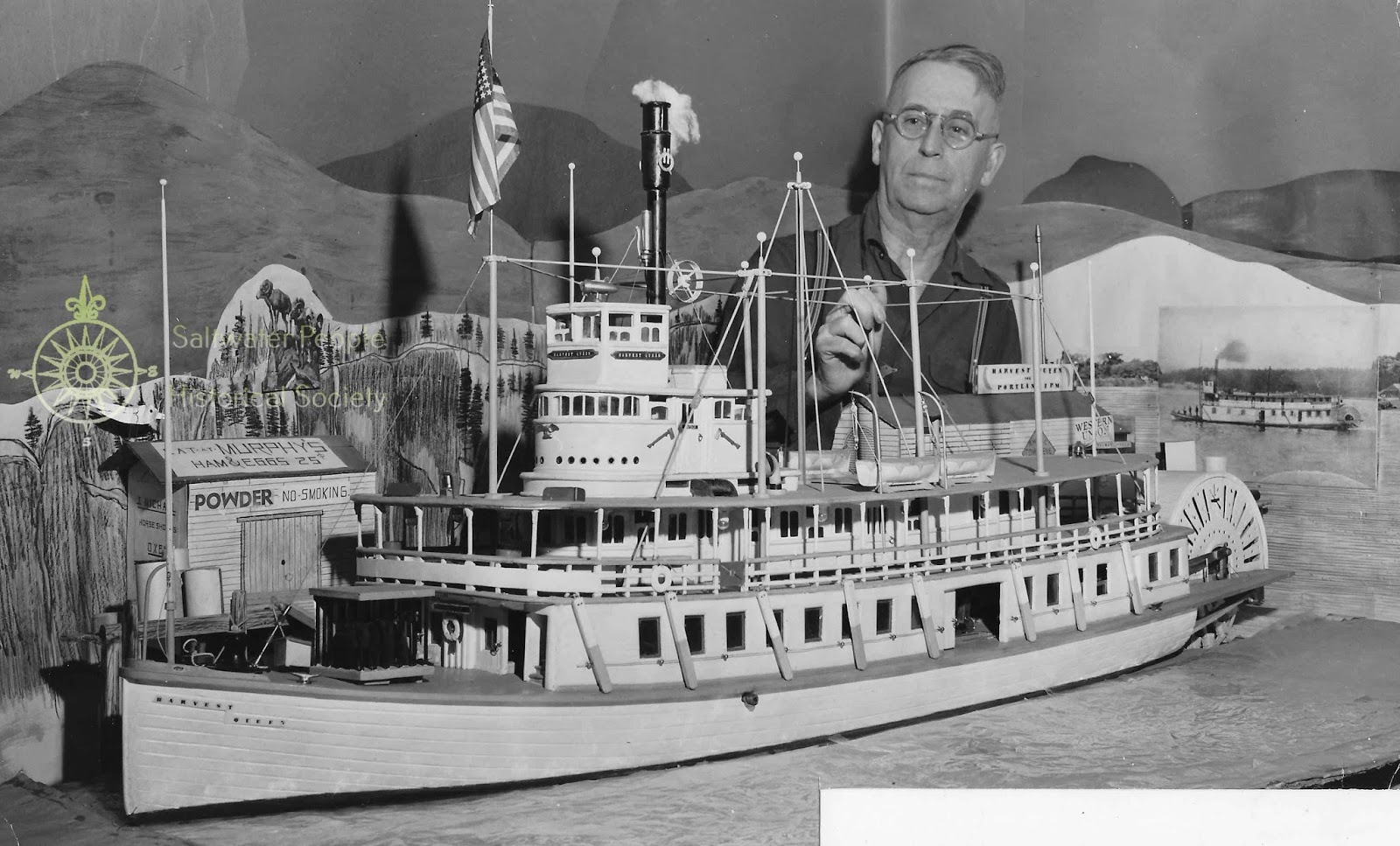
HARVEST QUEEN
6-ft long ship model by Spencer W.Young, 1953.
Young took 13 months to make the craft of birch, oak, pine, and
mahogany. Boilers and twin engines drive walking beams,
11" long, that turn the paddlewheel. The lounge is furnished
with a grand piano, armchairs, tables, all to scale.
LIghts come on in cabins and smoke pours from the stack.
Unknown photographer.

Original photo from the archives of
the Saltwater People Historical Society©
1928: Capt. Troup had a truly great maritime career that closed with his retirement at age 73 years of age––having passed the age limit set by BC Coast Steamship Service by 8 years.

09 December 2015

❖ WIND WRECKAGE OF 1934

The 15,000 ton liner PRESIDENT MADISON
windswept into s
teamer HARVESTER,
Smith Cove, Seattle, WA. 

October 1934.
Original out-of-focus photo by Marine Photo Shop.
from the archives of S.P.H.S.©
The arrow indicates the keel, partly submerged,
of the sternwheeler HARVESTER,
that plied between Seattle and Mount Vernon.
The crew leaped to safety aboard nearby barges.
The NORTH HAVEN (L), and the tug ROOSEVELT
also were damaged as they pounded against the
side of the MADISON during the fierce
70-mile an hour gale, taking a toll of 17 lives,
in the Puget Sound area.
One of the worst gales in many years swept the Puget Sound area on 21 October 1934; southwest winds up to 70 miles-an-hour causing damage in the millions of dollars to ships, buildings, and standing timber. The American Mail Line's liner PRESIDENT MADISON figured in another spectacular mishap at Seattle when she was torn from her moorings at the outer end of Pier 41 (now Pier 91) and went drifting across the harbor, crashing into the sternwheel steamer HARVESTER of the Skagit River Navigation & Trading Co and sinking her in deep water. She also collided with the steamship NORTH HAVEN of the Northland Transportation Co inflicting considerable damage to that vessel. 
         
The HARVESTER
After being righted, 12 November 1934.
Heavy cables were run under the vessel and carried
across the deck to the outer rail where they were made fast.

Original photo from the archives of the S.P.H.S.©

      The HARVESTER was built in 1912, at Stanwood, WA, for Capt. H.H. McDonald for 30 passengers as well as greater freight capacity than previous vessels in this service.
      She was 638 t. / 152' x 36.2' x 6.8', a larger steamer than the GLEANER, built by McDonald in 1907. She was of shallower draft and was able to navigate the shallow Skagit and Stillaguamish Rivers more successfully than her elder running mate.
Above text: H.W. McCurdy's Marine History of the Pacific Northwest. Gordon Newell, editor. Superior (1965.)  
Ship model of the sternwheeler HARVESTER
with Mrs. Anna G. Grimison.
Her son, "first mate" Harry E. Grimison, is the suspected builder.
Location of this fine model???
Original photo from the archives of the S.P.H.S.©
      President of the Skagit River Navigation Co, Mrs. Anna G. Grimison was at the helm of the line for almost forty years. The line was started by her father, Capt. H. H. McDonald. Her last two freight boats were the sternwheelers SKAGIT CHIEF and SKAGIT BELLE. Mrs. Grimison, who made it clear she did not want to be compared to 'Tug Boat Annie,'  retired in 1962 and passed away in Seattle in 1964.

11 May 2015

❖ OCEANID ❖ A Novel Craft

OCEANID
(ON 285719)
heading southwest in Upright Channel,
San Juan Archipelago

With telephoto lens; undated photo from S.P.H.S.©
Unusual watercraft are nothing out of the ordinary on the waters of Puget Sound, but whenever Robert H. Ellis, Jr, Portland, OR, landscape architect, went for a cruise from his Shaw Island summer home, boat lovers cast envious eyes his way.
      Ellis' craft was the OCEANID, an English steam yacht built just before the end of WWII for harbor mine-patrol duty.
      Ellis, who is of English descent, and who went to school in England, loved steam engines all his life. This led to his decision to own an English steam yacht. Brokers scoured England, Wales, and Scotland, on his behalf, until he learned that the Royal Navy's Launch 370 was in good condition and was for sale. Ellis bought it.
      After being rebuilt, the launch was shipped to Seattle on the deck of the SIMBA, a Danish freighter, arriving in Spring 1961.
      The OCEANID was towed to Lake Union, where it was inspected by the Coast Guard––as thorough an inspection as for any ocean liner, with the same rules applying as for any full-size steam vessel. The yacht went to Shaw Island under steam on 30 June, and since then has seen service on sight-seeing cruises Ellis runs for friends and his island neighbors.
      Ellis had no experience with boats of this size, so he faced one problem: who would run the OCEANID? He particularly needed someone with steam experience to handle the engineering end.
OCEANID
Squaw Bay home dock, Shaw Island, WA.
      About the time the OCEANID was ready to be shipped to this country, he learned that a Shaw Island neighbor, Claire Tift, was a retired steam engineer with 13 years of experience in steamships on ocean-going runs.
      Tift held an unlimited license for 30 years. He was chief engineer for the Tacoma Oriental Line for some years and also served on ships of the American Mail Line. He worked for the government from 1933 to 1958, when he retired.
      Since then Tift has lived on Shaw Island; he volunteered to act as engineer for Ellis.
      Getting into the spirit of neighborly cooperation on what has almost turned into a community project, two other Shaw Islanders, Dan Mather, and Earl Hoffman, offered their services as pilots. Both have spent much of their lives in San Juan waters and know its rocks and bays.
      Another summertime neighbor, E. C. Bold of Seattle, father of a teenage son, Skippy, who "signed on" as an assistant engineer. Bold said Skippy has been "on boats since before he learned to walk" and his particular interest is engine-room operation.
      Ellis built a special floating concrete dock for the OCEANID. His landing was opposite Canoe Island just outside Squaw Bay.
      The OCEANID was built at Ipswich, England, by C.H. Fox & Son, Ltd, in 1946. It originally was 52.5-ft long. A maximum of wood, mostly teak, and a minimum of steel, was used in building the yacht to minimize its magnetic attraction for mines in its wartime service.
      
Fine article by the late
Bill Durham, editor
Steamboats & Modern Steam Launches
1962.
Mr. Durham was the engineer
for two years in the early 1960s.

After Ellis bought it at Gosport, the wheelhouse was changed, an awning was placed aft of the stack, and much of the teak was replaced. The stern was modified, resulting in an extra 7 1/2-ft of length.
      The OCEANID had a Scotch marine boiler (Scotch used here, as a trade name, not a nationality) and an 85-HP fore-and-aft compound steam engine using a 120-pound-pressure steam atomizer. It used diesel fuel.
      The yacht had a speed of 8 to 10 knots, a 13-ft beam, 6-ft draught and displaced 30 tons. She had her own 3-kilowatt light plant, and 400-gallon-capacity fuel tanks to give her a cruising range of about 250 miles. 
Above text by historian/author David Richardson, San Juan County, WA., The Seattle Times 1961

Bob Ellis was a member of the Puget Sound Live Steamers in their early years and welcomed steaming friends to his place at Squaw Bay.
9 July 1961:
"About 11:30 AM we headed to the Bob Ellis dock, where we boarded the OCEANID. Claire Tift was in charge. The Earl Hoffmans, the Dan Mathers, the Ted Coppers, the Sullivans, the Durhams, Tommy Thompson, Romanos Windsor and one other, young Skip Bold was helping in the engine room. We circumnavigated the island, blowing the whistle whenever passing a house. Out about 2 1/2 hours." Erret Graham.
Fate: OCEANID is out of service.


Steamboats and Modern Steam Launches 

27 March 2015

❖ ARE THEY SWIMMING OR WALKING?

Piling Busters Yearbook 1952
Stories of Towboating by Towboat Men

SKAGIT QUEEN
116866

BUILT IN 1898, WEST SEATTLE,
for CAP H. H. McDONALD,

FOR SKAGIT RIVER NAVIGATION AND TRADING.

125.5' x 25.7' x 4.6'
318 tons.
Original photo from the archives of the S.P.H.S©

"At the tender age of 17-years, I had taken a job as a Quartermaster on the old SKAGIT QUEEN with Capt. McDonald Sr. On this particular trip, we were headed from Seattle and way-points to Mt. Vernon, and after leaving Utsalady [Camano Island], we headed for the Skagit River, and right into pea soup fog. Cap said, 'Boy, go down on the foredeck and keep a good lookout, and sing out if you see anything.' Being a dutiful 'boy' I took this job seriously, as I should, and after some time, all at once, a black patch appeared, and 'boy' shouted in the best seafaring style, something dead ahead 'sir' and Cap came back with, 'what is it?' By this time I could see it was a flock of ducks; and called, 'it is ducks, Sir, and back from the pilothouse came this reply, 'are they swimming or walking?'
This actually happened."
Al Smiley

01 May 2014

Ashes Overboard––100 Years Ago

FLORENCE K. at Eagle Harbor, WA.
Original photo from the archives of the S. P. H. S.©
"When the steamer ATALANTA was built in 1914, there was a hot argument over her fuel. My father held out for diversity but he lost out to his senior brother, Arthur, who built her to use fuel oil only. He had a long-term contract at a favorable price in order to promote the use of fuel oil, which then had some problems.
      The ship got her supply during the war years, but when the contract expired the oil price skyrocketed and we had to raise the rates just when competition again reared it's ugly head in the form of a subsidized county ferry. The ATALANTA was sold in 1919 and father took his share in the sole ownership of the FLORENCE K. She was promptly equipped with a supply of coal grates for the boiler; her hold on either side of the boiler and engine room were lined and equipped for coal and her cargo space was arranged to store wood, if necessary. He played the fuel market very well––coal when the supply and price were right––oil when the supplier listened to reason––and cordwood if that was indicated. The grates came out for oil but went back in for wood and coal.
      The coal was the dirtiest, of course, and it seemed to me we hoisted out as much ash as fuel originally went in. When you dumped ashes on the lee side the soot, etc. went swirling all over the ship, so there had to be a lot of cleaning. The old craft left her night mooring at the People's Dock near the entrance to Gig Harbor at 6 am. The fireman and I devised a scheme of getting aboard somewhat earlier and dumping ashes and clinkers over the side in the quiet of the harbor.
      This went along quite well until one day, with a rather low tide, Captain Fred Sutter, hit bottom while trying to make a landing. Capt. Fred was a very kind man and a great teacher to me. After he got clear of the dock he had a good talk with yours truly about homemade reefs in front of dock space and we promptly went back to dumping ashes on the run.
      Capt. Arda Hunt never would listen to any talk about Diesel engines. He wouldn't consider putting himself in the position of dependence on one source of fuel, and besides, he wanted the warm boiler room for his crew to dry out in wet weather."
Above text by Reed O. Hunt, Gig Harbor, WA. 
Published by The Sea Chest, Puget Sound Maritime Society, Seattle, WA.
  

24 March 2013

❖ Thomas Thompson's STEAMBOAT ❖ by brother Jack


Thompson steamboat.
Leaving cove at Neck Point to attend the
9th annual Puget Sound Live Steamers Meet,
McConnell Island, San Juan archipelago.
Photo by Joanne (Patterson) Ridley©, 1979.


Thomas Thompson at Shaw Island,
steaming to the 1965
Puget Sound Live Steamers Meet,
McConnell Island, WA.
Photo by Jo Ann (Patterson) Ridley©

The Tommy Thompson steamboat that some people called FIRE CANOE, was a well-known character in the San Juan Islands from 1949-1997; if not seen, we were often brought to attention by the sound of her beautiful whistle. 
      We are honored for these words from Thomas' brother Jack. 

"My favorite story of my sister, Harriet, running Thomas’ steamboat is as follows. Thomas told this story:

      One day Thomas had gone over to Friday Harbor to get a haircut and was sitting reading a magazine. Also, a few old-timers were sitting in the barbershop talking among themselves. They were commenting about his steamboat and didn’t know Thomas was the owner. Several days earlier Harriet had steamed into the public float near where the Coast Guard tied their vessel in Friday Harbor.  She was in her usual summer clothes –short, short, Levis and her grey and black heavy knitted Indian sweater. She had her usual deep tan. She had an eagle feather stuck in one of her pigtails.  One of the men said, “ Did you see that good looking babe running the steamboat. Man, I sure would like a date with her.” – Another of the men said, “Hey you better stay away from her. She’s related to one of the Haida chiefs. If you even THINK about her, that Haida chief will have your scalp (or other parts).” The men talked for another minute about her. Thomas just listened and related the story the following evening at dinner on McConnell Island.

      We bought the surf boat at a war surplus for $400 and were going to the U of WA. It had a Buda four-cylinder gas engine in it. For two years it was run with the gas engine, then Thomas finished his rebuilding of the engine and built the boiler. When it was installed I sold the gas engine and the boat became Thomas’.
      Incidentally, Thomas never called his steamboat the FIRE CANOE. Someone started calling it that, but Thomas and the family called it the Steamboat or the Boat.
      Actually, Thomas got me and many other persons interested in steamboats. The poor old surf boat finally succumbed about 1999 to dry rot. His son has the engine. Thomas fired the steel boiler with beach wood. Obviously, the pipe boiler rusted out so, every several years, he would build a new boiler. The steam drum was of good steel and was always way over-strength, but he always replaced the new boiler entirely. I think he went through 5 or 6 boilers.
      Incidentally, Thomas worked on the locomotives in Iran during WWII. The Army took over the railroad and hauled war supplies to the Russians. I believe the rail line was about 900-miles long and climbed over 2 or 3 passes of 7000 (?) feet. That must have been some real railroading! 
      I was on an Army operated railroad in France. After Antwerp was liberated I was in Belgium, then in Germany. Thomas and I had many letters back and forth about railroading.
      Thomas was known pretty well through the US regarding steam locomotives and readily shared his knowledge with others, all over the country."
Above text by the late live steamer Jack Thompson, brother to Thomas.
For the Saltwater People Historical Society/March 2013

20 March 2013

✪ ✪ ✪ TUG MARY C BORN ON DECATUR ISLAND ✪ ✪ ✪

Steam tug MARY C with tow.
Undated photocopy courtesy of Cliff Thompson.


"MARY C was in many ways typical of the steam tugs that operated in Northwest waters in the earlier days. Her detailed history is furnished by Albert W. Giles, who made many voyages on her under Captain Hugh Gilmore who commanded her for 22 years.
      
      'It has been said that Henry Cayou had only the best in mind when he ordered a new tug built for the then booming salmon fisheries. In 1903 he ordered the MARY C, named after his wife, from the Reed Brothers Yard at Decatur Island. He insisted upon and got wonderful construction, the stem being a natural crook that ran fifteen feet along the keel. The first five planks above the keel were said to be full length and edge drift bolted. The rest of her construction was of like quality and only the very best of materials went into her.
      Her Heffernan-built engine was a fore-and-aft compound of 12" and 23" bore and 23" stroke, taking steam from a Fairhaven Boiler Works Scotch boiler at 165 lbs pressure.
      Shortly after her completion, Mr. Cayou turned her over to the E. K. Wood Lumber Co. of Bellingham, WA, where she went into log towing for that firm, under command of Capt. Zura B. Murry. After two years of this, and a year on charter towing to Skagway, the boat passed to the American Tug Boat Co of Everett. Her first master there was Angus Fife, followed by Frank Perkins, and by Hugh Gilmore, in 1910. For the rest of her life her work was the usual Puget Sound combination of log and barge towing with an occasional ship docking, or a sailing vessel pick-up and escort to sea. Her range was from Olympia to Comox, B. C.
      As her design made her one of the best pulling boats for her power, it also compelled her to keep clear of shallow ports and tidal race-ways, as she was of sharp design, and would lay way over if beached on a flat beach. This caused her some embarrassment one time in Big Skookum, Hammersley Inlet, as she grounded at Cape Horn, and layed so far over that she filled before rising on the next incoming tide. From then on she was never sent into the Skookum. She drafted at 12.5' and had a long, easy run, all aft ahead of her wheel, which gave her good water to the screw and resulted in her exceptional pulling abilities.
      She originally burned coal but was changed over to oil in 1916. She was a dependable, successful, boat all of her life and was in steady use until 1932, when she was tied up, primarily due to the depression. She was idle for some years and she was finally stripped and the hull abandoned on the jetty at Everett. Her excessive draft caused her owners to forego converting her to diesel power. It is said that her pilothouse still sits on the bank of the Snohomish River [1965] where some beachcomber hauled it out.'
      Capt. Hugh Gilmore served as her master steadily from 1910 until her lay-up in 1932."

Text from: The H. W. McCurdy Marine History of the Pacific Northwest, Gordon Newell, editor, Superior, 1965.
Photo courtesy of Cliff Thompson, Deer Harbor, WA.
    
According to the federal Master Carpenter's Certificate on file, The MARY C (O.N. 93374) was 70.7' x 18.3' x 8.8', 92.52 G. t. and 47 N. tons burden. 
      The builder was listed as William H. F. Reed (born 1869, Blakely Island--died 1935, Anacortes).
      The first boat that William built at the Reed Shipyard was this steam tug, listed as owned by himself and Henry Cayou, each owning one-half interest. 
      Reed had earlier been employed building boats at Dawson during the Klondike gold rush where he personally knew many of the noted characters of that time and region.
      Next, he was employed by the Pacific American Fisheries in Alaska, as a foreman in their shipyards.                  
      Closer to home he was a shipbuilder for three or four years for Skinner & Eddy, Seattle.
      He was known as a most conscientious, honest shipbuilder, never putting out inferior work, or using inferior materials. A scale model he built was entered at the 1909 Alaska Yukon Pacific Exposition, where he won a prize.
Friday Harbor Journal, Jan. 1935.
From the archives of the S. P. H. S.  
      

Archived Log Entries