"The Cure for Everything is Saltwater, Sweat, Tears, or the Sea."

About Us

My photo
San Juan Archipelago, Washington State, United States
A society formed in 2009 for the purpose of collecting, preserving, celebrating, and disseminating the maritime history of the San Juan Islands and northern Puget Sound area. Check this log for tales from out-of-print publications as well as from members and friends. There are circa 750, often long entries, on a broad range of maritime topics; there are search aids at the bottom of the log. Please ask for permission to use any photo posted on this site. Thank you.
Showing posts with label Sternwheeler. Show all posts

29 November 2021

A MODEL MAKER DOES HIS MOSQUITO RESEARCH


The S.S. Bailey Gatzert was an important sternwheelin' gal who caught our attention and yours with a lengthy post in 2016. Her looks also caught the attention of the skilled craftsman, Ralph Hitchcock, who has written below about the requirements needed to see her fine lines come to life again.


S.S. BAILEY GATZERT
Built by the J.J. Holland Yard, 
Ballard, Washington & launched in 1890.
Her first master was Capt. George Hill.
Out of service in 1925.
Original photo from the archives of the
Saltwater People Historical Society©

"The sternwheeler Bailey Gatzert was a very historic vessel known around the nation. She so impressed the author that a special file of information was started over 30 years ago with additions being made from time to time. She was certainly a mosquito fleet vessel of special interest.
      The Bailey Gatzert was built in Ballard in 1890 for the Seattle Steam Navigation & Transportation Company. Her registered dimensions were 177.3' x 32.3' x 8'. These remained her dimensions until 1907. Her steam machinery was supplied by James Ross & Sons, Pittsburgh, Pennsylvania. The popper valve engines were 22" diameter by 84" stroke. She was non-condensing. It is assumed that her boiler was built in the Pacific Northwest.
      The Gatzert operated on the Seattle-Tacoma-Olympia run until 1892, when she was acquired by the Columbia River & Puget Sound Navigation Co and transferred to the Columbia. There she engaged in the excursion trade until 1895 and then operated on the Portland-Astoria run.
      Apparently, her hull became unserviceable, for in 1907 a decision was made to build a new hull and to transfer the passenger cabin, texas, and pilothouse, from the old hull to the new. According to The H.W. McCurdy Marine History of the Pacific Northwest, the engines were transferred to the Gatzert from the Telephone at the time of her rebuild. The hull design was by J.H. Johnson, whose Portland shipyard built the new hull. The new registered dimensions were 194.3' x 32.8-ft x 8'.
      Many photographs show the second Bailey Gatzert running excursions to the Cascade Locks after the 1907 rebuild. No specific reference has been found stating that she ran from Portland to Astoria, but it seems likely that she did.
      In 1917 the Gatzert was purchased by the Navy Yard route affiliate of the Puget Sound Navigation Co, and in 1918 she was towed by the tug Wallula to Puget Sound where she served on the Seattle-Bremerton run starting 18 April 1918. In 1920 she was sponsoned out for additional hull stability, and an elevator was installed on her forward deck, allowing her to carry 30 cars of that day. She was the first car ferry on the Seattle-Bremerton run.
      In 1922 the Gatzert was stripped of her machinery. In 1926 she was taken over by the Lake Union Drydock & Machine Works in Seattle and converted into a floating ways and machine shop. At that time her hull was found to be well-preserved.
      The Bailey Gatzert was a fast sternwheeler. She participated in races on Puget Sound with the Greyhound and the T.J. Potter. The "hound" won two, the Gatzert a third. In the two races with the Potter, each vessel won one race. According to the Railway and Marine News of October 1909, though they never raced against each other, the Hassalo, Telephone (number 2), and Bailey Gatzert were the fastest sternwheelers on the Columbia. The same article quotes Mr. Marcus Talbot, general manager of the Alaska Pacific Steamship Company, as saying, 'The Gatzert is the fastest sternwheeler in the world.'

      Surely such a historic and photogenic vessel deserves to be presented to posterity by an accurate and representative model. However, such a model must be preceded by precise scale drawings showing all external details just as they were on the original vessel. Experience dictates such a procedure. The author prepared detailed drawings to the scale of 1/4" - 1'0" before building models of the Flyer, North Pacific, and J.M. White. The first two of these are in the Washington State Historical Museum in Tacoma, the latter in the Smithsonian Museum in Washington, D.C. It is interesting to note that 150 detail drawings were prepared and needed to construct the J.M. White model.
      Drawings for the Bailey Gatzert are well underway. One very fortunate basis for these drawings is a drawing of the new (1907) hull for the Gatzert prepared by John H. Johnson, builder of the new hull. The photocopy of this drawing was procured recently from the Oregon Historical Society. As usual, detailed photographs are indispensable to such work. Photos being used for the Gatzert model drawings include twelve from the PSMHS Williamson Collection, eight from the Oregon Historical Society's files, one each from Bill Somers and Bert Giles, as well as numerous photo reproductions from books.
      It is expected that the Gatzert model drawings will be completed by the time this article is in print. Thus a model of the Gatzert could be initiated in 1989 and presented to PSMHS upon completion. The author solicits proposals from one or more experienced model builders to proceed with the Bailey Gatzert model."

      Words by Ralph Hitchcock. The Sea Chest, published by the Puget Sound Maritime Historical Society. Seattle, WA.
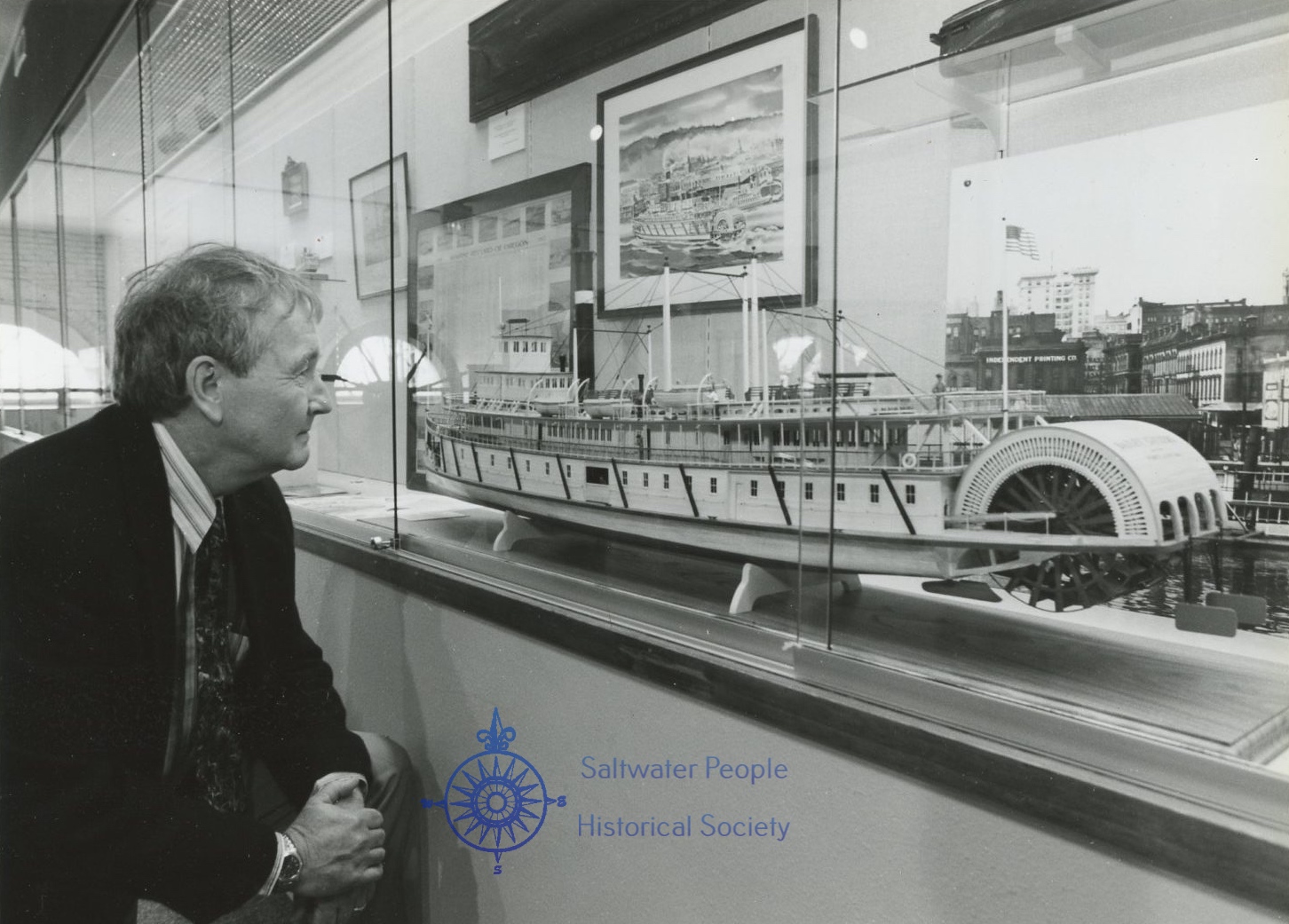

And the Bailey Gatzert model was completed
by Ralph Hitchcock.
Is this the one he built and but do you know
of her whereabouts? 
Tap image to enlarge.
This photo is dated March 1995.
Original photograph from the archives of the 
Saltwater People Historical Society©


07 December 2020

❖ Monday Night Mosquitos ❖

The COLUMBIA RIVER STERNWHEELER--A TYPE
Written by Fritz Timmen
Blow for the Landing
Caxton Printers, Ltd. 1973.

WAUNA
The low, powerful lines of a sternwheel towboat
are evident on Wauna of 1906. She was built
for Lake River log towing. She later handled
oil barges on the Willamette until her layup in 1937.
Original photo by James Turner from the archives of 
Saltwater People Historical Society©

"To the eye of many beholders, there was beauty in the Columbia River type sternwheeler. Her hull lines were graceful, clean, and shallow, and about five times longer than the beam. The slight dead-rise made for a flat deck. The lower deck was housed forward from the wheel, with the forward doors and those on the guards wide enough for freight or engine and boiler parts. Above was the cabin deck, with a wide, railed promenade all around, a central passenger lounge and dining room, and windowed saloons fore and aft. The upper, or hurricane deck, carried a texas, with crew cabins or passenger accommodations. Atop the texas and well forward was the pilothouse. This was the Holy of Holies, grandly occupied by the captain and pilot, with lesser mortals granted admission only by special dispensation. Three sides of the pilothouse bore gracefully carved name boards. Often fancy fretwork topped it all.
      Aft of the pilothouse rose the single stack. The kingpost soared amidships, flanked by at least four hog posts to which were secured the hog chains that keep the supple hull aligned. After 1870, the stern-wheel often was enclosed in a box on which appeared the craft's name and port of registry and which also served to keep spray off the passengers.
      The main deck forward was open for winches and capstans and cargo.
      Wood construction was favored, even after steel became available. The initial cost and upkeep of wooden hulls were cheaper. Damage repair was easy -- a soft patch spiked over a broken plank kept the boat afloat until it could reach the beach.
      For propulsion, early engineers preferred a high-pressure, non-condensing engine. Cylinder bores varied between ten and twenty-two inches and the piston stroke was six or seven feet, rarely more. Locomotive-type boilers had a working pressure of about one hundred pounds per square inch. Not until well after WW I did cross-compound engines appear. These engines transmitted relatively low but effective power to the wheel and so were often provided with a bypass valve to permit fast injection of live steam into the low-pressure boiler in case the pilot called for extra power in a hurry. A few tandem-compound power plants were built. Among these was the Henderson at the time of her 1929 rebuild.

Sternwheeler HENDERSON 
O.N. 93168
Here she is working in a film in 1952 as
the RIVER QUEEN.
Built by Shaver Transportation Co. in 1901
158.7' x 31.' x 7.5' 
The skipper this day was
Capt. Sidney J. "Happy" Harris.
She was burned for scrap in 1964.
More about her racing on the river
 can be seen
HERE


      A sleek, trim sternwheeler, moving grandly through a covey of noisy, bustling steam tugs, had a never-to-be-forgotten air about her whether she was a fast passenger packet or a towboat. Sure enough, they don't make 'em like that anymore."


23 February 2019

❖ INTO THE RIVER BELOW ❖

Sternwheeler ELWOOD
136181
Built in Portland, OR., for service on the
Willamette River in 1891. Her first owners
were Jason Eldridge and brothers Guy, Charles,
and George Abernathy of Champoeg, OR.
Later she paddled on the
 Lewis River in WA, the Stikine River in BC,
and Puget Sound.
154' x 46.4'
510 g.t. 420 N.t.
It was said she was built to run on a heavy dew.

She was out of service in 1920.
Vintage, original photo from the archives of the 
Saltwater People Historical Society©
“Only two years old, the little sternwheel steamer ELWOOD groped her way up the Willamette River toward Portland’s Madison Street bridge through blanketing river fog. In the wheelhouse, the pilot shivered against the November morning’s frost.  He pulled the whistle cord, a long and three shorts for the draw span, and rang the engineer to stop the engines. The bridge tender acknowledged and swung shut the bridge gates; the span slowly creaked open to pass the ELWOOD through. 
      At the throttle of the town-bound Hawthorne trolley 'INEZ,' the motorman eased back a few notches to check the speed picked up on the downgrade to the bridge. As he peered through the fog, he saw the barrier and the open draw. He pushed the control lever to full off and wound on the hand brake to stop the car. The wheels locked, then slid like sled runners on the frosty rails.
      The barrier’s wood snapped into slivers; for an instant of time the car hung on the edge, then it slipped slowly over into the river. It barely missed the steamer.
      There was nothing the pilot, Capt. J.L. Smith could do as the ELWOOD drifted over the circle of bubbles where the car had been. He couldn’t start his engines. The paddle wheel would strike survivors struggling in the water. He could only wait until he was clear of the bridge to turn back and help. Rowboats were there by then, and twenty who struggled free of the car were pulled into them and onto the ELWOOD. Eight did not make it.
      The ELWOOD was built in 1891 for the Oregon Railway and Navigation Co.,  for the Portland-Oregon City shuttle run. She was of light draft to pass the rapids on the mouth of the Clackamas River and, with her younger sister boat the ELMORE.
      Competition must have been unprofitable, for in 1894 she was sold to the Lewis River Transportation Co and put into service on the Lewis River-Lake River route. In 1903 she was running for new owners between Seattle and Tacoma. There the ELWOOD’s history ends.”


Other officers and crew:
Capt. H.H. McDonald, Capt. James D. Miller (d. 1914,) Capt. R. Young.
Source: Fritz Timmen. Blow for the Landing. Caldwell, ID. Caxton Printers, Ltd. 1973.
Gordon Newell, editor. H.W. McCurdy's Marine History of the Pacific Northwest. Superior. 1965. 


30 July 2018

❖ The 1870s with STERNWHEELERS ❖


100' sternwheel steamer ZEPHYR (R)
28074

Built in 1871 by J.F.T. Mitchell & M.M. Robbins.
First master, Capt. Thomas A. Wright, until 1875.
Charles H. Low, the first mate.
The next master was Capt. N.L. Rogers.
Out of service in 1907. 
Click image to enlarge.
Photo from the archives of
the Saltwater People Historical Society©

"During the Seventies on Puget Sound, the era of sternwheelers had its beginning. This was the decade in which settlers staked their claim on some of the most remote reaches of the  Sound. The islands capable of supporting the population became populated. A new type of steamer was needed to enter the rivers, bays, and inlets, where deeper draft vessels of the outer Sound could not go.
      In 1871, the flat-bottomed sternwheeler ZEPHYR was built at Seattle for Captain Tom Wright and his father-in-law, Capt. James R. Robbins. The ZEPHYR was comparable to the old sternwheeler ENTERPRISE that Capt. Wright had operated successfully on the Fraser River, during the memorable days of the 1858 gold rush. Some scoffers predicted that the ZEPHYR would never pay her way on Puget Sound, but she immediately proved to be a profitable investment.
      Commanded by Capt. Wright, the ZEPHYR made two trips a week between Seattle, Mukilteo, Tulalip, and Snohomish City. Since the CHEHALIS ran to the Snohomish River on weekends, both trips of the ZEPHYR were scheduled for the other five days.
      The pioneer spirit was strong in Capt. Tom Wright, however, and he seldom was satisfied on any route after it was well established. On 22 March 1873, he and James Robbins joined James S. Lawson, R. G. O'Brien, S.W. Percival, B.B. Tuttle, C.H. Rothchild, T.S. Russell, and John Lathan, to form the Merchants' Transportation Co. The organization had a capitalization of $100,000 divided into 1,000 shares, and the steamer ZEPHYR became an asset of the company, their first steamboat. For years, thereafter, she ran between Seattle, Tacoma, Steilacoom, and Olympia, and way-stops en route, but continued to make weekly trips to Snohomish, as well.
      During the early years of settlement on Vashon Island, the people relied upon oars and sails for transportation. The ZEPHYR and the MESSENGER, on their regular trips through the East Pass, rounded Point Robinson every day, however, some settlers on Maury Island cut a trail to the point. Capt. W. R. Ballard of the ZEPHYR, and Capt. Parker, of the MESSENGER, then agreed to pick up passengers from a rowboat. They would stop,  provided that a flag had been raised on the beach, as a signal. This system required the cooperation of several persons. The passenger had to have someone accompany him out, to row the boat back, and take the flag down. Before a passenger could get off the steamer, someone had to be there with a boat to meet him. On foggy mornings, a few problems were involved in this arrangement."

Above notes from The Steamboat Landing on Elliott Bay and The Sound and the Mountain. Carey,  Roland.Seattle, WA. Alderbrook Publishing Co. 1970

Below:
Steamer ZEPHYR was a Sound Pioneer
A few years later in the life of this sternwheeler...
Unidentified, undated newspaper clipping from the scrapbook of the well-known Wm. C. Thornily,
103 G. T. P. Dock, Seattle.

"Tied up at the Tacoma Mill Co. dock, beginning in 1887, or puffing laboriously on the bay with a tow of rafts of logs or scows of lumber the sternwheel steam tug ZEPHYR may be seen every day. She is not a pretty craft to look upon. Her sides and upper works are painted a barn-red color, and here and there on her hull are scratches or gouges, the result of numerous jams into logs. Her task is a homely one, yet she does it well, and there is but little question but that she has towed more logs than any steamer on all this inland sea.

      But there are those who remember the ZEPHYR in her palmy days, when, painted a pure white, her decks filled with gaily dressed people, a silken flag waving from her foremast, a band of music waking the echoes of the dense forests that fringed either side of Puget Sound, her sharp bows cutting the blue waters and ending up a feather pillow on either side, and the wake from her wheel leaving a fluted ribbon of rainbow color, who was plying as a packet between Seattle and Olympia by way of Tacoma. That was before the days of the railroads. It was during the days when steamboating on the Sound was like steamboating on the Mississippi before the war. To be exact, it was the early seventies. In those years the steamboat was the only method of communication between the different settlements and towns.
      The ZEPHYR used to leave Seattle one day and return the next. She was called a fast boat and she must have been, but it took her just twice the time to make the trip that it takes the ordinary steamer of today. But there were plenty of excuses. At Al-Ki Point, at Des Moines, at Stone's Landing, in fact at any and every place where there was a cabin and where there was a floating landing, no matter how crude, the old boat poked her nose in and stopped. After reaching Tacoma she must stop at Steilacoom and at McNeils, at Anderson and other islands and if when dark settled down she was pulling in at the wharf in the capital city, she had done a good day's run.
      Capt. Parker, who is now master of one of the fine boats of the Sound, and a man of wide experience, was then a boy in his teens and it was on the ZEPHYR that he was first commissioned mate. The master of the steamer was Capt. Ballard, has since had fortune thrust upon him by being the owner of the site of the present prosperous city of Ballard. It is said that the captain did not want the land but in some settlement, the outcome of legal proceedings was forced upon him.
      Captain Ballard was very proud of his position as master for 9 years and the sole owner beginning in 1883;  if he knew little of seamanship, he at least allowed no one to tell him of it. His orders were a mixture of land and sea lingo––enough so, to be still quoted in many steamer cabins. For instance in pulling into the wharf at what is now Tacoma, and was then called New Tacoma, one day, he yelled to a deckhand:
       "Hey, you, haul in that hind line, tight."
      Another time when the ZEPHYR had stopped in at Steilacoom to pick up a consignment and was about to depart the captain called to the wharf master;
      "Throw that rope off the post, will you!" and the boat crew laughed.
      Once he was making a landing at Al-Ki Point and the mate was steering. The captain was standing on the lower deck near the engine room door. He thought the ZEPHYR was going to hit a rock and yelled at the engineer;
      "Run her backward, hard and fast."
      The engineer reversed his engine all right, but he committed the unpardonable sin of laughing, and there was a vacancy in his department.
      Nothing cut the captain quite so much as to have people call his boat slow, but when from 12 to 16 hours were occupied in the trip from Seattle to Olympia passengers certainly had some cause for making remarks, and according to the best records at hand, they did so at times.
      Shaffer, the brewery man, had an order from a certain customer at Tacoma, for some aged beer. When he put the keg aboard the ZEPHYR, he said to the captain;
      "Captain, Mr. Blank's order reads for aged beer, if you will, you may explain to him that beer sent by the ZEPHYR is always thoroughly aged before it reaches Tacoma."
      One of the first state school superintendents elected was on his way to Olympia one day when the boat was particularly slow. Calling the captain to one side he gravely remarked: "Captain I shall, upon my arrival at Olympia, ask that a law be passed forbidding any person under the age of 21 going on the ZEPHYR."
      "Why, why?" asked the surprised captain.
      "Because, here an individual may grow from infancy to manhood in one trip, and yet with the utmost indifference you have provided no school advantages whatever."
      And, yet, after all, the ZEPHYR was not a slow boat. There was no other way of getting freight into the various settlements except by boat, and she had to stop wherever there was freight. Watch her now, as unhampered by a tow, she steams across the bay, and you will see she is making time that would be a credit to many of the passenger boats of today."

~E. W. Wright in Lewis & Dryden's Marine History of the Pacific Northwest, claims the ZEPHYR was the first sternwheeler in the Pacific Northwest.

      The highly regarded popular Seattle sailmaker and rigger, George Broom (1870-1935), born in Norfolk, England, came across the Atlantic from Antwerp to New York on the Red Star Liner ZEELANDIER. Across the USA he rode the Northern Pacific Railroad to Tacoma. On 24 October 1886, he arrived in Seattle in class, on the sternwheel steamer ZEPHYR and lived happily for forty-nine years. 


21 March 2018

❖ ANNA AND HER CHIEF ❖ 1948

Mrs. Anna G. Grimison
SKAGIT CHIEF,
10 January 1939.

Click image to enlarge.
Original photo from the archives of the
Saltwater People Historical Society©
"The Pacific Northwest has had a big year for tourists. Although the weather was not as warm and sunny as it normally is in summer, the highways were dotted with cars from other states, and sight-seeing tour entrepreneurs were more than busy. As the No. 3 industry of this part of the country, next to lumber and fishing, the tourist business did well. Of course, while they were here, many out-of-staters took to the water, one of the most beautiful attributes of the Evergreen Playground. Charter boat operators had a good trade to the San Juan Island area and on north along the Inside Passage. Tom Hamilton reported a busy season at his swank Malibu Club at the mouth of picturesque Princess Louisa Inlet.
      Tourists in Seattle waterfront gazed with interest at the modern steel freighters and mighty Army transports moving in and out of Elliott Bay. But the vessel they went home talking about was the SKAGIT CHIEF.
SKAGIT CHIEF
1935-1956
502 tons
165' x 40' x 6.4'

Original photo by James A. Turner
from the archives of the Saltwater People Historical Society©

She is a broad-beamed dowager, pushed around the bay by a large paddle-wheel slapping at her stern, and she is the only sternwheeler still in action in the harbor. Oddly enough though, she is no sentimental hangover from the good old days of steamboating on Puget Sound. She was built at Lake Union Drydock & Machines in 1935 for the Skagit River Navigation Company and specifically for service on the Skagit River. This river, if seen from the air can easily be distinguished by its meandering course and muddy channel as it flows into Puget Sound near Mt. Vernon. The shallow draft and stern-wheel propulsion of the SKAGIT CHIEF are made to order for skimming over the snags and flats of this wide but shallow river run.
      Normally sightseers would have seen her younger sister, the SKAGIT BELLE, around the Sound too, but she was temporarily out of service this summer. "Head man" of the Skagit River Navigation Co is a woman, efficient Mrs. Anna Grimison, who has been at the helm since 1924. She has always loved ships but makes it clear that she does not want to be typed as a waterfront character or a "Tugboat Annie!"
For another post including the salty Anna and her company please click HERE
The above text was published in Motor Boating Nov. 1948


17 December 2017

❖ MOSQUITO ON RIVER ICE ❖ WINTER 1930

N.R. LANG (ex-SALEM)
A light draft boat built in 1880 by Capt. Geo. Raabe.

Original 1930 photo from the archives of the Saltwater People Log©
In this photo above the steamer N. R. LANG was on her way from Camas to Portland with a load of paper when caught in ice that closed around her at Ryan's Point, 1 1/2 miles upstream from the Interstate bridge. She was reported held in the frozen mass 150 yards from shore. Provisions were carried across the ice during the afternoon and with steam being kept up aboard, while Captain Ed Williams and other of her company were prepared to make the best of the situation. 

1900: rebuild for Joseph Kellogg.
1918: Owned by Western Transportation Co of Portland

1940: She was scrapped for metal.

20 November 2017

❖ MOSQUITO MERWIN––Hauling the Gold Rushers ❖

(Left) W. K. MERWIN 1883-1900
ON 80959
On the Snohomish River.
108' x 22.5' x 4.2'
G.t. 229.08, N.t. 165.04
MAY QUEEN on right.
Original photo from the archives of the
Saltwater People Historical Society©
This image appears in several PNW maritime books, also
with photographer unknown.

      "The W. K. MERWIN was built in Seattle in 1883, for Captain W. K. Merwin, who then sold her to the Washington Steamboat Co. She was assigned to the Olympia-Seattle run for a short time and then was switched to run the Skagit River, which served the rich agricultural towns of the region, under the command of Capt. Merwin. A disastrous collision with the railroad bridge in Mt. Vernon, 19 January 1896, wiped out all the upper works, including the pilothouse and Texas deck, which was reduced to kindling back to the smokestack.
      Repairs were made to the superstructure, after the accident, and the W.K. MERWIN was used for a few months on Puget Sound––then the old vessel was laid up to rot on the Snohomish River.
      The gold rush days of the Klondike brought on a demand for anything that would float so the MERWIN was prepared for a tow up the coast to St. Michael by the Moran Shipyards in 1897. One of the noticeable changes made in the vessel was the installation of public toilets the entire width of the upper deck abaft of the glass-enclosed saloon. She was encased from bow to stern in a wooden jacket to protect her against possible high seas en route. The stack and the wheel were removed and stowed on deck. 
      The steam tug RICHARD HOLYOKE took the W. K. MERWIN, the POLITKOFSKY, an old vessel which was filled with coal, and a small yacht, the BRYANT, and headed for Alaska with 16 passengers boarded up inside. These people were willing to do anything to reach the gold fields. The MERWIN's towline parted once en route when she encountered a terrific storm but the tug succeeded in getting a second line aboard. Capt. Tom Lyle was in charge of the MERWIN and eventually started her up the Yukon. They were forced into winter quarters in a blind slough at the Indian village of Nanook. Here they spent nine months icebound and still hundreds of miles from the gold fields.
      The MERWIN arrived in Dawson the end of June 1898, taking ten months and 20 days to make the trip from Seattle. On her next trip, she left Dawson on 4 July 1898, for a trip to St. Michael. Late in the season she again reached Dawson and was credited with bringing 50 tons of freight into the city on each trip.
      The Columbia Navigation & Trading Co was shown as her owners and as far back as 25 December 1897, that company was listing the name of the W. K. MERWIN as one of their boats in Seattle P-I ads soliciting freight and passengers for the trip up the Yukon to Dawson. 
      The W. K. MERWIN was then assigned to the upriver run, making a trip to White Horse Rapids before coming back down to Hootalinqua to lay up for the winter. This trip was almost her downfall as on her way back down river from the rapids she was trying to get by the sunken steamer JAMES DOMVILLE in Thirty Mile River and was driven against the hull almost wrecking the MERWIN. 
      She delivered 200 tons of freight to Dawson the following spring from her winter quarters. While wintering at this location, the Messrs. Hamilton, LeBlank, and McGrade bought the vessel. 
      The new owners elected to withdraw her from the upriver run because of the hazards of Five Finger Rapids and removed her steam capstan.
       The new owners had a change of heart about the need for a steam capstan because on 15 July 1899, they sent outside for a replacement. That year the MERWIN wintered in Dawson in 1900, where Alex McDonald chartered her to make a trip to Nome and arranged to have her fitted for ocean travel. By this time the excitement of the Dawson strike had died down and the new find of gold in Nome was the news of the day.
      The  W.K. MERWIN was poorly stocked with food for the trip and her 200 passengers soon lowered the supply to the danger point. The boat and her barge were so crowded that people had to stand up on the way, and they were forced to eat in shifts. At Circle City, they tried to stock up with provisions but the town had nothing to sell except whiskey so they took a 40-gallon keg aboard for the bar. Capt. R. A. Talbot disappeared at this point and the crews refused to work as they had not been paid. Finally, the MERWIN got on the way again and stopped at every trading post from then on but found not a thing for sale. The trip had started from Dawson on 31 May 1899, without replenishing the stock cleaned out the previous winter. The food shortage became so acute that the MERWIN resorted to stopping occasionally so passengers could try their luck at shooting ducks and geese and to gather eggs on the shore. Upon reaching St. Michael they found plenty of food.
      The W. K. MERWIN was wrecked on the beach at Nome during a storm on 2 August 1900. She was declared a total loss which was a sad ending for the oldest boat to be taken over the ocean route to the Yukon River. 
      As a special note of interest, Capt. Jack Green showed up in history for the first time as pilot of the W. K. MERWIN in June of 1899. Capt. Green went on to other vessels and was captain of the second steamer YUKON when its ill-fated crew lost their lives in the fall of 1918. They had finished a successful season on the river and were on their way to their homes on the outside, aboard the steamship PRINCESS SOPHIA which hit a rock south of Skagway and sank with all hands." 
Sources:
Arthur E. Knutson. The Sea Chest Journal of the Puget Sound Maritime; Seattle, WA. March 1988. 

25 June 2017

❖ RACING ON THE RIVER ❖ 1952


HENDERSON (ex-M.F. HENDERSON)
sailing here under her movie name RIVER QUEEN
Click image to enlarge.
Original photo from the archives of the S.P.H.S.©

1901: Built as the M.F. HENDERSON by Shaver Transportation Co, Portland, OR. She was used as a freight boat as well as a towboat.
1911: In an overhaul she lost her initials "M.F." and became HENDERSON.
The M.F. HENDERSON, towing a Standard Oil Co barge from Astoria toward Portland, was run down by the well-known steam tug DANIEL KERN towing rock barges to the jetty. The M.F. HENDERSON capsized and sank in shallow water, lying on her side. No lives were lost. She was afterward righted by five sternwheelers pulling on her at once, and was then taken to the Portland Shipbuilding Co where she was dismantled and her engines and other equipment, except the boiler, installed in the new HENDERSON the following year. 
H. W. McCurdy's Marine History of the PNW.
1912: This year the HENDERSON was built by the Portland Shipbuilding Co for Shaver Trans. Co receiving most of the machinery and fittings from the wreck, but receiving a new locomotive boiler built by James Monk, having twice the capacity of the old boiler. 
1952: An old-time Columbia River sternwheeler she played an important part as the River Queen, in the historical movie the Bend of the River, based on a novel Bend of the Snake by Bill Gulick. The movie starred Jimmy Stewart and Rock Hudson, released 13 February. When first released, the film received poor reviews but since then gained more critical acclaim and is recognized as a great western.

The RACE

In 1952, to promote the release of the new movie, the Henderson participated in the last sternwheeler race on the Columbia River, commanded by Capt. Sidney J. "Happy" Harris.  The filming was done in Mt. Hood, Sandy River and Timberline, OR. Although favored to beat the new steel-hulled sternwheeler, the Portland, commanded by Capt. Bob Williamson, the Henderson fell behind early in the race when she lost steam. The engine crew quickly shunted live steam into her low pressure cylinder until the paddlewheel approached 30 rpm. Actor Jimmy Stewart and other cast members of the film Bend in the River were on board to cheer the vessel on––the Henderson came from behind to beat the Portland in the 3.6-mile race.
      Trivia on imdb.com––some of the river scenes were filmed on the Sacramento River in CA.
Sternwheeler PORTLAND
Her last day of duty helping to move the 930-ft
MOBIL ARCTIC 
for the Port of Portland.
PORTLAND was the last remaining vessel of its kind
in commercial service in the world.

Click image to enlarge.
Original photo dated 27 October 1981
from the archives of the S.P.H.S.©
1956: In December, with a grain ship in tow, the Henderson encountered heavy swells near the mouth of the Columbia River. Declared a "constructive total loss," she rested on shore until she was burned for scrap in 1964.
In 1981: After almost 30 years of service in and around the Portland harbor, the stately Portland yielded the harbor to Diesel-powered youngsters. The Port of Portland faced economic realities, and decided to retire the labor-intensive steam tugboat in 1981. 
      She sat some years at Terminal One, quietly rusting. Her wheelhouse and Texas were removed and rested on the dock. Her wooden super structure rotted away down to the steel housing of her machinery space. The powerful sternwheel dried and cracked where exposed; the underwater surface grew long tendrils of marine plants.
      In 1991, the sad remains of the Portland were deeded to the Oregon Maritime Museum. With funds from Meyer Memorial Trust, Murdock Trust, and the Port of Portland, a group of dedicated volunteers began restoration of the last steam powered sternwheel tug. The work is never ending; the results are well worth the effort. Today the Portland gleams inside and out. 
1997: She was entered into the National Register of Historic Places.

28 August 2016

❖ MOSQUITO STEAMING TO EASTSOUND ❖


S.S. STATE OF WASHINGTON

brought excursionists to Eastsound,
Orcas Island

for summer fun in the sun.
New in the collection,
the upper photo is back-dated 1911
.

1889: Steamer built by John J. Holland, Tacoma, WA.
1889-1902:
The STATE was on the Seattle-Bellingham route.
1915: she was converted to a towboat.
1921: she was destroyed in a boiler explosion.
Original photos from the archives of the S.P.H.S.©

Date data from Steamer's Wake by Jim Faber.


Early, much photographed, bird's eye view  

of Eastsound, Orcas Island, 
in the San Juan Archipelago, WA.
The seaside village,
with the early Inn (lower image), 

is out of the photo to the left but this highlights 
beautiful Madrona Point where
there was another popular inn for visitors.

Orcas Island has laid out
 the welcome for many decades, as seen 

 in newspapers from the late 1800s.
Original photo from the collection of the S.P.H.S.©


First known as East Sound House;

then in 1909 as Mt. Constitution Inn,
when it was refurbished with a large 

 living room added, for a price of 
ten dollars per week, children half rate.
It is now known as Outlook Inn,
along the waterfront of Eastsound, Orcas Island, WA.
Original photo from the collection of the S.P.H.S.©

"Early on, the San Juan Islands became a favorite of vacationers. But it took a bit of determination––just to get there. At the turn of the century, those heading for Orcas Island went by steamers like the paddle wheeler, State of Washington, to Anacortes. There they boarded a smaller steamer for the island. Service was also provided from Whatcom County, and via the Lydia Thompson direct from Seattle. Favorite hostelries included the East Sound House. An early reviewer outlined other attractions:
    Hammocks and rustic seats
    are found in many a secluded
    spot, silently weaving a web of
    enchantment to entrance (sic)
    the mind and lull the heart to
    happy rest. Out upon the beach,
    saltwater bathing can be 
    enjoyed during the languid summer
    afternoons, while at evening 
    clam bakes with bonfires and 
    singing, charm with wild delight.
    San Juan County Album, U of WA Library Collection."

Above text Jim Faber. Steamer's Wake. Seattle; Enetai Press. 1985.


22 February 2016

❖ HIS DREAM CAME TRUE ❖

OWEN TRONSDAL GOT HIS OWN STERN-WHEELER, 
after 40 years.

JOHN EDWARD 
On the Swinomish Channel at LaConner, WA. 

Undated postcard by Puget Sound Mail & Printing.
From the archives of the S.P.H.S.©
If Owen "Tony" Tronsdal acted like a kid with a new toy when he was around his 65-ft sternwheeler, that was because he was realizing a dream that had been on his mind for 40 years––since he was 10.
      Ever since he saw his first sternwheeler chug up the Skagit River to disgorge passengers and take on peas, oats and vegetable crops, he has had one consuming passion––to own his own sternwheeler.
      And then the dream that came true right before his eyes. A beautiful river queen took shape near Tronsdal's auto mechanics shop in Conway. 
      Neighbors and pals dropped around to watch the big flat-bottomed boat grow and none have been able to resist hopping aboard to lend a hand. 
      Glen Seehorn, Mt. Vernon, stopped at the building site in LaConner to see how his old friend Tony was doing with his new toy. He wound up spending three days getting the boat up on dollies and moving it a mile to the water.
Top: inscribed, Diesel Sternwheeler
JOHN EDWARD, Conway, WA.
April 1966
Bottom: LaConner, WA., 3 Feb. 1963.
Photos courtesy of Capt. Jack Russell, Seattle, WA.

      It was floated to Fresh Water Slough on the South Fork of the Skagit. 
      This all began in 1961 when Tronsdal and his wife decided they wanted a summer home. Tony conceived the idea of a sternwheeler that would serve a dual purpose––satisfy his life-long dream of piloting his own sternwheeler and provide a summer home at the same time.
      As the boat took shape Tony was asked by so many people to hire out for a trip up the Skagit that he finally decided he would turn the paddle-wheeler into a commercial venture and sell tours from Mount Vernon to the mouth of the Skagit, 12 miles. 
      Tony wouldn't say how much the boat cost, but did admit "you could buy a nice house, I mean, a nice modern house, for the price of this boat."
      The first thing Tony did when he decided to proceed was hire the best boat builder he could find. This was Howard Boling, a commercial fisherman in season and a boat builder in the offseason. 
      The vessel contained a 180-HP GMC Gray Marine Diesel engine for power that took it easily at eight knots. The paddle is 10-ft in diameter and 11-ft wide. The boat itself was built 65-ft overall in length and 18-ft in beam. 
      The hull is 100% Alaska cedar and only galvanized bolts were used throughout. An extra slab of concrete five and one-half inches thick backs up the heavy decking in the bow. "No deadhead is going to poke through and sink this baby," Tronsdal said.
      The wheel itself is a masterpiece. Two young men in Mt. Vernon High School, Bill and Albert Olson, asked if they could have the privilege of outfitting the paddle-wheeler with its wheel. One brother worked on it for two years and when he graduated from shop class a second brother moved in to finish the job. It is five feet in diameter and made of mahogany and teak.
      Tronsdal was asked to sell his blueprints.

      "There aren't any. This baby came right out of my head. I just drew a picture of what I wanted and some details and Boling started building her. And who's there to go to for advice on building a stern-wheeler? Nobody. They're all dead and gone."
      The vessel was named after Tony's son, John Edward Tronsdal. He was 10 years old at the time, the same age as when Tronsdal saw his first sternwheeler.
Text by Willis Tucker for The Skagit Herald, 22 March 1966
JOHN EDWARD lived to go on to other owners under the name of EMERALD QUEEN. 
Well, it is only 2 1/2 years but I said I would get back with more history on this vessel.

1979:
Capt. Owen (Tony) Tronsdal of Conway, Skagit County, formed a partnership and revived the 12-year old sternwheeler, JOHN EDWARD, with Capt. Ray Hughes of Mukilteo, a skipper for WA. State Ferries.  They called their business the Skagit Bay Navigation Co. They began by mooring her at St. Vincent de Paul's on Lake Union but loaded passengers from the Puget Sound Excursion Line dock at Fisherman's Terminal in Ballard. They hoped to cater to tourists, church groups, and senior citizens, to show the fantastic points of interest along Seattle's inland waters. Then next we see a new owner––


EMERALD QUEEN
(ex-JOHN EDWARD)
Built 1967
Capt. Alan W. Cox out for sea trials on Lake Union.
March 1987.
Click image to enlarge.
Low res scan of an original photo from the archives of
the Saltwater People Hist Society©

1987: In March the Seattle Times announced a new cruise in town with the EMERALD QUEEN, Capt. Alan W. Cox taking a test run. For a $3. ticket a person could glide all day along the shores of Lake Union on the sternwheeler. The QUEEN was licensed for 49 passengers with speed on the lake at 7-knots. Several restaurants had signed on including the Hungry Turtle, the Lakeside, Arnie's Northshore Restaurant, Franco's Latitude 47, Triples, and the Rusty Pelican. 


04 February 2016

❖ BAILEY GATZERT, Once Queen of the Sound


BAILEY GATZERT
ON 3488

Williamson Collection
Original photo from the archives of S.P.H.S.©
"A dingy storeroom float rode at moorings at the plant of the Lake Union Dry Dock & Machine Works. Fishermen climbed aboard to store gear in rows of lockers. The long, narrow frame structure was spacious and conveniently near a score or more of trim schooners repairing, over-hauling or tied up to wait the opening of the 1940 halibut fishing season. Few of the fishermen or busy shipyard employees gave a thought to the fact that beneath the dingy storeroom was the hull of the swift stern-wheeler BAILEY GATZERT, that made steamboat history on Puget Sound and the Columbia River.
      There was a fascination in the name "BAILEY GATZERT" to old-timers on the waterfronts of Puget Sound. There was an air of grandeur about the famed vessel. She was a floating palace in her day. The BAILEY GATZERT met the fate of all ships a number of years ago, but her memory still lives––on Puget Sound and the Columbia River.
     The famed sternwheeler's nameplate, a weather-beaten piece of timber, has adorned a wall in the offices of The Marine Digest in the Canadian National Terminal on the Seattle waterfront ever since she reached the end of her career. Jackson B. Corbet, editor and publisher says it is not unusual for some stranger to come into his office and ask for the privilege of sitting down and gazing at the plate with affection and reverence. 'They come from all over––the Columbia River, San Francisco, and Los Angeles,' Corbet said.
      On Puget Sound, the BAILEY GATZERT is remembered chiefly for her great record in the Seattle-Tacoma and Seattle-Bremerton routes, but she also operated between Seattle and Olympia, plying in this service more than a year in the early part of her career.
      With her wheel, twenty-two feet in diameter, churning the waters of the sound, the BAILEY GATZERT defeated the swift sternwheeler GREYHOUND in an exciting race. Later she left the sidewheeler T.J. POTTER astern in one of the most furious races in the history of the Sound.
BAILEY GATZERT
ON 3488
177.3' x 32.3' x 8'
Williamson Collection.
Original photo from the S.P.H.S.©
      Launched broadside in Ballard in the fall of 1890, the BAILEY GATZERT moved away under her own steam. The launching party which made the journey from Seattle to Ballard by train, was carried by the new vessel on an excursion cruise to Tacoma and return. The vessel was built by the John Holland yard for the Seattle Steam Navigation Co. Her first service was in the Seattle-Tacoma route.
      In 1891 her original owners sold the BAILEY to the Columbia River & Puget Sound Navigation Co, which immediately transferred her to the Seattle-Olympia route. In 1892, the vessel went to the Columbia River. The BAILEY GATZERT's career on the Columbia and her subsequent return to Puget Sound to become one of the queens of the inland sea is an interesting chapter in the history of navigation in this region.
      The BAILEY GATZERT was the finest vessel of her day plying inland waters. Her interior decorations were carried out under the direction of an English artist named Harnett. The panels in her engine room were the work of Capt. Howard Penfield, who was first to hold the position of mate in the vessel. The GATZERTS's first master was Capt. George I. Hill, who had as his engineer, Charles Follett.
      Skippers of the BAILEY GATZERT included Capt. Harry Anderson, now port captain of the Puget Sound Navigation Co; Capt. Gilbert Parker, who took the GATZERT to the Columbia River in 1892, and Capt. R. B. Holbrook, who brought the vessel to Seattle in 1918 after she had been sold by The Dalles, Portland & Astoria Navigation Co to the Navy Yard Route.
      In the spring of 1920, the BAILEY GATZERT became the first automobile ferry between Seattle and Bremerton. The vessel was named for Bailey Gatzert, one of Seattle's most widely known pioneers, who came to this city in 1869. He was a member of the City Council in 1872 and 1877 and was elected mayor in 1875.
     Bailey Gatzert helped to organize the Seattle Drydock & Shipbuilding Co and was its first president. He died 19 April 1893 and as a tribute to a life rich in ability, enterprise, and charity, one of Puget Sound's most remarkable steamboats was named in his honor."
Unidentified publisher. 
Below notes from H.W. McCurdy's Marine History of the PNW. Newell, Gordon. (1966)

Invitation for a passage on the new
Steam Bailey Gatzert
Ballard to  Olympia, Washington
from the archives of the
Saltwater People Historical Society 


1905:
The BAILEY GATZERT was extremely popular during the Lewis & Clark Exposition of this year and a popular song, the Bailey Gatzert March was published. 
1907: 
She was reconstructed with heavier hull & engines. 
Her whistle, one of the most melodious among the Northwest steamboats, and her ornate name board are preserved by Seattle's Museum of History and Industry on South Lake Union.

27 October 2012

❖ The Steamboat RACE ❖ 1945

Sternwheeler CITY OF ABERDEEN
Commanded by Capt. Gus Soderman.
Photographer unknown,
From the archives of the S.P.H.S. ©
"The steamboat story of early days of Puget Sound sprouted when your cruising correspondent casually mentioned to Fred Marvin, Port President, that he had conversed with old "Nick" Perring at Olympia. Exclaimed Fred:
      'Gosh all hemlock! Is Nick still alive? I am glad to hear this. You know, Nick is one of the greatest engineers Puget Sound ever had? A great steamboat man.'
      This fact was agreed to. It was added that this pioneer marine man had told a bit of the story of the famous race in which the CITY OF ABERDEEN had beaten the famous GREYHOUND in a trifle of a race between Seattle and Tacoma.
      'You can bet your life she did!' The ABERDEEN beat her. I saw the finish of the race. This was on Sunday afternoon in the very early 90s. I've got the date in one of my old log books at the ranch.'
      So the story of this Puget Sound steamboat race was authenticated by the port commissioner. This was one of the great steamboat races of the Sound. Private, to a great extent, the affair was held closely in the minds of those taking part.
      Nicholas C. Perring, 'Nick' to old associates, started his career on the Sound in 1878 on the sidewheel tug GOLIAH. In his time he served on many of the famous steamers, including the GREYHOUND.
      'That was quite a race. Old man Willey came aboard one day and asked me if I could best the GREYHOUND with the ABERDEEN. I told him I could, providing I was allowed to have the say in loading the ABERDEEN. She was a deceiving outfit when it came to speed. To run she had to be trimmed just right. I knew the GREYHOUND. She was fast and had a great reputation for speed.
Sternwheeler GREYHOUND,
Commanded on race day by Capt. Ed Darrington.
Original photograph from the Marine Salon
Archives of the Saltwater People Historical Society©
Preparing for the Race:
      'Well, we began to get ready for the run. I had the boys save the best of the fuel. We stowed in plenty of bark to fill up the holes in the firebox. Bark makes a terrific heat.
      The time of the race came and we went to it. I have forgotten who was engineer on the 'HOUND' or who was our skipper. The ABERDEEN hit it up at a good clip. When the boys passed the word back that the GREYHOUND's crew were heaving their cordwood overboard I knew we had them. We beat them into the dock at Tacoma by some distance--in fact, when we docked the 'HOUND' was nearer Brown's Point than the dock.'
      When questioned as to the excess steam carried in the boiler, if any, the veteran engineer parried:
      'Of course, the greater amount of steam carried will naturally increase the speed to an extent.'
      Reporting his observations, Commissioner Marvin said:
      'This race was a fixed affair between the crews of the steamers and several interests to settle the question of which of the steamers was the faster. The race was on the quiet so far as publicity went. There were not many passengers on board, but plenty of excitement. I think the ABERDEEN passed the 'HOUND' at Dash Point. But it's a fact you could hear them coming before you could see them. Both boats were wide open and the long exhausts sounded like a half dozen locomotives going up a hill. I guess the crew of this GREYHOUND lost their shirts and payrolls in that race.'
      The CITY OF ABERDEEN was built at Aberdeen, WA. The steamer was 127-ft long. The craft plied between Seattle, Tacoma, and Olympia for a number of years. In later years the vessel was altered to a tug and operated out of Bellingham"
Above text by James Bashford
Tacoma Times, Sept. 1945.
"James O. Bashford was a 'roustabout' on the Tacoma waterfront, eventually becoming engineer on some of the boats plying the harbor about 1905. Apparently neither a professional reporter nor photographer, Bashford nonetheless put in a stint on the Tacoma Ledger and was ambitious in both capacities, leaving behind copious notes and photographs, many of which now repose in the C. Arthur Foss collection."
The above profile on the Ledger columnist Bashford 
by Gordon P. Jones 
Puget Sound Maritime Historcal Assoc. newsletter supplement Nov. 1966.


Archived Log Entries