

 |
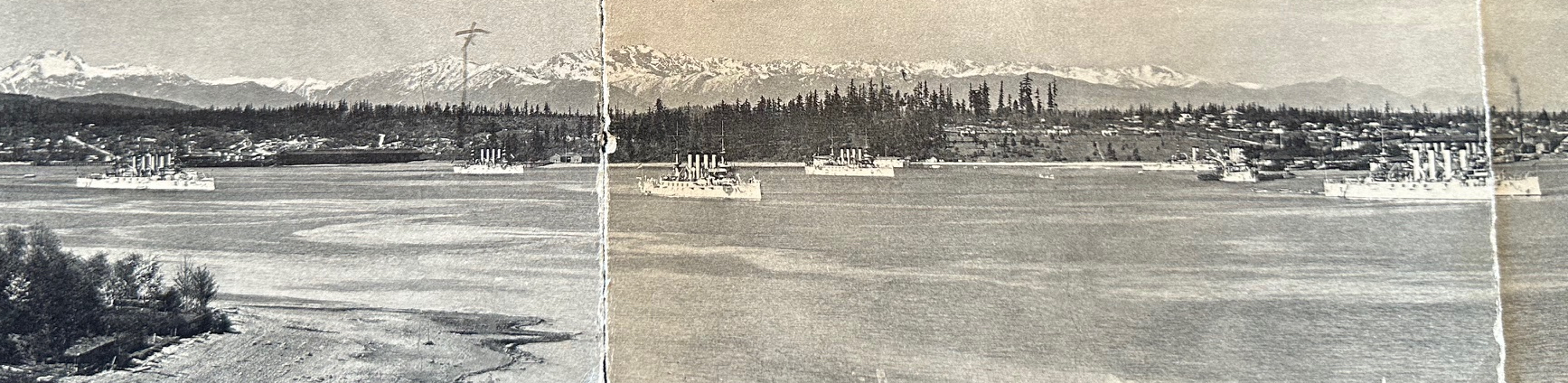
BREMERTON NAVY YARD crop of a 3-panel photograph by Romans, 1908. click on image to enlarge. from the archives of the Saltwater People Historical Society© |
"The need for a first-class navy yard on the PNW coast of the USA was eagerly desired by the Navy Department. When the “White Fleet” consisting of the cruisers Chicago, Baltimore, Philadelphia, and Yorktown, were being built or would be building. A commission of navy officers was appointed by the President to proceed to Puget Sound and adjacent waters and pick out the most available place for a naval station.
The personnel of the commission appointed were the late Capt. A.T. Mahan, USN., the celebrated writer on "Sea Power;" Commander Chester, the present retired rear admiral; and Lieutenant Commander Stockton, afterward, rear admiral. The late Rear Admiral Uriel Sebree, USN, who was at that time Lighthouse Inspector of the 13th District (now the 17th District) was added to the above-named commission
On their arrival at Seattle, they boarded the Lighthouse steamer Manzanita, commanded by Capt. Charles Richardson with William E. Gregory, first officer, the late Harry C. Lord, chief engineer, and Alfred Rickards, assistant engineer. On the day following their arrival at Seattle, the Manzanita left the ocean dock (now Pier B) and steamed towards Port Townsend, Port Angeles, and Dungeness.
After having examined these places the Manzanita proceeded to Fairhaven where a stop was made. A committee of citizens presented to the officers for their approval what they termed an ideal site for a navy yard— a place called Chuckanut. From Fairhaven the Manzanita steamed through Ship Harbor, Deception Pass, and the site of Everett, thence returning to Seattle for mail and supplies.
On the following Monday morning, the Manzanita again left Seattle and proceeded to Tacoma, where a delegation of prominent businessmen boarded the steamer and requested the naval committee to investigate Gig Harbor and Quarter Master Harbor in that vicinity, as they thought either of the locations mentioned would be a good place to locate the naval station. After examining the two sites, the Manzanita proceeded to Olympia and Nisqually Flats before again returning to Seattle. Here a group of the leading men of the town boarded the steamer and requested the naval committee to inspect the waters of Lakes Union and Washington.
With the Seattle delegation on board, the Manzanita steamed down to the entrance to Shilshole Bay, where the party boarded a steam launch to be taken through Salmon Bay, and to land about where the municipal bridge is now, and walked to Lake Union where another launch took the party to Lake Washington. A portage was made to Lake Washington, where the old sidewheeler Kirkland was waiting; on boarding her, the Kirkland proceeded through the lake, stopping at intervals to allow soundings to be taken under the direction of Capt. Pratt of the Coast Survey, first mate Gregory, and Capt. Harris, a junior officer of the coast survey steamer Gedney, later of the Pacific Coast Steamship Co. On board the Kirkland, a most elaborate luncheon was served with champagne, cocktails, etc, with very much evidence showing even at the time of 1889, that the “Seattle Spirit” was flourishing. The greatest depth of water found by the Manzanita’s leadsman on board the Kirkland was thirty-eight fathoms. The lake was thoroughly surveyed a short time ago by the coast survey and probably deeper water was found.
A few days later, the Manzanita steamed to Port Orchard, where a short visit was made to the wharf at Sidney, the present Port Orchard, and one or two prominent men of that village were taken on board when the Manzanita steamed over to the other side of the bay and anchored off the site of “the Bremerton Navy Yard.” All members of the commission were landed and walked up the hill to a small white house, centering in about an acre of cleared ground, and held a conversation with the occupant of the house. One can look back and see the little white farmhouse and the wild trees, bushes, and vegetation of the place at the time, and then glance at the magnificent navy yard that is there now with its immense dry docks, wharves, repair shops, marine barracks, storehouses, etc., with some of the largest and finest battleships in the world either anchored in the Bay in or lying alongside the immense wharves and thousands of workmen employed the year around looking after the needs of these battleships and the other units of the USN —and wonder.
On the return of the Manzanita from Seattle the naval commission left for the City of Washington where they submitted a voluminous report to the Secretary of the Navy with their findings that Bremerton was their choice for a site for a naval station. The Bay had plenty of deep anchorages; the whole place could be easily defended; besides, it was close to a growing and thriving town– Seattle, where plenty of artisans and workmen could be obtained.
When the report, sent from Washington, reached the northwest, certain interests immediately went to work to block the location and the opposition became so intense that President Harrison appointed another commission to go over the same ground and to report their finding as soon as possible. This commission was composed of Captain (later Admiral) Selfridge, USN, Senator Tom Platt of New York, and Ex-Secretary of the Navy Thompson. Once more, the Lighthouse steamer Manzanita was detailed to convey people over the same course the proceeding commission had traveled. Once more, the second group endorsed the site that the first commission had chosen – Bremerton.
After the usual delays, work was at last started on the new naval station, the old sloop of war Nipsic was anchored in the Bay about opposite where the first dry dock was being built under the direction of Lieut. White, USN, civil engineer in charge, Commander Morong, in command of the Nipsic, with Liut. R. C. Hollyday assistant. The contractors for the drydock work were Messrs. Balow, Blackwell, and Dugan. The first drydock was built of lumber and was known as the Simpson plan.
After the work had been underway, a difference of opinion in driving the pilings arose between the engineer in charge and the contractors. Work was stopped until the arrival of the Secretary of the Navy, H.A. Herbert. The Lighthouse tender Manzanita was detailed to take the Secretary and party on board... On the arrival of this group, the Secretary of the Navy's flag was hoisted to the main truck, so to the little lighthouse tender Manzanita goes the honor of bearing the Secretary of the Navy's flag for the first time it was shown in the Pacific Coast northwest waters, Secretary Herbert being the first Secretary of the Navy to officially visit the northwest.
The first step after the tender left Seattle was at Port Townsend where an address of welcome was made by Judge H.A. Ballinger. The next stop was at Fairhaven. From there, the Manzanita returned to Seattle while the Secretary and his party went to Everett via the Great Northern. The Secretary's party joined the Manzanita when they returned to Seattle and the following day the tender proceeded to Bremerton. On arrival at the Navy Yard, the Secretary immediately got in touch with the engineer in charge, and the contractors and a pile were placed in position, ready for driving.
The first pile driven, while the Secretary was looking on, was 20 feet long and was struck 84 blows and the penetration was only 7.5 feet. The second pile was about the same length and was struck with the same number of blows but it ceased to go down any further. The specifications called for the piles to be struck with an 8000-pound hammer in a fall of 25 feet, they would not sink over one-quarter of an inch the last blow.
The finding of the Secretary was that the contractors must try to drive the piles deeper and proceed with the plan as insisted on by the engineer in charge.
A luncheon on board the Nipsic was next and four musicians discoursed some excellent music. The Nipsic will be remembered for the heroic struggle she made during the hurricane at Samoa when the United States frigates Trenton and Vandalia were wrecked and some of their crews were lost. Two German corvettes were also lost and the old Nipsic was driven ashore, but was afterward hauled off.
The Manzanita with the party on board returned to Seattle and the following morning left for Tacoma. Here the Secretary was taken in charge by the reception committee and he had "resources" talked to him till his eyes stuck out, and the trip to and around Quartermaster Harbor and back to Tacoma he listened to the praises of the State of Washington, Tacoma, and Puget Sound.
The following day the Secretary and his party left over the Great Northern for Washington and the Manzanita returned to her regular lighthouse duties."
 |
Captain William E. Gregory writer of this essay on locating the site of the Bremerton Navy Yard, 1889. Original photograph from the archives of the Saltwater People Hist. Soc.© |
Words by Captain William E. Gregory, once a widely known master of the North Pacific.
This abridged essay was published by an unknown Seattle newspaper and also by the Marine Digest, Seattle, in 1927.
This hand-typed document is from Capt. Gregory's estate, courtesy of descendant Dan MacGillivary for the Saltwater People Historical Society.
 |
US Navy Repair Ship MEDUSA Launched on the 32nd anniversary of the establishment of the Puget Sound Naval Shipyard, Abstract of title to the Navy Yard property, having been delivered to Lt. Wyckoff, acting for the Secretary of the Navy, on 16 April 1891. Building cost, $4,000,000. 483' 10.5" LOA, 70' x 19' (loaded) Displacement tonnage ca. 10,000 . Original photo from the archives of the Saltwater People Historical Society© U.S.S. Medusa notes from H.W. McCurdy's Marine History of the Pacific Northwest. Superior. 1966 |
 | ||||
Bremerton Navy Yard Dated 22 June 1931. FAST WORKERS This year, the cruiser Louisville was built in record time for construction of cruisers, and now a new record for speedy work in building a new reinforced concrete dry dock, 652 ft long and 120 ft wide in only four months. The project was approved by Congress as part of the emergency construction program to relieve unemployment. The average number of men employed was 23, and the maximum was 310. The project involved the demolition of an old timber dock and building of the new one, 13 ft longer, in its place, at $400,000. Associated Press Photo From the archives of the Saltwater People Historical Society©
|

 |
Bremerton, Washington. Dated 23 April 1962 The aircraft carrier Kearsarge enters the world's largest drydock located at the Puget Sound Naval Shipyard. Built for $23 million and big enough to hold the largest battleship man has ever built, the drydock was dedicated today. Click image to enlarge. AP Wire photo from the archives of the Saltwater People Historical Society© |
 |
22 October 1971 The battleship MISSOURI, attracted more than 185,000 to the Naval Shipyard at Bremerton last year was moved into drydock to have her hull scraped and painted –– a $350,000 project. The Japanese signed surrender papers on the ship on 7 September 1945, ending WW II. Commissioned in June 1944, the Missouri steamed more than 500,000 mi during WWII and the Korean War. The Missouri was decommissioned in Feb. 1955. Original photo from the archives of the Saltwater People Historical Society© |


 Posts
Posts

