"The Cure for Everything is Saltwater, Sweat, Tears, or the Sea."

About Us

My photo
San Juan Archipelago, Washington State, United States
A society formed in 2009 for the purpose of collecting, preserving, celebrating, and disseminating the maritime history of the San Juan Islands and northern Puget Sound area. Check this log for tales from out-of-print publications as well as from members and friends. There are circa 750, often long entries, on a broad range of maritime topics; there are search aids at the bottom of the log. Please ask for permission to use any photo posted on this site. Thank you.
Showing posts with label Al Ulbrickson. Show all posts

10 March 2022

"MIND IN BOAT"-- the GENIUS COXSWAIN


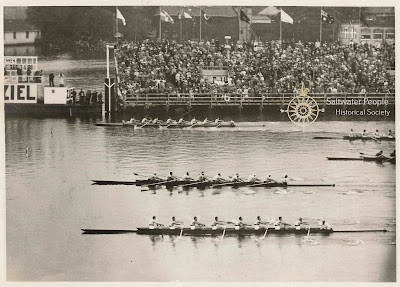
The 1936 Olympics / Berlin

Cox Moch screaming his fellow crew first to the
finish with Hitler looking down from the stands.
Royal Brougham, the writer of this news clip,
did not brag, but he was also in the bleachers
catching the impressive story of 
Seattle on this Olympic course.
Click image to enlarge.
Gelatin-silver photograph from the archives of 
the Saltwater People Historical Society©

One year after the Olympic gold:

"Lucky Al Ulbrickson, the boys are saying. A world championship rowing crew right in his lap; all eight men back; nothing to do but sit in the coaching launch and watch them coast home with the gold-rimmed, diamond-studded crown.

Sure, all eight oarsmen are back at the sweeps but remember the little squirt who steered the boat to victory on Lake Washington, at Poughkeepsie, at Princeton, and at the little village of Grunau near Berlin? (That entire winning crew in the photograph above.)

Bob Moch--he'll be missing. 

The Huskies will miss the paperweight coxswain with the baritone voice like N.Y. Yanks would miss Lou Gehrig. Nobody knows the vital part that the quick-thinking Moch played in Washington's success.

Maybe the game Don Hume and his gallant fellows would have emerged victors in Berlin; maybe they would have won in the Olympic trials and on the Pacific Coast, but here's one observer who doubts very much if Ulbrickson's crew would have finished in front at Poughkeepsie but for the icy little man who rode the stern seat. As thrilling as their win in the Olympic Games finals, I maintain Washington's accomplishment on the Hudson was the finest bit of rowing of the year, and for that matter, of the decade.


Courtesy of The Seattle P-I newspaper

Everybody knows how Moch kept the slow-starting eight together despite the fact that the boat was three full-lengths behind, in fifth place, with a little more than a mile to go, the Husky adherents had given up the ship, and even Ulbrickson had resigned himself to bitter defeat. But Moch, shouting the Washington watchword, "M.I.B.--M.I.B.." maneuvered his crew to the most sensational triumph the historic old river has ever seen. The mysterious symbols reminded the boys to keep "Mind in Boat"--not once all year did a husky oarsman as much as steal a glance at the enemy. 

"Take ten more for Ulbrickson," he shouted as they went under the bridge.

"Now ten more for Pocock," he screamed.

"Here's California, boys--ten more big ones for mother and dad," he yelled, as astonished experts ashore thought the shell had been shot out of a gun, so rapidly did it eat up that last spread of water, to finish ahead by a length.

The picture of Bob Moch driving his Huskies to victory both at Poughkeepsie and at Berlin still thrills this hard-shelled scribe to the tips of his fingers.

All eight oarsmen back at Washington? Not a man missing from the championship shell? Maybe so, but the Little Napoleon of the tiller ropes won't be squatting in the stern, and the musclemen at the oars will have to prove to me that they can win without him."

Thank you to journalist Royal Brougham for these goosebumps written in 1937. 
Published by the Seattle P-I.  

Pocock, Moch, and the musclemen are gone but they left behind their George Pocock shell "Husky Clipper"-- archived at the University of Washington. A daughter of one of the crew tells more about the  Shellhouse here.


25 June 2013

❖ U OF WASHINGTON CREW WINS GOLD IN BERLIN ❖

Very much in the good book news this year is the story of the University of Washington win in the 1936 Olympic games held in Berlin, Germany. The master craftsman, "Mr. Pocock", the coach, Al Ulbrickson, the amazing new 62-ft Western red cedar HUSKY CLIPPER, her tough crew, the supportive university, Hitler watching in the stands, and one talented writer, Daniel James Brown, all add up to an unforgettable story. As this post is being typed, the mail arrives at  the local wharf––the latest Wooden Boat magazine Number 233––with an 8-page touching article The Boat that Beat Hitler by Daniel James Brown, of Redmond, WA., author of The Boys in the Boat, published by Viking (2013). 
U of Washington sweeps the regatta with California.
UW won the Varsity, Frosh and Jayvee races on Lake
WA, to make a clean sweep of the annual regatta 
with U of Cal. The Huskies won all three races by
wide margins, setting new course records.
Photo shows the UW driving into the finish three lengths
ahead of the Golden Bears. Winners at left.
Photo dated 18 April 1936.
From the archives of S.P.H.S.©

Last home practice before heading east,
to the Princeton trials.
UW Crew, Lake Washington, 2 June 1936.


Only once in the years of association could the shell builder, Mr. Pocock, recall the coach, Al Ulbrickson showing any emotion.That was after his Husky crew defeated an outstanding Penn crew at the Olympic qualifying finals in New Jersey: 


"Al was as unemotional as ever during the race in which his crew won the right to represent the US at the Olympic Games in Berlin. Some time after the finish, he and I were walking back to the hotel. Suddenly he stopped, held out his hand and said, 'thanks, George, for your help.' Coming from Al, that was the equivalent of fireworks and a brass band." George Pocock.

After the UW victory at Princeton the team had one week before sailing on the steamship MANHATTAN, to Hamburg, en route to the Olympic Games. Their revered boatbuilder was with them.  

Photo above––crossing the line in first place is U of W.
1936 Summer Olympics, Berlin, Germany.
Al Ulbrickson's Gold Medal crew consisted of 
Coxswain, Bob Moch, 
Roger Morris, bow oar,
Charles Day, No. 2 oar, 
Gordon Adam, No. 3 oar, 
John White, No. 4 oar, 
Jim McMillan, No. 5 oar, 
George Hunt, No. 6 oar, 
Joe Rantz, No. 7 oar, 
Don Hume, stroke oar. 

UW Crew of 1936
At a 40th Reunion at Conibear Shellhouse, 1976. 
Empty place for the late Charles Day who pulled No. 2 oar.
Photo by Jerry Gay for The Seattle Times©
Original from the photo collection of the S. P. H. S.
BOOK REVIEW
By 'Nagronsky' of Skagit Valley, WA, adapted from Amazon.
   
      "As a lifelong Husky fan, I was excited when I read the synopsis that this was about the 1936 University of Washington crew. I'd always been more familiar with the eight that won the 1948 World Championship over the USSR crew in Moscow but I love tales of 'small town' Seattle and the Great Generation, so I dove eagerly into it.
      Trust me, this is not a book simply about rowing, but also is about what the West, the United States, and Europe were going through in the mid-1930s, as Nazi Germany was flexing muscles. It also touches on class systems in the US and Great Britain. I was immediately strongly reminded of Laura Hillenbrand's Seabiscuit: An American Legend and her Unbroken: A World War II Story of Survival, Resilience, and Redemption, and the subjects of both books are so well-done that they almost read like novels, which is the case with this book, the Hillenbrands I mentioned, George McGoverns' The Great Coalfield War, and Timothy Egan's The Worst Hard Time: The Untold Story of Those Who Survived the Great American Dust Bowl. Coincidentally, Egan and Hillenbrand are both cited in this book (as is the patron saint of Lesser Seattle, Emmett Watson.)
      Although I've seen many races through Seattle's Montlake Cut, I never knew until reading this that crew races were formerly staged over 3 miles (rather than 2000 meters) on Lake Washington (and the Oakland estuary and the Hudson River), or that they ran north of Sand Point all the way to Sheridan Beach, or that viewing trains ran along the course from University Station on what is now the Burke-Gilman Trail (the former Seattle, Lake Shore and Eastern Railway). I'd never known that the famous shell builder, George Pocock, had won the Thames boatman's race (Doggett's Coat and Badge) before emigrating to Vancouver and Seattle with his brother.
      I'd known for years (pre-'House') that actor Hugh Laurie had rowed for Cambridge, but was unaware that his father had also won his rowing Blue and rowed stroke oar there and on the 1936 England Olympic crew. Actually, Laurie didn't know until he found a medal among his father's socks. The coxswain on the Cambridge and England eight was John Noel Duckworth. When captured by the Japanese, Duckworth objected to his captors' treatment of his fellow prisoners who were wounded and offered that he himself be mistreated. He was a POW at Changoi Camp in Singapore, and then was moved to the Siam Railway project (think Bridge on the River Kwai). We Americans aren't the only people with a Greatest Generation.
      Brown chooses to focus on one member of the UW crew who he happened to become acquainted with Joe Rantz, and Rantz's childhood, adolescence, and struggles to pay tuition are almost worthy of a single book. Rantz was able to endure his mother's death, being abandoned as a teen by his father and new wife, and muscling a jackhammer (while dangling from ropes) working the construction of the Grand Coulee Dam.
      Once the UW crew and the Olympic team reaches Berlin, Brown gives more insights into life in and around mid-1930s Berlin, as well as into the disagreements between Joseph Goebbels and Leni Riefenstahl.
      I really can't recommend this book highly enough. While I loved Seabiscuit, I'm not a horse racing fan. With Louie Zamperini's spiritual redemption in Unbroken, I could care less about Billy Graham, but loved this book. As regards The Boys in the Boat, as I said previously, this is not simply about the sport of rowing, but is so much more."


THE BOYS IN THE BOAT book search
     
UW Crew, Winners of Gold at 1936 Olympics, Berlin
50th Reunion at team dock.

Space unoccupied by their late teammate Charles Day.

Photo by Alan Berner for The Seattle Times©.
 Dated 1 August 1986.
Original from photo collection of the S. P. H. S.
The HUSKY CLIPPER can be seen on display at the University. Hail to the cast, who have all rowed on.
      
For the best historical documentation of Mr. George Pocock, the premier racing shell builder in the world, Gordon Newell has written the classic Ready All! George Yeoman Pocock and Crew Racing, University of Washington Press, 1987. 
A new edition with a foreward by Dick Erickson including two cover photos from the Saltwater People Historical Society archives was published in 2015: 
READY ALL book search 

Archived Log Entries