"The Cure for Everything is Saltwater, Sweat, Tears, or the Sea."

About Us

My photo
San Juan Archipelago, Washington State, United States
A society formed in 2009 for the purpose of collecting, preserving, celebrating, and disseminating the maritime history of the San Juan Islands and northern Puget Sound area. Check this log for tales from out-of-print publications as well as from members and friends. There are circa 750, often long entries, on a broad range of maritime topics; there are search aids at the bottom of the log. Please ask for permission to use any photo posted on this site. Thank you.
Showing posts with label author Glen Carter. Show all posts

17 September 2017

❖ MEMORIES OF USCG's BIG RED ❖ with Glen Carter (1923-2002)

US Coast Guard STATEN ISLAND
Built 1942.

"My favorite Coast Guard icebreaker is up for sale. She's Big Red, moored at Pier 90. I drive past her each morning from home to work. She's formally known as the Staten Island and by either name is a good old gal.
       But she is 33 and retired. I don't think I will bid on her through the General Services Administration. She would cost as much as a yacht at 269-ft long, 64-ft wide, and drawing 29-ft of water.
      Besides, at today's high fuel costs, I couldn't steam far on the six main propulsion engines totaling 10,000 HP. The fuel tanks hold 676,000 gallons of diesel oil plus 17,000 gallons of jet aviation fuel. A helicopter on the stern isn't part of the package.
      Big Red got her nickname from me as a news chronicler. All the Coast Guard's breakers used to be white. But they were difficult for returning helicopters to see against dazzling white polar ice and snow.
      So she was painted red––as eventually, all others were, and I dubbed her in newsprint as the first Big Red in the Pacific Northwest to wear that color.
      I live near Piers 90-91, her home base, and got acquainted with her men and skipper, Capt. Bob Moss. They showed me around. Big Red is the only ship I've seen that could rock-'n-roll her way out of an ice trap. Huge ballast tanks were in her. Water was pumped at a tremendous rate from one side to the other to make her roll from side to side. Or maybe she wallowed with a waddle––whatever.
      She was packed with sophisticated electronic equipment. In March of 1973, I was sitting at home and the phone rang. Big Red was somewhere in the Arctic on a scientific mission with Russians. The caller was Captain Moss. His radio voice was loud and clear and it ricocheted off a satellite spinning somewhere in space.
      Moss phoned to tell me that all was going well in Big Red and with the Russian ship Priboy. They were in an ice pack with the ship positioned to permit the radio Ping Pong game with the satellite.
      The captain's radio voice traveled 186,000 miles a second and bounced off the satellite to a Kodiak station that relayed the communication to my home by a telephone line. The conversation was monitored by stations in Hawaii and Alaska and by a Goddard Space Center station in Maryland.
      The Big Red had historical character. She was built in 1942, in San Pedro and delivered to Russia under wartime lend-lease. She was returned to the USN in Germany in 1951. In 1955 the Navy transferred the ship to Seattle and assigned her to the Coast Guard in 1966. 
      A national news-service reporter said crewmen nicknamed her Big Red because she had been used by Russians. The story was teletyped nation-wide. But Big Red got her nickname because I tagged her with it after she was painted.
      The old seahorse made many trips to the Arctic and Antarctic, but she first gained national prominence by helping the Manhattan then America's biggest tanker, make its historic voyage through the Northwest Passage.
      But I remember her best for her last return from the Far North on 2 October 1974 when I reported:
      'Big Red came home with ice-damaged bow sections last night from her last voyage, but she wasn't limping.
      The 269-ft breaker and her 175 men came steaming around Magnolia Bluff with all six engines pounding smoothly at 16 knots. The old gal slid around Pier 91 with a flourish and skirts flying.
      The Staten Island was back from 11 weeks in the Arctic and three decades of service. A thousand kisses and hugs were exchanged in a matter of minutes.'
      That night I encountered Lt. Pat Denny who regarded Big Red as special for personal reasons. His mother had worked in the wartime shipyard at San Pedro, CA, and helped build her. Denny served aboard as a CG officer, and in 1973 his son, Pat was aboard as a civilian shipyard worker.
       That made three generations of involvement with Big Red, and she was my favorite."
Above essay was written by Glen Carter from My Waterfront. Seagull Books. Seattle, WA. 1977. 
Carter was a Chicago-area reporter before joining the Seattle Times in 1967. He was their magazine feature writer and columnist––then became Editor for Maritime and lived aboard CAROSEL. Four other articles of his are included on this Log.

20 August 2016

❖ COOLING OFF ON THE BERING ❖ 1937

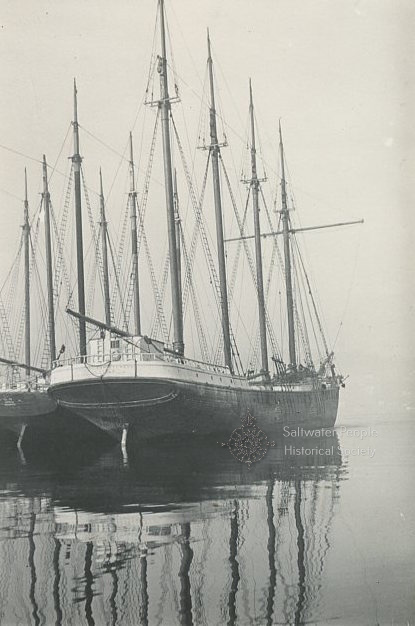
Schooner SOPHIE CHRISTENSON
Coming home from the Bering Sea.
Photo dated 2 years before James Flynn story below.

Original photo from the S.P.H.S.©
"James N. Flynn of Issaquah and his cousin, Richard Holder of Langley, Whidbey Island, remember codfishing in the Bering Sea aboard the four-masted SOPHIE CHRISTENSON as the most difficult $300 they ever earned.
      Flynn kept a pencilled 1937 journal of their ordeal. Most of the pages were accidentally lost, but his memory is keen. The SOPHIE'S exploits, and those of her captain, J.E. Shields, are documented.
      Men like Flynn and Holder are significant to me because each day I can look out my office window, north over Lake Union, and see Seattle's last remaining sailing ship, the forlorn-looking three-masted WAWONA. She, too, was a codfisher in the Bering Sea, at times within hailing distance of the SOPHIE.
      Equally important, Flynn's penciled journal and his recollections convince me that wooden ships were manned by men of iron. Ashore, many of the men were stumbling, rum-soaked derelicts. One readily admitted he chose thieving to working for wages. Two were tough, grizzled men in their 80s who had been at sea all their adult lives. One was a stowaway deaf mute. There were 45 men in all, and every one performed courageously and well.
      One day, Flynn handed me the age-yellowed pages of his journal. I looked at them and asked what would have been the title. He grinned and said, "Five Months Without a Bath."
      This is James N. Flynn's story.
❖  ❖  ❖
      My cousin, Rich, was only 17 but he was around 6 feet and husky. I was 22, and both of us and been toughened by manual labor. Neither of us and been at sea. We hired on as salters, helped by 'connections.' Times were lean.
      We were aboard the SOPHIE somewhere near Pier 51, waiting to be towed by tug beyond Cape Flattery. It took seven hrs to get the crew on board. They were trying to drink enough to last them for five months.
      I was in awe. Thirty men out of their drunken minds. The mates would herd a group aboard, then go into the taverns for the others. While the mates were gone, those on board would wander ashore again.
       We got under way in the evening, in tow. Up on the forecastle, the jugs and bottles were open. They were drinking everything dry before we were to let go of the tow line.
      When the tug's tow line let go, beyond Cape Flattery, the drinking stopped. According to some kind of code, all remaining booze was tossed overboard.
      Then began a weird transformation in the men, like a Jekyll-Hyde change. The drunks straightened up and became sailors. They cleansed themselves, changed clothing and went to work. We hoisted sails and got under way. I went aloft and was scared at the 100-foot height, but the old hands understood and helped me. 
Aloft on SOPHIE CHRISTENSON
Undated, unknown fishermen,
Unknown photographer.
Courtesy of R.R. Burke

I learned that if you are willing to pitch in, you get help and respect.
      The men were mechanical wizards. We had 22 fishing dories aboard, each equipped with a 10-HP Johnson outboard engine (only recently the dories had  been sail-powered.) The men disassembled the engines to basic pieces on the docks, right down to needle valves. They cleansed and inspected every part, then reassembled the engines and honed them to perfection, as if a man's life depended on a perfect engine. It did.
      We hauled out ropes and lines, canvas and brass. The old-timers went to work with their needles and twine. The dress gang sharpened knives.
Aboard Fishing Schooner SOPHIE CHRISTENSON
Unknown date, crew or photographer.
Click to enlarge.
Courtesy of R.R. Burke

      We sailed through an Aleutian pass, probably Unimak, and into the Bering Sea.
      Now, we're organized into rosters: 23 men listed as fishermen, 18 in the dress gang. The deck fisherman was Jalmar, the tongue cutter was Mac, the watchman was Harry, and the cooks were Walter and Frank. I did not record last names, but two men signed themselves as Cash Money and No Dory.
      The captain, J.E. Shields, and his brother and son owned the codfish packing plant at Poulsbo, the SOPHIE, C.A. THAYER and MY NORDIC MAID.
      Captain Shields operated the ship's store and, as we sailed northward into cold, sold us warm clothing and foul-weather gear as desired. He was the doctor, provisioner, chaplain, navigator, and judge.
      But crewmen settled their differences among themselves. When Finns and Swedes became clannish and segregated themselves, we insisted that everybody speak English. AS for medical aid, nobody during the 4 1/2 months became ill in that adverse climate––no flu, no colds, no lung congestion. Health was excellent.
      The SOPHIE was traditionally a good-luck ship. By reputation, illness or storm damage never enfeebled her. By 9 July we had taken and salted down 212,154 cod. Fourth July is memorable, not because it was a holiday, but because a one-day blizzard, or williwaw, iced the decks and sent us below.
      There was no heat in the crew's forecastle and no electric lights. We had no bathing facilities, except for buckets or whatever we improvised. The toilet was on the weather deck, extending over the side.
      These dorymen awed me.
Crew of SOPHIE CHRISTENSON
Bering Sea
Undated, unknown crew names,
unknown photographer.
Courtesy of RR Burke.
 They fished from dawn to dusk, and there wasn't much darkness. We worked up to 18 hours a day. They did not wear life preservers, because they reasoned the cold water would finish them in seven minutes. They would come back to the ship, heavily laden, and disappear behind giant waves. They would come alongside to mountainous gray swells and pitchfork their catches to us on deck, using one-prong forks. 
      Our hands were calloused like dogs' paws by rock salt and sea water. Our hands would split wide open and bleed. Men would strike matches on their horny palms. One common healing balm for split hands was human urine––our own.
      Maybe you have heard of the codfishermen's war against the Japanese. The Japanese fishing ships laid a net around us, entirely hemming us in. The captain was infuriated and gave orders to sail through it, ram our way out. We became entangled, our rudder was disable, and men tried to dive down and cut us fee. The cold water immobilized them. Finally, using knives attached to the ends of poles, we cut our way free of the nets. Captain Shields threatened to shoot at the encroachers with rifles, but he was dissuaded. (But the next year, in 1938, he instigated an arms buildup among fishermen which bordered on a shootout.)
      We returned to Seattle in late August 1937. I was a year older, having observed my 23rd birthday on 8 May. We sailed into Poulsbo, to Captain Shields' codfish processing plant, carrying about 400,000 pounds of cod. We had been gone about 4 1/2 months, and my wages were $300 net. 
Schooner SOPHIE CHRISTENSON
Home at winter moorage, Seattle, WA.

1941 photo by James A. Turner from
the Archives of the S.P.H.S.©

      Many of the crewmen collected their pay and resumed where they left off––in the taverns. My cousin and I returned to Issaquah in time for the potato harvest in the Yakima area. I had gained 25 pounds.
      I know you wonder whether I would sail aboard the SOPHIE again. Yes, I would––as a young man."
Above text from: My Waterfront. Carter, Glenn, Seattle, WA. Seagull Books Co. 1977.


27 June 2016

❖ A SHEET IS A SHEET? AND OTHER NAUTICAL JARGON ❖

YANKEE CLIPPER 
and her Sea Explorer crew
Elliot Bay, Seattle, WA., 1955.
Happy sailors without a vang, but they have
 Charley Noble and John Kelly aboard.

Click to enlarge.
Original photo from the archives of S.P.H.S.©
"Count me among the dissenters against crotchety nautical terminology. I refuse to call a stove's smokestack a Charle Noble. Up with plain old tin chmineys.
      If a guest aboard my boat asks where the bathroom is, I tell him or her. I have no bathroom aboard. It is a head. But no matter. Let them call the fantail the back porch and never mind.
      Thank heaven I have no vangs aboard. I am not sure what vangs are or is. My handy-dandy mariner's dictionary does not adequately define vangs. I think none is lurking in my gaff-rigged sloop. Or if one is, may it rest undisturbed. My baggywrinkles are fine, thank you.
      I have crutches aboard that have nothing to do with physical impairment. They hold up the mainsail boom when the sail is furled. They are two varnished boards hinged like scissors. The boom rests on the X.
      Nautical terminology is as complicated and wispy as the English language. We try to describe ships, scantlings and rigging in a hodgepodge borrowing from French, Dutch, Spanish, Latin, Scandinavian and Chaucer-era English that when read aloud by an expert sounds like High German.
      It is hopeless.
      I have a doghouse aboard but no dog. I herewith avoid mention of cats and houses for obvious reasons. But "cat" does figure prominently in nautical terminology.
      I am in deep trouble, subject to censure, by my grumblings over traditional nautical designations. I should be an example-setter as the Times maritime editor and an avid weekend sailor and professed old-ships buff. But there comes a time for bare-faced honesty in the name of common sense. 
      I am thinking of installing a gallows on my sloop, but nobody will be hanged. A gallows is a permanent support for the main boom. 
John Alden cutter JOHANNA
launched Shaw Island, 1987.
Sailing the San Juan Islands with her Boom Gallows, 
designed and crafted by Kit Africa.
I used to call a gallows a "fixed boom support" until I was severely corrected.
      The incident happened when I visited a salty-socks live-aboard crony to inquire about his main-boom support on his doghouse topside. It was teak and handsome.
      He listened and then looked at me questioningly.
      'I'm going to eliminate my cock-pit crutch in favor of a fixed boom prop atop my doghouse,' I said.
      How would I have stated it more precisely?
      What you really want is a gallows,' he said smugly.
      'Which would belay the vangs,' I said matter-of-factly with intent to befuddle. Then I laid my topper on him: 'that way, I won't have to watch for bothersome dollops.'
      If you're ever a guest aboard a freighter and wish to impress a master mariner, ask him about the Plimsoll mark on the ship's side. It shows when the maximum load is aboard. Samuel Plimsoll, a Briton, fought valiantly for adoption of the Plimsol mark. He finally won the consensus of an international maritime convention in 1929. 
      Plimsoll marks are complicated. But simplified, the abbreviations signify drafts, such as FW for fresh water, IS for Indian Ocean summer, S for summer, W for winter and WNA for winter in North Atlantic.
      Remember that.
      On your first visit to a yacht, don't call ropes ropes. There are only two ropes aboard––the bell rope and the foot rope on old sailing ships. Call the others lines, sheets or halyards. Please don't ask me why. (Except that a halyard once was a 'haul yard.')
      Speaking of salts, I'll never know why a three-cornered sail is so hard to identify by its parts. 
YANKEE CLIPPER
and some crew of the West Seattle Sea Scouts.
Trying to determine the leach from the luff en route to the
Swiftsure Race in Victoria, B.C., 1955.
L-R: Andy Pederson, Ron McFarlane, Mate Wayne Watters,
Tom Emerson and Lorne Wilson. Out of the photo is the
Skipper, and Sea Scout Master John Kelly.
Original photo from the archives of the S.P.H.S.©
To my oversimplified way of thinking, there's a foreside, bottom side and slant side. But heaven forbid substitution for luff (fore,) leech (slant) and foot (bottom.) The ropes, hanging from it are the halyards and sheets. And watch out for the lazy jacks. A lanyard is something else, which many an old salt will defend as a bell rope.
      Once when writing an article I wearied of the repeated word 'sails.' The subject was about sails, but he word became unbearably excessive. So I deftly inserted 'sheets' as inconspicuously as I could––in the vernacular of 'bed sheets.'
      The uproar of reaction in my mailbag was startling. A sheet is a line used for maneuvering sails. On a boat a sheet is a sheet is a sheet.
      There are other peculiarities. A john boat is not what the word implies.
      A gin pole has nothing to do with a martini, but splicing the main brace does. A gimlet is an anchor turned after it has been rove to the hawspipe. Gins are iron sheaves set in iron shells. A jigger is light tackle for various work about docks or to rig booms in or out.
      Port is one side and the starboard the other. Time was, port was known as 'larboard'––often confused in high-wind noise with 'starboard.' So the word was changed.
      Legend has it that a master mariner acquired a secret box when the change to 'port occurred. He kept the box locked. He often left the wheelhouse watch stealthily to open the box and furtively peer within. Then he'd slam the lid and click the lock.
      Finally he retired in old age––swallowed the anchor––and settled ashore in a snug haven. The box was left aboard and unclaimed. It was forced open by those who remembered the old gent's peculiar manners.
      Inside was a scrap of paper with the notation: 'Port means left and starboard means right.'"
Above text verbatim from My Waterfront. Carter, Glen; Seattle, WA. Seagull Books Pub. 1977.


17 June 2016

❖ A LETTER TO ERNIE GANN ❖

Strumpet
ON 539162 
Built by Jensen Shipyard, 1972, for Ernie Gann,
all of San Juan Island, WA.

Photo scan courtesy of Jan and Dave.

Ernest K. Gann
San Juan Island

Dear Ernie:

      You don't know me and perhaps are irked at the gall of a stranger addressing you informally. If so, beg pardon. But your boat was moored near mine the other day, so I tied up and hiked over for a closeup look.
      Curiosity rather than brashness drew me to her. I wanted to see what qualities in a man who had authored 13 books were reflected in his boat. Your 14th. Band of Brothers is just off the press, I'm told.
      I greet you informally because nobody I know on the waterfront around here refers to you as Ernest K. Most of the guys call you Ernie and let it go at that. They know you best, as waterfront men and boaters, through your book, Song of the Siren, in which you described 17 other boats you had sailed.
      As a waterfront newsman I am supposed to be cynical on my beat, but am not. Curious, yes––one reason I went back to look at your 35-ft Diesel cruiser, Strumpet. She was at Commercial Marine on Westlake North where Dave LeClereq and his guys were installing a gurdy and doing other chores. I went aboard and peeked around, with Dave's permission. Besides, she was open and a couple of men were working. They said come aboard, thinking you wouldn't mind. I only looked––didn't touch. 
      I've never written to a book author––or anybody else who was notable, for that matter. John Wayne's yacht, the Wild Goose, comes to town occasionally. But I have never visited it or him. I mean, it is a converted ex-Navy minesweeper. If you've been aboard one, you've seen 'em all, right? Wayne, I recall, played the lead in The High and the Mighty, which you wrote. Sorry to say I never read it but I did catch the filmed version.
      Also, Bobby Darin, the late singer-actor, was in town and bought the old tug boat, Jim. Darin spent a bundle to make the interior posh. But I never went aboard or tried to see him.
      But your Strumpet is something else. The first time I saw her was at night at Doc Freemen's moorage. Ole Johansen, who skippers a rescue vessel he acquired in Norway, was with me. We stood on the pier and ogled the Strumpet like young men would gawk at a beauty queen in a ripped bikini.
      We thought she was an authentic North Sea trawler out of Scotland or perhaps Scandinavia. We stood there in the night's damp chill, wondering who owned her and if she was hauled over in a freighter or sailed across the Atlantic, through the Panama Canal, and up the coast.
     So I was surprised to learn later that she was designed by Jay Benford of Seattle and built only last year by the Jensen & Sons Shipyard at Friday Harbor on San Juan Island.
      The waterfront guys here respect your Strumpet, which as you know is known as an indirect tip of the watch-cap to the skipper. She's honest, genuine, and well done. Those shipwrights at Friday Harbor must have gone all out to put their best into her.
      I'm told you were very particular about details during architectural planning and actual construction. A hull containing all the thick cedar, oak, and the finest fir has to be skookum. The interior mahogany, bereft of plastic and cuteness, is soothing to the eye.
      The guys installing the gurdy said you apparently were going deep-water fishing, probably for halibut.
      The first thing that held my eye was her canoe-like stern, quite full and nearly round to provide lift in following seas. She's got an extraordinary fantail, all right––like a plump little blond I used to know in bygone years. But she wasn't as beamy in proportion––the blond, I mean. A 12-ft width on a 35 length is a lot of broad.
      The most eye-grabbing object in the wheelhouse was the shiny brass engine telegraph. For a moment I envisioned your buddy, La Frenier, on all fours in the engine compartment, acknowledging your engine-speed signals. As I read Sirens describing you and him in the fish boat Fred Holmes. I thought you were a goner while crossing that stormy bar at Astoria. Then I realized the Strumpet's engine was bridge-controlled and the telegraph was only a throttle-gearshift.
      Your Strumpet is the first boat I've seen with a solid-copper stovepipe. Never knew they existed. In fact, I've never seen as much copper tubing in a boat. Most of the guys use galvanized black iron or plastic stuff around here. I'm told the 6-cylinder engine lets her cruise nicely at seven knots and with a fuel capacity to permit a 1,250-mile range. Benford said she exceeded by about a knot his architectural predictions on paper.
      Something else about the Strumpet. I never saw a 35-footer with three stoves aboard––one aft, one in the galley, and one in the forecastle bunk area. Usually, a galley stove is sufficient. At least one old wood burner is enough in my gaff-rigged sloop. The little kerosene "swede stove" in the bunk area was a delightful surprise–solid brass, too. 
      Your padded engine room floor is the only way to go. They told me the lining in the compartment effectively deadens the engine noise.
      

Ernie Gann
In his studio on San Juan Island. 

Original gelatin-silver photo from
 the archives of the Saltwater People Historical Society©
      Another reason I went to see her was to learn what you have evolved to after owning 17 boats since your boyhood days. That's how many you described in Sirens. I recall the imposing Albatros, the old bucket that was the object of your biggest love affair, and the tiny Thetis that charmed you. And the fish boat, Fred Holmes, which you and La Frenier took a beating off Oregon. Also, the quirky Don Quixote needing a blowtorch to start its cantankerous engine. Then there was the Butterfly, hardly more than a raft with patchwork sails that rose and nearly soared gull-like before the wind.
      You ended the book with the Albatros, and I often wondered what you went down to the sea in after her. Evidently, the Strumpet now is your sequel siren.
      Here in Puget Sound country, in this cold and wet wintery state of affairs, I often chicken out when the cover tarps stiffen and ice forms on deck. Then I am landlocked and wait impatiently for sunshine to breakthrough. When it does finally come, I remember that last italicized paragraph in Sirens:
      "I think we can sail today. Both the wind and the sea have gone down and there is a patch of blue sky to the north as big as a Dutchman's pants. Which is invitation enough for any sailor."
      The guys at the marine yard installed your fishing gurdy good and proper. They mounted it on a teak pad and socked in plenty of bedding compound.
      Good fishing out there, Ernie.
Above text: Carter, Glen. My Waterfront. Seattle; Seagull Books Co. 1977.
There is another post on Gann and his Strumpet posted here.


26 January 2012

❖ THE LONE SEA ROVER ❖


Capt. Thomas Drake,

1863-1936.
Photo dated 1933.
Original photo from the
Saltwater People Historical Society©

The first photographic morsels of Captain Thomas Drake to slip into this historical collection came with the arrival of two vintage photo postcards. Research indicates the bluewater sailor had this card (below) printed in Seattle to sell at speaking engagements for funds for his international sailing adventures. 
      The puzzle for this writer started unfolding when brief references to Captain Tommy were noticed in books by Andrews and Kirwin, This was Seafaring and also, High Tide by newspaperman R. H. Calkins. These writers indicated Drake was a sailor friend to many in the Northwest, sometimes mooring in Seattle or Stanwood, but known around the globe.


PROGRESS 

(O.N. 231796)
Captain Thomas Drake
She was built in Tacoma in 1932;
lost with the skipper in 1936.
Homeport was Stanwood, WA,
as listed in federal documentation.

Undated original photo postcard from
the Saltwater People Historical Society©

Below text by Glen Carter, The Seattle Times, 1973.
Thanks to the Northwest and Special Collections Librarian, Sean Lanksbury, WA. State Library, Olympia, WA. Herein a long-winded story of one tough, deep-water, sailor:

"If Seattle ever establishes a Hall of Fame for extraordinary old men of the sea, Captain Tom Drake would get my vote. Should somebody form a Tom Drake Fan Club, I'll be first in line to register.
      A man who would roam the seas alone for more than 120,000 miles--as late in life as 76--he deserves a tip of the watch-cap. Consider also that he built the boats he sailed--none longer than 37-ft.
      If you've never heard of Tommy Drake, you're not alone. He didn't make big headlines--even when he went down to the sea in his last little ship in 1936. Captain Tom just went away for a while. He was last seen headed out from San Francisco, bound down the coast for San Diego and ports beyond.
      Drake favored double-enders--those boats pointed at both ends. He built or worked on all of them at Stanwood, Snohomish County, which he also called home. He sawed his own timbers and scantlings there.
      Captain Tom was some sea-going man. He was only 5-feet tall, mustached; the grin into a camera's lens was ever-ready.


Thomas Drake

Faint inscription by him inscribed 
on the face of the photograph.

Drake had postcards published 

in Seattle and England 
to promote his talks.
Click image to enlarge.

Undated, original photo postcard from
the Saltwater People Historical Society©

      A tough little guy, he was. At 70, he pulled into the Seattle harbor from Hawaii after battling mountainous seas for part of 53 days. His 37-foot PROGRESS was limping with sails shredded and bowsprit gone. Tommy also was battered. His right arm hung loosely at his side. The hand was broken and the arm badly sprained. He had caught them in the boat's spinning wheel-spokes.
      'I'm going into Marine Hospital to get patched up, then I'll head out again,' he told a reporter. Tommy said he had steered and sailed left-handed for 20 grueling days.
      Who WAS Tommy Drake? The records are sketchy but complete enough. He was a peppery little man who talked with a Cockney accent, in short, clipped sentences. He limped badly on a leg shortened 4-inches by a shipboard fall in his youth. He began sailing out of England at age 13.
      Old newspaper clippings describe him as 'The Lone Sea Rover'. He never traveled with a companion. Newsmen repeatedly said he had roamed the seven seas, calling on 117 ports and logging 120,000 miles out of Puget Sound. He had sailed in windjammers and rounded Cape Horn as a matter of life. The last two tall ships on which he was mate were the bark IFIFIA and the brig TARTER.
      Men here knew him well. He was a member of the Seattle and Queen City Yacht Clubs. His oil portrait, done by Peter Jordan Savage, was a prized adornment of the Seattle Yacht Club. [Do you know the whereabouts of this painting?]
      In 1935 a newsman wrote: ' Tommy Drake, venerable seaman and nautical hermit, is gone again.  He left at dawn yesterday and pointed his schooner's bow outbound from Lake Union. Where was he going? Nobody knows, except perhaps Tommy himself.'
      Tommy was that way--chatty and congenial but close-mouthed about his destinations. One summer he shoved off and didn't return for more than four years. During those absences, he wrote to friends such as 'Doc' Freeman, Harry Kirwin, Jacob Lough, George Broom, and others.
      It was Lough, a druggist, who traveled to San Francisco, August 1937, and on to Pescadero Point to examine the beached wreckage of a boat identified as Captain Tom's.
      In October 1926, it had been Lough who received a letter from the lone skipper who wrote he had arrived safely in Balboa, en route to his boyhood home in England by way of Cape Horn. There had been no word from him since his departure from Seattle four months earlier in his 36-foot schooner, the PILGRIM.
      He did battle his way around the Horn, up to the Bahamas, made a good passage across the Atlantic, sighted the Azores without putting in, and arrived off the English coast in a gale that forced him to heave to. Blown back out to sea, he had to beat for nearly a week before he made Fowey after 52 days at sea.


PILGRIM

O.N. 223254
35.5' x 11' x 4.2'
Built in 1923, Quilcene, WA
Location: South coast of England.
Original photo from the archives of S.P.H.S.©
Archived 23 March 2016,

Courtesy of a reader in Wales.

      He called at coastal villages, then sailed up the English Channel and entered the Thames, happy and triumphant to revisit the river waters he had left 50-years earlier. But his joy was marred when he luffed into the moorage of a Gravesend yacht club and was told he could not tie up, being a non-member of a yachting fraternity.
      Drake explained that his lame hip was painful, that he had voyaged a long distance and was tired. Club officials still denied his mooring, so he went to a less prestigious club and told officials there he was a member of a Seattle yacht club. After confirmation by the Atlantic cable was made, Drake became a celebrity on the London waterfront. The yacht club that had denied him moorage sent a delegation to offer the club's apologies. The press reported that he received the apologists cordially and invited them aboard.
      He left England for leisurely touring of Scandinavia and Holland. Then came a press report out of Amsterdam that described how the Lone Sea Rover had been shipwrecked and was rescued by fishermen.
      Tommy worked his way on a ship to the East Coast, rode a freight train cross-country and arrived in Seattle's railroad yards.
      Drake, then 66, was back from the sea in Seattle after four years and six months.
      In all, Captain Drake sailed 4 of his home-built ships out of Puget Sound. His first schooner, the SIR FRANCIS, was completed in 1915. She was 32-feet, a double-ender, and drew less than four feet. The vessel was lost in a storm on the east coast of Mexico after he had logged 31,000 miles in the Pacific, Atlantic, South American, and Caribbean waters.
      Then followed the 35-foot double-ender, SIR FRANCIS II, lost off Cuba.


Capt. Thomas Drake
of Stanwood, WA., USA.
Photo dated 1927. 
Sailing solo from Charleston, S.C. to
  this Port of Southhampton, England.

The white canvas sign reads: 
"Come and See the Big Ship PILGRIM."
Click image to enlarge.

Original photo from the archives of S.P.H.S.©

     But the PILGRIM, that he sailed to Europe and lost off Holland, probably was his best-liked boat. After he arrived home to Seattle on the freight train, he went to work on his last ship, the PROGRESS, 37-feet, with inside ballast of 5-tons and draft of 4-feet. To shake her down, he sailed down-coast and across to Hawaii. It was on his return passage to Seattle that he broke his hand.
      In the fall of 1936, Drake shoved off--again down the coast, not announcing his ultimate destination. In March, his Seattle friends began to voice apprehension. For him not to mail letters for months was not unusual. But uneasiness was growing. 
His last known whereabouts was San Francisco, where he had headed outbound under the Golden Gate Bridge in November 1936.
      The skipper's age then was reported in the press as 76 years."


The Seattle Times, 16 May 1937 reported:
      'The aged skipper's fraternity of friends are afraid that when Captain Drake stood proudly erect at the PROGRESS's wheel during the marine parade through the Lake Washington Ship Canal last summer, Seattle had its last look at him. They hope he'll turn up--in Hawaii, India, in the South Seas, or somewhere.'
      Occasionally you find an old-timer who knew Tommy Drake well, and he talks about his long-ago friend. But there ought to be a memorial or some kind of remembrance in Puget Sound country for Tommy Drake. He was a champion of sorts."


Quote below from: Sea Quest, Borden, Ballantine, 1967.          

"Once or twice a year for a quarter of a century, the Cape Flattery lookout at Tatoosh Island, recognizing the familiar scrap of hull and sail coming up over the horizon, would report Capt. Tom bound into the Strait of Juan de Fuca again from Samoa, Honolulu, Panama, and other ports around the world." 


Closer to home; from Chuckanut Chronicles. Thomas, Robert B.
      "A well-known world navigator, Captain Thomas Drake, who hailed from the home port of Stanwood, WA, was a frequent visitor to the yacht club in Chuckanut Bay, [Whatcom County] with his small sailing vessel. He was an honorary member of yacht clubs the world over."


Further reading:
      The Sea Chest,  Journal of the Puget Sound Maritime Hist. Society. Dec. 2013. Seattle, WA. Cherie Christensen. Pages 72-83. 
      Midget Magellans, Great Cruises in Small Ships. Devine, Eric. New York. Harrison, Smith and Robert Haas, 1935. Pages 63-83. 


Drake, Capt. Thomas. The Log of the Lone Sea Rover; being the story of the 32,000-mile voyage alone of Captain Thomas Drake, As Told by Himself. Copy kindly shared by Stanwood Area Historical Society, Stanwood, WA. (SAHS 86.01.04.01) 


Archived Log Entries