"The Cure for Everything is Saltwater, Sweat, Tears, or the Sea."

About Us

My photo
San Juan Archipelago, Washington State, United States
A society formed in 2009 for the purpose of collecting, preserving, celebrating, and disseminating the maritime history of the San Juan Islands and northern Puget Sound area. Check this log for tales from out-of-print publications as well as from members and friends. There are circa 750, often long entries, on a broad range of maritime topics; there are search aids at the bottom of the log. Please ask for permission to use any photo posted on this site. Thank you.
Showing posts with label author June Burn. Show all posts

02 May 2025

ENJOYING THE ARCHIPELAGO, with JUNE BURN, 1929.


Views of the Archipelago as 
wanderer June Burn cruised from
her home in South Bellingham,
through the islands and home 
again in 1929.
Photographs by Ellis, Jacobson, 
and Clyde Banks Studio.
Click image to enlarge. 
From the archives of the
Saltwater People Historical Society.

"Just one week from today, I left Bellingham bound for the islands. Another too-perfect day for the return. 

Dazzling sunshine and water ruffled prettily with a wind from over the sea and far away, pushing up the water into little humps that spill over on each as if in conscious play. There is a sense of awareness about the water, as if it responded voluntarily to the playful pushes and pulls of the wind, as if it ran sprawled upon the beaches just for fun.

The bluffs and beaches, coves, and villages of the island shine in the sun as if they had all just come home from the laundry. The Olympics behind us, Mount Baker softened by the thinnest veil of gray haze to the right of us, the white Cascades thrilling in front of us, Canada to the left and autumn-sweet islands around--if anybody thinks he can paint a picture to compare with that, let him try!

Down the channel again past Prevost, and Waldron,  Deer Harbor, West Sound, Orcas, and Shaw, on over the three-hour run from Shaw to Belingham. I have my nose buried in my typewriter this heavenly day, racing to gather the harvest of my days in the islands before other days come swarming down upon me. We are in Bellingham Bay before I know it, the tip of Baker just disappearing over Chuckanut Mountain, across Eliza Island.

"There are more deer on Eliza Island than in the rest of the state of Washington." I hear one of the boatmen say. "They swarm around the cookhouses, so thick you can't get in. But take those same deer when they swim over to Lummi Island, and you can't get near them. They know they are protected here all right."

The neat white cement plant is the first building I can see as we draw in sight of Bellingham. Then, around the Point of Eliza, the smokes of Bellingham and the city itself pour down from all the hills into the bay. Are those the Selkirks over the horizon north-by-west? Shadowy through the yellowish-purple mist?

Five blackfish come spouting up the bay alongside the San Juan II. We leave them behind while we race over the wide harbor towards the city.

Like a wide, deep amphitheater is Bellingham swinging down and around the hills from south to north, the curve narrowing and deepening as we draw closer. South Bellingham in the sun is as colorful as a flower garden or as Heather Meadows in  October. Tan and yellow and red and white against the brown and green of the hill. The Fairhaven Hotel is like a feudal castle nestled at the foot of the hill, while the new hotel in North Bellingham is like a young skyscraper. The smokes remind me of a New England factory town, while the beauty of the scene is like nothing but Puget Sound. 

And Baker! You can't lose that mountain for long at a time! Here she is, her head and shoulders thrust up again over the hills! She is reminding me that Mr. Huntoon has promised to take me up that snowy radiance on snowshoes. I am glad to be hurrying back home! I had clean forgotten about that promise in the joy of the islands. What a world full of things to do in Puget Sound! And what a lot of friendly people willing to help you do them!

This is all of the island for a while--until next summer, maybe, though I make no promise! When the big winds come, I shall want to go down to see how the old eagle's nest rides the storm high in the branches of a dead fir tree. And I'd like to climb Constitution in the snow if there is to be snow this winter. I'd like to see how the spray freezes against a yellow bluff and the sun makes rainbows all down the bank of ice. I'd like to go stand on the end of Iceberg Point on Lopez Island and feel the wind beating against me from all over the Strait. You don't know your land at all if you know her only in summer! I think Puget Sound people, of all the people I have ever known, are winter-time folks, too!

See you tomorrow."

Published in the Bellingham Herald, evening of 5 November, 1929.

If you would like to view the vessel on which she jumped aboard, SAN JUAN II, it and more of her writings can be viewed on this post HERE.


20 December 2022

LIME WORKS WITH JUNE : November 1929


Roche Harbor,
San Juan Archipelago, WA.
 The Lime Transport
moored to load barrels.
Click image to enlarge.
Original gelatin-silver photographs from 
the Saltwater People Historical  Society©

Puget Soundings
June Burn
Bellingham Herald, November 1929

"Five years ago and Capt. Wirstrom retired from the sea. He had sailed his last ship, kept his last watch, and tooted his last whistle in a pea-soup fog. He was going to farm for the rest of his life and take things easy far from the mad winds and the merciless reefs of rock out where no gentlemanly reef ought to be.
      Today, as you read this, Captain Wirstrom is probably down in Coos Bay, having navigated a boatload of lime rock from Roche Harbor, WA, to the paper mills of Empire City. For, when the call came, the old mariner found he could not resist it and so he sits again in what seems to me a lonely state in his captain's quarters aft, on the big Roche Harbor Lime Transport.
      On the northern tip of San Juan Island, two companies dig lime from hills full of the purest lime deposit in the world, they say. Moreover, there is said to be enough lime in those hills to last more than a century with both companies going for all they are worth. (It is my private opinion that in a hundred years they will have dug up the whole island at the rate they are going now.


Orcas Lime Company
Click image to enlarge.

"The Orcas Lime Co worked a small quarry 
just a few hundred yards south of the 
Roche Harbor deposit. 
It supplied its single kiln with 
limestone by means of rail carts pushed 
along on top of a long trestle.
That plant and dock were located on narrow
Mosquito Pass, also served by 
Puget Sound Freight Line boats.
When the quarry rock finally gave out 
in the mid-30s, this trim little competitor
 gave up the ghost and the land 
  became a sheep ranch."
Text from the Journal Jan. 2003.
Author unknown.

Roche Harbor, San Juan Island, WA.
Original gelatin-silver photograph from the 
archives of the Saltwater People Historical Society©


On the beautiful old Scurr place, the Orcas Lime Works dig out the fine, white angular rocks to be broken and burned in the kilns where they will become flaky snow-white lime for a score or uses.
      And against the curving hill slopes behind one of the prettier harbors in the world, Roche Harbor Lime Company digs and burns, and barrels are loaded on ships for places far and near.
      The fine long dock at Roche Harbor is piled with barrels upon barrels, four deep, all filled with lime ready for the boats. Sacks upon sacks of lime are stacked behind the barrels. The daily capacity of the works is 1,500 barrels.


Antique copper stencils 
once used to inscribe lime barrels  
shipping out to these destinations from
Roche Harbor Lime Co.
Now archived at the 
San Juan Island Historical Museum.
Stop by during their open hours
and visit their wonderful 
effort highlighting history of San Juan Island,
San Juan Archipelago, Washington.


Boats come and go, bringing in thousands of cords of wood to Roche Harbor, going out with tons and tons of lime from Roche Harbor. The little bay is lively with boats.
      Ten years ago we helped to dig rock out of those hills. That is, Farrar broke the rock and I watched him! I used to walk up the Clematis-covered banks, over the tiny railway to the high-walled quarries to watch the men with their big sledge hammers cracking the boulders, breaking off one corner after another, sometimes finding themselves faced with an almost round, unbreakable rock at the end if they weren't skilled. The game was to break them so that there would always be another angle left. Farrar used to say there was poetry in watching the rocks come down after the blast, in selecting one's boulder to conquer with sledge and muscle, in breaking it so skillfully that the last bit was so full of sharp angles as the original boulder had been.
      The Clematis on those banks was planted forty-three years ago on the birthday of Mr. McMillin's son. The original plant is now a hoary old vine several inches thick, crawling all over the place. And the progeny of that vine softens every nook and cranny of the hill. It is chiefly responsible for the beauty of the place as one comes in by boat.

Hotel de Haro
Roche Harbor, 
San Juan Archipelago, WA.

      Against the dark hill rising up from the harbor on the left, as one enters, are the white cottages of the laborers, the combination church and schoolhouse, with its spire, the vine-covered hotel, the Clematis banks, and the big flower garden coming down to the water's edge. The effect is incomparably lovely. If there were no lime there at all, and no industry, the dainty small harbor would still be a village for the sheer beauty of the location.
      But to get back to Captain Wirstrom: Several years ago the lime company bought a big sailing boat––a beautiful thing she is, with flowing robes riding her prow. For two or three years, the long slender six-masted schooner sat still in the harbor. She too has retired, maybe. Thought to ride the calm waters of a picturesque harbor for the rest of her days. But now she is to be used again. Stripped of three of her masts, part of them used now as cargo booms, she will haul lime rock down the coast to the new paper mills at Empire City in Coos Bay.
      La Escocesa (Scotch Maid) was built in 1868 in Dundee, Scotland. She ran as a steamship between England and India. Later her name was changed to Coalinga and she was used in the carrying trade, whatever that means. Freight, I suppose. Finally, the Alaska Packers bought her, changed her name once more to Star of Chile, and used her as a sort of floating cannery in Alaska. Now she is the Roche Harbor Lime Transport barge and once more a "carrier" of things.
      Of iron her hull--thick plates of Swedish iron--and of her iron spirit, else she would never have lived out the seas which have broken over her in every sea in the world. And perhaps there is some iron in the spirit of her new captain that he comes from retirement to pilot a "barge." She doesn't look like a barge, certainly, with her trim lines and the three masts rising so fine and tall. But she is to be towed, sailing only when there is sufficient wind to make the use of her small canvas, worthwhile, and so she must now be called a barge, though her captain doesn't like it.
      Here comes my boat to take me to another island! I had thought to have dinner in the attractive hotel here and the soft-voiced Japanese boy is just serving the salad, but I must run. There will be a sunset on the channel as we chug across the island's dark shadow against the bright waters. See you tomorrow. June. "


22 July 2022

AT WOODMEN HALL AND AROUND LOPEZ ISLAND with June ::: May 1930


Lopez Island, 
San Juan Archipelago, WA.

"We didn't arrive at the big Woodmen hall, standing alone in the middle of the woods, until along about 9:30 p.m.

It was exactly like going to meeting in the South. The meetinghouse was a lodge hall and we were going to play five hundred instead of sing and pray. But the feeling was the same. The same quiet assembling of buggies, one after the other coming in out of the night, finding their places between the trees. Except that they were all automobiles instead of buggies. The same leisurely goings and comings to and out of the meetinghouse. The same low talking. And when we get inside, the meeting had started so that we felt a little embarrassed at being late, exactly as if the friendly preacher was about to scold us!

It was a delightful evening and I almost learned how to play five hundred. 

Esther is coming to drive me over the island. What a prosperous, beautiful island it is! The  New England farms look no mellower, no healthier than these big Lopez farms reclaimed in the last seventy-odd years ago. they look like generations of people, of cattle, of crops had grown up here.

Grassy pastures and orchards in blossom on the Strafford farm. Berries and cattle, green fields, and a tractor plowing on the neat Erb place. Rolling green slopes and dozens of gorgeous apple trees in fragrant bloom on the Kilpatrick farm.

Down the road along the backbone of the island, beautiful farms fell away into pleasant valleys on both sides. Sheep in the pastures, chickens cackling from modern hen-houses. Loganberries on Joe Ender's place. The McCloud house, low and brown, nestled on a big rock.Strait of Juan de Fuca. 

A very tiny loghouse with a very big ivy cluster nearly hiding it, a cloud of pear blossoms hovering over it. Somebody lived in that diminutive picturesque house once and enjoyed its charm, enjoyed the sweep of pastoral beauty on the slopes below it.

Pheasants and mountain quail in gardens. the McCauley farm is lush and lovely on both sides of the road. 

Down the dim cathedral woods to McKay harbor. Hemlock, white fir, and cedar. Long, curving beach washed by gentle surf. Crows on a fence. The pretty white Tralness house above the beach and a lavender-pink mass of starry flowers on the edge of the road. Out in the harbor, a gray slick rock tipped with seagulls.

In Barlow's Bay a great flower-covered rock. Lacy yellow blooms. Sedum is about to burst into fragrant blossoms. Dark blue verbena-like flowers, bell-like flowers. Crane's bill. A creamy white bell-like flower––how tantalizing not to know the names of these sweets! You would not live here so long without knowing all the flowers by their real and common names, would you? Well, I knew them once. And I shall know them again!

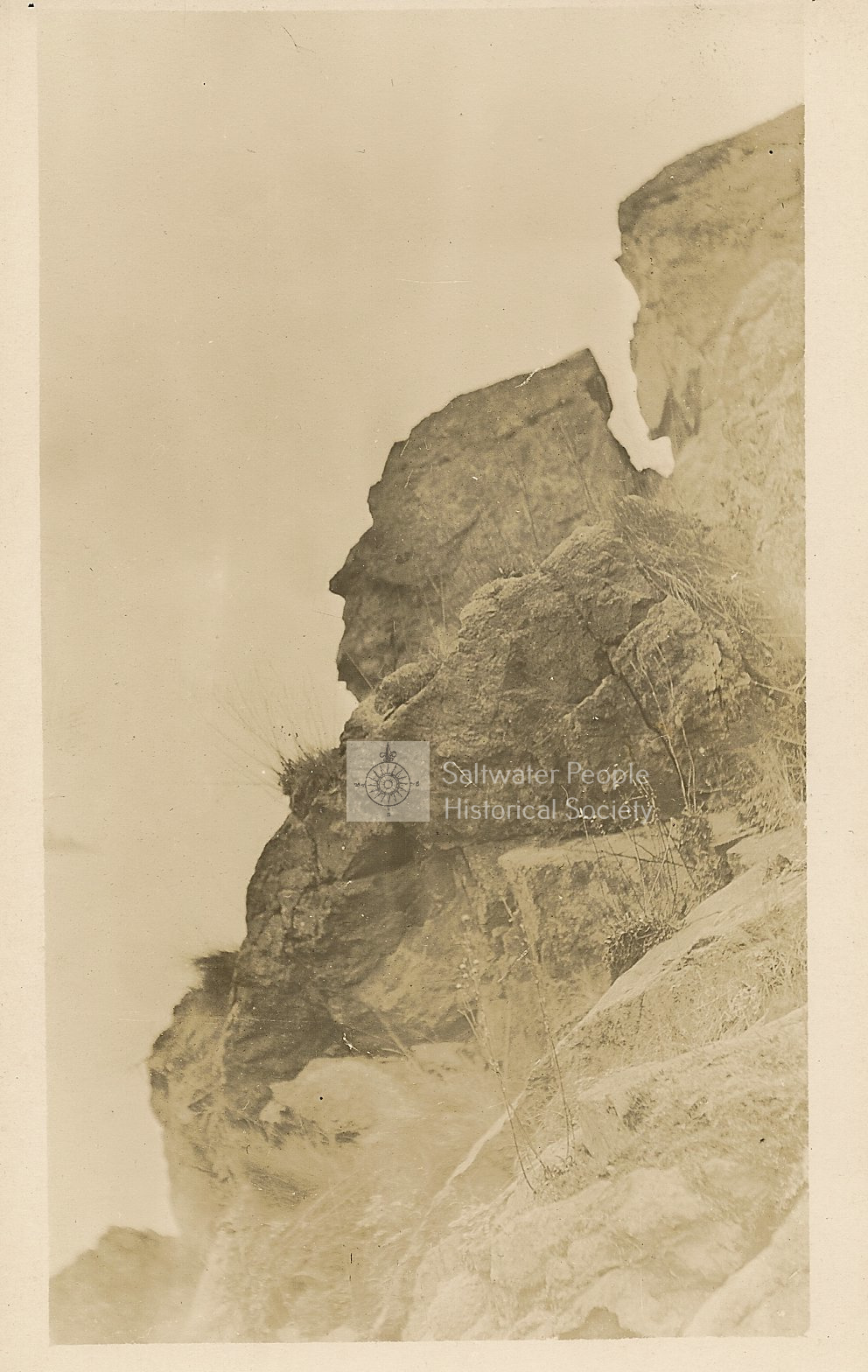
We climb up into the woods and around the outer bluff of the island to find Washington's profile. 


Washington's profile
A rock formation on Lopez Island
that went by several names.
June Burn mentions the
landmark in this essay.
Click image to enlarge.


We find the bluff where the face used to be, but something seems to have happened to the nose, or else we have not come to the right place.

But we find dark blue camas in bloom. And against an old abandoned house a gorgeous lilac heavy with purple flowers. The woods are full of wildflowers. Lady slippers, Oregon grape, starflower. Soapalalee will be along presently. From these berries, the Natives make a bitter foam which some call Native ice cream.

Across the island, is John Thompson's big lonely house where the white-headed old mariner lives alone. He promises to take us with him to Smith's island next Monday. 

The Mud Bay schoolhouse and Eaton's pretty home. On up and around to the Vogt loghouse built a half-century ago of alder logs mind you. Inside, an old square piano, hooked rugs in original designs, and handsome ship models made by the son while tending fishtraps. Outside, flowers and blossoming fruit trees and green meadows and the forest not a hundred yards away. A lovely place.

Well, you needn't think I can go all over the whole island in one letter! See you tomorrow. June"

June Burn. Puget Soundings May 1930


15 May 2022

INLETS OF PUGET SOUND with June


June Burn
Original photo from the archives of the 
Saltwater People History Society©

"Be as greedy of happiness as you please and charge it to my account! We didn't think, last New Year's Day, that January 1930, would find us playing around the inlets of Puget Sound with Vancouver, did we?
          Whidbey returns from Bellingham Bay, named by Vancouver in all probability for Sir William Bellingham, and describes it: "It is situated behind a cluster of islands, from which a number of channels lead into it . . . It everywhere affords good and secure anchorage. Opposite its north point of entrance, the shores are high and rocky, with some detached rocks lying off them. Here was found a brook of most excellent water. To the north and south of these rocky cliffs the shores are less elevated. . . where some of those beautiful verdant lawns were again presented to our view . . . the forests were composed of an infinitely less variety of trees and their growth was less luxuriant. Those commonly seen were pines of different sorts, the arborvitae, the Oriental Arbutus (is this the madrona?) and, I believe, some species of cypress. On the islands, a few small oaks were seen with the Virginiana juniper . . .
          Every smallest bay and cove and inlet has now been examined from Port Discovery down to Budd Inlet, back northward into Canada as far west as Texada Island. It is hard to conceive that so much territory has been covered in two months-– from the last of April to the last of June. It has been possible by working for several crews day and night, going short of provisions to finish a set task, staying out in the rain, and forever keeping at it.
          While Vancouver's party was up in Canada discovering and exploring and naming channels and islands, and the Chatham with Mr. Whidbey was exploring Bellingham Bay, the Discovery had taken a run over to the San Juan Islands to try to make a picture of them. But they couldn't make heads or tails of all those little coves and capes in the time at their disposal. For all general purposes to get them down as islands in a group was sufficient. Besides which, none of them seemed to think much of our islands, a lapse in appreciation. I find it hard to forgive Vancouver and Menzies – the rest were exploring with so much work to be done, probably.
          There is nothing to do now but to go on towards the west and during July and August, explore that vast meandering labyrinth of islands and tiny inlets and bays off Vancouver Island and up in the northwestern corner of the Sound country. The Spanish vessels join Vancouver's party and the four ships proceed together, ___?___portions of the country to explore, the officers of the boats having dinners and good times together.
          Point Marshall, Harwood's Island, and Savary's Island were named on the way. Natives told them they could get through to the ocean up that way, but, while they hoped it was so, they put little faith in the news as knowing too well the savage trick of telling you what he thinks you want to hear!
          In this neck of the woods Vancouver proves himself as able to describe ugliness as he had been able to praise beauty at Port Townsend not 200 miles to the southward: " . . . as dismal and gloomy an aspect as nature could well be supposed to exhibit . . . dull and uninteresting . . . dreary rocks and precipices that compose these desolate shores . . . Our residence here was truly forlorn: an awful silence pervaded the gloomy forest, whilst animated nature seemed to have deserted the neighboring country, whose soil afforded only a few small onions, some samphire, and here and there bushes bearing a scanty crop of indifferent berries . . . and not a fish could be tempted to take the hook." I think he is very tired. Worn out with so much beauty, so much exertion. If he had got here first and to Port Discovery last the whole story might have been reversed. I once heard a homesick girl from Kansas say she didn't like our islands ––they were so barren! From Kansas, mind you! I never did understand what she meant, and here is Vancouver calling them barren, too. Well, she was homesick and he was tired.
          Point Mary, Point Sarah, Bute's Channel, Point Mudge, Stuart's Island, Loughborough's Channel and Desolation Bay, where they were so miserably camped, were all explored and named. And Mr. Johnstone did find that hoped-for channel through to the great ocean. It was named Johnstone's Straits for him. On one shore of the straits, Natives were found possessed of muskets and knowing well how to use them. One of the deserted villages they found to be protected by a very ingenuous fort–– so well constructed that they would have doubted that Natives had lived there if they hadn't found their implements, bones, and old clothing. Several of the officers–– both Spanish and English–– examined the discarded clothing so closely that they had to go jump into the Sound immediately afterward. But that gave them no relief so they boiled all their garments, and presumably washed their heads in hot water to kill the myriad of fleas.
          Hardwicke's Island, Point Chatham, and Thurlow's Island were named by Vancouver. I suppose it was the politeness of the Spanish that permitted the English captain to do the naming. They were all working together, but I find no hint here in the journal of Spanish given names, around here. The Spanish vessels that leave of Vancouver as he starts through Johnstone Straits for the ocean. I wonder where they go. And if it is on this trip that they name our islands SAN JUAN ARCHIPELAGO.
          On through the "inside passage" the English ships go naming as they proceed, first the Discovery and then the Chatham going aground on rocks, until at last, they come out into____?_______ exploring inlets and naming them. Finally, they turn towards Nootka and Quadra, who, they have heard several times, awaits them very impatiently, arriving on 28 August 1792. Thus ends a more thoroughgoing examination of Puget Sound than we were to have until 1838, and so ends the most fascinating journal of exploration I have ever read. See you tomorrow. June."

June Burn. Puget Soundings published 1 January 1930.

13 December 2021

SAILING THE ISLANDS WITH JUNE

Apologies to readers who are fond of the writing of June Burn, it has been too long since we've enjoyed her cheerful words. Here she comes sailing through the islands she loved so well.


Several of the San Juan Islands in view  
from a vantage on Orcas Island, WA.
Silver/gelatin photograph by J.A. McCormick
an early photographer who set up his studio in 
the drugstore, Friday Harbor, WA.
Dated 11 June 1933.
Low-res scan from the archives of the 
Saltwater People Historical Society©
     On the way to Friday Harbor in the Pawnee, chugging into the first southeastern of the season. The steel-blue waves come rolling up the channel towards us, our little boat climbing them merrily. What fun to feel the lift and drop, lift and drop of the light boat over waves at right angles to our keel. If they were coming side-on the heavy rocking wouldn't be at all pleasant. One might even condescend to get seasick in that case. But to go galloping over waves, up and down, is great fun. The splash of the fine spray into the face, the difficulty of keeping the footing, the delight of feeling oneself so close against the very breast of raw life––it isn't hard to understand why old sailors pine away and die when they retire!
        The islands sail by in stately procession––Speiden and the Cactus group, Flat Top, Jones, Yellow Island, McConnell, Orcas, and the shores of San Juan. Around the last point of San Juan, before the boat slides into Friday Harbor Bay, we see the new home of Dr. Frye, director of the biological station. It extends high against the sky on a grassy, rocky bluff. You will know it by its isolation, its pale rose color, and its location. Snug, sunny little houses, it looks with its many windows.
        Beautiful Friday Harbor with its wide curving bay front and the hills rising soon behind it, the white houses swarming over every hill. There are few seafront villages prettier. The waterfront has not been allowed to grow shabby. Nothing is untidy. The effect is one of freshness and charm. Even on a gray day, the village looks shining and lively.
        On the left of the entrance is the fish cannery, surrounded on any Saturday in season, by a fleet of purse seine boats home for the holiday of no fishing. I went to the cannery first thing to ask Captain Willy how many cases of salmon he had canned this year.

        A hundred thousand, he said, and called it an average year. If that is average I wonder what a bumper year would yield? I've bought Friday Harbor canned salmon in Washington, DC to California, in Florida, and wherever else I've ever lived. I dare say if one went to Hindustan, one could buy Friday Harbor salmon. Some of the fishermen out on the traps say that it has been better. Captain Willy's average is pretty likely to be nearest the truth.
        Salmon canning started in Puget Sound back before 1887. The peak was reached in 1917, with forty-five canneries running. There were fourteen in 1928. The biggest year was in 1913, with a total catch of spring, sockeye, coho (silvers), chums (dogs), pinks (humpbacks), and steelheads of a little over two and a half million fish with a total value of thirteen and a third million dollars. The total catch in 1917 was 892,244 fish, valued at $7,957,330. The next best year was in 1917 when there was a big run of pinks.
        On the extreme right of the entrance to Friday Harbor stands the pea cannery. Mr. Henry tells me that they canned 6 4,000 cases this year. The best year they have ever had, he says. The cannery itself plants 200 acres on San Juan Island, supplying itself with peas for about half the pack. The rest of the peas are bought from farmers who sell the hulled (they call them "vined:) peas to the cannery and feed the vines and hulls to their stock, thus realizing two profits from their crop. They get something like $70 a ton for the vined peas, which is the average yield from an acre. Thy hay and hulls are worth five or six dollars a ton for the four or five tons to the acre. But the cream which is produced by the hay and hulls is worth a great deal more than that so that the farmer who raises peas harvests a "right smart" crop. Moreover, the peas enrich the land they grow on.
        The quality of the peas was better this year than ever before, too Mr. Henry says. Sunny Isle and Saltair are the world's best. Sweeter, juicier, tenderer, and fuller of piquant flavor than peas grown inland. There is something about the salt air that does improve the flavor of peas, they say.


The upper view looks northeast 
towards Bellingham and Mt. Baker. 
A cruise on the mailboat route
 to various islands, from June's 
homeport in Bellingham,
  Whatcom County, WA.
Click image to enlarge.
Original photos from the archives of 
the Saltwater People Historical Society©

        The cannery employed about a hundred workers this season, with nearly fifty more vining in the fields.
        Up the steep main street which overlooks the water, I met Captain Scribner of the Medea. That is the boat in which the biological students go afield hunting red algae and dogfish, snails, and sea urchins, sand dollars, and a thousand and one other sea plants and animals with long Latin names, most of them so little familiar that they have never been given pet names at all. If any of you want to spend a profitable and delightful summer learning things about this wonderful country of ours, take a summer course at the U of WA biological station at Friday Harbor. You will be compelled to study and work hard. I tell you, but it is the best way to get acquainted with your land. See you tomorrow. June.

Author/journalist June Burn.

18 December 2020

❖ NO ROADS? With June Burn ❖


CHICKAWANA
San Juandering with writer June Burn on 
Orcas Island, San Juan Archipelago, WA.
Click image to enlarge.
From the archives of the 
Saltwater People Historical Society©


In the old days, there were no roads. Many now living can remember when the first wagon was driven from Olga to East Sound. "No limousine ever looked so bright and beautiful and luxurious," said one of those early settlers.
      I suppose the earliest settlers boiled over from the Fraser River goldrush into this section as they had come to the Olga neighborhood. Mr. King, who settled here over 45 years ago, said he came to Orcas instead of to Whatcom county because it was so easy to get here. There were no roads back into the vacant land of Whatcom in the early 1880s, but the road to the islands has always been clear. Somebody had told him he ought to come to see the islands. He came, he saw and was conquered, and he and his wife live yet in the cedar log house which he built down by the bay way back yonder in 1885 or '86.
      We drove in the 75-cent moon down to the King Ranch, going on up first to see the moon path across Cascade Lake and saw instead the long white tracks where the skaters had been.
      This beautiful house, built of squared cedar logs, stands as securely as it stood forty years ago, the very same mortar perfectly solid in the chinks. Mr. King and a helper got the cedars out of the woods, squared them with an ordinary ax, set them up, and finished the house in two months. Logs go all the way to the points of the gables and inside the house, the walls are whitewashed logs, very attractive. Even the cracks in the logs (not between them) are interesting, and the huge fine old square piano set against one of these handmade walls books perfectly at home, as if music were no hifalutin' snob.

      On the wall inside the piano hangs a panel on which five pairs of deer horns are mounted. Mr. King killed them all one night thirty years ago, though he says he shares the honors with his wife. "Yes," she agrees," I held the lantern while he shot them and I stumbled over one dead deer after another following after him and I got my skirts bloody." The deer these days ate the gardens faster than the settlers could eat the deer. The Kings were raising strawberries and blackberries for the market. Also, there was road work. These two slender sources of income plus the garden and the deer made up their living. The schools lasted only three or four months, Mrs. King used to teach the school at Doe Bay for $23 a month and her board. When the three-month term was out then she would come over to East Sound and teach for another four months. At Doe Bay, she used to board around between the Vierecks, the Moores, and the Greys, walking to school of course--walking, if need be, all the way to East Sound.
      The mailman used to walk, too, with his pouch of mail on his back, following that long road three times a week. Sometimes he rode what Mr. King calls a cayuse.
      

Eastsound, Orcas Island, 
San Juan Archipelago, WA.
Click image to enlarge.
Original photo from the archives of the 
Saltwater People Historical Society©


      There used to be a lime quarry near East Sound and the limerock is still there in paying quantities. But a syndicate bought up the land, stopped work for some reason, and so we still have as much limerock as ever. Shattuck kept store in the old days. He had a bolt of calico, a strip of bacon, and a pair of overalls," and what else was there to want?
      The Kings have lived off the land a good deal trying to keep up with their children in their goings and comings. But now that the children are all settled the two young old people have come back to the log house where they spent their first years together. Mrs. King is busy piecing a quilt of the pattern "glittering star," her stitches tiny and many. There are the flowers, too, and the grapes, the garden, the wood-getting, the canning and a swarm of things to keep them as busy as they used to be, and I declare they seem as happy as any young couple I ever saw just starting out. I tell you, there is some magic about this pioneering way of life which for the right people makes the most real happiness anybody can know.
      It was the gayest, warmest sunniest morning of the "cold spell" when I took the Chickawanna once more to go on to Orcas another village at which I had never stopped. East Sound slipped back against the bright background of island green as the little boat clicked off down the bay and disappeared as we rounded the west prong of the big island. There are worlds of interesting things and people at Olga and East Sound which I have not mentioned but there will be times again to come San Juandering. See you tomorrow. June.

June Burn 
Puget Soundings
22 January 1930

07 July 2020

❖ Sluckus from the Upper Islands ❖ with June Burn.


San Juan Archipelago
including Spieden Island where the author
June Burn homesteaded with Fararr Burn.

This card courtesy of publisher Smith-Western Co, Tacoma, WA.©
from the archives of the Saltwater People Log.
Apologies for taking so long to coax June Burn back to share another of her soothing stories through the northern islands she knew so well. 
   
      "The little group of upper San Juans around the Canadian line is a favorite resort of the Natives. They can find as much employment as they want cutting cordwood in the winter, fishing in the summer, and resting a good deal between jobs. The Native women lead lives of purest romance and maybe you think they don’t know it! My neighbor, who employs them off and on his farms, will admonish a wife of one of his workmen, urging her to stay at home more and prepare suitable food for her husband who is working hard at the wood cutting. He doesn’t make any progress to speak of! She will grunt, maybe smile sheepishly, maybe even make some sort of reply. But she won’t stay at home and cook. Not she!
      Early in the morning of a day sunny or gray–– what difference does the weather make?–– Native women can be seen out trolling up and down the channels. A woman-full dugout canoe rowed, maybe, by one little 6-year old boy and his 7-year old sister, will glide around the point, head in to the beach for no apparent reason, and deposit its entire human load. Perhaps to go berrying with little buckets and cedar bark baskets. Maybe they will gather sluckus if the tide is out (sluckus is a narrow, long, leaf-like sea plant that grows on the rocks and which may be gathered at low tide on most of the rocky beaches. I believe it is sea lettuce, though am not sure.) They may build a small fire and boil something or other in curious kettles. They may only sit around and talk or hunt agates among the various colored gravel of the beautiful beaches. I wish I did know what their comings and goings mean.
      Right now, I see Old Katherine, fat Isaac’s wife, sitting up on a yellow grass bank hunkered over her knitting tending a miniature campfire. Her colorful washing of blue work shirts and pink petticoats flaps on a line behind her. The youngest born of one of the women out fishing in a nearby channel lies in a little box near Katherine. She is “minding! it. And meanwhile of what is she thinking? Neat and tidy is Katherine and something of a leader among them, I think, though there again I am on unsure ground.
      I’ve grown so accustomed to seeing the Natives around the islands I know best that it wouldn’t be coming home if they were not here now. Stewart Island’s nearness to the Canadian border keeps them here. They sell their sluckus in Victoria, whence it is shipped to China for soup. They get 10 and 15 cents a pound for it dried and sometimes return to America with 30 or $40 worth of gaily painted washpans, calico, outing flannel, fancy china, and who knows what all else stowed away in their cedar dugouts. Relatives live on the Canadian side, also, which keeps them visiting back and forth across the line. Further down the islands one hardly ever sees a Native save as their dugouts or motor launches pass back and forth in the channels.
      Once, when the boys and I were summering on Johns Island, General and his family, with old Isaac and Katherine, decided to go up to the Sucia Islands to gather sluckus. General came up to my cabin to ask me to take care of his chickens while he was gone. I promised, but later discovered he had taken them with him, fearful, perhaps, that I might forget to look after them a mile down the island from me.
      They pulled out early one morning on a fair tide around my end of Johns Island out into the channel towards the Sucias. In General’s thirty-foot dugout five people sat on the bottom of the boat or on thin narrow slats across the edge. Besides the family, there were two boxes of chickens, one of a hen setting on her eggs and the other of the hen whose five chicks had just hatched. There were tents and bedding, cooking things, and boxes of food, a crippled lamb donated by Spieden to be killed for food, every personal belonging of both women of the family, and sacks in which to gather the sluckus. It was the fullest boat ever I saw. And to top it all, in the bottom there lay the flat rocks on which they would build their little campfire in mid-channel and cook their food in the boat while it was moving along.
      Two weeks later the family returned, General who had done the bulk of the rowing, looking thinner than ever and very hungry. They had got a hundred pounds of sluckus for which they would receive a fourth of what they would have made if they had stopped at home and cut cordwood. But that was not the point. Gathering sluckus to sell for lots of money was only an excuse. Romance was the main crop, although they did not know it. They perhaps don’t bother to say in words what it is that drives them through terrific tides after little dabs of sluckus or clams or fish and it may be that they don’t question themselves at all. But I’ll bet old Isaac could phrase it if he chose!
      Hello, high bluffs of Spieden! This long mountain ridge up thrust high and steep above the water is the first island we knew. Its people neighbored and fed and transported us in homesteading days. The very tip of the three-mile-long island was itself, homesteaded many years ago by a naturalized soldier from the English Camp, Robert Smith. To have climbed so high to find his perch proves that he loved hard things. It is his daughter who lives there now, never having known another home. She has running water and electric lights now and radio and piano and automobile and boats and wealth. But the marvelous scape of sea and island and sky and snowcapped mountains from the top of Speiden is what holds her there. See you tomorrow. June."
June Burn. Puget Soundings. The Bellingham Herald. 26 October 1929.

29 March 2020

❖ With June on the CHICKAWANA ❖


Mailboat Chickawana
cruising through her stops in the
San Juan Archipelago
with June Burn aboard.
Click image to enlarge.

Original photo from the Saltwater People Log collection.
"An ecstatic day aboard the Chickawana. The sun straight down on Bellingham from behind the clouds.
      At last, I am off to the biological station at Friday Harbor, where I shall be for six weeks reporting adventures in science, talks with scientists from all over the world.


U of WA Oceanic Laboratories

Friday Harbor, San Juan Archipelago.
Original photo dated August 1931.

From the archives of the Saltwater People Log
      How good it always is to walk down a little gangplank into one of the little Sound boats and come swinging off down-harbor, blue water glimmering in our wake. Bill, Hally, and Heinie, friendly, casual crew of the Chick, take it so much for granted that I am shamefaced to be so excited about just going to Friday Harbor.
      A little way out we cross a line of foam, on one side of which the water is blue and on the other brown. Heinie says it is where the muddy waters of the Nooksack come down and spread themselves thinly over the heavier salt water. The eye can follow its course to the end, which is a definite line below Eliza Island. The boys say they have never seen the line quite so distinct before. In the brown water, it feels exactly like being on a river and one can almost feel the current washing the boat downstream!
      When you are too tired to carry on; when you are lonely, depressed, or sad; when you want to feel the lift of ecstasy in your heart, get up at daylight, board the 7 o'clock boat and come out into the islands. It will recreate you. Even if you do not leave the boat, just the sting of salt air on your cheek will renew you. Bring along a heavy coat, for it is always cold on the water. Bring a hearty lunch, too, for you will not get to Friday Harbor until nearly 2 o'clock and there is not the time for dinner if you are to return on the same boat on which you came. You will get back home at 6 or 7 in the evening, tired, and rested if that makes sense. There are Sunday excursions now, but it is more fun to snatch a holiday out of an everyday week to come San Juandering.
      The dark forms of the islands are blue against the horizon. they creep closer, loom up sheer and green at the bow of the boat, and presently slide behind in leisurely fashion. Sedum, bright yellow on the gray rock cliffs, Madrona (Arbutus) trees shining, sleek against the slopes. Firs in erect military ranks marching up the slopes. Long curves of graveled bench sloping down into the water. Little nooks between the points of land to catch and hold the sunshine. A village now and then cuddled against the hills. Seven seagulls gone to sea on a plank––life flows by while one sits on an orange crate feeling as if the whole show were just for one's self. Oh, come to the islands for just one day! It costs 75 cents one way to Friday Harbor, or for 50 cents you can come part way, stopover at one of the radiant villages on Orcas, Sinclair, Shaw, or Lopez. (The Chick does not stop at Lopez but the ferry does, if you are leaving from Anacortes. Perhaps some of the other boats also stop.) On any one of a hundred beaches, you can build your fire. But always be sure to build below the highwater line so that the incoming tide will put out every vestige of your fire. Only very thoughtless persons build fires up against the banks, where it is exceedingly dangerous. There is an abundance of driftwood. Coffee can boil in five minutes. You can huddle around such gracious warmth to eat your sandwiches while you watch the flowing shadows on waters and slopes so beautiful that it takes years and years to realize their perfection. And, when the boat comes back on its return voyage, you can walk back to the village, get aboard, and go home along the way you came, trying your best to soak your memory in those vistas. To have a rich, full memory is the final best good, isn't it?
      At 11 o'clock on Friday, June 27, there is a tide lower than it has been in many a year. The tide book gives it as a minus 3.3 which means that thirteen or fourteen feet of bluff and beach will be exposed below the highwater line. Tiny scarlet starfishes in clusters on the rocks will look like flowers, the bright green seaweed and algae, the foliage. Under every rock and stick, in the sand, everywhere there will be a wealth of life and movement. You will see animals and plants you never saw before and dine on steamed or roasted clams. Or, if you have sharp eyes, you can find deliciously sweet rock oysters on the rocks and feast on them.
      Strangers from all over the world come to see these islands, these waters, to feel the thrill of travel on small boats whose decks are close to the blue water. Why shouldn't we have these adventures, too?
      ...We have left Deer Harbor behind and are crossing San Juan Channel now. Just around the next point, Friday Harbor will be in sight. And the biological station. See you tomorrow. June."
June Burn. Puget Soundings. 17 June 1930. 

16 September 2019

❖ A Bout with Surf ❖

One Hundred Days in the San Juans
Day 57 with June Burn

Inside this published map of the
Resorts in San Juan County,
most of the mentioned are situated on Orcas Island.
Locals began advertising their waterside cabins
and hotel rooms in the local newspapers beginning
in the late 1800s as restful retreats for tourists.
From this cropped detail of the double-sided
9" x 15" map we can trace the wake of the Burns,
in the essay below, as they rowed along the north shore.
Click image to enlarge.
Publishing date unknown,
suspected to be the 1950s.
Original from the archives of the
Saltwater People Historial Society©
"North Shore, Orcas Island. How different are the islands! How like the different countries even the different shores of the same island. This northeast shore of Orcas is a strange land, steep, high, with dark, forbidding beaches. Along the part that is the waterline of Mount Constitution, the trees seem to lie flat, they look as if one bank of them grew out of those below. The kelp beds are close against the bank which means deep water very close to shore.
      
BUCKHORN LODGE
The view from the water as mariners,
June and Farrar were rowing west to Harnden's beach.
From the archives of the Saltwater People Log©

As we near Buckhorn Lodge, a sleek, new mahogany boat upholstered in blue leather comes flashing out to meet us. Ten seconds ago it was at its moorings, now it is alongside us and Mr. Payson from Tacoma, the owner of these 115 leashed horses, offers us a tow to wherever we are going. We accept. The wind failed some time ago. We've been rowing a long way. A tow for five minutes behind this boat will take us nearer to our night's camp-spot than we could walk with our arms in two or three hours.
      The Harndens live somewhere along this north shore. We have an invitation to camp on their beach. It is past six o'clock, time to camp.
      People all along here are picnicking down on their beaches, fishing, or sitting on porches, talking dreamily. Houses sit on bluffs, hidden, secret. Or they cluster together low on the beach, friendly, gregarious––but which house is the Harndens'––they who used to live on Sucia Island? 'About a mile down the shore,' a girl shouts out to us. We have let our horses go back too soon.
      Slowly, we ease along this shore, looking for a comfortable beach. Underwater boulders left here by the glaciers are strewn over the low tidelands. We'd go aground, or a-rock, on one of those and never get off! On and on.
      This is low land, now––the isthmus at the head of East Sound. Just a mile down there is the village. We'll go over there tomorrow and spend the day talking to some of the most interesting old-timers in all the islands.
      Sand dollars! My stars, look at them all over the bottom of this bay! Black, standing up on edge, they look even stranger than when we find them on beaches, white and dead, mere skeletons, their star-shaped centers cut out with holes like the doors of an old kitchen safe.
      This tall white house with the luscious garden and the flowers, all with such a ship-shape look––this must be the Harndens. I'll just go ashore to say we're camping on their beach tonight––and they are not home.
      We camped anyway, not far away, on a shallow beach below the old salt marshes which are now fertile fields. It had the feel of prairie there––a new feel in the islands. We got a sudden sense of homesickness for the prairies of Oklahoma which we both have known. Home! How many places turn out to be home. How many places are wonderful and dear for some sudden sharp likeness to a little spot on which you stood to watch a meadowlark on a fence post, maybe.
      But that night another north wind came up. We had awakened to a sunrise clear and pure, the old ball rolling up over Lummi Island and shining straight across to us, still comfortably abed. Then all at once, without the slightest warning, there was the wind and in two minutes flat, surf rolling in over this flat beach.
      'We'll be aground in 10 minutes,' Farrer shouted as he ran down the beach, throwing off pajamas and grabbing on garments as he ran. I follow only one button behind him. At the water's edge, we were fully dressed, but we shouldn't have been, for in two more minutes we were fully wet pushing off the boat. But we managed to load it before it could quite come ashore.
      And so, away again, breakfastless, tickled at our first brush with surf in our lives.
      We'd row on around Point Doughty to Orkila, the YMCA boys' camp, we said. They had invited us. We could dry out there and ––maybe!––they might ask us to breakfast.
      But if it had been any later than five o'clock in the morning, we'd never have made it. It took us nearly three hours to row those few miles, for the wind wasn't going our way and, for once, we didn't propose to go its way. Finally, we rounded the point, slide down the bay to Orkila.
      And, sure enough, a man came down the beach to meet us. It was Mr. Emory, director of the Queen Anne 'Y' in Seattle. 'You'll have breakfast with us?' he said and we said you bet and in no time at all, boys had secured our boat in the lesser surf on this beach. Boys had built a fire in the big dining room and a day at Orkila had begun.
      We met 125 boys and 30 staff members. 
Beach Haven Resort
Click to enlarge.
Original photos from the archives of the
Saltwater People Historical Society©

We went down the beach to see Mr. Kimple's and his two partners' Beach Haven resort, where Dr. Turner of the University's new medical college caught five salmon the first time he ever fished in our waters, met Mrs. Fleming, wife of Seattle's superintendent of schools, sitting on a log knitting, had some cookies made by Mrs. Kimple. That's all for today! See you tomorrow. June."
      If you have been following along with this Log there are many more excerpts from the newspaper articles by June Burn entitled One Hundred Days in the San Juans. She had a contract with the Seattle Post-Intelligencer in 1946. In the 1980s editors with the Longhouse Printcrafters in Friday Harbor, published them in a book format, under the same title. Now a collector's item.
      

09 July 2019

❖ ADVENTURES WITH CAPT. TARTE ❖ June Burn in 1930

From Military History Now. 
"The adventure in which young Jim Tarte was involved in Victoria, was far more serious than a mere thirty-six-mile row on the Strait of Juan de Fuca at its maddest. Even if that trip had meant death to him it would still have been less serious than the incident I am about to relate now. 
      It used to be the custom in the English navy to flog naughty sailors at 4 o'clock in the morning. Many was the time the Tarte family had heard the screams of some poor devil getting his daily dozen from the cat-o'-nine tails out on a man-of-war a mile away from Victoria. Perhaps recollections of those horrible early-dawn sounds made young Jim more willing to engage upon the dangerous job of helping one of those sailors due for such a flogging.
      The chap, a marine, was a body-servant to one of the officers. It being the custom for officers to use the enlisted personnel thus. The officer was especially overbearing, exasperating. One day the marine, suddenly unwilling to endure any more, lifted his hand to strike his master, thought better of it quickly, lifted the motion into a salute. But the officer, knowing what was meant, reported him. He was court-martialed, sentenced to be whipped and turned adrift on a hatch grating with a day's supply of food and water. 
      His fellows asked young Tarte if he would aide them to help the fellow to desert. Plans were made. Somehow they got the irons off his arms, got him ready for the rowboat. 
      'My brother and I rowed quietly alongside,' Captain Tarte says. 'They dropped his little bundle down into the boat and then dropped the marine down and we made off to the shore. When we got on land the fellow offered me $10 but I refused. I made him hold up his right hand and swear that he would touch no drop of liquor until he was out of the country. If he had spent his money for liquor, he would have got drunk and have been caught as others had been. I suppose he kept his promise. I never heard from him again. That was the only time I ever helped a deserter. It would have been five years for me if they had caught me doing it.'
      When the summer in Victoria was over, Jim bought himself a light rowboat, put it aboard the steamer Enterprise, came up the Fraser River to Ladner Landing, had himself set down with his boat. There he hired a yoke of oxen and a sled and hauled his boat to Boundary Bay when he rowed home to Semiahmoo in 1871. Later he sold that boat for $20 to a man down at Bow. 
      In 1872, young Jim shipped on the historic General Harney, owned by Capt Roeder, captained by Mason Clark. Jim was mate.
      In those days the boat would anchor in the mouth of the river at Marietta in eighteen feet of water. Ten years later the river silt had filled in the harbor eleven feet so that the water was only seven feet down. Today [1930] trees grow where the old General Harney used to stand at anchor! That seems incredible and is due, doubtless, to the increased washing from the hills because of their being logged. Bellingham waterfront has been filled in, too, but mostly by artificial means. All manner of buildings stand along our bayfront where ships used to lift and fall with the swells.
      Jim Tarte went off to Seattle for another job on a boat.
      The first thing he got at Seattle was a job loading lumber on Yesler dock. A big Siwash took the end of the lumber on the even side of the pile, leaving the smaller man the far more arduous job of handing the odd lengths. In two days he was done up. A wreck. The captain of the Colfax was looking for a man. When Jim applied the captain cursed him, said he was looking for a man and not a ghost, but ended by giving the young lad a chance. 
      Thus began two years of steamboatin' with one of the roughest old captains whoever came to the Sound.
      See you tomorrow." June Burn. Puget Soundings. April 28 1930.

Jim Tarte (c. 1850-1933) served as mate on steamers COLFAX, ADDIE, NELLIS, DESPATCH & others. His last command was on the steamer BESSIE and his last active service was as mate on the tug DANIEL KERN to Clallam at age 80 years.


25 May 2019

❖ THE SUCIA ISLANDS ❖


Rock formations in the
Sucia Islands group,
click image to enlarge.
Top photo is known to be by a professional photographer,
J.A. McCormick, a part-time, early resident of
Friday Harbor, WA. He traveled the area to
capture trap fishers on the water and the
village and farm life on shore.
Photos from the archives of the
Saltwater People Historical Society©

Georgia Strait 
Day Fourteen of One Hundred Days in the San Juans
June Burn, 1946.
      

"We’re headed for Sucia after the perfect night at Patos Island. The tide is far out, again, going further. The rocks of the gourd-shaped Patos come out to meet us to the very edge of their shelf. The long island sits there so quietly, not a soul around except a big blue heron standing on one leg. Now he flies, flapping away, long legs dangling.
      The trees on Patos are short and wind-blunted. Winter’s southeasters must tear across this island like somebody going to a fire –– now we must leave these pastel bluffs behind and strike across another opening in Georgia Strait for Sucia. Farrar steadily rowing. The light breeze is against us but the tide still ebbs toward Sucia (we hope.)
      The San Juanderer is an easy boat to row, so heavy that when it gets up momentum it tends to keep going. By that token, I thought, a battleship might be still easier, but Farrar says you couldn’t get it started in the first place. Remember that: buy the heaviest boat you can possibly start and maybe it won’t ever stop and you’ll go on around the world in it — just like that. Provided you have no tides! This one we’re in now can’t make up its mind whether it’s going back to Patos or on to Sucia or off in some other direction altogether and Farrar’s dictum about the heavy boat is meaningless here. We’ve been just off Sucia for a half hour — for an hour. I’ve been rowing meanwhile—for two hours — I’ve been rowing some more — ahh! We get around that, too...and here is Fossil Bay after four hours of rowing a little more than four miles.

      The high cliffs of Sucia rise above us on two sides, the head of the bay a low, narrow neck of land connecting with a bay on the other side — Fox Bay.
Sucia Islands are in the northern part of the archipelago. They were named by the Spaniard, Eliza, in 1792. The name means “foul” or “dirty,” referring not to the island but to the rocks and reefs which lie everywhere around. Huge boulders, round, square, all shapes and sizes, lie in tumbles on the beach, seem to have taken root and grown into reefs just offshore. Boats skirt this island with caution. But once in these bays, there is security!
      
The Sucias are 749 acres in area. There are eight islands. In the cluster with myriad bays between. A whole school of peninsulas. One of the islands seems to have no name other than “one of the fingers.” The names of others are Sucia, Little Sucia lying off the west shore, Herndon Island, a mere dot in Fossil Bay, North and South Finger Islands, lying parallel in Echo Bay, and Ewing Island, off the eastern end of the big horseshoe.
      The bays are comparatively shallow but deep enough for any of the pleasure cruisers that play around here. The bluffs are high, all but unclimbable with their tumble of boulders. The low portions are rich in growth. Madrona trees, like glossy Magnolias, are thick on all the islands. Wind-torn junipers give an ancient look to the place and the blown firs a worn-out look as if Sucia were old and weary. The wild and formidable mess of rocks completes the picture.
      As we come slowly into Fossil Bay we see the curious “guest book” on Herndon Island’s rock face. The names are of boats rather than of individuals which makes it more interesting.

      A boat comes purring out of the bay, looks at us, goes out again. A kingfisher alights on a high boulder, makes his sudden, powerful dive after a fish, goes off with it. Two bald eagles go screaming by, seagulls after them, barn swallows dipping and darting among the gleaming madronas. As we draw into shore, we see the clams spurting in the shale and when we go on shore, I hear the eternal clicking of the knitting needles as a million barnacles shut their traps.
      We take out a few lunch things, make a cup of coffee and sit on the rocks of the beach for lunch. It is 12:30. The silence sings in the treetops. The sun lies still and hot over the water and on our bare feet. It is a summer afternoon on a San Juan Island.
      But on the whole, you can have your beautiful Sucias! Their bold, steep bluffs, the madrona thickets, and the junipers, the endless shoreline full of boulders, the beaches, and the shallow bays. After Patos and Waldron and even Skipjack, this looks like the end of the world, wild, and dead, forgotten, unloved."


June Burn. Author, journalist, happy camper from San Juan and Whatcom counties was under contract with the Seattle Post-Intelligencer to write columns of her sailing days through the San Juan archipelago in 1946.
      In the 1980s, this collection of published newspaper articles, One Hundred Days in the San Juans, was published in book format by editors on staff with the well-known owners of Longhouse Printcrafters, Friday Harbor, WA. 

Archived Log Entries