"The Cure for Everything is Saltwater, Sweat, Tears, or the Sea."

About Us

My photo
San Juan Archipelago, Washington State, United States
A society formed in 2009 for the purpose of collecting, preserving, celebrating, and disseminating the maritime history of the San Juan Islands and northern Puget Sound area. Check this log for tales from out-of-print publications as well as from members and friends. There are circa 750, often long entries, on a broad range of maritime topics; there are search aids at the bottom of the log. Please ask for permission to use any photo posted on this site. Thank you.
Showing posts with label Lake Washington. Show all posts

19 February 2018

❖ STEAM FERRIES ON LAKE WASHINGTON

Steam ferry LINCOLN
580 tons, 147.3' x 43' x 12.6'
Built at Capt. John Anderson's
Lake Washington Shipyard, Houghton, WA.

Original photo from the archives of the Saltwater People Historical Society©
"The automobile ferry, which was to eventually replace the passenger steamboat fleet of Puget Sound, first became a familiar sight on Lake Washington, where a comparatively heavy population and the early construction of connecting roads on both sides of the Lake made the development of this type of water transportation a natural. 
      The steel steam propeller ferry LINCOLN was built at Houghton for operation by King County on Lake Washington with the WASHINGTON of 1908. The LINCOLN was placed on the Madison Park (Seattle)-Kirkland route.
   
Steam ferry ISSAQUAH 
288-ton double-ended vessel 
114.4' x 38.2' x 8.9'
Click image to enlarge. Unknown photographer.
Original photo from the archives of the Saltwater People Historical Society©
      The Anderson Steamboat Co. followed the same year with the construction of the steam propeller ferry ISSAQUAH at its yard on the Lake. Designed by Capt. John Anderson, with several new features incorporated, including double runways for automobiles and teams on the lower deck, and an adjustable loading apron. The ferry was placed in service between Leschi Park and Newport, making a stop en route to Roanoke, Mercer Island. At Newport the ferry connected with the new state highway to Lake Sammamish, Fall City, Issaquah, North Bend and Snoqualmie. Following her successful trials, during which she was in charge of Capt. Anderson, she was commanded by Capt. Fred Wyman. The ferry steamer was equipped with a hardwood dance floor and made moonlight excursions on the lake after her regular scheduled crossings during the summer months. The operation of ferry vessels on the lake, frequently at a loss which was underwritten from tax revenues, by King County and the Port of Seattle, was rapidly making a private operation of passenger and ferry steamers economically unfeasible. The ISSAQUAH and the little steamer DAWN were the last vessels built by Capt. Anderson for his own use and the ISSAQUAH'S career in the Northwest was brief, being sold in 1918 to Klatt & Hanford as the first vessel of the Rodeo-Vallejo Ferry Co. operating across Carquinez Straits, CA. Later she was operated in conjunction with the pioneer Puget Sound ferry steamer CITY OF SEATTLE by the city of Martinez."
Above text from H.W. McCurdy's Marine History of the Pacific Northwest. Editor, Gordon Newell. Superior Publishing. 1966
   

01 May 2015

❖ History of OPENING DAY, Seattle ❖

History of Opening Day 
"As far back as 1879, a Seattle yacht club was sponsoring regattas, but the first mention we could find of the term, "Opening Day" was in 1909 when the Elliott Bay Yacht Club opened the boating season on May 1. That day the club featured a contest for its three fastest yachts. Later that year, the Elliott Bay and Seattle yacht clubs merged, taking the name of the latter.
      News releases in 1914 mention an "annual opening day," that occurred on 16 May. In 1915, Opening Day was shifted back to May 1.
OPENING DAY ❖ ❖ 12 MAY 1932
Lake Washington, Seattle, WA.
A few minutes later a light breeze sprung up
and the boats were away from the starting line. 
Original photo from the archives of the S.P.H.S.© 
Opening Day 
Lake Washington, Seattle, WA.
Dated 4 May 1934.
More than 100 sailing craft, ranging from tiny flatties
to schooner rigged yachts participated this day.
Original photo from the archives of the S.P.H.S.©
Flagship LADY GRACE ❖ ❖  3 May 1950. 
The 38-ft Kettenburg is ceremoniously dipping the flag
as she passes the LADY GRACE during the
Seattle Yacht Club's opening day regatta
on Lake Washington, Seattle, WA. 
Original photo by Acme from the S.P.H.S.©
      ...In the 1950s a more organized parade format was instituted. The proposal to include other yacht clubs was promoted, and the clubs responded. In the mid-1950s, a flag-raising ceremony and a few short speeches were added to the day's events. A military band, the hoisting of the burgees of visiting clubs and the honoring of their commodores became part of the ritual. 
      As the ceremonies became more complex, the starting time for boats to assemble on Portage Bay was gradually moved from noon to 9:30 AM. Over the years the competition for the best-decorated boat, selection of parade themes, assigning judges, and awarding prizes became part of the day. In 1970, crew racing was added to the festivities."
Above text from" Seattle Yacht Club 1892-1992; Warren, James R. 1992.

A post of 1961 Opening Day with the Freeman steamboat MOHAI can be seen here

03 May 2014

❖ Lake Washington Ship Canal ❖ Opens 1917

Opening Day 1956,
Photo by Larry Dion

Original from the archives of the S.P.H.S.©

Lake Washington Ship Canal and Portage Bay
   "The opening of the Lake Washington Ship Canal in 1917 was important in the history of Northwest yachting. Construction of the canal was justified on the basis of commercial usage, but the effect on pleasure craft has been great. It not only made a large freshwater area available for racing, cruising, mooring, repair, and construction facilities, but as a result, lakefront owners could now keep boats to use for both freshwater and saltwater pleasures.
      The combination of protected water and excellent spectator space in the middle of a large metropolitan area makes possible what may be the largest and best known Opening Day of the yachting world.    
      After years of considering alternative canal routes (a cut through Beacon Hill, for example) and after facing opposition by such groups as the mill owners on Salmon Bay, ground was broken for lock construction in 1911. In 1915 the part of Lake Union east of the old Latona St. Bridge was renamed Portage Bay in commemoration of the traditional way of transporting boats, logs, and other materials from Lk Washington to Lk Union. In October 1916, the canal was opened from Salmon Bay to Lake Union, and the following May it was open for navigation to Lk Washington.
      An earlier canal had existed. According to the abstract of title for property on Portage Bay owned by the Seattle Yacht Club, in 1861 this federal property (obtained from the American Indians by treaty) was sold by the appropriate board of commissioners to raise funds to build a territorial university. Harvey Pike, the purchaser, obtained 161.83 acres at the north end of what is now the Montlake District for $242.75.
      Pike tried with a pick and shovel to connect the two lakes with a small canal but 

09 December 2012

❖ Twenty-Five Years of Ferry Lunches ❖

Written by author, historian Lucile McDonald (1898-1992)


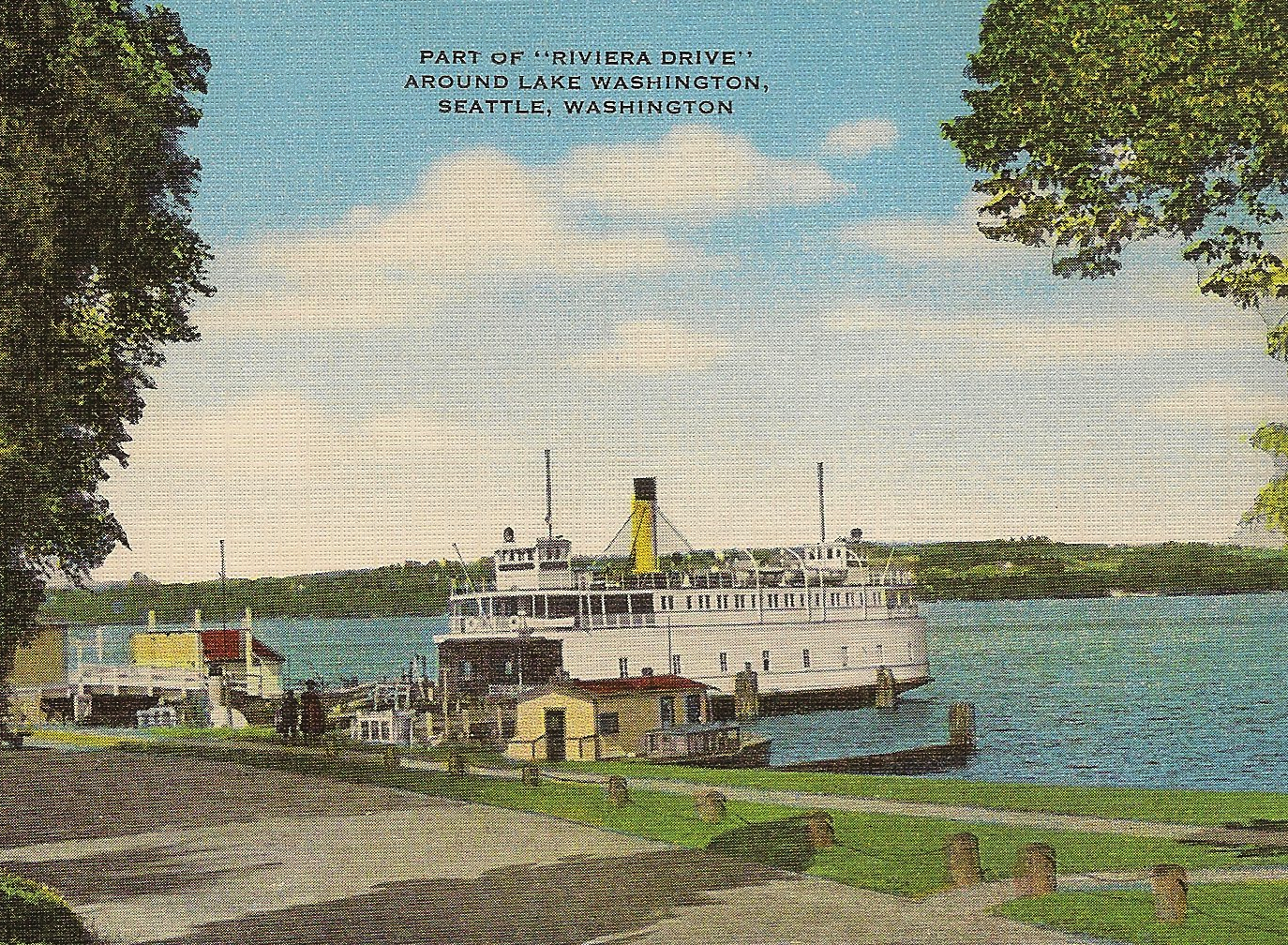
Ferry LINCOLN c. 1930
postcard from the Clinton H. Betz Ship Collection, 
Archives of the Saltwater People Historical Society©


"Living on the western edge of Redmond, WA, is an 84-year-old niece of Capt. John L. Anderson, who used to be king pin of the Lake Washington ferry service. Olga Carlson Dunkel says that she opened the first lunchroom aboard his boats and remained with the business a quarter of a century. 'I always liked boats and I got along well with people'.
      Mrs. Dunkel came to Seattle from Sweden in 1913. ' I had to get a job as soon as I got to this country. I did housework for $50 a month.'
      One day in 1924, Anderson told Olga that the ferry LINCOLN was laid up at Houghton for its annual overhaul and he had installed a lunch counter on board the vessel. 'I want to know what you think of it'. His niece visited the boat as requested and told him the arrangement looked fine. 'You can have it,' Anderson announced.
      From then on she managed the lunch service. 'There would be about four of us women on a shift. We were paid $3 a day and eats when I started, but I got more after the union was organized. Besides serving food we sold newspapers, candy, gum, and chances on punchboards.
      It took 22-minutes to cross Lake Washington from Madison Park to Kirkland, but people could consume an awful lot of food in that amount of time. We sold hotcakes, waffles, eggs, a tremendous number of hamburgers and pies --40 or 50 pies on weekend.They brought in a lot of money although a serving cost only ten cents. Doughnuts were three for a dime and coffee was five cents.
      When I started I had to take home beans to bake and then carried them back to the boat. Sauerkraut and wieners were popular, so were soups, Swedish meatballs, and potato salad. Later I didn't have to take the beans home because we got an electric oven and steam tables. 
      When the LINCOLN was laid up once a year for repairs we went in the old WASHINGTON. She was an awful boat. Sometimes we were chartered for an excursion, especially kids bound for the camp at Denny Park.
    
Ferry WASHINGTON
Photo from the archives of S.P.H.S.

When the first Lake Washington bridge opened I was working on the LESCHI, running to Medina. She had the best lunchroom of any of my uncle's boats.
Ferry LESCHI, Seattle-Kirkland
November 1948.
Original photo from the Saltwater People Historical Society.©

      During WWII we did big business with the shipyard workers at Houghton. I worked a shift beginning at 6 a.m. but some of the girls were on the night run which meant getting home at 2 a.m.' 
      One of Mrs. Dunkel's best memories is of meeting her future husband when he was a regular passenger on the ferry. He was running a hog ranch at Redmond and she was then living in Kirkland. After her marriage in 1942, she kept her job and had to ride to work in a taxi.
      Asked if she had any adventures aboard the ferries, 'Yes, once a hold-up man came aboard in the early morning on the first ship leaving Kirkland. I saw he was watching me and I wouldn't open the lunch counter. Officers got him before he left the boat.
      Another time when I was on the LINCOLN enormous waves from a passing naval ship nearly turned us over. The ferry went clear down in the water and I was pinned in a corner and hot coffee poured over my legs. I worked several more hours with my stockings off and my legs bandaged, but I gave up about 2 p.m. and wound up in the Kirkland hospital. 
      Although many decades have passed since the last ferry quit running, Mrs. Dunkel says every once in awhile someone comes up to her and asks, 'Didn't you used to be on the boats.'"

Archived Log Entries