"The Cure for Everything is Saltwater, Sweat, Tears, or the Sea."

About Us

My photo
San Juan Archipelago, Washington State, United States
A society formed in 2009 for the purpose of collecting, preserving, celebrating, and disseminating the maritime history of the San Juan Islands and northern Puget Sound area. Check this log for tales from out-of-print publications as well as from members and friends. There are circa 750, often long entries, on a broad range of maritime topics; there are search aids at the bottom of the log. Please ask for permission to use any photo posted on this site. Thank you.
Showing posts with label Jensen Shipyard. Show all posts

06 September 2024

FRIDAY HARBOR SHIPBUILDERS

Noted Friday Harbor Shipbuilders
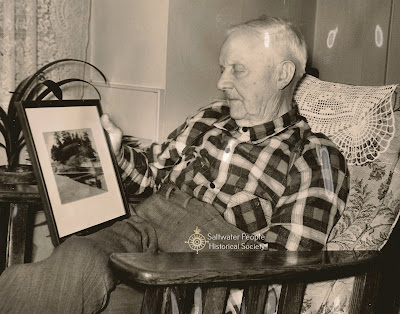

Shipbuilder Frank Jensen
Photograph dated 1960

Admiring a photo of his boat VERDUN,
built in 1919
for himself and his brother Joseph,
as stated on the federal 
Master Carpenter Certificate.
Click image to enlarge.
Original silver-gelatin photo from
the archives of the 
Saltwater People Historical Society©


A family tradition that reaches well back into the 19th Century, was carried on at Friday Harbor, in the San Juan Islands. The shipyard of Albert Jensen & Sons, Inc., was a Jensen family enterprise since the early days of the island’s settlement.
      Nourdine Jensen, the last owner of the company was the third generation of Jensen family boat-builders. His father was boatbuilder, Albert Jensen.
      Nourdine’s grandfather, Benjamin Jensen, was a shipbuilder in Bergen, on the north coast of Norway, in the 1860s and 70s. He also sailed some, making several trips to Canada. Finally, he came to the New World for good and settled on San Juan Island in 1883. His sons Joe, Albert, Frank, and Pete were with him.
      At the time of this interview, Frank Jensen was 86 and retired. He kept up his interest in the activity at the shipyard, making occasional trips to “see how things are going.”
      The Jensens lived for a while at San Juan Town, or “Old Town,” as it was called by the old-timers. After three months, the family moved to a farm on Griffin Bay, building a house on a spit just below the bay now known as Jensen Bay.
      Along with their farming, Benjamin and his four sons began building a few boats, almost as a sideline. The “sideline” turned into a regular thing, but Frank Jensen recalled they never considered that they were running an organized business.
       “We were no company at all,” Jensen said. “We just built boats.
      Among the boats the Jensen “just built” were the sailing ships NORTH STAR and the NELLIE JENSEN. The NELLIE JENSEN, on the ways for three years, was the largest sailing vessel the family built. It was 59 feet long and carried a crew of five. Later it was given a steam engine.
      Other early vessels they built were the steamships GRIFFIN, MESSENGER, and the VALIANT
      The last boat to be built at Jensen Bay was the Adventurer. The NELLIE JENSEN burned to the water, years ago, off Dungeness while carrying a cargo of shingles. The GRIFFIN was wrecked and is on the bottom of Lake Washington. The VALIANT was lost on the beach at California, and another Jensen boat was wrecked in Alaska on the Chignik River.
      Jensen says he doesn’t know of a single life being lost in any of these mishaps.
      In 1901, Frank Jensen got the gold fever and went to Alaska. He never struck it rich but worked for wages shoveling dirt. He didn’t stay long in Alaska. Years later, he made another trip to Alaska, landing at 3 o’clock in the afternoon. By 9 o’clock that night, he was on his way back to Seattle.
      In 1905, Frank married and a few years later, moved to Friday Harbor. About this time, the family became involved in a sawmill operation, but before long the Jensens were back to building boats again. In 1910, they acquired property on a bay a mile south of town and built the shipyard which was long in operation.
      Frank and Joe married sisters, Emily and Alice Guard. When Joe died, his wife, Alice, stayed on with Frank and Emily Jensen in the country place Frank built east of the shipyard, across from Turn Island. The Jensens lived in that house 29 years.
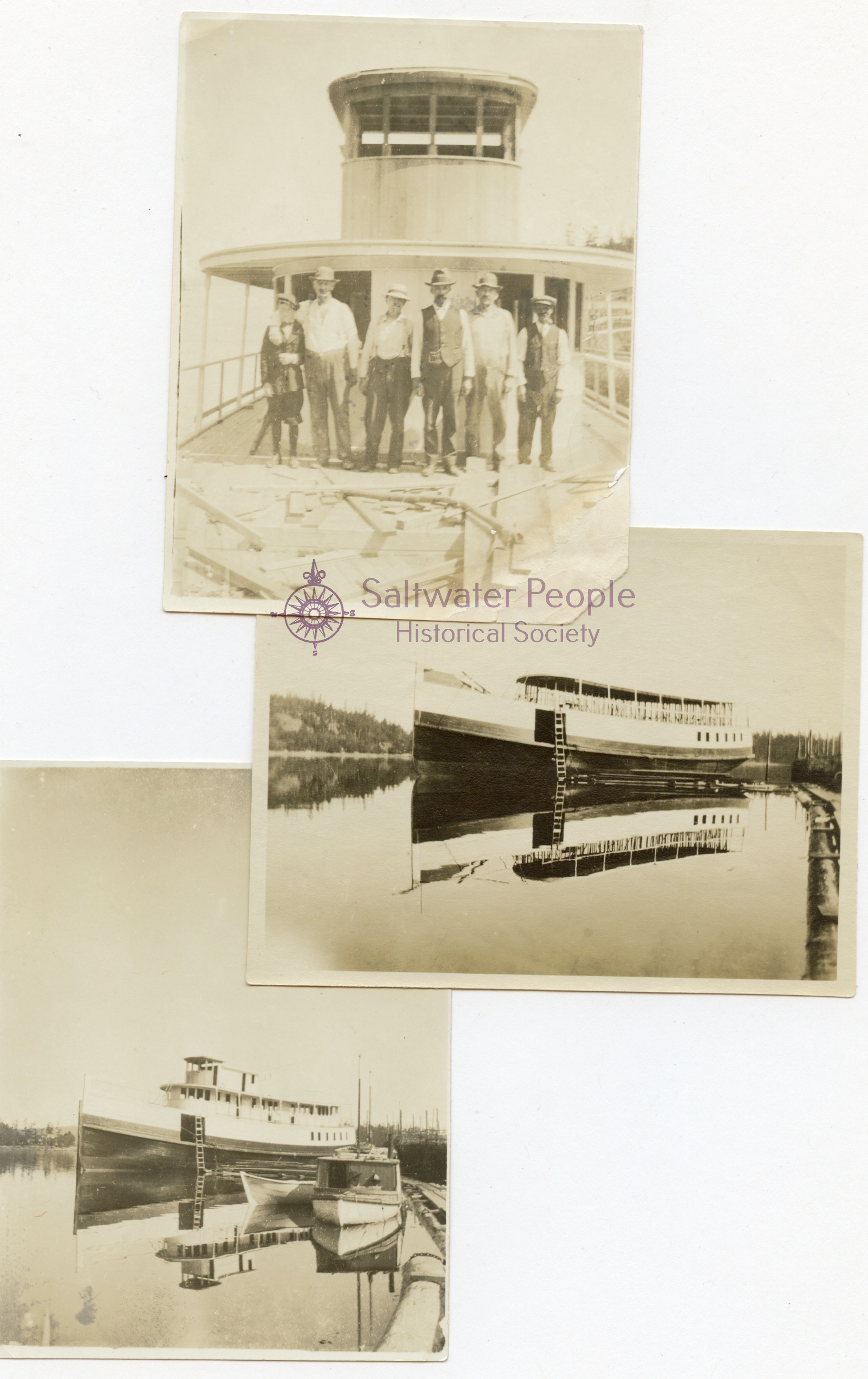


The ISLANDER,

new launching at Jensen's Yard
Friday Harbor, San Juan Island,
all dated 1921.
Click image to enlarge.
The work crew is so far unidentified.
Can you help?

      One of the largest boats the family ever built, and no doubt the best known, was the ISLANDER––a 106 ft freight and passenger boat. The business “Life Line” of the San Juans for many years, the ISLANDER made regular trips through the islands from Anacortes and Bellingham.


clips courtesy of the
Friday Harbor Journal.
Click image to enlarge.

      Later, the ISLANDER was sold to the Puget Sound Freight Lines and renamed the MOHAWK.


Cannery tender NEREID
Moored in her home port of Friday Harbor, 
San Juan Island, Washington.
Jensen built in 1911.
Original photo from the 
Saltwater People Historical Society©


      The first boat built at the new yard was the NEREID, a boat used for decades by the Friday Harbor Canning Company. Julia Jensen says the NEREID also was designed by her husband and was his favorite of the boats built by the family.
      During WW II, Albert Jensen and Sons built a fleet of 36-ft tugboats and a dozen wooden barges for the war effort. Another shipyard started up during the war adjacent to the Jensen yard. Both companies specialized in building pleasure boats in the under 90-ft category, as well as fishing boats, and occasionally other types of craft.
      A recent Jensen boat that attracted the attention of numerous boating journals was the 55 foot MECO, built for Archie Morgan, of a Seattle electrical contracting firm.
      Altogether, Nourdine estimates his company built about 50 boats of more than 20 feet each in the years since the war, for an average of two and one-half boats a year.
      Nourdine’s brother, Frits, carried on the family tradition as a prominent Seattle naval architect.
      Frank Jensen was one of the county’s longtime residents. He recalled the island’s settlers well and could recite the names of all the farmers and businessmen who had “places” on San Juan at the end of the past century.
      Frank doesn’t consider that his family pioneered in the usual sense; he recalls there was very little vacant land left on the island when they arrived.
      Of all the Jensen-built boats, Frank’s favorite was the one built for his own use, the 40 foot VERDUN (pronounced with the accent on the first syllable.) He made four or five trips to Alaska with her and sailed her throughout the San Juan Islands many times.
      When he was home, Frank kept her anchored in the bay off Turn Point, where she was a familiar sight for many years. Next, the VERDUN saw service in the San Juans as a fishing and workboat owned by Sherman Thompson of Deer Harbor, Orcas Island.

Words by the late author, historian David Richardson, formerly of San Juan and Orcas Islands in the Archipelago. Published by the Seattle Times.

The Port of Friday Harbor purchased the Jensen Shipyard which was reported here.


17 June 2016

❖ A LETTER TO ERNIE GANN ❖

Strumpet
ON 539162 
Built by Jensen Shipyard, 1972, for Ernie Gann,
all of San Juan Island, WA.

Photo scan courtesy of Jan and Dave.

Ernest K. Gann
San Juan Island

Dear Ernie:

      You don't know me and perhaps are irked at the gall of a stranger addressing you informally. If so, beg pardon. But your boat was moored near mine the other day, so I tied up and hiked over for a closeup look.
      Curiosity rather than brashness drew me to her. I wanted to see what qualities in a man who had authored 13 books were reflected in his boat. Your 14th. Band of Brothers is just off the press, I'm told.
      I greet you informally because nobody I know on the waterfront around here refers to you as Ernest K. Most of the guys call you Ernie and let it go at that. They know you best, as waterfront men and boaters, through your book, Song of the Siren, in which you described 17 other boats you had sailed.
      As a waterfront newsman I am supposed to be cynical on my beat, but am not. Curious, yes––one reason I went back to look at your 35-ft Diesel cruiser, Strumpet. She was at Commercial Marine on Westlake North where Dave LeClereq and his guys were installing a gurdy and doing other chores. I went aboard and peeked around, with Dave's permission. Besides, she was open and a couple of men were working. They said come aboard, thinking you wouldn't mind. I only looked––didn't touch. 
      I've never written to a book author––or anybody else who was notable, for that matter. John Wayne's yacht, the Wild Goose, comes to town occasionally. But I have never visited it or him. I mean, it is a converted ex-Navy minesweeper. If you've been aboard one, you've seen 'em all, right? Wayne, I recall, played the lead in The High and the Mighty, which you wrote. Sorry to say I never read it but I did catch the filmed version.
      Also, Bobby Darin, the late singer-actor, was in town and bought the old tug boat, Jim. Darin spent a bundle to make the interior posh. But I never went aboard or tried to see him.
      But your Strumpet is something else. The first time I saw her was at night at Doc Freemen's moorage. Ole Johansen, who skippers a rescue vessel he acquired in Norway, was with me. We stood on the pier and ogled the Strumpet like young men would gawk at a beauty queen in a ripped bikini.
      We thought she was an authentic North Sea trawler out of Scotland or perhaps Scandinavia. We stood there in the night's damp chill, wondering who owned her and if she was hauled over in a freighter or sailed across the Atlantic, through the Panama Canal, and up the coast.
     So I was surprised to learn later that she was designed by Jay Benford of Seattle and built only last year by the Jensen & Sons Shipyard at Friday Harbor on San Juan Island.
      The waterfront guys here respect your Strumpet, which as you know is known as an indirect tip of the watch-cap to the skipper. She's honest, genuine, and well done. Those shipwrights at Friday Harbor must have gone all out to put their best into her.
      I'm told you were very particular about details during architectural planning and actual construction. A hull containing all the thick cedar, oak, and the finest fir has to be skookum. The interior mahogany, bereft of plastic and cuteness, is soothing to the eye.
      The guys installing the gurdy said you apparently were going deep-water fishing, probably for halibut.
      The first thing that held my eye was her canoe-like stern, quite full and nearly round to provide lift in following seas. She's got an extraordinary fantail, all right––like a plump little blond I used to know in bygone years. But she wasn't as beamy in proportion––the blond, I mean. A 12-ft width on a 35 length is a lot of broad.
      The most eye-grabbing object in the wheelhouse was the shiny brass engine telegraph. For a moment I envisioned your buddy, La Frenier, on all fours in the engine compartment, acknowledging your engine-speed signals. As I read Sirens describing you and him in the fish boat Fred Holmes. I thought you were a goner while crossing that stormy bar at Astoria. Then I realized the Strumpet's engine was bridge-controlled and the telegraph was only a throttle-gearshift.
      Your Strumpet is the first boat I've seen with a solid-copper stovepipe. Never knew they existed. In fact, I've never seen as much copper tubing in a boat. Most of the guys use galvanized black iron or plastic stuff around here. I'm told the 6-cylinder engine lets her cruise nicely at seven knots and with a fuel capacity to permit a 1,250-mile range. Benford said she exceeded by about a knot his architectural predictions on paper.
      Something else about the Strumpet. I never saw a 35-footer with three stoves aboard––one aft, one in the galley, and one in the forecastle bunk area. Usually, a galley stove is sufficient. At least one old wood burner is enough in my gaff-rigged sloop. The little kerosene "swede stove" in the bunk area was a delightful surprise–solid brass, too. 
      Your padded engine room floor is the only way to go. They told me the lining in the compartment effectively deadens the engine noise.
      

Ernie Gann
In his studio on San Juan Island. 

Original gelatin-silver photo from
 the archives of the Saltwater People Historical Society©
      Another reason I went to see her was to learn what you have evolved to after owning 17 boats since your boyhood days. That's how many you described in Sirens. I recall the imposing Albatros, the old bucket that was the object of your biggest love affair, and the tiny Thetis that charmed you. And the fish boat, Fred Holmes, which you and La Frenier took a beating off Oregon. Also, the quirky Don Quixote needing a blowtorch to start its cantankerous engine. Then there was the Butterfly, hardly more than a raft with patchwork sails that rose and nearly soared gull-like before the wind.
      You ended the book with the Albatros, and I often wondered what you went down to the sea in after her. Evidently, the Strumpet now is your sequel siren.
      Here in Puget Sound country, in this cold and wet wintery state of affairs, I often chicken out when the cover tarps stiffen and ice forms on deck. Then I am landlocked and wait impatiently for sunshine to breakthrough. When it does finally come, I remember that last italicized paragraph in Sirens:
      "I think we can sail today. Both the wind and the sea have gone down and there is a patch of blue sky to the north as big as a Dutchman's pants. Which is invitation enough for any sailor."
      The guys at the marine yard installed your fishing gurdy good and proper. They mounted it on a teak pad and socked in plenty of bedding compound.
      Good fishing out there, Ernie.
Above text: Carter, Glen. My Waterfront. Seattle; Seagull Books Co. 1977.
There is another post on Gann and his Strumpet posted here.


19 February 2015

❖ JENSEN SHIPYARD ❖ Friday Harbor


VENTURE (ON 204609)

&0.5' x 15.3' x 5.4' cannery tender
with 175 HP steam plant

 built 1907 Griffin Bay,
San Juan Island, WA.

She was chartered to
White Crest Canning Co &
 Coast Fish Co.
She hauled 10 tons of spuds for P.A. Jensen &
transported the family to Seattle to visit 
the Alaska-Yukon-Pacific Exposition in 1909;
she was a busy gal.

In 1925 VENTURE was bought by
Wagner Towing
and depowered to be purchased by 

 Foss Launch & Tug in 1937
and renamed 
HILDUR FOSS.
Great notes in Mike Skalley's
Foss, 90 Years of Towboating.
Fate: Intentionally sunk 1 April 1949.
Photo courtesy of Nourdine Jensen.
      
"If it hadn't been that a horde of voracious grasshoppers that ate Ben Jensen, father of Albert Jensen and grandfather of Nourdine Jensen, out of his Iowa homestead in the late 1880s, there might never have been an Albert Jensen & Son Shipyard on San Juan Island.
      A former seaman and carpenter, Ben Jensen migrated from Norway to this country in the middle 1880s.
      "My grandfather came to San Juan County In 1883," said Nordine, owner of Jensen Shipyard, located at the east end of Friday Harbor Bay. "My Dad was about nine yrs old when grandfather came to this island. He had two sisters, Amelia Martin and Nellie Paxson. There were also three brothers, Pat, Joe, and Frank.
      Sometime around 1906 or 1907, Albert and his brothers went into the sawmill business in Friday Harbor. The mill was located in the vicinity of the Union Oil dock; early photographs show sailing vessels lying at anchor in the Bay waiting their turn to take on lumber. In 1919 the Jensens sold the mill and a short time later it burned to the ground.
      During the time the Jensen brothers operated the mill they also built two tugboats, the VENTURE, an 80-ft cannery tender they used to haul commercial freight. Both vessels were built on the beach at Griffin Bay.
      "In those days, if you didn't have a boat of some kind you were island-bound because there were no ferries," Nourdine explained.
      The NELLIE JENSEN served the Jensens for some eight years before she burned beyond repair.
      "I suspect my Dad also built the MARINER about the same time. She was an 80-ft cannery tender that operated around AK."
      Nourdine recalls his father telling about using the MARINER in AK for a season after which the vessel was sold to a Seattle cannery.
      "Dad was on his way to deliver the MARINER to a buyer when the engine quit. It was a stormy day off Iceberg Point [Lopez Island] and the vessel went aground. At the time Dad had his ticket for Australia with him, he was scheduled to go as the rep of Union Engine Co. However, he hadn't yet paid for the engine in the MARINER, but he lost no time getting a pile driver to the sunken boat where he managed to salvage the engine.


NEREID (ON 209491)
Fondly remembered in San Juan County.
Built by and for Albert Jensen as Master Carpenter;
72.7' x 16.75' x 6.4' ; 29 tons burden.
Launched Friday Harbor 1911.
Sold that year to Friday Harbor Cannery.
Source: Master Carpenter document filed at NARA, Seattle.
Photo from the archives of 
the Saltwater People Historical Society©

      That same winter Albert built the NEREID and installed the MARINER's engine.
      "These were the days of fish traps and non-powered fishing boats. These boats operated on the west side of San Juan and off Whidbey Is. They were towed out by a tugboat. Today they are called seine skiffs.
      When fishing was over the tug would round up the fish boats and tow them in. This was their only means of getting from one location to another. The tugs, or fish tenders, were first powered by steam and later by diesel."
      Nourdine points out that during the fish trap days (WA outlawed commercial fish traps in 1934, except for the treaty rights for Indians) a great amount of equipment was required to install and remove the traps, logs, and to store various tools required for the job.
      Before starting his Friday Harbor Shipyard, Albert Jensen worked as a steam engineer on various boats around the Sound. These vessels were affectionately referred to as the 'Mosquito Fleet'. After Jensen gave up steamboating, he taught school for a short time in Shaw Island's one-room schoolhouse. 

      Statistically, Nourdine questions the general assumption by laymen that more fish are being caught today than in earlier years.
      "That's pretty hard for me to swallow, particularly when you consider  there were some fifty or sixty canneries operating in the Puget Sound area. In the San Juans there were two canneries on San Juan Island, one at Deer Harbor and West Sound on Orcas. Anacortes had four or five and Bellingham had a half dozen. There were also a number of fish canneries in Port Townsend, Everett, Seattle" [and Shaw Island.]
      In 1910, Albert Jensen established his shipyard at the east end of Friday Harbor off San Juan Channel. Many changes have taken place since the yard opened all those years ago.
      "One of the most noticeable changes in our business has been the gradual change over the past five years from custom boat building to that of maintenance and repairs.
      Custom boat building, which has been our stock in trade since Dad first opened this yard, has been steadily declining each year, while assembly line type of boats is on the increase.
      Financing is another problem today. Banks are more willing to finance a boat that is already built and carries a price tag on it, rather than financing a boat still in the building stages."
      As to whether Nourdine prefers custom boat building to that of maintenance and repairs, he has this to say:
      "Personally, I much prefer to work with handcrafted boats, but as far as making a living goes, we really made no money to speak of on our handcrafted boats. There is actually more money to be made in the maintenance and repair business today."
      Although the Albert Jensen Shipyard still employs the same number of men [at the time of this writing] between 5 and 7, depending upon the season, the requirements for this new type of work differ from those of custom boat building.
      "You've got to roll with the punches, so we've been gradually changing our method of operation to meet this new demand. We've had to. If we depended solely on custom boat building today we'd be out of business. It's that simple."
      In thinking back over some of the boats his firm has turned out, a number of outstanding vessels come to mind.


MOHAWK (ex-ISLANDER)

ON 221640 
91.6' x 21.1' x 7.2' ; 173 G.t. 140 N.t.
Blt by Albert Jensen, Friday Harbor,
September 1921.

Source of data:
Federal MCC document from NARA, Seattle.
       "Perhaps our best known was the 91-ft ISLANDER launched in 1921 and later named the MOHAWK. Prior to WW II, the MOHAWK was sold to Puget Sound Freight Lines. She was later conscripted by the US gov and used to tow supplies to Kiska Island in AK."
      Other memorable vessels built by the yard include the LIBBY, a 54-ft cruiser owned by a Portland man, who moored her in Anacortes. There was also the PUFFIN, a cruiser built for Dr. Clark, and the RUSSWIN built in 1947 or '48 for Doc Russell of Orcas, and then later owned by Gordy Fox. Then there was the HI-SEAS, a 50-ft charter cruiser that was a former USCG vessel and completely rebuilt by the Jensen yard and owned by J.H. Woods of Olga. The most recent handcrafted boat turned out by the Jensen yard was the STRUMPET, a 35-ft troller designed by local architect, Jay Benford, and owned by the author, Ernie GannThe list goes on.


BÃ…TEN of Friday Harbor, WA.

Launching, 5 April 1978
A smidgeon under 20 ft.
Designed by Jay Benford,
then of Friday Harbor, 

for Marilyn Anderson & Rachel Adams
of Crane Island, San Juan Archipelago,

 by Jensen Shipyard, Friday Harbor, WA.
Photo possibly by Al Hamilton,
on the scene this day. 

Shared by Nourdine Jensen
to SPHS web admin.

      
There was a moment's lull as Nourdine Jensen stared reflectively from the window of his small shop office. The rain beat a staccato rhythm against the tin roof. A slow grin spread across his face.
           "From where I stand the boat business looks good for a least another 65 years."
Gordon Keith. Voices from the Islands, True Stories about those Who Live in One of America's Most Beautiful Areas, Washington State's San Juan Islands. Thomas Binford Publisher. 1982.
Keith was a resident of Orcas Island, WA., who had many short stories and photographs published by the Islands' Sounder.
   

Archived Log Entries