"The Cure for Everything is Saltwater, Sweat, Tears, or the Sea."

About Us

My photo
San Juan Archipelago, Washington State, United States
A society formed in 2009 for the purpose of collecting, preserving, celebrating, and disseminating the maritime history of the San Juan Islands and northern Puget Sound area. Check this log for tales from out-of-print publications as well as from members and friends. There are circa 750, often long entries, on a broad range of maritime topics; there are search aids at the bottom of the log. Please ask for permission to use any photo posted on this site. Thank you.
Showing posts with label THERMOPYLAE. Show all posts

30 April 2022

SOLID GREEN WATER ::::::::: A GALE OF 1902


Green Water Ahead.
Tacoma to Durban 
Click image to enlarge.


"This is an account of one of the heaviest gales I was ever in at sea. I do not say it was worse than the other shipmates of the Thermopylae have been through, for everyone who goes to sea gets into really bad weather sometimes.
        This time of which I am writing was in the year 1902. We were bound Tacoma to Durham, South Africa with a cargo of flour and canned fruit. We left Tacoma on 17 March. The run down to the Horn was uneventful. We rounded the Horn on 15 May with a westerly gale behind us.
        It never left us till we were off the Cape of Good Hope.
        For nearly two weeks we ran before it with the seas getting heavier all the time. They would come rolling up astern looking like hills with the wind blowing spray from their crests and just when it looked as if they were going to bury the ship she would rise to them, though they generally broke on board from both sides and filled the decks to the rail.
        It became a common occurrence for seas to break onboard all the way from poop to the forecastle head and often they would break right over the top of the deckhouse and fill the boats, bursting in the covers.
        There were lifelines stretched along on deck on each side and the fore braces were led along to the bitts on the foredeck as it was impossible to stand amidships and brace the yards.
        There was no fresh water to drink as the pumps were continually underwater. We used water out of a barrel in the lifeboat but it was so bad we could hardly drink it.
        One evening in the second dog watch I was returning some mess tins to the galley. It was quite dark at the time. I worked my way along the deck on the port side and just as I came around the corner of the deckhouse I saw a tremendous sea roll up to the rail on the starboard side, shining with phosphorous. I should imagine it was about twenty feet high when it broke over the side.
        I dropped the mess tins, which I never saw again, and grabbed the lifeline. My feet were swept from under me and I was in solid green water like one drowning.
        The same sea broke in the two-inch teak galley door and washed away the winch abaft the main hatch, breaking the castings just above the deck. The winch went into the scuppers, the broken castings plowing up the deck as it went. It took about half the next watch to get it lashed; it was underwater most of the time. One man stood in the main rigging with a lantern while the rest of us lashed it to the bulwark stanchions.
       

Clipper Thermopylae 
by M. Reilly

         Just at seven bells in the 4 to 8 watch the next morning she took the biggest sea of all. I had just gone into the half-deck to call the watch below and had no sooner closed the door than it came on board with a roar. I felt the ship tremble and then she seemed to go dead as if she had settled down. It was daylight at the time and for several seconds the solid green water stood against the porthole and squirted in all around the door––and that was a deck house!
        The second mate, who was on watch, said that as far as he could see there was nothing but the three masts out of water. The only damage it did was flood the cabin, every room was awash.
        That evening the captain decided to try to heave despite the risk. We got her around all right but she still continued to keep the decks full of water. The green seas came over the bows so bad that we had to keep lookout from the roof of the deckhouse. We could tell that the sidelight was burning by watching the reflection against the water every time she took a sea. It was no use to strike the bells as the bell was tolling continuously with the motion of the ship.
        I was on the roof of the deckhouse on the lookout from ten to midnight. Just before eight bells, she shipped a sea. It must have broken exactly as it met her for she shook as if she had struck something solid. I don't know how high that sea mounted but in the darkness, it looked as if it was coming over the foreyard. 
        The main topmast staysail was stowed at my feet and when the sea struck me the clew of the sail dragged me off my feet and I seemed to go away in a solid body of water. I didn't know where I was. When I got hold of something solid I found I was on the main deck amidships, jammed between the deck spar and the bulwarks.
        The next day we found that the bulwarks were bent where that sea had hit her, several stanchions were started and the door of the wash port was gone.
        The half-deck was never clear of water for weeks. Our chests were afloat most of the time and were moored at both ends like ships at a wharf. The bunks got so wet that we had to sleep in the sail locker.
        This gale continued till we were off the African coast. We arrived at Durban on 10 June, 28 days from Cape Horn and 85 from Tacoma.
        Words by Cornishman F. Walter Hearle who later settled in Victoria, B.C. 

           Deep Sea Stories from the Thermopylae Club, Ursula Jupp editor. Victoria, B.C. 1971.

27 December 2016

❖ GREEN WATER ON DECK ❖

THERMOPYLAE
Litho by M. Reilly
Public domain.

Deep Sea Stories from the Thermopylae Club
Edited by Ursula Jupp.
Published by author. Victoria, BC. 1971.
This story written by F. Walter Hearle.
Mr. Hearle was born in the Cornish village of St. Constantine, he apprenticed on the barque PENRHYN CASTLE and finished his maritime career in Victoria, BC, preparing huge warps for tugs towing great booms to the mills and making nets for the life-saving Carley floats during WW II. Several of Hearle's valuable stories were archived by the Thermopylae Club, Victoria, BC. 
 A Heavy Gale––1902

"This is an account of one of the heaviest gales I was ever in at sea. I do not say that it was worse than the other shipmates of the THERMOPYLAE have been through, for everyone who goes to sea gets into real bad weather sometime.
      The time of which I am writing was the year 1902. We were bound from Tacoma to Durban, South Africa with a cargo of flour and canned fruit. We left Tacoma on 17 March. The run down to the Horn was uneventful. We rounded the Horn on 13 May with a westerly gale behind us.
      It never left us till we were off the Cape of Good Hope.
      For nearly two weeks we ran before it with the seas getting heavier all the time. They would come rolling up astern looking like hills with the wind blowing spray from their crests and just when it looked as if they were going to bury the ship she would rise to them, though they generally broke on board from both sides and filled the decks to the rail.
      It became a common occurrence for seas to break on board all the way from poop to the forecastle head and often they would break right over the top of the deck-house and fill the boats, bursting in the covers.
      There were life-lines stretched along on deck on each side and the fore braces were led along to the bitts on the fore deck as it was impossible to stand amidships and brace the yards.
      There was no fresh water to drink as the pumps were continually under water. We used water out of a barrel in the life-boat but it was so bad we could hardly drink it.
      One evening in the second dog watch I was returning some mess tins to the galley. It was quite dark at the time. I worked my way along the deck on the port side and just as I came around the corer of the deck house I saw a tremendous sea roll up to the rail on the starboard side, shining with phosphorous. I should imagine it was about twenty feet high where it broke over the side.
      I dropped the mess tins, which I never saw again, and grabbed the life-line. My feet were swept from under me and I was in solid green water like one drowning.
      The same sea broke in the two-inch teak galley door and washed away the winch abaft the main hatch, breaking the castings just above the deck.The winch went into the scuppers, the broken castings plowing up the deck as it went. It took about half the next watch to get it lashed; it was under water most of the time. One man stood in the main rigging with a lantern while the rest of us lashed it to the bulwark stanchions.
      Just at seven bells in the 4 to 8 watch the next morning she took the biggest sea of all. I had just gone into the half-deck to call the watch below and had no sooner closed the door than it came on board with a roar. I felt the ship tremble and then she seemed to go dead as if she had settled down. It was daylight at the time and for several seconds the solid green water stood against the porthole and squirted in all around the door––and that was a deck house!
      The second mate, who was on watch, said that as far as he could see there was nothing but the three masts out of water. The only damage it did was to flood the cabin, every room there was awash.
      That evening the captain decided to try to heave to despite the risk. We got her around all right but she still continued to keep the decks full of water. The green seas came over the bows so bad that we had to keep look out from the roof of the deckhouse. We could tell that the side lights were burning by watching the reflection against the water every time she took a sea. It was no use to strike the bells as the bell was tolling continuously with the motion of the ship.
      I was on the roof of the deckhouse on the look out from ten to midnight. Just before eight bells she shipped a sea. It must have broken exactly as it met her for she shook as if she had struck something solid. I don't know how high that sea mounted but in the distance it looked as if it was coming over the foreyard.
      The main topmast staysail was stowed at my feet and when the sea struck me the clew of the sail dragged me off my feet and I seemed to go away in a solid body of water. I didn't know where I was. When I got hold of something solid I found I was on the main deck amidships, jammed between the deck spar and the bulwarks.
      The next day we found that the bulwarks were bent where that sea had struck her, several stanchions were started and the door of the wash port was gone.
      The half deck was never clear of water for weeks. Our chests were afloat most of the time and were moored at both ends like ships at a wharf. The bunks got so wet that we had to sleep in the sail locker.
      This gale continued till we were off the African coast. We arrived at Durban on 10 June, 28 days from Cape Horn and 85 from Tacoma."


20 March 2012

❖ Guardians of the Sea ❖ THERMOPLYAE CLUB ❖ Victoria, B. C.

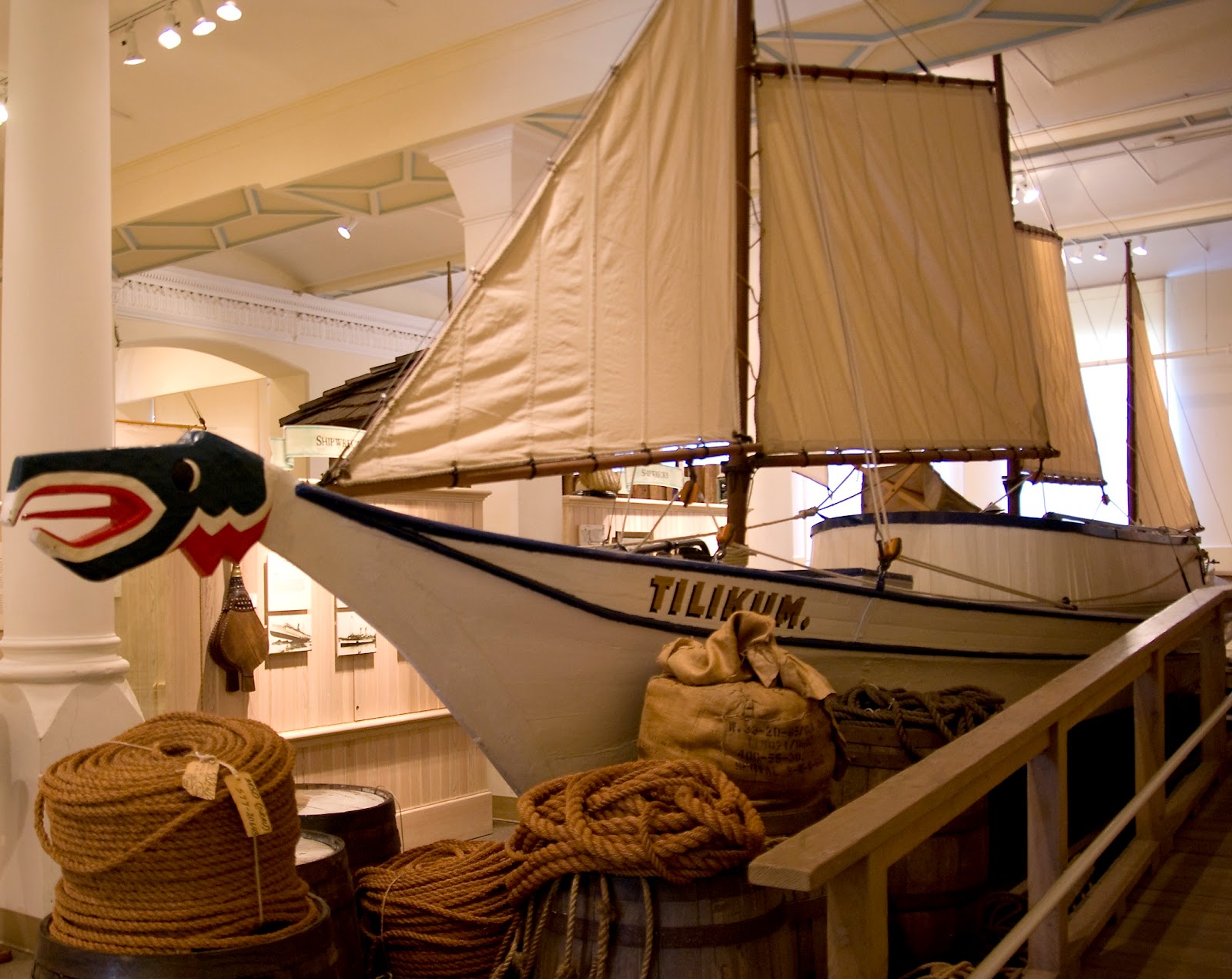
"As guardians of memories of the sea, the Thermoplyae Club [formerly of Victoria, B.C.] has undertaken a variety of projects. Of these, most valuable was its part in the preservation and restoration of the famous TILIKUM, the craft (basically an Indian canoe), in which in 1901 Captain J. C. Voss set out from Victoria; three years and 40,000 miles later he reached England after a voyage that took him across three great oceans [with a near] circumnavigation of the world.
TILIKUM 
Home port, Maritime Museum of B.C., Victoria.
      That this boat should, after all the admiration heaped on her at Earls Court, by the mid-1920s have become a derelict hulk, rotting in the mud on the banks of the Thames, seems unbelievable. Equally surprising is it to learn that although in 1930 the efforts of the Victoria and Island Publicity Bureau and the generosity of the Furness Withy Line saw the canoe returned to its home port, the repair the hull was given was but rudimentary, and it was left roofless, exposed both to the weather and to the depredations of vandals.
      So she lay for some years--but then there came one evening to the Thermopylae Club meeting some naval yachtsmen who had just sailed across the Pacific. These told the club members in no uncertain terms their opinion of a group that called itself ship-lovers yet neglected such a priceless, irreplaceable craft as the TILIKUM.
      The club sprang into action. Led by the dynamic Captain McDonald, they soon collected the money needed to finance restoration and Captain Victor Jacobsen started on the work that saw her returned to more or less, the condition in which she appears in the Maritime Museum today.
      Later the Thermopylae Club, on the suggestion of old sealing captain Max Lohbrunner, and through the work of shipmate Bob Dallaway (with the permission of the BC government) installed in her three hollow masts. These, though shorter than the original, do give some idea of her rig and also provide ventilation for the interior.
      The club has also painted her hull and encouraged her removal to the protected position in Thunderbird Park that she occupied for many years. Today they rejoice that now she, like themselves, enjoy the hospitality of the Maritime Museum in Bastion Square, Victoria.
      Another spot that finds TILIKUM and THERMOPYLAE close neighbours is on the Causeway wall above Victoria's Inner Harbour. Here 28 bronze plaques make up the Centennial Parade of Ships which commemorates vessels that had some historical connection with Victoria, TILIKUM and THERMOPYLAE of course among them. The first was donated by the Royal Victoria Yacht Club, the second, presented by its namesake, is easily found since it is the only tablet bearing an illustration of the craft it memorializes--a non-conformity not achieved without effort and obduracy on the part of the veteran mariners!
      Another reminder that Victoria was once the home port of this famous ship was the ten-foot water-line model of her entered in the history section of the Victoria Day Centennial street parade of 1958.
      Built on the premises of the 100-year ship chandling firm owned by Shipmate Emerson Smith, and not far from the rings on the cliff at which the original clipper once tied up, the model is one of fine detail. That these are accurate was assured by the daily visits of Captain Harry Bilton to the premises on Wharf Street. It was by then 65-years since he had trodden her decks but he had not forgotten, although it is to be doubted that on so small a replica her figurehead of King Leonidas would be provided with the demountable sword whose removal, for safety's sake, the old captain remembered as one of his last duties before the start of each voyage.
      Later this model was given to the Rainbow Sea Cadets in whose headquarters in Victoria West she holds an honoured place.
      Yet a few miles farther west, above a little cove in Esquimalt Harbour, a concrete pillar marks the spot where, as the bronze tablet on it records:

      'When Vancouver Island was an infant colony nearly a century ago it was here that the gallant sailing ships from the old world stopped to replenish their supplies of water.'
Conceived by Shipmate John Keziere and carried out through the co-operation of provincial government departments, the generosity of city building supply firms and the sweat of sundry Thermopylae Club members, the cairn recalls the days when, from ships anchored off in Limekiln Cove, sailors poled to shore the floats loaded with barrels in which they would take on from the fresh-flowing stream water for the long journey back to Europe.
      Today the sailing ships and most of the men who sailed them are gone, but through this book some of their experiences, it is hoped some little contribution may be made to the preservation and dissemination of the memories of those sturdy times".
Ursula Jupp, Home Port: Victoria. Published by author, Victoria, B.C. 1967.


Book search here––


Not quoted here but an interesting book on the "absorbing and instructive true-life story" of Captain J. C. Voss (1854-1922) and his 40,000 mile voyage from Victoria to England has been published.

Captain John C. Voss
The Venturesome Voyages of Captain Voss, 
Century Publishing, 1989.

A introduction to the Voss book by F.E. Grubb, the Registrar & Librarian of the Maritime Museum of B.C., lists historian/writer Ursula Jupp as the greatest authority on Captain Voss.
 Book search here––

24 February 2012

❖ The Ship THERMOPYLAE ❖ Victoria B.C.

Detail of a painting by Robert McVittie.
THERMOPYLAE 
off the west coast of British Columbia.
The ship in her later years, in cut down barque rig.
"To have been the home port of one of those queens of the seas, the speedy tea clippers of the latter half of the eighteenth century was an honour for any sea town. To have been able to claim, as Victoria could from 1891 to 1895, that on her port register was one of the two fastest ships afloat is an honour of which this city has perhaps never been sufficiently aware.
      The question of whether it was THERMOPYLAE or CUTTY SARK that should have the pride of first place is one that even today is good for an argument in sailing circles but certainly at the time THERMOPYLAE was berthed in Victoria there was one old veteran sailing ship captain who was not afraid to write in the local press of "the THERMOPYLAE which, I believe, is still the fastest sailing ship afloat."                                                    
THERMOPYLAE picking up the pilot at the mouth of the Columbia R.
Photo by Robert Reford, her agent. 
Courtesy of the Vancouver Public Library.
      She was beautiful...and she was glamourous... with an aura which rubbed off onto those who sailed on her so that they were said to be "not like other men."
      Small wonder then that when a group of retired sailormen in Victoria looked for a name for their sea-lovers' club they decided to call it 'The Thermopylae Club'.
      Many have written of this famous clipper, Basil Lubbock among them. 'How sweetly she sailed!' he wrote, 'able to fan along at seven knots in an air that would not extinguish a lighted candle, yet she was both comfortable and easy to handle when running over 13 knots under all plain sail.'
      Even those she defeated applauded her. On her first passage, when she passed H.M.S. CHARYBDIS off Port Phillips Heads, her captain hoisted the warm-hearted message, 'Good-bye. You are too much for us. You are the finest model of a ship I ever saw. It does my heart good to look at you.'
      To use bald figures about such beauty seems sacrilegious, but then that is the practice of the day, so here in all their starkness they are: Length from stem to stern 212-ft, beam 36-ft, depth 21-ft, displacement when loaded 970-tons. From keel to topside her hull was rock elm, above that India teak.
      In rigging this vessel--planned to be a winner in the days when the earliest load of tea to reach London commanded the premium price--her builders made some changes from designs already in use. Mast height was lowered, sails widened, her mainyard a great 80-ft spar from which dropped a mainsail 40-ft deep at the bunt. Thirty-two hundred square feet of canvas in that sail alone!
      The THERMOPYLAE was built to make records--and she did. Her speedy passages helped by her first captain, the daring, driving, Kemball. It was under his command that, in the dim of early morning in Nov. 1868, she left the London docks. By the time she returned to them she had broken many records, including making in  24-hours, 380 miles and cutting two days off the record for the FOO CHOW, China to London run.
      THERMOPYLAE then was the talk of the docks.
      It is rather sad to have to add that this record was not hers for long. Within two weeks the SIR LANCELOT had shortened the passage by a further two days!
      But the THERMOPYLAE continued to pile up other records until rivals were driven to build the CUTTY SARK to challenge her reign. 
      Finally, it was steam that put an end to all sail in the tea trade and the ships moved to other uses.                    
      THERMOPYLAE was sold to the Montreal firm of Reford who planned to use her on the Pacific to bring rice from the Orient to Puget Sound.
      At midnight, on 24 June 1891, by the light of a moon just over full, she sailed for the first time up the Juan de Fuca Strait and anchored in Royal Roads.
      Later in Victoria, she as taken over by Nova Scotia-born Captain J.N. Winchester and added to her crew a number of men from the sealing schooners, as well as three apprentices.
      On her runs to the Orient, the THERMOPYLAE had some rough times, the worst, that reported in the Colonist of 24 March 1892.
      They arrived here 101 days after leaving Bangkok. Waterspouts had menaced them and winds had been so destructive that captain Winchester had felt he had to excuse his vessel's battered and untidy appearance when she reached Victoria with the words 'though we left Bangkok with three suits of canvas, she now has not one presentable or serviceable sail!'
      They had also run out of food and for the last ten days had been subsisting on rice, this while they were enduring two weeks of struggling to make the entrance into the Strait.
      How different another voyage from China in a record 29 days!

THERMOPYLAE 
loading lumber through ports cut in her bows.
The size of the pieces being loaded is 24" x 23" x 100'.
The figurehead of Leonidas stands proudly at the bow.
Courtesy of the Vancouver City Archives.
       In 1895 Victorians had their last sight of her cloud of white canvas coming up behind Race Rocks and she was once more off for Europe, this voyage being the only one, I believe, on which she rounded Cape Horn. In her holds then she had some of British Columbia's great forest harvest, including monstrous balks of Douglas fir, a hundred feet long and 24-inches square!
      So ended Victoria's connection with a world-famous ship, a jewel in this city's history for long overlooked but now recalled by the plaque which the Thermopylae Club added to the Parade of Ships embedded on the Causeway wall in 1962."
Text by Ursula Jupp. Home Port: Victoria, BC. 1967. 


Well done book of short stories by one of the most regarded maritime historians from British Columbia.
Book search here––Home Port: Victoria


This fine book has 14 beautiful pages devoted to the THERMOPYLAE.  
Book search here––

Westcoasters, Boats that Built BC

Archived Log Entries