"The Cure for Everything is Saltwater, Sweat, Tears, or the Sea."

About Us

My photo
San Juan Archipelago, Washington State, United States
A society formed in 2009 for the purpose of collecting, preserving, celebrating, and disseminating the maritime history of the San Juan Islands and northern Puget Sound area. Check this log for tales from out-of-print publications as well as from members and friends. There are circa 750, often long entries, on a broad range of maritime topics; there are search aids at the bottom of the log. Please ask for permission to use any photo posted on this site. Thank you.
Showing posts with label six-master. Show all posts

01 January 2019

❖ SAILING a SIX-MASTER into the NEW YEAR


HELEN B. STERLING (ex-OREGON FIR)
In the mist of Seattle according to the building sign,
in the background. The six-master was
loading up with lumber to head down under.
Click to enlarge.

c. 1927 original photo by James A. Turner, Seattle, WA.
from the archives of the
Saltwater People Historical Society©

HELEN B. STERLING
(ex-OREGON FIR)
220032
2,526 G.t./ 2,350 N.t.
267' x 49.6' x 25.2'
Launched 1920, Portland, OR.

Original photo from the archives of 
the Saltwater People Historical Society©
We haven't been under the canvas for a while so let us go into the new year aboard a big girl sailing from the US west coast to Sydney, Australia, of course, with a cargo of lumber.
      The OREGON FIR was built at the Peninsula Shipbuilding yard in Portland, OR., for Grant-Smith-Porter & Co., for the offshore lumber trade. She ended her career in Australia in 1934.

1927: She was purchased by Capt. J.C. Brownfield of WA. Tug and Barge from the Schwabacher Hardware Co and resold the same year to Portland Pacific Export Lumber Co. of Portland, OR. 
      She arrived off the Northwest coast in Jan 1927 under Capt. F.G. Nelson, 81 days out from Shanghai with sails and gaffs lost in a series of heavy storms and drifted into Queen Charlotte Sound. She was within 300 yards of the beach before she was towed to safety. Arriving at Astoria 18 Jan, she was sold to Capt. E.R. STERLING, receiving her new name. As the HELEN B. STERLING, she made only one voyage under Capt. Sterling's ownership. She made two more voyages to Australia with lumber.
1930s: The second photo is dated 1930 with notation she is off Sydney, Australia. She was libeled for debt that year. Capt. Henry Oosterhuis stayed with his ship for almost two years, finally returning to the Pacific coast almost destitute. The vessel was eventually dismantled at Sydney in 1934.
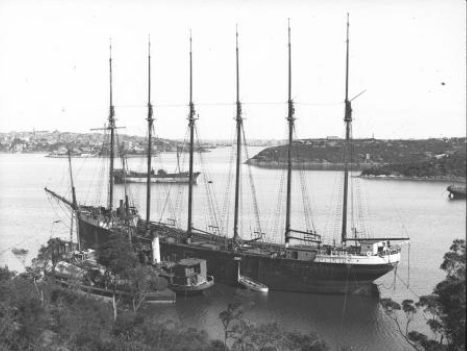
HELEN B. STERLING,
Sydney Harbor, Australia,

where she ended her life.
Courtesy of the Australia National Maritime Museum
Source: 
Gordon Newell, editor. H.W. McCurdy Marine History of the PNW; 
The Australia National Maritime Museum.

10 January 2015

❖ E. R. STERLING ❖ Many Masts and Many Names.

E. R. STERLING 
Homeport, Seattle.
Lying in the West Indian Dock, London,
to sail no more.
Original photo dated 17 May 1930
from the archives of the S.P.H.S.©

Six-masted Barque E.R. STERLING of Seattle, WA.
West Indian Dock, London.
With the loss of three masts and her first officer. 
The French ships carpenter examines the stump of 
the lost mizzen mast. 
Original photo from the archives of the S.P.H.S.©

In the above photos in our collection, the famous E. R. STERLING of Seattle is a sorry mess after a voyage of nine months from Australia, where she had been idle for a year, under command of Capt. E. R. Sterling.  She was caught in a gale off the Falkland Islands on 4 July 1929. Two months later in the latitude of the Cape Verde Islands, she experienced another storm, lost her first officer, Roderick Mackenzie, and three masts. Under jury rig, she reached St. Thomas on 15 October. The Dutch tug INDUS towed the STERLING, with her load of wheat, 4,000 miles to the Thames River, England, arriving 28 January 1930. She is photographed at the West Indian Docks, London. After discovering the prohibitive costs of repairing, Capt. Sterling sold his vessel to the Sunderland shipbreakers, where she was dismantled for scrap.
      There has been an inquiry to a history research friend in Seattle, so we shall list the little we know regarding this vessel. It is a guideline. In McCurdy's Maritime History of the PNW, the date of her scrapping is listed as 1927/28 but this above photo has a professional date stamp of 1930.

1883, 21 July. Launched as LORD WOLSELEY. She was built by Harland & Wolff at Belfast, Ireland, as a 4-masted iron ship. Delivered to Irish Shipowners Co. (T. Dixon & Sons), Belfast.
GRT 2,576; NRT 2,518; 308.2-ft x 42.9-ft x 25.1-ft

1898.  Sold to J. C. Tideman & Co., Bremen and renamed COLUMBIA. She was reduced to a barque.
Somewhere in this time period, she reverted back to her original name of LORD WOLSELEY.
E. R. STERLING 
ON 212613
Original photo from the archives of the S.P.H.S.©
1903. (This date stands to be corrected.) Sold to a Seattle group including lumberman Everett G. Griggs, steamship owner Joshua Green, C. E. Peabody, Vancouver, renamed EVERETT G. GRIGGS.  Still flying the British flag, she was re-masted, re-rigged as a 6-m barquentine, the first in the world.

"EVERETT G. GRIGGS
Launched as 4-masted LORD WOLSELEY,
Belfast, Ireland 1883."
This typeset text on verso by a Wilbur J. Smith.
Original photo from the archives of the S.P.H.S.©


1910.
Sold to E. R. Sterling, Blaine, WA, and renamed E. R. STERLING.


1930. Broken up in England.

Reference:
H. W. McCurdy's Marine History of the PNW; Newell, Gordon, editor.
List of Merchant Vessels of the United States 1915. Bureau of Navigation.
Verso of the 1930 photo, S.P.H.S. collection.

The above-matted photo of the EVERETT G. GRIGGS, Wilbur J. Smith inscribed verso that the German Navy was using the GRIGGS as a training vessel at the outbreak of WW I. She was seized in the South Pacific as a Prize of War and sold to the St. Paul and Tacoma Lumber Co. 


Archived Log Entries