"The Cure for Everything is Saltwater, Sweat, Tears, or the Sea."

About Us

My photo
San Juan Archipelago, Washington State, United States
A society formed in 2009 for the purpose of collecting, preserving, celebrating, and disseminating the maritime history of the San Juan Islands and northern Puget Sound area. Check this log for tales from out-of-print publications as well as from members and friends. There are circa 750, often long entries, on a broad range of maritime topics; there are search aids at the bottom of the log. Please ask for permission to use any photo posted on this site. Thank you.
Showing posts with label Sch. WAWONA. Show all posts

25 February 2022

"CODFISH FLEET WILL SAIL AND DAMN THE JAPANESE"–– 1940


Spars a'waiting to go north.
Wawona and Azalea
winter moorage, Seattle, WA.
Click image to enlarge.
Original gelatin-silver photo from the 
James A. Turner Collection
Saltwater People Historial Society©

"War in the Pacific has no terrors for officers and crews of two romantic old sailing schooners, survivors of the days of "iron men and wooden ships," preparing for deep-seas fishing operations.
      The vessels were the three-masters Wawona, down the ways in Fairhaven, CA, a year before the outbreak of the Spanish-Amerian War, and the Azalea, built in Eureka, CA, fifty-two years ago. Both vessels were owned by the Robinson Fisheries of Anacortes.
      "Unless the dangers from enemy vessels in the North Pacific and the Bering Sea are greatly increased, we will send the Wawona and Azalea to the fishing banks about 15 April, said J.E. Trafton, president of Robinson Fisheries, as he supervised the overhauling of the two sailing schooners.
      The Wawona and Azalea have two-way radiotelephones, and we will be able to keep in constant touch with them while they are on the banks. Two new masts will be stepped in each of the vessels."
      Capt. John Haugen, who has made many voyages to the banks, will command the Wawona. A master for the Azalea has not been selected.
      The 12th Naval District recently announced that plans were being made for the protection of vessels of the fishing industry in the North Pacific.
      Captain Haugen was mate of the Wawona 14 years under the late Captain Foss, who died aboard the vessel in Alaska waters, and was
buried at Lost Harbor, Akun Island, in the Eastern Aleutians.
      Reputed to be the largest fore and aft sailing vessel in the world the 156-ft Wawona has a fine record for her owners. She made a voyage to the Fiji islands in the south with lumber during the first world war and since 1912, has been a unit of the Bering Sea codfish fleet with the exception of one season in the Alaskan cannery trade and her voyage to the South Seas.
      Outfitting for the Wawona and Azalea for cruises while the US was at war with Japan, recalled the experience of Capt. J.E. Shields of Seattle, owner and master of the codfather Sophie Christenson in the Bering Sea in 1938.
      Capt. Shields found Japanese fishermen with nets across the lanes followed by migrating salmon in Bristol Bay and sent a wireless message to his Seattle office asking for rifles and ammunition with which to drive the Japs from the Alaska fishing grounds. Soon after the message was sent, the Japanese left the Bering Sea and headed for Japan.
      One Japanese fishing vessel had three ninety-foot motorized scows laying crab nets, while eleven more fifty-four boats were used to gather the catches.
      Capt. Shields estimated that the fishing vessel laid 400 miles of nets."


Newspaper clipping from an unknown publisher, dated 27 February 1940.


Codfisher WAWONA
Survived the war–– she is seen here at 
Clam Harbor, the home shore of the Robert Schoens,
West Sound, Orcas Island.
Seattle photographer brothers Bob and Ira Spring
caught her in this beautiful setting in 1950.
Click image to enlarge.
Low-res scan of a gelatin-silver photograph from 
the archives of the Saltwater People Historical Society©

26 August 2019

❖ BERING CODFISH FLEET OF 1914


Robinson Fisheries Company & Porter Fish Co,

Fidalgo Island, Washington.

Click image to enlarge.
Low res scan of an original antique photo from the
Saltwater People Historical Society©

Robinson Fisheries Company

Postcard from the archives of the Saltwater People Log©

Schooner ALICE

Preparing to head out from Anacortes, Washington.
Suspected to be earlier than the 1914 essay below.
Low res scan of an original photo from the
archives of the Saltwater People Historical Society©

BERING CODFISH FLEET OF 1914


"Schooners AZALEA, WAWONA, and ALICE reach Port in the order named—Robinson Fisheries Flagship Returns with Most Fish Ever Brought Home in an American Bottom.


AZALEA
Baldheaded codfish schooner

heading north to the Bering Sea fishing grounds.
Low res scan of an original donated by
sailor Miles Mccoy, Orcas Island, WA.
Click image to enlarge.
From the archives of the Saltwater People Log©


Eberhardt Bruns (1902-1982),
then a resident of Shaw Island, WA.
Hanging highest in the rigging,
going north on the schooner AZALEA,
for Robinson Fisheries, circa 1924.
We have Eber's written memories of
signing ships' papers as Chief Engineer
on a full-rigged schooner with no power.

Those can be seen here


With the arrival of the Robinson Fisheries Company’s schooner ALICE, Capt. John McInnis, in port today with a full catch of Bering Sea codfish, three of the Anacortes fleet are home from the north after one of the best seasons on record in the Pacific. The Matheson Fisheries flagship AZALEA was the first to arrive Tuesday and was followed by the Robinson flagship WAWONA. This was the maiden trip for both the WAWONA and AZALEA and both made good, the WAWONA bringing back a record-breaking cargo.
      Distinguishing herself on her maiden voyage as a codfisher by bringing out of the Bering Sea the largest catch of codfish ever brought home in one trip by an American vessel, the Robinson Fisheries schooner WAWONA arrived at her homeport in Anacortes Tuesday night. Her hold was filled to capacity with a catch of 240,000 of the finest fish ever brought out of the Bering. The catch will easily weigh 550 tons.
      The ship, which is the largest vessel of the Puget Sound codfish fleet has a catch that exceeds the number of fish ever landed in an American bottom and caught and prepared on the vessel in one trip. This applies to the Atlantic as well as the Pacific coast. Thus Anacortes, the “Gloucester of the Pacific,” has beaten the records of the Atlantic.


Codfish schooner WAWONA

heading to the Bering Sea.
165' x 35' x11.5'
Launched in 1897 at Fairhaven, CA.
Date and photographer unknown.
Click image to enlarge
Only archived photo of the big W at sea, from the
Saltwater People Historical Society©

      Almost all of WAWONA’s cargo was caught in deep water, ranging from 32 to 45 fathoms and almost all of the other vessels caught their fishing shoal water.
      The WAWONA made an unusually fast trip, both going and returning. The vessel cleared from Anacortes on 31 March and sighted Sanak Island at the entrance of Unimak Pass and the Bering on 8 April. The past season has been a particularly stormy one, but the fishing was exceptionally good. Owing to rough weather the WAWONA, in common with the other vessels of the fleet was late to start fishing, storm following storm for several weeks. In the gale of 24 May, the WAWONA lost an anchor and 50 fathoms of chain. Shortly after that she went through another storm and lost another anchor and 50 fathoms of chain, leaving the vessel with only one anchor to finish the trip. They depended on this and no further accident happened. The trip was free from any sickness or casualties, and after the weather settled the fishermen made up for lost time.

*Capt. Charles Foss and all of his crew are enthusiastic in praise of their staunch vessel. Capt. Foss declares that the ship would not have been better if she had been built especially for cod fishing. The WAWONA, built for a lumber carrier, was purchased by the Robinson Fisheries company last winter to take the place of the schooner JOSEPH RUSS which was wrecked two seasons previous in northern waters.


Codfish schooner JOSEPH RUSS
on the Bering Sea, Alaska.
Click image to enlarge.

Low res scan of an original photo from the
Saltwater People Historical Society©
Photograph by John Thwaites.

      Second mate Emil Isakson was high line with a catch of 17,036. First mate Sam Ostman was second high line with a catch of 16,203 and Chris Norvick was third man with a catch of 14,442. From these figures the individual catches ranged all the way down to 5,000, most of them being 9,000 to 12,000. 
      The WAWONA arrived in the Straits of Juan de Fuca after a remarkably fast run of ten days from the north. On reaching the straits she became becalmed and being unable to get a towboat, she sailed into Anacortes and arrived at her wharf without the aid of a towboat."
Anacortes American 10 September 1914


Schooner WAWONA. 1964.
berthed in Lake Union, Seattle, WA.
It was 50 years previous when WAWONA
made her maiden voyage to the codfish banks
in the Bering Sea as flagship for Robinsons Fisheries.
After several months the Save Our Ships
committee secured title to the schooner
from William Stoddert, Anaconda.
A campaign committee of 60 business and
civic leaders tried to save the big ship
who was born with 6"-8" thick,
120' long, clear old-growth, fir planks.
Volunteers worked and worked but the full
restoration never happened and in 2009
she went screaming to the knacker man.

Low res scan of an original photo from
the Saltwater People Historical Society©
* Captain Charles Foss, age 70, while in command of the WAWONA, died 16 August 1935 at Unimak Pass, Alaska. A Saltwater People post including photos of the tombstone for the well-known captain left behind on Akun Island can be seen here.

23 December 2014

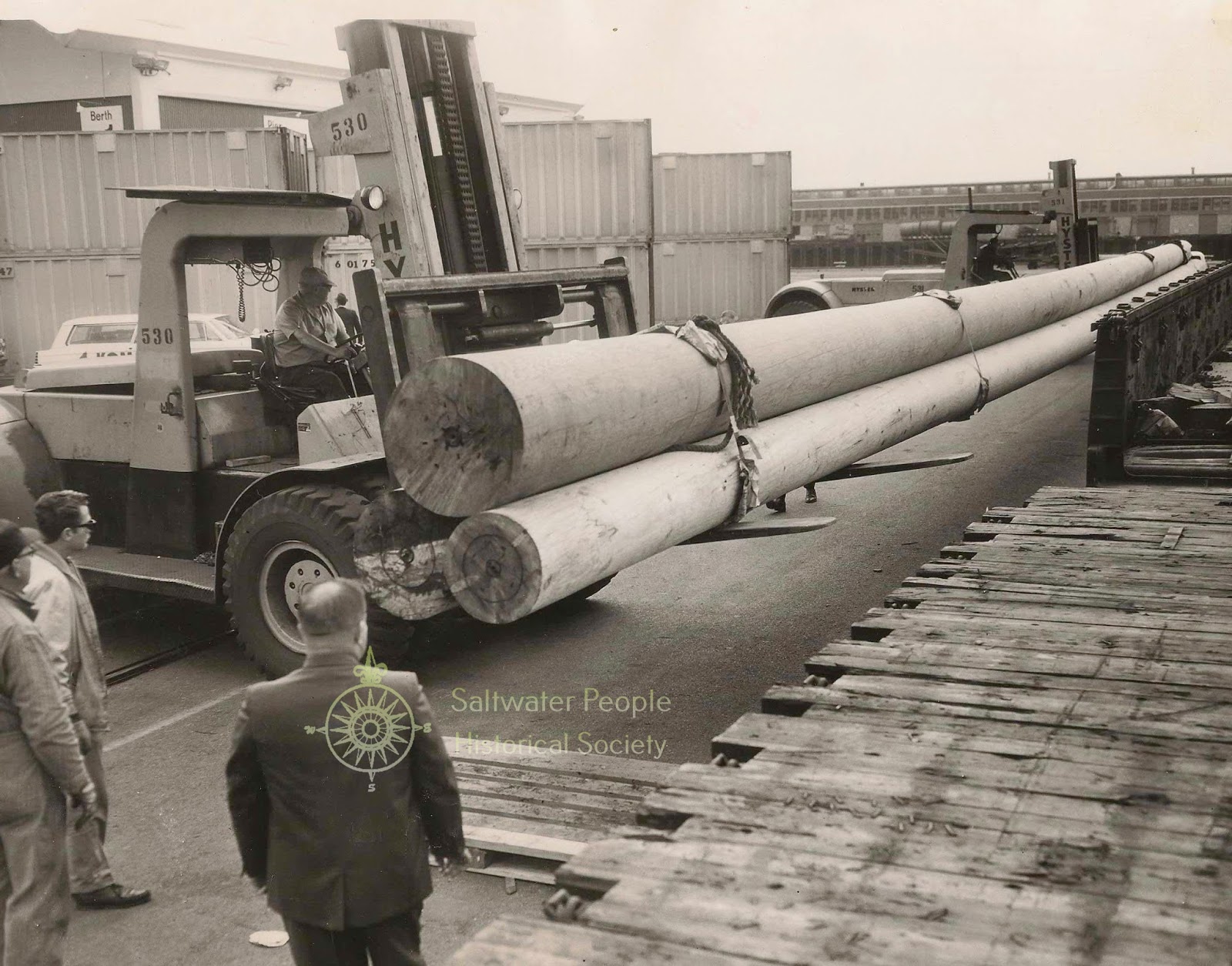
❖ WAWONA'S NEW SPARS ❖


Tall donation by four timber companies
and turned by the 
Cascade Pole Co. of Tacoma.
Original photo from the archives of the S.P.H.S.©


Note Mr. Vallentyne swinging from the hook.

Cropped from an original 10"x14"
photo dated 1966

from the archives of the S.P.H.S.©

Three New Masts for WAWONA

Save our Ships member, James D. Vallentyne*, swung from the hook of a Port of Seattle crane at Pier 46 in October 1966, as he began preliminaries for replacing the rotten 103-ft masts of WAWONA.
      Foss Launch & Tug Co donated the towing, Port of Seattle donated use of its crane, and Longshoreman's Union (Local No. 19) paid the salary of the crane operator.
      In May 1968, three new masts for the schooner were taken off a flatcar at Pier 46. The sticks were donated by four timber companies and turned by the Cascade Pole Co., Tacoma. The WAWONA, berthed at the north end of Lake Union, needs some work before the masts are stepped; Hunter Simpson, president of Save Our Ships, which owned the schooner was quoted as saying the group is hoping to make her into a museum ship.
      The WAWONA, built in 1897 by Hans Ditlev Bendixson, distinguished herself as a codfisher on her maiden Bering Sea voyage with Captain Charles Foss, for bringing home the largest catch of cod surpassing records on the Atlantic coast to 1914. The enthusiastic Captain Foss was quoted, "the staunch vessel could not have performed better if she had been built especially for codfishing."
      Being unable to get a towboat after arriving in the Strait of Juan de Fuca that year, she sailed into Anacortes and slid in next to her wharf, without the aid of a tug. Highliner was Second Mate Emil Isakson with a catch of 17, 036 fish. An Anacortes reporter noted she was discharging at Robinson Fisheries, Anacortes.
      The famous Capt. Ralph "Matt" Peasley, hero of Cappy Ricks sailing yarns, was WAWONA's skipper from 1900 to 1906.

Author Ernest K. Gann:
"WAWONA lives still and she is not going to die tomorrow or even the day after because her heart and physique are both mighty. And because she was created the old way when things were built to last.
      WAWONA will survive for a few more years even without your help. But then she will be gone. Forever. Not for you to see. Not for our kids to walk her decks and at least dream of voyaging under sail. Never.
      We are going to lose WAWONA to time and in her final weakness to the elements which she defied so bravely for so long."

WAWONA was scrapped in 2009.
Notes from The Seattle Times, 1966 and 1968.
Two photos from the archives of the S.P.H.S.©

*In the following year of 1967, Mr. Vallentyne, a past president of the Puget Sound Maritime Historical Society and owner of Vallentyne's Marine Repair, was lost off the Columbia River Bar in a storm, while bringing a vessel up the coast to Seattle.


Book search here
Pacific Schooner Wawona 

12 March 2012

❖ Schooner WAWONA "A Lucky Ship" ❖

"Ships of the sea, particularly those graceful sailing ships now finally slipping into the limbo of the past, have always been endowed with distinctive individual characteristics. No ship ever built has been exactly like any other. Once down the ways each ship has acquired not only a name but a soul of its own in an amazingly short time. And a reputation.
      One would soon be known as a dry ship, another as a wet one. This one would be called a "stiff" ship, that one "easy". One would be labeled "steady", her sister a "roller". She might be known as a "happy" ship or a "workhouse". Some ships cruise like a millionaires' yacht, while others get into all sorts of trouble.
      Sailors have only one definition of the character of a ship. The wet, uncomfortable, cantankerous workhouse they would call an "unlucky" ship. The other kind would simply be known as "lucky".
      A "lucky" ship has been the WAWONA, a three-masted fore-and-aft rigged schooner owned and operated by the Robinson Fisheries Co. of Anacortes, WA. If ever there has been a ship worthy of the appellation, the WAWONA is it. For she has been serving faithfully and well for nearly fifty years, in many parts of the world, and is still making money for her owners. From the days of Capt. Matt Peasley, one of her first masters, to the present, she has been every inch a lady, well behaved, and the pride of the men who have sailed her.


Robinson Fisheries, Anacortes, WA.

Original vintage postcard from
the archives of the Saltwater People Historical Society.

      In the offices of the Robinson Fisheries they actually speak in reverent tones of the WAWONA. Jack Trafton, the company's president, and E. N. Trafton, his son, could scarcely find words to tell of the old schooner's long service in the N. Pacific codfish trade, of the masters, mates, and men to whom she has been home and career, of the part she played in both world wars. But the company watchman, who has known the WAWONA a good part of his life, expressed it in a few words:

"She has always been a lucky ship, and 

has always landed a good trip of fish."
Postcard reproduction was purchased 
from the Anacortes Museum.
      The WAWONA was built in Fairhaven, CA., in 1897, by the famous [Hans Bendixsen] yard. Her registered dimensions are 468 G. tons, 413 N. tons, 156-ft. length, 36-ft. beam, and a depth of 12-ft., 3-in. One of her first masters was Capt. Matt Peasley of "Cappy Ricks" fame. In that era, Peter B. Kyne's stories in the Saturday Evening Post were widely read, and Matt--the fellow who, in fiction, wiped up the deck with the "Big Swede" and who finally married the attractive daughter of Cappy Ricks--was identified with the life-sized skipper. Capt. Peasley, now 80-years of age, retired from the sea a few years ago, and now lives in Aberdeen, WA.
      The Robinson Co. purchased the schooner in 1914, and she has made a least one trip to the Bering Sea every year since except when she was in government service. She is the largest fore-and-aft rigged sailing ship on the Pacific Coast, and she is one of the few sailing ships that have served through both world wars and is still in active service. In 1917, during WW I, she made a voyage from Vancouver, B.C., to Suva in the Fiji Islands with a full load of lumber, and served with the U.S. Army from 1941 through 1945. Between wars, she has landed a tremendous tonnage of codfish for her owners.
      Captain Charles Foss was her master from 1914 through 1935, which was one year when misfortune overtook the hard-working ship. While clearing Unimak Pass on her way home from the 1935 codfishing season in the Bering Sea, Capt. Foss suddenly passed away. The ship was put about, and Capt. Foss was buried by his sorrowing crew in Lost Harbor, AK. The first mate, now Capt. Tom Haugen, took command and has been her master ever since, except when she was in Army service. On her first trip north in 1936, she carried with her a monument to mark Capt. Foss' grave, and each year on her way north the WAWONA stops at remote Lost Harbor, Akun Island, so that her crew may pay their respects to Foss and care for his resting place.


The 1940 burial of Capt. Richard A. 
Trafton, 
M.V. DOROTHY,
at Lost Harbor, Akun Island, AK., next to the grave of
Capt. Charles Foss, who died on board WAWONA, 1935.
Courtesy of Bruce Trafton for S.P.H.S.
      The WAWONA has always been a proud ship, but she has never been prudish. At sea, she has always been as graceful as a bird, yet during the late war, stripped of her masts and gear, she served without shame as a lowly scow. Since then her former beauty and accouterments have been restored in shipyards at Friday Harbor and Bellingham. Once again the grime of war service is gone. She is scrubbed and shined and polished. Three 114-foot "sticks" were brought down from the woods and stepped in. With Tom and his crew of 36 men, she sailed this spring for another season in the Bering.
      The WAWONA has always been a "lucky" ship. Her reputation is still good. And when that can be said of such a ship, it is like saying of a fair lady, "here is a useful and honorable life."

Above words by Leon M. Swank
Pacific Motor Boat
October 1946
Archives of the Saltwater People Historical Society
Typed verbatim.
1941: An unlucky day on 27 May when the 2nd mate, Nick Field, age 58 of Tacoma was lost from a WAWONA dory. The master was Capt. Tom Haugen.
Seattle Times 4 Sept. 1941.
1963: An organization known as "Save Our Ships" was organized with the intent to purchase the WAWONA, one of two remaining sailing ships in Puget Sound. The other, FALLS OF CLYDE, was purchased by a fast, fund-raising campaign in Honolulu, where the vessel was taken in 1963 to serve as a floating museum. All of the other sailing ships either have been broken up for scrap or sold to other ports for maritime museums.
1968: Not quoted in this log but a fine tribute to WAWONA is featured in West Coast Windjammers by Jim Gibbs. Superior.
1970: WAWONA was declared a National Historic Site, the first vessel to receive that designation in the country.
1981: The president of the National Maritime Historical Society, Peter Sanford, sent out an SOS to save the WAWONA, owned at that time by Northwest Seaport who moored her in Lake Union, Seattle, WA. Sanford described the WAWONA as an international maritime treasure that deserved better treatment than decrepitude.
2009: After 46 years of volunteer effort, the WAWONA was towed to a Seattle scrapping yard.
2011: Archived on this Log are some of those scraps in Schooner WAWONA's Bones, written by Roy Pearmain.


Archived Log Entries