"The Cure for Everything is Saltwater, Sweat, Tears, or the Sea."

About Us

My photo
San Juan Archipelago, Washington State, United States
A society formed in 2009 for the purpose of collecting, preserving, celebrating, and disseminating the maritime history of the San Juan Islands and northern Puget Sound area. Check this log for tales from out-of-print publications as well as from members and friends. There are circa 750, often long entries, on a broad range of maritime topics; there are search aids at the bottom of the log. Please ask for permission to use any photo posted on this site. Thank you.
Showing posts with label ROSALIE. Show all posts

05 January 2022

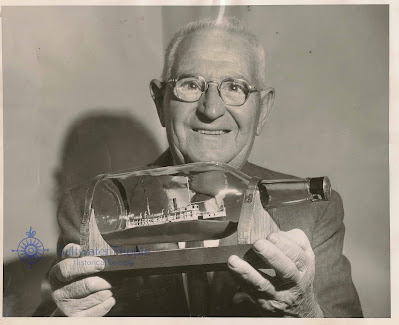
ONE HAPPY CAPTAIN........ 1965


Captain Louis Van Bogaert
with his prize of friendship from 
craftsman Ralph Hitchcock, Seattle, 1965.
The steamer Rosalie, his sweetheart.
Original gelatin-silver photograph from the archives 
of the Saltwater People Historical Society©

"Capt. Louis Van Bogaert who retired in 1957 after 54 years on Puget Sound vessels, 
had a special fondness for one boat, the ROSALIE.
      He had gone to work on the ROSALIE as a watchman in 1910. Later he was second mate, then first mate, and finally, in 1914, her skipper. So the captain was especially happy about a gift which he took back to his home in Alhambra, CA, after a recent visit in Seattle.
      It was a bottle with a scale model of the ROSALIE in it. The model was the work of Ralph C. Hitchcock, a past president of the Puget Sound Maritime Historical Society. Hitchcock had driven from California to Seattle with Captain Van Bogaert and on several occasions, Van Bogaert had wanted to stop and look for a bottle with a shipmodel in it. But Hitchcock always found an objection.


Ralph Hitchcock
Ship model maker. 
Photo dated 1965, Seattle.
Gelatin-silver original photo from the archives of
the Saltwater People Historical Society.©

"I'll get you a bottle," Hitchcock kept saying.

But Van Bogaert was surprised when the bottle turned out to have a model which Hitchcock himself had made.
      Hitchcock made the model of the famous Puget Sound passenger vessel FLYER which is in the State Historical Museum in Tacoma, but the ROSALIE is the first model he ever assembled in a bottle.
      The model was in 334 pieces before Hitchcock began assembling it inside the bottle, which has a neck with a diameter only three-quarters of an inch across.
      The ROSALIE, 136 feet long, was built in Alameda, CA in 1893. She carried passengers between San Francisco and Oakland when it cost only a nickel to make the trip.
      Then the ROSALIE came to Puget Sound, but when gold was discovered in Alaska she was put into service between Seattle and the Northland. Among her skippers while she was owned by the Alaska Steamship Co., was Capt. Johnny (Dynamite) O'Brien.
      Much of ROSALIE's service was in the San Juan Islands as part of the Puget Sound Navigation Co fleet. That was where Van Bogaert served aboard her.

Steamer ROSALIE
off the coast of Lopez Island, dated 1907.
click to enlarge.
L.A. Cadwell has marked numbers on the buildings,
the schoolhouse, two churches, the Creamery,
 the Post Office, the Store, and
"part of our orchard", in the foreground.
Original photo from the archives of the 
Saltwater People Historical Society ©


The ROSALIE (L)
Click to enlarge and view the 
 Sidewheeler YOSEMITE
Steaming through the Islands.
Postcard mailed in Eastsound in 1907
Original photo from the archives of the 
Saltwater People Historical Society©

1907, July 7.

"When on the Victoria route a few days ago, the steamer ROSALIE won a fine silver service in competition with the steamer VICTORIAN in a voting contest to determine which was the more popular vessel." Good going, Rosalie!
        The ROSALIE's career came to an end 22 June 1918, when she caught fire while tied to a pier of the Duwamish Waterway and was a total loss." 
Words with no byline from the Seattle Times Oct. 1965


06 February 2021

❖ CROP MOVEMENTS AND A SOCIAL HALL ❖


The S.S. ISLANDER
Built in 1904 by J.A. Scribner
at Newhall, Orcas Island, WA.
Fate: sold to Mexico.
From the archives of the 
Saltwater People Historical Society©


Above clips from the Friday Harbor Journal
with dates from 1911.


S.S. ROSALIE
ON 111022
Built in 1893.
Here she stops at West Sound, Orcas Island,
(postmarked 1908)
and Richardson, Lopez Island, undated,
San Juan Archipelago, WA.
Click the image to enlarge.
From the archives of the 
Saltwater People Historical Society©

"In the newly settled San Juan Islands crop movements became a life support system to steamers like the Rosalie and the Islander. Settlers had broken ground on Decatur, Blakely, Stuart, and Waldron Islands, all virtually deserted today but settled enough by 1900 to warrant post offices. Most island crops were grown on the bigger islands: Shaw, Lopez, Orcas, and San Juan, cultivated by homesteaders from Ireland, Germany, Sweden, Norway, Denmark, England, Scotland, and Canada. Others arrived fresh from the worked-out goldfields of California or the riffles of the Fraser River. Captains on vessels loading spars for Falmouth and Brest returned to come ashore and "swallow the anchor." Other island settlers were Civil War veterans [such as Oscar Fowler and Isaiah Jones, the latter the father to San Juan County sheriff Newton Jones] and Midwest farmers beaming at the misty rains.
      In 1900, Island County boasted its population had soared 40 percent during the past decade. Stripped of boosterism, that still meant a population of only 3,000. But the newcomers were prodigal producers.

        Island apples became as popular as today's harvest from Yakima and Wenatchee, soon to begin bearing fruit and deny the islanders' dreams of becoming the "Apple Basket of America." Wagons rattled their way to island docks laden with fruits, dairy products, grains, and beef and lamb.
By the turn of the century, another bounty—along with the lime mined on San Juan Island—was making its way to market on the steamers. Drawn by the closeby migratory routes of salmon, fish traps, reefnetters, and boatsmen were bringing in a rich harvest. One Friday Harbor cannery alone packed 50,000 cases in a single year.
      Vashon Island shipped berries, greenhouse tomatoes, and cucumbers. Steamers stopped to load cases of eggs that were to win national blue ribbons.

      On Whidbey Island, Langley and Coupeville docks creaked with movements of provender for Everett and Seattle, including potatoes grown by Chinese farmers and sacks of wheat harvested by Dutchmen who, until soils became depleted, harvested
record-breaking yields of wheat (117 bushels per acre in 1892.)

      The San Juan Islanders became the first on the Sound and its ancillary waters to become wedded to the steamer. Most were landlubbers, but they relaxed aboard workhorses like the Islander and the Rosalie.
      Islanders had watched some of these being built by their skipper owners on crude ways in a tideland clearing. To the islanders, the steamer was a truck, an ambulance, a school bus, a hearse, and a bearer of mail and visitors. Best of all it was a social hall where, in the warmth of a cabin, coffee could be shared and loneliness melted as the blue-black shores of the islands flowed by."


Jim Faber. Steamer's Wake. Enetai Press, Seattle. 1985.


29 May 2019

❖ DEAN OF MARINERS on the SOUND ❖


Capt. Sam Barlow
1870-1938
Storybook Skipper of the San Juans,
“A colorful sea captain named Sam Barlow grew up on Lopez Island. Some of the old-timers in the islands still remember him when he captained the old steamer, ROSALIE and later the Black Ball Line’s first ferry, ROSARIO. And small wonder. In stormy weather Captain Sam would wear, instead of his conventional Captain’s hat, a black felt hat with a broad rim so he could more easily pick up certain echoes from the islands. The unorthodox hat proved particularly helpful on foggy days in the pre-radar era. Suddenly his uncanny sense of hearing and an unbelievable sense of smell would come into full play. Somehow the ship he skippered, the rocks nearby, the heavily timbered shorelines he hugged-even the currents which baffled most mariners—became to Sam Barlow––close friends. Ultimately this man was to bear the moniker of THE DEAN OF MARINERS ON PUGET SOUND!
      Sam, the boy, was one of the youngest of the Barlow family’s ten children. At his home on beautiful Barlow Bay (named after his father), he learned a lot about sailing from his father. He’d often gaze out at the sparkling sea and dream of a day when he’d be commanding his own vessel through the intricate passages around Lopez and the other islands. But first young Sam endured quite a hair-raising adventure for a sea-smitten kid. It seems that it all began when a stranger offered the boy twenty dollars to transport him from Oak Bay on Vancouver Island to a certain point on Whidbey Island.
Sam felt as if he’d just been offered a gold nugget. He had access to one of his father’s boats so the man and the boy made a deal. The first trip was a success and young Sam collected his money. But a little later the same man asked Sam to take him and some mysterious ‘baggage’ on the same trip. This time everything went wrong, including a storm at sea. The sailboat started to ship water and it was about to be swamped. Sam went to work to fight for his boat and his life. But his passenger was more concerned about the ‘baggage’.
Sam told the man something like this. “It takes only twenty pounds to keep a man afloat. You take the mast, sails and anything else that will float and lash them into a long parcel, then fasten this crosswise of the boat. If all the heavy articles are thrown overboard, the boat, though full of water, will float just below the surface. And this is precisely what they did--for four hours.
The poor passenger almost drowned, so concerned was he with his baggage, but Sam fought on saying, ‘It’s a poor time to die.’ When they eventually got their feet on dry land, Sam told the man he’d had it. Even for twenty dollars he wouldn’t make such a trip again. Later someone asked Sam what he suspected was in that package his passenger valued more than his life.
‘Opium, probably,’ he said, ‘And wouldn’t I be in a fine fix with a dead man and a load of opium aboard?’
From this misadventure Sam went on to the very legitimate adventure of serving aboard such steamers as the LYDIA THOMPSON and the ROSALIE, both of which he later became captain. One of the mates who served under Captain Sam on the ROSALIE told me not too long ago, ‘Captain Sam was on the island run so long he knew all the points by name, and those that had no name, he gave a name!’
In time, steamers were out and ferries were in. Captain Sam eagerly took over the command of the 156-foot ROSARIO, the first ferry on the San Juan Islands run. She was a floating palace and Sam was mighty proud of her. 
Later Captain Sam commanded the CITY OF ANGELES on the San Juan route. In fact, most of the old-timers in the islands will connect him with this ferry. Years ago when some of Barlow’s fellow Masons were riding with him in the pilothouse of this ferry, he asked a mate to dock her at the Orcas ferry landing. Somehow, the mate miscalculated a bit and brought the vessel to an embarrassing stop at the Easterly side of the pilings. All he could do was back her up and try again. As the mate made his second approach Captain Sam said: ‘Well son, everybody gets into fixes like this occasionally. You’ll just have to get out the best way you can.’
A great deal of notoriety has been given Sam Barlow in connection with his membership in both the Seattle and Anacortes Masonic Lodges. In 1923, before he became a member of the Fidalgo Lodge, he was instrumental in arranging a visit between this Lodge and the Mt. Newton Lodge, F. & A.M. in Saanichton, B.C. Ever since this initial visit, which was instigated by Sam, the two lodges have met on a semi-annual basis. One member recently remarked: ‘God willing, may this delightful custom never cease.’
Following Sam Barlow’s death in 1938 (he was 63), and for many years, the Masons of both lodges honored the Captain by riding the ferry to Upright Head on Lopez Is. There the ferry engines ground to a stop near the ferry landing. In the stillness and scenic splendor, a group of Masons would float a floral wreath on the water in Captain Sam’s memory. 
If Sam Barlow ever sounded like a rough and tough skipper, he wasn’t. He had a sentimental side. His daughter Bernice still recalls how she’d stay at the Orcas Hotel summers in order to be near her beloved father. When his ferry approached the dock, she and other islanders would run down to the landing to greet him. Quite often they’d sing a song called “on Dear Ol’ Orcas Isle”; this was written by Ethel B. Auld in 1926. Here are the lyrics:

     "Oh dear old Orcas Isle, 
that’s where we rest awhile. 
Where skies are ever blue
 and sweethearts roam. 
Where sweet Madronas grow,
On dear old Orcas Isle, 
Our Island home.”


Former mates who sailed with Captain Sam, islanders who still remember him for his friendliness and special kindnesses, and the Masons who honored him each year, prove that unlike old soldiers, this skipper’s memory will never fade away.” 

Shirley Dever (1924-2008) was a magazine writer who retired to Orcas Island to live in the White Beach area in 1962. 
Published by the Island Booster, Orcas Island, WA. 1971.


09 January 2017

❖ MOSQUITO FLEET MONDAY ❖ SWEETHEART, ROSALIE ❖


S.S. ROSALIE
ON 111022
Built by Hay and Wright 
Alameda, CA.
136.5' x 27' x 10'

1893-22 June 1918.
According to historian Ralph Hitchcock,
she was powered by a
compound steam engine with a 15-inch diameter
high-pressure 
cylinder and a 340-inch diameter
 low-pressure cylinder.
The power was rated at 300 HP.

The image is stamped verso by
the Steamship Historical Society of America, Inc.
Photo from the archives of the Saltwater People Historical Society.©

There once was a very special "mosquito" who was built in California but sailed soon after to work for two years in Puget Sound before running off to immerse herself in the excitement of hauling miners to the Klondike Gold Rush. Following those years traveling the coast, she spent her best years serving people of the San Juan Islands. Here are words from Mr. Ralph Johnson, who worked in his youth, on the sweet ROSALIE. 
The San Juan Islands Route of the ROSALIE
      "As a boy, I heard of a beautiful group of islands called the San Juans, a long way from Seattle, and saw them for the first time while working on the steamer SIOUX. I made up my mind that I would try to work on a steamer running to the Islands the next summer, if possible, and after two weeks on the steamer INDIANAPOLIS in June 1912, I transferred to the steamer ROSALIE.
      At 12 o'clock midnight every Sunday, Tuesday, and Thursday the mooring lines and gangplank were hauled in; with her whistleblowing the parting signal, the ROSALIE left Colman Dock for Port Townsend, the San Juan Islands, and Bellingham. 


S.S. ROSALIE
ON 111022

Moored Richardson, Lopez Island,
San Juan County, WA.
Original photo from the archives of
the Saltwater People Historical Society.©
Click image to enlarge.

      We arrived at Port Townsend at four AM, then crossed the Strait of Juan de Fuca to Richardson, on the tip of Lopez Island [above photo]; this was our first stop in the Islands and the home of Capt. Sam Barlow, master of the ROSALIE.
      Crossing the Strait in rough weather was an experience that developed 'sea-legs' and a gyroscopic balance as the steamer became a nautical ballerina in her own right.
      On the first two trips, I spent as much time as possible looking at the beautiful, ever-changing scenery and was amazed at the labyrinth of channels. Much to my disappointment I was not always able to leave my work and look at all the communities and towns tucked away in coves, but eventually, I did.
      The steamer did not always stop at all the places shown on the schedule, but there were centers of activity such as Friday Harbor, the seat of San Juan County, Roche Harbor, the scene of lime production, Orcas, East Sound, then on to Olga.
      I remember Deer Harbor as a quiet, sleepy place with a cluster of buildings beyond the dock, and a cannery on the opposite shore. 


S.S. ROSALIE

Pole Pass with Orcas Island in the background. 
Low res scan of an original photo
by James A. McCormick
from the archives of
the Saltwater People HIstorical Society.©
Click image to enlarge.

Pole Pass was the most restricted channel for clearance of any I can recall and it seemed that I could throw a stone to either shore from the boat deck of the ROSALIE.
      East Sound impressed me as one town where more freight was handled than at any other stop; I'll never forget a load of sheep we took on there. Roche Harbor was the second most active.
      An unusual stop was made when the steamer picked up a woman and girl about ten years old from a rowboat in a channel, not long after we left Richardson. I learned that they were family of a lighthouse keeper from Smith Island.
      Roche Harbor was the focal point of interest in the Islands as far as size and activity. I learned about the basic industry when we took on a load of agricultural lime that I was told brought a premium price. We discharged it at South Bellingham.
      The responsibility of navigating a passenger steamer is never a light one, but in fog, it multiplies. Add to that the channels with strong currents where a compass and course protractor are of little use. 


Captain Sam Barlow

Well-known master of the ROSALIE
Photographer and date are unknown.

Low res scan of an original photo
from the archives of
the Saltwater People Historical Society©

Captain Barlow was born on Lopez and spent his boyhood and youth learning the maze of channels and characteristics. Being of Indian lineage he had inherited the knowledge of natural phenomena beyond that of laymen and his keen sense of hearing was as efficient as radar is today.
      The people of the islands I met were friendly, home-spun and seemed to bring the essence of their island with them when they came on the steamer. They were never in a hurry and a few minutes one way or the other made little difference. The islands bred an atmosphere of tranquility.
      Time is a paradox. I began working on the steamer INDIANAPOLIS as soon as school was out and the long, three-months vacation stretched into the hazy future. But a few blasts of a whistle blew ninety days into the void of no return and I almost met myself coming on board as I walked down the gangplank from the ROSALIE for the last time. My days of steamboating, as a member of a crew, were over.
      As a young boy there were three steamboats whose names held particular significance for me; the ALGOMA, an ice-crushing steamer on Lake Michigan, on which my father was engineer, the MAUDE FOSTER (MUD HEN) on Lake Union, and the ROSALIE on which my father returned to Seattle from Alaska and the gold rush in 1900.
       The ROSALIE was built in Alameda, CA in 1893, operating out of and adjacent to San Francisco until 1895. I was told while working on her that she was named for a lady affectionately known as Madam of a palace of pleasure on the Barbary Coast of S.F. and served as a gambling ship for a while. The steamer came to Seattle in 1895 and served under the house flag of the Northwestern Steamship Co., until 1897 when she was acquired by the Alaska Steamship Co. In May 1901, the ROSALIE became a part of the fleet of the Puget Sound Navigation Co., where she remained until 1904.
      The steamer then returned to the control of the Alaska Steamship Co., until June 1905, when she began flying the house flag of the International Steamship Co. In May 1911, the ROSALIE became the property of the Inland Navigation Co., for whom she served until Jan 1914, when PSNC took her back. She flew their house flag again until 1918.
      In the early morning of 22 June 1918, while tied up in the west waterway south of the Spokane Street Bridge, the watchman smelled smoke and found the steamer on fire. We alerted others on board but their combined efforts could not prevent the fire from spreading. A tug nearby with a tow of logs dropped the tow and came to the assistance of the firefighters. The lines holding the ROSALIE were severed and the steamer cast adrift, but not before the steamer CHIPPEWA, by which the ROSALIE was tied, was slightly damaged.
      The ROSALIE started drifting; to keep her from setting fire to commercial establishments along the waterway, the tug pushed the burning steamer into a mud bank. The fireboat SNOQUALMIE arrived on the scene, but because the tide was out there was not sufficient depth of water for her to get near the burning craft and the steamer became a total loss.
      She had written her epitaph in smoke. 
      She was not the fastest steamer on the Sound, but knew where she was going and usually got there."

 Writer: Ralph Johnson. Published in The Sea Chest, September 1976 by Puget Sound Maritime, Seattle, WA; membership journal.

A glimpse of the work days in San Juan County for the ROSALIE:
1907: 
Puget Sound Navigation Co replaces the LYDIA THOMPSON on the Seattle-Bellingham route (through the San Juan Islands) with the ROSALIE, Capt. Sam Barlow; Ira D. Nordyke, first mate. She only lands at Bugge Trading Co wharf dock when in Friday Harbor.

The San Juan Islander.
1907: 

In November the steamer has taken about 5,500 boxes of apples from this county to Seattle within the past week and 1,100 cases of canned fruit. Her cargo last Saturday was the largest she has ever carried between Sound ports. 

The San Juan Islander.
1909:
The ROSALIE landed at the Friday Harbor Cannery dock to unload another of the four big retorts for the packing company. 
The San Juan Islander.
1909:
The Clam Cannery shipped 8 tons of crushed clam shells by the ROSALIE to Tacoma, to be used in large poultry yards there. 

A two-ton shingle machine came in on the ROSALIE for the Western Mills & Lumber Co. The machine is a Sumner with a capacity of 50,000 shingles per day.
The San Juan Islander. 
1912: 
Captain Sam Barlow of the steamer ROSALIE was married at Bellingham on the 10 July 1912. The name of the fortunate lady we have not learned. 

The San Juan Islander.
1912:
A large amount of cement was landed at Olga last week by the steamer  ROSALIE for the big new dam at the upper lake being built by Mr. Moran. Jensen and Davis hauled the cement up to the dam site. 

The San Juan Islander.

Other known masters of the ROSALIE:
Capt. George Roberts
Capt. John "Dynamite Johnny" O'Brien
Capt. Louis Van Bogaert
Capt. C. W. Ames
Capt. William Williamson

Capt. John "Red Jack" Ellsmore
Mate: Ira D. Nordyke


13 October 2012

❖ A Ship for Captain Louis Van Bogaert ❖


Captain Louis Van Bogaert

Original 1957 photo
from the archives of the S.P.H.S.©
"Captain Louis Van Bogaert, who retired in 1957 after 54 years on Puget Sound vessels, had a special fondness for one boat, the ROSALIE.
      He had gone to work on the ROSALIE as a watchman in 1910, later he was second mate, then first mate, and finally, in 1914, her skipper.
      So the captain was especially happy about a gift that he took back to his home in Alhambra, CA, after a visit in Seattle.


Ralph C. Hitchcock

Ship model maker, 1965, Lopez Island.
Original photo from the
archives of the S. P. H. S.
      It was a bottle with a scale model of the ROSALIE in it.
      The model was the work of Ralph C. Hitchcock, a retired Boeing engineer. In retirement he became a professional model builder, producing 22 models, most all of museum quality. Mr. Hitchcock and his wife lived on Lopez Island for several years and bestowed 3 ship models to the collection of the Lopez Historical Museum. His work also went to the Puget Sound Maritime Historical Society, the WA. State Hist. Museum and the Smithsonian.
     Hitchcock and his wife, Eva, had driven from CA to Seattle with Capt. Van Bogaert and on several occasions Van Bogaert had wanted to stop and look for a bottle with a ship model in it. But Hitchcock always found an objection.
      'I'll get you a bottle,' Hitchcock kept saying.
      But Van Bogaert was surprised when the bottle turned out to have a model which Hitchcock himself had made.
      Hitchcock made the model of the famous Puget Sound passenger ship the FLYER which is in the aforementioned State Museum at Tacoma, but the ROSALIE is the first model he ever assembled in a bottle.
      'And it only took twice as long to make as I thought it would,' he said. That made it an 85-hour job.
      The model was in 34 pieces before Hitchcock began assembling it inside the bottle, which has a neck with a diameter of only three-quarters of an inch across.
      The ROSALIE, 136 ft, was built in Alameda, CA in 1893. She carried passengers between San Francisco and Oakland when it cost only a nickel to make the trip.
      The ROSALIE came to Puget Sound, but when gold was discovered in AK she was put into service between Seattle and the North. Among her skippers, while she was owned by the Alaska Steamship Co was Capt. Johnny (Dynamite) O'Brien.
      Much of the ROSALIE's service was in the San Juan Islands as part of the Puget Sound Navigation  Co. fleet. That was where Van Bogaert served aboard her.
      ROSALIE's career came to an end 22 June 1918 when she caught fire while tied to a pier on the Duwamish Waterway and was a total loss."
The above text from The Seattle Times. 1965
Ralph HItchcock recorded that he had made 22 ship models up to this date.


Steamer ROSALIE, 
West Sound, Orcas Island, WA.
The captain left his Orcas home 
in 1903 to sign on the  
shrimper VIOLA. 
He worked on the water for 54 years.
When a passenger asked him if he knew 
where all the rocks were on his route--
he replied--'No, But I know where they aren't."

Photo from the archives of the S.P.H.S.©


Archived Log Entries