"The Cure for Everything is Saltwater, Sweat, Tears, or the Sea."

About Us

My photo
San Juan Archipelago, Washington State, United States
A society formed in 2009 for the purpose of collecting, preserving, celebrating, and disseminating the maritime history of the San Juan Islands and northern Puget Sound area. Check this log for tales from out-of-print publications as well as from members and friends. There are circa 750, often long entries, on a broad range of maritime topics; there are search aids at the bottom of the log. Please ask for permission to use any photo posted on this site. Thank you.
Showing posts with label Victoria. Show all posts

13 February 2024

THE FOREST FRIEND


Captain Edward L. Tindall,
One-time master of
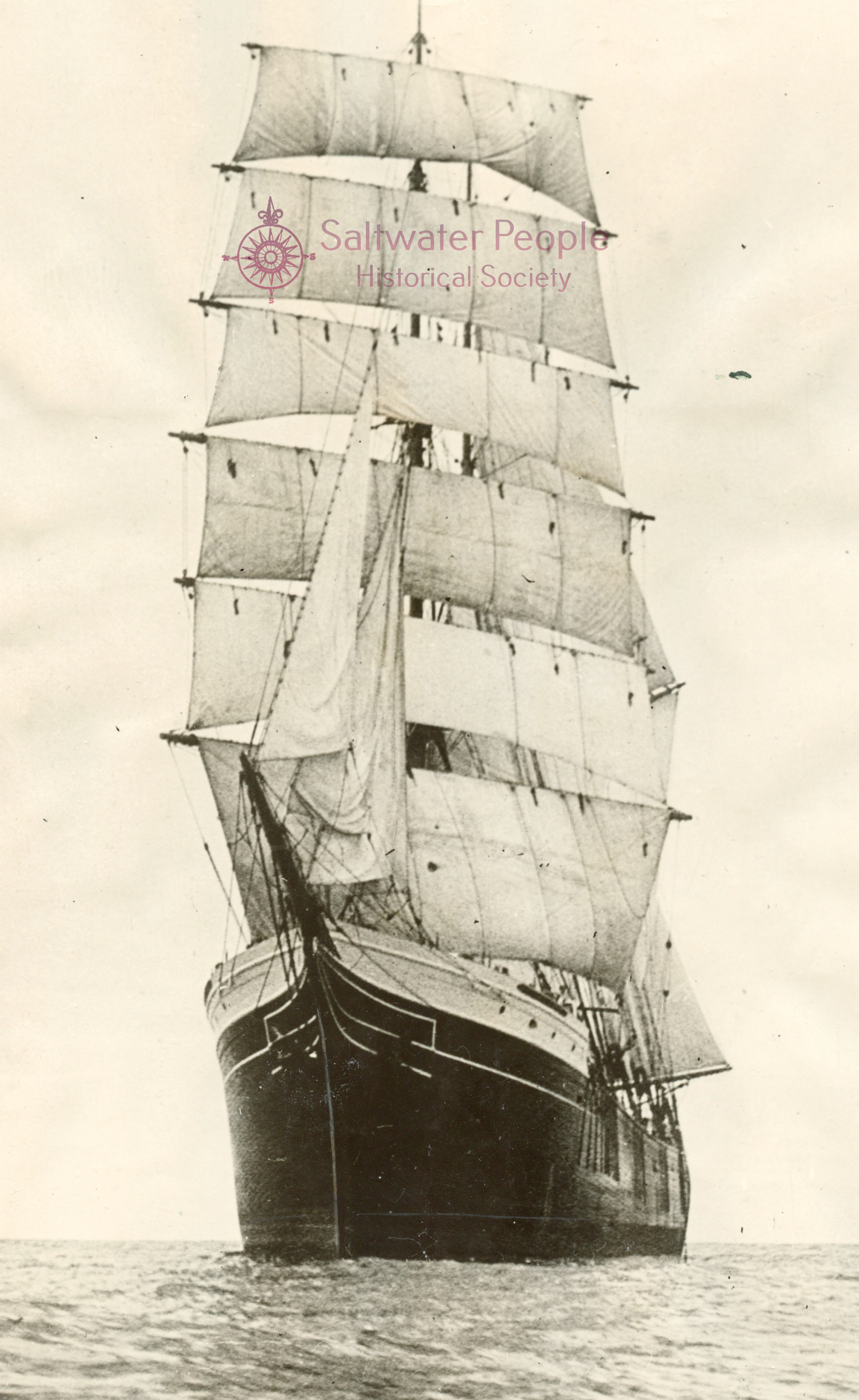
Barquentine FOREST FRIEND

Low-res scan courtesy of his 
great-grandson,
Ed David,
to accompany the below essay.


FOREST FRIEND
219452
built 1919, 
Aberdeen, WA. 
243' l x 44' b x 10' d.
1,614 G.t.
click image to enlarge.
scan from a gelatin-silver 
photo from the archives of the 
Saltwater People Historial Society©

Words by Reece Hague,
Formerly with the Adelaide Journal.
Published by The Mail,
Victoria, British Columbia, Canada
31 August 1929


10 June 1929

"Take off your hats, gentlemen, she is the last of a vanishing race."
        The speaker was Capt. Edward L. Tindall, veteran master mariner, and as he spoke he directed attention to a barquentine sailing with all the grace and dignity of her kind, through the heads which give access to the beautiful Sydney Harbor.
        A closer examination would have revealed that the barquentine had lost much of her pristine splendor, but to the sailor and his landsmen friends, she was a thing of beauty and romance.
        It was February 1928, the barquentine FOREST FRIEND majestically entered Sydney Harbor, to awaken memories and longings in the hearts of many old seadogs.
        Capt. Tindall himself had almost decided to settle down to a humdrum existence on land, but the sight of the FOREST FRIEND revived a latent longing to take his place once again on the poop deck of a windjammer.
        As he left the harbor, musing over past happy years, Capt. Tindall murmured, "Oh, for one last trip on a ship such as that."
        Little did he then realize that less than 12 months later she should be towed, under the command of none other than Capt. Tindall himself, into the Esquimalt Harbor, Vancouver Island, there to be ignominiously libeled, and eventually sold for her value as a hulk.
        It was actually only a few days after his first glimpse of the FOREST FRIEND that Capt. Tindall was informed that a skipper was required for the barquentine, and his desire to sail once again the high seas as the master of a windjammer was realized.
        In May this year, while the FOREST FRIEND was lying at Esquimalt with libel notices nailed to her mast, I met Capt. Tindall, and told him that I had been present in Port Adelaide, Australia, in the latter part of 1927, when I had seen the barquentine in a similar predicament.  
        Together we gathered up the threads of the story that I was now unfolding.
        In November 1919, when the whole world was crying out for ships to carry freight, a new and splendid barquentine, bearing the name FOREST FRIEND on her bows, sailed for the first time out of the harbor of Aberdeen, Washington, where she had been constructed a cost of £ 25,000. In June 1929, the same ship was sold to Victoria, B.C., for £800 to a firm of general towage contractors.
        For the first 2 or 3 years of her life, the FOREST FRIEND sailed jauntily over the great ocean.
        Then, as more and more mammoth steamships were built by the seafaring nations of the world, the owners of the FOREST FRIEND found it increasingly difficult to secure suitable cargoes.
        Speed in transporting cargo became a watchword, and fewer and fewer cargoes were available for the fast-vanishing sailing ships.
        The climax, of the FOREST FRIEND came in May 1927, when, 90 days after she had sailed from Anacortes, WA, the barquentine, badly battered by storms, limped into the Port Adelaide Harbor.
        Immediately, the American master of the ship cabled to his owners for money with which to meet the ship's liabilities. The owners considered that the FOREST FRIEND had been sufficient of a liability for some years, and ignored the request.
        Harbor officials became tired of waiting for the dues and libeled the ship.
        Long legal proceedings followed, and after many delays, a Supreme Court judge ordered the sale of the vessel.
        At the sale, an offer of £ 500 was received, and the barquentine was knocked down for that sum to South Australian interests styling themselves the Massey-Mort Shipping Co.
         Legal costs absorbed most of the £ 500, and the crew were sent to their homes in the United States by American boats, and the master obtained a berth as second mate on a ship bound for America.
        Capt. Adams another American sailor, who happened to be in South Australia, accompanied by his wife and child, was given command of the FOREST FRIEND, and in February 1928, sailed for Sydney. Heavy weather was encountered, and one morning, while Capt. Adams was attending to one of the halyards when his oilskins 
caught in the barrel winch, and he was severely injured.
        The mate signaled with flares, and a pilot cutter was dispatched from Sydney to the FOREST FRIEND, which was then laying 20 miles from the heads. The captain and his wife and child were taken ashore and the ship was taken to anchorage by the mate.
        Three weeks later Capt. Adams died from his injuries, and on 29 March 1928, Capt. Tindall took command of the barquentine. She sailed for Peru with a cargo of Australian coal.
        Capt. Tindall's words:


"We set out from Sydney with a scratch crew of 13 men. The first mate was an inveterate drunkard and as I had been unable to get a second mate I was forced to appoint one of the men from the forecastle. He turned out to be quite useless.
        Only three of the crew were experienced sailors, and before we had been out two weeks I had trouble with one of them. He was a Russian. He was demoralizing the rest of the crew, so I sent for him, and with the aid of the storekeeper and steward, I put handcuffs on him. I kept him in irons for the rest of the voyage.
        As soon as I reached Callao, Peru, I cabled the owners for funds to pay off the crew, but it was two weeks before the money arrived. In the meantime, the crew refused to work until they got their money.

        When I paid off the crew, I was left on the ship alone except for the mate, who had gone on a prolonged drinking bout as soon as he got his money.

        Before I could get a fresh crew to take the boat out it was necessary to get a portrait from the port captain, and he insisted that I should take my old crew back. I did not want the men back and squared the immigration authorities to lay off them, but the port captain called upon the police to arrest them and put them on board the FOREST FRIEND. the police would bring one or two on at a time, and as soon as they had departed in search of another batch the first crew would go back on shore.
        The port captain got so sick of seeing me around that he approved one of the many crew listed I had presented to him. I left Callao in ballast for Port Townsend, Washington.
        The trip from Peru was uneventful until we ran into the latitude of San Francisco when gale after gale struck us. For a long time, we lay off Cape Flattery but managed to get 10 miles down Juan de Fuca Strait. It commenced to blow hard from the southeast, and I had to anchor in Neah Bay. There we waited for a fair wind, but the barometer was dropping, and had weather was looming up. We were in a very 
dangerous position off an exposed coast when a coastguard wirelessed for a tug. Four hours after we had left in tow for Port Townsend a howling gale set in."

        It was in November 1928, that the FOREST FRIEND arrived at Port Townsend. Capt. Tindall was instructed by his owners to proceed to Port Winslow, WA, for cargo on charter. A survey of the ship showed that repairs amounting to ca. £1,600 would be necessary before the underwriters would insure her for the outward voyage. The charterers refused to release £2,000 in trust, and Capt. Tindall was reduced to borrowing money on the security of the ship and himself to pay off the crew.
        Pleas to the owners in Australia for money were in vain, but eventually, they instructed Capt. Tindall to proceed to Esquimalt, Vancouver Is, B.C. On arrival in B.C., the captain was informed by cable that the company owning the ship had gone into liquidation. Claims amounting to £950 were immediately filed against the ship.
        Once again, as had happened at Port Adelaide, libel notices adorned the masts of the FOREST FRIEND. Witnesses told Mr. Justice Martin, in the Victoria, B.C., Admiralty Court, that the FOREST FRIEND was valuable only as a hulk and might fetch £1,000 at a forced sale.
        The ship was appraised at a value of £950, the total of the claims against her, and early in June a sale was conducted on the deck of the vessel.
        When the terms of the sale were explained, it was discovered that as the FOREST FRIEND was of American registry it would be necessary to pay duty amounting to ca. £ 400 on the barquentine before she could be used off the coast of B. C., Canada.
        The additional sum for duty brought the price to more than anyone was willing to pay, and no bids were received.
        The Admiralty Court authorized the marshal to receive private bids on the vessel, and on 23 June, Hodder Brothers, general towing contractors of Vancouver, tendered an offer of £ 800 for the vessel. The offer was promptly accepted.
"What will be the future of the FOREST FRIEND?" I asked the Hodder brothers after they had left the Admiralty office.
        Mr. Hodder shook his head somewhat sadly as he replied, "Well, I am afraid she will have to end her days as a hulk carrying lumber or other commodities. It seems a shame for such a noble ship, but after all, what else can I do with her?"
        And this is the tale of the FOREST FRIEND, one of the stateliest sailing ships that ever sailed the seven seas. She is to be relegated to the menial tasks of the hulk engaged in the lumber or the cannery trade on the B.C. coast.
        And how does Capt. Tindall view the fate of the barquentine of which for 12 months he was the master?
        "She was a fine ship," he said slowly, as I walked with him after he had taken his last view of his late command. "but I suppose, the days of the sailing ship have passed."
        Capt. Tindall, however, will command another sailing ship.
        "I have been instructed to find a small barque and take it to Peru, he told me.
        It will not have the stately lines of the FOREST FRIEND but in the eyes of Capt. Tindall it will be infinitely superior to steam.

There is another SPHS post of this former Washington-built sailing vessel HERE

If anyone has ship's plans for FOREST DREAM, FOREST FRIEND, or FOREST PRIDE, please email or leave a comment in the box below. Thank you.

05 June 2022

CORONATION REGATTA :::::: VICTORIA in 1953


4 JUNE 1953

Native tribes of British Columbia
participating in a gala
Regatta to honor the coronation of 
Queen Elizabeth II
 at the Gorge Waters,
Victoria, British Columbia, Canada.  
Each canoe is manned by 11 crew.
Click the image to enlarge. 
Low-res scan of an original photo from 
the archives of the 
Saltwater People Historical Society©

12 March 2019

❖ HOSTMARK AND THE HATTIE ❖


HATTIE HANSEN
O.N. 96233
Built 1893 at what was known on her US
documentation papers as Pontiac, WA.
Ordered by Capt. W.K. Curtis but sold before completion
to Capt. John L. Hansen.
HATTIE was later renamed SECHELT
by last owners in B.C., Canada.
71' x 15.7' x 6.6'
113 G.t. / 77 N.t.
Click image to enlarge.
Original photo collected by J. Williamson; from the
archives of the Saltwater People Log©

"Between the day that the Annie Gray went into service, and the night the Rosario was taken out of it, Hostmark saw cross-sound transportation develop. His career was linked closely with the companies which built up the routes, fought each other bitterly in the days of competition, and gradually brought about an integrated system. One of the transportation pioneers was Capt. John L. Hansen of the Hansen Transportation Co. One of his boats was the Hattie Hansen, named in honor of the captain's daughter.
      Alf Hostmark loved both the girl and the boat. In 1897 he married the daughter and became the skipper of the boat named for her.
      In 1907, when the Kitsap County Transportation Co., was formed, Hostmark was one of its organizers, along with W.L. Gazzam and H.A. Hansen, a skipper, and O.L. Hansen, an engineer, sons of Capt. John J. Hansen.
      Those were the days of rugged individualists, with no holds barred as skippers and their boats fought for passengers, freight, and sea room. Races between the boats were common, and collisions frequent. 
      One bitter rivalry was between Capt. Hostmark, then on the steamboat Kitsap, and Captain Chris Moe of the Monticello. Eventually, their two boats crashed.
      Capt. Hostmark, righteously indignant, charged that Captain Moe deliberately had him run down. 
       Steamboat inspectors, more tolerant of such things than their successors are now, decided that the accident wouldn't have occurred "had the masters been on friendly terms," and the best thing to do was forget it.
      Both men could laugh about it later. They became fast friends."
Source: The Seattle-Times, 30 December 1951. 


CAPTAIN ALF HOSTMARK
Dated June 1951.
He started sailing Puget Sound in 1889
when he family arrived from Norway.
His father Capt. Adolph Hostmark operated
the post office where Poulsbo was later established.
Capt. Alf commanded the HATTIE HANSEN,
the HYAK, and was skipper for the Black Ball Line
until the merger with Puget Sound Navigation Co.
When WA. State Ferries took over, the captain
was in command of the Fauntleroy-Vashon
run until a heart attack slowed his course in 1953.
Original photo from the archives of the
Saltwater People Historical Society©


SECHELT (ex-HATTIE HANSEN)
March 1911:
The SECHELT began running on the Victoria-Sooke route (with her new name) although most Victoria shipping men considered the narrow little craft unfit for service in the Strait of Juan de Fuca and prophesy of trouble was frequent.

24 March 1911: Near Race Rocks, lost with all hands, 18, crew and passengers.
      There is some incorrect information posted on a Seattle website accessed recently. There were no survivors.
      Because of the loss of life, there was a huge BC government investigation. This is posted on Library and Archives Canada regarding the steamer SECHELT  and her quick plunge 40 fathoms down in a south-west gale. 
       The crown examined a Surveyor for Lloyds Register of Shipping, a senior lighthouse keeper, a steamboat inspector, chief engineer, a surveyor, long-time ship masters, a superintendent of the marine railway, a boiler & machinery inspector, dock agent, wharfinger, a hull inspector, examiner of masters & mates, the lone eye witness and one of the two owners who was not on board for the trip. There were inquiries into the depth of hold, the term shade deck, scupper gates, mean draft, cargo ports, belt combing, broken sea at Race Rocks, an eddy wind, hand deck pump, reserve buoyancy, the character of the mate, dimensions of the hatch, the contents of the freight, where it was stowed, how much it weighed, the lines of the vessel and much more, I am still reading the 400+ pages.
H.W. McCurdy's Marine History of the Pacific Northwest; Gordon Newell, editor. Seattle, WA., Superior Publishing. 
Library and Archives Canada
List of US Merchant Vessels of the US. 1901. p. 250.


23 September 2018

❖ The S.S. PACIFIC ❖ Remembered by Capt. Oscar Scarf (updated.)

Captain Oscar Scarf, a boy at Otter Point
SIDEWHEELER PACIFIC 
lost off Cape Flattery, Washington in 1875.
Click to enlarge.
Original photo from the archives of the
Saltwater People Historical Society©

"A native Victorian among the early Thermopylae Club members was Oscar Scarf, who was born in Esquimalt in 1864 and spent all his life on this coast and the adjacent waters.
      In this yarn, he tells of a marine tragedy that once stunned Victoria. It was on 4 November 1873, that the steamship PACIFIC, loaded with nearly 300 passengers, set out from Victoria bound for San Francisco. A few hours later she was seen by a boy from the beach at Otter Point, and yet another few hours and she, and all but two aboard her, were lost, victims of a glancing blow from a sailing ship which after the collision, sped into the darkness unaware that the damage she had inflicted was more than minor character. It was, in fact, to prove fatal.
      For the sail-powered ORPHEUS indeed the main need seemed to be to attend to her own repairs, wasted effort as it turned out, for a few hours later she too became a total loss near Cape Beale on the west coast. However, fate was kinder to her for not a life was lost.
      In Victoria the next day relatives and friends of the hundreds on the PACIFIC went peacefully about their business, unaware that those to whom they had yesterday waved goodbye were already corpses.
      A storm 6 Nov may have given them concern but then surely the PACIFIC must be well off the coast.
      To the boy at Otter Point, the storm meant the chance of finding some flotsam on the beach, and so it was that the news of the wreck that was to shock Victoria was started on its way by a beachcombing ten-year-old boy—a boy who was later known as Captain Oscar Scarf, sealer.
      Probably no other member had memories that stretched so far back into the history of this coast as did those of Oscar Scarf. Even by the time, the big square riggers that brought White and McDonald to Victoria in the 1890s had sailed up the strait, Juan de Fuca had been for him familiar waters. Here from the decks of sealing schooners he had gazed up at many ships, including probably even the THERMOPYLAE herself.
      But by 1905, after eleven harsh years in the North Pacific, he was ready for amiable waters and moved to boats coasting around lower Vancouver Island and down to CA. He was also, for a time, on the Dunsmuir yacht DOLAURA.
      Last of all 'my boat' meant to Oscar Scarf the little launch in which he carried the mail across Brentwood Bay to Bamberton. By now it was the 1930s and he was also a member of the Thermopylae Club and spinning yarns. The story of the PACIFIC follows immediately."

~~~~~~~~~~~~~~~~~~~~~~~
"In the late summer of 1872 I left Esquimalt with two white men and some Indians in a large Indian canoe like the TILIKUM and, after some delay on account of headwinds, landed on the beach at Otter Point, 33 miles west of Victoria where the late Mr. Tugwell, with whom I lived, had a cabin and owned the land there.
      I was just eight years old and did what little I could to help the men to build a new house one mile further west. There I spent most of my time for the next ten years. It was while living there that with a friend, Indian Jonnie, we would look out to sea and wonder what could be at the other side of the great body of water, little dreaming of the strange things that were to happen to both of us on the other side and among the strange people we had never heard of at that time.
      It was also while living there that I saw something that I shall never forget.
      On 4 November 1875, the steamer PACIFIC, outward bound with mail and nearly 300 passengers and crew, and the steamer SALVADOR, inward bound, passed, as many steamers did, about a mile off in front of our house. Each ship blew three whistles as they passed out of sight towards Cape Flattery, not thinking of course that of her passengers and crew few would see the lights of another day.
      That night the PACIFIC sank following a collision with a sailing ship off Cape Flattery. Only survivors were a Mr. Jelly who was found floating in a trunk and a Mr. Henley on a small raft sometime later [see photo.]
      Though misty it was not bad weather but two nights later we had a very heavy storm and, as usual, after a storm, I went to the beach soon after daylight to pick up some pieces of timber that came up on the beach and might be useful on the farm. I was surprised to see a large ship’s deck-house and part of a ship’s deck breaking up in the heavy surf in front of our house.
      I at once notified Mr. Tugwell who, after seeing the wreckage, sent a man on horseback with a letter to Mr. Michael Muir, the postmaster at Sooke, who in turn sent word of the wreck to Victoria.
      The three-mile beach from Otter Point to Muir Creek was covered with doors, buckets, and life belts plainly marked SS PACIFIC. We also found the golden eagle, a large gilded wooden eagle that the PACIFIC carried on her pilot-house. We sent it to Victoria and it was given to the owners of the wrecked vessel.
      On the beach at Otter Point, strange to say, no bodies from the PACIFIC were ever found though some were found near Victoria and San Juan Island."

Ursula Jupp. Home Port Victoria. Pp 62-65.

Captain Neil O. Henly
Photo dated July 1942.
Veteran sea captain, survivor of the
wreck of the PACIFIC, off Cape Flattery
in 1875.
Photographer unknown.
Original photo from the archives of
the Saltwater People Log©
      Charles A. Kinnear wrote to Seattle journalist C.T. Conover that Neil Henly came to Seattle in the 1870s as a boy of 10 when the wreck of the steamship PACIFIC was the sensation of the day. Henly managed to clamber into a lifeboat containing 15 women and seven men. As the little boat plunged and careened, it struck something and all aboard were thrown into the sea.
      Henly lived in Steilacoom City 69 years. He was an organizer and the first president of the Tacoma Chamber of Commerce. He told his story of this disaster to the Pioneer Association of Washington at the Ice Arena in 1942. Two years later he passed away at age 88, with a wife, and five sons and 2 daughters who survived him. 
      Ursula Jupp was born on the Scilly Islands, where no one lives more than a mile from the sea. Memories of a sailing-ship grandfather and many other relatives closely connected with the sea and ship-building lie behind her deep interest in all that pertains to the world of ships and sailors. She was one of the first women to join the Thermopylae Club [Victoria, BC.] when, in 1954, it began to sign on female crew members.


24 February 2012

❖ The Ship THERMOPYLAE ❖ Victoria B.C.

Detail of a painting by Robert McVittie.
THERMOPYLAE 
off the west coast of British Columbia.
The ship in her later years, in cut down barque rig.
"To have been the home port of one of those queens of the seas, the speedy tea clippers of the latter half of the eighteenth century was an honour for any sea town. To have been able to claim, as Victoria could from 1891 to 1895, that on her port register was one of the two fastest ships afloat is an honour of which this city has perhaps never been sufficiently aware.
      The question of whether it was THERMOPYLAE or CUTTY SARK that should have the pride of first place is one that even today is good for an argument in sailing circles but certainly at the time THERMOPYLAE was berthed in Victoria there was one old veteran sailing ship captain who was not afraid to write in the local press of "the THERMOPYLAE which, I believe, is still the fastest sailing ship afloat."                                                    
THERMOPYLAE picking up the pilot at the mouth of the Columbia R.
Photo by Robert Reford, her agent. 
Courtesy of the Vancouver Public Library.
      She was beautiful...and she was glamourous... with an aura which rubbed off onto those who sailed on her so that they were said to be "not like other men."
      Small wonder then that when a group of retired sailormen in Victoria looked for a name for their sea-lovers' club they decided to call it 'The Thermopylae Club'.
      Many have written of this famous clipper, Basil Lubbock among them. 'How sweetly she sailed!' he wrote, 'able to fan along at seven knots in an air that would not extinguish a lighted candle, yet she was both comfortable and easy to handle when running over 13 knots under all plain sail.'
      Even those she defeated applauded her. On her first passage, when she passed H.M.S. CHARYBDIS off Port Phillips Heads, her captain hoisted the warm-hearted message, 'Good-bye. You are too much for us. You are the finest model of a ship I ever saw. It does my heart good to look at you.'
      To use bald figures about such beauty seems sacrilegious, but then that is the practice of the day, so here in all their starkness they are: Length from stem to stern 212-ft, beam 36-ft, depth 21-ft, displacement when loaded 970-tons. From keel to topside her hull was rock elm, above that India teak.
      In rigging this vessel--planned to be a winner in the days when the earliest load of tea to reach London commanded the premium price--her builders made some changes from designs already in use. Mast height was lowered, sails widened, her mainyard a great 80-ft spar from which dropped a mainsail 40-ft deep at the bunt. Thirty-two hundred square feet of canvas in that sail alone!
      The THERMOPYLAE was built to make records--and she did. Her speedy passages helped by her first captain, the daring, driving, Kemball. It was under his command that, in the dim of early morning in Nov. 1868, she left the London docks. By the time she returned to them she had broken many records, including making in  24-hours, 380 miles and cutting two days off the record for the FOO CHOW, China to London run.
      THERMOPYLAE then was the talk of the docks.
      It is rather sad to have to add that this record was not hers for long. Within two weeks the SIR LANCELOT had shortened the passage by a further two days!
      But the THERMOPYLAE continued to pile up other records until rivals were driven to build the CUTTY SARK to challenge her reign. 
      Finally, it was steam that put an end to all sail in the tea trade and the ships moved to other uses.                    
      THERMOPYLAE was sold to the Montreal firm of Reford who planned to use her on the Pacific to bring rice from the Orient to Puget Sound.
      At midnight, on 24 June 1891, by the light of a moon just over full, she sailed for the first time up the Juan de Fuca Strait and anchored in Royal Roads.
      Later in Victoria, she as taken over by Nova Scotia-born Captain J.N. Winchester and added to her crew a number of men from the sealing schooners, as well as three apprentices.
      On her runs to the Orient, the THERMOPYLAE had some rough times, the worst, that reported in the Colonist of 24 March 1892.
      They arrived here 101 days after leaving Bangkok. Waterspouts had menaced them and winds had been so destructive that captain Winchester had felt he had to excuse his vessel's battered and untidy appearance when she reached Victoria with the words 'though we left Bangkok with three suits of canvas, she now has not one presentable or serviceable sail!'
      They had also run out of food and for the last ten days had been subsisting on rice, this while they were enduring two weeks of struggling to make the entrance into the Strait.
      How different another voyage from China in a record 29 days!

THERMOPYLAE 
loading lumber through ports cut in her bows.
The size of the pieces being loaded is 24" x 23" x 100'.
The figurehead of Leonidas stands proudly at the bow.
Courtesy of the Vancouver City Archives.
       In 1895 Victorians had their last sight of her cloud of white canvas coming up behind Race Rocks and she was once more off for Europe, this voyage being the only one, I believe, on which she rounded Cape Horn. In her holds then she had some of British Columbia's great forest harvest, including monstrous balks of Douglas fir, a hundred feet long and 24-inches square!
      So ended Victoria's connection with a world-famous ship, a jewel in this city's history for long overlooked but now recalled by the plaque which the Thermopylae Club added to the Parade of Ships embedded on the Causeway wall in 1962."
Text by Ursula Jupp. Home Port: Victoria, BC. 1967. 


Well done book of short stories by one of the most regarded maritime historians from British Columbia.
Book search here––Home Port: Victoria


This fine book has 14 beautiful pages devoted to the THERMOPYLAE.  
Book search here––

Westcoasters, Boats that Built BC

Archived Log Entries