"The Cure for Everything is Saltwater, Sweat, Tears, or the Sea."

About Us

My photo
San Juan Archipelago, Washington State, United States
A society formed in 2009 for the purpose of collecting, preserving, celebrating, and disseminating the maritime history of the San Juan Islands and northern Puget Sound area. Check this log for tales from out-of-print publications as well as from members and friends. There are circa 750, often long entries, on a broad range of maritime topics; there are search aids at the bottom of the log. Please ask for permission to use any photo posted on this site. Thank you.
Showing posts with label Capt. Louis Van Bogaert. Show all posts

05 January 2022

ONE HAPPY CAPTAIN........ 1965


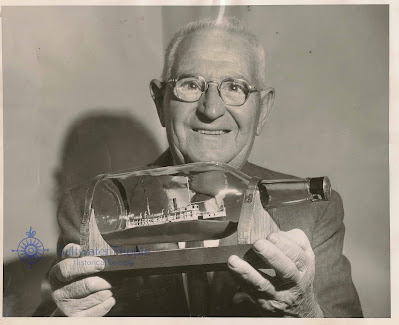
Captain Louis Van Bogaert
with his prize of friendship from 
craftsman Ralph Hitchcock, Seattle, 1965.
The steamer Rosalie, his sweetheart.
Original gelatin-silver photograph from the archives 
of the Saltwater People Historical Society©

"Capt. Louis Van Bogaert who retired in 1957 after 54 years on Puget Sound vessels, 
had a special fondness for one boat, the ROSALIE.
      He had gone to work on the ROSALIE as a watchman in 1910. Later he was second mate, then first mate, and finally, in 1914, her skipper. So the captain was especially happy about a gift which he took back to his home in Alhambra, CA, after a recent visit in Seattle.
      It was a bottle with a scale model of the ROSALIE in it. The model was the work of Ralph C. Hitchcock, a past president of the Puget Sound Maritime Historical Society. Hitchcock had driven from California to Seattle with Captain Van Bogaert and on several occasions, Van Bogaert had wanted to stop and look for a bottle with a shipmodel in it. But Hitchcock always found an objection.


Ralph Hitchcock
Ship model maker. 
Photo dated 1965, Seattle.
Gelatin-silver original photo from the archives of
the Saltwater People Historical Society.©

"I'll get you a bottle," Hitchcock kept saying.

But Van Bogaert was surprised when the bottle turned out to have a model which Hitchcock himself had made.
      Hitchcock made the model of the famous Puget Sound passenger vessel FLYER which is in the State Historical Museum in Tacoma, but the ROSALIE is the first model he ever assembled in a bottle.
      The model was in 334 pieces before Hitchcock began assembling it inside the bottle, which has a neck with a diameter only three-quarters of an inch across.
      The ROSALIE, 136 feet long, was built in Alameda, CA in 1893. She carried passengers between San Francisco and Oakland when it cost only a nickel to make the trip.
      Then the ROSALIE came to Puget Sound, but when gold was discovered in Alaska she was put into service between Seattle and the Northland. Among her skippers while she was owned by the Alaska Steamship Co., was Capt. Johnny (Dynamite) O'Brien.
      Much of ROSALIE's service was in the San Juan Islands as part of the Puget Sound Navigation Co fleet. That was where Van Bogaert served aboard her.

Steamer ROSALIE
off the coast of Lopez Island, dated 1907.
click to enlarge.
L.A. Cadwell has marked numbers on the buildings,
the schoolhouse, two churches, the Creamery,
 the Post Office, the Store, and
"part of our orchard", in the foreground.
Original photo from the archives of the 
Saltwater People Historical Society ©


The ROSALIE (L)
Click to enlarge and view the 
 Sidewheeler YOSEMITE
Steaming through the Islands.
Postcard mailed in Eastsound in 1907
Original photo from the archives of the 
Saltwater People Historical Society©

1907, July 7.

"When on the Victoria route a few days ago, the steamer ROSALIE won a fine silver service in competition with the steamer VICTORIAN in a voting contest to determine which was the more popular vessel." Good going, Rosalie!
        The ROSALIE's career came to an end 22 June 1918, when she caught fire while tied to a pier of the Duwamish Waterway and was a total loss." 
Words with no byline from the Seattle Times Oct. 1965


23 January 2017

❖ MOSQUITO FLEET MONDAY ❖ CHIPPEWA––AGROUND NEAR CAPE HORN ❖


STEAMER CHIPPEWA

127440
Dressed ship for her first run
to Victoria, BC.

Moored in front of the Empress Hotel.
Original photo from the archives of the S.P.H.S.©

Once a splendid, twin-stack, passenger steamship launched in Toledo, Ohio in 1900, the CHIPPEWA was designed to run as a fast commuter ship on the Great Lakes. She did so for seven years before a sale was negotiated by Joshua Green of the Puget Sound Navigation Co. with Arnold Transportation Co. Green's partner, Charles E. Peabody, negotiated to purchase two other steamers, the INDIANAPOLIS and the IROQUOIS.
      A mechanical overhaul was done on the CHIPPEWA at Hoboken prior to the departure on the afternoon of 18 February 1907, Capt. McClure, commanding and C. F. Bishop as chief engineer.
      On her trip west to Seattle, she traveled 17,500 miles on the Cape Horn passage. She spent 54 days, and 17 hours of actual running time with some extremely rough weather in the Strait of Magellan.
      Trouble began soon after the New York harbor pilot was dropped. Fires started throughout the ship as seawater shorted out the electrical cables. The navigating lights went out, the boiler injector pipes began to leak, pipe joints blew out and the forward bulwarks were stove in. "Everybody is sick and everything going wrong," wrote Bishop in his engine room log. Saltwater kept getting into the boilers and it was necessary to shut one of them down completely for much of the voyage. On 24 March, just south of deadly Cape Horn at the entrance to the Straits of Magellan, the CHIPPEWA twice went aground; (click on "read more" just below ––

31 May 2014

❖ SOUND SKIPPERS ❖ June 1933 ❖

Date, ferry, location, master, all unknown.
We do know it is an original photo by Aashel Curtis.
From the archives of the S. P. H. S.
Click to enlarge.
This is the time of the year when folks start getting acquainted with the Puget Sound ferry captains. Whether you are a daily commuter to Vashon or Bainbridge Islands, the Kitsap County mainland, or a passenger on the longer ferry trips on Puget Sound, it's worthwhile to know who is the captain of the boat on which you are riding
Capt. Louis Van Bogaert with unknown passenger

to many Seattleites, the Sound skippers need no introduction. They're institutions. Take Capt. Wallace Mangan of the ferry CHIPPEWA, for instance. He's been on the Seattle-Bremerton route for 22 years and his alternate, Capt. Thomas Sumner has been a Sound skipper for Puget Sound Navigation Co for 14 years.
S. S. IROQUOIS Menu
with Captain L. Van Bogaert listed as skipper, 1938.

From the archives of the S. P. H. S.©
  Among the Black Ball Line few skippers have a better record than Capt. Louis Van Bogaert of the IROQUOIS that runs between Seattle and Victoria, BC, via Port Angeles. Capt. Van Bogaert has been with the company since 1904 and has often saved small craft in distress. [Capt. Louis, who was raised on Orcas Island,  retired in 1957 after working on the water his whole career.]
      Manchester commuters could be offended if Capt. James Anderson and Capt. George Clements, alternate on the ferry CROSLINE, were not mentioned while Capt. Lawrance Crowley of the ferry QUILLAYUTE running between Edmonds and Port Ludlow, has been on the Port Ludlow route since its establishment and has hundreds of friends on the Olympic Peninsula.
Captain Clarence Lampman 
Dated original stamped 14 August 1961.
From the archives of the Saltwater People Log©

      Other popular Sound skippers are: Captains Clarence Lampman and Lyle Fowler of the ferry SEATTLE, running between Bremerton and Seattle; 
      Capt. Ole Rindal of the ferry INDIANAPOLIS on the Edmonds-Port Townsend route; Capt. Walter Murry of the ferry AIRLINE on the Seabeck-Brinnon route; Capt. A. N. Draper of the SOL DUC on the Seattle-Kingston route; Capt. S. F. Hunsiker of the Mukilteo-Columbia Beach route; Capt. Oliver van Nieuwenhuise of the COMANCHE on the Straits route; Capt. John Oldow of the Gooseberry Point-Orcas Island route and Capt. Carl Stevens of the excursion steamer TACOMA.     
      The Kitsap Ferry Line, operating boats to Vashon, Bainbridge Island, Rolling Bay, and Poulsbo also has its familiar captains, many of whom are veteran Sound navigators like Capt. C. T. Wyatt, who alternates with Capt. Tom Birkland on the run to Port Blakeley. There's Capt. Ward Henshaw of the Str. WINSLOW that runs to Eagle Harbor points. And Capt. Arney Rodal of the MANITOU, which runs between Seattle and Rolling Bay points, not to overlook the popular Capt. Jim Shaw of the VASHON who keeps on schedule despite the fact that he has saved more than one man from missing the "last boat" by waiting a few minutes.
      
The highly regarded Captain Sam Barlow
and the ROSALIE
serving the San Juan Islands.
Three photos from the archives of the S. P. H. S.©
      No list of Sound skippers would be complete without mention of Capt. Sam Barlow of the ferry ROSARIO on the Anacortes-San Juan Islands route. The holder of one of the oldest master's licenses on Puget Sound, Capt. Barlow [born on Lopez Island] was an early captain on the old ROSALIE, one of the first Black Ball steamers.
Above text published by The Seattle Times, June 1933     
      

13 October 2012

❖ A Ship for Captain Louis Van Bogaert ❖


Captain Louis Van Bogaert

Original 1957 photo
from the archives of the S.P.H.S.©
"Captain Louis Van Bogaert, who retired in 1957 after 54 years on Puget Sound vessels, had a special fondness for one boat, the ROSALIE.
      He had gone to work on the ROSALIE as a watchman in 1910, later he was second mate, then first mate, and finally, in 1914, her skipper.
      So the captain was especially happy about a gift that he took back to his home in Alhambra, CA, after a visit in Seattle.


Ralph C. Hitchcock

Ship model maker, 1965, Lopez Island.
Original photo from the
archives of the S. P. H. S.
      It was a bottle with a scale model of the ROSALIE in it.
      The model was the work of Ralph C. Hitchcock, a retired Boeing engineer. In retirement he became a professional model builder, producing 22 models, most all of museum quality. Mr. Hitchcock and his wife lived on Lopez Island for several years and bestowed 3 ship models to the collection of the Lopez Historical Museum. His work also went to the Puget Sound Maritime Historical Society, the WA. State Hist. Museum and the Smithsonian.
     Hitchcock and his wife, Eva, had driven from CA to Seattle with Capt. Van Bogaert and on several occasions Van Bogaert had wanted to stop and look for a bottle with a ship model in it. But Hitchcock always found an objection.
      'I'll get you a bottle,' Hitchcock kept saying.
      But Van Bogaert was surprised when the bottle turned out to have a model which Hitchcock himself had made.
      Hitchcock made the model of the famous Puget Sound passenger ship the FLYER which is in the aforementioned State Museum at Tacoma, but the ROSALIE is the first model he ever assembled in a bottle.
      'And it only took twice as long to make as I thought it would,' he said. That made it an 85-hour job.
      The model was in 34 pieces before Hitchcock began assembling it inside the bottle, which has a neck with a diameter of only three-quarters of an inch across.
      The ROSALIE, 136 ft, was built in Alameda, CA in 1893. She carried passengers between San Francisco and Oakland when it cost only a nickel to make the trip.
      The ROSALIE came to Puget Sound, but when gold was discovered in AK she was put into service between Seattle and the North. Among her skippers, while she was owned by the Alaska Steamship Co was Capt. Johnny (Dynamite) O'Brien.
      Much of the ROSALIE's service was in the San Juan Islands as part of the Puget Sound Navigation  Co. fleet. That was where Van Bogaert served aboard her.
      ROSALIE's career came to an end 22 June 1918 when she caught fire while tied to a pier on the Duwamish Waterway and was a total loss."
The above text from The Seattle Times. 1965
Ralph HItchcock recorded that he had made 22 ship models up to this date.


Steamer ROSALIE, 
West Sound, Orcas Island, WA.
The captain left his Orcas home 
in 1903 to sign on the  
shrimper VIOLA. 
He worked on the water for 54 years.
When a passenger asked him if he knew 
where all the rocks were on his route--
he replied--'No, But I know where they aren't."

Photo from the archives of the S.P.H.S.©


Archived Log Entries