"The Cure for Everything is Saltwater, Sweat, Tears, or the Sea."

About Us

My photo
San Juan Archipelago, Washington State, United States
A society formed in 2009 for the purpose of collecting, preserving, celebrating, and disseminating the maritime history of the San Juan Islands and northern Puget Sound area. Check this log for tales from out-of-print publications as well as from members and friends. There are circa 750, often long entries, on a broad range of maritime topics; there are search aids at the bottom of the log. Please ask for permission to use any photo posted on this site. Thank you.
Showing posts with label Puget Sound. Show all posts

02 May 2025

ENJOYING THE ARCHIPELAGO, with JUNE BURN, 1929.


Views of the Archipelago as 
wanderer June Burn cruised from
her home in South Bellingham,
through the islands and home 
again in 1929.
Photographs by Ellis, Jacobson, 
and Clyde Banks Studio.
Click image to enlarge. 
From the archives of the
Saltwater People Historical Society.

"Just one week from today, I left Bellingham bound for the islands. Another too-perfect day for the return. 

Dazzling sunshine and water ruffled prettily with a wind from over the sea and far away, pushing up the water into little humps that spill over on each as if in conscious play. There is a sense of awareness about the water, as if it responded voluntarily to the playful pushes and pulls of the wind, as if it ran sprawled upon the beaches just for fun.

The bluffs and beaches, coves, and villages of the island shine in the sun as if they had all just come home from the laundry. The Olympics behind us, Mount Baker softened by the thinnest veil of gray haze to the right of us, the white Cascades thrilling in front of us, Canada to the left and autumn-sweet islands around--if anybody thinks he can paint a picture to compare with that, let him try!

Down the channel again past Prevost, and Waldron,  Deer Harbor, West Sound, Orcas, and Shaw, on over the three-hour run from Shaw to Belingham. I have my nose buried in my typewriter this heavenly day, racing to gather the harvest of my days in the islands before other days come swarming down upon me. We are in Bellingham Bay before I know it, the tip of Baker just disappearing over Chuckanut Mountain, across Eliza Island.

"There are more deer on Eliza Island than in the rest of the state of Washington." I hear one of the boatmen say. "They swarm around the cookhouses, so thick you can't get in. But take those same deer when they swim over to Lummi Island, and you can't get near them. They know they are protected here all right."

The neat white cement plant is the first building I can see as we draw in sight of Bellingham. Then, around the Point of Eliza, the smokes of Bellingham and the city itself pour down from all the hills into the bay. Are those the Selkirks over the horizon north-by-west? Shadowy through the yellowish-purple mist?

Five blackfish come spouting up the bay alongside the San Juan II. We leave them behind while we race over the wide harbor towards the city.

Like a wide, deep amphitheater is Bellingham swinging down and around the hills from south to north, the curve narrowing and deepening as we draw closer. South Bellingham in the sun is as colorful as a flower garden or as Heather Meadows in  October. Tan and yellow and red and white against the brown and green of the hill. The Fairhaven Hotel is like a feudal castle nestled at the foot of the hill, while the new hotel in North Bellingham is like a young skyscraper. The smokes remind me of a New England factory town, while the beauty of the scene is like nothing but Puget Sound. 

And Baker! You can't lose that mountain for long at a time! Here she is, her head and shoulders thrust up again over the hills! She is reminding me that Mr. Huntoon has promised to take me up that snowy radiance on snowshoes. I am glad to be hurrying back home! I had clean forgotten about that promise in the joy of the islands. What a world full of things to do in Puget Sound! And what a lot of friendly people willing to help you do them!

This is all of the island for a while--until next summer, maybe, though I make no promise! When the big winds come, I shall want to go down to see how the old eagle's nest rides the storm high in the branches of a dead fir tree. And I'd like to climb Constitution in the snow if there is to be snow this winter. I'd like to see how the spray freezes against a yellow bluff and the sun makes rainbows all down the bank of ice. I'd like to go stand on the end of Iceberg Point on Lopez Island and feel the wind beating against me from all over the Strait. You don't know your land at all if you know her only in summer! I think Puget Sound people, of all the people I have ever known, are winter-time folks, too!

See you tomorrow."

Published in the Bellingham Herald, evening of 5 November, 1929.

If you would like to view the vessel on which she jumped aboard, SAN JUAN II, it and more of her writings can be viewed on this post HERE.


30 May 2022

CAPT. THORNTON & HIS TROUPE MEET THE TROOPS, ROUND THE CLOCK.


Capt. W.P. Thornton
and Barbara Mercer.

Barbara joined the captain at the wheel
to take a last-minute peek at her
audience across the water on the troopship,
troopship before she braved the 
icy wind to go into her act.
The girls did not let the cold weather
affect their enthusiastic welcome 
 to the returning troops. No matter 
the hour or weather, the Welcome Ship  
 and U.S.O. entertainers were there
to greet returning troopships.
Click the image to enlarge.
Dated 10 Feb. 1946.
Original gelatin-silver print from the archives
of the Saltwater People Historical Society©


WELCOME HOME

Capt. W.P. Thornton watched the goings-on
on his little ship with amusement.
The short trips he made in the
Welcome Home were routine to him. 
Capt. Thornton was a youth when he joined the 
Coast Guard, and has chased smugglers of Chinese,
including Pirate Kelly, and rum runners. Now he's 
proud of his new work and his traveling chore of 
transporting the welcoming troupe ––to greet 
the returning servicemen.

Unknown photographer. Gelatin-silver print 
from the archives of the 
Saltwater People Historical Society©


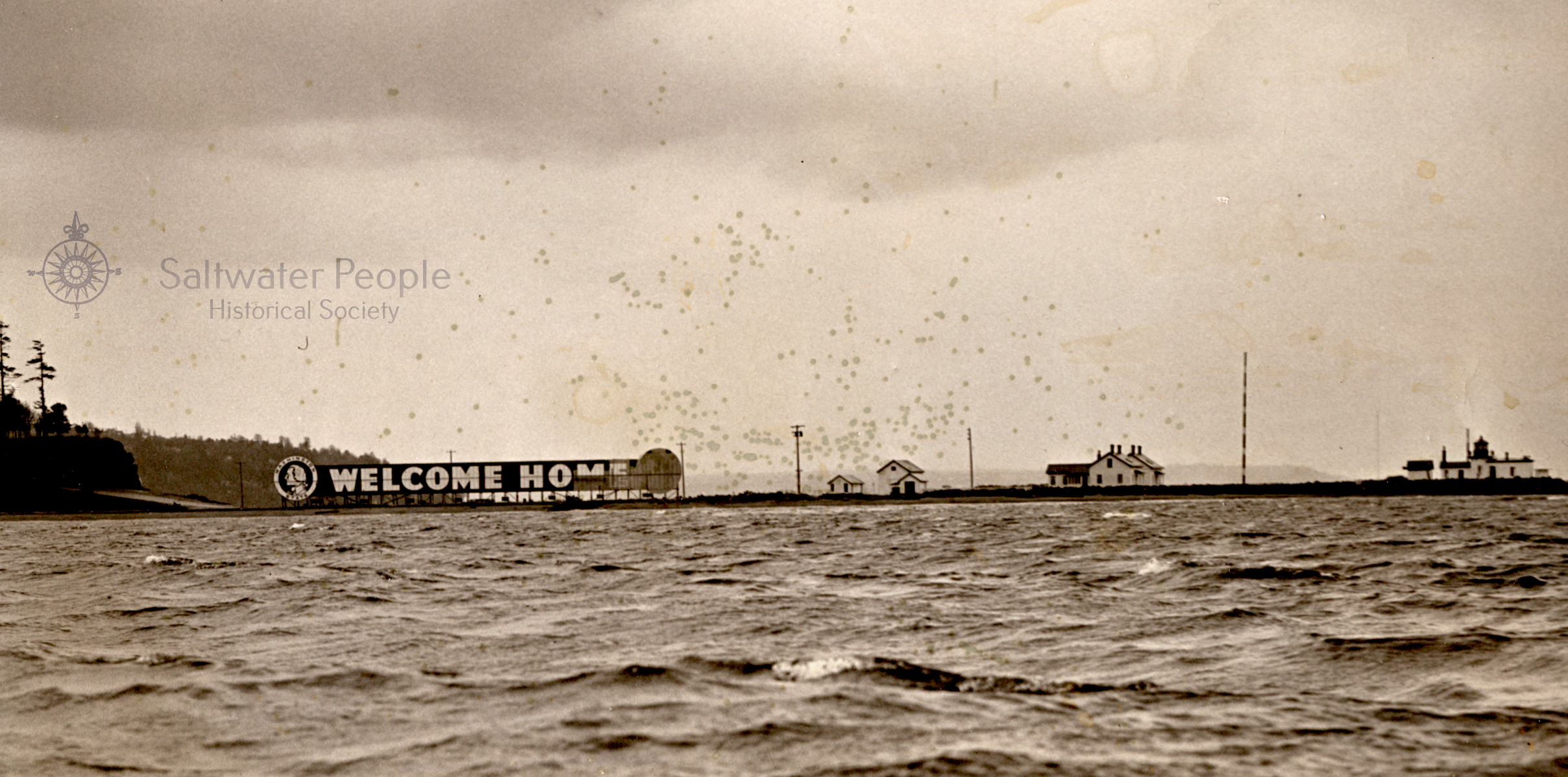
This huge sign built on West Point
to greet returning veterans was lit
at night with floodlights.
The Seattle Sportsmen's Club campaigned
for half the total cost, $9,000, and
the state paid the other $4,500. 
In the background can be seen the
old-time "West Point Light,
 which guided mariners into Seattle
since before 1880.
On a clear day, the sign can be seen
from Point No Point
nearly 15 miles away.
Click the image to enlarge. 

Gelatin-silver photograph from the archives of the 
Saltwater People Historical Society©


Seagoing "riots" broke out when
troupes met troopship in Seattle 
 and delighted roars came from 
thousands of G.I.'s hanging
over the rails of their vessels 
when they glimpsed the U.S.O.
entertainers on the Welcome Home
boat sent out by the 
 Seattle Port of Embarkation.


Always aboard the welcome
vessel were seven U.S.O. gals and
a Seattle woman, Barbara Mercer,
 a night-club entertainer,
who always accompanied
the troupe with her
baton-twirling act on the deck.
 The troupe also included 
an accordionist, a dancer,
and singers.

Source: Some text by Betty Cornelius for the Seattle-Times, Feb. 1946.

15 May 2022

INLETS OF PUGET SOUND with June


June Burn
Original photo from the archives of the 
Saltwater People History Society©

"Be as greedy of happiness as you please and charge it to my account! We didn't think, last New Year's Day, that January 1930, would find us playing around the inlets of Puget Sound with Vancouver, did we?
          Whidbey returns from Bellingham Bay, named by Vancouver in all probability for Sir William Bellingham, and describes it: "It is situated behind a cluster of islands, from which a number of channels lead into it . . . It everywhere affords good and secure anchorage. Opposite its north point of entrance, the shores are high and rocky, with some detached rocks lying off them. Here was found a brook of most excellent water. To the north and south of these rocky cliffs the shores are less elevated. . . where some of those beautiful verdant lawns were again presented to our view . . . the forests were composed of an infinitely less variety of trees and their growth was less luxuriant. Those commonly seen were pines of different sorts, the arborvitae, the Oriental Arbutus (is this the madrona?) and, I believe, some species of cypress. On the islands, a few small oaks were seen with the Virginiana juniper . . .
          Every smallest bay and cove and inlet has now been examined from Port Discovery down to Budd Inlet, back northward into Canada as far west as Texada Island. It is hard to conceive that so much territory has been covered in two months-– from the last of April to the last of June. It has been possible by working for several crews day and night, going short of provisions to finish a set task, staying out in the rain, and forever keeping at it.
          While Vancouver's party was up in Canada discovering and exploring and naming channels and islands, and the Chatham with Mr. Whidbey was exploring Bellingham Bay, the Discovery had taken a run over to the San Juan Islands to try to make a picture of them. But they couldn't make heads or tails of all those little coves and capes in the time at their disposal. For all general purposes to get them down as islands in a group was sufficient. Besides which, none of them seemed to think much of our islands, a lapse in appreciation. I find it hard to forgive Vancouver and Menzies – the rest were exploring with so much work to be done, probably.
          There is nothing to do now but to go on towards the west and during July and August, explore that vast meandering labyrinth of islands and tiny inlets and bays off Vancouver Island and up in the northwestern corner of the Sound country. The Spanish vessels join Vancouver's party and the four ships proceed together, ___?___portions of the country to explore, the officers of the boats having dinners and good times together.
          Point Marshall, Harwood's Island, and Savary's Island were named on the way. Natives told them they could get through to the ocean up that way, but, while they hoped it was so, they put little faith in the news as knowing too well the savage trick of telling you what he thinks you want to hear!
          In this neck of the woods Vancouver proves himself as able to describe ugliness as he had been able to praise beauty at Port Townsend not 200 miles to the southward: " . . . as dismal and gloomy an aspect as nature could well be supposed to exhibit . . . dull and uninteresting . . . dreary rocks and precipices that compose these desolate shores . . . Our residence here was truly forlorn: an awful silence pervaded the gloomy forest, whilst animated nature seemed to have deserted the neighboring country, whose soil afforded only a few small onions, some samphire, and here and there bushes bearing a scanty crop of indifferent berries . . . and not a fish could be tempted to take the hook." I think he is very tired. Worn out with so much beauty, so much exertion. If he had got here first and to Port Discovery last the whole story might have been reversed. I once heard a homesick girl from Kansas say she didn't like our islands ––they were so barren! From Kansas, mind you! I never did understand what she meant, and here is Vancouver calling them barren, too. Well, she was homesick and he was tired.
          Point Mary, Point Sarah, Bute's Channel, Point Mudge, Stuart's Island, Loughborough's Channel and Desolation Bay, where they were so miserably camped, were all explored and named. And Mr. Johnstone did find that hoped-for channel through to the great ocean. It was named Johnstone's Straits for him. On one shore of the straits, Natives were found possessed of muskets and knowing well how to use them. One of the deserted villages they found to be protected by a very ingenuous fort–– so well constructed that they would have doubted that Natives had lived there if they hadn't found their implements, bones, and old clothing. Several of the officers–– both Spanish and English–– examined the discarded clothing so closely that they had to go jump into the Sound immediately afterward. But that gave them no relief so they boiled all their garments, and presumably washed their heads in hot water to kill the myriad of fleas.
          Hardwicke's Island, Point Chatham, and Thurlow's Island were named by Vancouver. I suppose it was the politeness of the Spanish that permitted the English captain to do the naming. They were all working together, but I find no hint here in the journal of Spanish given names, around here. The Spanish vessels that leave of Vancouver as he starts through Johnstone Straits for the ocean. I wonder where they go. And if it is on this trip that they name our islands SAN JUAN ARCHIPELAGO.
          On through the "inside passage" the English ships go naming as they proceed, first the Discovery and then the Chatham going aground on rocks, until at last, they come out into____?_______ exploring inlets and naming them. Finally, they turn towards Nootka and Quadra, who, they have heard several times, awaits them very impatiently, arriving on 28 August 1792. Thus ends a more thoroughgoing examination of Puget Sound than we were to have until 1838, and so ends the most fascinating journal of exploration I have ever read. See you tomorrow. June."

June Burn. Puget Soundings published 1 January 1930.

06 January 2021

❖ CAPTAIN WILLIAM P. THORNTON ❖


Capt. William P. Thornton (L),
veteran Puget Sound mariner.
With him, the well-known writer Gordon Newell 
who learns the history of the Duwamish, in the 
background, first placed in service as a coal-burning 
steamer 49 years before this photo was taken in 1959.
The men were preparing for a presentation for the 
annual waterfront reunion and banquet sponsored
by the Puget Sound Maritime Historical Society 
at the Hotel Edmond Meany.
Original photo from the Marine Salon collection 
dated 29 Sept. 1959 from the archives 
of the Saltwater People Historical Society©


Captain William P. Thornton was one of the first ferryboat skippers on Puget Sound. He began his maritime career at 12 years old, after moving to Friday Harbor from the midwest. He spent the rest of his professional life in marine activities and became prominent on the waterfront. He was a member of the crew of the Lydia Thompson when the vessel went aground off Orcas Island in 1898.

The crew of the S.S. Lydia Thompson
that ran aground on Barrel Rock,
off Orcas Island, 
San Juan Archipelago, WA.
15 December 1898
Here they were camped with the ship's wheel,
at the old Guthrie Place 
near Grindstone Harbor, Orcas Island.
 They were hauled off
the rocks on 27 December 1898.
Standing L-R: Whitlies, sailor; Charlie Mickelson, fireman;
Capt. E.V. Ruger; Clay, cook; Wait, messman; Fred Hall, sailor;
Red Shuler, fireman;
William P. Thornton, stevedore.
Sitting, front row.
Casey, sailor; Clarence Kline, sailor;
Bats, asst engineer; Millard Hutchinson, first mate.
Photo from the archives of the 
Saltwater People Historical Society©

      Shortly thereafter he obtained his captain's papers and commanded a Revenue Service ship on the Sound.
      Capt. Thornton also skippered ships in the Alaskan trade and "mosquito fleet" ships, small passenger vessels for Puget Sound Navigation Co. In 1906 he scored a first by agreeing to take a Stanley Steamer aboard his vessel at Hoodsport and take it to Seattle. It was the first automobile to be ferried across the Sound.
      Capt. Thornton was a port captain in Seattle for the PSNC from 1914 to 1923. He then had his own tugboat business and later operated the Seabeck-Brinnon Ferry Line on Hood Canal until retiring in 1932.
      He left retirement during WW II to serve as a captain in the Army Transport Service, commanding a gunnery -- training ship out of Seattle.
      He also commanded the "Welcome Home" ship that greeted troop ships returning from the war.

Captain Thornton was a member of the Puget Sound Maritime History Society.
Text by the Seattle Times. 1959

01 January 2021

❖ CHASING RUM ON PUGET SOUND ❖

Lucile McDonald (1898-1992) was an amazing journalist/historian/author on the prowl for Washington State history. Let's once more follow her trail through Puget Sound when she was beach-combing for tales of the rum-running days during the Prohibition Era.

~~~~~~~~~~~~~~~~~~


Roy T. Lyle,
Federal prohibition chief, 1 June 1922,
with part of the shipment of "salt fish" liquor 
seized in a Seattle freight shed.
Click image to enlarge.
Original photo from the archives of the 
Saltwater People Historical Society©
If one waits long enough, almost any true experience becomes a collector's piece.
      National Prohibition ended in December 1933; it was the following March before Washington's first state liquor stores were in business.
      For nearly 14 years the entire United States had been dry. Washington had suffered thirst four years longer than that because of a Prohibition Law of its own, effective 1 January 1916.
      Sufficient time has elapsed so that minor actors in the drama of the Prohibition Era feel that now their part can be told. One of them volunteered the information that he was hired to work on a farm at Washington Harbor, Clallam County, and discovered its owner was a bootlegger, ostensibly raising turkeys and hay. The main purpose of the hayfield was to conceal a ditch in which liquor was stored.
      Another told how his father had moved from Samish to Sucia Island because farming was not as profitable as repackaging liquor goods. He removed bottles from boxes and repacked them in gunny sacks.
      "Yes, but some other repackaging was done, and not always on the level," another man commented. "You might be paying $120 a case for good liquor. You received it in a straw-stuffed gunny sack with a handle. You opened it and what did you have--three bottles of good liquor and the rest of the bottles filled with tea!"
      One of the men who gave stories to the State had been employed on a railroad. He related that a small-time bootlegger proposed that a train conductor let him store cases of whiskey between the walls of the caboose.
      Space was found for four cases each trip. They had cost $50 apiece in Canada and the bootlegger doubled his money in Bellingham.
      "He made $2,500 a month easily," said the trainman.
      "He paid me $10 a day just to stay in the car so that nobody would hijack his goods."
      The same narrator recalled deliveries made in Bellingham with buttermilk jugs, painted white, filled with moonshine retailing at $8 a gallon. Painted milk bottles also were delivered, customers paying $3 a quart "for that kind of milk."
      The trainman spoke of shingles which were loaded by the carload at a Canadian mill, where a bootlegger would have an arrangement to place some of his wares on board at the same time.
      Shingles would be piled densely in front of the car door and, when customs officers inspected the car at Blaine, the contents looked innocent. Hijackers, however, sometimes received a tip on the number of the car and stole the liquor before it reached its destination.


Coast Guard cutter Arcata
with a captured "rum runner" vessel.
Stamped with date of 25 August 1924.
From the archives of the 
Saltwater People Historical Society©


Speedboats carrying contraband cargo came directly to Seattle and landed cases on piers or at suburban beaches. Some commonly passed through the Government Locks and put their cases ashore on a county wharf at the foot of Stone Way. A man who worked at a boathouse nearby said that two or three trucks stopped there regularly at night to pick up liquor.
      Shipments for large-scale bootleggers left British Columbia ports on "mother" ships, ostensibly bound for Guatemala and Mexico. They hove to outside the 12-mile limit and discharged into "daughter" ships, which delivered the contraband cargo to the San Juan Islands, where they were met by speedboats. These in turn carried the goods to Seattle or nearby points.
      In 1925, the Coast Guard employed 22 vessels on Puget Sound and in nearby waters to lie in wait for the liquor craft. Frequently a thrilling chase occurred, when the sound of firing brought Whidbey Island residents out in the night to watch the pursuit from the bluffs.
      If a fleeing craft ignored a signal to halt, the Coast Guard fired a shot across the bows. If the fugitive vessel still did not stop, the Coast Guard unlimbered a Lewis machine gun.


Coast Guard with their Lewis gun on deck.
Motoring out of Anacortes, WA.
Photo dated 1931 from the archives of 
the Saltwater People Historical Society©

      Sometimes, if badly shot up, a pursued vessel made a crash landing on a beach and the crew disappeared in the bushes. Most bootleg vessels were faster than the patrol craft and could outrun them.
      Liquor commonly was packed 12 bottles to a gunny sack. Sometimes these were towed from the stern, ready to be cut adrift.
      One method of delivery was to place rock salt and cut cork with the bottles in the sacks. They sank when dropped overboard, but a few hours later, after the salt had dissolved, the sacks were floated by the cut cork and retrieved by a watch onshore.
      Liquor frequently was stowed under lumber, logs, and sawdust on barges in tow from Canada, or buried on sand scows. It might be shipped in barrels and kegs, in metal pipes that appeared to be part of engine-room fittings, or in a gasoline tank supposed to contain fuel.
      In the last years of the Prohibition Era, one former Coast Guardsman said, the heavy traffic was in canvas bags fastened underneath log rafts being towed.
      "A tugboat fellow," he related, "told me about a tow of cedar logs from Ladysmith with a queer gimmick. Several hollow logs were filled with cases of liquor and the ends were plugged with sacks of sand."
      The former officer's most unforgettable adventure had to do with a craft that always carried a cargo of scrap metal. The skipper made about three round trips every week into the San Juans ostensibly buying old iron. It always looked the same and the revenue men were suspicious.
      One night in 1925 off Point No Point, the craft went by in the kind of weather that would send most vessels to shelter. The revenue cutter went alongside and hailed the skipper.
      "One of the seamen--he was just a kid--noticed a short piece of rope trailing in the water," the former Coast Guardsman said. "He snagged it with a pike pole, gave a strong pull, and, as it came loose a case of whiskey came with it. The searchlights were turned on and we could see a secret compartment built under the keel. We had tapped that boat all over and it never gave forth an echo, the false bottom was so cleverly built. It had space for 24 cases.
Text above by Lucile McDonald for the Seattle Times 1961.


19 August 2020

❖ Champion of Gallant Tradition ❖ with Ralph Andrews


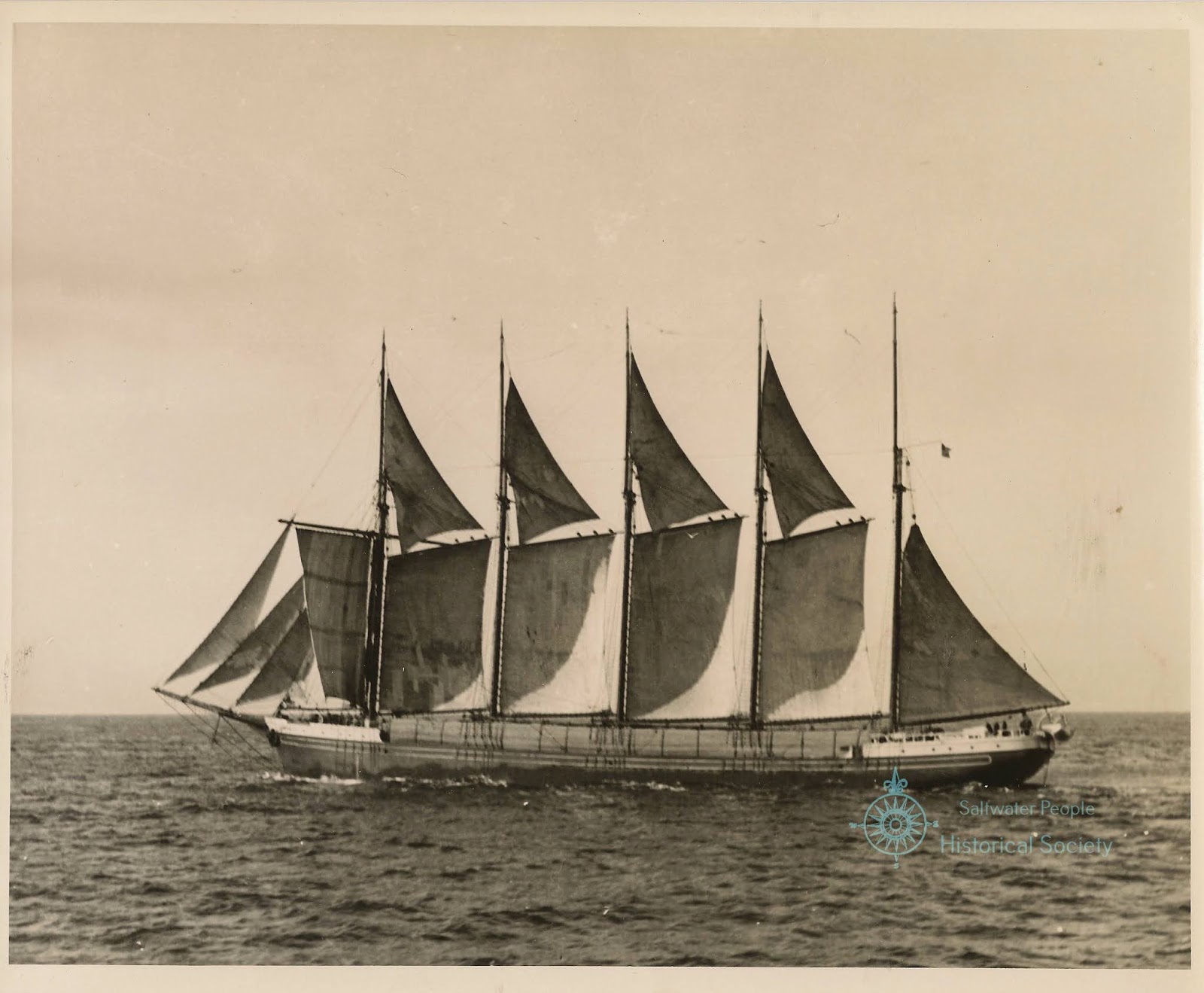
Schooner VIGILANT
Skippered by the famous Capt. Matt Peasley
and later by Capt. Charles H. Mellberg.
From the archives of the
Saltwater People Historical Society©
Her five masts standing as staunch monuments to sea trade of a past era, the sturdy schooner VIGILANT was last of the sailing ships regularly engaged in commerce between Hawaii and the Pacific coast.
      "Owned by the City Mill Company of Honolulu, the vessel is employed every summer to transport millions of feet of lumber from the Pacific Northwest to Hawaii. When she rounds Diamond Head with her sails filled and her big sticks straining, she's a proud sight that makes Hawaii forget for the moment that this is an age of clipper planes and trim motor freighters.

Capt. Charles H. Mellberg
Photo dated 1932.
Click image to enlarge.

Photo from the archives of the 
Saltwater People Historical Society©
      Freshly painted after a year of idleness in Bellingham, Washington, she arrived in Honolulu recently 25 days out of Puget Sound. Her master, Capt. Charles Mellberg, reported an uneventful crossing distinguished by unusually favorable winds, which carried her along steadily for most of the distance and promised for a time to assist her in beating her best previous record of 17 days. But as she neared the islands the breezes withdrew their aid and teased her into port with occasional puffs. For one crossing last year from Bellingham to Honolulu she took 55 days.
      

Capt. Matt Peasley
Dated 1929.
Original photo from the archives of the
Saltwater People Historical Society©
      Honolulu waterfront men remember the days when Capt. Matt Peasley, original of Peter B. Kyne's 'Cappy Ricks' stories, used to bring the schooner into port. Old-timers remember, too, the friendly rivalry between the Vigilant and the Commodore, now shorn of her masts and used as an Alaskan oil barge.
      Still fresh in the memories of many local waterfront observers is the race from Honolulu to Seattle in which these two gallant vessels engaged in November 1931. The COMMODORE departed from Hawaii for the Sound November 20 of that year. She made fair progress; was comfortably on her way when the VIGILANT sailed for the same destination six days later.
      Favorable winds carried the COMMODORE straight up to the Strait of Juan de Fuca, where they dropped her like a punctured balloon and left her to icy winter squalls and tricky currents. She was taken in tow by tugs dispatched to her assistance. But before she could be brought into peaceful sound waters a storm caught her, broke the two lines, and drove her out to sea. The VIGILANT which had trailed her by more than 1400 miles up to that time, skirted the storm and scudded triumphantly into the Sound to be declared the official winner."
Ralph Andrews. This was Seafaring. Seattle. Superior Publishing. 1955
      

02 August 2019

❖ STEAMERS OPENED PUGET SOUND TRAVEL

Northwest Washington State
with Puget Sound.
Click image to enlarge. 
Map published by C.P. Johnson Co., Seattle.
"Residents of western Washington, ever since the early days of civilization here, have faced the crossing of Puget Sound.
      The only change is man’s struggle to cross the Sound. And man struggles with man, as well as with the Sound, for there still are those who curse and those who bless Peter Puget’s waterway.
      This is the story of that struggle.


Port Blakeley, Puget Sound, Washington Territory.
Verso dated 1882.
Ships await loading with steam rising from the sawmill
in background. Lumber shipping was one of
the first industries in the Sound.
Click image to enlarge.
Original photograph by Huff, from the archives
of the Saltwater People Log©
Port Ludlow
Photo by Torka Studio, Pt. Townsend, WA.
Port Ludlow, WA.
47°55'25" N   122°40'32" W
Listed on the map above.
      In the beginning, there was timber. They were all sawmill towns... Port Ludlow, now just a yachtsman’s pleasant harbor dozing in the memory of her great mill; Port Gamble, her historic mill; Port Madison, a maritime suburbia; Port Blakely, her modern homes not quite erasing all the remnants of what once was the world’s largest sawmill, and Seattle, a metropolis whose historians still remember Yesler’s Mill.
Port Gamble, WA.
Click image to enlarge.
Port Blakely
Milling & Shipping Lumber on Puget Sound, WA.
Edward H. Mitchell, Publisher, San Francisco.

      So it was that the first organized crossings of Puget Sound were steamers, augmented by company tugs, which obligingly carried passengers, were the first. This was enough. Near the turn of the century, there were no highways; the dirt roads were no highways; the dirt roads did not wander too far from the milltown shores.
      If you wanted to travel, you did so by boat... by the mosquito fleet of passenger vessels. Darting here and there, they served more than 200 communities.
      Fares varied. There were no regulatory bodies. The fare was determined mostly by what it cost a man to operate his vessel, by the competition and by the traffic. In 1872, it cost $1, each way, between Port Blakely and Seattle on the Success, or on the Augusta, linking Port Madison and Seattle. But in 1887, in Poulsbo, you paid .50 cents to reach Seattle by steamer.


Poulsbo, Liberty Bay, Keyport, WA.
Photo by Pacific Aerial Surverys, Inc., Seattle, WA.
From the archives of the Saltwater People Log©

      That's about the way it was until the days of WW 1. By this time, the automobile revolution had forced the building of highways. Man was on the move. He wanted to see the other side of Puget Sound, not just as a foot passenger, but in a shiny, new, black Ford. Larger passenger boats were constructed, with hoisting devices for loading a few cars aboard.


HYAK, RELIABLE, VASHON II
Early Mosquitoes of Puget Sound.

       But this was cumbersome and costly. Thus the era of the ferry, a vessel with at least one end open to permit a person to drive a car aboard.
      In 1919, there were only three ferry runs on Puget Sound: from Seattle to its water separated peninsula, West Seattle; between Des Moines and Portage on Vashon Island, and across the Narrows, between Tacoma and Gig Harbor, technically, the very first “cross-sound ferry run.”
      But in 1920, the Puget Sound Navigation Co, the 'Black Ball Line,' converted the old steamer Bailey Gatzert, into an automobile ferry and put her on the Bremerton-Seattle route, thus creating the first real ferry run to the Olympic Peninsula.
      A similar conversion gave Bainbridge Island its first vehicle-carrying vessel three years later when the Liberty went on the Port Blakely run toting a maximum of 32 Model Ts.
M. V. LIBERTY 
Low res scan from an original from the archives
of the Saltwater People Log©


Steamer PUGET
Dated 8 July 1923
Built originally as a steamboat, here she is being pressed 
into service as a ferry for the Seattle-Port Ludlow route.
Photo from the archives of the
Saltwater People Log©

      Right there, perhaps, was where the man-to-man struggle began over what kind of crossing should be made of Puget Sound. For the car ferry apparently spelled the doom of the passenger-only vessel although whether this should be put down as a permanent 'death' remains to be seen; even now [1964], there is talk of a return to fast passenger-only vessels, perhaps of the hydrofoil design.
      But in the 1920s, the brave “mosquito fleet” began to die.
      The runs serving the western side of Bainbridge Island and their adjacent mainland ports of call were the first to go. In 1924, a tiny, six-car ferry, the Hiyu, began to shuttle between Fletcher Bay and Brownsville. A bus ran between the ferry landings at Port Blakely and Fletcher Bay for the benefit of those who didn’t come by car.
      Mixed up in the struggle of man-with-man was a business rivalry between Black Ball Line and the Kitsap County Navigation Co, also known as the white-collar line. White-collar passenger steamers still served Eagle Harbor, Yeomalt, Ferncliff, Rolling Bay, and around the end of Bainbridge Island to Port Madison. Ferries running from Ballard to Indianola and Suquamish and to Port Ludlow had replaced passenger-vessel service to those and other nearby North Kitsap ports."
Words by Walt Woodward. Kitsap County Herald, 1 April 1964. 

24 July 2019

❖ OLD SHIPS ARE LIKE RARE WINE

4 July 1948 


YACHT EL PRIMERO
Built in 1893 at Union Ironworks,
San Francisco, CA.
The image is inscribed with the name
of the yacht owner,
S. A. Perkins, Tacoma, WA.
From the archives of the Saltwater People Log©
'Old ships are like rare wine –– they improve with age if kept in repair.' That was the observation of Commodore S. A. Perkins, Tacoma capitalist, newspaper publisher, and philanthropist, as he strolled the decks of his sturdy steel yacht, EL PRIMERO, moored in Lake Union.
      'But you must keep them up –– make replacements and improvements from time to time,' Perkins added as he showed visitors the comfortable after deck with its attractive furniture, the cabins, galley, pilothouse and crew quarters.
      'Do you know, the EL PRIMERO is a better yacht than when she was constructed at the Union Iron Works in San Francisco. She was rebuilt three times, once by the Lake Washington Shipyards in 1926. She has four steel collision bulkheads and is double-riveted and double-plated below the waterline.
      The EL PRIMERO is so sturdy she could plow through the heaviest ice floes. She is built like a battleship, pocket-size and can take seas of any height. And she is the best seaboat I ever traveled in. No yacht afloat has more deck space. She has cruised to Honolulu and to every part of Alaska.'
      The EL PRIMERO has a cold-storage plant sufficient for the needs of a cruise from Puget Sound to Alaska and return; a machine with a capacity for 30 pounds of ice an hour, fule capacity for a cruise of 5,000 miles and three heating plants.
      While underway, the steam boiler furnishes heat. There is an independent hot-water plant for time spent in port and as an electrical heating system for the staterooms. Other equipment includes a powerboat, an unsinkable lifeboat, and a life-buoy.
      'Probably more presidents have been entertained aboard the EL PRIMERO than any yacht afloat.' Perkins continued. 'They included Taft, Roosevelt, Harding, and Hoover. And during the Times Cup races on Lake Washington some years ago, the EL PRIMERO carried more Navy admirals than any vessel in existence. She was the flagship at all the Times' Cup races.'


EL PRIMERO
The flagship for the Times Cup races,
Lake Washington, Seattle.
Click image to enlarge.
Original photo from the archives
of the Saltwater People Log©

      Recently, the 137-ft yacht and her triple-expansion compound steam engine were given a complete overhaul at the plant of the Lake Union Drydock Co and after the work was completed, Perkins received a letter from Frank Oliver, the yard's superintendent. It said:
'Hoping all waters on the globe shall prove good cruising for you and yours, and all others aboard who love the sea. Bon voyage to the EL PRIMERO and my good friend, Sam Perkins.'
      Oliver said he found the EL PRIMERO in excellent condition and 'far superior to many vessels of the same age have made ready for sea. In fact, your vessel seems to improve with age.'
      The 17-knot EL PRIMERO formerly was owned by the late Charles Thorne*, Tacoma banker. 
      The EL PRIMERO can carry 125 persons on deck. She has sleeping accommodations for 30 persons and carries a crew of eight men who always address the yacht's owner as commodore. Crew members have their own eating and sleeping quarters.
      Perkins has master's licenses for ships of any tonnage, steam or diesel, on any ocean and also is a licensed pilot.
      Born in Boston, Perkins has large business interests, but the EL PRIMERO is his pride and joy. 'She is in fine condition and we will be shoving off soon on a cruise.' Perkins said. 'Perhaps to British Columbia or Alaska."

Above text from the Seattle Daily Times. 4 July 1948 p.15 
Courtesy of Ronald R. Burke, maritime historian, who submitted this clipping to the Saltwater People Log from his high school scrapbook, 24 July 2019.


EL PRIMERO
Photo by Ronald R. Burke, Seattle.
2013.
*1911: H.W. McCurdy's Marine History of the Pacific Northwest lists Chester Thorne, Tacoma banker, selling the El Primero to S. A. Perkins. The legend is that Thorne lost the yacht to Perkins in a card game.
1919: Listed on the timeline on the home page of the Saltwater People Log there is a short clipping of El Primero getting up steam for a race with Aquilo. Click here
1926: El Primero was extensivley rebuilt at Houghton, WA., for S. A. Perkins.
1954: Sidney A. (Sam) Perkins, 90, died.
The ship lives on at this writing. Update coming soon.


29 June 2019

❖ Little Mosquito to the Summer House

S.S. SENTINEL
1898-1928.
One member of the hard-working Mosquito Fleet,
the photograph is dated 11 April 1913,
Click image to enlarge.
From the archives of the
Saltwater People Log©
"With the first indications of the near approach of the unrivaled summer of the great Northwest, the advance guard of campers, suburbanites, and lovers of the bracing out-of-doors yesterday started transportation of furniture, tents, and supplies to many of the scenic island resorts in the vicinity of Seattle. The steamboat SENTINEL, operated by the Merchants' Transportation Co, left Seattle for Vashon Island points with her holds crammed and decks packed high with campers outfits. Officials of the line said that during the coming summer of 1913, Vashon Island and points on the mainland served by the SENTINEL will be thronged with campers and those making their summer homes out of Seattle. The SENTINEL maintained a service from Seattle to the west side of Vashon Island and ran to Lisabeula, Quartermaster Harbor, Cove, and Colvas."
News clip possibly from the Seattle-Times, 1913.


Upper Puget Sound
 early communities, containing
VASHON-MAURY ISLAND.
Click image to enlarge.
Oceans of thanks to cartographer
Ronald R. Burke, Seattle, WA.

1898: built for the Hunt brothers.
1903: sold to Hansen Transport Co., rebuilt and widened to increase passenger capacity from 100 to 250.
1921: sold to Ed Lorentz.
1928: scrapped and the engine installed in the steamer ARCADIA.

Some of the known officers and crew working aboard;
Capt. Francis Sherman (1899), Capt. A. R. Hunt, Capt. John Dorotich (1910, 1911, 1912.)
Ethan E. "Eth" Emmons, Engineer    

17 November 2018

❖ SMALL CRAFT, TALL CRAFT, ALL SAILORS FIND PORT TOWNSEND

Metsker's PUGET SOUND COUNTRY
with a detail highlighting
Port Townsend, WA., on Admiralty Inlet.
Click image to enlarge.
Windjammers loading lumber, grain, and 
general freight for world markets.
Location,  Port Townsend
1890s.
Click image to enlarge.

Photo print copied by Huff from an original.
Archives of the Saltwater People Historical Society©


U.S. RUSH
Built by Hall Brothers Yard, WA., in 1885
Anchored Port Townsend, WA.
Photo by P.M. Richardson from the archives
of the Saltwater People Historical Society©

Schooner PROSPER
Built by Hall Brothers Yard, WA.
Sailing into Port Townsend, WA.
Click image to enlarge.
Original photo pre-dating 1911
by P.M. Richardson
from the Saltwater People Historical Society©

Barkentine KOKO HEAD
Built 1908 by Hind-Rolph
Sailing into Port Townsend, WA.
Photo by Torka's Studio, Port Townsend, WA.
From the archives of Saltwater People©
Union Dock, Port Townsend, WA. 
Dated 1908.
Litho postcard from the archives of the
Saltwater People Historical Society©

"Port Townsend began with homestead claims filed in April 1851, six months before Seattle's pioneering Denny party landed at Alki Point.
      By 1854 the U.S. Customs office moved here.

U.S. Customs House
Port Townsend, WA.

Litho postcard from the Saltwater People
Historical Society©
It had been in Olympia, which forced sea captains to sail the length of Puget Sound before legally going ashore. Isaac Ebey had been appointed customs collector in 1853, and he campaigned for Port Townsend to be designated as the official port of entry. From his home on the west shore of Whidbey Island, he could see ships turning in or out of the Strait of Juan de Fuca and cross the inlet to clear them.
      With ships required to stop, Pt. Townsend readily grew as a supply center. Its legal services included banking and merchandising and also consul representation by Great Britain, France, Norway, Sweden, Germany, and the independent kingdom of Hawaii.

Union Dock, Port Townsend, WA.
SS CHIPPEWA on the left.
Click image to enlarge.
Photo by P.M. Richardson from the archives of the
Saltwater People Historical Society©
Pt. Townsend's 1850s economy at first depended largely on San Francisco's gold rush appetite for Puget Sound timber. By 1858 and into the 1860s it benefited from gold discoveries on the Fraser River and in the Cariboo District of B.C., thousands of miners streamed north. Through the 1870s Pt. Townsend grew steadily but unspectacularly. For a while it expected to be the West Coast terminus of the transcontinental railroad, a vain hope fostered by the appointment of Judge James Swan as Northern Pacific agent. The tracks stopped at Tacoma instead. Nonetheless, Pt. Townsend burgeoned, boosted by the population surge and overall optimism that rode the rails across the entire state in the 1850s.

Gig ashore, Port Townsend, WA., c. 1910
Original photo from the archives of the 
Saltwater People Historical Society©
       Pt. Townsend slumbered without a major industry until 1927, when a pulp mill opened. In one way, the long lull was a blessing: handsome commercial buildings and homes were neither altered nor razed. They remain as a remarkably intact legacy from the past."
Source:
Above text: Ruth Kirk and Carmela Alexander. Exploring Washington's Past. The University of WA. Press. 1990.

Waterfront, Port Townsend, Washington
Undated photo.


Point Hudson boat harbor with
entries for the Pacific International
Yachting Association's regatta, July 1957.
Port Townsend, WA.
Photographer unknown.
Original photo from the archives of the
Saltwater People Historical Society©
1938 Danish Spidsgatter PIA
S38 D14
Aho'i and Maggie
Home Port –– Olympia, WA.
Early departure from Watmough Bight anchorage,
San Juan Archipelago, 6 Sept. 2018.
En route to meet with 300 wooden boats at the
42nd Port Townsend Wooden Boat Show.
Photo courtesy of mariner Jason Hines,
who sailed to the show in his Danish-built, SVANE.

Point Hudson

42nd Annual Port Townsend Wooden Boat Show
Courtesy of PIA crew Maggie Woltjer©
September 2018.

Our roving reporter/mariner Maggie of PIA©
helps us wrap it up with flowers.
Port Townsend Wooden Boat Show, Sept. 2018.
Wooden Boats Forever.
Thank you to these talented participants;

volunteers, woodworkers, sailors, photographers, florist.

Archived Log Entries