"The Cure for Everything is Saltwater, Sweat, Tears, or the Sea."

About Us

My photo
San Juan Archipelago, Washington State, United States
A society formed in 2009 for the purpose of collecting, preserving, celebrating, and disseminating the maritime history of the San Juan Islands and northern Puget Sound area. Check this log for tales from out-of-print publications as well as from members and friends. There are circa 750, often long entries, on a broad range of maritime topics; there are search aids at the bottom of the log. Please ask for permission to use any photo posted on this site. Thank you.
Showing posts with label San Juan County. Show all posts

02 May 2025

ENJOYING THE ARCHIPELAGO, with JUNE BURN, 1929.


Views of the Archipelago as 
wanderer June Burn cruised from
her home in South Bellingham,
through the islands and home 
again in 1929.
Photographs by Ellis, Jacobson, 
and Clyde Banks Studio.
Click image to enlarge. 
From the archives of the
Saltwater People Historical Society.

"Just one week from today, I left Bellingham bound for the islands. Another too-perfect day for the return. 

Dazzling sunshine and water ruffled prettily with a wind from over the sea and far away, pushing up the water into little humps that spill over on each as if in conscious play. There is a sense of awareness about the water, as if it responded voluntarily to the playful pushes and pulls of the wind, as if it ran sprawled upon the beaches just for fun.

The bluffs and beaches, coves, and villages of the island shine in the sun as if they had all just come home from the laundry. The Olympics behind us, Mount Baker softened by the thinnest veil of gray haze to the right of us, the white Cascades thrilling in front of us, Canada to the left and autumn-sweet islands around--if anybody thinks he can paint a picture to compare with that, let him try!

Down the channel again past Prevost, and Waldron,  Deer Harbor, West Sound, Orcas, and Shaw, on over the three-hour run from Shaw to Belingham. I have my nose buried in my typewriter this heavenly day, racing to gather the harvest of my days in the islands before other days come swarming down upon me. We are in Bellingham Bay before I know it, the tip of Baker just disappearing over Chuckanut Mountain, across Eliza Island.

"There are more deer on Eliza Island than in the rest of the state of Washington." I hear one of the boatmen say. "They swarm around the cookhouses, so thick you can't get in. But take those same deer when they swim over to Lummi Island, and you can't get near them. They know they are protected here all right."

The neat white cement plant is the first building I can see as we draw in sight of Bellingham. Then, around the Point of Eliza, the smokes of Bellingham and the city itself pour down from all the hills into the bay. Are those the Selkirks over the horizon north-by-west? Shadowy through the yellowish-purple mist?

Five blackfish come spouting up the bay alongside the San Juan II. We leave them behind while we race over the wide harbor towards the city.

Like a wide, deep amphitheater is Bellingham swinging down and around the hills from south to north, the curve narrowing and deepening as we draw closer. South Bellingham in the sun is as colorful as a flower garden or as Heather Meadows in  October. Tan and yellow and red and white against the brown and green of the hill. The Fairhaven Hotel is like a feudal castle nestled at the foot of the hill, while the new hotel in North Bellingham is like a young skyscraper. The smokes remind me of a New England factory town, while the beauty of the scene is like nothing but Puget Sound. 

And Baker! You can't lose that mountain for long at a time! Here she is, her head and shoulders thrust up again over the hills! She is reminding me that Mr. Huntoon has promised to take me up that snowy radiance on snowshoes. I am glad to be hurrying back home! I had clean forgotten about that promise in the joy of the islands. What a world full of things to do in Puget Sound! And what a lot of friendly people willing to help you do them!

This is all of the island for a while--until next summer, maybe, though I make no promise! When the big winds come, I shall want to go down to see how the old eagle's nest rides the storm high in the branches of a dead fir tree. And I'd like to climb Constitution in the snow if there is to be snow this winter. I'd like to see how the spray freezes against a yellow bluff and the sun makes rainbows all down the bank of ice. I'd like to go stand on the end of Iceberg Point on Lopez Island and feel the wind beating against me from all over the Strait. You don't know your land at all if you know her only in summer! I think Puget Sound people, of all the people I have ever known, are winter-time folks, too!

See you tomorrow."

Published in the Bellingham Herald, evening of 5 November, 1929.

If you would like to view the vessel on which she jumped aboard, SAN JUAN II, it and more of her writings can be viewed on this post HERE.


27 January 2025

SOLO CANOE PASSAGE WITH TRACES OF SNOW


Errett M. Graham (1877-1974)
Land surveyor and County Engineer
paddling his canvas Old Town Canoe.
Circumnavigating Shaw Island,
San Juan Archipelago
on his 94th birthday. 
Photograph in the calm of June
by Babs Cameron,
from the archives of the 
Saltwater People Historical Society©


Passed on to the Friday Harbor Journal was this quote by Emmett Watson, previously published by the Seattle-P-I in 1970:

        "Sometime quite soon, residents of San Juan County will say goodbye to Mr. Errett M. Graham, the county engineer. What makes this goodbye rather special is the fact that Mr. Graham, now 92, just retired in May. He always paddled his own canoe into Friday Harbor for the meetings of the Board of County Commissioners–ignoring the ferries. He celebrated his 90th birthday by paddling his canoe around Lopez Island. . ."


These words are from the handwritten daily diary of the canoe master, Mr. Errett Graham.

20 February 1951:

"Tough Trip

If I had had even a premonition of the difficulties I was fated to encounter on my return trip today, I would either have stayed over or made a very early start. I landed at a homestead just short of Limestone Point walked over to the point, and saw I couldn't possibly buck the tide there. The man there said that the tide split at Limestone Pt. and that once around it, I should have a favorable tide. I found a road over which I could portage and got in the water again just south of the white Limestone Point. I made a few hundred feet along a nice gravel beach to a rocky and forbidding projecting point at its southeasterly end. Attempting to get around this, I got in some very rough water, shipped several quarts, and made absolutely no advance; in fact, I lost ground and had to land on a coarse rock beach. I took a long walk down the beach to give the tide or wind time to change, and had visions of having to spend the night there. When the whitecaps quieted a bit, I refloated the canoe and made another attempt, succeeding this time and heading straight for Brown Island to make the channel crossing before the tide became adverse again. Water was quite rough, but nothing like it was at Limestone Point. Evidently, the tide did not split at that Point as I had been told; passed east of Yellow Island and touched shore in Squaw Bay tired and chilled. There were traces of snow on Lopez. A hot supper and a bath, the house warmed up. O.K., now."

1951 Diary of Errett M. Graham.
Archived in the Shaw Island Historical Museum

23 January 2025

DOGFISH OIL


Pacific Dogfish
Courtesy of the Monterey Aquarium


The viscous, malodorous extract of the skin and liver of the dogfish was at the heart of the operation of the Port Townsend, Washington area's nineteenth-century lumber industry. This rancid oil was primarily used to grease the skid roads along which lumbermen transported the harvested logs. Hides tanned with dogfish oil were used as drive belts in sawmill machinery. It was the source of nighttime illumination in the mills, which often operated twenty-four hours a day. The crude but effective lighting fixtures were the kettles, similar to and sometimes adapted from a teakettle, with spouts on two sides. The kettles were filled with foul fuel and wicks let down the spouts were lighted. The fetid odor was intensified by combustion. 

The Klallam and Chimakum extracted the oil for use as a paint base and as a seasoning and cooking agent, though not surprisingly the slightly less rank seal or whale oils were favored for edibles. Before extraction caps were established by whites, they traded with the Natives for the oil. Extraction was left to the Native women, who collected the dogfish in discarded dugouts and crushed the carcasses by climbing into the canoes and trampling them. When the fish were sufficiently squashed, the women added saltwater, allowing the mixture to decompose for days or weeks. The oil rose to the top of the noisome brew and was skimmed off. Whites did not improve much on the extraction procedure. They introduced iron-bottomed wooden troughs instead of canoes so a few could be kindled beneath to hasten the process.

Several factors in the mid-1880s marked the beginning of the end for the dogfish industry. Petroleum products, which cost less and were more efficient, became readily available. Skid roads were being phased out in favor of "lokies" (locomotives,) steam donkeys, and logging carts on rails. Carbon arc lighting, a novelty ten years earlier, was common in sawmills by the decade's end. Finally, rubberized belts were introduced into the more modern sawmills, replacing animal hides. Like the stench it created, however, the industry was tenacious, and as late as 1890, fifty thousand 
gallons of oil were produced in Washington plants.
Above essay: "City of Dreams," editor Peter Simpson. Bay Press, Port Townsend, WA. 1986.

And later still...

=======


"In 1906, Bruce Willis was in the port of
Friday Harbor, in his auxiliary sloop,
AILSA, en route to Griffin Bay to fish.
 He sold 30 gallons of dogfish oil here,  
though he says this is not as good a price,
as Anacortes. It brings ten cents more
per gallon there, the prices 
here only being .25 cents."
The San Juan Islander 2 Mar. 1906.

Photo scan from Jane Barfoot Hodde, 
a friend and neighbor of the Willis family
of Olga-Doe Bay, Orcas Island, WA.


A 1907 wanted ad in the 
San Juan Islander newspaper 
from the well-known Robert Moran, 
a new resident of Orcas Island.


=============

" The U and I, Capt. G.I. Peterson of Mitchell Bay was in port the first of the week on her way to Richardson, where Mr. Peterson will dispose of a barrel of dogfish oil to Hodgson & Graham. He is a veteran fisherman and enjoys the life. Each season he goes to Cape Flattery, and invariably makes good. Even last year, when so many barely paid for the gasoline they burned, the captain netted a fair sum. The U and I was specially built for him, after his own specifications and with her, he ventures further out than most boats and stays out in all kinds of weather. "

The San Juan Islander. Friday Harbor, WA. 14 March 1913.

18 June 2024

BIG PACKARD ENGINES RUNNING FOR HOME.


The San Juan Islands
Souvenir Year Book

1930
Published by the
San Juan Islands 
Publicity Bureau
Anacortes, WA.
Click to enlarge.
Original booklet from the 
S.P.H.S. library.

"Even though this was just another trip among the hundreds that we had already made, the adrenalin was burning my stomach sour, it always did, even when the load was gone. Everything done now was done with careful thought; there could be no mistakes. Cold –– it was always cold and dark this time of year in the late afternoon, and the dawn was hours away. Good weather for what we were doing. The mist was swirling about us, visibility only a few hundred yards; the problem was, it worked both ways. The cutter could happen upon us as easily as not, then it would be a desperate run to get out of range and out of sight.

The diesel is muffled and quiet at this speed; the exhaust is muted due to its location beneath the sea; however, if we have to start the big Packards, all that will change. They are warm and should start instantly; we run them up once every hour until we have crossed the line somewhere between D'Arcy Island and San Juan. The darkness pulls at my eyes; we cannot afford the luxury of going below decks, for the winter tide brings out the deadheads. We are loaded with one hundred and fifty cases of scotch whisky that is to be delivered just south of Anacortes tonight.

I turn my head slightly so that I see out of the side of my eye; peripheral vision picks up any small change in light, and it has been as black as the inside of a barrel for what seems like hours. Turn Point slides by on the starboard side, and if we had running lights the keeper would see us, but we are not advertising and it is doubtful that even if anyone knew we were here they would not see us - no lights, muffled exhaust, and a hull painted a dark maroon that blends into the blackness.

It has taken hours to work our way to the rendezvous point, but at least the unloading will warm us up. A shaded light flashes from the shore, twice rapidly and once after a pause - tonight's signal. We drop the anchor and wait for the smaller boat to come out to us. It takes four trips to carry all the cargo ashore, but so far it has been an easy trip, the tide is out, and with any luck, we should be back in Victoria Harbor by dawn.

Now clear of the area, it is time to start the big Packard aircraft engines and run for home; daylight is not a good time to be seen in these waters. I start up the first engine; the noise always surprises me, and the second engine is that much louder. The surge of power throws the boat ahead; we are doing twenty knots with another fifteen in reserve. If the weather holds; if the Coast Guard cutter hasn't planned an ambush; if we don't tear a hole in the hull on a deadhead; if we don't take out a prop on driftwood, it will be a piece of cake. My eyes strain to see the water ahead, watching for the kelp that mark reefs and the debris that every winter tide pulls off the beach; the wind tears at my face and the cold is penetrating; the temperature can only be a few degrees above freezing. Every fourth or fifth wave sends bullets of icy spray back over the wheelhouse; the steering window is open and the spray cuts like a knife. The fog is lifting and the wind has begun to pile the waves into ever-increasing humps that we feel through our legs.


US Coast Guard 
ready for action during prohibition years, 
near Anacortes, Skagit County, WA.
Click to enlarge and view the foredeck.
Photo from the archives of the 
Saltwater People Historical Society©

The light is coming up behind us and the Coast Guard cutter stands out from the land as it rounds the point ahead – he must have been laying in Roche Harbor. The cutter can only hope to sandwich us against South Pender; he knows he can't outrun us, but if he can get close enough to use his one-pound cannon we could be in trouble. We have sea room to manoeuvre and I run the boat up to thirty knots, at this speed, the impact of each wave hammers up through the hull and adds to the din of the engines in full race. A round from the one-pounder raises a plume of water slightly behind us off the port side, the sound drowned by the howl of the engines. We are gaining ground but a turn to the southwest is necessary very soon. We have the distance and the boat heels as the rudder throws us to the starboard lean and we make the turn to port that will take us across Haro Strait. Today we will not return to Victoria, that would just lead to awkward questions from the customs people.

We are out of range and I bring the power back to the twenty-knot cruise range that will give us time to steer around any debris. It would have been nice to have avoided the encounter with the Coast Guard, we could have gone quietly home to a hot bath and to relax. Our extended journey is part of the price we must pay. It will be an hour before my ears stop ringing from the thunderous howl of the big power plants."

Words by Richard S. Soley
Vintage Vessels of British Columbia
Power and Sail, Work and Pleasure
The Classic Wooden Boats of a Bygone Era.

Book donated by the crew of the 1930 Geary-designed Danae, featured with a Rigging Card within this book. 


08 February 2024

DAYS OF BLOOD IN THE EARLY LIME QUARRYS----from 1860-- 1959 with Lucile McDonald


Remains of the old Cowell quarry
stands on a hillside of
western San Juan Island,
where the Island's limestone industry began.
Photo dated 1959.
Click image to enlarge.
Photograph by W.R. Danner.
From the archives of the
Saltwater People Historical Society©

"Geologists this summer (1959) combed the San Juan Islands in a study of limestone deposits, trying to determine how much of the mineral resource remains on the islands and how practical the deposits are for exploitation.

Long ago the white substance furnished the principal year-round payrolls in the islands and was one of the factors in their settlement. Quarrymen, kiln-tenders, and coopers comprised an important part of the population between 1870 and the end of the century. 

Dr. W.R. Danner, a Seattle geologist on the U of British Columbia faculty, headed a crew sent out by the Division of Mines and Geology of the State Department of Conservation to make a comprehensive survey of the deposits in the past three months. He worked mostly in the San Juans and in Skagit County, while Dr. J.W. Mills of WA. State University, with a similar crew, carried on the search east of the Cascades.


Dr. W. R. Danner,
Seattle geologist, at the door of 
a disintegrating limekiln at the former
Eureka site on San Juan Island, WA.
Click image to enlarge.
1959 photograph by Parker McAllister,
from the archives of the 
Saltwater People Historial Society©


Industries such as pulp manufacturing consume enormous quantities of limestone, now being imported into Washington because of lower production costs elsewhere.

At present, only one operator, of the Everett Lime Co. deals in this commodity from the islands. He employs a crew to blast rock from the Westerman quarry at Eastsound, Orcas Island, break it into chunks called 'spalls', and load it on barges to be taken to pulp mills.

The market for Washington limestone has shrunk greatly. Only in cement manufacturing is it expanding. However, this outlet requires large and easily accessible deposits.

It was once supposed there was so much limestone in the San Juans that possession of tiny O'Neal Island alone was sufficient reason to justify the British-American boundary dispute of 1859. 

Danner found this century-old idea amusing because, although limestone is visible on the surface of O'Neal, the island on close examination proved to have a negligible amount of the mineral.

'Islanders think lime is all over the archipelago,' Danner said. 'This is not true. It is found in small deposits; there are no great sheets of it. We want to discover what actually is here, what is left in the quarries, and what deposits have not been quarried.'

With his two assistants, Danner tracked down forgotten places such as limestone caves, crumbling towers that once were kilns, and prospect holes in picturesque fern-filled glens where early-day miners did not find enough mineral to justify quarrying.

'There are nine groups of quarries on San Juan Island and at least 14 groups on Orcas.' Danner said 'The Roche Harbor operation on San Juan, which ended several years ago after having been the largest on the Pacific Coast, had 12 quarries.'

The Roche Harbor plant was modern, compared with the ruins of earlier ones scattered in the islands. The towering old stone kilns, into which rock was dropped from the top and drawn out through oven doors at the bottom, have a medieval look about them.

Seven kilns can be seen on San Juan, ten on Orcas, two on Henry, and one in ruins on Crane, Danner says. The geologist found 21, including some which have almost disappeared.

Inaccessibility usually was the factor governing the closing of the old mines. A few were abandoned because of the height of overhanging cliffs, which threatened landslides. Another was shut down because of the death of a workman. Most became too costly to operate.

Danner had explored for lime in the islands in previous summers for private companies. This year he thoroughly examined San Juan, Orcas, Henry, Cliff, Crane, O'Neal, and Jones Islands for the state. He mapped old workings, took samples, and assembled all the lore he could extract from residents. Many of the lime properties have become residential sites.

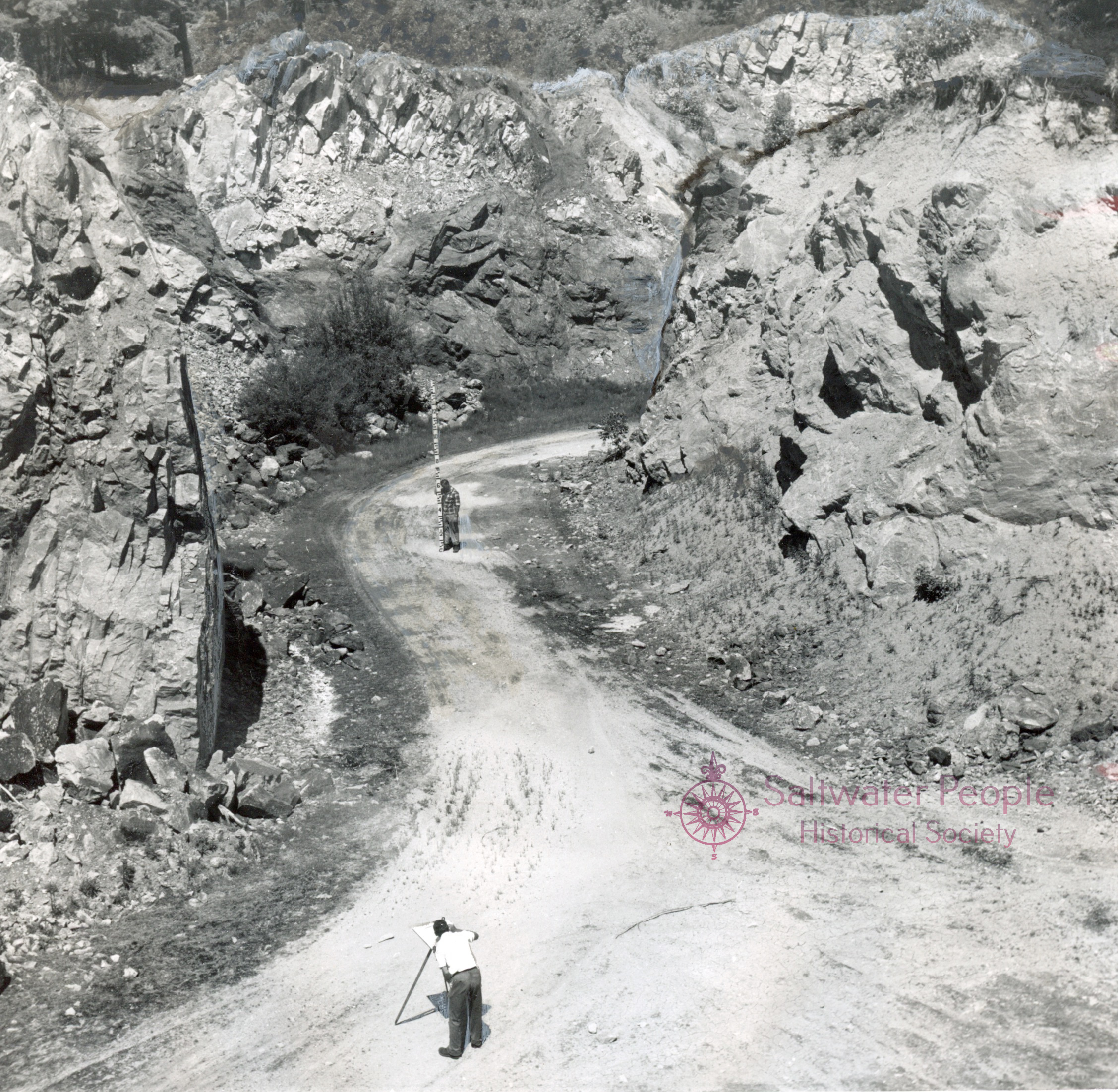
Charles McKillop, Friday Harbor, foreground 
& Alder Revisto, of Tacoma, survey the old 
Cowell quarry in 1959, on San Juan Island,
San Juan County, WA. 
They were assistants to Dr. W.R. Danner.
Click image to enlarge.

Photo by Danner from the archives of the 
Saltwater People Historical Society.©

The industry began on San Juan Island's west side, on the cliffs near Lime Kiln Lighthouse.

Augustus Hibbard, who became the island's first quarry operator in 1860, was a man who attracted trouble. Military authorities were annoyed with his men for keeping liquor in camp and selling it to soldiers and Indians. Hibbard's cook was stabbed to death by a cooper and Hibbard himself was killed by his partner, on June 17, 1868, in a quarrel over an Indian woman.

Hibbard died just before the completion of a new kiln. His heir, who journeyed from the East to take possession, died two years later. The federal census of 1870 indicated that the firm then employed 18 persons and in 12 months had produced 13,000 barrels of lime, worth $26,000.

Lime at that time was used mainly for mortar and as a soil 'sweetener' in agriculture. None had been discovered closer than California or Vancouver Island, so trade in Washington Territory appeared to offer good prospects.

George R. Shotter, a Canadian, opened the first quarry on Orcas about 1862, across Eastsound from the site where Clauson is mining today (1959.) The Shotter site, north of Rosario on Eastsound, is owned by the Crown Zellerbach Corp. Two ruined kilns on the beach are all that remains of the lime settlement of Port Langdon, which existed before there was a town of Eastsound.

Nova Langell, an old resident of the island, is a son of Ephraim Langell, a Nova Scotian who went to work at the quarry in 1871. He recalled that the company's oldest kiln has disappeared: the two standing on the shore are later ones.

In 1874, after American ownership of the San Juans was agreed through arbitration, the British quarry firm sold to Daniel McLachlan, an employee, and Robert Caines of Port Townsend, who later bought McLachlan's interest.

McLachlan went to the east side of San Juan Island and, with his brother, William, and Thomas H. Lee, a relative by marriage, in 1881, organized the Eureka Lime Kiln, on what became the property of Mrs. D.M. Salsbury.

Seven little quarries are scattered through the woods on Mrs. Salsbury's 250-acre tract and two kilns stand on the beach. Once a small community was on the spot, including a hotel, post office, saloon, and 20 families.

Eureka is one of the oldest quarries in the islands, older than the McLachlan-Lee enterprise. Probably it was opened by an Englishman named Roberts during the joint military occupation of San Juan by the British and Americans. Early in 1863, American squatters attempted to seize it from him through an illegal order of the Justice of the Peace. The controversy ended with Roberts's death by drowning before the year was out.

The Eureka property has not been operated since about 1890. Mrs. Salsbury converted two of the quarries into a Japanese grotto and a woodland chapel. Rock from one of the kilns was used for building her chimney and fireplace.

Danner found the forgotten quarry of the Chuckanut Lime Co. on the east side of Point Lawrence, Orcas Island. It was abandoned before 1910.

One of the most spectacular quarries, Danner said, is on the west side of Orcas Island, about 300' up in the cliffs, where the Orcas Lime Co plant for many years was operated by a woman, Mary Louise Dally. She and her husband, F.W.R. Dally, bought the original kiln on the President Cannel side of the island in 1900.

From 1914 until she died in 1928, Mrs. Dally had lime properties on San Juan and Henry Islands, including one with an ancient pot kiln, the most primitive type of oven to be seen in the archipelago.

Part of Danner's objective has been to learn the age of the limestone deposits in the islands, using tiny fossils of one-celled creatures that lived in shallow sea-bottom and were uplifted after the age of glaciers. On Orcas, he found limestone 350,000 years old.

The fossils, Danner said, are dependable clues to the age of any land where they exist. Through their presence, scientists have determined that the San Juan Mountains (now submerged, the islands are their peaks) ca. 200,000,000 years older than the Cascade Range.

The basic purpose of the summer work has been to learn whether suitable deposits of limestone are available to attract new industries.

Whereas kilns used to be of backyard proportions and a 200-barrel shipment was considered newsworthy in 1875, today's thinking has to be on a gigantic scale. If quarrying should reopen in the islands it will have to be undertaken by some large corporation financially able to overcome the physical obstacles and install an economical burning plant."

Words by historian/author Lucile McDonald and published by the Seattle Times.

23 December 2023

A Christmas Surprise for Tib –– From "Jello" Island and Lew Dodd


The Tib and Lew Dodd cabin 
Yellow Island, 
San Juan Archipelago, WA.
Ca. 1948.
Courtesy of their family.


"Tib" Van Order Dodd (1895-1989)
and Lew Dodd (1892-1960)
Yellow Island residents
Photo courtesy of their family.
Click image to enlarge.


A letter written by the former co-owner of Yellow Island, San Juan Archipelago, WA.

"Jello Island"
(is what one Swede calls it)
Deer Harbor, WA.
December 1957

"Dear –––––––––––,

Well, the Islands are about rolled up in mothballs until Springtime, I guess, and from all appearances anyway–for there are extremely few boats to be seen nowadays; the Channels are deserted except for the mailboat and the ferry.
        It is not really broad light in the morning until 7:30 and the sun (if any -and wherever seen) goes down behind the black San Juan Island hills at 4:15 PM. The whole Archipelago is slumbering and quiet in its usual winter hibernation so far as any comparison with June to October.
        For the first time since last July, accompanying Jack Tusler in his boat, we went to Deer Harbor, most of whose sparse population isn't very much in evidence; for, those who can afford it have folded their summer tents, so to speak, and have migrated to the South––the road from Kirk's to the store, black in the gloomy wet and little traveled, and at Norton's dock a single troller leaning wearily against the float as if utterly tired out from the summer's fishing, the essence of ennui!
        Blue smoke issues straight up from a few chimneys, and the forlorn old red cannery seems to stare vacantly upon the scene, which more than at any other time of year, resembles a small Port that once was and may never be again; deserted, forlorn, useless, abandoned; hopeless! Hard by, across the inlet, at the bridge, a forlorn sawmill no longer sings a tune, drift logs beachcombed, and red rust is King over all its metal machinery. The attitude which the whole hamlet has seemed to have acquired is one of extreme lassitude, and, perpetual waiting in a permeating forlorn hope that--well--"Something might occur someday; maybe." The place somehow manages to convey a very bleak empty and depressing picture as it sits on its sidehill, soggy, sodden, clammy, and damp--with its feet in the cold December sea. --Deer Harbor in winter! "The deserted village!"
        We are always glad to return to our Island from such a brooding atmosphere, for upon clearing the vicinity the forlornness and the lifelessness leave one as if awakening from an unrealistic dream.
        Back on our own Island, we are happy to pull the skiff up into its snug boathouse, shoulder the provisions, and climb the path to the bright, warm cabin where for so long as we have lived here we have been happy and content.
        There is never a dull or uninteresting day at our Island home and no two days are alike: for there is always something, yesterday Tib and I watched two otters hauled out on our East end. It was a sight seldom seen by even those who do live in the country, and we may never see such an interesting performance as they went through with no idea in their heads that two human beings were observing through binoculars every move they made.
        One reason that prompted me to drop you a line is because I wanted to (which is an excellent one, in my opinion!) Another reason is that I need Lloyd's advice:
        Recently I saw an "ad" in December National Geographic of Zenith's new Transistor Transoceanic radio (8 bands) etc. price advertised as $250. Lloyd, what do you think of this radio and do you deal with them?
        We are out here beyond television until they produce some kind of a battery set maybe––and even then if the programs don't get any better we wouldn't be interested. But, radio, a good one, yes, for it would give us worldwide contact everywhere, internationally––everywhere there are broadcasters. Ship to shore, aircraft, etc. How do these transistors stack up with the tube radios in performance? Do you think this new Zenith is a good buy at that price and could you buy one of them at any sort of a discount if you do not handle them?
        I've been toying with this zenith idea to surprise Tib for Christmas. (I'm 65 now and may not last too long.) I can manage to pay for something that should give us whatever is to be had in worldwide radio for some time to come. But before I make any move at all I'd like your candid opinion about this machine. Just what your knowledge and experience can tell me. I will certainly appreciate it.
        Tonight 8:00 PM we're having a hard westerly (about 40 mph) and the sea is noisy but the solid little cabin doesn't have a vibration in it, the kettle sings on the stove, the lamp is bright, and it a sweet, sweet home on an island in the San Juans far from the milling crowds and traffic, the fumes, and burning gasoline and the roar of trucks and trailers.
        Our sojourn in Bellingham this summer, after so many years away from the modern clatter and clutter taught us both to appreciate and love even more our peace and quiet, sweet air, unchlorinated water, clear running tides; and natural surroundings, the seabirds calling and soaring in the clear, clean sky! We are so thankful and grateful for it all. It is a good life.
        Our best wishes to you for a happy holiday season and we hope your year ahead will be a successful and contented one filled with whatever is GOOD and with whatever you most prefer."

Signed, Lew and Tib.

Another SPHS post of Yellow Island Dodd's can be seen HERE
Another SPHS post of Lew's sail on Gracie S around Vancouver Island, B.C.,                         can be seen HERE
And a post under the History section on the home page, for the 8,500 mile 
passage crewing the R.B. Brown schooner Ranger from Milwaukee, WI.  to Orcas Island in 1939, 
click HERE.

14 May 2023

THE WATERFALL WIPE-OUT AT THATCHER BAY, BLAKELY ISLAND (UPDATED)


Blakely Island,
San Juan Archipelago, WA.

Click image to enlarge.
Please see below for one recall update
of the Spencer Lake dam by 
Blakely Islander, L.A. Douglas. 
 

BLAKELY ISLAND DAM BREAKS
DESTROYS MANY LANDMARKS
By Baylis Harris, Owner,
Blakely Island Marina, Blakely Island,
San Juan Archipelago, Washington

January 1965

"Sometime before daylight in the morning of January 30, 1965, the dam and spillway on well-known Spencer Lake on Blakely Island, gave way from the force of heavy overflow of melting snow and several days of unusually heavy rain.
        The situation was reported to Blakely Marina, by the mail boat crew on arrival at about 7:20 a.m. The marina also serves as the Post Office for Blakely Island. When subsequently investigated by islanders, the destruction created is beyond description. The break created a ravine estimated at an increase of ca. 75 feet deeper than the former run-off stream bed. Both Thatcher Bay and Eastsound were muddy for miles in all directions. Hundreds of trees and litter covered an area of approximately 30 square miles, consisting of various trees, the old Thatcher Mill site, which was completely demolished, and fruit trees, and their products floated everywhere throughout the Eastsound area, Peavine, and Obstruction Passes.


The broken dam on Spencer Lake,
Blakely Island, San Juan County, WA.
as noted in the photograph,
 courtesy of L.A. Douglas,
an eyewitness to the scene on this day.
Blakely Island, San Juan Archipelago, WA.
Click the image to enlarge.


Overflow and destruction
from Spencer Lake dam break.
1965
courtesy of eyewitness L.A. Douglas,
Blakely Island, San Juan County, WA.


         Spencer Lake covered an area of approximately 60 acres and was quite deep. Therefore, literally millions of gallons of water were lost along with many of the historical landmarks of the Island.
        As late as 4:00 p.m. in the afternoon, the force of water down this newly created ravine, cut to bare rock, and the cascading waterfall into Thatcher Bay was an awesome sight. Mr. Maurice Rodenberger who was making the early morning ferry trip to Anacortes reported on his arrival and even later by the crew of the Sidney bound ferry via radio.
        From a recreational standpoint, the loss of Spencer Lake will be quite a substantial loss to the Blakely Island Development. Fortunately, the main water supply for domestic use is taken from Horseshoe Lake."

Above text by Baylis Harris. Published by the Friday Harbor Journal, 1965.


THE SPENCER LAKE DAM
By Lance Douglas
(eye-witness testimony below) 
Blakely Island.
Submitted to the 
Saltwater People Historical Society 
May 2023. 
 
"Back around the turn of the 20th century, the people starting the mill at Thatcher Bay built a dam on Spencer Lake to raise it about 15-20 feet to provide more year-round water to operate the mill. The lake as seen nearby the orchard and dam was not there; the lake started out around the corner by the rock cliff. The dam added millions of gallons of water. A 12-inch steel "penstock" was installed down the steep hill to run a generator to power the mill. A penstock is a pipe that delivers water to a hydroelectric generator. The mill folks were certainly entrepreneurs back in the day and they tapped into the penstock with a 2-inch pipe that ran out the length of the pier. Filtered fresh water was then sold to the steamer boats that served the islands from Seattle, Anacortes, and Bellingham. Remnants of the twisted old penstock were still visible at the base of the gorge into the present century. 
        In the winter of 1965, an overflow culvert plugged up and water flowed over the dam and it washed out in a rush of force that could be heard on other islands. All of the mill buildings that were abandoned in the 1940s were destroyed and washed out to sea. The road to Armitage Bay washed out and left the south end of the island isolated for a year or so. A couple of archived photographs show the washed-out area in the mid-1960s and a small access dock to control a culvert valve under the dam during construction.
        After the new earthen dam was built,  the lake filled in one winter from the huge watershed including Horseshoe Lake which flows into Spencer Lake. During the mill operation days, the lakes were referred to as the "upper" and "lower" lakes.
        Around 1980, a brilliant engineer in the north-end community could not stand to see all of the kinetic energy in the form of water flowing out to sea not being harnessed, so he commissioned a generator system to be built. It was located at the bottom of the gorge where the post office once stood and the dam was beefed up and a new 12" PVC penstock was installed down the road to power it. Up into the 21st century, the penstock delivers about one million gallons of water daily to the 50 kW generator but only runs seasonally. The generator system was gifted to Seattle Pacific University who had been gifted many acres of land where they built a marine biology lab on the island with a full-time caretaker."

Below: 
History of the earliest days of Thatcher Mill Company written by 
Nancy McCoy. Article sponsored by Lopez Island Historical Museum; published by the Islands' Weekly, 2000.


Click image to enlarge.
From the archives of the 
Saltwater People Historical Society.


20 April 2023

FROM THE DEPTHS OF BLIND BAY TO THE KNACKERMAN


Brochure from the 
chartering days of the 
beautiful MORNING STAR
(1956-2023)
when she was owned 
by her penultimate skipper,
Captain Lee.

THE MORNING STAR

"She was a Chesapeake "Bugeye" designed by Luther Tarbox. Bugeyes date back to 1830 and were used to dredge oysters and crabs, haul freight, and buy catches from their sloop version, the skipjack. 

MORNING STAR was built in Seattle by master shipwright Harvey Graham. Her keel was laid in 1956. Built entirely of Alaska yellow cedar, she is a strong work platform, finished as a live aboard and a powerful sailer-cruiser. She was 56 feet overall, 48 feet on deck, 13.5 feet beam, and 38 inches draft with the centerboard raised. She carried 1,034 square feet of sail." Above words by Tony Lee.

This spring she was raised from the muddy bottom of Blind Bay, San Juan Archipelago, and escorted to a haulout at Deer Harbor to end her happy sailing days in the San Juan Islands. 


16 March 2023

A SALTY BIO BY ROBERT F. SCHOEN LATE OF CLAM HARBOR, ORCAS ISLAND, WA.


CHANTEY 
Sailing the honeymooners,
Bob & Mary Schoen,
to Orcas Island,

San Juan Archipelago, WA.
1946.
Click image to enlarge.
From the archives of the 
Saltwater People Historical Society©


"My name is Robert F. Schoen, pronounced Shane. I lived in Seattle at 10th and Ravenna Blvd. I went to Univeristy Heights grade school, John Marshall Jr. High, and Roosevelt High School, graduating in 1936, and the U of W in 1943. (The war intervened.)
        When I went to high school we were living in the Kirkland area on the east side of Lake Washington, Homes Pt. Drive. I was boat CRAZY. During high school, I met John Adams and Anchor Jensen, and we all had a love of sailing. Bill Garden was our mentor and teacher.
        Jack Kutz, John Adams, and I all had 28-foot boats. Kutz had a gaff-headed cutter, John had a clinker double-ended teak lifeboat schooner, and I had a V-bottom John Hannah ketch, gaff main, Marconi missen.
        We were out cruising every moment we could get away, winter and summer. We learned to sail our boats well. On the first of August 1941, I joined the Coast Guard. Kutz went into the Navy, and Adams finished his architecture at the U of W, then entered the Navy as an officer.
        My boating experience served me well. I went into the Coast Guard because I wanted to work in small boats. I was stationed in West Seattle after 7 Dec 1941. I was made Chief Boatswain Mate before being transferred to California from Seattle in 1942. From Government Island, Oakland, CA, we were sent to Borneo. Several weeks later we arrived at Hollandia for our assignment vessel, a 155-foot Uniflow steam tug, L T 218.


Bob's first ship in the South Pacific.

As he inscribed verso.

From his estate papers for the 
archives of the Saltwater People
Historical Society. 
     

         We were in the invasion of the Philippines, towing three barges of aviation gas to White Beach, near Tacloban.
         I had never seen so many ships of every kind, over 10,000 boats, rather exciting. Our tug broke down when we returned to Hollandia. It looked like it would be a long wait. I opted to take a transfer and went to Samar and duty on a US Army F. boat at a P.T. base. We followed behind the P.T. boats as they strafed the Japanese-held islands. We supplied fuel and ammunition and at times carried Japanese prisoners back to the base at Samar.
         We stopped at Iloilo where the army was mopping up the Japanese soldiers in the village. We were across a river, away from the fighting. From there we went to Zamboanga and waited for an escort to take us to Balikpapan, Borneo.
         From Hollandia, I went to Manilla where the Philippine sailors took over the boat. In Manilla, we boarded a transport for San Francisco and home by train to Seattle. Nov. 19, 1945, I was discharged from the Coast Guard. It was a great experience to be in the Coast Guard and I am proud of it.
        My sailboat, 29' Marconi cutter, W.H. Dole design was at the Tony Jensen Boat Yard and I stopped to check in and told Anchor to get her ready for me to take her north for a few days and then continued to mother's house with all my gear and shared that I was going for a short cruise in Chantey. She responded with "Haven't you had enough boating?"
         I got hold of a couple of buddies and we headed for Friday Harbor in the San Juan Islands. It took us a few days and all of a sudden they decided one had to get back to register for college. The other had a girl he just had to see.
        About this time I remembered that I had just met a lovely young gal from the Juanita Beach area. I headed back and looked again. In July of 1946, we were married. It's been 53 years and we are still here.
        We sailed up to the San Juans in CHANTEY on our honeymoon and decided this looked like home.
        One of the things I did in the interval before we got married, I bought and learned to fly an airplane. When we were on the island I had the only plane on the island and I was working at various odd jobs such as sliming fish in the Deer Harbor salmon cannery and helping build a garage for the school bus near the Orcas ferry landing.
         I was frequently asked by loggers and people wanting things from Bellingham, such as medicine and auto parts. Bellingham had a large airfield built during the war, eighteen minutes by air from Orcas. This made me decide to purchase a four-place plane and enter pilot training in the U.S. Veterans Flying School on Bellingham Airfield.
        That was a great experience, lots of fun. In two and a half years I operated and founded the Orcas Island Air Service on Orcas. Just before I sold the service we had a major fire at the Orcas ferry dock which burned up the store section of the dock and part of the oil dock.
        Things worked out that I could purchase the dock which included the Union Oil Co distributorship and agent for the Black Ball Ferry system. This kept me very busy.
        In 1950, we took CHANTEY to Port Ludlow for a New Year's party of cruising sailboats, about twenty or so. This was the first party since WW II.
        We departed Orcas the day before New Year's Day and after passing Point Wilson we headed for the channel between India Island and Hadlock. HOLY COW, there was now a bridge and the old NORDLAND lying on the beach on the Hadlock side.


NORDLAND

Official No. 228932
Class: Ferry
34 G.T., / 30 Net tons.
L, 58.1 x 22.4 b.
Home Port: Port Townsend, WA.
Built in 1929 at  
Hadlock, Jefferson County, WA., 1929.
Construction: wood
Power: WA. Estep 2 cyc. 26 HPR diesel
With the author of this essay at his 
dock, next to the Orcas ferry landing.
Click to enlarge.
From the archives of the 
Saltwater People Historical Society©


       On returning north from the Port Ludlow New Year's party and passing the Nordland on the beach I had inspiration hit me between my eyes. This is just what I need at Orcas to supplement the oil business. I stopped at Port Townsend and looked up Blair Hetrick and Zelma, old-timers here. Blair was a hard hat diver in the area. I told him my thoughts about the vessel, and he told me it was for sale on a sealed bid. He took me up to the county courthouse and I went into the commissioner's office and they referred me to the county attorney. I went into his office and he said, "Kid, that thing is a pile of junk, forget it and save your money." I went back and told Blair about this and he said I'll get a bid form from one of my commission friends, I told him to get me two bid forms. I'll mail one in and I'll mail one to you to give to your commissioner friend and have him open it at the end of the opening. I got the bid by fifty bucks.
It took me six months to get those papers and only after I went back to the commissioners in person.
        It was a learning experience handling the old girl. She would slide sideways as fast as she went forward, with her 26 HPR  engine, not very powerful, and her reverse not too hot. BUT she could carry a hell of a load. And with her ramp, you could load and offload easily. It was something like learning the operation of an air-starting heavy-duty engine.
        You learn to love those wonderful machines. If you keep oiling them and keep the diesel coming they run forever, the engineer that ran the Nordland said 'They never shut the engine down the full length of WW II.'


Home port for NORDLAND

ORCAS LANDING
DATED 1954.
Click the image to enlarge. 

From the archives of the 
Saltwater People Historical Society©.

Our first jobs were delivering fuel to loggers on islands without ferry service which involved filling steel 55-gal drums along with tractors, and logging equipment, not all at the same time. We had a loading area just west of the Orcas ferry landing, one at Obstruction Pass, and several others. We landed on various beaches all over the county. We always tried to land them on the highest part of the tide and immediately reverse and get off the beach. If we missed and couldn't get off, we could be stuck till the next tide, 6 or 8 hours later.
        Working the tides was very crucial to the job. When delivering fuel, the logger had to be there with a tractor or some men to roll the drums up above high tide or a full drum of fuel would drift away.
        I have hauled, over my 12 years of operating the NORDLAND; cattle and sheep to a Lopez slaughterhouse, broken aircraft, 1,000 sacks of cement, mobile homes, everything.
        The development of Blakely Island was started with Nordland. Four years later they built their own barge.
        The Orcas Power and Light Co used NORDLAND in several inter-island cable laying and repair jobs. I did most of the early years running of the boat usually alone or with my wife and kids. I had help from Miles McCoy and he later ran it as stand-by.

        In 1963, I sold NORDLAND to Wayne "Corkey" North of Deer Harbor. He moved the wheelhouse to the stern and raised it so he could look over the vehicles and cargo on board.
      In 1968, NORDLAND was sold to Bob Greenway of Friday Harbor. He remodeled the wheelhouse again, installed a marine toilet, and replaced the WA Estep diesel with a 671 G.M. engine. The old WA-Estep was dumped out on a sandspit near Jensen Shipyard in Friday Harbor. A diesel engine school in Bellingham came over and picked up the old engine and rebuilt it as a school project. Somebody in the last few years purchased it and took it to California for another old boat.
      Al Jones, who has homes in San Francisco and San Juan Island, purchased the NORDLAND in 1976.
      Finally, it was from Alaska Packers haul out at their plant on Semiahmoo in Blaine, WA that I came upon the SEMIDI.


SEMIDI

ON 214876
Built Astoria, OR 1917.
36 N.t./ 45.95 Gross t.
Oil screw, 59.0' x 16.4' x 7.05' 
Atlas Imperial Diesel engine
4 cyl. 135 HPR
Purchased by Robert F. Schoen
5 Oct. 1959
Sold 11 July 1965

      I used this boat for log towing, worked with Orcas Power and Light Co in servicing the cable laying, helped locate and service cable recovery, hauled cased goods, and barreled products. Many times I worked the two boats together on a job.


The author Bob Schoen
off watch with his wife, 
Mary, at the helm.
August 1961
Click image to enlarge.
From the archives of the 
Saltwater People Hist. Society.©
Photos and essay by Mr. Robert Schoen,
Clam Harbor, Orcas Island, WA.


28 December 2022

WRECK; HOOSIER BOY~~1911

 HOOSIER BOY

96409
Built in 1898 for Coast Fish Company of Anacortes, WA.
31 G.t.. 58' x 12.4' x 5.5'


Scanned photo courtesy of J. Canavit.
From the archives of the 
Saltwater People Historical Society.


San Juan Islander newspaper, 9 June 1911.

From the archives of the S.P.H.S.


20 December 2022

LIME WORKS WITH JUNE : November 1929


Roche Harbor,
San Juan Archipelago, WA.
 The Lime Transport
moored to load barrels.
Click image to enlarge.
Original gelatin-silver photographs from 
the Saltwater People Historical  Society©

Puget Soundings
June Burn
Bellingham Herald, November 1929

"Five years ago and Capt. Wirstrom retired from the sea. He had sailed his last ship, kept his last watch, and tooted his last whistle in a pea-soup fog. He was going to farm for the rest of his life and take things easy far from the mad winds and the merciless reefs of rock out where no gentlemanly reef ought to be.
      Today, as you read this, Captain Wirstrom is probably down in Coos Bay, having navigated a boatload of lime rock from Roche Harbor, WA, to the paper mills of Empire City. For, when the call came, the old mariner found he could not resist it and so he sits again in what seems to me a lonely state in his captain's quarters aft, on the big Roche Harbor Lime Transport.
      On the northern tip of San Juan Island, two companies dig lime from hills full of the purest lime deposit in the world, they say. Moreover, there is said to be enough lime in those hills to last more than a century with both companies going for all they are worth. (It is my private opinion that in a hundred years they will have dug up the whole island at the rate they are going now.


Orcas Lime Company
Click image to enlarge.

"The Orcas Lime Co worked a small quarry 
just a few hundred yards south of the 
Roche Harbor deposit. 
It supplied its single kiln with 
limestone by means of rail carts pushed 
along on top of a long trestle.
That plant and dock were located on narrow
Mosquito Pass, also served by 
Puget Sound Freight Line boats.
When the quarry rock finally gave out 
in the mid-30s, this trim little competitor
 gave up the ghost and the land 
  became a sheep ranch."
Text from the Journal Jan. 2003.
Author unknown.

Roche Harbor, San Juan Island, WA.
Original gelatin-silver photograph from the 
archives of the Saltwater People Historical Society©


On the beautiful old Scurr place, the Orcas Lime Works dig out the fine, white angular rocks to be broken and burned in the kilns where they will become flaky snow-white lime for a score or uses.
      And against the curving hill slopes behind one of the prettier harbors in the world, Roche Harbor Lime Company digs and burns, and barrels are loaded on ships for places far and near.
      The fine long dock at Roche Harbor is piled with barrels upon barrels, four deep, all filled with lime ready for the boats. Sacks upon sacks of lime are stacked behind the barrels. The daily capacity of the works is 1,500 barrels.


Antique copper stencils 
once used to inscribe lime barrels  
shipping out to these destinations from
Roche Harbor Lime Co.
Now archived at the 
San Juan Island Historical Museum.
Stop by during their open hours
and visit their wonderful 
effort highlighting history of San Juan Island,
San Juan Archipelago, Washington.


Boats come and go, bringing in thousands of cords of wood to Roche Harbor, going out with tons and tons of lime from Roche Harbor. The little bay is lively with boats.
      Ten years ago we helped to dig rock out of those hills. That is, Farrar broke the rock and I watched him! I used to walk up the Clematis-covered banks, over the tiny railway to the high-walled quarries to watch the men with their big sledge hammers cracking the boulders, breaking off one corner after another, sometimes finding themselves faced with an almost round, unbreakable rock at the end if they weren't skilled. The game was to break them so that there would always be another angle left. Farrar used to say there was poetry in watching the rocks come down after the blast, in selecting one's boulder to conquer with sledge and muscle, in breaking it so skillfully that the last bit was so full of sharp angles as the original boulder had been.
      The Clematis on those banks was planted forty-three years ago on the birthday of Mr. McMillin's son. The original plant is now a hoary old vine several inches thick, crawling all over the place. And the progeny of that vine softens every nook and cranny of the hill. It is chiefly responsible for the beauty of the place as one comes in by boat.

Hotel de Haro
Roche Harbor, 
San Juan Archipelago, WA.

      Against the dark hill rising up from the harbor on the left, as one enters, are the white cottages of the laborers, the combination church and schoolhouse, with its spire, the vine-covered hotel, the Clematis banks, and the big flower garden coming down to the water's edge. The effect is incomparably lovely. If there were no lime there at all, and no industry, the dainty small harbor would still be a village for the sheer beauty of the location.
      But to get back to Captain Wirstrom: Several years ago the lime company bought a big sailing boat––a beautiful thing she is, with flowing robes riding her prow. For two or three years, the long slender six-masted schooner sat still in the harbor. She too has retired, maybe. Thought to ride the calm waters of a picturesque harbor for the rest of her days. But now she is to be used again. Stripped of three of her masts, part of them used now as cargo booms, she will haul lime rock down the coast to the new paper mills at Empire City in Coos Bay.
      La Escocesa (Scotch Maid) was built in 1868 in Dundee, Scotland. She ran as a steamship between England and India. Later her name was changed to Coalinga and she was used in the carrying trade, whatever that means. Freight, I suppose. Finally, the Alaska Packers bought her, changed her name once more to Star of Chile, and used her as a sort of floating cannery in Alaska. Now she is the Roche Harbor Lime Transport barge and once more a "carrier" of things.
      Of iron her hull--thick plates of Swedish iron--and of her iron spirit, else she would never have lived out the seas which have broken over her in every sea in the world. And perhaps there is some iron in the spirit of her new captain that he comes from retirement to pilot a "barge." She doesn't look like a barge, certainly, with her trim lines and the three masts rising so fine and tall. But she is to be towed, sailing only when there is sufficient wind to make the use of her small canvas, worthwhile, and so she must now be called a barge, though her captain doesn't like it.
      Here comes my boat to take me to another island! I had thought to have dinner in the attractive hotel here and the soft-voiced Japanese boy is just serving the salad, but I must run. There will be a sunset on the channel as we chug across the island's dark shadow against the bright waters. See you tomorrow. June. "


Archived Log Entries