"The Cure for Everything is Saltwater, Sweat, Tears, or the Sea."

About Us

My photo
San Juan Archipelago, Washington State, United States
A society formed in 2009 for the purpose of collecting, preserving, celebrating, and disseminating the maritime history of the San Juan Islands and northern Puget Sound area. Check this log for tales from out-of-print publications as well as from members and friends. There are circa 750, often long entries, on a broad range of maritime topics; there are search aids at the bottom of the log. Please ask for permission to use any photo posted on this site. Thank you.
Showing posts with label Bering Sea. Show all posts

22 May 2018

❖ "GLACIER PRIEST" EXPLORER with a heart for ALASKA ❖


AMELIE, 1933.
224429
Built at Pt. Blakely, WA., in 1925 as a tender for
Sunny Point Packing Co.
81.1' x 18.7' x 8.8', 99 G.t. 67 N.t.
165 HP.
Then she went exploring with the
Father Bernard Hubbard expeditions in Alaska.
Click image to enlarge.
She is in documentation in 2018 at Ketchikan.

AP photo from the archives of the Saltwater People Historical Society.©

Text with this photo states, "Father Bernard R. Hubbard, S.J., famous 'Glacier Priest,' led an exploration party through the wild and remote regions of the Alaska Peninsula last summer, checking geological changes in the volcanic region and discovering a new harbor in the crater of Bogoslov, a marine volcano known as "the Disappearing Island of the Bering Sea." When his ship AMELIE visited the harbor it was the first time a ship had ever entered the crater of a volcano, Father Hubbard said. The exploration party returned to Seattle on 9 October 1933, after taking 100,000 feet of motion picture film, much of which was 'shot' in spots never before seen by human eyes. The party spent six months in the region known as the Valley of Ten Thousand Smokes."


Father Bernard R. Hubbard, S.J.
1888-1962
courtesy of Santa Cruz University.

Hubbards's King Island Expedition:
In 1937 and 1938, Father Hubbard lived on King Island with his boats, dogs, expedition members, and more than 100 tons of supplies and equipment. During this expedition, he continued his glacier research and captured the King Island people on film. The King Islanders took him on a 2,000-mile open-water trip by umiak in his attempt to prove that the Eskimos, from Nome to Barter Island, shared a common language.
      Hubbard's arrival on the Island had an impact on the community. Among his supplies were powerful electric generators and engines to power his moving picture equipment and light the hall he constructed to show his films, as well as to give power to other parts of the village. He constructed buildings for the villagers and introduced oil-burning stoves to replace the dirtier and less efficient coal-burning units they had been using.
      Hubbard made several long documentary films and took thousands of still pictures of almost every aspect of King Island life, including native funerals and the celebration dance of success at bear hunting. Bogojaviensky and Robert W. Fuller, who published a number of Hubbard's still photographs in 1973 in Polar Bears, Walrus Hides, and Social Solidarity, praised their high quality. "The ethnographic and historical significance of these photographs is enormous––To our knowledge, there exists no comparable photographic record of an aboriginal sovereign state in all of Arctic ethnology."
      Hubbard's stay on the island generated controversy. After his party left, Joseph McElmeel, the General Superior of the Alaska mission, wrote "Just at present Father Lafortune has the task of overcoming the bad influence of the Hubbard party on the island last winter. The seculars with Father Hubbard should never have been taken there. Father Hubbard has admitted to me that he can no longer control them as he used to. Even non-Catholics in Nome spoke to me about the danger that the King Islanders would be affected by the stay of the Hubbard party. The too-frequent moving pictures developed a craze for pictures in the Islanders. On their visit to Nome this summer it was observed by seculars that they were no longer as simple as they used to be. Father Hubbard is a hard-working man, but he should not be permitted to come to the missions with the type of men he brought this year." The accusations, however, apparently were not very serious because Hubbard and four others, including Edgar Levin, were welcomed back in the summer of 1940 for more photographic work, and to make further improvements to the village." 
Source: Santa Clara University archives.


Father Bernard Hubbard
Saying mass at Seattle University.
Original photo dated Mar. 1950 from the 
archives of Saltwater People Historical Society


      "One of the more colorful personalities of former years was Fr. Bernard Hubbard, S.J., the 'Glacier Priest.' He came to Santa Clara in 1926 and was assigned to teach mineralogy and geology but his heart was not in the classroom. It was in Alaska. There he explored volcanoes in the Aleutians and, for some months, lived among and studied the culture of the King Islanders. Each summer he enlisted a few friends to join him in these expeditions. Finally, in 1995 a stroke limited his activity but did not discourage him from his annual trip to AK. When at Santa Clara he spent his time editing films and preparing for his popular lecture tours.
      Financial help came from his lectures, friends, and advertisements which he inserted in his motion pictures. Some advertisers also gave him fishing gear, rowboats, camping equipment, cameras, and film.
      In some respects, he was like a little boy. He had a charm and an uncanny way of wresting permissions from his religious superiors. Because he didn't drive a car he appointed me to drive his Chrysler station wagon. Once we stopped at a fruit stand and he drank so much cider that he had to stay at home near a bathroom the next day. But once he decided to drive to the campus of Montezuma school in the Santa Cruz mountains. A 'No trespassing' sign was posted but he told me to ignore it. We were promptly stopped. To persuade the guard to allow us to enter, he informed him that he was Father Hubbard. The guard replied that he had never heard of him. We later enjoyed a good laugh and never allowed Father to forget this. Toward the end of his life, he received a Christmas card from a local mortician. He laughed and said: 'Those buzzards are really waiting for me!' Fr. Hubbard remains in my memory as a good friend, a unique personality, and a man with an undying love for Alaska." 
Carl H. Hayn, S.J., Professor of Physics. 1962.

For further study, please see The Legacy of the "Glacier Priest," Bernard R. Hubbard, S.J. C.M. Scarborough, and D. Kingston. Santa Clara Univ. Dept of Anthropology and Sociology. 2001. LINK


20 August 2016

❖ COOLING OFF ON THE BERING ❖ 1937

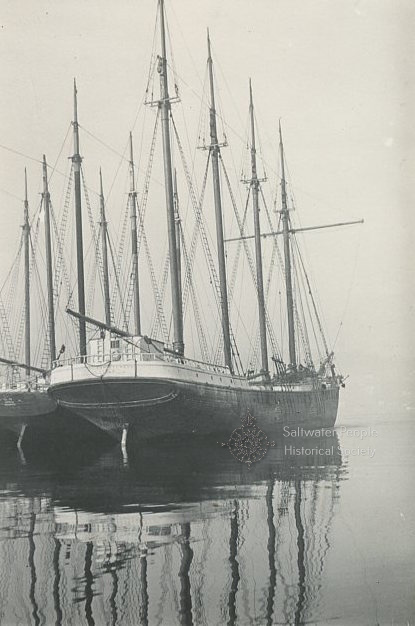
Schooner SOPHIE CHRISTENSON
Coming home from the Bering Sea.
Photo dated 2 years before James Flynn story below.

Original photo from the S.P.H.S.©
"James N. Flynn of Issaquah and his cousin, Richard Holder of Langley, Whidbey Island, remember codfishing in the Bering Sea aboard the four-masted SOPHIE CHRISTENSON as the most difficult $300 they ever earned.
      Flynn kept a pencilled 1937 journal of their ordeal. Most of the pages were accidentally lost, but his memory is keen. The SOPHIE'S exploits, and those of her captain, J.E. Shields, are documented.
      Men like Flynn and Holder are significant to me because each day I can look out my office window, north over Lake Union, and see Seattle's last remaining sailing ship, the forlorn-looking three-masted WAWONA. She, too, was a codfisher in the Bering Sea, at times within hailing distance of the SOPHIE.
      Equally important, Flynn's penciled journal and his recollections convince me that wooden ships were manned by men of iron. Ashore, many of the men were stumbling, rum-soaked derelicts. One readily admitted he chose thieving to working for wages. Two were tough, grizzled men in their 80s who had been at sea all their adult lives. One was a stowaway deaf mute. There were 45 men in all, and every one performed courageously and well.
      One day, Flynn handed me the age-yellowed pages of his journal. I looked at them and asked what would have been the title. He grinned and said, "Five Months Without a Bath."
      This is James N. Flynn's story.
❖  ❖  ❖
      My cousin, Rich, was only 17 but he was around 6 feet and husky. I was 22, and both of us and been toughened by manual labor. Neither of us and been at sea. We hired on as salters, helped by 'connections.' Times were lean.
      We were aboard the SOPHIE somewhere near Pier 51, waiting to be towed by tug beyond Cape Flattery. It took seven hrs to get the crew on board. They were trying to drink enough to last them for five months.
      I was in awe. Thirty men out of their drunken minds. The mates would herd a group aboard, then go into the taverns for the others. While the mates were gone, those on board would wander ashore again.
       We got under way in the evening, in tow. Up on the forecastle, the jugs and bottles were open. They were drinking everything dry before we were to let go of the tow line.
      When the tug's tow line let go, beyond Cape Flattery, the drinking stopped. According to some kind of code, all remaining booze was tossed overboard.
      Then began a weird transformation in the men, like a Jekyll-Hyde change. The drunks straightened up and became sailors. They cleansed themselves, changed clothing and went to work. We hoisted sails and got under way. I went aloft and was scared at the 100-foot height, but the old hands understood and helped me. 
Aloft on SOPHIE CHRISTENSON
Undated, unknown fishermen,
Unknown photographer.
Courtesy of R.R. Burke

I learned that if you are willing to pitch in, you get help and respect.
      The men were mechanical wizards. We had 22 fishing dories aboard, each equipped with a 10-HP Johnson outboard engine (only recently the dories had  been sail-powered.) The men disassembled the engines to basic pieces on the docks, right down to needle valves. They cleansed and inspected every part, then reassembled the engines and honed them to perfection, as if a man's life depended on a perfect engine. It did.
      We hauled out ropes and lines, canvas and brass. The old-timers went to work with their needles and twine. The dress gang sharpened knives.
Aboard Fishing Schooner SOPHIE CHRISTENSON
Unknown date, crew or photographer.
Click to enlarge.
Courtesy of R.R. Burke

      We sailed through an Aleutian pass, probably Unimak, and into the Bering Sea.
      Now, we're organized into rosters: 23 men listed as fishermen, 18 in the dress gang. The deck fisherman was Jalmar, the tongue cutter was Mac, the watchman was Harry, and the cooks were Walter and Frank. I did not record last names, but two men signed themselves as Cash Money and No Dory.
      The captain, J.E. Shields, and his brother and son owned the codfish packing plant at Poulsbo, the SOPHIE, C.A. THAYER and MY NORDIC MAID.
      Captain Shields operated the ship's store and, as we sailed northward into cold, sold us warm clothing and foul-weather gear as desired. He was the doctor, provisioner, chaplain, navigator, and judge.
      But crewmen settled their differences among themselves. When Finns and Swedes became clannish and segregated themselves, we insisted that everybody speak English. AS for medical aid, nobody during the 4 1/2 months became ill in that adverse climate––no flu, no colds, no lung congestion. Health was excellent.
      The SOPHIE was traditionally a good-luck ship. By reputation, illness or storm damage never enfeebled her. By 9 July we had taken and salted down 212,154 cod. Fourth July is memorable, not because it was a holiday, but because a one-day blizzard, or williwaw, iced the decks and sent us below.
      There was no heat in the crew's forecastle and no electric lights. We had no bathing facilities, except for buckets or whatever we improvised. The toilet was on the weather deck, extending over the side.
      These dorymen awed me.
Crew of SOPHIE CHRISTENSON
Bering Sea
Undated, unknown crew names,
unknown photographer.
Courtesy of RR Burke.
 They fished from dawn to dusk, and there wasn't much darkness. We worked up to 18 hours a day. They did not wear life preservers, because they reasoned the cold water would finish them in seven minutes. They would come back to the ship, heavily laden, and disappear behind giant waves. They would come alongside to mountainous gray swells and pitchfork their catches to us on deck, using one-prong forks. 
      Our hands were calloused like dogs' paws by rock salt and sea water. Our hands would split wide open and bleed. Men would strike matches on their horny palms. One common healing balm for split hands was human urine––our own.
      Maybe you have heard of the codfishermen's war against the Japanese. The Japanese fishing ships laid a net around us, entirely hemming us in. The captain was infuriated and gave orders to sail through it, ram our way out. We became entangled, our rudder was disable, and men tried to dive down and cut us fee. The cold water immobilized them. Finally, using knives attached to the ends of poles, we cut our way free of the nets. Captain Shields threatened to shoot at the encroachers with rifles, but he was dissuaded. (But the next year, in 1938, he instigated an arms buildup among fishermen which bordered on a shootout.)
      We returned to Seattle in late August 1937. I was a year older, having observed my 23rd birthday on 8 May. We sailed into Poulsbo, to Captain Shields' codfish processing plant, carrying about 400,000 pounds of cod. We had been gone about 4 1/2 months, and my wages were $300 net. 
Schooner SOPHIE CHRISTENSON
Home at winter moorage, Seattle, WA.

1941 photo by James A. Turner from
the Archives of the S.P.H.S.©

      Many of the crewmen collected their pay and resumed where they left off––in the taverns. My cousin and I returned to Issaquah in time for the potato harvest in the Yakima area. I had gained 25 pounds.
      I know you wonder whether I would sail aboard the SOPHIE again. Yes, I would––as a young man."
Above text from: My Waterfront. Carter, Glenn, Seattle, WA. Seagull Books Co. 1977.


23 January 2016

❖ CHIEF ENGINEER without an engine


Schooner AZALEA
ON 106787
Built 1890, Fairhaven, CA.
344 G.t. 327 N.t. 
150' x 35' x 11'
This photo hung in the office of Rich Exton for many years.
Photo kindly donated by Miles McCoy of Orcas Island.
"About 1914, the AZALEA went into the Bering Sea long line cod fishing. I heard she carried 24 dories for Robinson Fisheries of Anacortes. About 1920, Robinson remodeled her, put a full deck house on and installed a one-line, one-pound, tall-can salmon fish cannery. They didn't make any money.
SCHOONER AZALEA, Seattle
Leaving for the Bering.

Click to enlarge.
A little later than Eber Bruns employment.
Undated, original photo by James A. Turner of Seattle.

 From the archives of S.P.H.S.©
In 1924 I went up on her. That year we all signed on before a shipping commissioner. When he asked the skipper my duties he said 'chief engineer.' So I was chief engineer of a full rigged schooner with no power.
Eber Bruns, the highest in the rigging.
Image shared by his daughter, Ellen.
      My job with the cannery was to try and keep all engines workable, cannery boat, beach seine winches, outboards and any other thing that needed doing. That included running the cannery for about 10 days when the foreman got sick. I went back again in 1925. Long hours when the fish were running good, but fun in lots of ways.
      I was furnished a boat the first year, a 32-ft troller with a 16-HP. The second year, a 44-ft seiner with 40-HP. We used to run her up and down the coastline so I could check the winches the fishermen used on the beach for pulling seine.
      The schooner was anchored out from shore about 1/2-mile in the middle of the long bay. We had to bring water from shore in a scow, out to the cannery. We had a chute fixed up at a creek to fill the scow, then pumped it aboard.
      The AZALEA was towed from Seattle to off Cape Flattery. They sailed across the Gulf. We were met by one of our power boats and towed into Zacher Bay, Kodiak Island, AK."
Above text by Eber Bruns  (1902-1982). Shared with web admin by his daughter Ellen Madan.

1939: SOPHIE CHRISTENSON, AZALEA, and WAWONA made up the Bering Sea codfishing fleet this year, making a combined catch of 863,263 fish.

1946: Robinson Fisheries received WAWONA back from the government, succeeded in refitting her, but the AZALEA was hard-used by the Army as a barge and was not returned to service by Robinsons. AZALEA ended up in Sausalito Harbor where she sunk, stern to the old schooner BEULAH of 1882.


❖ Eber was born on Lopez Island, raised on Blind Bay, Shaw Island and then later moved with his wife, to raise their children on Orcas Island. 

      Bruns worked on the mailboat SAN JUAN II, under ownership of San Juan Transportation Company out of Bellingham, the work boat CALCITE of Roche Harbor, towing scows of lime rock to paper mills down sound, as an engineer on SALMONERO for Henry Cayou of Deer Harbor, as engineer on the ARTHUR FOSS, and on the M.V. FEARLESS, buying fish for Capt. Jones for the Deer Harbor Cannery. 
      After his time as a well-known commercial boatman on Puget Sound, the Orcas Power and Light Company hired Eber as chief engineer and operations superintendent, where he kept things running for almost thirty years.
Cod fishing schooner AZALEA 
Winter moorage tucked in behind

her big friend WAWONA.
Undated photograph by James A. Turner, Seattle. 
Original from the archives of S.P.H.S.©

11 March 2014

❖ THE SOPHIE RAN TO COD ❖

Captain John E. Shields
Dated 12 September 1948
Original photo from the archives of the S. P. H. S.©


Claiming the greatest voyage ever made by a American codfishing vessel, the four-masted schooner SOPHIE CHRISTENSON, was towed into Puget Sound, 5 Sept 1933, after five months in the Bering Sea. Captain-owner J. E. Shields and crew claimed for the SOPHIE; (1) the largest total catch made by one ship on one voyage––453,356 fish, 700 tons; (2) largest catch ever made by one man on one voyage––Ray Press––25,487 fish; (3) largest catch made by one man in one day's fishing––Dannie McEachran, Newfoundland second mate––1,051 fish; (4) largest catch made by one ship in one day––16,851 fish.
Records or not, the SOPHIE had just concluded her finest trip with some $30,000 pay to divide among her crew of forty-one. She brought back one black mark––empty dory No. 13. It had been found after a five-day southeasterly gale and twenty-eight year old Sven Markstrom was missing.
Capt. Shields and 2nd Mate McEachran told of days in the Bering Sea when a gray cloud-rack scudded over the mastheads as she labored through a smother that swept her decks from the jib boom to taffrail. In this sea, the dories, swung over the side one by one, were whirled away and out of sight in the great, gray waves churned along the schooner's sides.
Out in the dories each fisherman was alone between turbulent sea and sky, his outboard motor keeping him underway as the little craft soared and plunged, fishing all the time until the load crowded the gunwales. Then back toward the schooner and after making fast his falls, each man would dive like a porpoise for the decks as the sea swung him level with the pitching rail.
The men told of that record day––24 July––when the dories came out of the fog laden with enough fish to swamp the stay-aboard crew that had to split and salt the catch and everyone had visions of gold at the end of the rainbow.
The captain and men spoke low when they talked of that other day when Sven Markstrom was lost to leeward in the gale. They could not see the man alone in the dory as the ship lay miles away but they knew the trampling thunder of an Arctic sea towering out of sight. Somehow they knew this man would  never come back yet waited in silence under a beacon flare on the heaving deck. Five days later when the gale had blown itself out they found the empty dory. The men accepted this stoically as a part of codfishing in the Bering Sea.
The SOPHIE CHRISTENSON always made good newspaper copy. Writing in The Seattle Star, 28 April 1937, H. E. Jamison told of the preparations for another five-months stay in the north.

      Towering above the dock sheds the four masts of the SOPHIE CHRISTENSON have been beckoning waterfront wanderers to Pier Four. Monday, 22 dories were snuggled up to the port side of the windjammer, like so many chicks on a frosty morning.
They were waiting patiently to be hoisted aboard and nested 'tween decks for their long trek to Bristol Bay. Once beyond 'Smoking Moses' (Mount Shishaldin) in the Aleutians, these frail craft will be manned by lusty codfishermen.
Capt. John Shields, large and rosy-cheeked, looking more like a small town business man than a deep sea fisherman, was busy looking after last minute details and checking supplies aboard. He did manage to take time out to tell me he had 400 tons of salt aboard and that in the five months they'd be gone he hoped to bring back at least 600 tons of codfish.
The fishermen work on a share basis, while the others are on a monthly salary. Aside from the officers, the 'others' are mostly the dress gang––those who stay aboard, dress and clean the fish before they are passed to the salters in the holds.
The railings of the SOPHIE are scarred deep by lines from those aboard who fish when time lags heavy on their hands.

The fisherman I was talking to had been battling the waters of Bristol Bay for 23 years. He told me that in the old days the dories were fitted with leg-o'-mutton sails. When it blew up a storm the fishermen, who could not get back to the mother ship, fashioned a sea anchor from a sail, and hove to. Occasionally men were lost.
Now the 16-ft dories are equipped with 12-HP motors. These light motors are installed in a well that is entirely decked over. The bows are fitted with canvas shields to break the spray that comes aboard.
The men fish from dawn to dark. They are not supposed to go much farther than five or six miles from their vessel and keep a weather eye peeled for the signal that warns them the barometer is taking a nose dive. When the jib of the mother ship is hoisted they are supposed to make for it and batten down.

The cod is a bottom fish or, as my informant told me, a 'gurry sucker'. The mother ship anchors on the banks and the dories, when they are dropped over the side, drift with the tide, dragging an anchor around one of the flukes of which has been fastened a half hitch. This hitch on a taut line, robs the anchor of its effectiveness. The anchor bumps along the bottom, somewhat checking the speed of the dory. The fisherman has a line in each hand, one over each side of his craft, and as soon as he strikes good fishing he pays out all his anchor line. The slack causes the half hitch to come adrift and the anchor holds.
As soon as he has a load he hauls up the anchor on a handy gurdy, cranks up his engine and heads back to the ship. After the fish are loaded aboard the schooner he goes aboard for a 'mug up.' The table is never unset and the fishermen eat all they can whenever they can. "They fed swell on the schooners," said my fisherman.

If he should catch any fish he drifts back toward the mother ship when the tide turns and keeps at it until he has a load.
The fishermen average over and above expenses, about $500, or about $100 per month.
Incidentally, the fishermen never touch the fish with their hands. As soon as they are hauled alongside they slit the throats to bleed them. Then by skillfully manipulating their gaffs, they extricate the hook. They pitchfork them aboard the mother ship with along handled single-prong fork, called a pew.
All fishermen think theirs is the toughest of all fishing, but there is no doubt that dawn-to-dusk codfishing ranks close to halibut fishing for arduous work."
Words only from: Fish and Ships. Ralph Andrews and A. K. Larssen.


These 9 donated photos
aboard the Schooner SOPHIE CHRISTENSON 

are unidentified for date and names  
of fishermen. Can you help us with
names of any crew?


26 May 2011

❖ Captain J. E. Shields and His One-Man War ☆ ☆ ☆ A Memorial Day Tribute from "High Tide"

Captain J. E. Shields 
a'board SOPHIE CHRISTENSON
Photograph kindly shared by his grandson Jim Shields, 2011.


"Among my most interesting friends on Seattle's waterfront was Capt. J. E. Shields, shipowner and master mariner extraordinary, who became an international figure a few years before Pearl Harbor by saving from foreign invasion the rich Bristol Bay fishing grounds. This area is famous as the world's greatest district. 
      With nets across the lanes followed by migrating salmon, Japanese fishermen were a threat to the huge Bristol Bay salmon packing industry, and were hampering the operations of the Puget Sound codfishing fleet.
      Protests were of no avail; Capt. Shields sent his famous wireless message asking that a dozen rifles each and plenty of ammunition be sent to the schooners SOPHIE CHRISTENSON and CHARLES R. WILSON, fishing in the Bering Sea. Capt. Shields commanded the SOPHIE, while Capt. Knute Pearson was master of the WILSON.
      The dispatch attracted attention all over the country and was cabled to Japan by news agencies. It was followed a few days later by this message from the SOPHIE:

    'Hurrah! Hurrah! All Japanese boats out of the Bering Sea. Rifles no longer needed'.

     Shields, single-handed, had been successful in what repeated protests and international negotiations had failed to accomplish. The Japanese left the Bering before the run of red salmon began and consequently there was a big pack that year. The sturdy skipper had won a one-man war without firing a shot.
      The famous dispatch of Capt. Shields requesting rifles and ammunition for the SOPHIE CHRISTENSON and the CHARLES R. WILSON, was followed by an announcement by a high Coast Guard officer that "if there is going to be any shooting in the Bering Sea, the Coast Guard will do it," but leaders in the fishing industry only smiled.
      I remember a typical story of a codfishing cruise told to me in 1938 by Capt. Shields after his famous "one-man war" with the Japanese. The SOPHIE CHRISTENSON, commanded by the colorful sailing ship skipper, had just towed into Poulsbo, a codfish center for more than 40 years, after a five-month cruise. In the hold of the picturesque vessel were 385,000--not pounds--but codfish, caught on the Bering Sea fishing grounds. In the log of the four-masted sailing schooner were entries that read like pages of a movie thriller.
      Capt. Shields told of chasing the invading Japanese out of the Bering Sea.
      'We had 150 fathoms of chain out and it was blowing great guns,' read one of the entries in the log of the SOPHIE.
      There were days when it was impossible to get a dory over the side and not a fish was caught. Then there would be smiling skies and smooth seas and the fishermen were in their dories by 4 o'clock in the morning, harvesting the gray cod from the sea. The fishermen did not expect calm weather all the time and often sent their blunt-nosed dories into heaving swells, leaving behind them the whine of outboard motors and the odor of burned gasoline.
      One night, a hardy, bearded, fisherman told me, we were lost on the banks in a great fog far from the ship, but Capt.Shields was equal to the situation. With a mechanical fog horn going full blast, he went aloft to the crosstrees and there, 85-feet above the heaving deck, rigged an automobile spotlight hooked up to a six-volt battery. The skipper spent three hours there alone, flashing the brilliant light into the cold, murky night until he saw a faint blur through the ghostly fog. The 'lost' fishermen boarded the ship at 3 o'clock in the morning. They were glad to get back to the SOPHIE and thanked the skipper for what he had done for them.
      High-line man for the voyage was Ray Press with 21,155 fish. With a five-pound sinker and two hooks, Press landed as many as a thousand fish a day.
      Cod are caught in deep water with halibut for bait. The fisherman gradually brings the school closer to the surface, where he works with two lines, one on each side of his anchored dory. With the precision of a machine, he pulls up one line, takes the fish off, baits the hooks, drops the line with its five-pound sinker, and hauls away on the other line. The fish sometimes come into the boat at the rate of 100 an hour, often being caught two at a time.
      A typical day's work begins with breakfast at 4 o'clock in the morning and by 4:30, the dories go over the side and fan out from the mother ship.
      Arriving in the Bering Sea, the ship anchors about 10 miles offshore and the fishermen, in their dories, go as far as five miles from the vessel. By 9 o'clock in the forenoon, the dories, laden with codfish, begin coming in. The fishermen eat dinner before returning to the fishing grounds. This is the heaviest meal of the day. By 5 o'clock in the afternoon, they return for supper and conclude the day's work.
      During the morning, the dressing crew begins work as soon as the first dories arrive. If fishing is good, the crew works from that time until the day's catch is in the hold. Sometimes, these men work well into the night putting the catch in cure, since each day's take must be processed in order to be ready for the following day's catch.
     Capt. Ed Shields, son of Capt. J. E. Shields, is plant manager at Poulsbo and skipper of the schooner C. A. THAYER. He says his plant, originally started in 1911, is the only one of the Pacific Coast that produces and markets codfish.
      Ed Shields made his first trip to the Bering in 1934. Between cruises, he attended the UW where he studied engineering. He graduated in 1939 and then took a year of advanced engineering at Harvard. He put his engineering knowledge to practical use at the Puget Sound Naval Station during WWII.
 Pacific Coast Codfish Co. crew 
unloading their schooner, Poulsbo, WA.
Photo by B. Torvanger,  Pt. Madison, 1914.
From the Saltwater People Historical Society © archives.
      When the schooner returns to Poulsbo with her catch, the cured fish have lost 75 per cent of their weight. One pound of dried fish equals four pounds of fresh fish. More weight is lost in later processing, by the removal of the skin and bones, so a one-pound package of codfish is equivalent to six pounds of fresh codfish.
      As skipper and owner of the SOPHIE CHRISTENSON, Capt. J. E. Shields was the most versatile of master mariners. He was navigator, ship's doctor, pharmacist, a judge of all disputes involving the crew, chief fish-tallier and dentist."
This story, Captain J. E. Shields and His One-Man War, was written by the Seattle waterfront reporter R. H. Calkins, who published his colorful collection of c. 50 essays under the title High Tide, The Stories of Seattle's Waterfront.(1952) 


  To add this volume to your personal library,
try a book search here 

20 May 2011

❖ King Crab ❖ The Delicious Monsters!

Fisherman aboard the beam trawler 
the DEEP SEA.
Photo Life, photographer unknown.
The year 1941 will always live in the memory of a man named Lowell Wakefield, son of an Alaskan family long engaged in the business of herring fishing. That was the year he first saw "haystacks" in the sea, off the storm buffeted island of Kodiak. There appeared at lowtide a phenomenon seldom witnessed except on rare occasions by fishermen off the lonely coasts around Alaska and the Bering Sea--hundreds of giant King crabs, piled one on top of another in a huge pyramid--why, even the most eggheaded students of creatures of the deep have never been able to explain.
      The Kodiak islanders gathered the beached giants and had a memorable crabfest. The meat of the claws and legs proved to be more delicate than lobster and astonishing flavorsome. Wakefield's imagination was fired by the incident. These scores of fabulous crabs were a type seldom seen in the area, vicious-clawed monsters, some of them measuring six feet from tip to tip. As it turned out, he was destined to pioneer from these ugly eight-legged creatures, a $6 million industry never before essayed by an American.
      Wakefield sent some specimens to the Fish and Wildlife Service in Seattle. "These are delicious," he said, "but what kind of crabs are they?" Veterans of the Wildlife Service identified them as Paralithodes camtschatics, specimens of the King Crab, a giant crustacean peculiar to the North Pacific. When WWll ended, Captain Wakefield decided to go a-crabing. The Japanese with their floating canneries had been crab fishing commercially for years. Wakefield had a better idea--not canning, but freezing the delicious meat of the crabs taken fresh from the sea.
        As the crabs were hauled aboard, they were dumped into "live" tanks of circulating sea water where removed from the mighty pressure of the sea, they became sluggish and manageable. They were then washed, placed into wire baskets and plunged immediately into boiling water and cooked. The meat was removed, frozen in blocks and, as an extra insurance to perfection, covered with a freezing glaze of fresh, clear water. The DEEP SEA could freeze and store 170 tons of crab meat.
      The first three years were rough ones, during which Wakefield struggled to create a market. By 1950, the battle began to pay off. Fine restaurants were buying Wakefield's new frozen crab heavily, and it had made its first appearance in grocery stores. Two years later, Captain Wakefield was face-to-face with a brand new problem--demand threatened to exceed the supply.
      He made a quick decision that seemed foolhardy to old hands along the Seattle waterfront. He decided to risk a winter voyage to the Bering. The DEEP SEA was the only fishing vessel underwriters ever insured for winter voyages, but even she had always kept to port in January and February.
      The trip across the North Pacific was rough but uneventful. They stopped for fuel and water at False Pass, Alaska, on 31 January and two days later they took on three more crew members at the village of Akutan to make up a full twenty-two man complement. Early in the morning of 4 February, they reached their destination and began fishing operations.
       It was clear, calm, and cold. They made two prospecting hauls without success, but the third trawl showed promise.
       Then it began to blow, and for 5 full days, all hands fought the fury of the Arctic. It was a norther, 80-miles-an-hour fresh from the Polar ice cap, and the temperature was minus 14. Each sea crashing over the ship added to the tons of ice forming on decks, superstructure, and rigging, and the men chopped and beat at it with axes, crowbars and clubs day and night to prevent capsizing.
       On the tenth, the wind swung to the southwest and moderated to a gentle breeze. Air temp climbed to 22 degrees. A net was dug out from under two feet of solid ice and went over the side for a one-hour tow. As it was lifted alongside the ship, jammed to the wings with 8 or 10 thousand crabs, it was carried away from the sheer weight of the enormous creatures, and net and haul were lost.
      A new net was bent on, and trawling operations continued. They ended up packing to maximum capacity--15,000 pounds of King Crab legs and claws a day. Captain Wakefield had accomplished his purpose. His hard-earned market had an unfailing, year-round supply of King Crab, as promised.  
This story on small, yellowing, pages
was published in Photo Life,
date and author unknown. 
This image accompanied the article &
illustrated the action on board the DEEP SEA. 


For the fate of the DEEP SEA please see this link.

Seattle Fisherman's Terminal 
L-R: C. B. Wildes & Arthur Lauritzen.
When Wakefield Fisheries began using wire pots 
in the King crab fishery in Alaskan waters,
these men were hired for the job, Feb. 1956.

Click image to enlarge.
Original photo by Royal C. Crooks, Seattle,
from the archives of the Saltwater People Log© 
The Wakefield family lived for a short time at Griswold, Shaw Island, and West Sound, Orcas Island in the late 1800s.
Lee Wakefield owned Apex Cannery on Fidalgo Island.


Archived Log Entries