"The Cure for Everything is Saltwater, Sweat, Tears, or the Sea."

About Us

My photo
San Juan Archipelago, Washington State, United States
A society formed in 2009 for the purpose of collecting, preserving, celebrating, and disseminating the maritime history of the San Juan Islands and northern Puget Sound area. Check this log for tales from out-of-print publications as well as from members and friends. There are circa 750, often long entries, on a broad range of maritime topics; there are search aids at the bottom of the log. Please ask for permission to use any photo posted on this site. Thank you.
Showing posts with label shipmodel. Show all posts

29 November 2021

A MODEL MAKER DOES HIS MOSQUITO RESEARCH


The S.S. Bailey Gatzert was an important sternwheelin' gal who caught our attention and yours with a lengthy post in 2016. Her looks also caught the attention of the skilled craftsman, Ralph Hitchcock, who has written below about the requirements needed to see her fine lines come to life again.


S.S. BAILEY GATZERT
Built by the J.J. Holland Yard, 
Ballard, Washington & launched in 1890.
Her first master was Capt. George Hill.
Out of service in 1925.
Original photo from the archives of the
Saltwater People Historical Society©

"The sternwheeler Bailey Gatzert was a very historic vessel known around the nation. She so impressed the author that a special file of information was started over 30 years ago with additions being made from time to time. She was certainly a mosquito fleet vessel of special interest.
      The Bailey Gatzert was built in Ballard in 1890 for the Seattle Steam Navigation & Transportation Company. Her registered dimensions were 177.3' x 32.3' x 8'. These remained her dimensions until 1907. Her steam machinery was supplied by James Ross & Sons, Pittsburgh, Pennsylvania. The popper valve engines were 22" diameter by 84" stroke. She was non-condensing. It is assumed that her boiler was built in the Pacific Northwest.
      The Gatzert operated on the Seattle-Tacoma-Olympia run until 1892, when she was acquired by the Columbia River & Puget Sound Navigation Co and transferred to the Columbia. There she engaged in the excursion trade until 1895 and then operated on the Portland-Astoria run.
      Apparently, her hull became unserviceable, for in 1907 a decision was made to build a new hull and to transfer the passenger cabin, texas, and pilothouse, from the old hull to the new. According to The H.W. McCurdy Marine History of the Pacific Northwest, the engines were transferred to the Gatzert from the Telephone at the time of her rebuild. The hull design was by J.H. Johnson, whose Portland shipyard built the new hull. The new registered dimensions were 194.3' x 32.8-ft x 8'.
      Many photographs show the second Bailey Gatzert running excursions to the Cascade Locks after the 1907 rebuild. No specific reference has been found stating that she ran from Portland to Astoria, but it seems likely that she did.
      In 1917 the Gatzert was purchased by the Navy Yard route affiliate of the Puget Sound Navigation Co, and in 1918 she was towed by the tug Wallula to Puget Sound where she served on the Seattle-Bremerton run starting 18 April 1918. In 1920 she was sponsoned out for additional hull stability, and an elevator was installed on her forward deck, allowing her to carry 30 cars of that day. She was the first car ferry on the Seattle-Bremerton run.
      In 1922 the Gatzert was stripped of her machinery. In 1926 she was taken over by the Lake Union Drydock & Machine Works in Seattle and converted into a floating ways and machine shop. At that time her hull was found to be well-preserved.
      The Bailey Gatzert was a fast sternwheeler. She participated in races on Puget Sound with the Greyhound and the T.J. Potter. The "hound" won two, the Gatzert a third. In the two races with the Potter, each vessel won one race. According to the Railway and Marine News of October 1909, though they never raced against each other, the Hassalo, Telephone (number 2), and Bailey Gatzert were the fastest sternwheelers on the Columbia. The same article quotes Mr. Marcus Talbot, general manager of the Alaska Pacific Steamship Company, as saying, 'The Gatzert is the fastest sternwheeler in the world.'

      Surely such a historic and photogenic vessel deserves to be presented to posterity by an accurate and representative model. However, such a model must be preceded by precise scale drawings showing all external details just as they were on the original vessel. Experience dictates such a procedure. The author prepared detailed drawings to the scale of 1/4" - 1'0" before building models of the Flyer, North Pacific, and J.M. White. The first two of these are in the Washington State Historical Museum in Tacoma, the latter in the Smithsonian Museum in Washington, D.C. It is interesting to note that 150 detail drawings were prepared and needed to construct the J.M. White model.
      Drawings for the Bailey Gatzert are well underway. One very fortunate basis for these drawings is a drawing of the new (1907) hull for the Gatzert prepared by John H. Johnson, builder of the new hull. The photocopy of this drawing was procured recently from the Oregon Historical Society. As usual, detailed photographs are indispensable to such work. Photos being used for the Gatzert model drawings include twelve from the PSMHS Williamson Collection, eight from the Oregon Historical Society's files, one each from Bill Somers and Bert Giles, as well as numerous photo reproductions from books.
      It is expected that the Gatzert model drawings will be completed by the time this article is in print. Thus a model of the Gatzert could be initiated in 1989 and presented to PSMHS upon completion. The author solicits proposals from one or more experienced model builders to proceed with the Bailey Gatzert model."

      Words by Ralph Hitchcock. The Sea Chest, published by the Puget Sound Maritime Historical Society. Seattle, WA.
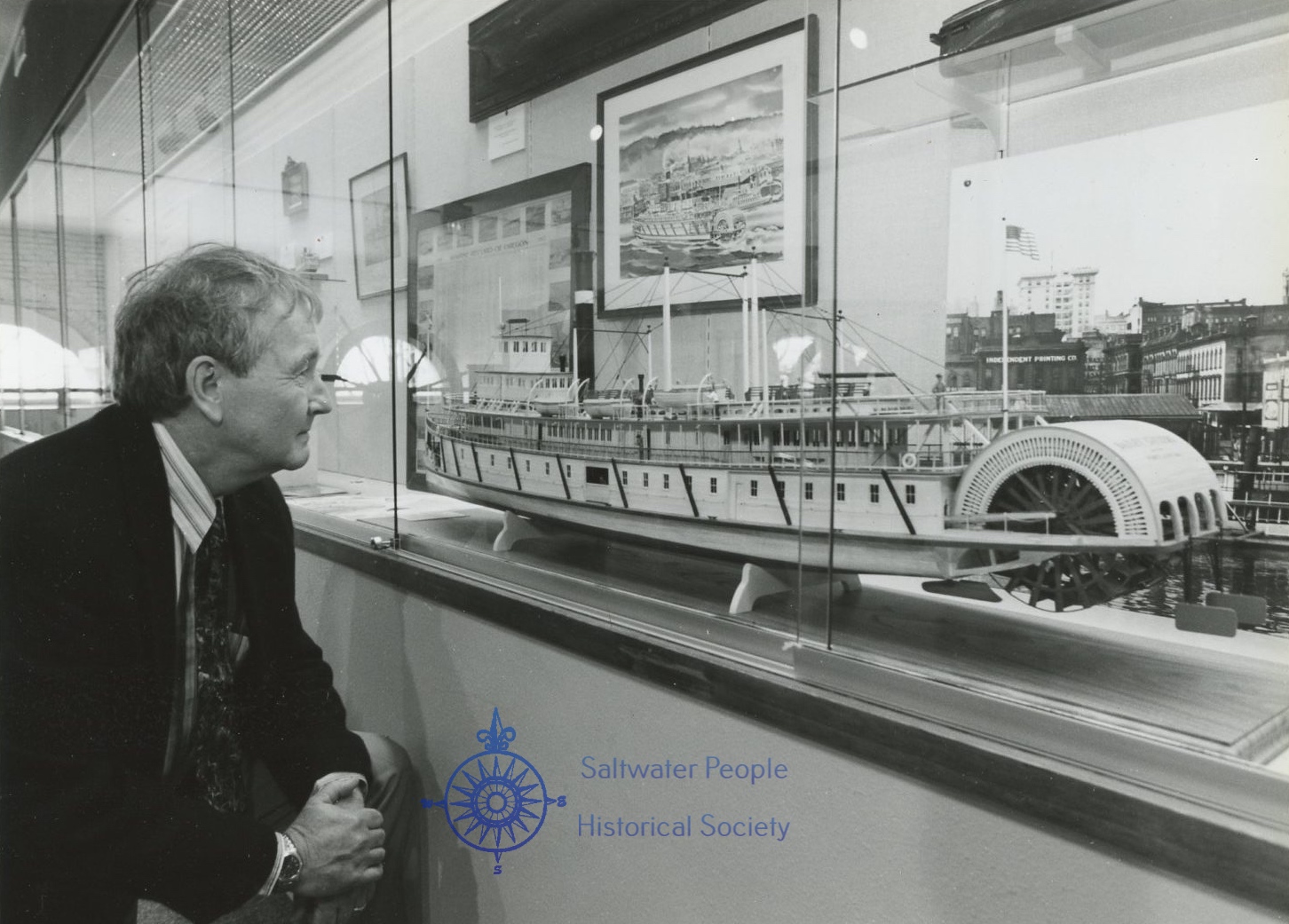

And the Bailey Gatzert model was completed
by Ralph Hitchcock.
Is this the one he built and but do you know
of her whereabouts? 
Tap image to enlarge.
This photo is dated March 1995.
Original photograph from the archives of the 
Saltwater People Historical Society©


13 January 2017

❖ WRECKED ON FRIDAY THE THIRTEENTH ❖ (photo update)

THOMAS W. LAWSON
ON 145943
1902-1907

Original photo from the archives of the S.P.H.S.©
"One of the largest sailing vessels ever built was the seven-masted schooner THOMAS W. LAWSON. The tremendous steel giant of the age of sail was built at Quincy, Mass, in 1902, for the Boston millionaire, stock broker, author of that name. She had the distinction of being the largest schooner and the largest sailing vessel ever built without an auxiliary engine, costing c. $250,000. She had a length between perpendiculars of 375' and an overall length exceeding 475', carrying 43,000 sq. ft of sail. The LAWSON had a gross register tonnage of 5,218 making her far greater in size than most of the steam propelled vessels of her day.
      As the world's first and only seven-masted schooner, the LAWSON utilized a tremendous spread of sail and could carry almost double her weight in coal. She was originally intended for the Pacific trade but instead was used as a collier along the US East Coast. 
      The strange thing about this vessel that crossed back and forth on the Atlantic for most of her brief five years, was that she was named after Thomas W. Lawson. And who was Thomas W. Lawson? He was a renowned author, his most famous mystery novel being, Friday the Thirteenth. The vessel was wrecked on Annet Island in the Scillies off the outlying tentacles of the English coast on Friday the 13th, with the loss of 17 lives, all but two of her crew. She had a cargo of 58,000 barrels of light paraffin oil aboard." 
The Unusual Side of the Sea. Gibbs, Jim. Windward Publishing Co. Seattle; 1971.
Captain George W. Dow
Pilot Billy "Cook" Hicks,
Engineer Edward L. Rowe, both of Boston, were the only survivors.
      The broken and scattered wreck was relocated in 1969. One of her anchors is now built into the outside wall of Bleak House, Broadstairs, the former home of Charles Dickens.
   
1960: 
Model of the Thomas W. Lawson
being viewed by Christopher Greef, age 13, at the 
Science Museum in London, Eng.

Original photo dated 26 Feb. 1960
from the archives of the S.P.H.S.©

    Further reading: click here

17 December 2014

❖ PAMIR and PASSAT ❖


Barque PAMIR
Martin Treder working on a model
of the ship PAMIR (1905-1957)
then plowing between Germany and South America.
The model was a year in the making; constructed with a
steel hull containing 40,000 rivets, 32 sails, 4,000 pulleys,
and cost about $9,000. It will be placed in cases
showing the evolution of water travel.
Original 1931 gelatin-silver photo from the archives of
the Saltwater People Historical Society ©


BUILDING A MUSEUM 1931
"Natural History Museums are the result of decades of painstaking collecting and the institutions are classed according to the number of genuine specimens they contain. However, in Chicago, a museum is literally being manufactured, and the fact detracts none from its worth. Scores of artists, wood-carvers, machinists, and electricians are at work building models for the Museum of Science and Industry founded by Julius Rosenwald. The Museum aims to portray the evolution of man's mechanical and scientific knowledge, and while every attempt is being made to get genuine exhibits, it is necessary that many be in miniature. Wherever possible the models will work; by pushing a button a student may see a gas engine, in section, in operation, or watch wheat being ground into flour and put in sacks. Similar working models will cover all fields of man's activities. The museum will be the only one of its kind in the Americas, and one of the few in the world. It will be housed in the rebuilt Fine Arts Building in Jackson Park, Chicago."
Publication unknown; incomplete news clipping from the archives of the S.P.H.S. 

Barque PAMIR
Suspected to be 1946 when she was sailing
out of Vancouver, BC, under the New Zealand flag.

Original photo postcard from the archives of S. P. H. S.©

Barque PAMIR
Builder: Blohm & Voss, Hamburg
For: F. Laeisz Line
Launched: 29 July 1905
375' x c. 46' x  23.5'
Carried: 40,000 sq. ft of sail
Speed: the top was 16 knots/ regular speed c. 8-9 knots.

One of 10 near-sister ships used by Laeisz Co in the South America nitrate trade.

Fate: caught 21 Sept. 1957 in a mid-Atlantic hurricane.
Captain Johannes Diebitsch
86 aboard/ 6 survived.


Gunter Hasselbach

Kiel, Germany, 25 Sept. 1957
Radio telephoto (UP) from the archives of 
the Saltwater People Historical Society©

The Coast Guard has identified the sixth survivor of the ill-fated German bark Pamir as Gunter Hasselbach. They reported that Hasselbach was the lone survivor of 22 men who abandoned ship in a lifeboat. The other five survivors were en route to Casablanca aboard the American transport ship Geiger. Of the 57 crewmen aboard the Pamir, only the six are known to have survived when the ship was lost in the mid-Atlantic hurricane. 

Many false reports have been published. For further reading from this source, including her ownership and past masters here is a Link

Update 2 February 2015

There is an 8-page in-depth article by Captain L. Gellerman on the colorful, 4-mast barque PAMIR with some of her life spent in the PNW; it can be found in  The Sea Chest, June 1985 published by the Puget Sound Maritime Historical Society, Seattle, WA.

There is a chance they may have a back issue of the journal.  
For membership information in that society please see this link.

A quote from that great piece:

" 'Then', writes Mr. MacNeil,  'we witnessed a drama reminiscent of that age, long past when the clippers reigned supreme. As we stood spellbound, PAMIR, came racing toward us. Huge seas boiled over her bow. Her sails, billowed out to the full, were a scene of grandeur––heeled well over in the terrific wind, she swept by majestically at a good 14 knots. SNOHOMISH's flags ran up, spelling 'Bon Voyage,' and her whistle hooted farewell to one of the last great wind ships. Soon she disappeared hull down on the horizon.'"

PASSAT, 

dated 25 July 1960.
Permanent anchor at Luebeck, Germany.
The vessel was purchased by the city
with hopes she could become a museum. 
The PASSAT is a sister ship of the PAMIR. 
The two vessels were caught in the same storm
that sank the PAMIR, but one managed to
escape with severe damage. Since then the
PASSAT has 
not been in regular use. 
Original silver-gelatin photo from the archives of 
 the Saltwater People Historical Society©


This 137 pg book describes the three voyages that the PAMIR made to Vancouver and Vancouver Island, BC, and records the careers of the tugs that towed her to and from the open ocean. Included are many unpublished photographs of the actual voyage tows, and illustrations by the author (a crew member on the tugs at the time) showing the PAMIR under tow and the rendezvous off Cape Flattery.
The Vancouver Voyages of the Barque PAMIR
Author; Richard Wells.
  

Archived Log Entries