

 |
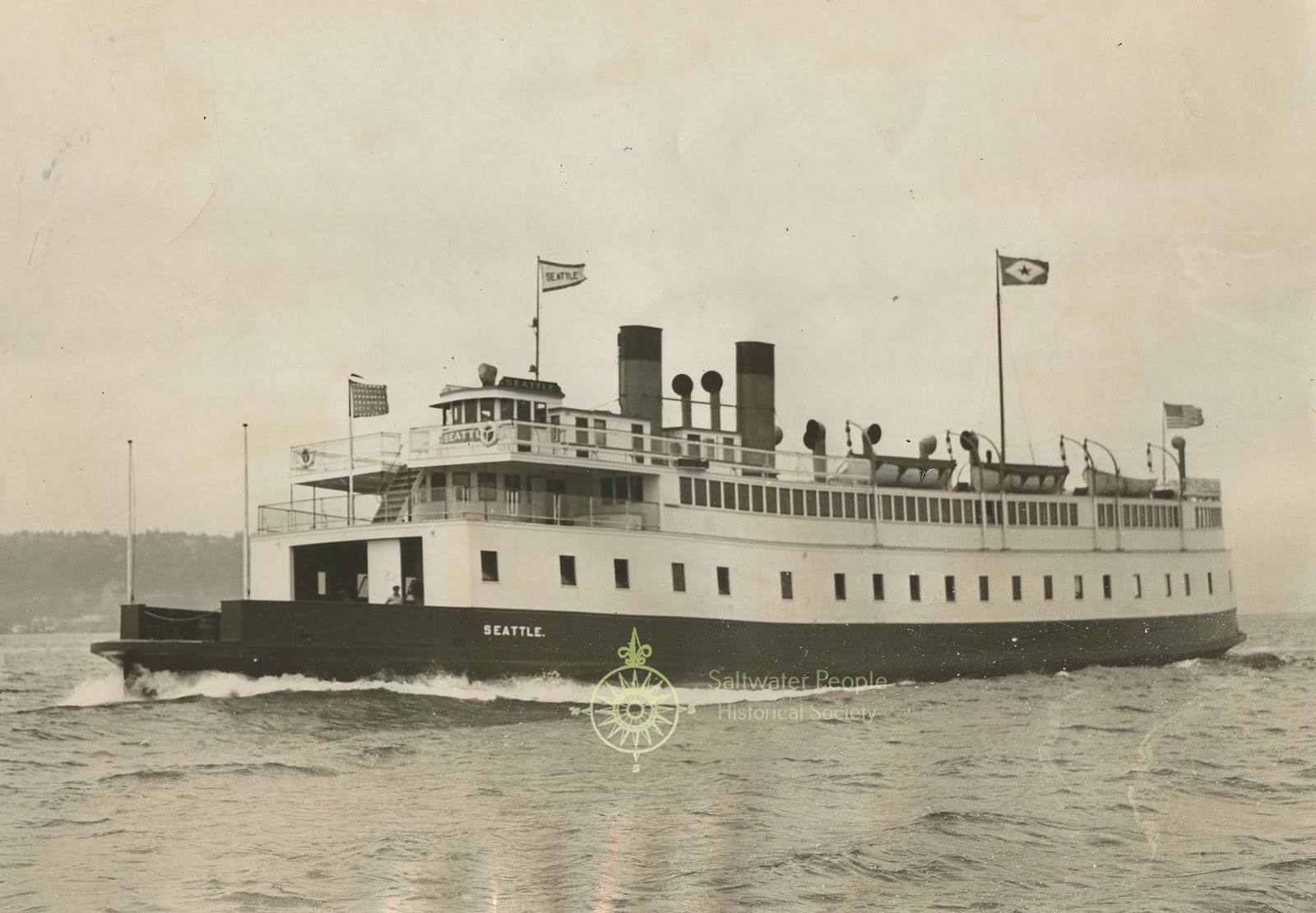
San Francisco-Oakland Bay Bridge. When the bridge system was in place -- many of the ferries sailed north after purchase by Puget Sound Navigation Co. This story regards Capt. Carl F. Frese in command of the M.V. Lake Tahoe, renamed the M.V. Illahee when she arrived in Washington State. |
Although the waters along the west coast are strewn with the wreckage of innumerable ocean-going vessels, the gods of the sea have been good to most small inland craft sailing the Pacific. Very few have experienced serious difficulty despite their open type of construction and limited freeboard that makes them easy prey to sudden storms frequently encountered along the coast.
While a few Northwest-built vessels have been transferred south, the largest movement has been in the other direction, occurring mostly in the years immediately following completion of the San Francisco Bay bridge system.
Between 1938 and 1940, 15 automobile ferries were brought up the coast by the Puget Sound Navigation Co., only one of which, a wooden vessel, sustained so much storm damage that repairs were impractical.
When the Pacific laid claim to another ferry of this group one night off the Oregon coast, the age-old struggle of men against the sea took an unusual turn. Both the men and the sea finally gave up and the ferry made good her own escape –– unaided and unharmed.
It was 9 August 1940, when Capt. Carl F. Frese and his crew left Oakland, California for Puget Sound with the Lake Tahoe, the first of six steel diesel-electric ferries purchased by the PSN Co.,'s Black Ball Line to increase its fleet. The boats had been idle for about a year after Southern Pacific-Golden Gate Ferries halted futile competition with the new San Francisco-Oakland bridge, the Lake Tahoe making the ceremonial last run.
This group of six fine vessels, only 13 years old, would almost double the capacity of the Puget Sound ferry fleet. Each was of 2,468 gross tons, larger than any ferry on Puget Sound.
As though glad to escape from idleness and an uncertain fate on San Francisco Bay, the Lake Tahoe, with engines running, was "pushing on the towline" behind the Commissioner, a Seattle tug, as they passed through the Golden Gate and headed north into the Pacific.
In preparing the ferry for the voyage, wooden bulkheads closed off both ends of the main deck, plywood sheets covered the window and the upper deck superstructure was braced with timbers.
The main deck bulkheads, intended to increase the vessel's seaworthiness, instead almost led to disaster.
In addition to Capt. Frese, the ferry's crew, all Seattle men, consisted of Henry Mehus, chief engineer, and assistants Irvin Lancaster and Arthur Scribner; Ray Volsky and Lewis Currien, deckhands, and Earl Sallee, cook.
Sea watches were set and the men on both the tug and the ferry settled down for the trip which was expected to require from a week to 10 days, depending on the weather.
Mehus, later port engineer for Washington State Ferries, remembers the voyage up the coast as uneventful until they were nearly abeam Coos Bay.
It was nearing the end of my 8-to-12 evening watch when I began to feel something was wrong. A moderate nor'wester we encountered that morning had freshened during the afternoon, raising a heavy swell and the tug had slowed to reduce the strain on the ferry.
"Down in the engine room I noticed a definite change to the vessel's motion which was becoming sluggish and she no longer was rising with the swells in a normal manner. I was pretty sure at least one of the forward compartments below deck was flooding and I had started the pumps when the Lake Tahoe took a list to port and remained in that position."

Communication with the Commissioner had been lost earlier in the evening when the ferry's radio failed but her plight was observed on the tug which dropped the towline and maneuvered up to the ferry's stern to discuss the situation with the crew.
The Lake Tahoe had taken a list when the temporary bulkhead across the bow had carried away, admitting tons of seawater to the main deck which now was building up on the port side and it was felt the ferry was in danger of capsizing. The consensus was that the Lake Tahoe be abandoned.
The tug embarked the ferry's crew without difficulty and then withdrew a short distance to stand a deathwatch which no one believed would be very long. Because there was everything to gain and nothing to lose, one generator had been left running on the Lake Tahoe to supply power to the pumps and all lights were left burning to aid in keeping the ferry under observation in the darkness.
As the night wore on, the abandoned Lake Tahoe continued her lonely struggle against the long swells, the angle of her lights indicating the list was increasing. The fact that she remained on course gave the watchers an eerie feeling that she was underway with someone at the helm. Then it was realized that the long towing wire, now hanging vertically from the bow, was acting as a sea anchor, holding her head into the wind.
Shortly before daybreak, Mehus was awakened from a nap by one of the tug's crew who told him, "If you want a last look at the Lake Tahoe, you'd better hurry. We think she's going down."
But in the increasing daylight, a closer study of the ferry showed little apparent change in her condition since the previous night. It was felt that an effort should be made to save her, particularly since there were signs of an improvement in the weather. Mehus and Lancaster volunteered to reboard the derelict.
Earlier, the Commissioner had radioed a report of the abandonment to the Coast Guard at Coos Bay from which a cutter and surf boat had been dispatched. The surf boat put the two engineers aboard the ferry. No sooner had they stepped aboard than the generator which had been left running faltered and then stopped, but they were able to start another one immediately.
The wind which had been blowing steadily from the northwest for more than 24-hours began to slacken. Since it was now determined that the ferry's list had increased only slightly during the night, there was a good reason to believe she could be salvaged although for the moment there was nothing the men could do.
As the swells moderated, the Lake Tahoe began to free herself of water on the main deck, and before long the bow as above surface. Now for the first time, the pumps were taking effect, further increasing the vessel's buoyancy forward. Soon she was entirely free of water and in normal trim. Surrendered by her crew to the sea, the Lake Tahoe had struggled free unharmed.
After the cutter had recovered the towing wire and returned it to the tug, a course was set for Coos Bay.
Safely moored inside the breakwater, the ferry's forward compartments below deck revealed the source of the trouble. A six-inch steel ventilator duct leading from the main deck and entering the forepeak from outside the hull had carried away, probably from stress as the ferry labored through heavy seas. The opening in the hull was well above the normal water line, but in open sea, each passing swell deposited a small amount of water inside the hull.
As the compartment began to fill, the bow was lowered until the temporary bulkhead was exposed to the full battering force of the rising seas. When this carried away, the main deck flooded, the weight of the water forcing the bow under.
This meant that the ruptured ventilator duct was completely submerged and although the pumps were operating at full capacity, they simply were pumping the Pacific Ocean through the compartment.
"We learned an important lesson from this incident," Mehus says. "When preparing a ferry for a coastwise voyage both ends of the main deck should be left open. Had we done so with the Lake Tahoe, the seas which came aboard after the bulkhead carried away would have swept on through and out the other end.
"As it was, the water was trapped between the after bulkhead and the oncoming swells.
"The rest of the ferries were brought up the coast with the decks open and later two boats were brought all the way from the East Coast in the same manner and experienced no difficulty."
After the opening in the hull had been plugged and the ferry once more prepared for sea, the Commissioner departed Coos Bay with her tow and reached the shipyard at Winslow without further trouble.
There a survey showed the ferry had sustained no structural damage on the voyage and after an engine overhaul, and painting, the Lake Tahoe, re-named Illahee, joined the Black Ball fleet on 3 February 1941. She went into weekend service on the Edmonds-Kingston run.
Above text by Grahame F. Shrader, retired ferry captain.
 |
The COMMISSIONER At what was then called Pier No. 3, Seattle, in August 1940, the year she succeeded in getting Lake Tahoe to her new home in that city. Then the tug went back south for more ferries. The 600-HP diesel tug Commissioner was built at Brunswick, Georgia in 1918. Here owned by Puget Sound Tug & Barge Co. 272 tons/ 108-feet fitted with an A-frame and steel boom of 10-ton capacity and steam boiler for operating salvage pumps, air pumps, etc. Click image to enlarge. This original photo from the collection of J.A. Turner from the archives of Saltwater People Log© |

Captain Carl. C. Frese
(1873-1960)
in command of the Lake Tahoe and
11 other ferries coming north from the
San Francisco Bay to Seattle, WA.,
at different times.
Photo 1947 at his retirement, age 74.
Born in Skamania County, he began
his career on paddle steamers
on the Columbia River. Someday
he needs his own post.
Original photo from the archives of the
Saltwater People Historical Society.©



 Posts
Posts

