"The Cure for Everything is Saltwater, Sweat, Tears, or the Sea."

About Us

My photo
San Juan Archipelago, Washington State, United States
A society formed in 2009 for the purpose of collecting, preserving, celebrating, and disseminating the maritime history of the San Juan Islands and northern Puget Sound area. Check this log for tales from out-of-print publications as well as from members and friends. There are circa 750, often long entries, on a broad range of maritime topics; there are search aids at the bottom of the log. Please ask for permission to use any photo posted on this site. Thank you.
Showing posts with label Columbia River. Show all posts

07 December 2020

❖ Monday Night Mosquitos ❖

The COLUMBIA RIVER STERNWHEELER--A TYPE
Written by Fritz Timmen
Blow for the Landing
Caxton Printers, Ltd. 1973.

WAUNA
The low, powerful lines of a sternwheel towboat
are evident on Wauna of 1906. She was built
for Lake River log towing. She later handled
oil barges on the Willamette until her layup in 1937.
Original photo by James Turner from the archives of 
Saltwater People Historical Society©

"To the eye of many beholders, there was beauty in the Columbia River type sternwheeler. Her hull lines were graceful, clean, and shallow, and about five times longer than the beam. The slight dead-rise made for a flat deck. The lower deck was housed forward from the wheel, with the forward doors and those on the guards wide enough for freight or engine and boiler parts. Above was the cabin deck, with a wide, railed promenade all around, a central passenger lounge and dining room, and windowed saloons fore and aft. The upper, or hurricane deck, carried a texas, with crew cabins or passenger accommodations. Atop the texas and well forward was the pilothouse. This was the Holy of Holies, grandly occupied by the captain and pilot, with lesser mortals granted admission only by special dispensation. Three sides of the pilothouse bore gracefully carved name boards. Often fancy fretwork topped it all.
      Aft of the pilothouse rose the single stack. The kingpost soared amidships, flanked by at least four hog posts to which were secured the hog chains that keep the supple hull aligned. After 1870, the stern-wheel often was enclosed in a box on which appeared the craft's name and port of registry and which also served to keep spray off the passengers.
      The main deck forward was open for winches and capstans and cargo.
      Wood construction was favored, even after steel became available. The initial cost and upkeep of wooden hulls were cheaper. Damage repair was easy -- a soft patch spiked over a broken plank kept the boat afloat until it could reach the beach.
      For propulsion, early engineers preferred a high-pressure, non-condensing engine. Cylinder bores varied between ten and twenty-two inches and the piston stroke was six or seven feet, rarely more. Locomotive-type boilers had a working pressure of about one hundred pounds per square inch. Not until well after WW I did cross-compound engines appear. These engines transmitted relatively low but effective power to the wheel and so were often provided with a bypass valve to permit fast injection of live steam into the low-pressure boiler in case the pilot called for extra power in a hurry. A few tandem-compound power plants were built. Among these was the Henderson at the time of her 1929 rebuild.

Sternwheeler HENDERSON 
O.N. 93168
Here she is working in a film in 1952 as
the RIVER QUEEN.
Built by Shaver Transportation Co. in 1901
158.7' x 31.' x 7.5' 
The skipper this day was
Capt. Sidney J. "Happy" Harris.
She was burned for scrap in 1964.
More about her racing on the river
 can be seen
HERE


      A sleek, trim sternwheeler, moving grandly through a covey of noisy, bustling steam tugs, had a never-to-be-forgotten air about her whether she was a fast passenger packet or a towboat. Sure enough, they don't make 'em like that anymore."


25 June 2017

❖ RACING ON THE RIVER ❖ 1952


HENDERSON (ex-M.F. HENDERSON)
sailing here under her movie name RIVER QUEEN
Click image to enlarge.
Original photo from the archives of the S.P.H.S.©

1901: Built as the M.F. HENDERSON by Shaver Transportation Co, Portland, OR. She was used as a freight boat as well as a towboat.
1911: In an overhaul she lost her initials "M.F." and became HENDERSON.
The M.F. HENDERSON, towing a Standard Oil Co barge from Astoria toward Portland, was run down by the well-known steam tug DANIEL KERN towing rock barges to the jetty. The M.F. HENDERSON capsized and sank in shallow water, lying on her side. No lives were lost. She was afterward righted by five sternwheelers pulling on her at once, and was then taken to the Portland Shipbuilding Co where she was dismantled and her engines and other equipment, except the boiler, installed in the new HENDERSON the following year. 
H. W. McCurdy's Marine History of the PNW.
1912: This year the HENDERSON was built by the Portland Shipbuilding Co for Shaver Trans. Co receiving most of the machinery and fittings from the wreck, but receiving a new locomotive boiler built by James Monk, having twice the capacity of the old boiler. 
1952: An old-time Columbia River sternwheeler she played an important part as the River Queen, in the historical movie the Bend of the River, based on a novel Bend of the Snake by Bill Gulick. The movie starred Jimmy Stewart and Rock Hudson, released 13 February. When first released, the film received poor reviews but since then gained more critical acclaim and is recognized as a great western.

The RACE

In 1952, to promote the release of the new movie, the Henderson participated in the last sternwheeler race on the Columbia River, commanded by Capt. Sidney J. "Happy" Harris.  The filming was done in Mt. Hood, Sandy River and Timberline, OR. Although favored to beat the new steel-hulled sternwheeler, the Portland, commanded by Capt. Bob Williamson, the Henderson fell behind early in the race when she lost steam. The engine crew quickly shunted live steam into her low pressure cylinder until the paddlewheel approached 30 rpm. Actor Jimmy Stewart and other cast members of the film Bend in the River were on board to cheer the vessel on––the Henderson came from behind to beat the Portland in the 3.6-mile race.
      Trivia on imdb.com––some of the river scenes were filmed on the Sacramento River in CA.
Sternwheeler PORTLAND
Her last day of duty helping to move the 930-ft
MOBIL ARCTIC 
for the Port of Portland.
PORTLAND was the last remaining vessel of its kind
in commercial service in the world.

Click image to enlarge.
Original photo dated 27 October 1981
from the archives of the S.P.H.S.©
1956: In December, with a grain ship in tow, the Henderson encountered heavy swells near the mouth of the Columbia River. Declared a "constructive total loss," she rested on shore until she was burned for scrap in 1964.
In 1981: After almost 30 years of service in and around the Portland harbor, the stately Portland yielded the harbor to Diesel-powered youngsters. The Port of Portland faced economic realities, and decided to retire the labor-intensive steam tugboat in 1981. 
      She sat some years at Terminal One, quietly rusting. Her wheelhouse and Texas were removed and rested on the dock. Her wooden super structure rotted away down to the steel housing of her machinery space. The powerful sternwheel dried and cracked where exposed; the underwater surface grew long tendrils of marine plants.
      In 1991, the sad remains of the Portland were deeded to the Oregon Maritime Museum. With funds from Meyer Memorial Trust, Murdock Trust, and the Port of Portland, a group of dedicated volunteers began restoration of the last steam powered sternwheel tug. The work is never ending; the results are well worth the effort. Today the Portland gleams inside and out. 
1997: She was entered into the National Register of Historic Places.

07 November 2016

❖ MOSQUITO FLEET MONDAY ❖ A Mosquito RUNS THE RAPIDS ❖ S.S. HARVEST QUEEN ❖

River steamboat HARVEST QUEEN
846 t. 200-ft., built at Celilo in 1878.
She and 8 or 9 other vessels were transferred to
the lower river in 1881, where this story begins.
Original photo from the archives of the S.P.H.S.©

The term 'Mosquito Fleet' may, to readers not familiar with the Puget Sound Country, suggest only very small craft. It was however, a phrase universally employed by the people and publications of that section to differentiate the Sound steamers from ocean and coastwise fleet. Some of the inland ships were as large as the deep-sea vessels, but their trade placed them in the 'Mosquito Fleet.' The term enjoys the authenticity of tradition and long usage. Author, historian Gordon Newell, 1951.

"The serenity of this scene as the HARVEST QUEEN moves out of her slip heading for the Columbia River is in sharp contrast to an earlier run of the HARVEST QUEEN––one that took her over Celilo Falls.
In 1881, hard times on the Middle River above the rocky barrier at Celilo Rapids had prompted the passage. It was a risky one. To breach the falls meant a 20-ft drop over a basalt ledge. Then followed the hazards of rock strewn Tenmile Rapids. This churning gutted into a mile long cauldron that compressed the Columbia between sheer rock walls less than 300-ft apart.

      Running the Celilo Rapids was first accomplished in 1866 when Capt. Thomas Stump threaded the OKANOGAN through the hazardous chasm, followed by other sternwheelers of similar size: the NEZ PERCE CHIEF, the classic ONEONTA, the HASSALO (II), and now one of the river's finer steamers, the HARVEST QUEEN. At the helm was Capt. James W. Troup, 29, who six years earlier had entered the HARVEST QUEEN's pilot house as her skipper. Peter De Huff, a veteran riverboat engineer, manned the engine room throttle as she moved from her Celilo slip. A slight rise in the low River had prompted the young captain to make his move. For a few minutes it seemed as though it might be his last for, as the HARVEST QUEEN swept into the narrow chute, she was unable to clear the ledge.
The rocks tore into the stem of the 200-ft steamer, ripping off her rudders and disabling the engine supports. Legend has it that Capt. Troup picked up his speaking tube and shouted:


'Back her, Pete! Back her if you love me!'
'I can't. Everything's busted,' came the doleful reply.

      Captain Troup, with the skill of command that was to make him an outstanding riverboatman on the Columbia and the Fraser, left his useless wheel. Anchors and kedges were dropped to pull the drifting HARVEST QUEEN out of the whirlpools and away from the threatening rocks into the eddy. The worst was over. Defying the chill waters, the steamer's crew completed repairs. Within two days, the HARVEST QUEEN was ready and defiant, sweeping at railroad speed through the remaining rapids to be greeted by cheering crowds at the Dalles."

Above words by author Jim Faber, The Steamers Wake. Entetai Press, Seattle. 1985.
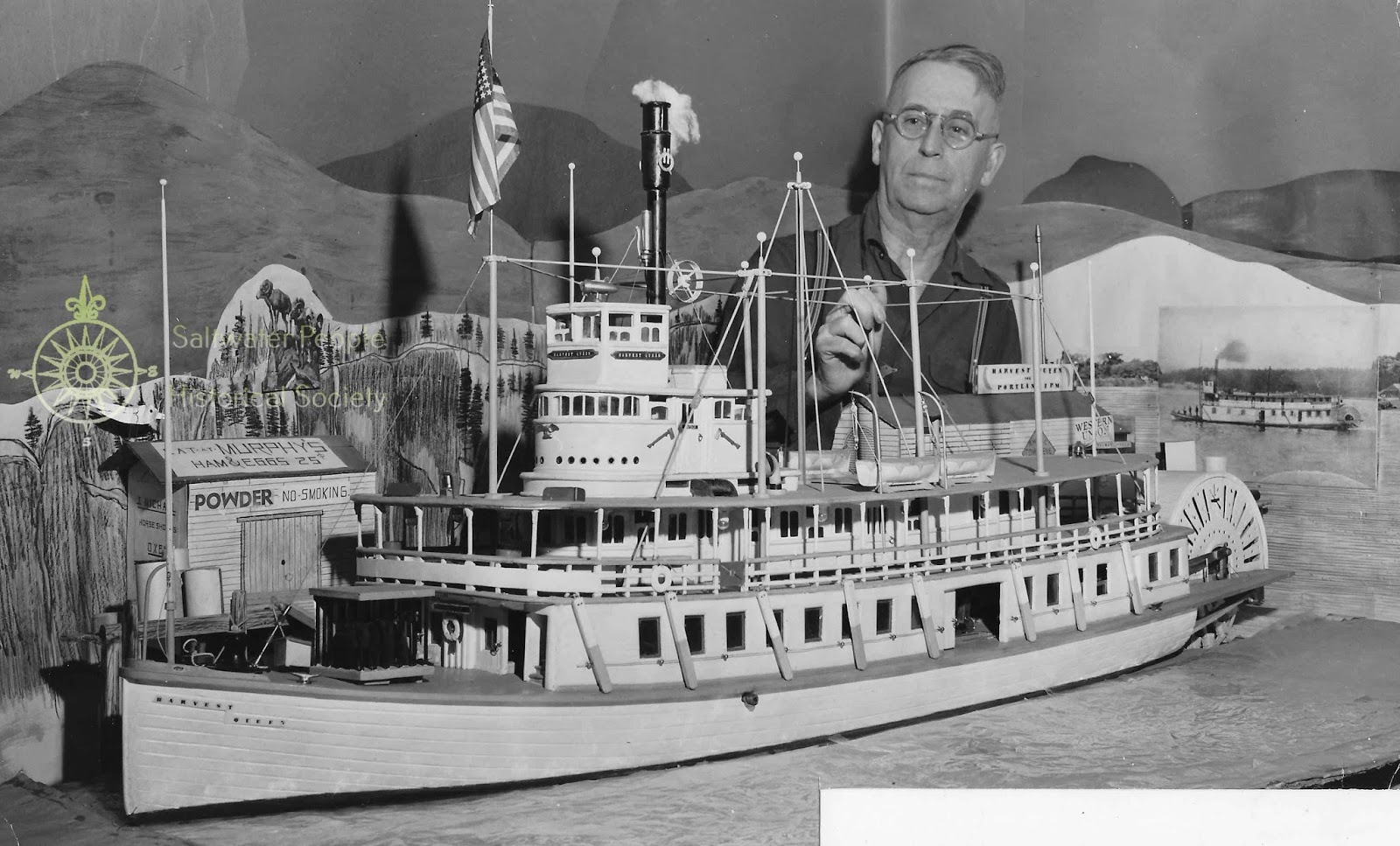
HARVEST QUEEN
6-ft long ship model by Spencer W.Young, 1953.
Young took 13 months to make the craft of birch, oak, pine, and
mahogany. Boilers and twin engines drive walking beams,
11" long, that turn the paddlewheel. The lounge is furnished
with a grand piano, armchairs, tables, all to scale.
LIghts come on in cabins and smoke pours from the stack.
Unknown photographer.

Original photo from the archives of
the Saltwater People Historical Society©
1928: Capt. Troup had a truly great maritime career that closed with his retirement at age 73 years of age––having passed the age limit set by BC Coast Steamship Service by 8 years.

Archived Log Entries