"The Cure for Everything is Saltwater, Sweat, Tears, or the Sea."

About Us

My photo
San Juan Archipelago, Washington State, United States
A society formed in 2009 for the purpose of collecting, preserving, celebrating, and disseminating the maritime history of the San Juan Islands and northern Puget Sound area. Check this log for tales from out-of-print publications as well as from members and friends. There are circa 750, often long entries, on a broad range of maritime topics; there are search aids at the bottom of the log. Please ask for permission to use any photo posted on this site. Thank you.
Showing posts with label Seattle. Show all posts

20 April 2025

NIEDER AND MARCUS, MARINE SALVAGE YARD ... with Captain Ed Shields


The JEFFERSON

(ex-ALASKA) passenger steamer.
1615 tonnage 
Fate: Nieder & Marcus Marine Salvage Yard,
1925.
Photo from the Saltwater People Historical Society.


The SAN JUAN
 
 284 ton halibut steamer 
built by Sloan & Hill yard of Seattle
for San Juan Fishing & Packing
(later passing to Libby, McNeil, Libby)
Fate: Nieder & Marcus Marine Salvage Yard.
1939
photo from the archives of the 
Saltwater People Historical Society


The firm of Nieder and Marcus was established in Seattle in 1908 by Michael and Harry Nieder and Ben Marcus and was located on West Waterway just north of the Spokane Street Bridge, on the Harbor Island side of the channel. Their principal business was dealing in scrap metals and other used merchandise salvaged from ships. Today, the word is recycling. Their yard was littered with scrap metal and marine hardware.

Many stories have been written about shipyards and how the shipbuilders assembled or put the vessels together. In the Nieder and Marcus yard, most vessels were taken apart. Over the years, many vessels passed through the yard. For most, it was the end of the line, although a few saw the light of day again and returned to useful service. The list of vessels at the end of this story contains the names of many well-known local vessels, showing the firm was active for over thirty years.

Harry Nieder served with the American Expeditionary Forces in France during World War I and, on his return to Seattle, assumed an active role in the firm along with Ben Marcus. From the beginning of 1909 until about 1924, there were only a few vessels being scrapped. However, during World War II, the War Shipping Administration and the U.S. Shipping Board contracted for the construction of an enormous number of both wood and steel vessels to meet the needs of the armed forces. With the end of the war in 1918, the shipbuilding progress was just getting well underway, but with the end of hostilities, many contracts were canceled, and others were extended just sufficiently that the vessel would be launched rather than leave the partially completed hull on the ways. Lake Union in Seattle became the mooring ground for many of these hulls, some complete and others without machinery.

These new Shipping Board vessels, at least the wood ones, were moored at anchor side by side in two rows comprising nearly forty in number. They were of the Hough and Ferris types intended as coal-fired steamers.

Other shipyards on the West Coast turned out many wood sailing vessels even into the early years of the 1920s. At this time, there was a great demand for vessels to carry lumber from the west coast mills to Australia and the islands of the South Pacific Ocean. However, the spurt in shipping soon ended, and as the vessels completed their return to Seattle, they, in turn, were moored in Lake Union or Eagle Harbor on Bainbridge Island. Around 1925, the owners of older, slow vessels had replaced them with newer, larger ones. Many vessels floating in or near Seattle would never see active service again.


Lake Union, Seattle, WA.
with a few of the inactive ships awaiting their fate, 
at Nieder & Marcus Marine Salvage Yard, Seattle.


As the owners became convinced that the shipping boom was over for good, they were finally willing to sell off those older bottoms to the scrappers. The firm of Nieder and Marcus was ready, willing, and able to reduce both the wood and the steel vessels to scrap, salvaging all that might be usable.

Beginning about 1925 and continuing through 1939, a steady flow of vessels passed through the control of this firm. Generally, the vessels were brought to the yard under tow and once there, with few exceptions, it was the beginning of the end. All the deck fittings were removed for possible sale to some other ship owner. For the iron or steel vessels, the workmen with their torches started the slow but fatal task of cutting the metal first into large pieces that the stiff-leg crane could lift onto the wharf and next into smaller pieces that would fit into the doors of the blast furnaces of the steel mills.

The masts, lifeboats, davits, stairways, smokestacks, lockers, storage racks, cleats, steering wheels, tables, port lights, running lights, and even dishes were removed intact if possible and stored in a covered shed or warehouse. At the top of the vessel was opened, exposing the interior. Other possibly reusable items were taken out intact, including engines and boilers. There was a market for steam boilers for the salmon canneries of Alaska or some of the sawmills. It was seldom there as a market for an old steam engine so those beautiful pieces of machinery were cut up.

As the removal of the vessel progressed, it would rise in the water until only the bottom and turn of the bilge remained. The propeller was generally brass or bronze with a high value and could be removed without the need for dry dock. The last portions of the keel and bottom plates were often towed to the local drydock, where they could also be cut. I believe some of the vessel bottoms were beached alongside the wharf at high tide and then the workmen could complete the cutting up at low tide. All steel was reduced to the small pieces mentioned above, then picked up with an electric magnet on a crane and placed in a large pile until it was again loaded with the magnet into hopper railroad cars for shipment to the steel mill.

Wooden vessels were also scrapped by the Nieder and Marcus firm. After the vessel was moored at the firm's wharf, all that was possibly reusable was removed. The masts were cut down, with the rigging wire being saved intact, especially for the logging industry. The turnbuckles from the rigging were stored in the warehouse along with the pumps, sails, stones, windlass, anchors, chain, lanterns, tank, donkey engine, etc. The masts and the spars, along with burnable material from the yard, were piled in the hold or on deck to provide additional fuel for the final fire that consumed the hull. When all was ready, the hull was towed to Richmond Beach at a site about one mile south of the present Edmonds Ferry Terminal and beached at high tide. Wires were stretched to shore and attached to stumps and winches that had been removed from other vessels. On a selected day, the hull was set on fire. Often, a generous amount of oil had been spilled throughout the vessel to start the fire.

These wood vessels were of a most heavy construction, the builders having made use of the finest and largest timbers from the mills on the coast. Outside planking of four to six inches thick was normal. The frames were of double-sawed type from ten to fourteen inches square, while the inside planking could be up to fourteen or more inches thick. The decks were at least four-inch plans with massive deck beams to support them. All in all, there was more timber in a vessel than that vessel could carry as cargo in many cases. Hence, there was an enormous amount of fuel for a fire that was required before the ship breakers could salvage the steel fastenings.

When set afire, the blaze would rage for hours. It was common to set the fire at high tide on a summer evening, so as the tide receded, more of the hull would be exposed on the outside. The blaze would consume the deck and much of the upper portions of the hull, but on the inside, the heat from the fire would dry out the planking during low tide, so on the returning high tide, the hull would fill with water rather than float as before. Hence the desire to consume the most as possible before the tide extinguished the fire. Some supper portions would remain smoldering the next day, as the timbers being so large, they would not sustain combustion when the light plans had burned away.

When the blaze was set, the vessel's funeral pyre could be seen for miles up and down the Sound, especially after dark.

The wood hulls, when first set on the beach, would draw from ten to fifteen feet of water, but as the fire consumed the upper portions, the remaining backbone with the frames would float with the incoming tide and then be hauled further up the beach at high tide. The winches on the beach hauled away on the old frames during these high tides, so at low tides, the exposed timer could burn.

When I visited the burning sites one day in the summer, there were several hulls there, each somewhat consumed. The workmen would, at times, use dynamite to break the sections of a vessel into small enough portions that the winches could haul together like the land clearing crews do now with stumps, thereby consolidating the remnants so the fire could be kept burning. A loose or individual timber would not burn of itself.

The purpose of the burning was to recover the metal fastenings that the shipbuilder had used in construction. Some of these hulls, when burned clear down yielded 100 tons of iron bolts! At low tide, the workmen went out on the beach and gathered up any piece of metal they could find. They had made steel sleds out of parts removed from other vessels, and these were filled, dragged up the beach by a winch, then loaded for shipment to the steel mills.

My father, Capt. J.E. Shields bought considerable quantities of ship blocks, turnbuckles, wire rigging, sails, anchors, chain, spars, etc., or use on the fleet of sailing vessels. I remember one day in the summer of 1930 when he had purchased everything he could remove from the ELINORE H. We took two codfish dories from Poulsbo over to Richmond Beach. At high tide, the company crew had thrown over the side of the vessel all the loose wood blocks and several booms and gaffs. We gathered up the heavy books at low tide and put them in the dories. The booms were tied in a long string. Then, when the tide came in, the dories floated with the load of blocks and other metal rigging and hardware that was on the beach. We returned to Poulsbo, where the booms were pulled up on the beach above the tide and the wood blocks in the warehouse. It was surprising how many of these salvaged items were later used. He also bought all of the sails from some of the vessels being dismantled, these being stored in our sail loft where, over the years, they were taken out, then cut down to a smaller size for the codfish vessels, or just portions of the canvas used as tarpaulins.

The main yard of Nieder & Marcus had a warehouse where the better "goodies" were kept in the hope someone with cash would come along. There was one portion that had a second story. The flooring was salvage teak decking, 4" x 4" they had bought after it had been removed during one of the overhauls of the USS SARATOGA. Other items I remember there, as I was a frequent visitor when accompanying my father, were many coal oil lanterns removed from vessels. How I would like to have them today. However, the one item I remember most vividly was a ship's bell removed from the USS PRINCETON. I never heard a more beautiful tone from a bell. It was mounted on a wooden frame where a person could strike the bell, and then the tone could be heard for at least three minutes. The bell, as I remem ber qa vour 24" across. At the time he vessel was built, the school children of Princeton, New Jersey, had collected money for a bell. They had donated dimes, silver 10-cent pieces, which were melted down to last the bell. Therefore, the bell was solid silver! A proud ship carried this bell. I have not been able to find the disposition of the bell. Nieer and Marcus had decided that, as the bell was donated by children from their dimes, whoever bought it had to guarantee it would not be melted down to recover the silver. If any reader knows the whereabouts of the bell, we would appreciate learning from you..

Mr. John Howelln, nephew of Joe Livingston, the last manager of the firm, has a scrapbook kept by the firm, and therein is contained the only remaining history. Some photos show vessels being cut down, and a few newspaper stories have been preserved. Of interest to me were the final bill of sale documents from the previous owner to N & M. The former owner was faced with a problem of disposing of he old vessels, and a fleet of sailing vessels such as those owned by Libby McNeil and Libby went for one dollar each. When N & M had a signed bill of sale properly notarized in hand, there was no question of ownership and the possible later claim for damages to the vessel or by the Coast Guard for barratry.

The list of vessels that passed through the hands of N & M is included here. Not all were reduced to ashes and scrap for the steel furnaces. The PATTERSON, originally a survey ship, was fitted out as a motor ship and engaged in racing to Point Barrow before finally being wrecked in 1938. MONITOR  became a fish reduction plant while K.V. DRUSE  became a log barge. The ferry SEATTLE was towed to Alaska for use as a fish plant. There may be others that saw the deep water of the ocean or inland seas under their keel again. 

Text by Capt. Edd Shields
for Puget Sound Maritime Society
Membership journal The Sea Chest, 1972.
Seattle, WA.


08 November 2024

CAPTAIN BEN JOYCE, FROM BOSTON TO ALASKA


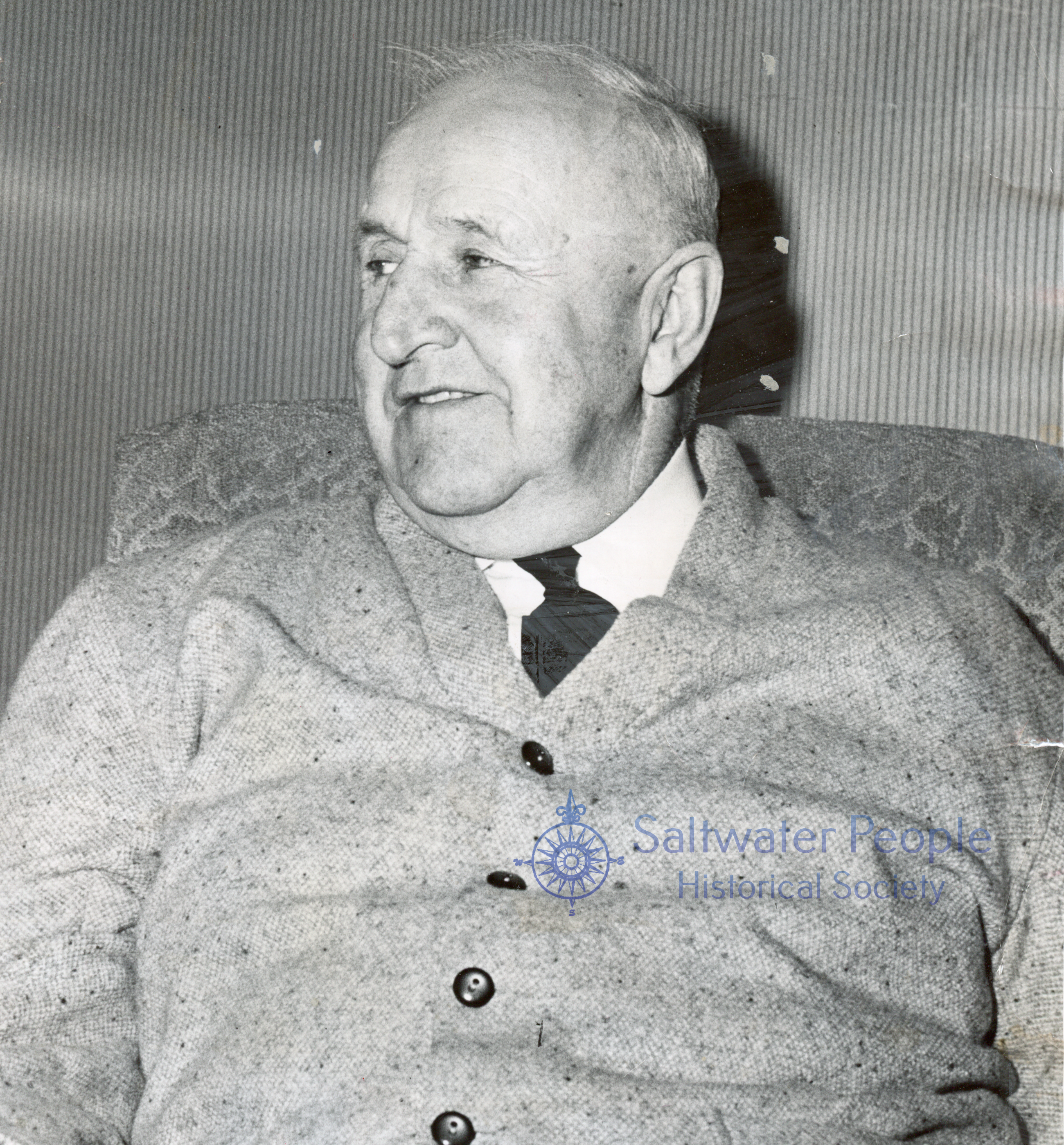
Captain Benjamin Joyce,
(1879-1971)
Life long mariner.
Photograph dated 1952.
Reports of an interview below
by Seattle's Lucile MacDonald.
Original photo from the archives of the 
Saltwater People Historical Society©

When the history writer, Lucile McDonald interviewed Capt. Ben Joyce for this essay in 1967, it had been 70 years since he had left home in Boston for a 14,300-mile voyage to St. Michael, Alaska, in a 122 ft halibut fishing boat.
        Around Seattle, it would be hard to find another old salt who could match this cruise through two hemispheres in so small a craft.
        Once upon a time, such voyages were fairly common, but most of the men who made them are long since gone. Captain Joyce began young, otherwise, he wouldn't be around to tell the tale.
        "in 1897, l was an office boy in Boston when we heard news of the big Klondike gold strike. No one knew where the Klondike was, but every young man wanted to go. The story of the arrival of the steamship Portland in Seattle with a ton of gold on board didn't lose any in the telling. I was 17 and I got gold fever with the rest."
        Joyce came from a line of sea captains and the tradition has been handed down to his sons, Capts. Emory and Ben Joyce Jr., and his grandson, Lieut. Comdr. Ben Joyce, in the Coast Guard, and Capt. Walter Hoopala, on a Foss tugboat in Vietnam.
        At the time when the first young Ben got itchy feet, his father, Capt. Hanson B. Joyce was employed by the New England Fish Co. as the supervisor of fishermen. He had been going to West Coast halibut fishing each winter since 1892, and returning home for the summers because there were no facilities for shipping fish across the continent in warm weather.
        In the spring of 1897, he was sent to Camden, M.J., to supervise construction of a new steam fishing boat, the NEW ENGLAND specially designed for catching halibut in the North Pacific. He was to see that it was the most efficient type for the work.
        "She looked like a towboat with two masts, Capt. Ben explained. She never used the sails, but had them for emergencies.
        "We wrote to father in Camden and told him I wanted to go to the gold rush. He said he'd do what he could to help me. He got me a job as a fireman on the NEW ENGLAND.
        When the steamer was finished, my father high-tailed it overland in December to the West Coast, this time taking Mother, my two sisters, and a brother along. This gave me family connections to come to.
        Young Ben went to Camden and joined the NEW ENGLAND to help take her to Boston.
         "On the way, the chief engineer decided I'd never make a fireman in this world or the next. I was called on the carpet by the president of the company. He told me they'd have to make an ordinary seaman out of me. The crew already was filled when they found another fireman, so I went as deckman, meaning I was available to do anything. There were 18 of us on board.
        We left Boston December 23 in bad weather and had to lie in at Woods Hole. From there to St. Thomas in the Virgin Islands was a nonstop run. We went in for coal and then left for Rio de Janeiro. We were sweeping the bunkers for fuel before we got in.
        I was shoveling coal most of the time that trip; the sailors had to move it to where it was within reach of the firemen. We had coal all over that boat, in the fish holds, and stacked on the deck. It had to be that way because the stops were few and far between.
        The weather was mostly fine all the way from Woods Hole to the Strait of Magellan. 


The INDEPENDANT
Landing halibut at Seattle, WA.
Postcard from the archives of the 
Saltwater People Historical Society 

We coaled again at Montevideo. We never went into any of these cities because of the shipping congestion. The coal always was lightered out to us and we'd be on our way as quickly as we could.
        We made the entrance of the Strait of Magellan at night and anchored until morning as there were no navigation lights in the passage. We'd gone into the Strait several hours when we saw a ship that looked to be on the beach. The captain thought she needed assistance, so we went over to her and found she was a Boston fishing schooner heading for Alaska.
        She was full of fishermen with gold fever. She needed no help; she was waiting for the wind. We visited with them all that day –– it was Sunday–– and we were under way the next morning and out of the strait that night into a storm on the West Coast. By then, we'd got all the deck coal down into the hold, where the firemen could handle it, so we made out all right."
         The next stops were at Talcahuano, Chile, and Callao, Peru, to refuel. Captain Joyce said by then he was "coal sick." He'd handled so much of it, along with the ash sent up in buckets and dumped overboard. Then on to San Francisco. The saving feature of the voyage was good food.
        The New England arrived at Vancouver, B.C. in March, almost three months to a day, from the Boston departure. Joyce's father was there to meet him, having just finished the halibut fishing season. He took over command of the boat for the rest of the voyage.
        "We were in Vancouver only about two days and then left for Seattle to pick up a tow of two river steamers for the Yukon. They were the ROCK ISLAND I and II."
        We used the Inside Passage when we could and headed for Dutch Harbor, where we fueled again and father arranged to tow two more river steamers to St. Michael after we delivered the pair we had.
        On the trip back from St. Michael, I had a new job – dishwasher and flunky. On the way north again, I was cook. I've done about everything."
        The NEW ENGLAND began halibut fishing out of Vancouver in the fall. Capt. Joyce became captain of her in 1912 and left her in 1916 for bigger vessels.
        Did he ever get to the gold rush?
        "Yes, I had to get that out of my system. It took five weeks. I went to the Atlin, sluiced about a month on Pine Creek, and got a few specks of gold dust in the bottom of a pill bottle."
        Joyce fished with his father on the NEW ENGLAND. She carried 12 dories and 24 fishermen They employed 350 hooks to a string and one day caught more than 200,000 pounds of halibut.
        "At first we hoisted them aboard by the tails, but that was too slow for father. He put cargo nets in the dories and hoisted them out full in one lift.
        The company allowed a fisherman 25 cents a fish when I began. Later we were getting 1.25 cents a pound. We worked sometimes from daylight to dark in the dories.
        The NEW ENGLAND was sold for junk late in the 1930s. Captain Joyce retired in 1955, but he still carried his steamboat license, the oldest one on the Pacific Coast.

Above words by Lucile MacDonald, Historian/ Author. Published by the Seattle Times. 1967.


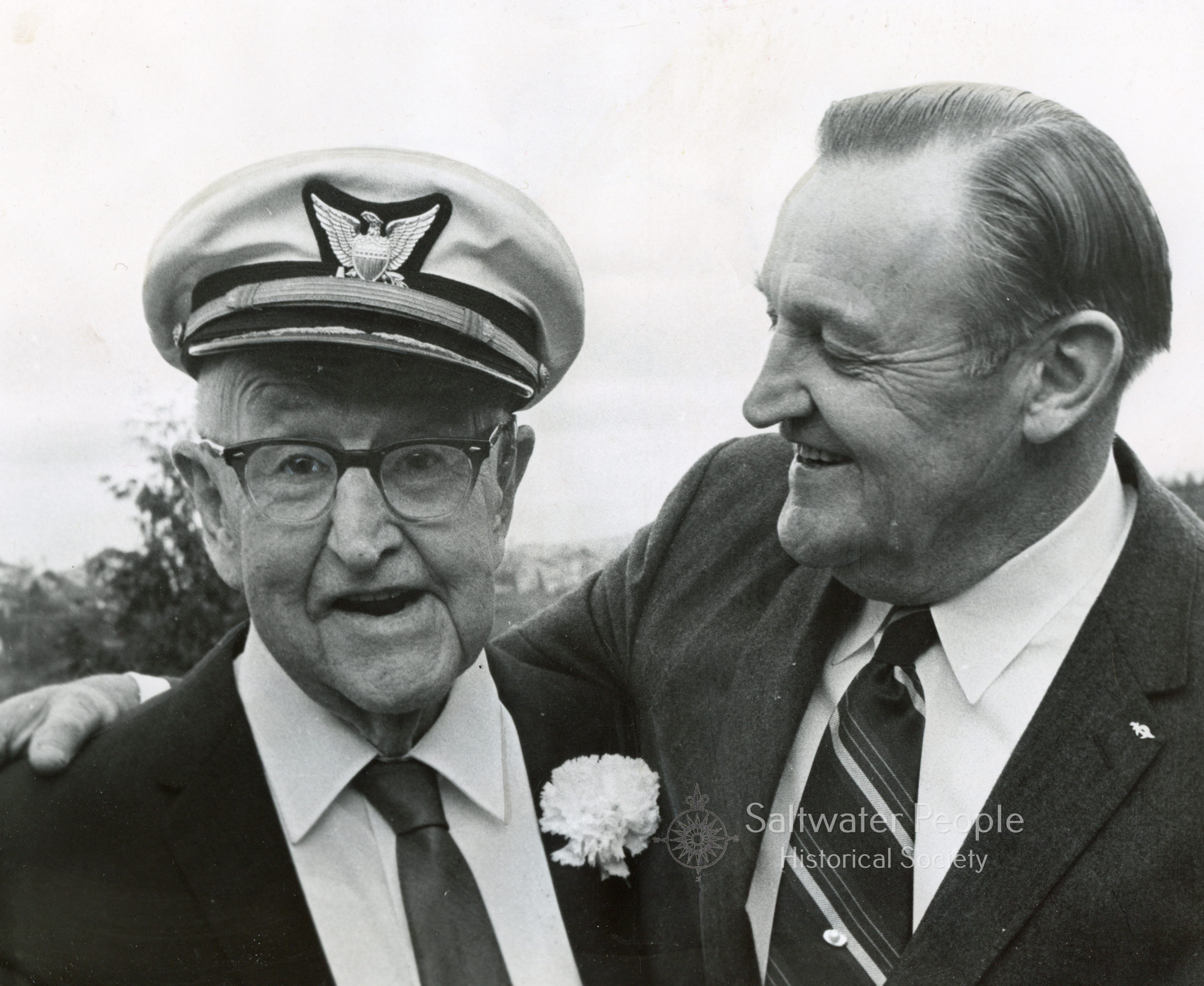
Capt. Benjamin Irving Joyce (L)
and son, Capt. Emery Joyce

Celebrating the 91st  birthday 
of Capt. Benjamin.
Original photo from the archives of 
the Saltwater People Historical Society©


Many guests of honor had ridden with the captain on ships of the old Alaska Steamship Co passenger fleet. Joyce, who was born on an island off Maine, did most of his sailing out of Seattle. He received his masters papers in 1902 and was the oldest licensed master on the West Coast. The last time it was renewed, in 1965, the Coast Guard officer who signed it was Capt. Emory Joyce, one of three sons who became captains. 
The celebration was at the home of Emory Joyce, now a Puget Sound pilot.
Text by Jay Wells, from the Seattle Times. Published February 1970.


05 April 2024

SEATTLE'S BARKENTINE DAYS


Barkentine DIAMOND HEAD
(ex-Gainsborough)
O.N. 157574
194.2' x 31.2' x 20.2' 
G.t. 1,012
Built 1866
photo by the remarkable tug master
Capt. H.H. Morrison
Undated. Low-res in public domain.

Text by Margaret Pitcairn Strachan
Courtesy of the Seattle Times 1947

"In 1866 an English ship-building firm named C. Longley christened the first large iron-hulled ship. Hundreds of persons flooded to watch her make her way into the Thames, expecting to see her sink, because such a novelty as a barkentine made of iron couldn't float! But cheers soon were forthcoming, and all those folk who saw the wonder of that age, sail proudly forth, are dead, while today (1947) the ship herself carries on in Seattle's own Lake Union.
        The Lady Gainsborough was indeed a thing of beauty. Painted white, with trimmings of mahogany and with solid teakwood railings, the barkentine had three tremendous masts that carried heavy canvas.
        Today, denuded of masts and super-structure and old-time fittings, she goes by the name of Diamond Head and is leased by the General Petroleum Co to Seattle's City Light for use as an oil-storage tank. Next year, when modern facilities replace the Diamond Head, she will revert to her previous job as an oil barge.
        Fantastic tales have been written about the ship, but mostly they have been the product of someone's imagination. Her real story is thrilling enough without resorting to invention.
        The Lady Gainsborough broke all records when she was in her prime, sailing around Cape Horn with her canvas whipping in the wind. She took mail to Englishmen stationed at the outposts of the Empire, and carried distinguished European passengers. Sometimes she stopped at China and brought back Chinese coolies, crowded together in her hold.
        When bigger ships were constructed, the Gainsborough became a tramp, carrying cargoes of coal and sugar. Laden with coal from Westport, N.Z., she was wrecked at Diamond Head, HI., 31 August 1896. Auctioned for $1,800 and pulled off, she was towed into port and placed under the Hawaiian flag. She was renamed the Diamond Head, for the place where she had come to grief. She served in Allen & Robinson's line of packets between Honolulu and West Coast ports of the US.
        From this time on, the Pacific Northwest figured in the log of the ship. Under a Capt. Petersen, she sailed from Port Gamble, Port Blakely, Port Townsend, Seattle, Vancouver, WA., and Ladysmith, B.C.


Capt. Waldemar C. Sorensen
(1870-1954)
One-time mate of the 
barkentine Diamond Head.
A native of Denmark, Sorensen came 
to Seattle in 1892. He was master of 
vessels sailing to Alaska and 
coastal waters until his retirement
ca. 1917. Before WW I he taught
navigation classes at the YMCA.

Original gelatin-silver photo from the archives
of the Saltwater People Historical Society©


There was a Captain who well remembers this phase of the ship's history, for he sailed on her as mate in 1907.
        The former mate is Capt. Waldemar C. Sorensen of Woodinville. The other day he came to board the Diamond Head once more and stand beside her wheel while I plied him with questions aboard the ship.
        "Here was where the first mate slept." he said, walking along the tarred deck "and here was the second mate's bunk, and here was the dining room. I first saw her when I was a deckboy, sailing on a Danish schooner in 1885. We were lying by Big Ben at London, and she came in. She was good-looking in those days, all right! All white-painted and with the figurehead of the Duchess of Gainsborough."
        Capt. Sorensen enjoyed meeting the present watchman of the Diamond Head, who is in truth a watch-woman--Mrs. Philip Mettler. Mrs. Mettler's husband became the watchman in 1935 and they lived on board, occupying the captain's quarters for two years while a houseboat was prepared for them next to the ship. When there was talk of doing away with the ship, Mettler began working on barges for General Petroleum. Then came the shortage of oil during the war and once more the ship was needed. Mrs. Mettler obtained her license as a "qualified tanker man," 
16 October 1942, and has held the job ever since.
        Three years after Sorensen sailed on the Diamond Head she was sold to the Tyee Whaling Co of San Francisco. Under the command of Captain Barnason, for five years her decks rang with the shouts of whaling men. General Petroleum Co., next purchased the vessel and her glorious days of riding the waves were over.
        Slowly mystery began to enshroud her history. It was told that she had been a vessel carrying prisoners to the penal colony at Van Dieman's Land, Tasmania. Imaginative men claimed to have heard strange noises on board and a tale of the captain's wife being murdered at sea grew rapidly, as well as stories of mutiny aboard her as a slaver.
        Today all known relics of the Diamond Head are gone –– except some teakwood cigarette boxes made from her railing. Her anchor was donated to the scrap drive during the war. Even the captain's quarters are absent. The hold is filled with 7,500 barrels of oil –– a paltry amount compared to the 100,000 barrels a 15,000-ton ship can carry. But those 15,000-ton ships can't boast of having been the first of the large iron ships, or of having been wrecked and salvaged at Diamond Head, or of breaking sailing records long, long ago."


30 January 2018

❖ 4 Million Dollars worth of DRYDOCK ❖ 1954

The largest concrete drydock built to date in the USA.
Seattle, WA. 1954.

Click image to enlarge.
Original wire photo from the archives of the
Saltwater People Historical Society©
Tugs slowly inch a huge 400-foot floating dry dock, made of enough concrete to cover an acre of ground five inches thick. Through the drawbridges in Seattle, en route to a shipyard for fittings. The $4,157,000 oceanic dock, the largest of its kind ever built in this country, will be turned over to the Navy after being outfitted with necessary equipment, including crew's quarters and gun emplacements.

10 May 2014

❖ Permission Granted ❖ Sea Trials with Fifty Women Aboard

1944 Minesweeper Sea Trials, 
Built by Associated Shipbuilders, Seattle, WA.
Original photo© from the archives of the S. P. H. S.
"An ancient sea-going superstition was reeling groggily, still dizzy from a series of paralyzing body blows dealt by approximately 50 women employees of Puget Sound Bridge and Dredging Co.
      The instrument with which the superstition was attached was one of the big new mine sweepers built at the Associated Shipbuilders' Harbor Island Yard.
      For the first time in the yard's history, the women set sail on the mine sweeper's initial test run, flying in the face of warnings from maritime doom-criers.
      According to salty superstition the trim vessel should have plunged to the bottom of Puget Sound for the old belier decrees that a vessel that carries women on her trial run is certain to meet disaster. However, the mine sweeper behaved like a princess, wringing approval even from those who had boarded her with their fingers crossed.
      The 50 women were chosen from the various departments on the basis of their absentee record, efficiency, and seniority. One woman is a welder, one a scaler, one a journeyman electrician. 
      The mine sweeper pirouetted like a dancer through a series of corkscrew turns. As the day wore on and it became apparent that the jinx, or whatever it was, had missed the boat, the women passengers relaxed, and numerous lively technical discussions sprang up among them. 
      Lieut. Comdr. J. C. Kettering, of Vancouver, a graduate of the U of Washington, had only praise for the vessel he is to command.
      "She showed up very well indeed. We're pleased with it. It will be a pleasure to take the ship out. No, the superstition doesn't bother us. I had women aboard once before, off Astoria, and nothing happened. Maybe that superstition is just worn out."
Text from The Seattle Times, September 1944.
      

06 May 2014

❖ SHANGHIED 1890 ❖

SHANGHAI 
"To kidnap or coerce against one's will; from the abuses practiced by boarding-house keepers who put drugged or drunken men aboard ships to serve as sailors." 
From Sea Language Comes Ashore by Joanna Carver Colcord


SAINT PAUL
115300
1,893 G.t. / 1,824 N.t.
228.2' x 42.1' x 19.7'
Built 1874 Bath, ME.

Master this day, H. De Gueldu, as inscribed verso.
Photograph by the noted Captain O. Beaton  

from the archives of the Saltwater People Historical Society©
Historic square-rigger ST. PAUL,
Moored near the Ballard locks, 1934.

In the spring, she was to be opened to the public
with an array of history exhibits from Puget Sound
.
From the archives of the Saltwater People Historical Society©
"Sixty years ago I was serving my apprenticeship in an old East India clipper and had just arrived in San Francisco harbor anchorage from Antwerp after the smartest passage of the season, 107 days.
      A few days after our arrival a tall down Easter passed close under tow and came to an anchorage off Green Street wharf. We could see that she was loaded; she must have come from either of wheat-loading ports of Porta Costa or Crockett. This vessel was SAINT PAUL. What a sight for our young eyes! If I remember rightly she swung three skysail yards; her bow scroll-work showed up to its best advantage with the sun shining on it as she came abeam of us. It must have been newly painted, probably done as she was loading up the river.
      Her white paintwork and the varnished stanchions around her poop had also been touched up; her yards were dead square with both lifts and braces; truly a sight that I, at least, have never forgotten. Some mate took pride in her!
      Now we apprentices had to take our old man ashore each day and as our landing was at the Green Street wharf steps, we passed each time close to the SAINT PAUL. She evidently was waiting for stores and also for one more seaman to make up her complement.
      Finally came the day when this list was supplied––the day I found that 'shanghai-ing' was not just a word.
      I was waiting that day at the dock for our old man's return when two men came from the direction of Telegraph Hill where there was a saloon on every corner. One man was well-plastered––this was to be the SAINT PAUL's new sailor, the other was a notorious 'runner' from Hansen's boarding house.
      The two commenced arguing and this seemed the signal for the arrival at the dockside of a square-stern rowing boat, in it a man we had pointed out as Red Crowley. We boys soon tumbled to the fact that he was in cahoots with the runner.
      Well, the two on the wharf still kept up the arguing and I remember the sailor telling Hansen, 'I'm going to have another beer before I go on board that hooker!'
      'Probably he'll be easier to handle then,' can have been Hansen's thought for away they went and I suppose he had his beer. Then back they came still arguing. The drunk shouted at Hansen, 'I'm not going on that ship!'
      I won't say what Hansen said in reply but they started to fight, Hansen continually edging the man towards the face of the dock. At its base, the boatman had backed in close, and when Hansen let the drunk have one under the chin, over the dock he went, and straight into the boat.
      Crowley immediately started pulling out towards the SAINT PAUL. As far as we could see the other man never moved after he landed in the boat, nor did Crowley interest himself in him––just kept pulling on his oars.
      We boys watched the whole affair until he arrived alongside. They pulled the drunk up in a bowline and landed him on the deck and that was the last we saw of the 'shanghaied' seaman."
Words by Alexander McDonald. Deep Sea Stories from the Thermopylae Club; 1971. Edited by Ursula Jupp. 
The author of this essay was a dynamic personality who was skipper of the Thermopylae Club, Victoria, B. C. for its first six years. Scion of generations of Aberdeen ship-builders and master mariners, he loved the sea and the courage of the men who sailed it with a love almost mystical.
      Not yet eight years of age when his mother waved him goodbye when he left London Docks on the ship, CITY OF CORINTH, of which his father was master, he returned a long sixteen months later quite sure that life at sea was what he wanted as a career.
In 1890 Alexander McDonald signed on as an apprentice and before his retirement, nearly fifty years later, he had sailed in many seas and had rounded the dreaded Horn twenty-six times.
On board at one time:
Capt. H. De Gueldu

Another post on this ship can be viewed here.
      

12 January 2013

❖ YACHT FANTOME ANCHORS IN BAY


Schooner FANTOME, July 1939.
Four months after her arrival in West Seattle,
the schooner is locking through en route
 to her SYC moorage. Photographer unknown.
Original photo from the archives of the S. P. H. S.©
"Residents who live on the bluffs of West Seattle above Elliott Bay rubbed their eyes and took a second look this morning when they saw a stately frigate moving gracefully through the haze and into the harbor. Painted like a century-old man-o-war, she was, with her gilt figurehead, a carved spread eagle, glinting in the morning sun. Shades of 'Old Ironsides', or the ghost of Captain Vancouver.
      But as the vessel moved closer and came to anchor, they saw a gleaming brasswork and polished teak, and flying from her ensign staff astern the coveted white and crimson flag of the Royal Squadron, England's proudest yachting society.
      She is the four-masted, schooner-rigged, FANTOME, one of the world's largest private yachts, and aboard is her owner, the Hon. A. E. Guiness of London, whose 'Guiness Stout' has been a popular beverage in England for many years, and a distinguished party of guests.
      The FANTOME is a vessel of 1,260 gross tons register, 257' long. She came to Seattle for a 41' dinghy manufactured by the Chris-Craft Co, which joined the yacht in the harbor. The dinghy will sleep eight persons and cost $12,000. She will be used as a 'ship to shore' tender in waters not deep enough to accommodate the huge yacht.
      The FANTOME left Southampton 4 February [1939] and arrived in San Francisco 12 March, where her owner and his guests joined the yacht. They had crossed the Atlantic on the liner QUEEN MARY and went from New York to San Francisco by airplane.
      After a cruise of B.C. and Puget Sound waters, Mr. Guiness and his guests will leave Vancouver, B.C. for England, but the FANTOME will remain in the Pacific Northwest. Capt. T. H. Frogbrooke commands the FANTOME yacht that carries a crew of thirty-four men. She is a unit of the Royal Yacht Squadron of Southampton.
      En route to the Pacific Coast the FANTOME called only at San Juan, P. R., for bunkers, and the Panama Canal. The yacht was built seven years ago for the Duke of Westminster. She is of the frigate type, resembling an old-time man-of-war. The vessel's taffrail is resplendent in gilt and carvings; she has a carved golden spread-eagle for a figure-head. A twin-screw Diesel-powered vessel, the FANTOME maintains a speed of eleven knots.
      The yacht will remain anchored on the south side of the harbor tonight and tomorrow, elegant for all to see."
Seattle Times, 30 March 1939
S. P. H. S. has another FANTOME post here

18 October 2009

❖ Schooner FANTOME ❖

FANTOME
Background photo donated by Nick Exton.
Foreground photo from the James A. Turner Collection, S. P. H. S.© 
"The black and white hull with its golden figurehead, its masts tall against the sky, became a familiar landmark in Seattle during the WW II years. The 1,200-ton, four-masted FANTOME was anchored in Portage Bay near the Seattle Yacht Club for so long she seemed part of the family.
      Her keel was laid in Italy during WW I, originally for a destroyer, but work stopped when the war ended. The Duke of Westminster bought the keel and on it built a floating palace, which was delivered in 1927. The Duke later sold FANTOME to an American who kept her for a year and then turned her over to a ship broker who sold her to A. E. Guinness, of the famous stout brewing family. Guinness sailed her all over the world.
      In the late 1930s Guinness had the FANTOME in Alaska, and while he was there England declared war on Germany. Rather than risk his magnificent yacht to submarines or warships, he anchored her in Portage Bay. (In 1939 Seattle was a neutral port.)
      The normal complement aboard the FANTOME was 35, but while she was in Seattle, only three lived aboard her. From time to time tours were given to help worthy causes. The caretakers, Mr. and Mrs. Long, made friends with SYC members who lived aboard their boats moored at the club. 
   
L-R: Joe Jones, Bill Jones, from longtime Decatur Island family.
Broker Phil Lewis.

Original 1950 photo from the archives of the S. P. H. S.©
       
In 1951, FANTOME was sold by the Guinness estate for $50,000 to William and Joe Jones of Seattle, who moored her at various locations in Lake Union and removed her furnishings and stores. In 1953, she sailed for Montreal, supposedly to be scrapped." 
      Above text by James R. Warren, The Centennial History of the Seattle Yacht Club 1892-1992

1969: Michael D. Burke, Windjammer Barefoot Cruises purchased FANTOME, gave her a reported $6 million make-over and registered her in Equatorial Guinea.
1998: FANTOME, Capt. Guyan March, was lost in 100-mph winds of Hurricane Mitch off the coast of Honduras and Guatemala with all hands (31).
The tragedy was reported by Ross Anderson for The Seattle Times, 4 Nov. 1998 and by Knight Ridder Newspapers in The Seattle Times of 8 Nov. 1998.

There is another post on this Log about the tragic loss of the FANTOME. Please click HERE.


Archived Log Entries