"The Cure for Everything is Saltwater, Sweat, Tears, or the Sea."

About Us

My photo
San Juan Archipelago, Washington State, United States
A society formed in 2009 for the purpose of collecting, preserving, celebrating, and disseminating the maritime history of the San Juan Islands and northern Puget Sound area. Check this log for tales from out-of-print publications as well as from members and friends. There are circa 750, often long entries, on a broad range of maritime topics; there are search aids at the bottom of the log. Please ask for permission to use any photo posted on this site. Thank you.
Showing posts with label Museum Ship. Show all posts

19 November 2014

❖ STAR OF INDIA ❖ (ex-EUTERPE) Museum Ship

Museum Ship STAR OF INDIA
San Diego, CA.
Photos from the archives of  S.P.H.S.
Click to enlarge.
"The STAR OF INDIA is the world's second oldest active sailing ship. She began her life on the stocks at Ramsey Shipyard in the Isle of Man in 1863, built by Gibson, McDonald and Arnold. Iron ships were experiments of sorts then, with most vessels still being built of wood. Within five months of laying her keel, the ship was launched into her element, 14 November. She bore the name EUTERPE, after the Greek muse of music and poetry.
      EUTERPE was a full-rigged ship and would remain so until 1901 when the Alaska Packers Association rigged her down to a barque, her present rig. She began her sailing life with two near-disastrous voyages to India. On her first trip, she suffered a collision and a mutiny. On her second trip, a cyclone caught EUTERPE in the Bay of Bengal, and with her topmasts cut away, she barely made port. Shortly afterward, her first captain, William John Storry, died on board and was buried at sea.
      After such a hard-luck beginning, EUTERPE settled down and made four more voyages to India as a cargo ship. In 1871 she was purchased by the Shaw Savill line of London and embarked on a quarter century of hauling emigrants to New Zealand, sometimes also touching Australia, California, and Chile. She made 21 circumnavigations in this service, some of them lasting up to a year. A baby was born on one of those trips en route to New Zealand and was given the middle name Euterpe. It was rugged voyaging, with the little iron ship battling through terrific gales, 'laboring and rolling in a most distressing manner,' according to her log.
      The life aboard was especially hard on the emigrants cooped up in her 'tween deck, fed a diet of hardtack and salt junk, subject to mal-de-mer and a host of other ills. It is astonishing that their death rate was so low. They were a tough lot, however, drawn from the working classes of England, Ireland, and Scotland, and most went on to prosper in New Zealand."
The above text from the San Diego Maritime Museum.
EUTERPE
Original photo from
Clara Abrahamsen, daughter of rigger Hans Abrahamsen.
The family late of Doe Bay, Orcas Island, WA.
From the archives of the S.P.H.S.©
EUTERPE
Tonnage: 1,318  g. tons, 1,247 Net tons 
 205' LWL, 278' sparred L x 35' x 22' (fully loaded)
Sail plan: full-rigged ship 1863-1901
                Barque (1901- )
Registered in the US: 1900.
Name change: 1906.
Last sail from San Francisco to Bristol Bay, AK: 1923.
1926: STAR OF INDIA was sold to the Zoological Society of San Diego, CA, to be the centerpiece of a planned museum and aquarium. It was not until 1957 that restoration began, leaving off the idea of an aquarium. Alan Villiers, a windjammer captain, and well-known author came from Europe to San Diego on a lecture tour.
Captain Alan Villiers (1903-1982)
One of the most famous modern-day historians,
seen here commanding the MAYFLOWER II,
a replica, sailing from London to the USA in 1957.

He made at least three trips to Seattle and was 
awarded Honorary Membership in the 
Puget Sound Maritime Historical Society.
More on this blue water sailor another day.
Original photo from the archives of the S.P.H.S.©

      Seeing STAR OF INDIA decaying in the harbor, he publicized the situation and inspired a group of citizens to form the 'Star of India Auxiliary' in 1959, to buy the vessel for $9,000 and support a restoration. Progress was still slow, but in 1976, STAR finally put to sea again. She houses exhibits for the Maritime Museum of San Diego, is kept fully seaworthy, and sails at least once a year. With the many other ships now in the Museum, she hosts frequent docent-led school tours for over 6,000 children a year, as well as a Living History Program in which students 'step back in time' and are immersed in history and teamwork activities during overnight visits.
      The 1863 STAR OF INDIA is the fourth oldest ship afloat in the US, after the 1797 USS CONSTITUTION, the 1841 CHARLES W. MORGAN, and the 1854 USS CONSTELLATION. 
Unlike many preserved or restored vessels, her hull, cabins, and equipment are nearly 100% original.


1961:  "I graduated from high school and my father a State Park Ranger at Half Moon Bay and an associate of Harry Dring got me a job at the "Old Ships Museum". I drove up in my 52 Chevy 4-door with my sea bag and was shown to bunk in the fo'c's'le of the C. A. THAYER. The THAYER, the WAMAPA, and the EUREKA were in the Oakland Estuary. A couple of working tugs and the mouldering ferryboat SAN LEANDRO on one side and a yacht harbor on the other. The memory is still vivid of rising from my historic bunk and making coffee alone on the hotplate in the galley, before using the sea suction in the foggy sunrise to hose off all the freshwater dew from overnight to protect her old hull from rot. I met Dickerhoff and a number of other riggers, and 'gophered' for them as they were building the new lower rigging for the STAR OF INDIA which was being restored in San Diego. They strung up the cables on the main car deck of the Ferryboat EUREKA and tensioned them between posts. Those guys could make a pot of coffee! The smell of Stockholm Tar and oakum and the spin of the mallet was constant for weeks as they wormed and served all that rigging. 20 years later, after the Marines, and college and a little life, I found Harry the king of his realm in the southern wheelhouse of the EUREKA in the new State Park at the foot of Hyde St. in SF. I rapped on the door. Harry, looking surprisingly fit, his pipe still firmly between his teeth, bid me enter. "Remember me?", I said. "Never knew a kid to have more tire trouble." was his immediate response, and I was mortified that all he could remember of me was my teen-aged lies to explain tardiness for work. Now, 56 years later, and in kidney failure, I try not to dwell on the old "skipper" hospitalizing me by ordering me into the hold of the WAMAPA with a Hudson Sprayer full of pentachlorophenol until the dioxin got me. Or, the weeks I spend burning and bubbling a 1/4' of lead paint and scraping it off the bulkheads of that delightful little saloon on the same ship. Or, stripping the 1915 insulation off the steam pipes in the engine room and wrapping the dusty pipes in strips of burlap, then painted muslin to look like the original. Asbestos? You bet. Masks? You jest. I'm not too upset. I've got some great stories. P. L. Sims 

1966: She became a California Historical Landmark and a United States National Historic Landmark.
Location: San Diego Maritime Museum, San Diego, CA., within the Port of San Diego tidelands. This location is slightly west of downtown San Diego, CA.
Captain Ken Reynard
One of the main helpers on the restoration project.
Seen here on the deck of the restored 205' 
STAR OF INDIA,
5 February 1973, 
San Diego, CA.

Original photo by Bruce Cox, from the archives of the S.P.H.S.©
Click image to enlarge.


      STAR OF INDIA has become one of the landmark ships in San Diego's Harbor. 
WAY TO GO SAN DIEGO!
For some behind the scenes talk and history of this great San Diego preservation team click here
A Link to San Juan County:
Rigger Hans Abrahamsen (1876-1956)
Moved to Doe Bay in 1907.


      Hans Martin Abrahamsen (1876-1956) was born in Larvik, Norway. He started out as a cabin boy at age 9 when he began his sailing ventures and worked his way up to the working role of an expert rigger. The fourth vessel on which he served was the EUTERPE in 1899, from Australia for Honolulu and from there to Port Townsend. He sailed on the west coast of the US for several years. and sailed on another well-known vessel, the KAIULANI. Hans came ashore to Ballard for a short time before he married and settled at Doe Bay, Orcas Island, WA. Hans and his Swedish wife farmed, raised their four children and lived out their lives on Orcas. 
      Sons Al and Harry both worked on the water; some of Al Abrahamsen's work was connected to hardhat diving for salvage from the much-publicized wreck of the DIAMOND KNOT, posted here.
Copy of a document from the Hans Abrahamsen family.
Note the signature of the highly regarded author/ WA. historian,
 serving as the Hawaiian Consul.
Copy in the archives of the S.P.H.S.

Click to enlarge.


02 September 2013

❖ MUSEUM SHIP, THE FALLS OF CLYDE ❖

Porcelain plate depicting the FALLS OF CLYDE
New accession donated to S. P. H. S. by Islander Skip Bold.
Artwork by Mark Myers.
Text from the reverse of artwork:"Only a few dozen four-masted full-rigged ships such as FALLS OF CLYDE were ever launched. Those aristocrats of the sea commanded respect and admiration at sea and in port. Captain Fred Klebingat, who served as chief mate in the CLYDE in 1916-1918, recalls meeting her at sea in 1910:
      'There was no need to hoist the ship's number; those on board her knew that we would never mistake the ship and that we knew as well as they did that there was no other vessel like the FALLS OF CLYDE. And so she sped on, her cotton canvas gleaming white in the morning sun. In another hour she was but a speak on the southwest horizon.'
      Built at Port Glasgow in 1878, the CLYDE, named after a series of falls on the River Clyde,  followed three sea careers. She was first an iron Indiaman, calling at such ports as Calcutta, Rangoon, and Karachi. In these years she also stopped in New Zealand, with such cargoes as 'plate and colored cotton, counterpanes, clocks, and watches.' Twenty years later she became passenger ship of the Matson Line, making regular runs to Hawaii. Finally, as sailing ship oil tanker, she operated from Southern California to the Islands for the Associated Oil Co. In 1922 the CLYDE was cut down to a barge and towed to Alaska. There she served for 33 years as a floating oil and gasoline depot. In 1959 FALLS OF CLYDE was towed to Seattle and put up for sale. 
FALLS OF CLYDE
Former Sailing Ship, Arriving Seattle from Alaska.
23 January 1959, owner William W. Mitchell, Jr.
Original photo from the archives of the S. P. H. S.©

Ship lovers on the Pacific Coast and Hawaii rallied to save her from scrapping or scuttling, and citizens of the Hawaiian Islands raised $25,000 in five weeks time to buy the old ship. She was towed to Honolulu in October 1963 to begin a new career as a museum ship."

      The Seattle Times,1963: "The CLYDE was towed to Honolulu from Kennydale, on Lake Washington, Seattle. The only other sailing ship in the US still available for restoration at that time was the WAWONA, moored on Lake Union. Most of the other sailing ships which would have been naturals for restoration in Seattle were purchased by San Francisco. 
      Publicity was given the ship's impending fate, especially by Capt. A. F. Raynaud, Seattle marine surveyor, and one-time sailing-ship skipper credited with renewing the interest of Hawaii residents in the vessel.
      The interest was not hard to arouse. The ship, originally under the British flag, was put under the Hawaiian flag by Capt. William Matson in 1898 and sailed as a Hawaiian ship until Hawaii became a US territory."
      This post honors the new accession, a porcelain plate of the four-master, donated by Skip Bold who inherited it from an uncle. Also, thanks go to Capt. Jack Russell of Sternwheeler Charters of Seattle for several news clippings about the history of the FALLS OF CLYDE.

More history of the life of this ship can be seen  here .

The Falls of Clyde has a Facebook page if you'd like to go there to see an update on her health and welfare and plans for summer of 2018!


11 May 2013

❖ The Sails of a Stately Lady ❖ The NIPPON MARU ❖ 1957

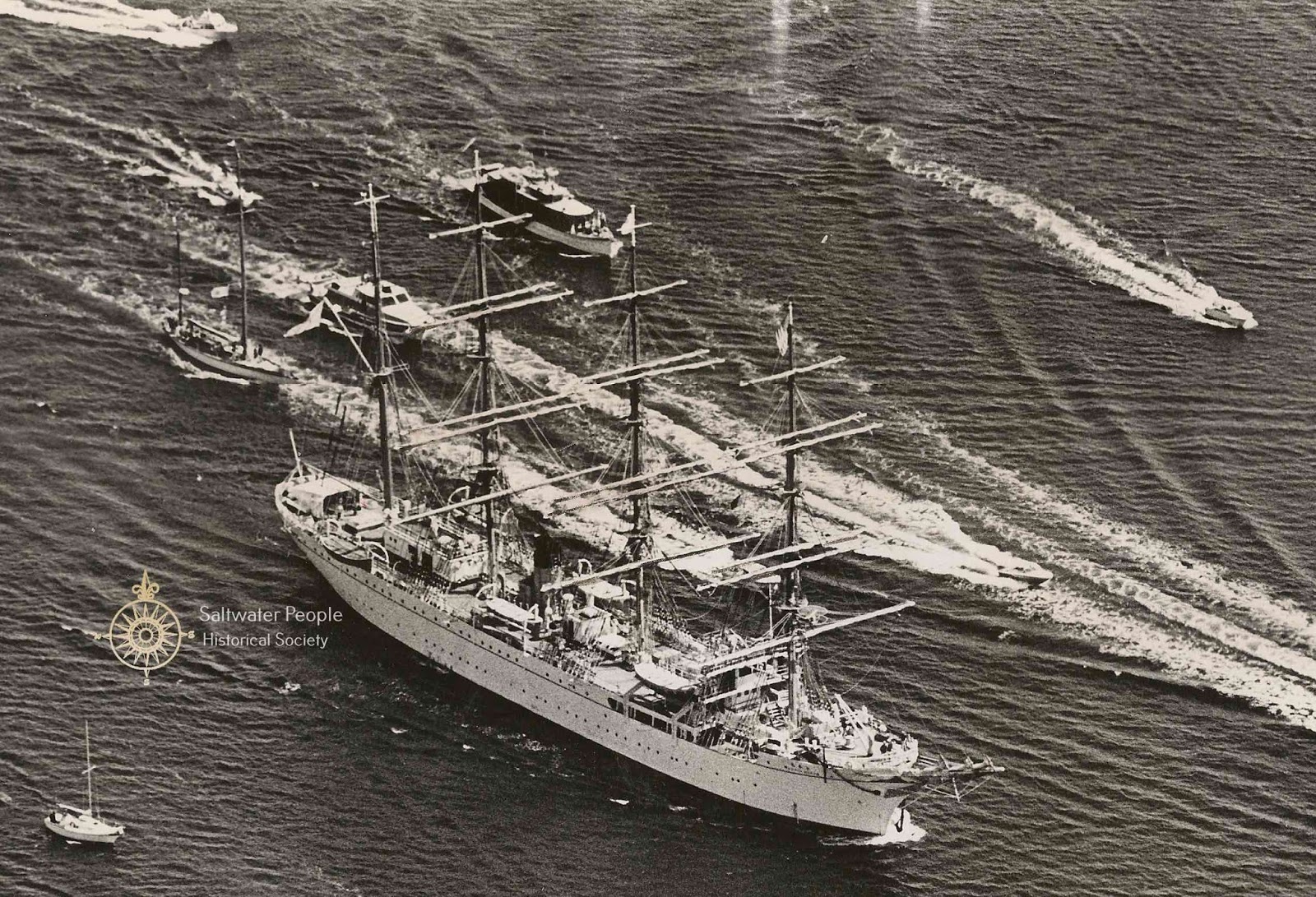
NIPPON MARU
Arriving Seattle 1957

NIPPON MARU
Arrival in Seattle, WA
For Seafair 1978.

According to the Seattle Times reporter, 
she could make 14.5 knots under sail,
faster than her Diesel propulsion speed of 11.4.

Photo by Larry Dion©
Original photo from the archives of the S. P. H. S.
      The magnificent, four-masted, steel, Japanese merchant marine training barque, the 318-ft  NIPPON MARU carrying 32 sails with 25,727 sq ft, en route to a Seattle pier. 
      She was built in 1930 by Kawasaki Shipbuilding in Kobe, Japan for the Imperial Japanese Navy; rated at 2,285 g. tons with a maximum mast height of slightly more than 176-ft. The ship carries 183 men, 20 officers, 112 cadets, and 51 crewmen who would perform sail drills for the huge crowds and open the ship for viewing. 
     
Nippon Maru
Seattle, WA., 1978.

Photograph by Larry Dion.
Original from the archives of the S.P.H.S.©


      Her good-will visitations to Seattle were 1938, 1941, 1957, 1962 for the World's Fair, 1965 with Capt. Isao Ikeda at Pier 56, 1973 with Capt. Shosaku Kadama at Pier 91, and 1978. Traffic stopping conditions existed along Alaskan Way when she was in port, with a fire-boat send-off display when she was departing.
      Decommissioned in the 1980s––NIPPON MARU is preserved as a museum ship at Nippon Maru & Yokohama Port Museum, where she is docked at Minato Mirai, Yokohama, Japan.

     
Nearing 50 years of age, NIPPON MARU, was the first of the Seafair Tall Ships to arrive in port with her 78 cadets, ages 21-25 as they head to Pier 70 in 1978. All are fifth-year students at the University of Mercantile Marine in Japan. Some of them plan naval careers after their September graduation, but for most, the six-month cruise is the climax to their careers. After graduation, several cadets said, they'll sell insurance, teach, or study law.
Thank you to Capt. Jack Russell of Sternwheeler Charters, Seattle, for the donation of maritime newspaper snippets depicting the years Seattle welcomed this beautiful visitor. 
      If you were on board this day and would like to leave a comment, it is easy to do just below this post. 

Archived Log Entries