"The Cure for Everything is Saltwater, Sweat, Tears, or the Sea."

About Us

My photo
San Juan Archipelago, Washington State, United States
A society formed in 2009 for the purpose of collecting, preserving, celebrating, and disseminating the maritime history of the San Juan Islands and northern Puget Sound area. Check this log for tales from out-of-print publications as well as from members and friends. There are circa 750, often long entries, on a broad range of maritime topics; there are search aids at the bottom of the log. Please ask for permission to use any photo posted on this site. Thank you.
Showing posts with label Reefnet fishing. Show all posts

08 October 2019

❖ FISHING THE HARD WAY ❖

November 1979 with columnist Jo Ann Morse


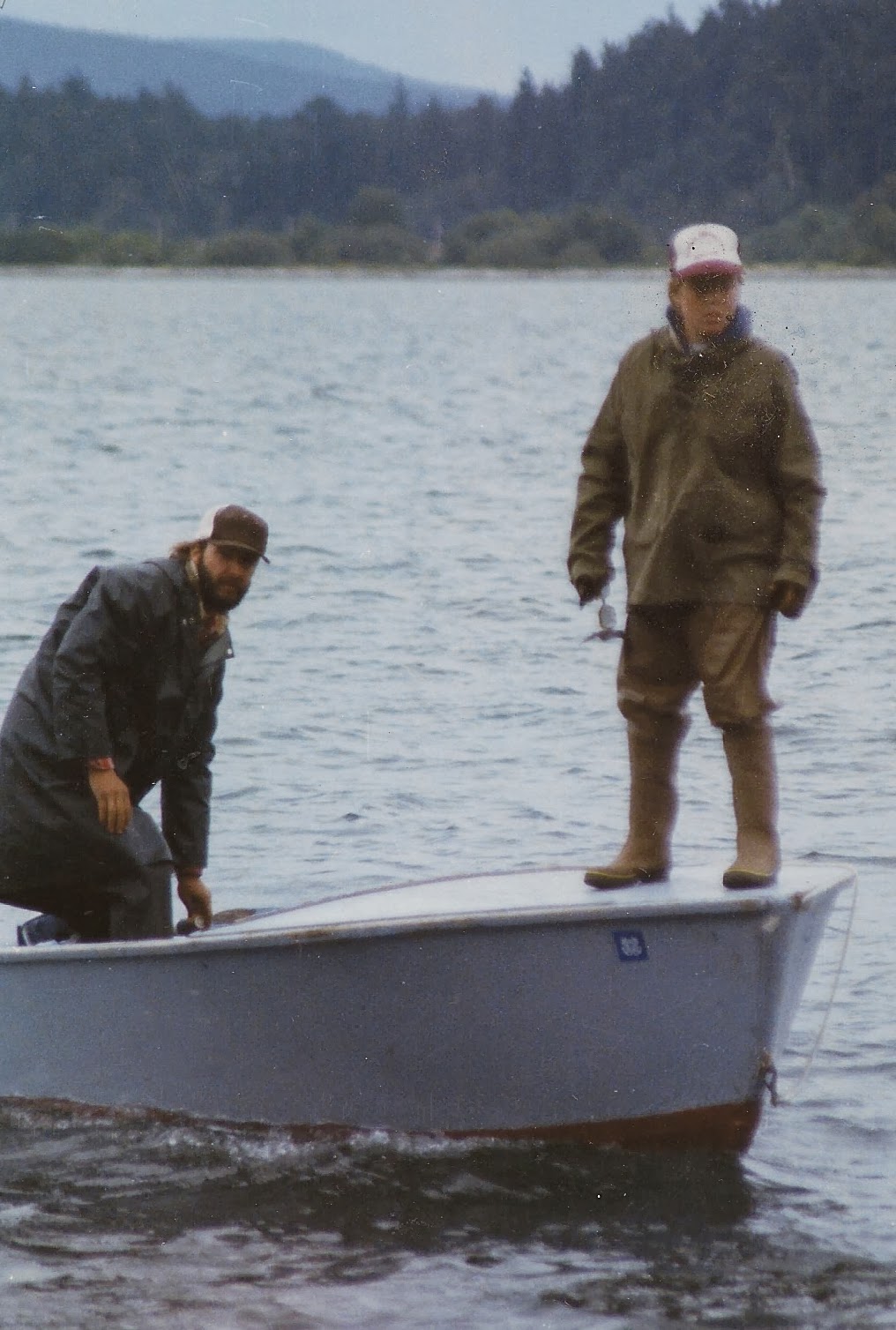
Jim Sesby & Ed Hopkins,
reefnet fishermen,

Off Squaw Bay,
Shaw Island, center of the 
 San Juan archipelago, WA.
Dated 1983
Photo courtesy of Gear 7 owners,
Ed and Kathy Hopkins.
click image to enlarge.


"Summertime travelers on ferries going between Lopez and Shaw Islands via Upright Channel often are intrigued by an array of open wooden boats, each with a tower at one end, anchored in an apparently deliberate pattern offshore of both islands. Lone figures stand motionless on each tower, staring intently at the water through Polaroid goggles.
      Few onlookers, if they don't live here, are aware they are watching one of the oldest methods of catching salmon known to man, a method said to have originated with the Lummi Native Americans just north of the San Juan Islands in Whatcom County.
      This is the only place in the world you'll see reefnet fishing. Here in the San Juans it's done by the white man who adopted the technique from the Native Americans. Around Lummi Island, both Indian and white fishermen set reefnet gear. Their boats and barges with outside towers are connected by nets with floats punctuating the rippled surface. 
      Most of the local reefnet gear has been brought in for the winter now, and we shall miss the 'set' that stood off the point a short distance from our waterfront deck. On a couple of occasions, we have managed to wheedle a salmon from the fishermen who spent daylight hours atop those towers watching for a run of fish headed north to spawn. We were close enough to hear the jubilant shouts ' Here they come!' and to watch the nimble tower-riders swoop down to hoist nets aboard, a couple of dozen salmon dancing shimmering silver in the sunlight.
      Some of the young people on our island have chosen to fish in this relatively primitive fashion and we silently cheered them on with each 'pull.' the season is short. This year they were not allowed to fish as often as usual. We suspect they may not have had enough to pay for the expensive nets, but these are the same people who push for conservation.
      Reefnetting carries with it an aura of native mystique. Reefnetters traditionally do not talk about what they do and discourage people from coming along to observe or photograph the operations. For one thing, there isn't much room in the narrow boats with their flared gunwales. Extra bodies are in the way and not at all welcome.
      Until this summer nobody had put this strangely intriguing harvest on film. But now comes an extremely determined graduate of Evergreen State College in Olympia who earned his degree by producing an extraordinary half-hour documentary entitled Salt Water People.

      Scott Miller, who never had written a grant proposal in his young life, spent four months at it. After observing that it was the best grant writing they'd seen, the Youth Grants program of the National Endowments for the Humanities awarded Miller nearly $10,000 to record this oldest of fishing arts in Northwest waters.
      That was three years ago. With Sid White of Evergreen State art department as his faculty sponsor, Miller and his friend Peter Alkins produced a film that earned Miller full credit on a two-year individual contract. In the process, he spent all of the grant money plus $2,000 of his own money, lived on crunchy granola,  bartered salmon in the county park campground on Shaw, and wore out his old station wagon. Evergreen supplied the technical equipment and local islanders cooperated in several ways. Miller's wife, Lisa, is an accomplished professional potter and Miller tells you frequently about the pottery sales and encouragement that kept him going.
      Salt Water People was a difficult film to make, partly because of the salt water people themselves. But Miller had good credentials. Several years ago he had fished with a well-known Shaw Island reefnetter. That friendship was invaluable in overcoming innate suspicion and talking himself aboard some of the reefnet boats. He also spent arduous months making quiet contacts among the Lummi, finally persuading one venerable tribal elder to talk about the legend and lore of reefnetting among her people. It was only a few days before the final editing that he even got permission to use some color stills of the Native woman. 
      The film is a head-on confrontation with the state of art as practiced today. Miller wisely eschewed the obvious, and probably tempting, archeological dig in favor of quiet narrative; the elderly Native woman, white reefnetters on Lummi, Shaw, and Lopez, who have run gear for many years, and finally a young Shaw Island couple who set gear within sight of their beachfront home.


L-R: Ed Hopkins, Doug Fawcett,
Kathi Melville, Doug Baier, Roger Melville,
Shaw Island reefnet fishers waiting for the tide.

Gear 7.
Photo courtesy of Ed & Kathy Hopkins. 

       It may look romantic from the deck of a ferry, but reefnetting is hard labor, complicated by strong currents that constantly foul gear which must be kept clear of kelp and flotsam. Reefnetters stand atop their towers in the blazing sun and in summer storms that can build up waves steep enough to toss the towers in sweeping arcs nearly down to the water. They can't quit on a fishing day, regardless of weather. Those days are too few.
      There is considerable footage of the competing fishing fleets that pave the Strait of Juan de Juca during the fishing season. Yet there is little bitterness in the voices and wonderfully weatherbeaten faces of the reefnetters. It's an art, a way of life, a love affair with a tough lady. They fish the hard way because they want to. One of the reefnet fishermen feels so intensely about it that he has turned some of the farmland into a final resting place for the years-old reefnet boats he finds about the country and up north near Lummi.
      Right now Miller is working and trying to find some more money for prints of the film. He is a softspoken, deceptively gentle 26-year-old who began his college career on a football scholarship at Colorado State. He bagged it, soon after, and if you want to know why, 'My next film may be about the insanity of college football...'


"Winter Storage"
Lineo cut block print, 1977
by Rex Brandt, N.A.(1914-2000)
former summer resident of Shaw Island, WA.

      Like its producer, Salt Water People is low-keyed and gentle, but it's full of throat-catching qualities that make me think it's an important one. The reefnet fisher may not be among endangered species––yet––but neither is it proliferating. The film tells you about the people who fish and how they do it. These are not the taciturn, grunting deckhands of a corporate commercial fishing vessel, pouring tons of salmon into cavernous holds. These are happy gamblers with nature because reefnetting is a kind of gamble and the reefnet fisherman admires his prey.
      Nets are set, lines strung to make the fish think they are approaching a reef. They swerve to avoid it and theoretically will swim right over and into the net. It's a critical moment that requires good timing. Sometimes they get away. In this film, they do get away. A young couple wearily resumes posts on the towers, and the gal excitedly calls across to her husband. 'Wow! I wonder if they feel like I'd feel if I got away!"


Photo postcard,
a winter haulout scene.
Blind Bay, Shaw Island, WA.
by Rod Peterson©

Text by Jo Ann Morse Ridley, for Enetai. 7 Nov. 1979


27 July 2019

❖ SHIPPING OUT FROM SAN JUAN COUNTY

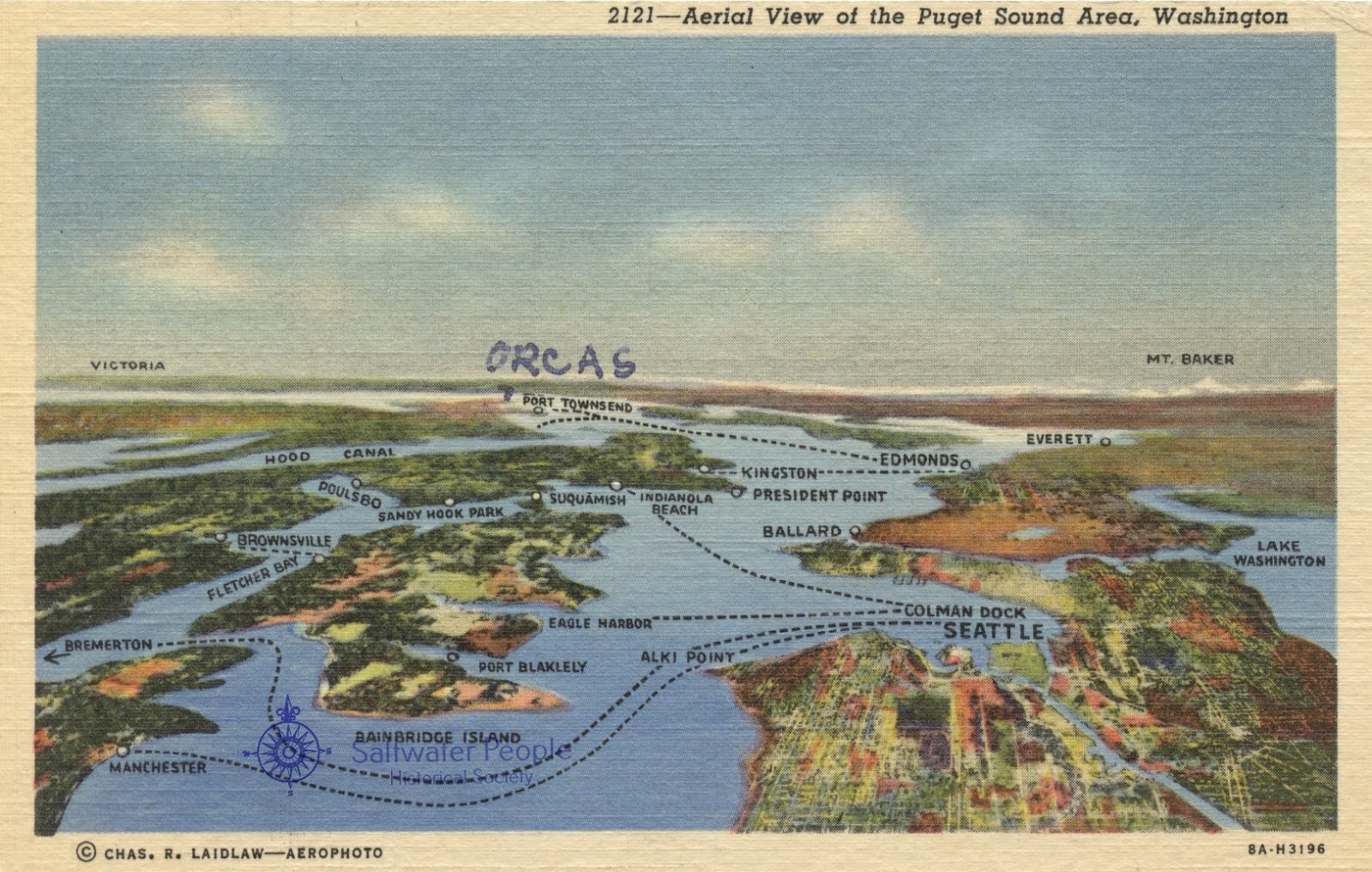
Puget Sound Ports
leading to the world.
Click map image to enlarge.
Getting closer to home,
Click the image to enlarge.
Map cards from the archives of the
Saltwater People Historical Society©

"From the first records to the present day the fishing and its industry have always been a most important factor in the development of this county. About 1850, numbers of small fishing sloops would fish around the southerly part of San Juan Island. They would anchor in what is now charted as Griffin Bay [formerly San Juan Harbor.] They prepared their fish for salting in barrels, that they sold to the Hudson's Bay Co., at Victoria, B.C. This being such a convenient haven some of them built shacks ashore and as the number grew, small schooners would come and gather up the barreled fish. This was probably the first freighting out of the islands. The shantytown grew and a man called Captain Higgins put in a small stock of supplies. Fishermen wrote letters and left them with him for mailing to Victoria. They gave as a return address, 'Victoria, care of Capt. Higgins, San Juan town,' and thus was born the first town in the county. Many Native American maidens kept house for the fishermen. In time there were two stores with liquor in the backroom, and rooms to rent on the upper floor, and fairly regular mail service. This first town was finally abandoned and was later destroyed by fire, but during the days of the boundary dispute, it was a lively place and high-life a-plenty.
      The fishing industry had a steady development. A fish saltery was built near Friday Harbor. A few years later it was destroyed by fire. Shortly after this loss a packer from the Columbia River, named Develin, built a cannery at Friday Harbor, San Juan Island. Fish traps were introduced and many of these made big money for their owners––and on the hush-hush, they often made money for the fish-pirates, too. 
Fish trap fishing
Pacific Northwest Washington.
The top photo is a trap in Point Roberts, WA.
Click image to enlarge
.
      It was quite a welcome income from the outside. Many of the piles were gotten out in the county and most of the traps were manned by young men from the growing families in the county. 


FISH TRAP LOCATIONS IN
NORTHERN PUGET SOUND
DATED 1913.
Click image to enlarge.
Fish trap 
westside of San Juan Island, WA.
Click image to enlarge.
From the archives of the
Saltwater People Historical Society©
At one time there were some 40 odd traps in the county. They were finally legislated out of existence. [1934]
      The first seiners were all hand-operated, but the advent of gasoline-powered engines soon put them out of the running. 
Puget Sound seine fishermen
hand-hauling in the net.
Low res scan of original photo dated 1943.

From the archives of the 
Saltwater People Historical Society©
The first powered seiners were a big advance, but no one could foresee that someday we would have the wonderful seaworthy and comfortable boats that now comprise the seining fleet. What with seiners, trollers, gillnetters, and the reefnet gears, [and the early fish traps], it seems a marvel of nature that there are enough fish caught to keep all this vast fleet in the black.
      
Reefnet fisher Ed Hopkins.
Day's end on the fish boat,
one of the pair of boats
comprising his gear #7.
Squaw Bay, San Juan County, WA.
1980s.


Fish in the net,
Gear #7
Squaw Bay,
Shaw Island, WA.
Ed Hopkins and
crew Jim Sesby.
Click image to enlarge.
Photos courtesy of gear owners
Ed & Kathy Hopkins.
      One of the very interesting operations is a reefnet gear. It is an operation originally used by the Native Americans, and boats and methods of fishing very much the same as it was when explorers like Captain Gray, Vancouver, and others first witnessed and described its operation. 
      At one time there were seven or more canneries operating in this county, now there are only two in this year of 1953.


Friday Harbor Waterfront
Undated.

      Quicker transportation, modern transportation, and machines that are so marvelously skillful and tireless have made a great change in the canning industry. Now, too, the top market for the highest grade is here in the United States. At one time the highest prices were obtained in England. In the early 1900s, a British bark was towed into Friday Harbor cannery and loaded most of the pack for delivery in England. In those days the humpbacks were not even canned, but thrown overboard, thousands and thousands of them.
      Lime is one of the major natural assets in the county and has made a major contribution in the wealth and development of San Jan county, and probably bids fair to outrun all industries, other than agriculture. Many an early settler while clearing his land and getting his farm in shape, was glad to put in off-time at cutting and hauling cordwood for the lime kilns.

      
Lime manufacturing
Roche Harbor, San Juan Island
Click image to enlarge.
Original photos from the archives of
the Saltwater People Historical Society©
There have been many changes in methods of packing and transportation of lime. The bucking and falling saws have given way to the chain saw and the cordwood wagons drawn by so many handsome draft horses have been entirely displaced by trucks; but the firing of the limestone is still a matter of heat, wood, and work.

      The first lime was probably burned by some of the English soldiers who were familiar with the industry. They built some small pot kilns and barreled the lime they made in empty beef casks and traded it to the Hudson's Bay Co. With the packaging of the lime, there came quite a development in coopering. This, too, was a gainful occupation that could be worked at during the off days from the seasonal farm work. Nearly all the early steamers were wood burners. The cutting and hauling of cordwood to the different boat landings furnished a considerable payroll. No one in those days would have believed that there would be ferry boats or any craft over 250-ft long making daily trips through the Islands. And what of the future –– who knows."
Words by Mr. Frank Mullis., from a pioneer family of San Juan Island, WA. for the Friday Harbor Journal Nov. 1956. Maps, chart, photographs from the archives of the Saltwater People Log. 
      

30 April 2018

❖ SIX GENERATIONS OF REEFNETTING IN THE SAN JUAN ISLANDS❖

1978

Charles Chevalier snapped the starting cord on his outboard motor.
      "It looks like a great day for fishing," he said.
      At 10:00 AM, the sun was already bright in the clear blue sky over the San Juan Islands and a light breeze ruffled the water.
Fisherman Charles Chevalier
Photo by the late great Josef Scaylea.
Date stamped verso 1978

Original print from the archives of the
Saltwater People Historical Society©

      Charles Chevalier is a part-Indian, sixth-generation reefnetter. His comment about the fish conditions was based partly on instinct, inner knowledge. It proved to be accurate.
      A grebe, floating in front of him, took a dive deep into the water to avoid Charles' boat as it headed out of Friday Harbor around the bay bound for Stuart Island. Chevalier was in a hurry. He wished to meet his crew at the reefnet site well before high tide at noon.
      Though bare-foot, Charles had tossed his tennis shoes into the seat in front of him, together with a light jacket and a sack lunch. He would not be home until dinner, and the late afternoon wind on the cold waters of the San Juans could be chilly.
      Charles passed a few gillnetters coming in late from their night's fishing off the salmon banks. Purse seiners, their huge nets wrapped around hydraulic drums, beat past him.
      And all around him, first in one direction and then the other, a quick eye could catch the flash of silver spray as the beautiful sockeye jumped out of the water to take a look around.
      Stuart, the most westerly of the San Juan Island group, is close to the Canadian boundary. Here off a kelp bed near the entrance to Reid Harbor, Charles came upon his reefnet rafts. His crew was already there cleaning drift out of the lines.
      This reefnet location has been fished continuously by members of Charles family for six generations. It is licensed by the State––one of 71 stationary sites still being fished commercially in Puget Sound waters. [1978]
      Reefnet gear includes two canoes or rafts anchored parallel to each other 200' from shore in a spot where the ebb tide and floodtide currents will carry salmon into the 50' square net spread between the canoes or rafts.
      Setting out the net was the job Charles and his crew set about doing. The net was heavy; its four-inch mesh had been dipped in black tar so that the fish wouldn't 'tangle up in it.'
      The crew pulled one side of the net tightly between two rafts, the line stretched taut on the surface of the water. The opposite side of the net, secured to anchor lines, was held down in the water by weights.
      A few salmon, running ahead of the tide, evaded Charles' net. The current was not yet strong enough to make the net 'bag back.'
      "Fish traps blocked most of the reefnet sites by 1890, and many of the native owners of the locations were forced out. But in 1934 fish traps were outlawed and some of the old locations were reclaimed.
      Our spot at Stuart has been fished continuously for as many years as we can search back. I've fished it myself since I was 12––some 35 years."
      "Grandpa Bill Chevalier and his partner, Al Drouillard, started fishing this site in 1905," Marge went on. "Grandpa made a ceremony out of setting the anchors for the nets.
      He would pick the huge rocks carefully for their shape, wrap cedar-branch cables around them, lash them to the canoe and wait for the tides to float the rocks to the reefnet location."
      Charles' father, Alfred Chevalier, and his uncle Louie (like their ancestors) used to 'call' fish to the net. They learned the call from Charles' Great-Great Uncle Ned, a medicine man.

Marge Chevalier Workman
Cousin to Charles Chevalier.
Photo by Josef Scaylea.
Original print from the archives of the
Saltwater People Historical Society©
Charles and Marge also occasionally use the call to coax fish into their nets and describe it as a soft, rather high-pitched cry not unlike that of an owl.
      "You have to feel it, they say. You have to be in tune with the fish. It's almost a spiritual thing."
      Traditionally, the first salmon caught is accorded special respect.
      "In days long ago," Charles says, "our people believed that the salmon had come to feed the people with their own flesh. So the first sockeye of the season (sockeye being the most powerful of all fish) received the special rite."
      Charles and Marge recall that no one would ever step across the first fish caught and that as the fish was cut, people would give thanks for the survival of the fish and the related survival of the people.
      Marge's father, Bill Chevalier, who is 81 and still living on San Juan Island, followed another custom which may have been unique to the area. He always took his first salmon of the season and laid it out for the yellow jackets, knowing that when there were lots of yellow jackets, there were also good salmon runs.
      Although Marge and Charles, being three-eighths and one-fourth Indian, respectively, no longer follow many of the ceremonies of their Indian ancestors, they say that descendants of the tribe on San Juan Island would like to get together and teach their children the traditions they've learned.
      But it was time to go back to work.
      Chugging down Speiden Channel was the 50' fish packer PRIMO, skippered by Clarence Mead. Clarence is the fish buyer for Whitney-Fidalgo at Anacortes, and it is he who makes the rounds of the reefnet positions daily during sockeye season.
      He maneuvered the PRIMO close to the rafts and the crew put off the salmon, using dip nets called 'brailers' to throw them aboard the fish packer for weighing.
      Clarence passed down a fish ticket indicating how much money would be credited to Charles for his day's catch.
      Is reefnetting a profitable venture? Both Marge and Charles laughed.
      "It varies," they agreed.
      "I remember one year," Marge said, "when I made $25 total. It was during WW II when all the boys were in the service. Grandpa asked me to come on up to Stuart and help him fish.
      Financially, no, it wasn't rewarding, but I love these islands and I love being here."
      Marge was born on Waldron Island, lived on John's Island, and went to school on Stuart, rowing across the bay and walking three miles through the woods to the little one-room schoolhouse. She played on Henry Island and visited her grandmother often on Speiden Island, which the family-owned.
      In the late afternoon sunshine, rocking gently on the reefnet raft, the two cousins reminisced.
      They remembered their grandmother's cousin Sara who used to fish from a canoe with a three-pronged spear.
      They repeated tales told to them of their great-great-grandmother who was from the Songish tribe and lived to be almost 100 years old in a little cedar-shake shed on the north end of Speiden Island. She always sat on a little box by her fire in the shed, never wore shoes and never learned to speak English.
      Their great-grandfather, Robert Smith, was a British marine stationed at English Camp on San Juan Island during the Pig War. He bought his way out of the Marines for $20 and married the old Granny's daughter, Lucy, establishing a homestead there that would be occupied by the family for many years.
      The Smith's daughter, Mary, (Charles and Marge's grandmother) was a beautiful woman who married Ed Chevalier, and together they 'ruled' for many years what became known as their 'island kingdom.'
      According to the book, Pig War Islands, Ed and Mary Chevalier were as widely known and loved as anyone in the San Juans. With their family of five children, they raised turkeys for market, tended a fruit orchard, grew all their own produce, kept sheep and horses, milked two cows, logged and cut wood. In addition, Ed built boats and held down a full-time job at Roche Harbor, rowing the two miles or so to work and back each day in fair weather or storm.
      He also fished commercially, and did so well at developing the technique that 'islanders looked on him as the local father of reefnet fishing.'
      "Grandmother," Marge says, passed down many of the Indian ways to our generation.
      She had regal bearing and a very gracious manner. I remember Sam Buck, Sr.. saying that he would like to take her to WA, DC, to present her to the President. She knew so much about the history of these islands."
      A maternal great-uncle of Marge's, Prosper Graignic, was "reputedly the most successful rum-runner on the Puget Sound." His father was a French sailor who jumped ship in Victoria in the 18870s, marrying an Indian girl from LaConner and settling on Waldron. "The large family they reared on Waldron grew up, it would seem, with seawater instead of blood in their veins. One of Prosper's brothers is said to have sailed the family sloop to Victoria and back at the age of 7. Another, although deaf, earned his way as a fisherman. His knowledge of local tides and currents is described by island people as uncanny. Even the girls in the family learned, early on, to be as much at home afloat as on dry land."
      While they were talking, Charles had pulled the reefnet out of the water and stowed it away, tying it down, and securing the lines.
      Their day's work was over now, in their ancestors' "gentle way to fish."
Above text was written by Patricia Latourette Lucas
For The Seattle-Times, 1978.

Charles R. Chevalier (1930-2015)


26 January 2017

❖ The Familiar Put-Put of the Island Launches ❖ with June Burn

SAN JUAN II
ON 210893
Built in Bellingham, WA.
58.3' x 13.9' x 6.4'

41 t gas passenger/freight propeller,
Indicated HP 100.
1913-1929

Photo scan courtesy of Charles Torgerson,

descendent of Willard Maxwell who started the 
San Juan Transportation Company, the crew 
awarded the mail contract for c. 40 years.

     "In the middle of the narrow swift-running tidal river of Johns Pass, between beautiful Johns Island and Stewart. Still aboard the SAN JUAN II. We are whistling for somebody to row out to the boat and relieve it of its note-taking passenger. Nobody comes, though my old neighbor's boat swings at his float. He is up in the swamp, maybe. We'll have to go on to the next island and whistle for a lift––no, the good captain skillfully noses his boat into Dad's small float. Homer goes down and helps my small son, South Robin, and I off the boat, and here we are! (How it always delights one to catch or leave a boat in the middle of a channel or far out from any dock. As if somehow the world were still the simple, friendly, unhurried place they say it used to be. I know well enough that the boat's crew can quickly get enough of that sort of thing, but it is fun while it lasts!) 
We set our bags and typewriter onto the PAWNEE, Dad's boat, and wander off up the dusty farm road to look for the master of the farm. There comes Dad in the clumsy wagon driving old Barney! He has been up to the swamp with grain for the turkeys fattening them for the Thanksgiving market. We climb aboard and sit talking of gone days. The sea laps the beach a dozen yards from us, lolloping in and out of the potholes of the sandstone formations. How good it smells! Dad says he sits at his window during winter storms watching the spray and sniffing that fragrance of salt water and seaweed. The people who live on the islands say very little about the romance of their home, but when you do get them talking about the water, and boating, and beaches, and agates, you discover there is a very positive appreciation of the beauties around them. 
      We go down to the boat to chug over to Speiden, the headquarters of this big farm sprawled over three islands. We'll go by the reefnets and watch them fish awhile.
      Oh, the familiar put-put of the little island launches, the smell of their exhaust, foul but somehow agreeable. The boats are twenty-thirty feet long, but there is no room on them. The engine with its oil and noise quite fills the cabin. The tender rides the afterdeck. The pilot stands at the wheel. If there is a passenger he rides in the seat of the tender if the weather is fine or hunkers down inside with the engine if the weather is rough. Roomy the boats look, but there is really no room for them at all. When outboard motors will do the work of inboards they will be enormously popular for the inboard engine is a hog for room.
      The near slopes and bluffs stroll leisurely by as we swing out and around the point to the reefnets on the south slopes of Stewart Island. The incomparable thrill of being home again. Bellingham, I love you––jolly, friendly, cordial, lively little city that you are––but I love the islands more!

June Burn loved the Islands,
the people of San Juan County loved her in return.

Click to enlarge.
From the archives of the S.P.H.S.©


The long, white graveled beaches and lush green ravines, the rocky bluffs and steep hills, the little coves, the fields of kelp, the smooth fair waters or the white madness of wind-blown channels; the grain fields and fishing banks; the flowers and birds and romance––but we are at the fishing grounds!
      One gear has already been lifted for the year, two others fishing now. Four, long, slender fishing boats lie out there on the water just outside the kelp field, the nets swung between each two boats, the leads running out fifty or more yards, spreading as they go. From the wooden floats of the leads hang lines that serve to direct the fish down the narrowing runway over the nets.
      One man in each boat stands on a high box from which vantage he can see deep into the water and know when the fish are coming down the road, bound lickety-split for his net. He gives a signal to the other members of his crew that the fish are coming, bids them be ready, tells them when to begin lifting the net and directs the speed of their lifting.
      At the gear furthest up towards the bay, Indians fish. General's thirty-foot canoe with its long, slender up-thrust bow and stern holds Willie Jim, maybe or Joe, with his two 16-year -old Indian girl helpers. In the other skiff fat old Isaac sits on the high box as watcher, while General (Major General Scott is his full given name) and one other man sit waiting for the signal.
      At the gear that I am watching, Art and Louis stand at the bows of their respective boats. The helpers are gone. Dad gets into Art's boat to be ready to help in case the fish come. I wonder what they would have done if we hadn't come along, for two men cannot easily handle a net full of fish.
      *  *  *  *  *
      Suddenly, the three men stiffen as if electrified. "Tu-tu-tu-tu-tut" Art begins to shout, which interpreted means "Here come the fish!" "Not yet!" he shouts. "Now!" and "Slow boys! Slow, now! Now they're in! Haul her in, fast! Uumph, umph, umph!" the men grunt as they haul the net up. The towboats come together slowly, the fish wiggling and leaping in the net.
      "Altogether, boys! Over with them! There goes a big fellow overboard––catch him, Louis! Ah-h-h!" as the net is emptied over into one of the boats––the one least full of fish. It is the end of the season and few fish are being caught. This is the only haul of the day, the boys are delighted to get even these few that leap and flop and squirm in Art's boat beside which I sit in PAWNEE's tender.
      Once this summer, the boys say they had 1,600 salmon in the boats, 800 of them having been hauled in at once. What shouting and yelling, and pulling, and tugging there must have been that day! What a shining silver mass of salmon! What leaping overboard, what flopping and slithering! It is a thousand wonders the net didn't tear, so old and black it is.
      The fish buyers come along every day and twice a day during the big run. Men hip-deep in fish, pitchfork the "shining apostrophes" from the 40' fishing boats into the fish buyer's barge, whence they are once more pitchforked into the receiving places of the cannery.
      So much for reefnet fishing. See you tomorrow. June." Puget Soundings. June Burn.1929


01 February 2014

❖ REEFNETS: A NORTHWEST ORIGINAL ❖

Dave and Don Yansen,
Leaving home for an early morning start 

to reefnet fish at Squaw Bay, Shaw Island.
Photo by mother Gwendolyn Yansen, mid-1950s.
Reefnet owner Doug Baier (L) and
helper, Dan Sweeney, 1980s
Heading to the fish boats outside
Squaw Bay, Shaw Island, WA.
"Reefnetting, believed to be the oldest form of net fishing in the world, is unique to the Pacific Northwest. In the San Juans, this ancient art was the primary salmon harvesting method for local tribes, and the techniques employed date back hundreds, and perhaps thousands of years. Even today, most modern reefnets sit on traditional sites that have been fished for hundreds of years.
      In their heyday, native reefnets stretched from the southwest coast of Vancouver Island, up through the San Juans, and on to the mouth of the Fraser River. The west side of San Juan Island, the southern shore of Shaw and the west side of Orcas, Iceberg Point, Flat Point, and the mouth of Fisherman Bay on Lopez were all home to native reefnet gear.
      At least four local tribes worked reefnets in their territories: the Songish on San Juan, the Saanich on Haro Strait, Stuart Island, and Point Roberts, the Samish on southern Lopez, and the Lummi on Orcas, Shaw, and northwest Lopez. Summer villages were established near the sites to support the fishers, and a great deal of ritual and ceremony accompanied the start of each season's fishing.

      The technique used by native peoples varied little from that used by modern reefnetters. The gears were set to face the prevailing current, along which the salmon swim, and a pair of special canoes, with wide bows and flat sterns, were anchored parallel to each other, sterns facing the current. A net made of willow bark twine, measuring approximately 40-ft long by 30-ft wide, and dyed black to blend with the water, was suspended between the boats, and stones were used to weight the open end of the net facing the current.
      Reefnets were often set in kelp beds, where a channel could be cleaned through the kelp to funnel the salmon toward the net. The kelp was also cleared to make room for "head anchor" lines made of twisted cedar withe, which ran out from the sterns of the canoes in a vee. It there was no kelp to channel the fish, "lead lines," were added from the canoes to a "head buoy", or "reef", sidelines were run from the lead lines down to the head anchor lines, which resulted in an artificial channel to direct the salmon into the net. If the water was deep, an artificial floor was created by adding horizontal lines between the head anchor lines to bring the salmon up to the proper depth to enter the net. To complete the illusion, enterprising fishers sometimes wove clumps of beach grass into the floor lines. A 'jump line', or peeled cedar pole near the net entry, spooked the fish as they funneled in, causing them to dive for the apparent safety created by the dark hole of the net.
      Native reefnets were set on hereditary sites, and manned by crews of 6 to 12 men, with a watchman in the stern of each canoe. The watchman in the offshore canoe was the captain, easily identified by his wide-brim cedar root hat, and deer tallow or red ochre on his face to cut the glare. Prior to the arrival of the Europeans, captains apparently wore a special headdress as a symbol of authority.

      The captain watched the fish enter the net, then gave the command to pull the net weights and the sidelines suspending the net. When the net was full, a pin was pulled to give slack in the anchor lines, and the canoes were allowed to swing together. The net was pulled into the inshore boat, and the salmon were rolled into the offshore boat. After the fish were removed for transport to the beach, where they were dried on racks by wind and sun, or over slow fires, the canoes were separated, the net reset, and the process begun again.
      Fishing the reefnets required particular conditions, including daylight, calm water, and reasonable clear weather, since darkness, surface chop or heavy overcast made it impossible to see the salmon enter the net. Since all reefnets fish only on a given tide, they were manned only when the currents ran the proper direction. Different gears were also fished during different salmon runs. One set might work well for Chinook, but not for sockeye. Another might be particularly effective only on cohos, pinks, or chums.
      With the coming of the non-native settlers, native populations, native fishing, declined. But the thing that almost wiped out reefnetting for good was the introduction of fish traps in the early 1890s. Those devices, huge enclosures built on pilings up to 120-ft deep, often extended their solid 'leads', up to half a mile out from the shore. Since they relied on the same currents as reefnets, they built upstream of the reefnet sites, and blocked, or 'corked' the traditional gears. The US Attorney sued on behalf of the natives in 1897, claiming the interception of the salmon by the traps was a treaty violation, but the courts ruled in favor of the traps, and the reefnets disappeared.

      Traps dominated the industry until they were outlawed in 1934, due to pressure from the growing purse seine fleet, and decreasing salmon runs, after which the reefnets began to make a comeback.
      Even though most of the reefnets in the islands were worked by non-native fishers after the demise of the fish traps, most gears were set on traditional sites, and the techniques remained largely unchanged. Manual winches were introduced which speeded up the process of pulling the nets and reduced the need for crewmen, and observation towers were added to the boats to improve visibility. But the boats were still essentially big canoes; the setup and techniques remained intact, despite using modern materials.
      While these improvements made the process more efficient, it was still grueling work. The season ran four or five months as different salmon runs came through the islands, and openings often lasted five or six days a week. Keeping the gear clear of kelp, working the big winches, and rolling the fish into the boats was exhausting, but it was a good living for many islanders.
      By the 1950s, there were some 90 reefnet operations in the San Juans and Lummi Island, says Lopezian Jack Giard, who heads the Washington Reefnet Owners Association, and who began working on the gears in the late 1950s. But due to declining runs of fish, a preference by most fishers for mobile techniques such as purse seining or gillnetting, and the infamous Boldt Decision, only 50 reefnets remain today (1997), with just 14 in the San Juans.
      Citing the 'environmentally friendly' aspect of his industry, Giard notes that reefnets don't trap birds, such as the endangered Marbled Murrelet, and also allow the safe release of 'by-catch', or endangered fish species. As a fixed gear, they're easily monitored and don't pollute, since they use no engines. 'I think those things, in today's fishing mode, give us a better chance of surviving what we're going through than any other (net fish) industry, period,' he says.

     
Ed Hopkins' reefnet gear No. 7,
Squaw Bay, Shaw Island, WA. 1981.
Ed Hansen and Jim Sesby pitching salmon
to the buyer boat, perhaps the PRIMO.
Courtesy of E/K Hopkins.

      The canoes have been augmented by rafts, that are more stable and can hold more fish in live tanks, and manual winches have been replaced by electric models that pull net more quickly and easily. Anchors are heavier, that allows the gears to work deeper sites and in swifter currents, and the nets are slightly larger and made of nylon. But even though the watchers have forsaken deer tallow in favor of Polaroid sunglasses, the essence of the art remains true to its ancient heritage. 'You still depend on your wits, Giard says. 'You still depend on your eyes.'"
Text by John Goekler for The Islands Weekly 3-10 August 1994.
Shaw Island reefnet boats stored onshore, 
in the winter of 1980.
Location: Squaw Bay, Shaw Island, WA.

Photo from the archives of the S. P. H. S.©

Former Shaw Island reefnet boats,
Crew initials carved over the decades,
an offering for the wooden gunwales
all chopped, awaiting their funeral.
The same site on private property
at the Squaw Bay haulout, 2011.
Photo donated by Debra Madan, Orcas Island, WA.


16 August 2013

❖ REEFNET FISHING in the SAN JUAN ISLANDS ❖ 1946 with June Burn


Lummi Island reefnet fishermen
making a haul, in Whatcom County, WA.
Photo by Mary M. Worthylake; dated July 1949.
Tap image to enlarge.
Original from the archives of the S. P. H. S.©
Stuart Island––Day 70 of One Hundred Days in the San Juan Islands, one in a series of newspaper columns June Burn wrote under contract with the Seattle P-I in 1946.

Before the white men came, Native Indians were reefnet fishing. They made nets with string woven of the inner bark of cedar, fished from their dugout canoes.
      Now we have string nets, ropes, plank boats, lead for weights, but the principle of reefnetting hasn't changed a particle.
      When traps were outlawed in this state [1934], fishermen began to take to reefnetting by the hundreds. But Dad Chevalier has been reefnetting off the same bluff of Stuart Island for 45 years. Before that, when he was only 18 he began fishing, making his nets with cedar bark as the Indians taught him.
       The principle of reefnetting is based on the rather tragic fact that salmon hug the shores on their historic run for their home spawning streams. They swim around every shore, a little way up into the mouth of every stream until they find their own stream, when they go on up and up, over every difficulty, to make their shallow "nest" in the gravel on the bottom-up where the stream is shallow, clear, swift, clean. There they lay their eggs, die, and yield up their own bodies as feed for whatever young are just then hatching. Thus, each salmon feeds young salmon, though never it's own, for, by the time its young are hatched, its body is long since consumed. The body of mother salmon is there ready, however, in this unique cooperative borning and dying. So that in reality, in this wholesale nature's way, each salmon does feed its own young with its own dead body.
      Hugging the shore, in search for the home stream, the salmon run headlong into the reefnets hung there between two longboats. This is how it works:
      You have two very long, narrow, deep, dory-like boats––oh, 35-ft long. At the bow of one, you build a high platform on which the fifth man of the crew stands for hours, looking down into the water to watch for fish. Two men in each of the boats wait for the watcher's signal, when they start pulling with all their might, hauling up the filled––or sometimes empty––nets.
       Down between the boats, the net swings for 24-ft below the surface. Out in front of the boats, reaching out down the bank for 30, 40, 50-ft or more, depending on the location, there is a rope lead, long rope, top, and bottom held 18-ft apart by floats and weights. Ropes six-ft apart are strong between them, making a squarish lead which the salmon obediently follow right into the net. Now and then the ropes of the lead must be taken out and washed so that the salmon will stay between them––afraid, you know, of the bright rope lines of a fence that isn't a fence––like the ones we'd stay inside of too, for lack of imagination and courage to get out.
      Right down the rope fence with pickets six-ft apart, the salmon swim. The watcher gives the signal. The men back in the boats, make ready. The watcher says when. They begin to haul in the nets. If it is heavy they begin to gloat, to shout, to jive, to holler, and laugh. If there are watchers onshore, we begin to shout, too, as if we were at a ball game, egging on the players.
      It doesn't take long to pull in 24-ft of the net. One of the boats is already full, say. We'll dump the load into the other boat. The men in hip boots do not mind the wet, slithery, spray that comes over the gunwale to fall all around them. They haul away on the lines, bring in the last beautiful sockeye. If it's 500 fish they've got on that haul, all the men shout and wave their hats. The men on the other two locations shout in sympathy––and wish it had been their boats that had made the haul.
      The boys and men––now and then a woman––fishing at this Stuart Island location are mostly Dad Chevalier's sons and grandsons and the Indians and their sons who have worked for him for 50 years. Johnny Sam is his bookkeeper. Old General is now pensioned, but he gives up his pension for the reefnetting––he wouldn't miss this fishing season if he starved the rest of the year!
      The men share and share alike except that Dad gets a share of each location for his boats and gear. Last year was the best they ever had. Each man made $2,000 a share on No. 1 net. In nine weeks of fishing, that isn't bad unless you're depending on that for your year's income as some do. Some years the fishing is woefully bad. This looks to be a bad year, so far, but it may pick up. (Though by the time you read this, it will be nearly over and the tale will be told, whatever it was.)
      Bill and Alfred, Bill's and Alfred's son, all Chevaliers, are fishing this year and General, and old Isaac, the rainmaker, and General's sons, and Johnny Sam and Louis Smith. In three locations, 15 men are employed. Norman Mills, a son-in-law, is on his own boat, the ALOMA, buying fish.

Norman Mills and his 46.8-ft fish tender
ALOMA (O.N. 243877),
buying salmon from Whatcom County
reefnetters in 1943, the same year ALOMA
 was launched at Friday Harbor, San Juan Island, WA.
Original dated photo from the S. P. H. S. ©
Caroline, his wife, and little Wilma Jean are living in a little house taken off a PAF barge, and planted on a Stuart beach. Lizzie Chev, from Waldron, is there with her menfolk and Adelaide Chev lives on Stuart. Sarah and Katherine, the Indian women, cook for their men and so all the crew gets fed. Reefnet fishing time is a time of work and picnic and camping and nobody would miss it for the world.
See you tomorrow"
June Burn

Archived Log Entries