"The Cure for Everything is Saltwater, Sweat, Tears, or the Sea."

About Us

My photo
San Juan Archipelago, Washington State, United States
A society formed in 2009 for the purpose of collecting, preserving, celebrating, and disseminating the maritime history of the San Juan Islands and northern Puget Sound area. Check this log for tales from out-of-print publications as well as from members and friends. There are circa 750, often long entries, on a broad range of maritime topics; there are search aids at the bottom of the log. Please ask for permission to use any photo posted on this site. Thank you.
Showing posts with label Fidalgo Island. Show all posts

04 July 2019

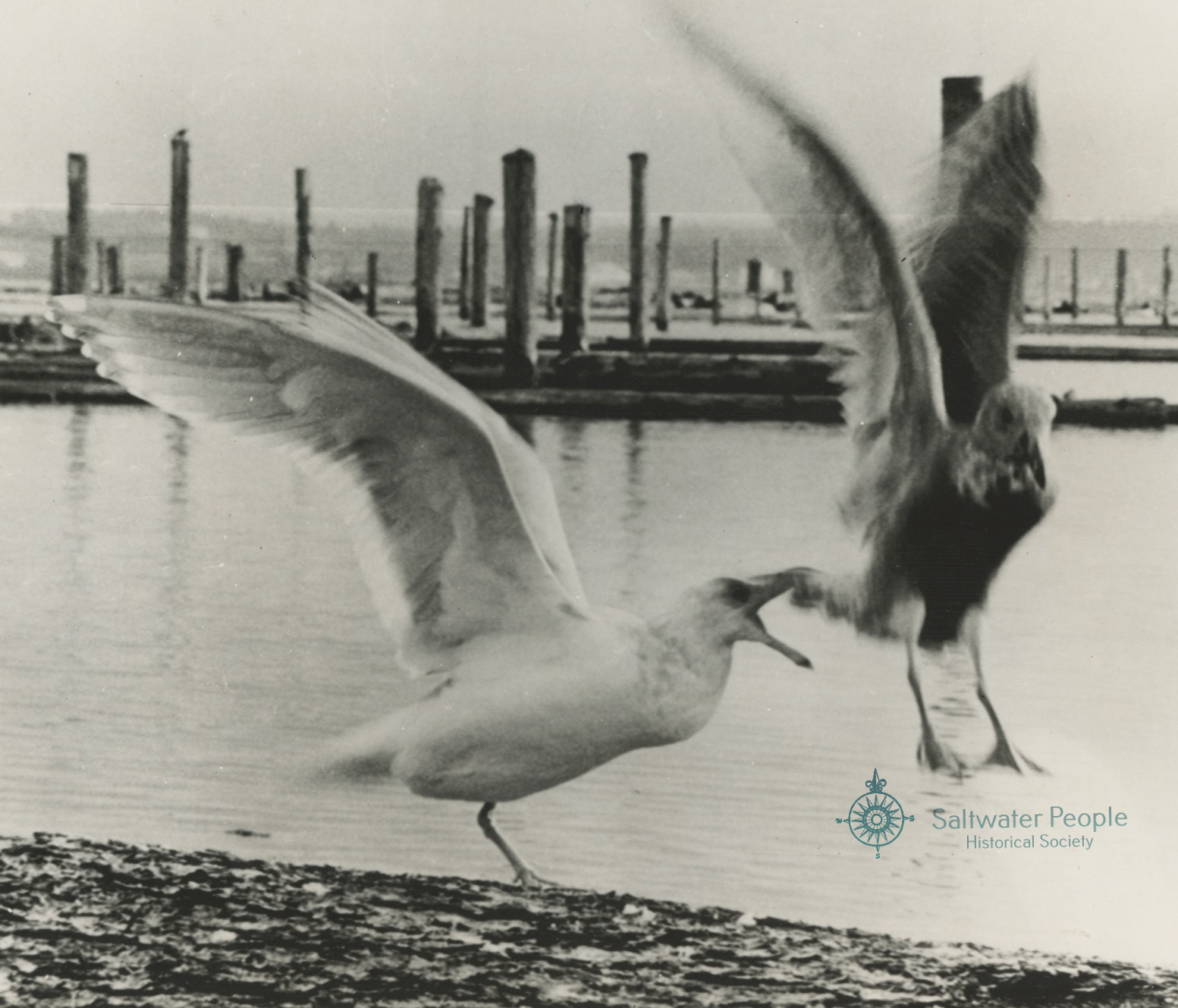
❖ PEGLEG BILL, LONG-TIMER OF FIDALGO ISLAND


PEGLEG BILL
photo dated 1972
Anacortes, WA.
from the archives of the
Saltwater People Historical Society©
AP Wirephoto.
"Pegleg Bill, a one-legged Glaucous-winged seagull whose home for more than 25 years has been the old pilings of an Anacortes, wood products company drives off a young competitor. 
      In 1947, a millworker rescued the bird when a bullet had left one leg smashed and dangling. A coworker, Clyde LeMaister, packs an extra sandwich daily for Pegleg Bill, who flies to unknown breeding rocks every April and returns each September to his 5-acre kingdom. When LeMaister retires next year, the bird no doubt will be on hand to screech a farewell."

~Clyde Bernard LeMaister (1908-2005) born on Lopez Island, lived to be 97 years, probably long surpassing the years of his bud, Pegleg Bill.
      Clyde, who served in Germany in the US Army 1944-1946, was one of the original shareholders in Anacortes Veneer. He worked as a tugboat operator until retirement in 1973 and was a member of the Samish Indian Nation. He was  buried on Guemes Island.

02 October 2013

❖ CHRISTENING OF A SHIP ❖


McTAVISH launch 4 May 1974
Artists Malcolm & Margaret Cameron,

launching the boat built by "Coonie" in his workshop
at their home at Neck Pt., San Juan Islands.
"Birth of a ship is not just the laying of the keel but the christening ceremony before a vessel first becomes waterborne. Many have seen ships christened just prior to launching but few have ever bothered to ask why bottles are used as part of the ceremony.
      In days of yore, it was considered a sign of a long and successful life for a ship by the throwing of a silver cup over the side on launching day. However, it is to the British we must turn for the custom of the present christening of ships, for it was Britain's King William III who considered the silver cup a bit wasteful and who instituted the custom of smashing bottles across the bow instead.
      And it was the suave Prince Regent, who later became King George IV of England, who added one step to King William's bottle christening by choosing a lady to perform the ceremony, mostly because it amused his many girlfriends and created excitement among them. The idea caught on, though the throwing of the bottle caused a bit of a hazard with the spraying of broken glass.
      At a later christening, an English lady, high on the social register nearly decapitated a spectator with a bottle when she missed the bow of the ship she was sponsoring; ever after the custom demanded that the receptacle is tied and swung against the ship's bow.
      Due to the fact that champagne has always been a toasting wine, almost from its inception, this beverage has been used to christen ships. But there have been exceptions. For instance, many missionary ships have been launched with milk, soft drinks, and water. 
Christenings have been filled with many amusing incidents. At a West coast shipyard in recent years the christening party arrived at the platform to prepare for the ceremony only to find that the ship had accidentally launched herself a few hours earlier and was sitting in the water. The entire program had to be changed and the christening took place at a later time at dockside.
      Frequently at launchings, women will take mighty swings and miss or may hit the desired target and find that the bottle refuses to break. The containers are usually wrapped with colored ribbon or cloth of some kind to prevent the glass from flying, but this does not prevent the bubbly champagne from sometimes spraying everybody in sight.
      Writer Raymond Lamont Brown tells of a Miss May Gould of Boston, Mass. who had a bottle-missing experience. When it refused to break and when the ship went down the ways the lady bravely leaped into the water fully-clothed. Doggedly she pursued the vessel and succeeded in accomplishing the task while waterborne.
      So, if the reader is ever privileged to attend a launching of a vessel, don't underestimate the power of a woman. You're liable to hear most anything emanate from her lips should she miss with the bottle, but most are plucky enough to get the job done in one way or another.
      As has been told, launching ceremonies go back into antiquity when the heathens often slew women and tacked their heads to the ship's prow as an offering to appease the sea gods. Their blood was sprinkled over the ship's bows or on the makeshift ways.
      The world has come a long way since such intolerable practices were used, but even in our day there is always a fair amount of apprehension at each launching ceremony before a vessel slides down the ways for her baptism in water."
Above text from: 

The Unusual Side of the Sea, by Jim Gibbs, Jr.,
Book search here 


Pile Driver at Maritime Shipyards,
19 October 1957.

William Gilbert took motion pictures 

of his new pile driver being lowered into the Ship Canal.
Photo from the archives of the S. P. H. S.©
Before William Gilbert was old enough to walk, he was accustomed to traveling around Lake Washington, strapped in his high chair aboard the VASTEN, passenger-freight boat operated by his father, Charles Gilbert, between Seattle and Mercer Island.
      On the occasion of this launching of a pile driver, it may be only a floating machine to some people but can be a work of art to the man who owns one. 
      This new pile driver, designed for the Gilbert Pile Driving C., by William Garden & Associates and built at Robert Albin's Maritime Shipyards, has a whirly crane for waterside construction work. 
      The pile driver measures 62-ft x 24-ft and can carry 2,400 gallons of fuel for the Diesel engine. The 20-ton crane has a 70-ft boom. 
      After its launching at the Maritime Shipyards, the crane was towed today to the Blanchard Boat Co. yard for outfitting.
      Ernest Zwiefelhofer, who has worked on the Seattle waterfront for years, will be foreman of the new pile driver."
Above text from The Seattle Times, 1957
Ben Bullitt, age 6, at 1966
Champagne re-christening of his
Great Grandfather's tug STIMSON,

after restoration in Ballard.
Boat was built in 1914 and was featured in
Pacific Motor Boat of that year.

Original photo from the archives of S.P.H.S.©
BRITISH OXYGEN
World's biggest Racing Catamaran, 9 March 1974.
L: Gerry Boxall with champagne
Robin Knox-Johnston, Brightlingsea, England.
70-ft loa, 32-ft b.
Designed by Rod Maculpine-Downie. 
Original photo from the archives of the S.P.H.S.©

Launching of gig ERICA,
Bowman Bay, WA., 1983.
Erica Pickett of Fidalgo Island, at the bow.

From the archives of the S. P. H. S.©


Champagne for the beautiful gig and
champagne for the well-wishers, 1983.

Photo from the archives of the S. P. H. S.©


ELIZABETH MUIR, 1991
Built by master craftsman Babe Lamerdin 
and multiple talented helpers, 
led by the devoted John Linderman.

LOA. 47.6' / LWL 34.6' x 11.8' B x 6.5' D.
Christening sponsor, Liz (Muir) Robinson.

Photos courtesy of A/R Nyborg.©

14 September 2013

❖ MARINE SUPPLY AND HARDWARE ❖ Rags to Riches in Heritage and History

Words by Bonnie Graham McDade for the former Washington State Ferries publication Enetai, 14 January 1983.
Marine Supply and Hardware,
Commercial Street, Anacortes, WA.
Web photo by Elizabeth K posted in 2012.
Mural art by Bill Mitchell.


"Steve Demopoulos, has taken the heritage his Greek grandfather built and is revitalizing one of the most intriguing 'discoverable' historic businesses in the Pacific Northwest.
      If you could stand behind the ancient cash register––it doesn't even ring up sales tax––your feet would settle into the furrows made by thousands of impressions on the equally ancient, oiled oak floors where clerks have helped customers pay for their wares during the past [100] plus years at Marine Supply and Hardware in Anacortes.
Making our way in the late morning fog still held heavy to the ground by the wintery idiosyncracies of a coastal fishing town, the wide sidewalk leading toward the Anacortes marinas at the north end of Commercial Street are stirring, low, whistles booming through the seemingly softened air. The historic old rambling building hugs the earth as it undulates over the expanse of its entire city block resting place. Resplendent in a new coat of burnt orange paint and yellow trim, following the same intricate detailing put there many years ago by its charismatic owner Mike Demopoulos, the grande dame of the Washington fishing fleets northern reaches, is taking on yet another spurt of renewed energy.
When Mike Demopoulos made his way from Greece to the furthest reaches of the then US--Anacortes, Washington--Marine Hardware was not even a glint in his eye. It grew, however, from the glint that became the Anacortes Junk Co, named apparently after a courageous and energetic Mike, dubbed by the locals 'Junky Mike.' Picking up all sorts of flotsam and jetsam in and around Anacortes (he even used to take the horse and cart all the way along Reservation and Snee-Oosh roads into LaConner and back, picking up any kind of junk he though somebody would want). His junk company grew and grew.
And his philosophy still lives on.
Grandson Steve Demopoulos, new owner of the shop, remembers his cantankerous and tough grandfather telling him, 'It's only junk, until someone needs it."
And who can scoff at that reasoning. The modern-day garage sale speaks to it with ever-recurring frequency.
It was Mike Demopoulos who opened his junk company near the Anacortes waterfront and became the friend and benefactor of most the northern coast fishing fleet. If Anacortes is nothing else, it is indeed a fishing capital of this particular PNW and its colorful fishing fleet, still very much in existence today, was the mainstay of that economy at the turn of the century.
It was Mike Demopoulos, born in the tiny Greek town of Bralos––about 70-miles north of Athens––who immigrated to the US at age 17. He spoke no English, and when a policeman in Portland, OR, heard him speak, he steered the young Mike to a Greek restaurant where he started his new life.
'All Greeks work in a restaurant sometime in their lives,' laughed Steve.
Mike worked his way up the coast to British Columbia doing almost any kind of job there was available. When he settled in Anacortes, he was experienced, spoke English some, and ready to take on the world.
Starting with what most see as a pile of scrap, Mike Demopoulos bought and sold his way to a minor fortune. Some people say he owned almost all of Anacortes before he died--summer of 1980.
And by the looks of the insides of Marine Supply and Hardware, he bought and sold just about everything else, too.
A trip through the store is an antique buff's dream, a do-it-yourselfers haven, and a walk back through history that will tickle even the most hardened of souls.
In a building that grew like topsy, with add-ons, and more add-ons, where the floors sag in places, the lights hang from single cords, and winds blow through the cracks in the walls, there is very little you can't find.
Today, Steve is organizing what is there. And what is there is worth a whole day of just digging through.
It's a literal museum of 'good stuff'. Mike was a past master at buying surplus––especially government surplus, just about the best you could get. And much of that surplus is still there. Like lots and lots of old wooden nail kegs, barrels, and barrels of different sized and same sized washers, nuts and bolts. Wandering back through the gerrymandered warehouse, there are old seamen’s lamps hanging on the wall, blocks of every size and description.
'You're looking at my granddad', says Steve, a bit wistfully, a bit proud, and with a lot of that Greek fortitude, obviously passed to him through the generations.
From the five-gallon cans of Knickerbocker Pure Penn-Perafin Motor Oil (where the can itself is probably worth as much today as the oil inside in sheer nostalgic value) through miles of the 'the best ropes in town,' to the Home-Laughlin heavy-duty china, it's really a truism what the sign says--'ask for it, we've got it."
     A link to Marine Supply and Hardware, Anacortes, WA., can be seen here

Archived Log Entries