"The Cure for Everything is Saltwater, Sweat, Tears, or the Sea."

About Us

My photo
San Juan Archipelago, Washington State, United States
A society formed in 2009 for the purpose of collecting, preserving, celebrating, and disseminating the maritime history of the San Juan Islands and northern Puget Sound area. Check this log for tales from out-of-print publications as well as from members and friends. There are circa 750, often long entries, on a broad range of maritime topics; there are search aids at the bottom of the log. Please ask for permission to use any photo posted on this site. Thank you.
Showing posts with label REUCE. Show all posts

22 January 2018

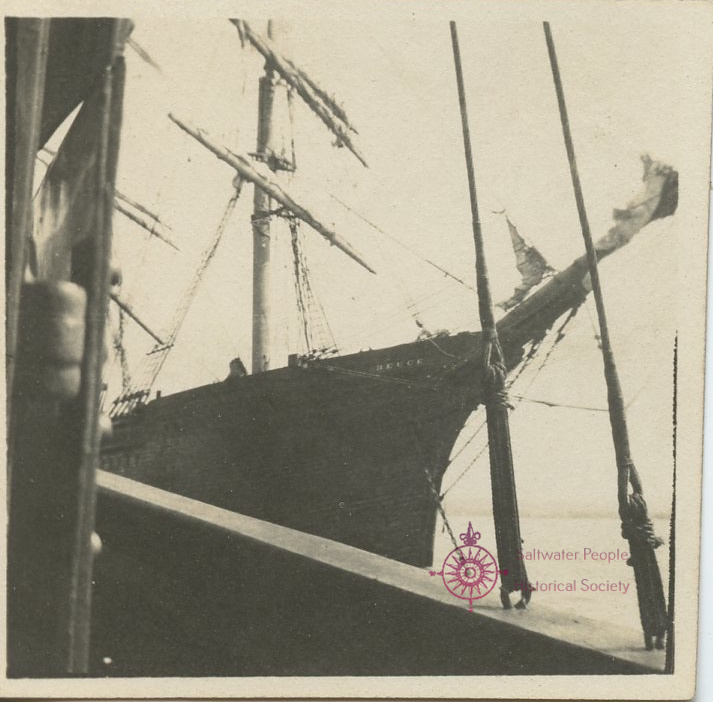
❖ CAPTAIN & CABIN BOY HAND PUMPING on the REUCE ❖ 1908

REUCE
110498
1881-1924.
Inscription on reverse of the above photo.


"A thrilling tale was unfolded by the exhausted officers and crew of the American ship REUCE, in command of Capt. F. B. Dinsmore, which unexpectedly put into Sydney yesterday in distress.
      The vessel sailed from Newcastle last week with a cargo of coal consigned to San Francisco. When about 300 miles on her journey, almost due east of Sydney Heads, the REUCE was assailed by strong southeasterly and north-easterly gales, and she was hove-to under lower topsails. The gale increased in violence and terrific seas were running, the result being that the vessel was strained severely. Suddenly she took a list to starboard, and all hands were engaged for some hours in trimming the cargo to right the ship.
      To the dismay of all on board, when the wells were sounded, it was found that there were 4 feet of water in the holds. All the pumps were manned, and for a time the inflow was kept in check. The steam pumps worked by the donkey-engine then became deranged, and the handpump had to be solely relied upon. The REUCE continued to labour heavily, and all hands were called upon to work night and day. The position became even more critical when the hand-pump broke down owing to the packing carrying away. By this time the water had increased to 5ft 9 inches. After a few hours work, the carpenter succeeded in repairing the pump, and the volume of water was temporarily reduced. Eventually, the hand-pump was worked by the captain and the cabin boy, while the sailors were employed below in trimming the shifted cargo. No sooner had the REUCE been righted, then she gave a sudden lurch, and her cargo moved over to the other side.
      For several days all the sailors and some of the officers were engaged in moving the coal cargo, while the remainder of the ship's company took their turn at the hand-pumps. When the gales moderated the REUCE had 5' 3" of water in her holds, but the pump again became disabled, and the water continued to gain on the vessel. The master then resolved to make for Sydney, the nearest port, and much to the relief of all on board favourable winds were met with on the run back. By Sunday the depth of water had increased to 5' 5", and when the REUCE entered the Heads shortly before midday yesterday the soundings gave 5' 9".
      The pumps were still in operation last night on board the REUCE at her anchorage below Garden Island, but until a survey has been made the leak cannot be located. The REUCE is a wooden vessel of 1925 tons gross, and 1601 tons net, and was built in 1881 by Mr. Thompson at Kennebunk, Maine. She is owned by the Californian Shipping Co of San Francisco, at which port she is registered."
Above text from Sydney Morning Herald 26 May 1908.
Courtesy of the National Library of Australia 


Inscription on the reverse of the above photo.
1889: Known among seamen in her Cape Horn days as the "Hungry REUCE." Late in this year she arrived in San Francisco with 17 of her crew down with scurvy. 
1891: It was charged this year that a seaman was trussed up to the mizzen stay off Cape Horn by the mates and later drowned while attempting to escape.
1917: after 30 years serving from San Francisco, REUCE was taken from Oakland mudflats and put into cannery service by Columbia-Pacific Packers of Portland, OR.
1922: the old wooden ship REUCE of the C.R. Packers was sold for the Oriental Lumber trade, although she had a sideline––a still being found turning out bootleg whiskey on board.
1924: REUCE was wrecked 10 Feb on the coast of Japan.

10 April 2017

❖ TUG GOLIAH ❖

The below undated original photos are from one collection just archived from descendants of mariner, Harry D. Wilkins, who worked on the GOLIAH. No story came with the images other than a few short inscriptions on the back, but included below are some GOLIAH words from the historian/author Gordon Newell.  
GOLIAH
ON 204800
414 G.t./221 N.t.
500 Ind. HP.
Owned at this time by Puget Sound Tug Boat Company.
Tug HERCULES
ON 204801
414 G.t./ 221 N.t.
500 Ind. HP.
Built 1907, Camden, N.J.
According to Pacific Tugboats,
 she is GOLIAH'S sister ship who
towed her around Cape Horn from the east coast to CA.

"In many ways, Puget Sound's second GOLIAH was typical of the Northwest's big deep-water steam tugs, both in appearance and in the work she did. Built in 1907 by John Dialogue of Camden, N.J., the GOLIAH and her sister tug, HERCULES, were massive, powerful steel steamers, 151' long, 27.1' beam and 15.2' depth, with a speed of better than 13 knots.
      The two boats came to the West Coast, via Cape Horn, the HERCULES towing the GOLIAH, which was loaded with extra fuel for the HERCULES' boilers. In San Francisco they went to work for the Shipowners' and Merchants Tugboat Co, but in 1909 the Puget Sound Tug Boat Co sent Capt. Buck Bailey and port engineer J.F. Primrose to the Bay to have a look at the GOLIAH. Their report was enthusiastic and the PSCo bought her. Capt. T.H. Cann piloted her north from San Fran.
      Shortly after WW I, the GOLIAH returned to the East Coast, having been sold as the sailing-ship trade of the PSTBC diminished. During the years she operated in the Northwest she had the comfortable reputation of a 'lucky ship.' This in spite of the many hazardous exploits in which she engaged.
      In 1916, skippered by Capt. T. Nielsen, the GOLIAH snatched the disabled Norwegian freighter NIELS NIELSEN from almost certain destruction on the lee shore of Vancouver Island, a feat which has been vividly described by R.H. "Skipper" Calkins, in his book High Tide (1952.)
Photo inscribed:
"Ship REUCE in tow of tug GOLIAH,
bound for Chignik, AK.
A slight list to starboard;
in smooth water after 3 days of pounding.
If there is such thing as a 'Hoo-doo Ship',
this is it."

ON 110498
1,924 G.t./ 1,601 N.t. 
Built 1881 in Kennebunk, ME.
      One of the GOLIAH's specialties was the towing of big Cape Horn windjammers up the coast when they had a deadline charter to meet on the Sound. In January of 1914, the GOLIAH set a new speed record for herself by towing the big American square-rigged ship ARYAN from the Golden Gate to Victoria in 89 hours and 30 minutes. The ARYAN, last wooden square-rigger built in America, was a heavy-hulled cargo carrier due to load nearly two million feet of timber for south Africa, and tugboat men agreed that her fast trip north was quite an accomplishment, even for the GOLIAH.
SEYMOUR NARROWS, B.C. 
Text on verso from this Wilkins collection:
"A more treacherous body
of water does not exist."

These photos were taken before Ripple Rock was
successfully drilled and blasted with dynamite in 1958.

Original photo from the archives of the S.P.H.S.©

      In June of the same year the GOLIAH set a new Alaska towing record, beating the one she had set two years earlier. Towing the barge JAMES DRUMMOND northbound and the barge ST. JAMES southbound, she completed the round trip between Seattle and Gypsum, AK.––1,900 miles––in 10 days and 12 hours. 
GYPSUM, Chichagof Island, near Iyoukeen Cove, AK.
A destination for part of GOLIAH'S work, as mentioned
in this piece by author Gordon Newell.
From the GOLIAH photo collection from the family of
mariner Harry D. Wilkins.

Original, undated photos from the archives of S.P.H.S.©

Both barges were loaded to capacity, but in their younger days they had been noted clipper ships, their fine-lined hulls helping the powerful GOLIAH to set another towing record.      

      In October 1910, GOLIAH ran into bad luck while engaged in towing a big barge, with tragic results. At the time the tug was hauling rock from Waldron Island, in the San Juans, to Grays Harbor, where it was used in the construction of the jetties at Westport. A fleet of nine seagoing barges was used to transport the rock, all of them tripped-down sailing ships like the PALMYRA, BIG BONANZA, CORONDOLET, JAMES DRUMMOND, and ST. JAMES, all of the staunch and seaworthy, and all of well over a thousand tons register. The smallest of the fleet was the ex-schooner WALLACUT, built at Portland, OR, in 1898, and rated at 798 gross tons. This was the barge that GOLIAH was towing to Grays Harbor. The story of what happened is contained in a shipping bulletin datelined Port Townsend, 5 Oct. 1910:

      "The loss at sea of Andrew Henderson, aged 24, and Hans Christensen, aged 25, from the rock barge WALLACUT is the latest of the long list of casualties due to the gale in the North Pacific Sunday. The men were swept from the barge while it was in tow of the tug GOLIAH at six o'clock in the morning off Destruction Island, while the craft, deep-laden with stone for Grays Harbor jetty work, was contending against a sea so furious it seemed almost certain to cost the lives of the five men constituting the barge's crew.
      A report of the tragedy was brought here by Capt. John Jarman, master of the barge, whose command was forced to return to Neah Bay after vainly trying for 30 hours to cross the bar into Grays Harbor.
      A point near Grays Harbor Bar was eventually reached, the barge leaking badly, and under weather conditions that prevented making an effort to pass into Aberdeen. With this plan frustrated, the tug turned for a return course to the Sound. While Henderson was about to relieve Christensen at the wheel, a wave more furious than any of the others that had threatened to send the barge to the bottom, broke in a big curling comber over the weather rail, sending both men clear of the ship and into the sea. The accident was witnessed by Capt. Jarman and his two other sailors, but no aid could be given. 
      Capt. Jarman is a veteran on the North Pacific and describes the storm through which he passed as the most severe experienced in these waters."

      Capt. Buck Bailey, who was skipper of the GOLIAH that trip, was noted for laughing in the teeth of the North Pacific when it was in its worst moods, frequently taking whatever big PSTBC craft he was piloting into danger which kept all other deep-sea towboats safe at anchor. If he mis-calculated that time, at the cost of two lives, he made it up many times over in daring rescue operations which made him famous the whole length of the Pacific Coast. 

      At the termination of the Waldron Island rock-towing contract, the GOLIAH steamed down the coast to take her station off the Columbia River mouth. 
CURZON
From the GOLIAH collection.
Possibly preparing for a pilot from the GOLIAH,
when the big tug was stationed off the Columbia Bar.

Undated original from the S.P.H.S.©
The Puget Sound Co. had decided to set up a pilotage and towing service there in opposition to the established bar tugs. The GOLIAH, with ample accommodations and oil tanks capable of stowing a month's supply of fuel, was well designed for such service, and she spent most of her time cruising off the lightship day and night, with her bar pilots aboard." Pacific Tugboats. Newell, Gordon. Superior Publishing. Pg 116-119.
Aboard the tug GOLIAH.
Unidentified mariner.
If you can identify this man, please let us know his name

for our history files.
Original photo from the archives of the S.P.H.S.©

Archived Log Entries