"The Cure for Everything is Saltwater, Sweat, Tears, or the Sea."

About Us

My photo
San Juan Archipelago, Washington State, United States
A society formed in 2009 for the purpose of collecting, preserving, celebrating, and disseminating the maritime history of the San Juan Islands and northern Puget Sound area. Check this log for tales from out-of-print publications as well as from members and friends. There are circa 750, often long entries, on a broad range of maritime topics; there are search aids at the bottom of the log. Please ask for permission to use any photo posted on this site. Thank you.
Showing posts with label San Juan Island. Show all posts

07 April 2025

The MASSACHUSETTS, THE FIRST AMERICAN STEAMSHIP TO VISIT PUGET SOUND, all the way to San Juan Island.


The MASSACHUSETTS
Postcard copyright 1896
Click image to enlarge.
Published by the Metropolitan News, Boston.
from the archives of the 
Saltwater People Historical Society©

"The Spring 1970 issue of Steamboat Bill, the quarterly of the Steamship Historical Society of America, carried a story on the "The Auxiliary Steam Packet MASSACHUSETTS." This historic vessel, built in 1845 at the East Boston shipyard of Samuel Hall, was given detailed chronological treatment of her rig and power plant changes with abbreviated accounts of her West Coast activities in between. The narrator related that she was transferred by the War Department to the Navy at Mare Island, CA., on 1 August 1849 and that she served as a storeship until 1853 when she returned to Norfolk, VA., to have new boilers installed. Then, he says, she sailed to the Pacific in July of the following year, and in 1855, she was listed as a storeship at Acapulco. Then he concluded that her name had been changed, and in 1862, she became the FARRALONES, which was still a storeship and coal ship in San Francisco.

Some of the most colorful chapters in the vessel's history were largely concerned with the Pacific Northwest, where her name loomed big in maritime movements. The MASSACHUSETTS performed so many important government duties in these parts that it seems fitting to give readers some details about these activities.

The MASSACHUSETTS was first heard of in this region when she arrived off the mouth of the Columbia River on 8 May 1949 with the first important contingent of American troops to be stationed in this area. On 13 May, the force arrived opposite Fort Vancouver and was landed the following day.

This was the end of a month's voyage from New York around Cape Horn. The vessel carried 161 officers and men of the First Regiment, U.S. Artillery companies M and Lk, commanded by Brevel Major J.S. Hathaway. Some would remain at Fort Vancocuver, where they would wreck barraks. Others were destined somewhat later to establish Fort Steilacoom for the protection of settlers on Puget Sound.

On the way to the Pacific Coast, the vessel created a stir when she entered Honolulu harbor on a calm day without the help of canvas. Astonished Hawaiian natives crowded the  beach to see the phenomenon, and an island newspaper headlined the went, "Arrival Extraordinary."

At that time, the sight of a vessel equipped with both sails and propeller was unusual. Steamboat Bill describes her equipment. The MASSACHUSETTS was 160 feet L on deck x 20 ft D x 32 ft B and measured about 776 tons. She was full ship-rigged and her steam power was strictly auxiliary to her canvas and was intended to be used occasionally when near land and in smooth water or to get in and out of port.

The motive power was a two-cylinder condensing engine capable of about 170 HP or a speed of nine statute miles per hour in smooth water. The engine and boilers were in the lower hold, with space in the wings for oal bunkers. The propeller was a six-bladed Ericsson screw 9 1/2 feet in diameter that could be lifted out of the water when the ship was under sail.

The MASSACHUSETTS was the first American steamship to visit Puget Sound. She anchored off Fort Nisqually on 25 April 1850. The story of how she got here goes back to the plea of Governor Joseph Lane of Oregon Territory for better aids to navigation and more protection for settlers and shipping.

On the last night of the 1850 session of Congress, Samuel P. Thurston, delegate from Oregon Territory, succeeded in founding up and getting into their seats enough representatives who would vote for his bill to set aside $53,140 for erection of lighthouses at Cape Disappointment, Cape Flattery, and new Dungeness, also installation of 12-iron-can buoys in the Columbia River. The measure passed, but the money was not spent immediately.

Meanwhile, the MASSACHUSETTS had brought the troops to the Columbia River and, after delivering the soldiers, had been sent back to San Francisco, where she was transferred to the Navy to transport a newly appointed commission. Its purpose was to examine the coast of the western United States lying upon the Pacific Ocean concerning points of occupation for the security of trade and commerce and for military and naval purposes." The ship was in command of Capt. Samuel Knox.

She sailed from California and was off the Columbia River on 20 April 1850. Her visit to Nisqually was duly recorded in the journal of the Hudson's Bay Trading post. It mentioned that Lieutenant Danville Leadbetter, representing the Army, was of the Topographical Corps and that he and the doctor called at the fort.

While in the area, the MASSACHUSETTS called at Victoria and Esquimault and continued north through the Gulf of Georgia to Beaver Harbor to take on coal. She rounded the north end of Vancouver Island and followed the route south. On the coast of Washington, she stopped at the mouth of Willapa Bay, where a party was dispatched to scrutinize the harbor. (This occasion was honored later when Leadbetter Point was named.) Part of the purpose was to determine how close the bay was to the Columbia River. A whaleboat was hauled over the portage between the two bodies of water with the help of a dozen or more Natives.

The commission reached Astoria on 30 June and examined the lower Columbia, arriving at Portland around the 11th of July. The MASSACHUSETTS next sailed for the Umpqua River and arrived back on San Francisco Bay around 1 September.

The Steamboat Bill article accounts for the MASSACHUSETTS next activity. After her return from Norfolk, VA., she came back to Puget Sound to replace the DECATUR, sent here during the Native American troubles of 1854.

In April 1855, citizens of Port Townsend requested the government to assign a war vessel to cruise between Bellingham Bay, Dungeness, Port Townsend, and Foulweather Bluff to guard against incursions of Haida and other Northern Natives from British Columbia. The MASSACHUSETTS was immediately sent back to Puget Sound and, early in 1856, was dispatched to Port Gamble to disperse a gathering of Canadian Natives. When they refused to leave, she opened fire and killed 27, which caused the Natives to vow vengeance. They later killed Col. Isaac S. Ebay on Whidbey Island in reprisal.  

The MASSACHUSETTS again played a role in local history in 1859 when she steamed out of Steilacoom with troops for the "Pig War" in the San Juan Islands. She also picked up Capt. George Pickett's company at Fort Bellingham and moved the soldiers to San Juan Island. The vessel played its final part in the unrest when Maj. Gen. Winfield Scott made her his headquarters while he was on Puget Sound on behalf of the president to settle the difficulty, resulting in joint occupation of the islands by both British and American troops. Scott left on the MASSACHUSETTS after his negotiations. 

After the MASSACHUSETTS name was changed to FARRALONES, she was drafted for the Civil War. In 1867, she was sold to Moore & Co. of San Francisco, and the last reference to the vessel as bark ALASKA, owned by that firm. No records of her existence after 1871 can be found but Steamboat Bill says she is reported lost on the coast of Chile in 1874."

Words by author/historian Lucile McDonald who wrote thousands of historical essays for the Seattle Times newspaper and many for The Sea Chest published by the Puget Sound Maritime Society. 

Some of her sources:  Steamboat Bill journal of the Steamship Historical Society of America.

Published in The Sea Chest journal of 1970 from the Puget Sound Maritime Society, Seattle, WA. 

01 November 2024

A NOTABLE DAY IN SAN JUAN HISTORY

 IMPRESSIVE EXERCISES AT AMERICAN AND BRITISH CAMPS


U.S. Monitor Wyoming 
with 200 officers and men 
even came back for the
 unveiling party. 
Click image to enlarge.
Antique postcard from the archives 
of the Saltwater People Log©

"The unveiling of the monuments at the American and British military camps, October 21, 1904, was a most notable occasion not only in the history of the county but of the PNW. The day was perfect and not a single incident occurred to detract from the pleasure of the exercises at either camp. 

Never before since the termination of the joint occupancy has there been so large a representation of the army and navy in the county, nor so large an assemblage of prominent people within its borders. If it were possible, or practicable, to assemble all the people of the county together in one place a vote of thanks would be unanimously tendered to the University Historical Society for having erected such appropriate monuments to make two of the most historical spots in the northwest.  Prof Meany, is the society's able and energetic secretary. 

Capt. Pickett was commander at American Camp. His cottage was removed to Friday Harbor after the termination of the joint occupancy and has ever since been the home of the well-known pioneer, Capt. Edward D. Warbass, who was Capt. Pickett's friend and companion for a number of years. 


Home of Capt. Delacombe and family.
He was the commander of the British Marines,
San Juan Island, WA.
Click the image to enlarge.
A low-res scan of an original gelatin-silver 
photograph from the archives of the 
Saltwater People Historial Society©

Today we publish a picture of the more spacious residence of the commander at English Camp, showing Capt. Delacombe and his family on the porch. We understand that the captain is still living and for some years past he has occupied the position of high constable at Derby, England. The building was destroyed by fire about ten years ago. It occupied a most beautiful location on a wooded hill above Garrison Bay, overlooking the Canal de Haro and the Strait of Juan de Fuca. The monument erected Oct. 21 now marks the site. 

Following the program of exercises as they took place at the two camps:

AMERICAN CAMP

March from shore of Griffin Bay to American Camp.
Music by the artillery band.
"The United States Army," by Capt. McCloskey, commanding the troops from the Puget Sound artillery district.
Address by Hon. Geroge H. Williams, the present mayor of Portland, read by Prof. Maynard Lee Daggy, of the University of Washington.
Music by the artillery band.

BRITISH CAMP

March from the shore of Garrison Bay to British Camp.
Presiding officer––Judge Cornelius H. Hanford, of the United States district court. 
Unveiling of the monument: music by the Puget Sound artillery band––"America" or "God Save the King."
National salute by U.S.S. Wyoming.
Address of welcome by Rev. C.C. Pratt, of Friday Harbor.
"First United States Customs Officer at San Juan. After the Arbitration Decision," by Mr. Frank H. Winslow, president of the Washington Pioneers' Association. 
Letter from Gen. Hazard Stevens, special commissioner under President Grant to adjust claims by British landholders on the San Juan Islands, read by I. A. Nadeau, of Seattle.
Music by the artillery band. 
Greetings from Wisconsin State Historical Society by President Robert I. McCormick.
Address by Hon. Bernard Pelly, British vice-consul at Seattle.
Benediction by Rev. R.I. Bussabarger, of Seattle. 
March to the shore with music by the artillery band.

Source: Text from the San Juan Islander, 29 October, 1904."

08 February 2024

DAYS OF BLOOD IN THE EARLY LIME QUARRYS----from 1860-- 1959 with Lucile McDonald


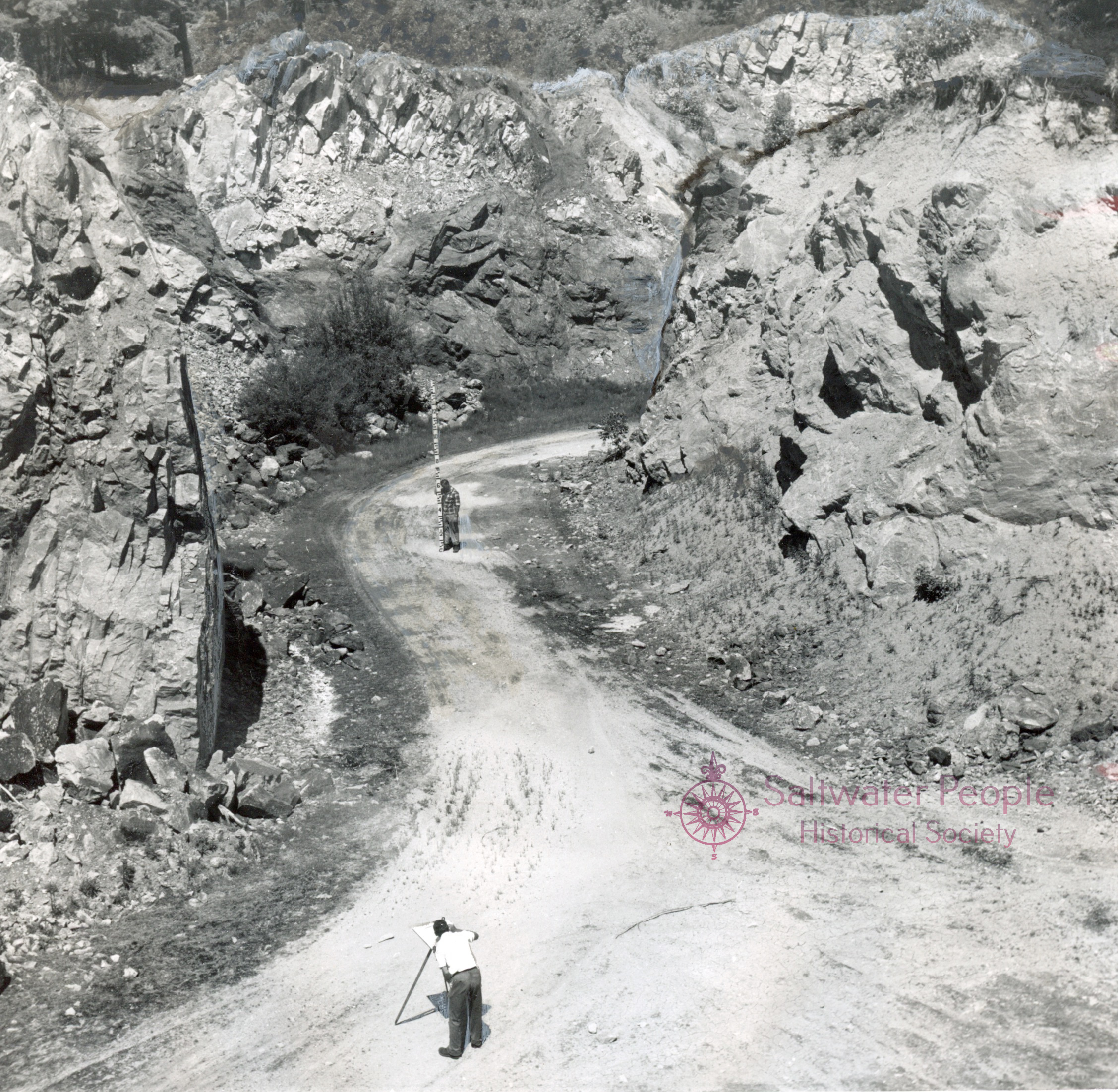
Remains of the old Cowell quarry
stands on a hillside of
western San Juan Island,
where the Island's limestone industry began.
Photo dated 1959.
Click image to enlarge.
Photograph by W.R. Danner.
From the archives of the
Saltwater People Historical Society©

"Geologists this summer (1959) combed the San Juan Islands in a study of limestone deposits, trying to determine how much of the mineral resource remains on the islands and how practical the deposits are for exploitation.

Long ago the white substance furnished the principal year-round payrolls in the islands and was one of the factors in their settlement. Quarrymen, kiln-tenders, and coopers comprised an important part of the population between 1870 and the end of the century. 

Dr. W.R. Danner, a Seattle geologist on the U of British Columbia faculty, headed a crew sent out by the Division of Mines and Geology of the State Department of Conservation to make a comprehensive survey of the deposits in the past three months. He worked mostly in the San Juans and in Skagit County, while Dr. J.W. Mills of WA. State University, with a similar crew, carried on the search east of the Cascades.


Dr. W. R. Danner,
Seattle geologist, at the door of 
a disintegrating limekiln at the former
Eureka site on San Juan Island, WA.
Click image to enlarge.
1959 photograph by Parker McAllister,
from the archives of the 
Saltwater People Historial Society©


Industries such as pulp manufacturing consume enormous quantities of limestone, now being imported into Washington because of lower production costs elsewhere.

At present, only one operator, of the Everett Lime Co. deals in this commodity from the islands. He employs a crew to blast rock from the Westerman quarry at Eastsound, Orcas Island, break it into chunks called 'spalls', and load it on barges to be taken to pulp mills.

The market for Washington limestone has shrunk greatly. Only in cement manufacturing is it expanding. However, this outlet requires large and easily accessible deposits.

It was once supposed there was so much limestone in the San Juans that possession of tiny O'Neal Island alone was sufficient reason to justify the British-American boundary dispute of 1859. 

Danner found this century-old idea amusing because, although limestone is visible on the surface of O'Neal, the island on close examination proved to have a negligible amount of the mineral.

'Islanders think lime is all over the archipelago,' Danner said. 'This is not true. It is found in small deposits; there are no great sheets of it. We want to discover what actually is here, what is left in the quarries, and what deposits have not been quarried.'

With his two assistants, Danner tracked down forgotten places such as limestone caves, crumbling towers that once were kilns, and prospect holes in picturesque fern-filled glens where early-day miners did not find enough mineral to justify quarrying.

'There are nine groups of quarries on San Juan Island and at least 14 groups on Orcas.' Danner said 'The Roche Harbor operation on San Juan, which ended several years ago after having been the largest on the Pacific Coast, had 12 quarries.'

The Roche Harbor plant was modern, compared with the ruins of earlier ones scattered in the islands. The towering old stone kilns, into which rock was dropped from the top and drawn out through oven doors at the bottom, have a medieval look about them.

Seven kilns can be seen on San Juan, ten on Orcas, two on Henry, and one in ruins on Crane, Danner says. The geologist found 21, including some which have almost disappeared.

Inaccessibility usually was the factor governing the closing of the old mines. A few were abandoned because of the height of overhanging cliffs, which threatened landslides. Another was shut down because of the death of a workman. Most became too costly to operate.

Danner had explored for lime in the islands in previous summers for private companies. This year he thoroughly examined San Juan, Orcas, Henry, Cliff, Crane, O'Neal, and Jones Islands for the state. He mapped old workings, took samples, and assembled all the lore he could extract from residents. Many of the lime properties have become residential sites.


Charles McKillop, Friday Harbor, foreground 
& Alder Revisto, of Tacoma, survey the old 
Cowell quarry in 1959, on San Juan Island,
San Juan County, WA. 
They were assistants to Dr. W.R. Danner.
Click image to enlarge.

Photo by Danner from the archives of the 
Saltwater People Historical Society.©

The industry began on San Juan Island's west side, on the cliffs near Lime Kiln Lighthouse.

Augustus Hibbard, who became the island's first quarry operator in 1860, was a man who attracted trouble. Military authorities were annoyed with his men for keeping liquor in camp and selling it to soldiers and Indians. Hibbard's cook was stabbed to death by a cooper and Hibbard himself was killed by his partner, on June 17, 1868, in a quarrel over an Indian woman.

Hibbard died just before the completion of a new kiln. His heir, who journeyed from the East to take possession, died two years later. The federal census of 1870 indicated that the firm then employed 18 persons and in 12 months had produced 13,000 barrels of lime, worth $26,000.

Lime at that time was used mainly for mortar and as a soil 'sweetener' in agriculture. None had been discovered closer than California or Vancouver Island, so trade in Washington Territory appeared to offer good prospects.

George R. Shotter, a Canadian, opened the first quarry on Orcas about 1862, across Eastsound from the site where Clauson is mining today (1959.) The Shotter site, north of Rosario on Eastsound, is owned by the Crown Zellerbach Corp. Two ruined kilns on the beach are all that remains of the lime settlement of Port Langdon, which existed before there was a town of Eastsound.

Nova Langell, an old resident of the island, is a son of Ephraim Langell, a Nova Scotian who went to work at the quarry in 1871. He recalled that the company's oldest kiln has disappeared: the two standing on the shore are later ones.

In 1874, after American ownership of the San Juans was agreed through arbitration, the British quarry firm sold to Daniel McLachlan, an employee, and Robert Caines of Port Townsend, who later bought McLachlan's interest.

McLachlan went to the east side of San Juan Island and, with his brother, William, and Thomas H. Lee, a relative by marriage, in 1881, organized the Eureka Lime Kiln, on what became the property of Mrs. D.M. Salsbury.

Seven little quarries are scattered through the woods on Mrs. Salsbury's 250-acre tract and two kilns stand on the beach. Once a small community was on the spot, including a hotel, post office, saloon, and 20 families.

Eureka is one of the oldest quarries in the islands, older than the McLachlan-Lee enterprise. Probably it was opened by an Englishman named Roberts during the joint military occupation of San Juan by the British and Americans. Early in 1863, American squatters attempted to seize it from him through an illegal order of the Justice of the Peace. The controversy ended with Roberts's death by drowning before the year was out.

The Eureka property has not been operated since about 1890. Mrs. Salsbury converted two of the quarries into a Japanese grotto and a woodland chapel. Rock from one of the kilns was used for building her chimney and fireplace.

Danner found the forgotten quarry of the Chuckanut Lime Co. on the east side of Point Lawrence, Orcas Island. It was abandoned before 1910.

One of the most spectacular quarries, Danner said, is on the west side of Orcas Island, about 300' up in the cliffs, where the Orcas Lime Co plant for many years was operated by a woman, Mary Louise Dally. She and her husband, F.W.R. Dally, bought the original kiln on the President Cannel side of the island in 1900.

From 1914 until she died in 1928, Mrs. Dally had lime properties on San Juan and Henry Islands, including one with an ancient pot kiln, the most primitive type of oven to be seen in the archipelago.

Part of Danner's objective has been to learn the age of the limestone deposits in the islands, using tiny fossils of one-celled creatures that lived in shallow sea-bottom and were uplifted after the age of glaciers. On Orcas, he found limestone 350,000 years old.

The fossils, Danner said, are dependable clues to the age of any land where they exist. Through their presence, scientists have determined that the San Juan Mountains (now submerged, the islands are their peaks) ca. 200,000,000 years older than the Cascade Range.

The basic purpose of the summer work has been to learn whether suitable deposits of limestone are available to attract new industries.

Whereas kilns used to be of backyard proportions and a 200-barrel shipment was considered newsworthy in 1875, today's thinking has to be on a gigantic scale. If quarrying should reopen in the islands it will have to be undertaken by some large corporation financially able to overcome the physical obstacles and install an economical burning plant."

Words by historian/author Lucile McDonald and published by the Seattle Times.

08 May 2023

THE ALMOST UNSINKABLE MARINER OF FRIDAY HARBOR, WA. by Brad Warren


CARTOON BY DENNIS DAY
1984
click image to enlarge.
From the archives of the 
Saltwater People Historical Society.


When the only bar on Friday Harbor's waterfront changed hands last year [1983,] its detractors watched the name disappear from its weathered sign and confidently predicted that the raucous Mariner Galley & Bar had finally, and fortunately sunk. It had surrendered its prime location, they gloated, to a fancy new restaurant that would show San Juan Island what "class" could be. But neither the Mariner nor Friday Harbor was ready to be gentrified. The new restaurant fizzled out in November, a financial and social disaster. In December the Mariner's old owners, Ron and Sandy Speers, reclaimed it and fighting the building's owners, and the State Liquor Control Board, brought the bar back to its former self. Almost.
        The Mariner was still a salty den of noisy fishermen, surly rebels, 19th-century holdouts, and 20th-century dropouts––still the stubborn soul of a roistering bordertown, fishing port past, and still for Mariner regulars at least, the place that kept Friday Harobr true to its real identity as "the southernmost town in SE Alaska."
        But the Mariner lost its liquor license––on account of past violations for which it has already paid fines, suffered closures, and fired bartenders, according to the Speers. Unless they could win the license back, their lease will expire. "We'll get it back," said Ron Speers. "I'm willing to fight this all the way into court if I have to, but I'm sure we'll prevail."
        "The Mariner was the first place I worked when I came to the island," says self-proclaimed Marinero Tom Hook. "I went in and saw the piano and asked if they need someone to play it. They put me to work that night. The pay was lousy but it was a great place to work. A few weeks later I met Phil Martin there. I was playing 'Take Five' and I looked up, and there was the biggest fisherman I'd ever seen––he filled the doorway. He had a black beard down to his chest, and he looked like Wolf Larsen, straight out of the Sea Wolf. When he saw me, he said, 'Oh! A piano player!'
        "He walked right over and grabbed the handles on the back of the piano, braced the bottom of it against his leg, and lifted the whole thing six inches off the floor while I was playing it. "My name's Phil, he said with a big smile. "I like country and western."
        "I gulped and looked up at him, I said, "Yeah? Well, I like tips."
        "He put down the piano, slammed a five-dollar bill on top of it, and said, "There's more where that came from, partner if you're any good."
        I met him when we were reporting for competing island newspapers, and we became friends when I started playing guitar at the Mariner with the Crawlspace Blues Band. It was a great rowdy place to play. We were never paid much––sometimes not at all–– but we always got a free meal. That made a big difference when cash was scarce, as it usually was on the island. Nobody had money in the winter.
        If the waitress wasn't around in the morning when were went to collect our free meal, we'd go behind the counter, pour our coffee, and tell the cook what we wanted. Phil Martin and a bunch of local fishermen would be there rumbling or joking about the bad fishing or repairs on their boats, sometimes griping about the Boldt decision, something just staring out the window at the harbor. The Mariner was their place; they ate, drank, and brooded there by day––between turns of a wrench on their boats or knots in a net they were mending––and they came back to cut loose at night.
        Some fishermen had no phones at home and gave out the Mariner's number. One was Dennis Day, a seiner and artist who used to sit at the bar all afternoon when he wasn't working, drawing on napkins: he made magnificent, mythical images of boats riding out storms, mermaids rising from the surf, black-bearded fishermen hauling in nets––elemental, powerful visions. The wall behind the bar gradually became Dennis' gallery as the bartender saved and hung his napkins, and on another wall, Tom Hook hung a hand-drawn map of places to get drunk in southern France.
        The Mariner was full of people whose rough looks hid surprising talents. Many had left their old lives in the fast lane to rust back on the mainland. There were fishermen with doctorates and an amateur live-aboard boatbuilder who had dissolved his successful public-interest law practice and came to hide out quietly on the island. Even Ron and Sandy, the owners, were an unlikely mix. They ran a farm on the island and looked like it. But Ron had graduated from Harvard and been a naval officer; Sandy, the Mariner's fearless den mother, had lived for years in Germany. Almost everyone there had made a sort of stand against nine-to-five, bureaucratic, domesticated, and disoriented mainland American culture. The sea was their antidote. My landlady, an Alaskan troller and sometime teacher in Friday Harbor, once told me, "When you're out there on the open water in your own tiny fishing boat and you see a big storm come up over the horizon, it does something for your priorities. It's you and the sea, and you've got to survive."
        The sale of the Mariner meant a lot more than a change of ownership. It was a signal of Friday Harbor's rapid, painful growth into a prosperous resort and retirement community––a prestigious place to have a second home or yacht. The population of San Juan Island had doubled during the 1970s, and few newcomers fit into the islands' rough-handed fishing, farming, and logging tradition, where good old boys held office and smugglers held out in the islands many hidden coves. That era came to a political finish in the late 1970s, when the new electorate recalled a corrupt county commissioner and voted in strict land-use controls and reforms. At the same time, poor management by the Washington Department of Fisheries and a raft of court-imposed restrictions crippled the commercial salmon fishery in Puget Sound.
        The old diehard spirit, which had reached its apogee when locally notorious lawyer Charlie Schmidt drafted a plan for the island to secede from the union and become a free port, was losing its grip. Islanders watched the changes and said cynically that Friday Harob r would soon be "the northernmost town in Southern California." Land prices were skyrocketing and it looked, in Sany Speers' words, as if "the little people were going to be squeezed out."
        The Speers' precarious revival of the Mariner won't change any of that. But it is somehow cheering to think of returning to find the old crowd still scowling and winking at the ferry as it pulls in, the last dive holding out for all that is un-reconstructible and defiant in Friday Harbor, an enduring chip off the ornery, generous heart of the islands.

Words by Brad Warren.
Published by the defunct Puget Sound Enetai
9 February 1984.
From the archives of the Saltwater People Historical Society.


13 February 2022

CUTLER'S GUN AND A PARK IN THE PLANNING


L-R: James Crook, Senator Henry M. Jackson,
with Lyman Cutler's gun, 
and Rhoda Anderson, sister to James,
standing next to the historic blockhouse 
at Garrison Bay, San Juan Island, WA.
Jackson was the chairperson of the Senate Interior 
and Insular Affairs Committee.
Click image to enlarge. 
Low-res scan of an original gelatin-silver photograph from the 
archives of the Saltwater People Historical Society© 

News Notes from the Washington State Historical Society
Vol. 5. No. 1, December 1964


"The world is full of battle monuments. It needs a few monuments to battles that never happened.
      Heed, then, the call of Senator Henry Jackson and others for national attention to be focused on a remote corner of Washington State, where an international boundary dispute almost erupted into battle, and finally, after a decade, was settled by a peaceful method ––arbitration.
      That corner is San Juan Island, the largest island in the group known collectively as the San Juans. On it are two historic sites––English Camp and American Camp. These and the area around them should be purchased by the federal government and turned over to the National Park Service who would then establish the San Juan Historical National Park.
      Some say it ought to be "Pig War" National Park. But that doesn't sound nice. Furthermore, it is inaccurate. There was a pig. But there was no war. And that's what needs to be commemorated.
      We spent last Saturday going to and from San Juan Island on a Coast Guard cutter, along with some 60 others assembled by the Washington State Historical Society, meeting with the local people at Friday Harbor and wandering about the site of English Camp, where the English blockhouse built before the Civil War still stands on the edge of a sheltered cove. Some history has to be related to understand the significance of the site: Euro-American settlers moved onto San Juan Island in the 1850s. Some were American homesteaders. Some were Hudson's Bay Co. sheep raisers. A treaty had been signed in 1946 finally settling the dispute of long-standing over the boundary between Oregon and Canada. It wasn't at 54 degrees, 20 minutes of latitude, as many had advocated, but instead was the 49th parallel and was to extend along "the middle of the channel which separates the continent from Vancouver Island and thence southerly through the middle of the said channel, and of Fuca's straits to the Pacific Ocean."
      This sounded all right in London and Washington, D.C. but it failed to specify which side of the San Juan Islands was to be considered the channel. Americans said it was on the west side. The British said it was on the other.
      Tax collectors, not surprisingly started the big row that ensued. The Hudson's Bay sheepherders wouldn't pay taxes to American tax collectors. So, 30 British sheep were seized and sold for payment of delinquent taxes. This produced an angry letter of protest from James Douglas, the British governor on Vancouver Island, to Gov. Isaac Stevens of newly organized Washington territory. But nothing was done. Then in 1859 an American settler on the island, Lyman A. Cutler, became enraged when one of the Englishmen's pigs kept invading his potato patch. In an unguarded moment, he gave vent to his rage by shooting the pig.
      He regretted his hasty action immediately and went to the Hudson's Bay agent with an offer to pay for the pig. But the Briton was angry, too, and said he would send to Victoria, for a gunboat to come and get Cutler and take him away to be tried and be punished. Cutler reloaded his gun and was prepared to defend himself, but was persuaded by his neighbors to hide so that he couldn't be found when the English came to arrest him. Then the settlers petitioned for help from the army, and a company of federal troops was dispatched from Fort Bellingham. They had no sooner arrived on San Juan, when three British warships anchored offshore and unsheathed their guns, ready for battle.
      The American commander on the island, Capt. George Pickett, showed more restraint than he displayed in later years at the battle of Gettysburg, and refused to fire the first shot. British Admiral Baynes, overruling the hotheaded Gov. Douglas, ordered the British ships not to fire unless they were fired upon.
      Gen. Winfield Scott was rushed to the scene, and he worked out a compromise agreement that called for joint military occupancy of San Juan until the diplomats resolved the question of who owned it. So for the next 12 years, while the diplomats dillied and dallied, the two nations 
maintained military camps on the island, a few miles apart.
      They didn't menace each other. They got along fine and visited back and forth. Finally, in 1872, the island boundary dispute was submitted to arbitration. The arbiter was the German emperor, Wilhelm I, grandfather of the Kaiser in WW I. He investigated the matter thoroughly and ruled that the channel actually was west of the islands, as the Americans had contended all along.
      Thereupon, the English broke camp, marched down to the shore, and sailed away never to return. They left several of their numbers, however, victims of drownings and accidents, buried in a little graveyard on a hill.
      Within two years a man named Crook moved onto the English campsite to homestead. His son, James Crook, lives there to this day [1964.] Senator Jackson assured him last week that he could have his wish to spend the rest of his days on the site. A man who has lived in one place for 90 years ought not to be moved.
      The federal government, if Jackson's bill goes through, would have no trouble with title insurance. No one but Crook and the State of Washington has owned the property––not since the day the German emperor resolved a dispute that began with the killing of a pig, and provided one of the few examples the world has ever seen of two nations resorting to international arbitration, rather than force, to settle an argument over territorial rights."
John M. McClelland Jr. Reprinted by permission from the Longview Daily News.


19 February 2015

❖ JENSEN SHIPYARD ❖ Friday Harbor


VENTURE (ON 204609)

&0.5' x 15.3' x 5.4' cannery tender
with 175 HP steam plant

 built 1907 Griffin Bay,
San Juan Island, WA.

She was chartered to
White Crest Canning Co &
 Coast Fish Co.
She hauled 10 tons of spuds for P.A. Jensen &
transported the family to Seattle to visit 
the Alaska-Yukon-Pacific Exposition in 1909;
she was a busy gal.

In 1925 VENTURE was bought by
Wagner Towing
and depowered to be purchased by 

 Foss Launch & Tug in 1937
and renamed 
HILDUR FOSS.
Great notes in Mike Skalley's
Foss, 90 Years of Towboating.
Fate: Intentionally sunk 1 April 1949.
Photo courtesy of Nourdine Jensen.
      
"If it hadn't been that a horde of voracious grasshoppers that ate Ben Jensen, father of Albert Jensen and grandfather of Nourdine Jensen, out of his Iowa homestead in the late 1880s, there might never have been an Albert Jensen & Son Shipyard on San Juan Island.
      A former seaman and carpenter, Ben Jensen migrated from Norway to this country in the middle 1880s.
      "My grandfather came to San Juan County In 1883," said Nordine, owner of Jensen Shipyard, located at the east end of Friday Harbor Bay. "My Dad was about nine yrs old when grandfather came to this island. He had two sisters, Amelia Martin and Nellie Paxson. There were also three brothers, Pat, Joe, and Frank.
      Sometime around 1906 or 1907, Albert and his brothers went into the sawmill business in Friday Harbor. The mill was located in the vicinity of the Union Oil dock; early photographs show sailing vessels lying at anchor in the Bay waiting their turn to take on lumber. In 1919 the Jensens sold the mill and a short time later it burned to the ground.
      During the time the Jensen brothers operated the mill they also built two tugboats, the VENTURE, an 80-ft cannery tender they used to haul commercial freight. Both vessels were built on the beach at Griffin Bay.
      "In those days, if you didn't have a boat of some kind you were island-bound because there were no ferries," Nourdine explained.
      The NELLIE JENSEN served the Jensens for some eight years before she burned beyond repair.
      "I suspect my Dad also built the MARINER about the same time. She was an 80-ft cannery tender that operated around AK."
      Nourdine recalls his father telling about using the MARINER in AK for a season after which the vessel was sold to a Seattle cannery.
      "Dad was on his way to deliver the MARINER to a buyer when the engine quit. It was a stormy day off Iceberg Point [Lopez Island] and the vessel went aground. At the time Dad had his ticket for Australia with him, he was scheduled to go as the rep of Union Engine Co. However, he hadn't yet paid for the engine in the MARINER, but he lost no time getting a pile driver to the sunken boat where he managed to salvage the engine.


NEREID (ON 209491)
Fondly remembered in San Juan County.
Built by and for Albert Jensen as Master Carpenter;
72.7' x 16.75' x 6.4' ; 29 tons burden.
Launched Friday Harbor 1911.
Sold that year to Friday Harbor Cannery.
Source: Master Carpenter document filed at NARA, Seattle.
Photo from the archives of 
the Saltwater People Historical Society©

      That same winter Albert built the NEREID and installed the MARINER's engine.
      "These were the days of fish traps and non-powered fishing boats. These boats operated on the west side of San Juan and off Whidbey Is. They were towed out by a tugboat. Today they are called seine skiffs.
      When fishing was over the tug would round up the fish boats and tow them in. This was their only means of getting from one location to another. The tugs, or fish tenders, were first powered by steam and later by diesel."
      Nourdine points out that during the fish trap days (WA outlawed commercial fish traps in 1934, except for the treaty rights for Indians) a great amount of equipment was required to install and remove the traps, logs, and to store various tools required for the job.
      Before starting his Friday Harbor Shipyard, Albert Jensen worked as a steam engineer on various boats around the Sound. These vessels were affectionately referred to as the 'Mosquito Fleet'. After Jensen gave up steamboating, he taught school for a short time in Shaw Island's one-room schoolhouse. 

      Statistically, Nourdine questions the general assumption by laymen that more fish are being caught today than in earlier years.
      "That's pretty hard for me to swallow, particularly when you consider  there were some fifty or sixty canneries operating in the Puget Sound area. In the San Juans there were two canneries on San Juan Island, one at Deer Harbor and West Sound on Orcas. Anacortes had four or five and Bellingham had a half dozen. There were also a number of fish canneries in Port Townsend, Everett, Seattle" [and Shaw Island.]
      In 1910, Albert Jensen established his shipyard at the east end of Friday Harbor off San Juan Channel. Many changes have taken place since the yard opened all those years ago.
      "One of the most noticeable changes in our business has been the gradual change over the past five years from custom boat building to that of maintenance and repairs.
      Custom boat building, which has been our stock in trade since Dad first opened this yard, has been steadily declining each year, while assembly line type of boats is on the increase.
      Financing is another problem today. Banks are more willing to finance a boat that is already built and carries a price tag on it, rather than financing a boat still in the building stages."
      As to whether Nourdine prefers custom boat building to that of maintenance and repairs, he has this to say:
      "Personally, I much prefer to work with handcrafted boats, but as far as making a living goes, we really made no money to speak of on our handcrafted boats. There is actually more money to be made in the maintenance and repair business today."
      Although the Albert Jensen Shipyard still employs the same number of men [at the time of this writing] between 5 and 7, depending upon the season, the requirements for this new type of work differ from those of custom boat building.
      "You've got to roll with the punches, so we've been gradually changing our method of operation to meet this new demand. We've had to. If we depended solely on custom boat building today we'd be out of business. It's that simple."
      In thinking back over some of the boats his firm has turned out, a number of outstanding vessels come to mind.


MOHAWK (ex-ISLANDER)

ON 221640 
91.6' x 21.1' x 7.2' ; 173 G.t. 140 N.t.
Blt by Albert Jensen, Friday Harbor,
September 1921.

Source of data:
Federal MCC document from NARA, Seattle.
       "Perhaps our best known was the 91-ft ISLANDER launched in 1921 and later named the MOHAWK. Prior to WW II, the MOHAWK was sold to Puget Sound Freight Lines. She was later conscripted by the US gov and used to tow supplies to Kiska Island in AK."
      Other memorable vessels built by the yard include the LIBBY, a 54-ft cruiser owned by a Portland man, who moored her in Anacortes. There was also the PUFFIN, a cruiser built for Dr. Clark, and the RUSSWIN built in 1947 or '48 for Doc Russell of Orcas, and then later owned by Gordy Fox. Then there was the HI-SEAS, a 50-ft charter cruiser that was a former USCG vessel and completely rebuilt by the Jensen yard and owned by J.H. Woods of Olga. The most recent handcrafted boat turned out by the Jensen yard was the STRUMPET, a 35-ft troller designed by local architect, Jay Benford, and owned by the author, Ernie GannThe list goes on.


BÃ…TEN of Friday Harbor, WA.

Launching, 5 April 1978
A smidgeon under 20 ft.
Designed by Jay Benford,
then of Friday Harbor, 

for Marilyn Anderson & Rachel Adams
of Crane Island, San Juan Archipelago,

 by Jensen Shipyard, Friday Harbor, WA.
Photo possibly by Al Hamilton,
on the scene this day. 

Shared by Nourdine Jensen
to SPHS web admin.

      
There was a moment's lull as Nourdine Jensen stared reflectively from the window of his small shop office. The rain beat a staccato rhythm against the tin roof. A slow grin spread across his face.
           "From where I stand the boat business looks good for a least another 65 years."
Gordon Keith. Voices from the Islands, True Stories about those Who Live in One of America's Most Beautiful Areas, Washington State's San Juan Islands. Thomas Binford Publisher. 1982.
Keith was a resident of Orcas Island, WA., who had many short stories and photographs published by the Islands' Sounder.
   

Archived Log Entries