"The Cure for Everything is Saltwater, Sweat, Tears, or the Sea."

About Us

My photo
San Juan Archipelago, Washington State, United States
A society formed in 2009 for the purpose of collecting, preserving, celebrating, and disseminating the maritime history of the San Juan Islands and northern Puget Sound area. Check this log for tales from out-of-print publications as well as from members and friends. There are circa 750, often long entries, on a broad range of maritime topics; there are search aids at the bottom of the log. Please ask for permission to use any photo posted on this site. Thank you.
Showing posts with label North to Alaska. Show all posts

28 April 2020

❖ SIX SAGSTAD SEINERS GOING NORTH ❖ 1962

Photo time before heading
north to Alaska
aboard the steamship Susitna that sailed
24 April 1962.
This original photograph by Ray Krantz
from the archives of the Saltwater People Log.©
Click image to enlarge.
These six boats, built by the Sagstad Marina for Pacific American Fisheries, lined up in front of the marina before going to the Alaska Steamship Company to be transported to Alaska. 
Sagstad was also building five other boats for Pacific American Fisheries and one for Andy Olsen of Cordova, AK. 
      The names of the vessels as seen above;

Moss Cape, Swedania, Balboa, Andronica, Bold Cape and Cape Elrington

02 July 2019

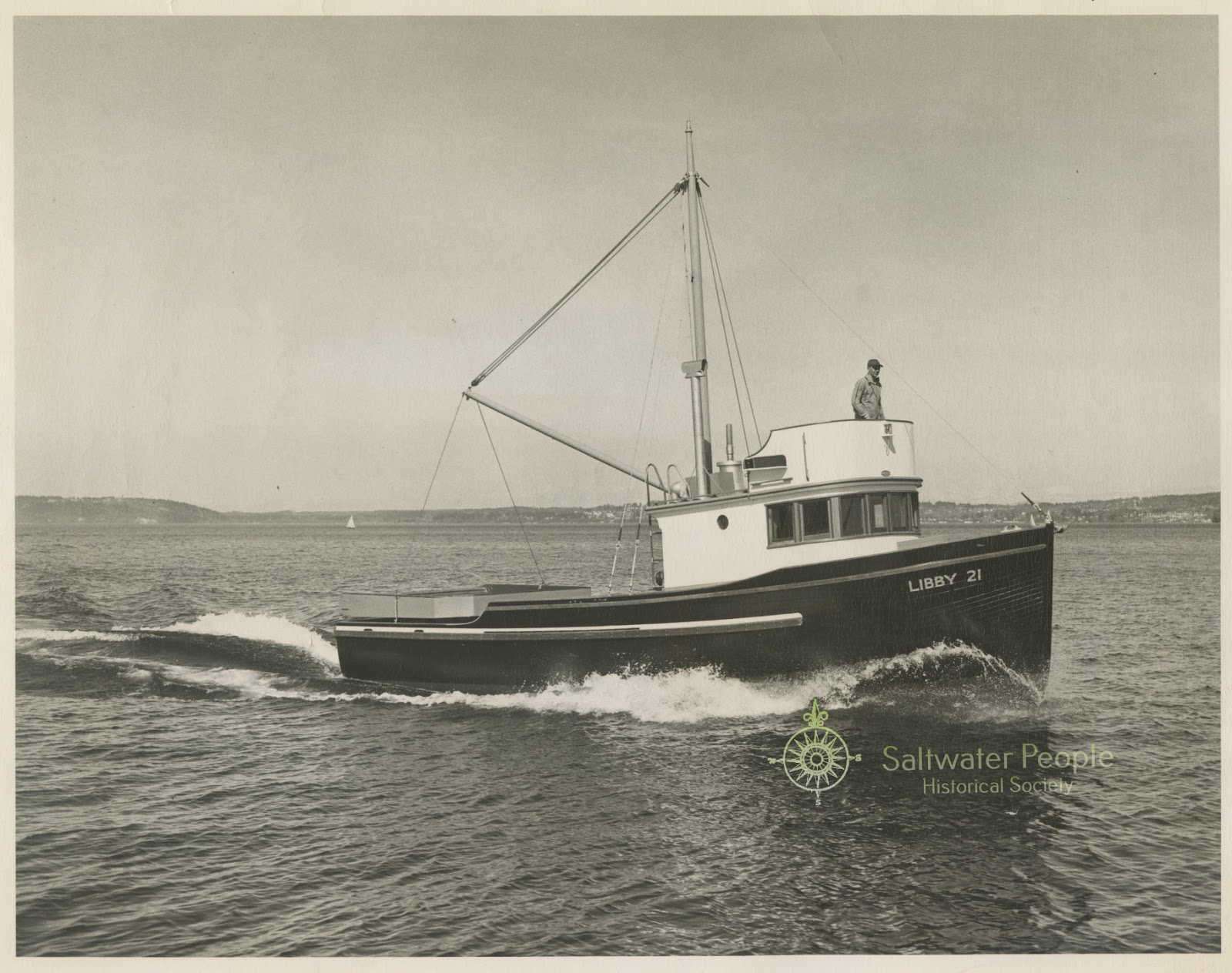
❖ NORTH TO ALASKA 70 SUMMERS AGO ❖


SEA TRIALS WITH A SEINER DESIGNED BY ED MONK, 
BUILT BY GRANDY BOAT COMPANY, 
AND READY FOR WORK IN THE FAR NORTH


LIBBY 21
"One of the speediest of the 1949 crop
of new fishing vessels built in Seattle, 
 was the Libby 21 from the drafting
board of designer Mr. Ed Monk of Seattle.
She was constructed by Grandy Boat Co
yard on Lake Union for the Alaska salmon
Department of Libby, McNeil & Libby.
She was equipped with a
140-HP engine and logged 11-knots.
The 40' purse seiner was shipped on the
deck of a freighter to the cannery
at Mosher Bay, AK."
Click photo to enlarge.
Photo by Ray Krantz
from his photo-boat STARDUST
on Lake Washington, Seattle, WA.
From the archives of the
 Saltwater People Historical Society©
Photo date of 3 June 1949.


By the 1940s Libby, McNeil & Libby was one of the largest producers of salmon canning operations in the US. On average it produced 700,000 cases of canned salmon annually. Their canneries were at Egegik, Ekuk, Libbyville, Koggiung, Egushik, Nushagak, Kenai, Yakutat, and Ketchikan.

13 June 2019

❖ CATCHING PASSAGE TO ALASKA ❖

All aboard the TANANA.
Photo dated 20 May 1966
Gillnet boats were thick on the deck of the TANANA
as the Alaska Steamship Co freighter 
prepared to sail for Bristol Bay.
Click image to enlarge.
Original photo from the archives of
the Saltwater People Historical Society©
The ship carried 33 of the salmon-fishing boats, the first troup of 118 that left Seattle on three Alaska Line ships within a week. Most of the boats were built by the Commercial Marine Construction Co., and the Wies Boat Shop & Marina, Seattle; the Morse Boat Works, Everett, and Ron Rawson, Redmond, WA.

20 June 2015

❖ WHALER HEADING TO THE BERING ❖

Whaler WESTPORT
209877
Original photo dated 1935

Click to enlarge.
From the archives of the S.P.H.S.©
The WESTPORT, one of the 14 ships of the Pacific Coast whaling fleet, shown leaving Seattle for the treacherous waters of the Bering Sea, some of which were uncharted at the time of this photo. With the harpoon gun on her prow, the men believed there would be a big profit in whale oil that year.
The next year, the crew of the Seattle whaler WESTPORT,
had their ship breakup on Bight Reef in the Aleutians

15 Sept. 1936.
The crew escaped and was brought to Seattle, 
5 October, on the Coast Guard cutter CHELAN.
Original photo from the archives of the S.P.H.S.©

1912: Built by the former Moran Brothers Shipyard (renamed the Seattle Construction and Drydock Co.) for Gray's Harbor Station of the American Pacific Whaling Co.

G.t. 116 / 59 N.t. 
88' Reg. L.  x 19.0' x 11.5'
450 HP-triple expansion engine, single Scotch boilers of 180 lb. working pressure.

1934: Capt. Harold C. Kristensen, 50, master of WESTPORT, killed when the harpoon gun he had fired, collapsed, & its heavy steel frame toppled over on him in western AK waters.

1935: WESTPORT lost off Akutan, AK., September 1936. No lives lost.
Above dated material from H.W. McCurdy's Marine History of the Pacific Northwest . Newell, Gordon, editor.

01 March 2015

❖ OFF TO ALASKA ON THE ARK ❖ Tacoma 1940 ❖


Paul and Molly Satko family
Launch day for the ARK OF JUNEAU
Tacoma, WA., 1940.

Two elder sons were left behind in Richmond, VA.
and two children were born later in AK.
Scan of original photo from the archives of the S.P.H.S.©
Onto the national news scene came the story of Paul and Molly Satko and their crew of children, shown in this striking photo taken in Tacoma. So many on-lookers had suggested the 40' boat resembled an ark, so that became her chosen name, the ARK OF JUNEAU.     
         Paul was an unemployed machinist/welder living in Richmond, VA, who had dreams for a better life. His plans led the man and his family on a long path, trailering his unfinished, home-built boat across the country to the west coast. Boat work is never done, so they were stuck on shore for three years prior to launching.
Authorities inspecting the ARK OF JUNEAU
Owner, Paul Satko on right.
Seattle, WA. 27 April 1940
Original photo from the archives of the S.P.H.S.©
         
Paul Satko with daughter Betty,
their journey interrupted by court action.
Their ARK, in background, is being viewed
by Seattle spectators.

Original photo from the archives of the S.P.H.S.©

Satko was encouraged to hear of federal homestead land still available in the Eagle River valley, near Juneau, AK. His scheme got bogged down in Seattle when the US Coast Guard and the Puget Sound Pilots said the trip couldn't be done safely in the awkward vessel. Following this stranding, the underage children were taken into protective custody for a time and Paul Satko was escorted off to jail.
ARK OF JUNEAU
Away but 
stranded on a sandbar 
near foggy Vashon Island.
After five hours Satko accepted a Coast Guard tow
and they were off with more troubles ahead.

Photo by Acme dated 30 April 1940
Scan of original photo from archives of S.P.H.S.


Paul Satko
In jail for resisting arrest.
Original photo dated April 1940,
From the archives of S.P.H.S.©
The people of Seattle were not helpful; surrounded with difficult days, the Satkos cruised along the coast to Anacortes, Fidalgo Island, Skagit County.
         It was in this port that the family found friendship. The well-known civic leader, Paul Luvera, welcomed them, energized the townsfolk to help provision the boat for the long trip ahead, and with his legal skills, helped Satko acquire Customs clearance papers.
         To avoid any difficulties from waterborne officials, they left quietly under cover of darkness, casting off from the island, a quick passage through the San Juan Islands (being noted in the local Friday Harbor Journal), past any resident US Coast Guard cutters, and safely into BC waters.
         The Satkos arrived at their northern destination just in time to welcome another baby, Northsea Meridians Satko, their tenth child.
         The story goes that they did find AK land to homestead but failed to file their claim within the time limit, so they did not achieve a patent deed. They farmed for a few years, with only a little success, some of the children married and settled in AK, but late in the 1940s, records show the parents had returned to VA., without the ARK.
Paul and Molly Satko Return.
The Satkos and six of their ten children were preparing
to drive this station wagon found in Seattle,   

to seek a new home in Arkansas.
Satko said he was through with 
homesteading in Alaska.
Original photo back dated 13 June 1946.
From the archives of the S.P.H.S.©

      Other details of the Fidalgo Islanders support, with follow-up on the family's adventure, can be viewed here

07 February 2015

❖ VETERAN TUG MARTHA FOSS HEADED NORTH TO ALASKA ❖

Submitted by William B. Evans, 
the 8-year old seen in these photos.
Click to enlarge.

Letter (2003) from William B. Evans to webmaster.
Bill is related to the late Chief Engineer David Stitt, of Shaw Island, WA.
Bill was eight years old when he took this trip. His second trip the next year, was also on the well-known veteran, MARTHA FOSS, Capt. Stark, towing a log boom. Thanks for your contribution, Bill.

08 May 2013

WESTERN PIONEER ✪ ✪ ✪ North with North ✪ ✪ ✪

WESTERN PIONEER
Loading up at Salmon Bay, Seattle, to head North.
photo copy from L.W. North for this essay.
"In 1943, I was hanging out of the apartment window in Anacortes, WA,  listening to old KVOS radio in Bellingham describe the launching of a new fleet tug for the USN, not giving a thought that in 37-years I would serve as chief engineer in Alaska, on board for over four years. Bellingham was quite proud of the ship they had built, and rightly so.
      She stretched out to 184' and drew 18' of water. Built with wood hull and steel super structure and powered with four 720-HP Copper Bessemer diesel generators that provided the power to two propulsion motors, giving her a 12-knot speed in the beginning.
      By the time she had finished her military obligation, she had slowed a bit. As a civilian she started a career freighting from Seattle to Dutch Harbor for Western Pioneer, Inc, on a round robin routine, in spite of weather, for 13-years, until an engine room fire tied her up in Lake Union. The Coast Guard ruled her unfit.
      The Magnuson Act provided new rules so she had another chance to serve as a private freighter with a licensed skipper, first mate, and chief engineer. Her most important asset was the converted refrigerated hold for hauling crab and fish.
      When I first went aboard, the engine room was so black from smoke and soot, that a 100-w light bulb looked like a candle on a dark night. But the fire damage was minimal and cleaning was the main concern on our way north. We ran on two generators and worked on the other two, since there had been a serious lack of maintenance.
      The first newspaper we got in Ketchikan, AK informed us of Mt. St. Helens' gas problem on 18 May.
      The skipper delayed at Cape Spencer for a long while, waiting for better weather on the gulf; then we ventured out after dark. In an hour we were rolling 40 degrees to starboard and 25 degrees to port, and the wind was doing 90-mph, with snow. 
      The deck load of iron pipe and steel reinforcing rod shifted, catching the 20' shore boat in cables, cutting it from deck to keel as it hung over the cabin side. In the engine room, parts that hadn't been seen for years came bursting out of their hiding places, to skid across the deck plate, bent on doing damage. Two men acted as cowboys and jumped on flying parts with rope and wire, to secure them before the next surprise threatened. Our tool count increased--as the lost were suddenly found--rolling about the deck.
      We made Yakutat much later and anchored in perfect calm and licked our wounds. When I heard the stories from the pilot house, I was glad to be an engineer.
      In the four years that I served we had been in the Yukon delta, Adak, Bristol Bay, Dutch Harbor, a tour of SE, and a lot of those other places that make Alaska different than any other and often more exciting." 
Above text written by Orcas Island mariner/historian L. W. "Corkey" North who has supported this historical endeavor from the outset, while being very patient with the webmaster. 
Essays by Corkey are included in the labels at the very bottom of this Log. He has shared memories or helpful notes on the boats IMPERIAL, KATY, NORTH STAR, NO WAKE, VASHON, WESTERN PIONEER, WINDENTIDE, and even one large, returning, visitor whale--SATCHELMOUTH. In other words, we'd be sunk without him. Thanks Corkey, keep writing Chief. 
WESTERN PIONEER, Alaska
Scan from copy from L. W. North
WESTERN PIONEER
Back from Adak, AK
Scan from copy from L. W. North.


WESTERN PIONEER
Dutch Harbor, AK.
Scan from a photo copy from L. W. North


Archived Log Entries