"The Cure for Everything is Saltwater, Sweat, Tears, or the Sea."

About Us

My photo
San Juan Archipelago, Washington State, United States
A society formed in 2009 for the purpose of collecting, preserving, celebrating, and disseminating the maritime history of the San Juan Islands and northern Puget Sound area. Check this log for tales from out-of-print publications as well as from members and friends. There are circa 750, often long entries, on a broad range of maritime topics; there are search aids at the bottom of the log. Please ask for permission to use any photo posted on this site. Thank you.
Showing posts with label Lopez Island. Show all posts

22 July 2022

AT WOODMEN HALL AND AROUND LOPEZ ISLAND with June ::: May 1930


Lopez Island, 
San Juan Archipelago, WA.

"We didn't arrive at the big Woodmen hall, standing alone in the middle of the woods, until along about 9:30 p.m.

It was exactly like going to meeting in the South. The meetinghouse was a lodge hall and we were going to play five hundred instead of sing and pray. But the feeling was the same. The same quiet assembling of buggies, one after the other coming in out of the night, finding their places between the trees. Except that they were all automobiles instead of buggies. The same leisurely goings and comings to and out of the meetinghouse. The same low talking. And when we get inside, the meeting had started so that we felt a little embarrassed at being late, exactly as if the friendly preacher was about to scold us!

It was a delightful evening and I almost learned how to play five hundred. 

Esther is coming to drive me over the island. What a prosperous, beautiful island it is! The  New England farms look no mellower, no healthier than these big Lopez farms reclaimed in the last seventy-odd years ago. they look like generations of people, of cattle, of crops had grown up here.

Grassy pastures and orchards in blossom on the Strafford farm. Berries and cattle, green fields, and a tractor plowing on the neat Erb place. Rolling green slopes and dozens of gorgeous apple trees in fragrant bloom on the Kilpatrick farm.

Down the road along the backbone of the island, beautiful farms fell away into pleasant valleys on both sides. Sheep in the pastures, chickens cackling from modern hen-houses. Loganberries on Joe Ender's place. The McCloud house, low and brown, nestled on a big rock.Strait of Juan de Fuca. 

A very tiny loghouse with a very big ivy cluster nearly hiding it, a cloud of pear blossoms hovering over it. Somebody lived in that diminutive picturesque house once and enjoyed its charm, enjoyed the sweep of pastoral beauty on the slopes below it.

Pheasants and mountain quail in gardens. the McCauley farm is lush and lovely on both sides of the road. 

Down the dim cathedral woods to McKay harbor. Hemlock, white fir, and cedar. Long, curving beach washed by gentle surf. Crows on a fence. The pretty white Tralness house above the beach and a lavender-pink mass of starry flowers on the edge of the road. Out in the harbor, a gray slick rock tipped with seagulls.

In Barlow's Bay a great flower-covered rock. Lacy yellow blooms. Sedum is about to burst into fragrant blossoms. Dark blue verbena-like flowers, bell-like flowers. Crane's bill. A creamy white bell-like flower––how tantalizing not to know the names of these sweets! You would not live here so long without knowing all the flowers by their real and common names, would you? Well, I knew them once. And I shall know them again!

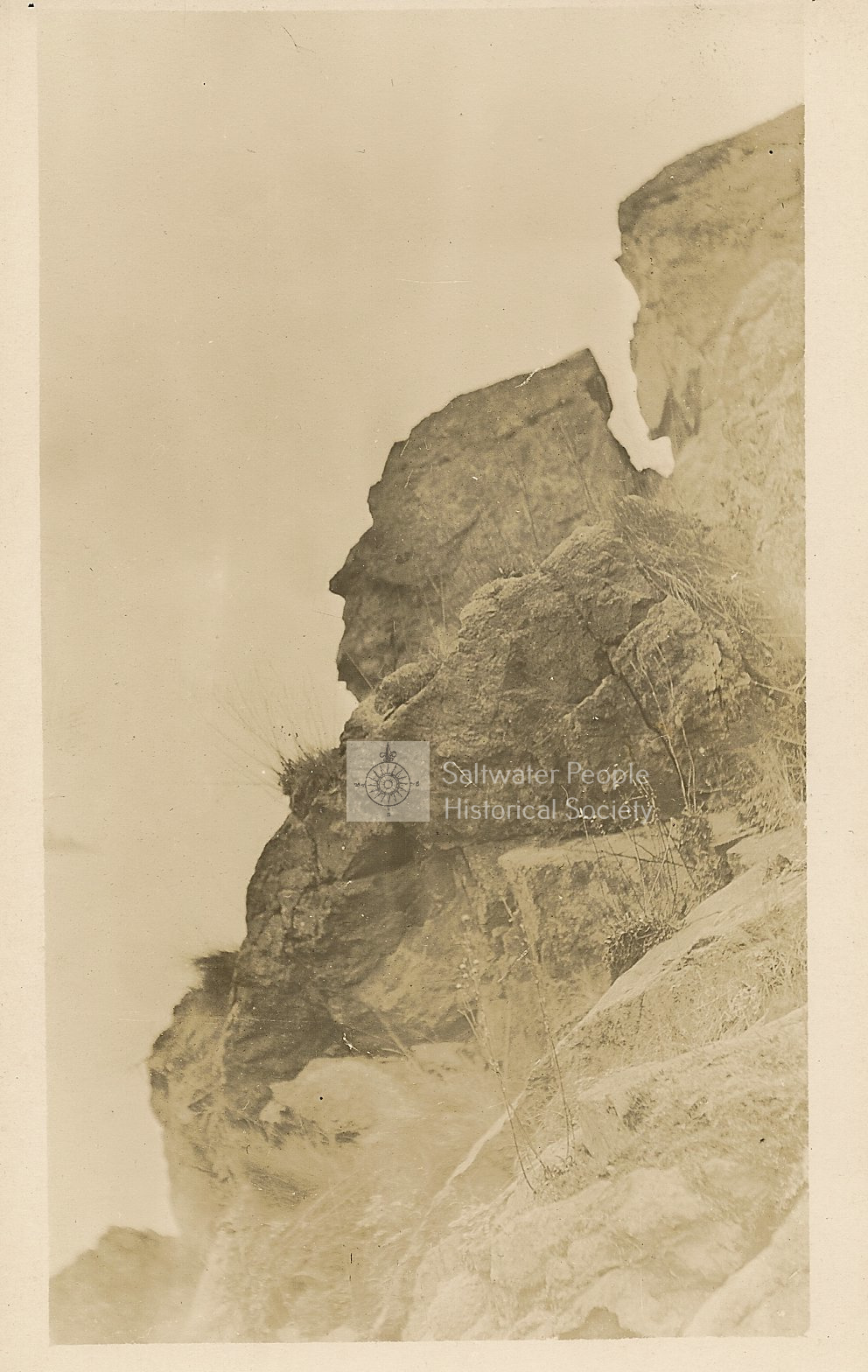
We climb up into the woods and around the outer bluff of the island to find Washington's profile. 


Washington's profile
A rock formation on Lopez Island
that went by several names.
June Burn mentions the
landmark in this essay.
Click image to enlarge.


We find the bluff where the face used to be, but something seems to have happened to the nose, or else we have not come to the right place.

But we find dark blue camas in bloom. And against an old abandoned house a gorgeous lilac heavy with purple flowers. The woods are full of wildflowers. Lady slippers, Oregon grape, starflower. Soapalalee will be along presently. From these berries, the Natives make a bitter foam which some call Native ice cream.

Across the island, is John Thompson's big lonely house where the white-headed old mariner lives alone. He promises to take us with him to Smith's island next Monday. 

The Mud Bay schoolhouse and Eaton's pretty home. On up and around to the Vogt loghouse built a half-century ago of alder logs mind you. Inside, an old square piano, hooked rugs in original designs, and handsome ship models made by the son while tending fishtraps. Outside, flowers and blossoming fruit trees and green meadows and the forest not a hundred yards away. A lovely place.

Well, you needn't think I can go all over the whole island in one letter! See you tomorrow. June"

June Burn. Puget Soundings May 1930


19 January 2021

❖ LOPEZ ISLAND'S CAPTAIN BARLOW & HIS MARINE ELEVATOR ATTRACTED WIDE ATTENTION ❖


CITY OF ANGELES
Shaw Island ferry dock
San Juan Archipelago, WA.
Barlow Marine Elevator aboard.
Click image to enlarge.
original photo from the archives of
 the Saltwater People Historical Society©


S.S. MOHAWK (ex-ISLANDER)
221640
With a Barlow Elevator.
She was built by the Albert Jensen Shipyard,
Friday Harbor, San Juan Island, WA.
for San Juan Island Transportation Co.
in 1921.
(Corkey this old friend is for you.)
Original photo from the archives of the
Saltwater People Historical Society©


"Freight handling on Puget Sound was transformed in the early 1920s by the introduction of a freight elevator that could be installed on either a dock or a ship.
      The Barlow Marine Elevator made possible the loading or unloading of a vessel at a dock during any stage of the tide.
      Captain Harry Barlow had invented the elevator in 1910; some were in use prior to 1920, but sales really took off after Capt. Barlow joined forces with the Colby Steel & Electric Co., in 1924.
      In Nov. 1926, more than a hundred Barlow elevators were in service on ships, on docks, and in warehouses. In 1930, the familiar four posts of the Barlow Marine Elevator could be seen on nearly every freighter or freight and passenger vessel in the Mosquito Fleet.
      Harry Barlow was born at Barlow Bay on Lopez Island in the San Juan Islands, on 1 January 1876. He was the younger brother of the well-known Capt. Sam Barlow, who had been born on the same spot, 3 April 1870.
      Their father was the pioneer Lopez settler, Capt. Arthur (Billy) Barlow, builder, operator, and owner of the schooners Henrietta and Port Admiral.
      Both boys were experienced seamen by the time they were in their teens.
      Harry was 12 when he shipped on the 52-foot Henrietta as a cook. On that vessel, and on the Port Admiral, he advanced from cook to seaman to mate. At age 20, he shipped on the sealing schooner Florence M. Smith and spent a season with the sealing fleet. 
      In 1898, while the master of the Port Admiral, Harry was wrecked in a snowstorm in Southeastern Alaska. He then took the little steamer Mocking Bird from Puget Sound to Alaska, and ran her between Skagway and Dyea, during the gold rush.
      When he returned to Puget Sound, he was hired as mate on the T. W. Lake, of the LaConner Trading and Transportation Co., headed by Joshua Green. With that company and its successors, he then served as master on the City of Denver, Port Orchard, Samson, and Rapid Transit.
      In 1905, Capt Barlow transferred to the Merchants Transportation Co., as master of the A.W. Sterett. On 30 Nov 1906, however, he joined William A. Marmont, a pioneer marine engineer, in purchasing the freighter Transport.
      In 1909, the partners purchased the Starr Steamship Co., and thereafter operated a fleet of freighters. One of the vessels acquired was the Fidalgo, and in 1910, Capt. Barlow installed his first elevator on that vessel.


FIDALGO
hauling grain before she was granted a 
Barlow Marine Elevator.
Undated. 
From the archives of the 
Saltwater People Historical Society


      The years of freighting and freight handling had provided the captain and former deckhand with ample opportunity to experience the joys of wrestling sacks of wheat from ship to dock at low tide. The docks always remained at the same level, while the ship deck could drop a distance of 12 feet in six hours. In another six hours, it could return to maximum height, as the cycle was completed.
      Unfortunately, ship operators couldn't wait for a favorable stage of the tide. To facilitate the movement of freight, inclined planes, called freight slips, were set into the faces of most docks. These extended from dock level to low tide, and deckhands were expected to haul freight up these incline on hand trucks.

      Few slips were on a slope of fewer than 30 degrees, and owing to the tide, the lower half was made underwater during a part of every day. Bathed twice daily in seawater, the portion of the slip was as slick as ice and twice as nasty.
      To speed the deckhand up the slip ahead of his heavily loaded hand truck, there was a memorable apparatus consisting of a hook and cable. A large pulley was secured to a ring and eyebolt at the top of the slip. The cable was then run through the pulley so that the hook could be dragged back to the freight deck of the vessel. The other end of the cable was also aboard the vessel, attached to a steam winch.
      When the hand truck was in position, astraddle the cable, the hook caught in a loop of steel hanging from the axle. The deckhand was then propelled up the slip at a speed deemed prudent by the winch operator. Since no one wanted the load to stall halfway up the slip, the speed was more than adequate to forestall any such occurrence.
      When the hand truck reached deck level, the winch was stopped, but momentum carried everything forward, as though it had been shot out of a slingshot. Meanwhile, the deckhand was trying to balance his load, while he sought to use the soles of his shoes for brakes, and at the same time, keep the projectile from running over him.
      On some docks, the distance from the top of the slip to the warehouse was not great, and it often appeared that deckhand, load, and all would go clear through and out the back wall.
      Capt. Barlow may or may not have been concerned about the discomfort of deckhands, but whatever his motive, someone was later to estimate that the Barlow elevator saved 50 percent in loading time. This attracted wide attention.
      Like most inventions, however, the Barlow elevator had to prove itself before it was adopted. For two years, the only one in existence was on the Fidalgo.
      Then, in 1912, a Barlow elevator was installed on the north side of the Colman Dock. In that same year, Capt. Barlow sold his interest in the Starr Steamship Co to his partner, William Marmont, and from that time on devoted full time to the development of the elevator.
      In 1914, the Canadian Pacific Railway Co., began installing the elevators in company terminals in Vancouver, B.C., and soon had 18 of them in operation.
      Operators of Puget Sound freight boats were making their own appraisals of the elevator. The Merchants Transportation Co., former employers of Harry, were among the first to accept his invention. In 1916, for instance, they installed one on the freighter T. W. Lake.

T. W. LAKE
with Barlow Elevator
Built in 1896 for the 
LaConner Trading & Transport 
under Joshua Green and associates.
Undated original photo from the archives of
the Saltwater People Historical Society©


      Since the elevator supplied such a basic need on tidal waters, the business was bound to prosper, and in 1924, Barlow turned over exclusive manufacturing rights to the Colby Steel & Engineering Co., Seattle. The company then had an office in the Central Building, then later on Harbor Island.
      Once the elevator was installed on a steamboat, there was no longer a need to drag freight up inclines. All movement was on the level, or horizontal. On the freight dock of a vessel, hand trucks were pulled onto the elevator platform at deck level. The platform was then raised to dock level, or just high enough to lift the outer end of a freight plank, extending out from the dock. The deckhand then pulled the hand truck across the plank, to the wharf.
      Advertising in the Marine Digest in 1927, the Colby Crane and Engineering Co., invited ship owners to write in, describing their freight handling requirements. The company would then build an elevator to the requirements of the particular vessel. Thus, the elevators were tailored to fit vessels of the Mosquito Fleet, regardless of size or characteristics.
      On the freight and passenger steamer Virginia V, a steam winch in the hold provided the necessary power for the elevator. The steam was piped from the source that supplied the main engine.

When the steamer Arcadia was launched in 1929, the engine from a Stanley Steamer automobile was installed in her to power the freight elevator. Steam, of course, was always available from the boiler, on steamboats. On diesel-powered freighters, however, power for the elevator was another problem.


F. H. MARVIN (ex-HARVESTER KING)
Former kelp-harvester; then remodeled as
the first ferry for Capt. Crosby's Anacortes-
Sidney ferry route. Rebuilt and fitted with
Barlow Elevator and a square bow to carry
 the same beam her entire length to manage
 a cargo capacity of 300 tons. 
Original undated photo from the archives of 
the Saltwater People Historical Society©


      When a Barlow elevator was installed on the motor vessel F. H. Marvin, power was supplied by the main engine, through a system of gears and a clutch. On the Sea Tac, the elevator was driven by compressed air. This proved to be far more satisfactory than the system of gears. 


SKAGIT CHIEF
On her maiden voyage with her new
Barlow freight elevator, 1935.
Designed as a shallow-draft vessel for 
the Skagit River Navigation & Transfer Co.
Launched at Lake Union Drydock & Machines
to service the Seattle, Stanwood, Mt. Vernon,
and LaConner route. 
Lost in 1956.


      On the Sea Tac, too, the Barlow elevator brought about another innovation in freight handling. In 1927, Fred H. Marvin, head of the Merchants Transportation Co, put a Hood tractor and five trailers aboard the vessel to replace the old hand trucks pulled by deckhands. Used with the elevators, this equipment was highly successful. So, without realizing it, perhaps, the company was moving in the direction of palletized loads.


S. S. HARVESTER
Built 1912 at Stanwood, WA.,  
for Capt. H. H. McDonald of
Skagit River Navigation & Trading Co. 
She had the Barlow Elevator and lots of 
freight capacity at 152-feet.
Original undated photo from the archives of
the Saltwater People Historical Society©


      In 1928, Capt. F. E. Lovejoy, of the rival Puget Sound Freight Lines, put Elwell Parker lift trucks aboard the freighter Skookum Chief.
     These lift trucks were the forerunners of the modern forklift. A lifting platform slipped under a flat skid or loading platform. The skid and load were then lifted and wheeled aboard the vessel.
      Three men could now handle 100 tons of freight per hour; one operating the Barlow elevator, the other two driving lift trucks. In 1929, the PSFL merged with the Merchants Transportation Co., and palletized 

freight handling became standard throughout the combined fleets.
      At the time of Captain Harry Barlow's death, in 1945, Barlow elevators were in use on the Pacific, Gulf, and Atlantic coasts, as well as in Canada, South America, and on the Mississippi River. Companies that had installed them included: the Erie Railway, the Union Pacific, the Munson Steamship Lines, Moore McCormack Lines, American President Lines, Canadian National Steamship Co., Crowley Tugboat Co., and Carnation Albers Co. A truly remarkable invention!"

Text by author/historian Roland Carey.


Capt. Harry Barlow
1876-1945.

Published by the good people at Marine Digest, Seattle, WA.

Pulled from the archives of Saltwater People Historical Society, courtesy of paper files donated by Captain Jack Russell. Thank you all.


16 August 2018

❖ Early Fishing Harbor of Richardson, Lopez Island ❖ with Beryl Troxell Mason

Looking down the hill to Richardson on the
 coast of Lopez Island.
Photo from the archives of the
Saltwater People Historical Society©
“One should not leave the decade of 1910-1920 without investigating the role of the Richardson store in the life of Lopez. Norman Hodgson had been the storekeeper and postmaster and dock owner for what seemed to me then a long time, since before my birth. He stocked staple goods, hardware, and yard goods. He had candy and cookies in glass-fronted bins near the entrance. His office and the post office were in the rear of the building that sat above the road on the top of the rock.
 
The Hodgson-Graham Store
Richardson, Lopez Island, WA.
L-R: Bertha Benson, hired staff,
Norman Hodgson, Jr, and Lottie Hodgson. 

Click image to enlarge.
C. 1908 original photo from the archives of
the Saltwater People Historical Society©

      The front porch was high enough above the road so that one could step out of the wagon or buggy onto the porch. He even sold meat upon occasion: pork that had been slaughtered just down the hill beyond the store. I can still hear the squealing of the stuck pig that led this curious child beyond the store in time towards while a tremendous hog was scalded in a huge steaming vat with a roaring fire below it. Then the hog was hoisted from the vat and edged onto a platform where men worked with brushes to de-hair the hide.
      Along about 1915 or 1916 Norman Hodgson, then also the County Road Commissioner for Lopez Island and a farmer, sold the Richardson store-dock-post office to a partnership of Crawford and Lundy from Seattle.
The Richardson dock was the most southerly situated 
  port in the San Juan Archipelago & usually 
 the first stop for vessels coming north from Seattle.
The steamer MOHAWK (ex-ISLANDER),
built on San Juan Island,
 is in the center photo and the faithful steamer 

 ROSALIE is alongside in the bottom photo.
 Original photos from the archives of
the Saltwater People Historical Society©
       Besides the food, hardware, and freight dock at Richardson another need became obvious and Standard Oil put in a huge gas tank to service the commercial fleet. The purse seiner fleet was immense. 
Standard Oil fuel tanks and
Richardson Store, Lopez Island, WA.
Click image to enlarge.
Photo of the store on pilings is dated 1958 

from the archive of the Saltwater People Historical Society©
Not only couldn’t you count the seine boats fishing on the Salmon Banks in the Straits south of Lopez and along West Beach on the Whidbey shore, but when night fell these boats had to tie-up somewhere: as many 275 boats would stay at Richardson overnight. Mackaye Harbor was full too. 
These original photos depict Salmon Banks and
Hidden Inlet Canneries and some of the vessels
that fished for salmon in the area.
Some of the legible names of vessels––
Buffalo, Elsie, Glacier, Hennie, Salmo, Superior,
Supreme and Viking.
Click to enlarge.
From the archives of the Saltwater People Historical Society


There were nine men to a boat, each boat stayed out five days, going home to Bellingham, Everett, Anacortes, or Gig Harbor during the Friday four PM to Sunday at four PM closed season. Gig Harbor being such a long expensive run some of these didn’t go home during the closed season. There was more demand than there was supply in the Richardson store.
Camp life on shore for the fisherman during
the two days of the closed fishing season per week.
The clean, white canvas tents can be seen in
the center background of the bottom photo.
Click image to enlarge.
From the archives of the Saltwater People Historical Society©
      In 1974 when we were at Richardson visiting friends, we found the old store had been moved down into an annex of the freight dock and the Lundy’s had an elegant view home up where the store had stood.
      A facet of our Lopez Island years was the celebration on August 12 of Mama’s birthday. The epic year must have been 1919. The KLATAWA gathered up celebrants from MacKaye Harbor and from Richardson Dock. We preceded by boat to Olga and from Olga we were to climb Mt. Constitution. Picnic baskets were not to be raided until we got to the top. We had a high old time and eventually, we all picnicked on top of the mountain."
Excerpt from:

John Franklin Troxell, Fish Trap Man 1891-1934. Mason, Beryl Troxell. Oak Harbor, Watmough Publishing. 1991. Beryl Troxell Mason (1907-1994)

1990: A favorite meeting place for one hundred years, the Richardson General Store, on the National Register of Historic Places was burned to the ground. It was owned by Ken and Sue Shaw. More of the sad day can be viewed HERE

25 March 2017

❖ DAVIS BAY CREW, Lopez Island ❖


The first house built on Lopez Island,
near Davis Bay.

 Mr. and Mrs. George Mead,
James E. & Amelia Davis, 

Lois Davis Middleton;
two children are Russell & Leonard Davis.

Meads were friends of the Davis family.
Photo provided to author by Mrs. Lincoln Weeks.
Tap image to enlarge.
Original print from the archives of S.P.H.S.©

 "At least 150 years have passed since the many branched Davis family of Dungeness and Lopez Island migrated to NW Washington.
      When members of the family got together in 1958 for a reunion at the old farm on Davis Bay, on the southwest side of Lopez Island, 104 descendants of Hezekiah Davis were present. Some 73 lived in Seattle and most of the others lived in nearby counties (in 1960.)
      Lopez Island boasts not only a Davis Bay, but a Davis Point, on its northwest side. The latter is a military reserve, known to the Davises as Jack Shearer's Point, for John Shearer, an Englishman nickname "Panama Jack," who squatted there for a quarter of a century.
      It is a mystery how the name Davis Bay got on the English Admiralty chart of 1859. American coast surveyors had discovered the anchorage in 1854 and called it Shoal Bight, a  name soon forgotten.
      The Davises did not establish homes in Washington until 1860, but there may have been another man of the same surname ahead of them.
      The 1870 census listed Benjamin Davis, a farmer from MA, on Lopez.
      Benjamin, who was no relation of Hezekiah and his offspring, probably was the American who tangled with military authorities on San Juan Island in 1865. He had been living on Lopez, running livestock there for several years, an account says, and went to San Juan to farm a seven-acre tract on shares.
      After working three months, Davis visited Lopez, to see how his cattle were getting along. On his return to San Juan, he spied a goat, which he said was his property, in the possession of the military officers.
      The commander of the post paid a $5 greenback for the animal. Ben demanded gold instead of devalued currency. Captain Gray, annoyed, asked Davis how long he had been on San Juan and if he did not know that he needed permission to remain there. Davis professed ignorance of the military-occupation rules. He said he wanted to stay. Gray told him the request was too late, Davis must settle his affairs within a week and depart. 
      The settler returned to Lopez. If he was indeed Benjamin Davis, he was still there in 1870, with his Indian wife and child.
      Meanwhile, James L. Davis, a son of Hezekiah, had taken his family to Lopez and built a log house near Davis Bay. None of his descendants ever heard of Benjamin Davis, who must have gone soon after Hezekiah's arrival. Ben was not around when the 1880 census was enumerated.
      The Davis clan, in 1959-1960, became interested in their lineage and several members have pieced bits together. They traced their genealogy back to 1777, when an ancestor received a crown grant of timberland in E. Ontario, Can. 
      Hezekiah, born in 1802, within four miles of Niagara Falls, had five sons, with two who caught the gold-rush fever and headed west.
      At least one of the Davis brothers, maybe two, moved north up the Coast across OR and WA. After seven years and much persuasion, according to  Eunice E. Troxell of Whidbey Island, who was assembling some of the Davis histories, her father, James L, and mother and three children came west and moved to Lopez in 1869. 
      Amelia Davis, James' wife, was the first white woman on Lopez. It was a lonely place for her. The 22 other settlers were bachelors or had Indian wives.
      James shipped in cattle from Texas by way of San Francisco and contracted to supply meat to the British garrison on San Juan. He hired Indians to clear land for him and after the boundary dispute ended three years later, he raised matched teams of Percheron horses and branched into dairying.
      Within sight of James' house and directly south of Davis Bay lay 58-acre Long Island, which had been the soldier's homestead of J.J. Culpeper. In 1874 the veteran sold his squatter's rights to Robert Firth of San Juan for $20, less than half the value of a cow.
      Hezekiah stayed on Long Island for some years before returning to Dungeness, where he died in 1890. 

Claude Davis (L) and Arthur Davis
of Friday Harbor,

talk over old times at a reunion in 1958.
They were standing on Blowers Beach at the farm

established by James L. Davis
on Davis Bay, Lopez Island, San Juan Archipelago.
Duane Weeks provided this photo to the author.
An original print in the archives of the S.P.H.S.©

      The Davises on Lopez Island multiplied. James and Amelia had ten children. The firstborn on the island was James Ernest, to whom his father sold the homestead in 1902. His son-in-law and daughter Lenore (Mr. and Mrs. Lincoln Weeks) live there now (1960.)
      James L. had increased his holdings to 210 acres, a portion of which went to another son, Herbert, who died in 1929. Herbert's widow, Mrs. Mary Davis of Garrison Bay, San Juan Island, was killed in an auto accident in December 1959, closing one chapter of the genealogy." 
The above column by author/historian Lucile McDonald. The Seattle Times, 6 March 1960.

1908: "In December J. L. Davis, the well-known farmer of Lopez Island went to Victoria with 274 boxes of apples. The shipment was made on the HERMOSA, of Lopez, which cleared from Friday Harbor. It is 41 years since Mr. Davis took his first shipment of produce from Lopez Island to Victoria, B.C., that being 5 years before the settlement of the boundary dispute. There were no customs officers on the islands then and settlers going to Victoria with produce reported to Capt. Delacombe, in command of the garrison at English Camp to secure a permit from him. Davis said that in the lot of produce that he took to Victoria he had 3 enormous Hubbard squashes that weighed about 90 lbs each and that he sold them for $27. He also sold potatoes in Victoria for $80 per ton and spoke of one lot of 7 tons shipped by schooner ORCAS, operated by Dan and Robert McLachlan." San Juan Islander.

1929: 6 January, Captain Herbert H. Davis passed away at his family home at English Camp, age 61 years, 7 months, son of J.L. and Amelia Davis pioneer residents of Lopez Is. During his early and active work, he followed the life of a steamboatman and was one of the best-known pilots on Puget Sound. For 15 years he was employed as captain for the Roche Harbor Lime Co. He was the first president of the San Juan Commercial Club, later voted in with a life membership. The Friday Harbor Journal. Publishing date?

1944: 19 October. Capt. Hilliard (Hill) Davis, 41, a native of Lopez Island, member of the well-known family of tugboat men, and master of the Foss ocean tug WANDERER, suffered a fatal heart attack aboard that vessel in October. According to the WANDERER's logbook, provided by Jay Peterson of the Foss Co., and information from Jim Henry and Walter Hedwall of that firm, the tug departed the Vancouver, BC grain elevator at 5:15 PM, 19 October with the barge ISLAND FORESTER laden with a full load of grain in tow. After passing out through First Narrows, Capt. Davis went to the after controls on the boat deck while the mate, Dutch Frye, proceeded to pay out the tow-line. When they had better than half the wire out and Capt. Davis still hadn't slowed her down, the mate looked up and saw the captain lying on the deck. Frye fetched up on the towing winch brake and ran to the controls and slowed her down, after which the towline was again shortened and the tug and barge anchored in English Bay. Capt. Davis had died almost instantly. Capt. Walt Stark was sent up from Seattle the next morning to take command of the WANDERER.
From: H.W. McCurdy's Marine History of the Pacific Northwest. Newell, Gordon, editor. 

1960: Late August or early September Arthur D. Davis, age 87, born on Lopez Island, passed away in Friday Harbor, one-half year after McDonald's Sunday Times interview was published. For many years he operated tug boats to Alaska and between Puget Sound ports. 
From: The Friday Harbor Journal, 8 Sept. 1960


15 October 2016

❖ LOBO DEL MAR from LOPEZ ISLAND ❖ by Louise Dustrude

L-R: Tom Chamberlin, his son Conrad 
and "Floyd,"
Late 1970s on Lopez Island, WA.
Courtesy of Jan Chamberlin.
"The 38-ft work boat, LOBO DEL MAR, has a sweet English Ford engine with a Sabb marine conversion that will push her along at hull speed, 8-knots, on less than two gallons of Diesel an hour with the help of a variable pitch propeller.
      The designer-builder-owner Tom Chamberlin, who would have been 100 years old today, 15 October 2016, loved sailing, so he designed the boat to run under either power or sail.
      Called a 'schooner' because of the location of the cabin astern, the boat is actually designed with a modified ketch rig with a 40-ft foremast and a 24-ft mizzenmast. 
      Tom said the sails offer 'another way to get home if something goes wrong,' but another reason is that 'sailing is fun.'
LOBO DEL MAR
at work in the islands in the early 1980s.
by C. Christensen
      At 38-ft overall with a 4-ft draft, the boat is small enough for it to lie alongside the reefnet boats from which he purchases salmon (he buys from gillnetters as well.) The hold capacity is probably about 12 tons, he figures. In his first two seasons, 1980 and 1981, he sometimes single-handed and sometimes had the help of his son-in-law, Malcolm Lea, a summer resident of Shaw. He was buying for Island Fresh Seafoods of Lopez.
      Tom designed the boat and then made a model he 'whittled away at' until he was satisfied, and then drew the final plans. He built the boat in a shed on his Lopez property overlooking Fisherman Bay, with the help of sons Conrad and Hank, of Douglas fir on oak frames. It took 13 months; the launch took place a couple of days before the first eruption of Mt. St. Helens.
LOBO DEL MAR
Friday Harbor marina
Courtesy of John Dustrude©, Friday Harbor, WA.
undated.

      Tom estimates that LOBO DEL MAR is 'about the 35th boat he's built, so he had some experience to draw on. He started when he was in the fifth or sixth grade with a little rowboat that ''leaked like hell,' and along the way he built a 57' ketch, CIRCE, taken after the L. Francis Herreshoff design, TIOGA I.
      He built CIRCE in 1961 and 1962 in Spain, and then sailed her in the Med with his wife, Sally, and their seven children. They had taken the children, then aged 5 to 16, to Europe because of their dismay at the lack of intellectual disciplines being taught in US public schools. In fact, it was when their daughter was being taught the use of lipstick and rouge in her fifth grade class that they decided to go. They wanted to expose the children to other cultures 'to give them some options,' and after about three years in the Med they went on to spend the next 13 chartering in the West Indies.
      The nearly three dozen boats Tom built over the years included four he built in the early 40s with George Calkins, designer of the 'Bartender,' using all hand tools; one was a 60-ft fishing boat and the others were 34-footers.
      Here in San Juan County Tom served on both the Energy Committee and the Tidal Generation Committee and found plenty of time to socialize with friends. But he's also at work on another boat, a 12' flat-bottomed skiff with a little sprit-sail, designed by his son Carl in Port Townsend.
      'I'm one of those guys who's happiest on the water,' but a close second had to be building a boat to take him out on the water."
Above words by Louise Dustrude. San Juan Islands Almanac Vol. 9.
Long House Printcrafters and Publishers. Friday Harbor, WA. 1982.
      We hear LOBO DEL MAR was shipped to the east coast. Thanks Louise, for capturing this boat and her family when she was living in the San Juan Islands.

14 December 2015

❖ SMUGGLERS WRECKED ON LOPEZ ISLAND, SJC. ❖

Lopez Island,
with wreck location at Davis Bay.
Click to enlarge.
By Quantity Photo Co.
Archives of S.P.H.S.
Thursday, 5 November 1903
"The Seattle papers published such garbled reports of the capture of fourteen Chinese on Lopez Island last week and the arrest of the two white men who smuggled them over from Victoria, that the Islander gives rather more space to the circumstances than would otherwise have been deemed necessary. Following are the facts:
      About midnight Tuesday the two smugglers, Harry Thomas, alias Summers, and Fred Anderson, left Victoria in a sloop about 28' long, with 14 Chinese laborers, destined for Seattle. They made good time across Haro Strait and were skirting the shore of Lopez Island in search of a safe and secluded anchorage for the day when a high wind sprung up quite suddenly, rendering the navigation of the heavily loaded sloop difficult and dangerous. The jib was soon carried away and the little craft was run into Davis Bay, near Richardson, and anchored. But it was very rough, even there, the wind being in the southwest, and the anchor line having parted, the sloop was driven upon the rocks and was soon a total wreck. Thomas jumped into the water and carried a line ashore; O.J. and E.J. Bruns, tenants of the Davis farm, having come to their assistance, the terrified Mongolians were landed and soon 'took to the woods.' The two smugglers, after offering Bruns brothers $100 to look after the Chinamen until they could go to Seattle and get another boat, walked to Lopez, about six miles, to take the steamer BUCKEYE for Anacortes. Bruns brothers, promptly notified Henry Towell, Justice of the Peace of the precinct, and Mr. Towell hurried to Lopez and engaged Weeks brothers to take him in their launch to Friday Harbor where he notified Deputy Customs Collector Culver. 
Steamer BUCKEYE
On smuggler duty for Sheriff McCrary.
San Juan County, WA.
The steamer BUCKEYE was then coming into the harbor, and Mr. Culver, accompanied by Towell and Sheriff McCrary, at once started after the smugglers who were expected to board the BUCKEYE at Port Stanley. They got aboard at Lopez, however, and were quickly arrested by Mr. Culver, handcuffed together and left in charge of Mr. Towell at Butler's store while the officers were taken by Ben Lichtenberg in search of the Chinese, whom the Bruns brothers had succeeded in 'rounding up' shortly before dark, on the Port Stanley road, taking them back to the Davis place, where the officers found them. From there they were taken in a wagon to Lopez, where they were lodged over Butler's store and guarded all night by the officers, the smugglers on one side of them and the Chinese on the other, the two white men having begged that they not be left in the same room with the Chinese from whom they seemed to fear violence. The nearest Chinese detention station being at Pt. Townsend, all were taken there on the steamer LYDIA THOMPSON Thursday, Bruns brothers also going, in the expectation that the preliminary hearings of the men would be held before the U.S. Court Commissioner there. Mr. Culver's responsibility in the matter ceased with the turning over of the party to Col. Fisher, inspector in charge of the Immigration Service.
      For the reason that Thomas (Summers) and Anderson had been arrested a few months ago in Seattle for the same offense, by Customs Officers Delaney and Brisker, and had been 'bound over' by Commissioner Keifer, Col. Fisher decided to take them there, after having had a very aggravating experience with Commissioner Kuhn in Port Townsend
The defense (?) of the prisoners is that they were en route with the Chinese from Victoria to Salt Spring Island, B.C. to cut wood, and were driven into the US by 'stress of weather.' Bruns brothers and Mr. Towell merit much commendation for their expeditious work and the good judgment they exercised. But for their prompt action Thomas and Anderson would have escaped."
21 January 1904: 
"Harry Thomas, alias Summers, and Fred Anderson, the two smugglers of Chinese arrested at Lopez on 28 October 1903, were convicted in the US Court in Seattle last week and each sentenced to imprisonment of one year in the federal penitentiary on McNeil's Island and also to pay a fine of $1,000."
Both articles from the pages of the San Juan Islander newspaper, Friday Harbor, WA. 
From the archives of the Saltwater People Historical Society.

14 July 2014

❖ "A lovely place" Lopez Island ❖ with June Burn.

Washington's Head
Lopez Island, pre 1930.

Photograph by James A. McCormick
"Lopez, what a prosperous, beautiful island it is! New England farms look no mellower, no healthier than these big Lopez farms. I suppose the Eastern farms were reclaimed from the wilderness a few hundred years ago. But ours have been reclaimed in the last seventy-odd years, most of them in the last half century. Yet they look like generations of people, of cattle, of crops that have grown up here.
      Grassy pastures and orchards in blossom on the Strafford farm. Berries and cattle, green fields,  and a tractor plowing on the neat Erb place. Rolling green slopes and dozens of gorgeous apple trees on the Kilpatrick farm.
      Down the road along the backbone of the island, beautiful farms falling away into pleasant valleys on both sides. Sheep in the pastures, chickens cackling from modern henhouses. Loganberries on the Joe Ender's place. The McCloud house low and brown, nestled on a big rock.
      The pale blue and white line of the Olympics off yonder to the south, across the Strait of Juan de Fuca. 
      Pheasants and mountain quail in gardens. The McCauley farm, lush and lovely, on both sides of the road. 
      Down the dim cathedral woods to McKay Harbor. Hemlock, white fir, and cedar. Long curving beach washed by a gentle surf. The pretty white Tralness house above the beach and a lavender-pink mass of starry flowers on the edge of the road. 
      In Barlow's Bay a great flower-covered rock. Lacy yellow blooms. Sedum about to burst into fragrant blossom. Dark blue verbena-like flowers. Crane's Bill. You would not live here so long without knowing all the flowers by their real and common names, would you? Well, I knew them once. And I shall know them again!
      We climb up into the woods and around the outer bluff of the island to find Washington's profile. We find the bluff where the face used to be, but something seems to have happened to the nose.
      But we find dark blue Camas in bloom. And against an old abandoned house a gorgeous lilac heavy with purple flowers. The woods are full of wild flowers. Lady slippers, Oregon grape, star flower. soapalalee will be along presently. From these berries the Indians make a bitter foam which some call Indian ice cream.
      Across the island, John Thompson's big lonely home where the white-headed old mariner lives alone. He promises to take us with him to Smith Island next week.
      The Mud Bay schoolhouse and Eaton's pretty home. On up and around to the Vogt loghouse built a half-century ago of alder logs, mind you. Inside, an old square piano, hooked rugs in original designs, handsome ship models made by the son while tending fishtraps. Outside, flowers and blossoming fruit trees, green meadows and the forest not a hundred yards away. A lovely place."
       Above text by June Burn, Puget Soundings. 1930.

27 May 2014

❖ HENDERSON CAMP ❖ Lopez Island, WA.

The top card, 1936, mailed from a camper
to his mother when the camp was founded as
San Juan International Camps
for Boys and Young Men, on San Juan Is.
The bottom photo card, posted in 1956, 

when the Hendersons relocated their camp 
on Sperry Peninsula, Lopez Island.
Click to enlarge.
Both originals from the archives of the S. P. H. S.©
Lucile Townsend Henderson and Frank Henderson founded the Henderson Camps which encompassed San Juan for boys and Northstar for girls. Lucile had been the director of the Seattle Girl Scouts Council and was on the national staff in New York; she also had lectured about field work at Harvard University.
     "Lucile and Frank were legends. That camp was there for as long as I can remember," said former Gov. Booth Gardner, who was a camp counselor during high school.
      Every summer from 1935 to 1966, when the Hendersons retired, the camp let kids sleep in tepees and learn canoeing, sailing, swimming, and Native American art and dance.
      Lucile inspired and continued to serve a vital role in the lives of former campers and camp counselors long after their summers at camp. She was very interested in the lives and development of the children and their safety, according to former camper John Dickson.
      Dickson spent 13 summers as a camper and then worked as a camp counselor in the 1950s and 60s, and later became a rheumatologist in Seattle. His relationship with the Hendersons was such that a significant donation is being made to the University of Washington's Division of Rheumatology from Lucile Henderson's estate.
      Members of the third generation of some families are now attending the camp, renamed Camp Nor'wester. [An earlier post of the artistic happenings at Camp Nor'wester on John's Island in 2013, can be viewed here.]
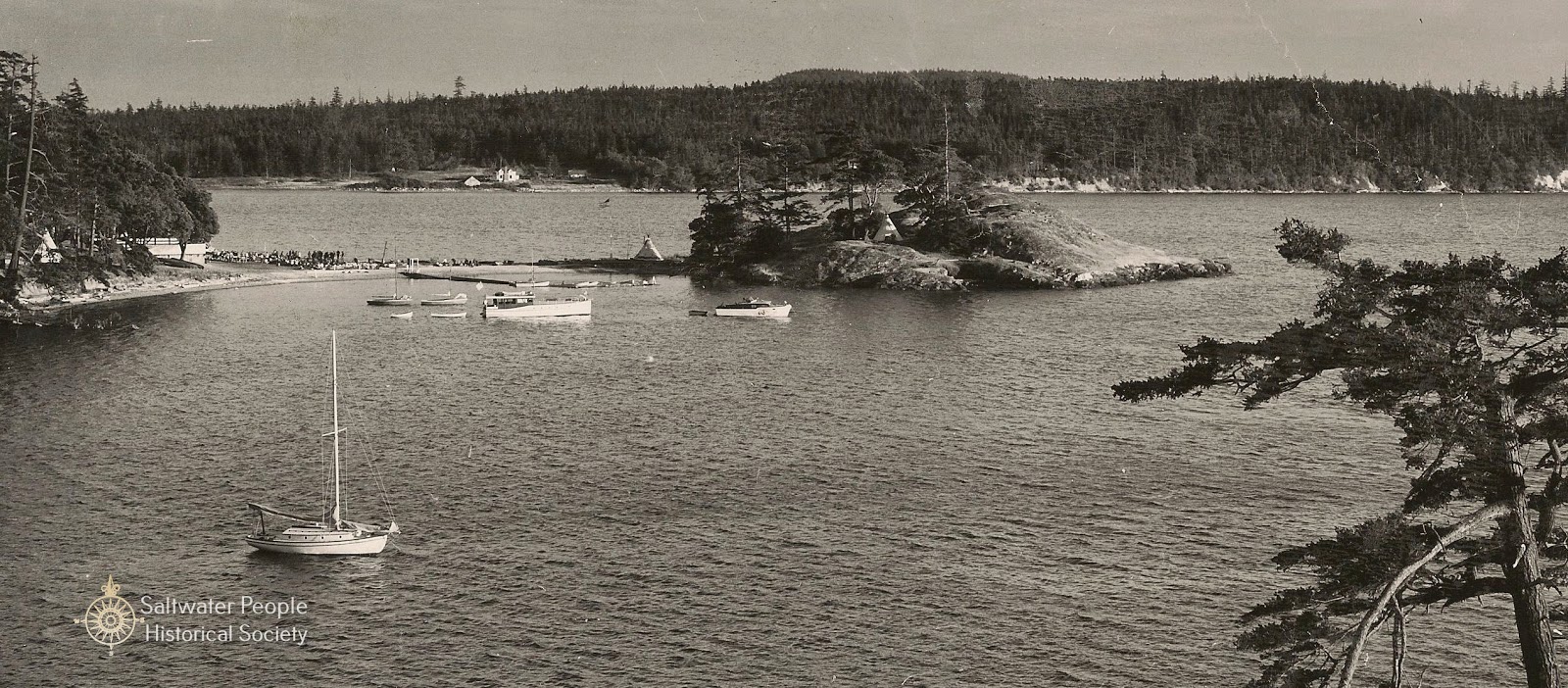
Henderson Camps, Lopez Island.
Cactus Rock, the Lodge, and pool.

Three original photos from archives of the
Saltwater People Historical Society©
      Donn Charnley, a state legislator from 1970 to 1984, spent his first summer at the camp in 1937. All six of his children have camped there over the years, and now his grandchildren are becoming involved.
      Charnley said he probably wouldn't have become a state official if not for the self-confidence inspired by the Hendersons. Charnley, a professor emeritus of geology taught occasionally at Edmonds Community College. "I became a teacher because of that camp; I learned to love the Earth," he said.
     
Henderson Camp, Lopez Island, WA. 1962
      Bill Holm, art professor emeritus at the University of WA and the Burke Museum, met his wife Marty when they were camp counselors in 1949. They married in 1953.
      Camp Nor'wester has passed through many hands since the Hendersons retired in 1966, but for many, it remains a Henderson institution.
      Gardner was instrumental in helping the property remain a camp after the Hendersons sold it. After the original land on Lopez Island was eventually sold, Camp Nor'wester reopened on John's Island in 2000.
      The Hendersons also campaigned to preserve Point Colville on Lopez Island from development. As a result of their work, the US Bureau of Land Management determined the land to be a significant wetlands area.
      After Mr. Henderson died in 1986, Lucile remained an important part of former campers' lives.
Above text by Kathy F. Mahdoubl, for The Seattle Times, 2006, written in celebration of the life of Lucile "Rabbit" Henderson who lived to be 101-yrs.

Archived Log Entries